C
hapter
14
t
he
p
roCess
of
C
hemiCal
r
eaCtions
585
ave you ever considered becoming a chemical engineer? The men and women in this profession develop industrial processes for the large-scale production of the chemicals we use to fertilize and protect our crops; synthesize textiles, plastics, and other ubiquitous modern materials; cure our diseases; and so much more. Or, perhaps you have considered becoming a research chemist, who figures out new ways to make existing chemicals and ways to produce chemicals that have never existed before. Although these two careers require different sets of skills and aptitudes, they also have some concerns and traits in common. For example, both kinds of chemist need to understand the factors that affect the speed with which chemicals can be made, and to know the reasons why chemical changes do not always proceed to 100% products. Armed with this knowledge, chemical engineers and research chemists can develop ways to make chemical products more efficiently, more safely, and
more economically.
This chapter introduces a model for visualizing the changes that take place in a reaction mixture as a chemical reaction proceeds. The model describes the requirements that must be met before a reaction can occur, and explains why certain factors speed the reaction up or slow it down. It will help us understand why some chemical reactions are significantly reversible and why such reactions reach a dynamic equilibrium with equal rates of change in both directions. It will also allow us to explore the factors that can push a chemical equilibrium forward to create more desired products or backwards to minimize the formation of unwanted products.
14.1 Collision Theory: A Model for the Reaction Process 14.2 Rates of Chemical Reactions 14.3 Reversible Reactions and Chemical Equilibrium 14.4 Disruption of Equilibrium
Describe the particle nature of gases. (Section
3.1)
Write or recognize the definitions of energy, kinetic energy, potential energy, heat, radiant energy, exergonic, exothermic, endergonic, endothermic, and catalyst. (Chapters 4 and 7 Glossaries.)
Describe the relationship between average
internal kinetic energy and temperature (Section 4.1)
Describe the relationship between stability and
potential energy. (Section 4.1)
Explain why energy is required to break chemical bonds. (Section 4.1)
Explain why energy is released when chemical bonds are formed. (Section 4.1) Explain why some chemical reactions
release heat to their surroundings. (Section 7.4)
Explain why some chemical reactions
absorb heat from their surroundings. (Section 7.4)
Write a general description of dynamic
equilibrium. (Section 12.1)
Review Skills
The presentation of information in this chapter assumes that you can already perform the tasks listed below. You can test your readiness to proceed by answering the Review Questions at the end of the chapter. This might also be a good time to read the Chapter Objectives, which precede the Review Questions.
Research chemists want to know how they can produce chemicals of the highest purity in the shortest time.
14.1
Collision Theory: A Model for the Reaction Process
Gasoline and oxygen coexist quietly until a spark from a spark plug propels them into violent reaction. Why? Why are ozone molecules in the stratosphere destroyed more rapidly in the presence of chlorine atoms released from CFC molecules? In order to understand these situations, we need to take a look at a model called collision theory, which is useful for visualizing the process of chemical change.
The Basics of Collision Theory
We will demonstrate the basic assumptions of collision theory by using it to describe the reaction of an oxygen atom and an ozone molecule to form two oxygen molecules.
+
2O2(g)
O(g) + O3(g)
Try to picture oxygen atoms and ozone molecules moving in a random way in the stratosphere. Some of the particles are moving with a high velocity and some are moving more slowly. The particles are constantly colliding, changing their direction of motion, and speeding up or slowing down (Figure 14.1). Some of the collisions between oxygen atoms and ozone molecules lead to the production of two oxygen molecules, but some of the collisions do not. To understand why some collisions are productive and others are not, we need to take a closer look at the events that take place in the reaction process.
objeCtive 2
Particles are constantly changing direction and speeding up or slowing down.
Step 1 Reactants collide: The process begins with a violent collision between an O atom and an O3 molecule, which shakes them up and provides them with enough
energy for the bond between two oxygen atoms in O3 to begin to break. We saw in
Section 4.1 that energy is required to break chemical bonds. At the same time as one O−O bond is breaking, another O−O bond begins to form between the original single oxygen atom and the oxygen atom breaking away from the O3 molecule. We know from
Figure 14.1
Ozone Molecules, O3, and Oxygen Atoms, O
objeCtive 3
14.1 Collision Theory: A Model for the Reaction Process 587
Chapter 4 that bond making releases energy, which in this case can supply some of the energy necessary for the bond breaking. Initially, the bond breaking predominates over the bond making, so the energy released in bond making is not enough to compensate for the energy necessary for bond breaking. The extra energy necessary for the reaction comes from the kinetic energy of the moving particles as they collide (Figure 14.2).
Bond making, (supplies some energy)
Bond breaking (requires energy) An oxygen atom collides
with an ozone molecule.
The collision causes an O-O bond in the ozone to begin breaking as a new O-O bond begins to form.
Step 2 Formation of activated complex: As the oxygen atoms of the O−O bond in
the O3 molecule separate, the attraction between them decreases, and as the attraction
decreases, less energy is needed for moving the atoms even farther apart. Meanwhile, the oxygen atoms that are forming the new bond move closer together, attracting each other more strongly and releasing more energy. At a certain stage in the progress of the reaction, bond breaking and bond making are of equal importance. In other words, the energy necessary for bond breaking is balanced by the energy supplied by bond making. At this turning point, the particles involved in the reaction are joined in a structure known as the activated complex, or transition state, which is the least stable (and therefore the highest energy) intermediate in the most efficient pathway between reactants and products. In the activated complex for our reaction between an oxygen atom and an ozone molecule, the bond being broken and the bond forming have roughly equal strengths and lengths (Figure 14.3).
Bond making supplies energy
equal to the energy required for bond breaking. Figure 14.2
Initial Stage of a Reaction Between Two Particles
Initially, the energy required for bond breaking is greater than the energy supplied by bond making. The extra energy necessary for the reaction comes from the kinetic en-ergy of the moving particles as they collide.
Figure 14.3
The Activated Complex for the Reaction Between Oxygen Atoms and Ozone Molecules objeCtive 3 objeCtive 2 objeCtive 4 objeCtive 2 objeCtive 2
objeCtive 6
Thus, as the reaction begins, an input of energy is necessary to produce the activated complex; as the reaction proceeds, and the system shifts from the activated complex to products, energy is released. In a chemical reaction, the minimum energy necessary for reaching the activated complex and proceeding to products is called the activation energy. Only the collisions that provide a net kinetic energy equal to or greater than the activation energy can lead to products.
Remember that at any instant in time, the particles in a gas, liquid, or solid have a wide range of velocities and thus a wide range of kinetic energies. If you were riding on a particle—in a gas, for example—you would be constantly colliding with other particles, speeding up or slowing down, and increasing or decreasing your kinetic energy. Sometimes you collide with a slow moving particle while moving slowly yourself. This collision is not too jarring. It has a low net kinetic energy. Sometimes you collide with a fast moving particle while moving rapidly yourself. This collision is much more violent and has a much higher net kinetic energy.
If a collision does not provide enough kinetic energy to form an activated complex, the reaction does not proceed to products. Instead, the atoms in the bond that has begun to break pull back together, the atoms in the bond that has begun to form fall apart, and the particles accelerate apart unchanged. This is like the situation depicted in Figure 14.5, where a rolling ball rolls back down the same side of a hill it started up.
If a rolling ball does not have enough energy to get to the top of a hill, it stops and rolls back down.
Figure 14.5
Not Enough Energy to Get Over the Hill
objeCtive 6
objeCtive 6
Step 3 Formation of product: As the reaction continues beyond the activated complex, the energy released in bond making becomes greater than the energy necessary for bond breaking, and energy is released (Figure 14.4).
Bond making supplies more
energy than is necessary for bond breaking... Beyond some point in the reaction, bond making predominates over bond breaking.
Energy +
so energy is released Figure 14.4
Final Stage of a Reaction Between Two Particles
14.1 Collision Theory: A Model for the Reaction Process 589
The activation energy for the oxygen-ozone reaction is 17 kJ/mole O3. If the collision
between reactants yields a net kinetic energy equal to or greater than the activation energy, the reaction can proceed to products (Figure 14.6). This is like a ball rolling up a hill with enough kinetic energy to reach the top of the hill, where it can roll down the other side (Figure 14.7)
Collisions with a net kinetic energy greater than the activation energy can react.
Collisions with a net kinetic energy less than the activation energy cannot react.
If a ball reaches the top of a hill before its energy is depleted, it will continue down the other side.
Figure 14.7
Ball with Enough Energy to Get Over the Hill
Figure 14.6 Collision Energy and Activation Energy
The bonds between oxygen atoms in O2 molecules are stronger and more stable
than the bonds between atoms in the ozone molecules, so more energy is released in the formation of the new bonds than is consumed in the breaking of the old bonds. This leads to an overall release of energy, so the reaction is exothermic. The energies associated with chemical reactions are usually described in terms of kilojoules per mole, kJ/mole. If the energy is released, the value is described with a negative sign. Because 390 kJ of energy are evolved when one mole of ozone molecules react with oxygen atoms to form oxygen molecules, the energy of the reaction is −390 kJ/mole O2.
objeCtive 6
objeCtive 6
Chemists often describe the progress of chemical reactions with energy diagrams such as Figure 14.8, which shows the energy changes associated with the O/O3 reaction.
It shows that the reactants must have enough kinetic energy to climb an energy hill before they can proceed on to products.
17 kJ Overall energy released in the reaction -390 kJ O2 + O2 Activated Complex Bond breaking predominates (energy absorbed). Bond making predominates (energy released). Activation Energy O + O3 Energy before reaction Energy after reaction Figure 14.8
Energy Diagram for the Exergonic Reaction of an Oxygen Atom with an Ozone Molecule to Form Two Oxygen Molecules
Endergonic Reactions
We know from Section 7.4 that if less energy is released in the formation of new bonds than is consumed in the breaking of old bonds, a reaction will be endergonic and will absorb energy overall as it takes place. If this energy comes from the motion (kinetic energy) of the reactants, the particles in the system will be moving more slowly after the reaction than before. The system will have lower kinetic energy, and the temperature will decrease. Because the system is at a lower temperature than the surroundings, it can absorb heat from the surroundings. Remember that when heat energy is absorbed in the process of a change, the change is called endothermic. The energies associated with
14.1 Collision Theory: A Model for the Reaction Process 591
endergonic (or endothermic) changes are described with positive values. For example, 178 kJ of energy are necessary to convert one mole of calcium carbonate, CaCO3, to
calcium oxide, CaO, and carbon dioxide, CO2. Thus the energy of reaction is +178
kJ/mole.
CaCO3(s) + 178 kJ → CaO(s) + CO2(g)
Figure 14.9 shows the energy diagram for a typical endergonic reaction.
A + BC
AB + C
Overall, energy absorbed in the reaction
Activated Complex Bond breaking
predominates
(energy absorbed) Bond making predominates (energy released) Activation Energy A B C Energy before reaction Energy after reaction Figure 14.9
Energy Diagram for an Endergonic Reaction
Even if a collision between two particles provides the activation energy, they still might not react. For the reaction to take place, the particles must collide in such a way as to allow the formation of the new bond or bonds to occur at the same time as the breaking of the old bond or bonds. For example, in the O3/O reaction, the new bond must form
between the free oxygen atom and one of the outer atoms in the O3 molecule. Therefore, the free oxygen atom must
collide with one of the outer oxygen atoms rather than with the central atom. The orientation of the particles in the first collision shown in Figure 14.10 can lead to reaction if the collision provides the activation energy. The orientation shown in the second collision is not likely to proceed to products.
Summary of Collision Theory
Collision theory stipulates that three requirements must be met before a reaction between two particles is likely to take place.
1. The reactant particles must collide. The collision brings together the atoms that will form the new bonds, and the kinetic energy of the particles provides energy for the reaction to proceed.
2. The collision must provide at least the minimum energy necessary to produce the activated complex. It takes energy to initiate the reaction by converting the reactants into the activated complex. If the collision does not provide this energy, products cannot form.
One favorable orientation
One unfavorable orientation Figure 14.10
Oxygen Atoms Collision Orientation
objeCtive 8
objeCtive 9
objeCtive 11
3. The orientation of the colliding particles must favor the formation of the activated complex, in which the new bond or bonds are able to form as the old bond or bonds break. Because the formation of the new bonds provides some of the energy necessary to break the old bonds, the making and breaking of bonds must occur more or less simultaneously. This is possible only when the particles collide in such a way that the bond-forming atoms are close to each other.
As you saw in the last section, the calcium carbonate in limestone can be converted into calcium oxide (lime) and carbon dioxide. At normal temperatures, this reaction is so slow that most limestone formations remain unreacted for thousands of years. Why, then, does it take place rapidly at 1200 °C? Similarly, why does the combustion
of gasoline take place more quickly when the fuel air mixture in a cylinder of your car is compressed into a smaller volume by a moving piston? How does your car’s catalytic converter speed the conversion of NO(g) into N2(g) and O2(g)? Now that we know
more about the requirements for reaction, we can proceed to answer questions such as these.
In this section, we focus on the factors that affect rates of chemical reactions, which for a gas can be described as the number of product molecules that form per liter per second.
rate of reaction = number of moles of product formed liter second
We can use the O/O3 reaction described in the last section as an illustration of the
factors affecting rate:
O(g) + O3(g) → 2O2(g)
rate of reaction = mol OL s2 formed
In the last section, we found that for a reaction between two particles to form products, the particles must collide with enough energy to reach the activated complex and with an orientation that allows the new bond or bonds to form as the old bond or bonds break. Any factor that affects these conditions will also affect the rate of the reaction. Let’s look again at the chemical reaction between oxygen atoms and ozone molecules.
Temperature and Rates of Chemical Reactions
In general, increased temperature increases the rate of chemical reactions . There are two reasons for this. One is that increased temperature means increased average velocity of the particles. As heat is transferred to a system containing O3 and O, for example,
the particles move faster. This leads to an increase in the number of particles colliding per second—and therefore an increase in the amount of products formed per second.
Increased temperature also means an increase in the average net kinetic energy of the collisions between the particles in a system. This leads to an increase in the fraction of the collisions that have enough energy to reach the activated complex (the activation energy)—and thus to an increase in the rate of the reaction. For the reaction of O3
14.2
Rates of Chemical Reactions
Heated to high temperature in an industrial plant, calcium carbonate, CaCO3, is quickly converted into lime, CaO, and carbon dioxide.
At normal temperatures, the CaCO3 in limestone, such as in the cliffs above, can exist for centuries.
14.2 Rates of Chemical Reactions 593
and O, an increase in temperature from 25 °C (298 K) to 35 °C (308 K) increases
the fraction of the particles with the activation energy from 0.0010 to 0.0013. Figure 14.11 summarizes why reaction rates are increased by increased temperature.
Increased temperature Increased average velocity of particles
Increased rate of reaction Increased number of collisions
between reactants per second Increased fraction of collisions between reactants with the minimum energy to react Increased average kinetic energy of particles
Figure 14.11
Temperature and Reaction Rate
Concentration and Rates of Chemical Reactions
Another way to increase the rate of a chemical reaction is to increase the concentration of the reactant particles. Concentration can be described as the number of particles per unit volume. For gases, it is usually described as moles of gas particles per liter of container. Gas concentration can be increased by either increasing the number of reactant particles in a container or decreasing the volume of the container. Once again, let us consider the O3/O reaction. The concentration of oxygen atoms in the system
described in Figure 14.1 can be increased by either adding more oxygen atoms, O, or decreasing the volume of the container.
Increasing the concentration of one or both reactants will lead to shorter distances between reactant particles and to their occupying a larger percentage of the volume. With shorter distances between the particles and less empty space for them to move in without colliding, more collisions can be expected to occur per second. Figure 14.12 shows the container from Figure 14.1 after more oxygen atoms are added. At a constant temperature, increasing the concentration of oxygen atoms in the container will increase the rate of collisions between O and O3 and increase the rate of the
reaction. The same would be true if the concentration of O3 were increased; increasing
the concentration of O3 would lead to an increase in the rate of the reaction. Increased concentration of
oxygen atoms leads
to inceased rate of collision between oxygen atoms and ozone molecules.
Figure 14.12
An Increase in One of the Reactants
Note that this image has twice as many oxygen atoms in the volume shown as the same volume in Figure 14.1.
objeCtive 12
objeCtive 13
Figure 14.13 summarizes why increased concentration of a reactant leads to an increase in the rate of reaction.
Increased concentration of reactant (Increased number of particles per unit volume) Decreased average distance between particles and decreased volume available in which to move without colliding
Increased rate of reaction
Increased number of particles fulfilling the requirements for reaction Increased number of collisions between reactants per liter per second Figure 14.13
Reactant Concentration and Reaction Rate
We can use similar reasoning to explain why the compression of fuel-air mixtures in the cylinders in a car engine speeds the reaction between the gaseous fuel and oxygen from the air. When a piston moves up in a cylinder, the decreased volume available to the reacting gases creates an increased concentration of each gas, which decreases the distance between the reacting molecules and decreases the volume available in which to move without colliding. This leads to more collisions between the reactants per second and a greater rate of reaction.
Catalysts
A catalyst is a substance that accelerates a chemical reaction without being permanently altered itself. Catalysts are employed by the chemical industry to increase the rates of 60-70% of the industry’s reactions, and most of the important chemical reactions that take place in your body are regulated by catalysts called enzymes.
One of the ways in which catalysts accelerate chemical reactions is by providing an alternative pathway between reactants and products that has a lower activation energy. Once again, the reaction between ozone molecules and oxygen atoms in the stratosphere provides an example.
O3(g) + O(g) → 2O2(g)
The activation energy for this reaction, as noted in Figure 14.8, is about 17 kJ/mole. At 25 °C (298 K), about one of every one thousand collisions (or 0.1%) between O3
molecules and O atoms has a net kinetic energy large enough to form the activated complex and proceed to products. (This does not mean that 1/1000 of the collisions lead to products, however. The collisions must still have the correct orientation in order for the bond making and bond breaking to proceed at the same time.)
Chlorine atoms can catalyze this reaction in two steps: O3(g) + Cl(g) → ClO(g) + O2(g)
O(g) + ClO(g) → Cl(g) + O2(g)
The net reaction that summarizes these two intermediate reactions is
Net reaction O3(g) + O(g) 2OCl 2(g)
objeCtive 13
14.2 Rates of Chemical Reactions 595
Thus chlorine atoms provide a second pathway for the conversion of O3 and O
to O2, but there is another reason why the chlorine reactions speed the destruction
of ozone. The reaction between O3 and Cl that forms ClO and O2 has an activation
energy of 2.1 kJ/mole. At 25 °C, about three of every seven collisions (or 43%) have
enough energy to form the activated complex. The reaction between O and ClO to form Cl and O2 has an activation energy of only 0.4 kJ/mole. At 25 °C, about 85%
of the collisions have at least this energy. Thus a much higher fraction of the collisions have the minimum energy necessary to react than in the direct reaction between O3
and O, in which only 0.1% of the collisions have the activation energy or more (Figure 14.14).
A portion of each curve has been cut out to maintain the correct proportion between the sections of the diagram.
O2 + O2 (+ Cl) Uncatalyzed activation Energy, 17 kJ O + O3 (+ Cl) O O O-O Cl O O-O ClO + O2 (+ O) Cl O O
Note that the catalyst provides an alternate pathway with a lower activation energy. Catalyzed activation
energy, 2.1 kJ
Catalyzed reaction Uncatalyzed
reaction 0.4 kJ
Figure 14.14
Potential Energy Diagram of the Catalyzed and Uncatalyzed Reactions that Convert O3 and O into O2
objeCtive 14
Figure 14.15 summarizes why the rate of a catalyzed reaction would be expected to be greater than the rate of the same reaction without the catalyst.
Figure 14.15 Catalysts and Reaction Rate
The catalyst provides an alternate pathway with a lower activation energy. A greater fraction of collisions have the activation energy.
Increased rate of reaction
A greater fraction of collisions lead to products.
Homogeneous and Heterogeneous Catalysts
If the reactants and the catalyst are all in the same state (all gases or all in solution) the catalyst is a homogeneous catalyst. The chlorine atoms are homogeneous catalysts for the reaction that converts O3 and O into O2 because the chlorine atoms and the
reactants are all gases.
If the catalyst is not in the same state as the reactants, the catalyst is called a
heterogeneous catalyst. A heterogeneous catalyst is usually a solid, and the reactants are either gases or liquids. For example, in Special Topic 9.2: Air Pollution and Catalytic Converters, you read that the catalyst in a car’s catalytic converter, which helps convert gaseous nitrogen monoxide, NO(g), into nitrogen gas, N2(g), and oxygen gas, O2(g),
is a solid mixture of transition metals and transition metal oxides.
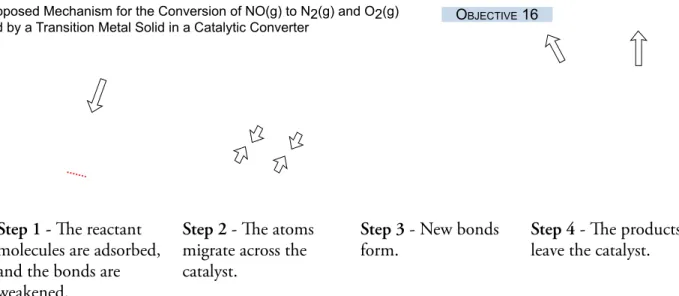
Heterogeneous catalysis is thought to proceed in the four steps shown in Figure 14.16, which uses the catalytic conversion of NO to N2 and O2 in automobiles as an
example. The model suggests that as exhaust from a car’s engine passes over the solid catalyst—a transition metal like platinum, palladium, iridium, or rhodium—nitrogen monoxide molecules become attached to the catalyst’s surface, bonds between nitrogen and oxygen atoms are broken, the atoms migrate across the surface, and new bonds form between nitrogen and oxygen atoms.
Step 1 - The reactant molecules are adsorbed, and the bonds are weakened.
Step 2 - The atoms migrate across the catalyst.
Step 3 - New bonds
form. Step 4leave the catalyst. - The products Figure 14.16
A Proposed Mechanism for the Conversion of NO(g) to N2(g) and O2(g) aided by a Transition Metal Solid in a Catalytic Converter
objeCtive 15
objeCtive 16
14.3 Reversible Reactions and Chemical Equilibrium 597
14.3
Reversible Reactions and Chemical Equilibrium
Our next step in understanding chemical change is to apply what we have learned about rates of reactions to explore what happens when a reaction is reversible. Let’s take a look at a real world example that we can use to illustrate our main points.
Let’s say you become so interested in chemistry that you decide to train to be an industrial chemist. Your first professional assignment is to design a procedure for making hydrogen gas that will then be used to make ammonia for fertilizers.
N2(g) + 3H2(g) → 2NH3(g)
After searching the chemical literature, you compile a list of all the reactions that lead to the formation of hydrogen gas, and then shorten it by eliminating all but the reactions whose initial reactants are inexpensive, readily available, and relatively nontoxic. The following reaction between methane, CH4 (the primary component of natural gas),
S
PECIALT
OPIC 14.1Green Chemistry—The Development of New
and Better Catalysts
Because catalysts are used by the chemical industry toproduce many essential products, the discovery of new and better catalysts is important for meeting the goals of
Green Chemistry (Special Topic 1.1: Green Chemistry)
As catalysts improve, less energy will be required for the production of industrial chemicals, and raw material and by-products will become more benign.
The Monsanto Company, as an example, received the 1996 Alternate Synthetic Pathways Award—a Presidential Green Chemistry Challenge Award—for improving the methods used in the production of their
herbicide Roundup. Formerly, the synthesis of this
product required the use of ammonia, formaldehyde, hydrogen cyanide, and hydrochloric acid. All of these substances pose dangers to the workers using them and to the environment, but hydrogen cyanide in particular is extremely toxic. Another problem was that the overall process produced up to one kilogram of cyanide- and formaldehyde-containing waste for every seven kilograms of product. When Monsanto developed a process that used a new metallic copper catalyst for making
Roundup, they were able to eliminate cyanide and
formaldehyde from the procedure and generate no waste at all.
Biocatalysts—catalysts produced by living organisms—are another important category of new
catalysts being developed for industry. Enzymes are biocatalysts capable of forming very specific products very quickly. In some cases, their use in industrial reactions eliminates the need for hazardous reactants or the production of hazardous by-products. For example, the conventional synthesis of acrylamide (used to make dyes, adhesives, and permanent-press fabrics) uses sulfuric acid in the first step of a two step process and ammonia in the second step. Both of these substances can be difficult or even dangerous to handle. The conventional synthesis forms acrylamide and the waste product ammonium sulfate. An alternative technique, using an enzyme called nitril hydratase, eliminates the need for the sulfuric acid and ammonia and does not produce ammonium sulfate.
Old Process New Process CH2 CHCN + H2O 1. H2SO4 2. NH3 CH2 CHCN + H2O CH2 CHCONH2 nitrile hydratase acrylamide CH2 CHCONH2 + (NH4)2SO4
and water vapor fits these criteria.
CH4(g) + H2O(g) → CO(g) + 3H2(g)
You decide to focus on this reaction and to research the conditions under which it is likely to produce high purity hydrogen gas as quickly as possible. You know that rates of chemical reactions can be increased by increasing the concentration of reactants, raising the temperature, and by adding a catalyst. Another search of the chemical literature shows you that the reaction between methane gas and water vapor runs most quickly (and yields a high concentration of gases) when it takes place over a nickel catalyst at a total gas pressure of about 4000 kPa and a temperature between 760 °C and 980 °C. This process, called steam re-forming, is summarized by the equation below.
The mixture of carbon monoxide and hydrogen gas formed in this process is used to make (synthesize) so many other chemicals that it is called synthesis gas.
CH4(g) + H2O(g) CO(g) + 3H2(g) 760-980 °C
4000 kPa Ni
The reaction between methane and water described above produces a significant amount of hydrogen gas, but industrial chemists are always searching for ways to increase the overall yield of their conversions. Therefore, your next step is to look for a way of using the carbon monoxide formed in the reaction to make even more hydrogen gas. You discover that carbon monoxide will react with water vapor to yield carbon dioxide and hydrogen gas (Figure 14.17).
CO(g) + H2O(g) → CO2(g) + H2(g)
Your first thought is that this reaction should be run in the same reaction vessel as the first reaction, but further study shows that at the temperature of the first reaction (760-980 °C), the reaction between CO and H2O does not give a very high yield of
hydrogen gas. At this temperature, the reaction is significantly reversible. As soon as CO2 and H2 form, they begin to react with each other to reform CO and H2O.
CO2(g) + H2(g) → CO(g) + H2O(g)
The two competing changes are summarized in a single reaction equation written with a double arrow (to show the reaction’s reversible nature).
CO(g) + H2O(g) CO2(g) + H2(g)
If you were riding on one of the hydrogen atoms, you would find yourself sometimes on an H2 molecule and sometimes on an H2O molecule, constantly going back and
forth. Although the hydrogen yield of this reversible process is low at 760-980 °C, it is much higher at the lower temperature of 425 °C (for reasons explained below). Therefore, your best overall plan for making H2(g) is to run the methane-water reaction
in one vessel at 760-980 °C, transfer the products of this reaction to another container,
add more water vapor, and run the reaction between carbon monoxide and water in the second container at 425 °C. The rate of the second reaction is further increased by allowing the reactants to combine over a chromium(III) oxide catalyst. (Note that because the reaction at 425 °C yields a high percentage of products, the equation
below has a single arrow.)
CO(g) + H2O(g) CO2(g) + H2(g) 425 °C
14.3 Reversible Reactions and Chemical Equilibrium 599
Reversible Reactions and Dynamic Equilibrium
Let’s look more closely at the events taking place in the reaction between carbon monoxide gas and water vapor, and at their effect on reaction rates. Because this reaction is significantly reversible at 870 °C, we write its equation at this temperature
with a double arrow.
CO(g) + H2O(g) CO870 2(g) + H2(g) °C
Picture a system in which 1.0 mole of CO(g) and 1.0 mole of H2O(g) are added
to a 1.0 L container at 870 °C. As the reaction proceeds and the concentrations of
CO and H2O diminish, the rate of the forward reaction decreases. At the start of the
reaction, there is no carbon dioxide or hydrogen gas in the container, so the rate of the reverse reaction is initially zero. But, as the concentrations of CO2 or H2 increase, the
rate of the reverse reaction increases.
As long as the rate of the forward reaction is greater than the rate of the reverse reaction, the concentrations of the reactants (CO and H2O) will steadily decrease, and
the concentrations of products (CO2 and H2) will constantly increase. These changes
lead to a decrease in the forward rate of the reaction and an increase in the rate of the reverse reaction, a trend that continues until the two rates become equal (Figure
objeCtive 19
objeCtive 18
objeCtive 17
objeCtive 17 Figure 14.17
Production and Use of Hydrogen Gas Chemical plants make a mixture of
hydrogen gas and carbon monoxide gas called synthesis gas.
A shift converter converts carbon monoxide and water into more hydrogen gas and carbon dioxide.
Ammonia for
fertilizers, explosives, plastics, and fibers Reduction of metal oxides
to form pure metals Methanol, used to makeformaldehyde, acetic acid, MTBE, and many other chemicals
HCl for cleaning metals acidifying oil wells, food
processing, and the manufacture of many other chemicals
14.18). At this point, our system has reached a dynamic equilibrium. Because all of the reactants and products are gaseous, this system is an example of a homogeneous equilibrium, an equilibrium system in which all of the components are in the same state.
In a dynamic equilibrium for a reversible chemical reaction, the forward and reverse reaction rates are equal, so although reactants and products are constantly changing back and forth, there is no net change in the amount of either. In our example, the CO and H2O are constantly reacting to form CO2 and H2, but CO2 and H2 are reacting
to reform CO and H2O at the same rate. Note that although the concentrations of
reactants and products become constant, they do not become equal (Figure 14.19). As long as the system remains in a dynamic equilibrium, the concentrations of CO, H2O, CO2, and H2 remain constant, and the rates of the forward and reverse
reactions also remain constant (Figures 14.18 and 14.19). This condition continues unless something occurs to disrupt the equilibrium. (You will see a list of ways that equilibrium systems can be disrupted later in this section.)
Rateforward
Ratereverse Reaction
Rates
Time
Rateforward = Ratereverse Dynamic Equilibrium [CO] = [H2O] Concentrations Time At dynamic equilibrium,
concentrations are constant but not equal.
[CO2] = [H2] Reactants
Products
Figure 14.18
The Rates of Reaction for
the Reversible Reaction CO(g) + H2O(g) CO2(g) + H2(g)
Figure 14.19
The Concentrations of CO, H2O, CO2, and H2 for the Reversible Reaction
CO(g) + H2O(g) CO2(g) + H2(g)
objeCtive 20
objeCtive 17
14.3 Reversible Reactions and Chemical Equilibrium 601
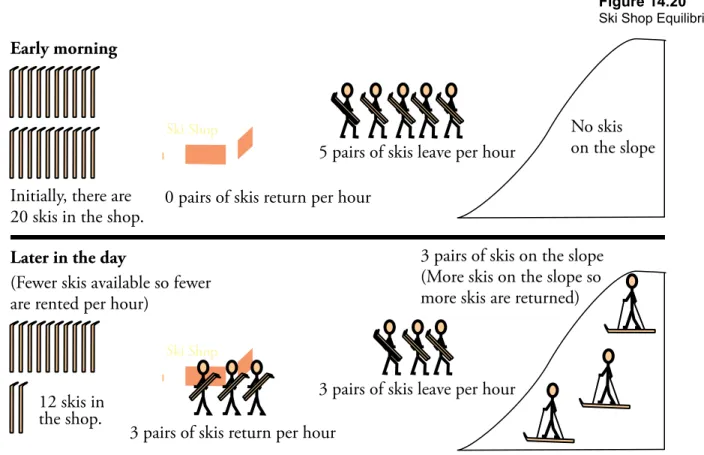
An analogy can be used to illustrate the idea of dynamic equilibrium. Suppose that you have left your job as an industrial chemist in order to start a ski rental shop near the Squaw Valley ski resort in California. To prepare for opening day, you purchase all the skis, boots, poles, and other accessories that you think will be necessary. When you open your doors for business, the skis begin to leave the store at a certain rate, Rateleave, and by the end of the day, a few of the skis are returned at a rate represented
by Ratereturn. This sets up a reversible process with two opposing rates of change.
skis(in) skis(out)Rateleave
Ratereturn
At the beginning of the first day of business, you have many different sizes and styles of ski boots and skis, so very few people are turned away without equipment. As the day progresses, you begin to run out of some sizes and styles that people want, so more people leave without renting anything. Thus the rate at which the skis leave the store is at its peak at the beginning of the first day and diminishes steadily.
As long as the skis are going out of the store faster than they are coming in, the number of your skis on the ski slopes increases. This leads to a greater probability that some people will decide to stop skiing and return their equipment to the store. Thus the rate of return increases steadily. Eventually, the increasing Ratereturn becomes equal
to the decreasing Rateleave. At this point, although skis will be constantly going out and
coming back in, there will be no net change in the number of skis in the store and the skis that your customers have outside the store. The system will have reached a dynamic equilibrium, and as long as the conditions for your business remain unchanged, this dynamic equilibrium will continue (Figure 14.20). (We will return to this analogy later to illustrate how changes in certain conditions can disrupt an equilibrium system.)
Ski Shop
Initially, there are 20 skis in the shop.
5 pairs of skis leave per hour
No skis on the slope Early morning
0 pairs of skis return per hour
12 skis in the shop.
3 pairs of skis leave per hour
3 pairs of skis on the slope (More skis on the slope so more skis are returned) Later in the day
3 pairs of skis return per hour
Equilibrium (No change in the number of skis in the shop and on the slope) (Fewer skis available so fewer
are rented per hour)
Ski Shop
Figure 14.20 Ski Shop Equilibrium
Equilibrium Constants
All reversible chemical reactions spontaneously progress toward an equilibrium mixture of constant concentrations of reactants and products. At equilibrium, some reactions yield more products than reactants; others yield more reactants than products. For example, sulfur dioxide, SO2, formed in forest fires and nitrogen dioxide, NO2, formed
in electrical storms, react in the atmosphere to yield sulfur trioxide, SO3 (which reacts
with water to form sulfuric acid, one of the components of acid rain) and nitrogen monoxide, NO. At normal temperatures, this reaction has a 99.92% yield, so it goes almost to completion.
SO2(g) + NO2(g) SO3(g) + NO(g)
At the other extreme, nitrogen gas and oxygen gas, which under the high temperature conditions inside a car’s engine react to form a significant amount of nitrogen monoxide gas, behave quite differently at room temperature. At 25 °C, the equilibrium mixture of N2, O2, and NO gases has about 1 x 10⁻³¹% of the N2(g) and O2(g) converted
into NO(g).
N2(g) + O2(g) 2NO(g)
The extent to which reversible reactions proceed toward products before reaching equilibrium can be described with an equilibrium constant, which is derived from the ratio of the concentrations of products to the concentrations of reactants at equilibrium. For homogeneous equilibria, the concentrations of all reactants and products can be described in moles per liter, and the concentration of each is raised to a power equal to its coefficient in a balanced equation for the reaction. The following shows the general form for the equilibrium constant expression:
aA + bB + … → eE + fF + …
[E]e [F]f…
Equilibrium constant = KC =
[A]a [B]b …
In this general equilibrium constant equation, the lowercase letters represent coefficients and the upper case letters represent chemical formulas. The brackets around a formula represent the concentration of that substance in moles per liter. Because the key variables are concentrations of reactants and products, the equilibrium constant has the symbol KC.
Gases in equilibrium constant expressions are often described with pressures instead of concentrations (mol/L). When an equilibrium constant is derived from gas pressures, we represent it with the symbol KP.
aA + bB +… → eE + fF +…
PEe PFf…
Equilibrium constant = KP =
PAa PBb …
The values for KC and KP for the same reaction can be different, so it is important to
specify whether you are using KP or KC.
objeCtive 22
objeCtive 23
14.3 Reversible Reactions and Chemical Equilibrium 603
e
xample14.1
- Writing Equilibrium Constant Expressions
The first step in the process you designed for producing hydrogen was to react methane gas with water vapor to form carbon monoxide and hydrogen gases. Write the equilibrium constant expressions for KC and KP for the following equation for this
reaction. CH4(g) + H2O(g) CO(g) + 3H2(g) Solution [CO] [H2]3 KC = [CH4] [H2O]
The coefficient before H2 is 3, so we raise the
concentration or pressure to the third power. PCO PH2
KP =
PCH4 PH2O 3
Note that the concentration of H2 in the KC expression and the pressure of H2 in the
KP expression must be raised to the third power, because in the balanced equation,
hydrogen has a coefficient of 3. Students commonly forget to do this.
e
xerCise14.1
- Writing Equilibrium Constant Expressions
Sulfur dioxide, SO2, one of the intermediates in the production of sulfuric acid, can be
made from the reaction of hydrogen sulfide gas with oxygen gas. Write the equilibrium constant expressions for KC and KP for the following equation for this reaction.
2H2S(g) + 3O2(g) 2SO2(g) + 2H2O(g)
objeCtive 22
objeCtive 23
objeCtive 22
objeCtive 23
Determination of Equilibrium Constant Values
One way to determine the value of an equilibrium constant is to run the reaction in the laboratory, wait for it to reach equilibrium, determine the concentrations or partial pressures of reactants and products, and plug them into the equilibrium constant expression. Note that equilibrium constants are usually described without units.
e
xample14.2
- Equilibrium Constant Calculation
Methanol is a common substance used both as a solvent and as a reactant in the synthesis of many other substances. Methanol can be made from synthesis gas, a mixture of CO(g) and H2(g). When a mixture of these gases is allowed to come to equilibrium
over a copper oxide catalyst at 200 °C, the partial pressures of the gases are 0.96 atm
for CO(g), 1.92 atm for H2(g), and 0.11 atm for CH3OH(g). What is KP for this
reaction at 200 °C? CO(g) + 2H2(g) CH3OH(g) Solution KP = PCH3OH PCO PH2 2 0.11 atm 0.96 atm (1.92 atm)2 = = 0.031 1 atm2 or 0.031 objeCtive 24 objeCtive 24
e
xerCise14.2
- Equilibrium Constant Calculation
Ethanol, C2H5OH, can be made from the reaction of ethylene gas, C2H4, and water
vapor. A mixture of C2H4(g) and H2O(g) is allowed to come to equilibrium in a
container at 110 °C, and the partial pressures of the gases are found to be 0.35 atm for C2H4(g), 0.75 atm for H2O(g), and 0.11 atm for C2H5OH(g). What is KP for
this reaction at 110 °C?
C2H4(g) + H2O(g) C2H5OH(g)
objeCtive 24
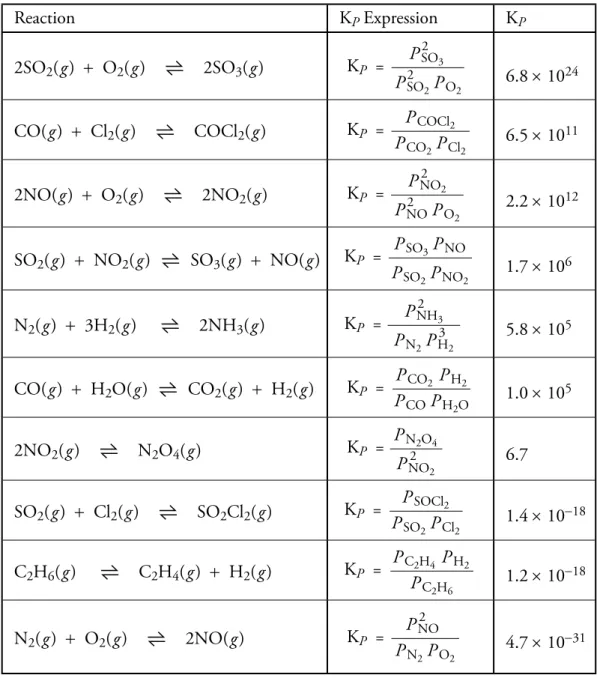
Table 14.1 shows KP values for some gas phase homogeneous equilibria at 25 °C.
Table 14.1
Equilibrium Constants for Homogeneous Equilibria at 25 °C
Reaction KP Expression KP
2SO2(g) + O2(g) 2SO3(g) KP = PSO3
PSO22 PO2 2
6.8 × 1024
CO(g) + Cl2(g) COCl2(g) KP = PPCOCl2
CO2 PCl2 6.5 × 10 11 2NO(g) + O2(g) 2NO2(g) KP = PNO2 PNO PO2 2 2 2.2 × 10¹² SO2(g) + NO2(g) SO3(g) + NO(g) KP = PPSO3 PNO SO2 PNO2 1.7 × 10 6 N2(g) + 3H2(g) 2NH3(g) KP = PNH3 PN2 PH23 2 5.8 × 10⁵ CO(g) + H2O(g) CO2(g) + H2(g) KP = PPCO2 PH2 CO PH2O 1.0 × 10 5 2NO2(g) N2O4(g) KP = PPN2O4 NO2 2 6.7 SO2(g) + Cl2(g) SO2Cl2(g) KP = PPSOCl2 SO2 PCl2 1.4 × 10 −18 C2H6(g) C2H4(g) + H2(g) KP = PC2H4P PH2 C2H6 1.2 × 10 −18 N2(g) + O2(g) 2NO(g) KP = PNO PN2 PO2 2 4.7 × 10⁻³¹
14.3 Reversible Reactions and Chemical Equilibrium 605
Equilibrium Constants and Extent of Reaction
Equilibrium constants indicate the extent to which reactions yield products as they progress toward equilibrium. The larger a value for K, the farther the reaction shifts toward products before the rates of the forward and reverse reactions become equal and the concentrations of reactants and products stop changing. The following generalizations provide guidelines for interpreting equilibrium constant values.
K > 102 Products favored at equilibrium
K < 10−2 Reactants favored at equilibrium
10−2 < K < 102 Neither reactants nor products favored
e
xample14.3
- Predicting the Extent of Reaction
Using the information on Table 14.1, predict whether each of the following reversible reactions favors reactants, products, or neither at 25 °C.
a. Carbon monoxide gas and chlorine gas combine to make phosgene gas, COCl2, a poison gas used in World War I.
CO(g) + Cl2(g) COCl2(g)
b. Ethylene, used to make polyethylene plastics, can be formed from the following reaction:
C2H6(g) C2H4(g) + H2(g) Solution
a. Favors Products – The equilibrium constant given in Table 14.1 is 6.5 × 10¹¹.
Reactions, like this one, with extremely large equilibrium constants, can be considered to go to completion and are often described with single arrows.
CO(g) + Cl2(g) → COCl2(g)
b. Favors Reactants – The highly unfavorable equilibrium constant for this reaction (1.2 × 10⁻¹⁸) seems to suggest that this would be a poor way to make C2H4(g),
but in fact, the equilibrium constant gets much larger, and more favorable toward products, as the temperature rises. At 800-900 °C, ethylene gas is produced in a
much larger proportion.
objeCtive 25
e
xerCise14.3
- Predicting the Extent of Reaction
Using the information on Table 14.1, predict whether each of the following reversible reactions favors reactants, products, or neither at 25 °C.
a. This reaction is partially responsible for the release of pollutants from automobiles. 2NO(g) + O2(g) 2NO2(g)
b. The NO2(g) molecules formed in the reaction in part (a) can combine to form
N2O4.
2NO2(g) N2O4(g)
objeCtive 25
objeCtive 25
The brown gas nitrogen dioxide, NO2, is one cause of the haze over this skyline.
Heterogeneous Equilibria
When the reactants and products for a reversible reaction are not all in the same phase (gas, liquid, solid, or aqueous), the equilibrium is called a heterogeneous equilibrium. For example, liquid phosphorus trichloride (used to make pesticides, gasoline additives, and other important substances) is made by passing chlorine gas over gently heated solid phosphorus.
P4(s) + 6Cl2(g) 4PCl3(l)
The equilibrium constant expression below is the one derived from the guidelines used for homogeneous equilibria.
[PCl3]4
[P4][Cl2]6
K′ =
As you will see, this is not the most common form of the equilibrium constant expression for the reaction. The more common form leaves out the pure solid and liquid.
1 KC =
[Cl2]6
When all reactants are gases, the concentrations in the equilibrium expression are described in moles per liter. Pure liquids and solids are treated differently, however, because, unlike gases, the concentrations of liquids and solids remain constant even when the amount of substance or the volume of the container change. To illustrate this, let’s consider a reaction vessel with a constant volume in which a mixture of P4(s),
Cl2(g), and PCl3(l) has come to equilibrium.
When more Cl2 gas is added to the system, the new gas mixes easily with the gas
already in the container, and because the moles of Cl2 increase but the volume is
constant, the concentration of Cl2 increases. The concentration of Cl2 could also be
changed if the volume of the container could change. If the gas were compressed, the concentration would increase, and if the gas were allowed to expand, the concentration would decrease (Figure 14.21).
Note, however, that the concentrations of solids and liquids cannot be changed in these ways. If the number of moles of P4(s) in the container is doubled, its volume
doubles too, leaving the concentration (mol/L) of the phosphorus constant. Increasing or decreasing the total volume of the container will not change the volume occupied by the solid phosphorus, so the concentration (mol/L) of the P4(s) also remains constant
with changes in the volume of the container. Similarly, the concentration of liquid PCl3 is also independent of the volume of the container and the amount of PCl3
present (Figure 14.21). By convention, the constant concentrations of pure solids and liquids are understood to be incorporated into the equilibrium constant itself and left out of the equilibrium constant expression.
[PCl3]4 [P4][Cl2]6 K′ = K′ [P4] [PCl3]4 = KC or KP = 1 [Cl2]6 = 1 PCl26 objeCtive 26 objeCtive 23 objeCtive 22
14.3 Reversible Reactions and Chemical Equilibrium 607
Double the moles of P4, Cl2, and PCl3
Constant volume
Concentrations of solid and liquid remain constant. Concentration of gas doubles. Half volume, with no change in moles Double mol Cl2 L Double mol Cl2 L Same mol P4 L mol PCl3 and L Concentrations
of solid and liquid remain constant. Concentration of gas doubles. mol PCl3 Same L Same mol P4 L PCl3(l ) P4(s) Cl2(g) Figure 14.21 Changes in Concentration with Changes in Amount of Substance and Volume of Container
e
xample14.4
- Writing Equilibrium Constant Expressions for
Heterogeneous Equilibria
One of the steps in the production of sulfuric acid is to make solid sulfur from the reaction of sulfur dioxide gas and hydrogen sulfide gas. Write KC and KP expressions
for this reaction.
SO2(g) + 2H2S(g) 3S(s) + H2O(g) Solution
[H2O]
KC =
[SO2] [H2S]2
The solid does not appear in the KC and KP expressions. PH2O
KP =
PSO2 PH22S
e
xerCise14.4
- Writing Equilibrium Constants for
Heterogeneous Equilibria
The following equation describes one of the steps in the purification of titanium dioxide, used as a white pigment in paints. Liquid titanium(IV) chloride reacts with oxygen gas to form solid titanium dioxide and chlorine gas. Write KC and KP expressions for this
reaction.
TiCl4(l) + O2(g) TiO2(s) + 2Cl2(g)
objeCtive 22
objeCtive 23
Equilibrium Constants and Temperature
Changing temperature always causes a shift in equilibrium systems—sometimes toward more products and sometimes toward more reactants. For example, some industrial reactions that yield an equilibrium mixture with less than 1% products at room temperature will yield more than 99% products at higher temperature. This shift in equilibrium systems is reflected in changes in equilibrium constants that accompany changes in temperature.
Before we tackle the question of why changing temperature affects equilibrium systems, let’s quickly establish some key characteristics of energy changes in chemical reactions. Remember that chemical reactions are either endergonic (absorb energy as the reaction forms weaker chemical bonds) or exergonic (evolve energy as the reaction leads to stronger bonds). In a reversible reaction, if the forward reaction is exergonic, the reverse reaction is endergonic. If the forward reaction is endergonic, the reverse reaction is exergonic.
reactants products + energyendergonicexergonic or reactants + energy productsendergonicexergonic
Increased temperature increases the rate of both the forward and the reverse reactions, but it increases the rate of the endergonic reaction more than it increases the rate of the exergonic reaction. Therefore, increasing the temperature of a chemical system at equilibrium will disrupt the balance of the forward and reverse rates of reaction and shift the system in the direction of the endergonic reaction.
If the forward reaction is endergonic, increased temperature will shift the system toward more products, increasing the ratio of products to reactants and increasing the equilibrium constant.
If the forward reaction is exergonic and the reverse reaction is endergonic, increased temperature will shift the system toward more reactants, decreasing the ratio of products to reactants and decreasing the equilibrium constant.
For example, pure water ionizes in a reversible endergonic reaction that forms hydrogen ions, H+ (which form hydronium ions, H3O+) and hydroxide ions, OH−.
The equilibrium constant for this reaction is called the water dissociation constant, Kw.
H2O(l) + energy H+(aq) + OH−(aq)
Kw = [H+][OH−] = 1.01 × 10⁻¹⁴ at 25 °C
objeCtive 27
objeCtive 28 White paint contains titanium dioxide.
14.3 Reversible Reactions and Chemical Equilibrium 609
Because the forward reaction is endergonic, increased temperature drives the system to products, increasing the value for the water dissociation constant. Table 14.2 shows Kw values for this reaction at different temperatures.
Table 14.2
Water Dissociation Constants at Various Temperatures
Temperature Kw 0 °C 1.14 × 10⁻¹⁵ 10 °C 2.92 × 10⁻¹⁵ 25 °C 1.01 × 10⁻¹⁴ 30 °C 1.47 × 10⁻¹⁴ 40 °C 2.92 × 10⁻¹⁴ 50 °C 5.47 × 10⁻¹⁴ 60 °C 9.61 × 10⁻¹⁴
The reaction between carbon monoxide gas and water vapor to form carbon dioxide gas and hydrogen gas is exothermic, meaning that energy is evolved as the reaction proceeds in the forward direction. Therefore, increased temperature favors the reverse reaction, shifting the system toward more reactants and decreasing the equilibrium constant for the reaction.
CO(g) + H2O(g) CO2(g) + H2(g) + energy
The fact that higher temperature leads to a lower percentage of CO(g) and H2O(g)
converted to CO2(g) and H2(g) creates a dilemma for the industrial chemist designing
the process for making hydrogen gas. To maximize the percent yield, the reaction should be run at as low a temperature as possible, but at low temperature, the rates of the forward and reverse reactions are both very low, so it takes a long time for the system to come to equilibrium. Some chemical plants in the U.S. have solved this problem by setting up two chambers for the reaction, one at high temperature to convert some of the CO(g) and H2O(g) to CO2(g) and H2(g) quickly, and a low temperature section
to complete the process.
You can visit the textbook’s Web site to see how weak acids are described with equilibrium constants.
objeCtive 29
You can visit the textbook’s Web site to see how concentration or gas pressures of reactants and products at equilibrium can be calculated from initial concentrations of reactants and products and equilibrium constants. You can visit the textbook’s Web site to see how the pH scale for describing acidic and basic solutions is defined.
Chemical systems at equilibrium are actually somewhat rare outside the laboratory. For example, the concentrations of reactants and products of the reactions taking place in your body are constantly changing, leading to changes in the forward and reverse reaction rates. These constant fluctuations prevent the reactions from ever reaching equilibrium. In most industrial procedures, the products of reversible reactions are purposely removed as they form, preventing the reverse rate of the reaction from ever rising to match the rate of the forward reaction.
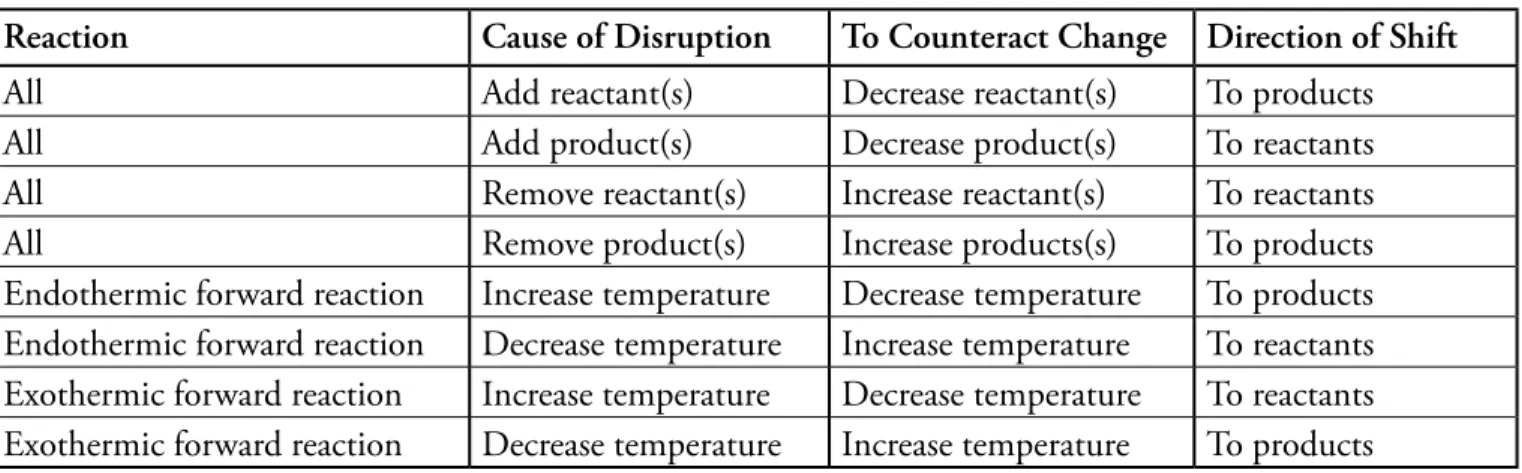
In general, equilibrium systems are easily disrupted. Every time you take a bottle of vinegar from a cool pantry and hold it in your warm hand, you increase the temperature of the solution and disrupt the equilibrium between acetic acid and its ions. To illustrate the conditions that lead to disruption of equilibria and to show why they do so, let’s return to our example of making hydrogen gas from carbon monoxide and water vapor.
CO(g) + H2O(g) CO2(g) + H2(g) Rateforward
Ratereverse
The Effect of Changing Concentrations on Equilibrium Systems
Any change in the concentration of a reactant or product in a chemical system at equilibrium will destroy the balance of the forward and reverse reaction rates and create a non-equilibrium situation, which in some cases will lead to a shift toward more reactants and in others a shift toward more products. One common means of shifting an equilibrium system toward the formation of more products is to increase the concentration of one of the reactants. Imagine that our system containing CO(g), H2O(g), CO2(g), and H2(g) is in equilibrium, so that the rate of the forward change
is equal to the rate of the reverse change. If more water vapor is added to the system, collisions between CO molecules and H2O molecules will be more frequent, and
Rateforward will increase. Initially, the rate of the reverse reaction, Ratereverse, will not be
affected, so the two rates will no longer be the same, and the system will no longer be at equilibrium.
To reiterate, the addition of water vapor to our equilibrium system causes Rateforward
to be greater than Ratereverse, so the products will be made faster than the reactants are
reformed. The concentration of the reactants CO(g) and H2O(g) will decrease, and
the concentration of the products CO2(g) and H2(g) will increase. Chemists describe
this situation by saying that the increase of one or more reactants shifts a system initially at equilibrium toward products (Figure 14.22).
14.4
Disruption of Equilibrium
objeCtive 30
14.4 Disruption of Equilibrium 611
System shifts toward products
Increased concentration of reactant for a system at equilibrium with Rateforward = Ratereverse
Rateforward > Ratereverse
Increased Rateforward
Figure 14.22
Effect of Increased Reactant Concentration on Equilibrium
As the concentrations of CO2(g) and H2(g) increase, Rreverse increases, and as the
concentrations of CO(g) and H2O(g) decrease, Rforward decreases. If there are no
further disruptions of the system, it will arrive at a new equilibrium with Rforward and
Rreverse once again equal. Note that at this new equilibrium, both Rforward and Rreverse
are higher (Figure 14.23).
Reaction Rates
Time
H2O(g)
added
New Dynamic Equilibrium Addition of reactant causes increase in rate of forward reaction Increase in forward reaction leads to increase in reverse reaction Rateforward Ratereverse Figure 14.23
Change in the Rates of Reaction when a Reactant is Added to an Equilibrium System for the Reversible Reaction: CO(g) + H2O(g) CO2(g) + H2(g)
Back at your ski shop, you might encounter a similar situation. When we last looked in on the business, we saw a dynamic equilibrium in which the rate at which skis left the shop, Rateleave, was equal to the rate at which they were being returned, Ratereturn.
If you buy more skis and equipment, however, you will be more likely to have what your customers want, so you will turn fewer customers away without skis. Thus the rate at which the skis leave the shop, Rateleave, will increase, making Rateleave greater
than Ratereturn. In time, though, as the number of your skis out on the slopes increases,
more people will decide to stop skiing and return the equipment. Eventually, the Ratereturn will increase until it is once again equal to Rateleave. However, both the rate
at which skis leave the shop and the rate at which they return will be greater at this new equilibrium (Figure 14.24 on the next page).
objeCtive 30
12 skis in the shop.
3 pairs of skis leave per hour
3 pairs of skis on the slope Before buying more skis
3 pairs of skis return per hour
Equilibrium (No change in the number of skis in the shop and on the slope)
Ski Shop
There are 12 skis in the shop.
5 pairs of skis leave per hour Immediately after buying more skis
There are 22 skis in the shop. (With more skis in the shop, more are rented per hour.)
Ski Shop
3 pairs of skis return per hour
3 pairs of skis on the slope
More skis leave than return, so the equilibrium is disrupted.
4 pairs of skis leave per hour Later
There are 18 skis in the shop. (This is more skis than before the purchase but fewer than immediately after the purchase.).
Ski Shop
4 pairs of skis return per hour
5 pairs of skis on the slope
New equilibrium (No change in the number of skis in the shop and on the slope) Figure 14.24
Ski Shop Equilibrium and Increased Stock
Another way to disrupt an equilibrium system and shift it toward products is to remove one or more of the products as they form. (We mentioned above that this is the practice in most industrial procedures.) For example, the reaction of CO(g) and H2(g)
from CO2(g) and H2(g) can be driven toward products by the removal of CO2(g) as it
14.4 Disruption of Equilibrium 613
excess water vapor and monoethanolamine, HOCH2CH2NH2.
CO(g) + H2O(g) CO2(g) + H2(g)
CO2(g) + H2O(g) + HOCH2CH2NH2(g) → HOCH2CH2NH3HCO3(s)
The removal of CO2(g) decreases its concentration, decreasing the frequency of
collisions between CO2(g) and H2(g) and therefore decreasing the rate of the reverse
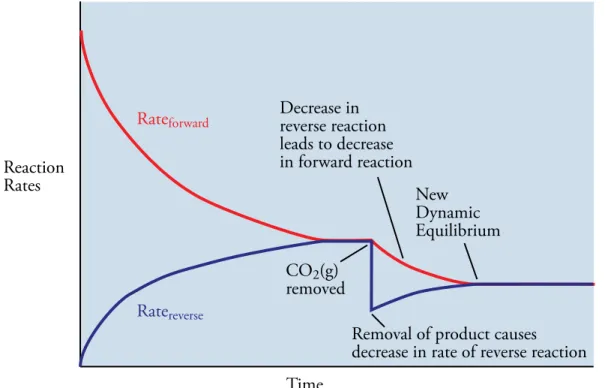
reaction, Ratereverse. This change makes Rateforward greater than Ratereverse, shifting the
system toward the formation of more products (Figure 14.25).
System shifts toward products
Decreased concentration of one product for a system at equilibrium with Rateforward = Ratereverse
Rate forward > Ratereverse
Decreased Ratereverse
Figure 14.25 Effect of Decreased Concentration of Product on Equilibrium
As the concentration of products increases, Ratereverse increases. As the concentration
of reactants decreases, Rateforward decreases. If no further changes are made to the
system, it will return to a new dynamic equilibrium with Rateforward equaling Ratereverse
(Figure 14.26). Reaction Rates Time CO2(g) removed New Dynamic Equilibrium
Removal of product causes decrease in rate of reverse reaction Decrease in reverse reaction leads to decrease in forward reaction Rateforward Ratereverse Figure 14.26
Change in the Rates of Reaction when a Product is Removed from an Equilibrium System for the Reversible Reaction: CO(g) + H2O(g) CO2(g) + H2(g)
objeCtive 31
objeCtive 31
objeCtive 31
You can visit the textbook’s Web site to read about how changing volume affects gas phase reactions at equilibrium.