OPEGA
Information Brief
PurposeOPEGA has a review of health care services in Maine’s
correctional system in progress. The review is primarily focused on the performance of key contractors MDOC uses to deliver health care services, and MDOC’s monitoring of those contractors. OPEGA engaged MGT of America, a national consultant with expertise in the provision of health care services in correctional facilities, to assist with this review. The final report is expected later this spring.
This Information Brief discusses some of the specific
suggestions MGT made for steps Maine could take to contain future costs and achieve efficiencies, while maintaining or improving the quality of care available to prisoners.
MGT shared its suggestions with MDOC, which is interested in pursuing them. Implementation will require planning and action that should begin immediately if the State desires to reap benefits within the next several years. The Legislature may wish to discuss these opportunities with MDOC during this
legislative session in the context of the Department’s priorities and any associated resource issues.
A
Revise Contract Structure, Terms and Conditions
Overview
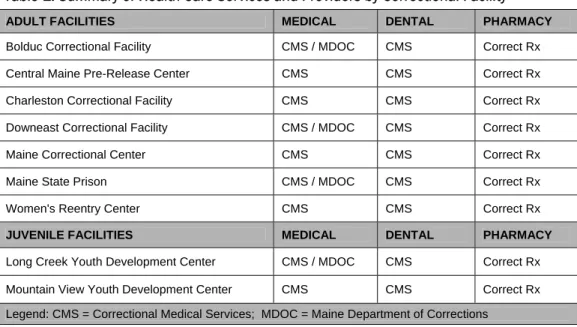
Maine’s Department of Corrections (MDOC) operates nine correctional facilities—two for juveniles and seven for adults—housing more than 2,000 prisoners as of December 2010. Each facility offers some health care services, and when a facility is not able to provide the level of care a prisoner requires, the prisoner may be transported off site to another correctional or health care facility to receive the necessary care. Although a few State employees still participate in the delivery of care, most services are provided through contracts with third parties. A summary of the services provided at each facility, and by which contractor, is provided in Table 1.
Table 1. Summary of Health Care Services and Providers by Correctional Facility ADULT FACILITIES MEDICAL DENTAL PHARMACY
Bolduc Correctional Facility CMS / MDOC CMS Correct Rx
Central Maine Pre-Release Center CMS CMS Correct Rx
Charleston Correctional Facility CMS CMS Correct Rx
Downeast Correctional Facility CMS / MDOC CMS Correct Rx
Maine Correctional Center CMS CMS Correct Rx
Maine State Prison CMS / MDOC CMS Correct Rx
Women's Reentry Center CMS CMS Correct Rx
JUVENILE FACILITIES MEDICAL DENTAL PHARMACY
Long Creek Youth Development Center CMS / MDOC CMS Correct Rx
Mountain View Youth Development Center CMS CMS Correct Rx
Legend: CMS = Correctional Medical Services; MDOC = Maine Department of Corrections Source: Information provided by the Maine Department of Corrections.
As shown in the summary, Correctional Medical Services (sometimes supported by MDOC staff) provides all medical and dental care, and Correct Rx provides all pharmaceutical services. Contracts with these entities are supported only by General Fund resources and amounts expended for FY 2010 totaled $12.0 million under the Correctional Medical Services (CMS) contract and $2.7 million for Correct Rx. MDOC has contracted with CMS since 2003 and Correct RX since 2007.
MDOC’s use of long-term, open-ended contracts diminishes vendor incentives to continually reduce costs. In addition, MDOC’s contracts with CMS and Correct Rx are “cost-plus” contracts. In these types of contracts the vendor is reimbursed at a specific rate, which includes actual costs for staff and services provided plus an amount to cover vendor overhead and profit. Cost-plus contracts are generally used in systems where costs are very well-defined and/or fixed, with little opportunity for cost savings. MGT of America (MGT), the correctional health care expert OPEGA hired for this review, noted two problems with this approach for contracting health care services from the standpoint of controlling costs:
Health Care Services in State Correctional
Facilities:
Opportunities to Contain Costs
and Achieve Efficiencies
April
2011
No SR-MEDSERV-09
1. The State assumes all of the risk in managing health care costs and there is no financial incentive for the vendor to achieve efficiencies or reduce spending. Because the vendor is simply reimbursed for actual staffing and off-site care costs, they receive little direct benefit from any efforts to manage utilization and reduce health care spending. Whether hospitalization costs run high, or are instead below projections, the vendor simply passes these costs along to the State. One of the primary benefits of privatization is for the State to minimize its risk for escalating costs by shifting responsibility for management of those risks to vendors with very specific expertise in correctional health care management. Under the cost-plus approach, the vendor assumes no risk and opportunities to achieve efficiencies often expected from privatization of correctional health care are minimized.
2. Cost-plus contracts increase the administrative burden on the vendor, which passes additional processing costs back to the State. The burden is also larger on the State directly, due to workload associated with confirming actual vendor spending and reconciling payments against those expenditures to ensure the actual cost of care was paid to the vendor. In an alternative arrangement where the vendor’s compensation is fixed, administrative costs like reconciliation are avoided.
Contract structures and terms that put the vendor at risk of losing money if costs exceed a certain level, or conversely provide an opportunity to increase profits if expenditures are reduced, are more likely to encourage effective cost management – particularly when vendor risk is allocated to those areas where the vendor’s experience and expertise can most effectively be leveraged. MDOC’s current contracts with CMS and Correct Rx do not include these kinds of risk sharing provisions and do not provide substantial financial incentives to aggressively control costs. However, the term of the CMS contract expires at the end of June 2011 and the Department has been preparing to issue a Request for Proposal (RFP) for correctional health care services. The upcoming bid of this contract is a good opportunity to bring competitive pressures to bear to reduce health care costs. MDOC has plans to incorporate some of MGT’s suggestions, as described below, into the RFP.
Opportunities for Improvement
MGT of America noted a number of proven contracting approaches that could contain future costs or generate cost savings in correctional health care services. The key to most of these approaches is to shift risk to the vendor, allowing them to increase their profitability as they decrease health care costs. Generally these approaches require vendors to bid a fixed price to cover the cost of health care services provided outside of correctional facilities. Establishing a fixed price incentivizes the vendor to effectively manage utilization, negotiate discounted rates for service and audit bills to achieve maximum efficiency in providing service. Providing vendors with opportunities to reduce their costs through their own performance should also increase competition for these contracts as they become potentially more profitable for more companies.
Alternative approaches MGT has observed as providing the most savings assign vendor risk to relatively predictable areas, as well as to those areas where vendor experience and expertise can yield savings. For example, the contract could require the vendor to assume responsibility and financial risk for managing and controlling off-site care costs, but also establish catastrophic caps. These caps can be used to put a ceiling on vendor responsibility for individual case cost, or to share the cost of care beyond a certain level. Catastrophic caps are beneficial because they can eliminate the vendor’s built-in cost for stop loss insurance by reducing the vendor’s overall risk for high cost cases. This allows vendors to more effectively price routine care and avoids additional risk premium costs to cover the major cases that might, or might not, occur.
Other costs, such as those associated with HIV, Hepatitis C, Factor VIII and IX, and organ transplants, can be very unpredictable. Vendors who must pay these full costs typically build a risk premium into their contract bid to cover these potential costs. The State could, instead, take responsibility to pay these costs in full, outside of the vendor contract. This allows the State to pay only the costs that actually arise rather than pay higher on-going rates to cover a built in premium based on potential costs in these areas.
OPEGA observed that a contract that shifts risk to the vendor, and subsequently allows the vendor increased profit opportunity, could potentially entice a vendor to make decisions that would increase profits, but be detrimental to
Information Brief – Health Care Services in State Correctional Facilities
the quantity and quality of services provided to prisoners. The best control to prevent this from happening is prudent contract administration and a strong system for monitoring vendor performance. MDOC would need to strengthen its current monitoring procedures to ensure quality of care under a non-cost plus contract.
Aside from recommending a move away from cost-plus contracting, MGT also noted a number of measures that have worked in other states to better manage costs and increase efficiencies, regardless of whether a cost-plus, or some alternate contract model is used. These approaches include:
• Set staffing reimbursement rates at 90 percent of contract requirements. CMS is currently paid each month on the basis of the full amount of staff hours required in the contract. There is then a monthly
reconciliation process to determine what credits are due to MDOC for contracted hours that were not provided. According to the CMS regional manager, CMS’ accounting staff spends significant time preparing monthly reports based on actual time records, comparing on-site staff time to the contract staffing
requirements. These calculations are then checked by MDOC staff. This monthly reconciliation can be quite detailed and time-consuming given the amount of vacancies present at any given time and normal staff time off. An alternative approach recognizes that staff fill rates seldom approach the contracted level and reduces monthly upfront payments to the vendor to recognize that. A number of systems pay vendors on the basis of 90 percent of contract hours provided, then just reconcile once a year to account for any overages or underages. The end result is improved cash flow for the Department due to reduced upfront payments, a simplified reconciliation process, and reduced overhead for both the Department and vendor as
reconciliations are cut from 12 per year to once annually.
• Consider including requirements for a comprehensive Electronic Medical Records (EMR) system in the RFP. The cost of these systems has come down in recent years, and acquiring a system through the contract process allows the cost of the system to be amortized over the life of the contract. MDOC should specify that any EMR system be non proprietary in nature, be compliant with any federal guidelines and be a system that is already operational on a large scale. The RFP should also continue to include telemedicine with requirements that the vendor have experience in developing and conducting those services. MGT has observed that integration of telemedicine and EMR systems have allowed a number of correctional systems nationally to dramatically improve the efficiency of service delivery. (See the EMR section on page 6 of this Brief for further discussion.)
• Encourage bidders to propose alternative staffing plans. In structuring the RFP, all vendors should be asked to bid on the same staffing plan. However, MDOC should also request that bidders propose alternative plans, tied to specific benchmarks of service, that can be used for negotiations. While the staffing pattern MDOC uses may be appropriate for Maine, vendors with extensive expertise in managing correctional health care services may have different approaches that could generate savings. MGT also observed that converting all remaining State health care positions to contract positions in the RFP could be helpful in addressing administrative issues associated with the joint management of contract and State staff in the same unit. OPEGA observes that such a conversion would require changes to the Department’s appropriations and authorized positions and would likely have union contract implications.
• Consider including pharmacy with medical services as a comprehensive contract. MGT finds that separating out medical and pharmaceutical services often drives up cost and dilutes accountability. An alternative model makes the vendor that is responsible for prescribing medication bear the financial consequences and risks of those prescribing practices. MDOC has had negative experiences with combining these services under one vendor in the past and believes this is a situation with both pros and cons that should be carefully considered.
• Establish a fixed contract term of 3-5 years. A multi-year fixed term contract in this range allows a vendor a sufficient time horizon to recoup investments in the system, but also retains the benefit of competitive bidding for the Department.
• Consider establishment of incentive programs, tied to performance benchmarks, to contain costs in medical care as well as other related areas such as security and transportation. MGT has found structured incentive programs are good alternatives to penalty programs, and will often generate improvements in medical
outcomes, greater efficiency in delivery of care and more creative ideas in managing care. The establishment of benchmarks for health outcomes is, however, critical to ensure appropriate care is not being
shortchanged to meet incentives. Services that exceed the set benchmarks are rewarded with incentive payments. Incentives can be readily established for staffing fill rates. Another area where incentives could be beneficial is off-site care. Adding incentives in this area should motivate the contractor to find ways to provide services on site, reinforcing such things as telemedicine, chronic disease management, on site specialty care, and effective infirmary use.
• Look for vendors with strong utilization management programs. RFPs should require bidders to provide a full explanation of their utilization management programs and MDOC should assess each program’s comprehensiveness. RFPs should not specify what should be included in the vendors’ utilization
management programs. Rather, MDOC should look for those programs that have built-in systems designed to continually improve service management, such as where doctors and other clinical staff consult on and review cases to bring in multiple levels of expertise. A well designed utilization management program should help identify and manage high cost areas.
Improve Planning and Care Alternatives for Chronically Ill and Elderly Prisoners
Overview
According to the Bureau of Justice Statistics in 2008, 4.7% of states’ prison populations were 55 years of age and older. Prisoners in their fifties are often considered geriatric due to their generally poor health and shorter life expectancy. While the number of these prisoners is small, they present special challenges in the delivery of health care. The cumulative effects of aging often mean they require more medical services, including costly long-term care. According to the National Hospice and Palliative Care Organization, end of life care in correctional settings will become increasingly necessary in coming years. As the number of aging and ill incarcerated men and women increases, correctional facilities’ methods to manage these prisoners in a humane and cost-effective manner are of particular importance. In addition, such care is guaranteed under the Civil Rights of Institutionalized Persons Act (CRIPA) and Americans with Disabilities Act Amendments Act of 2008 (ADAAA).
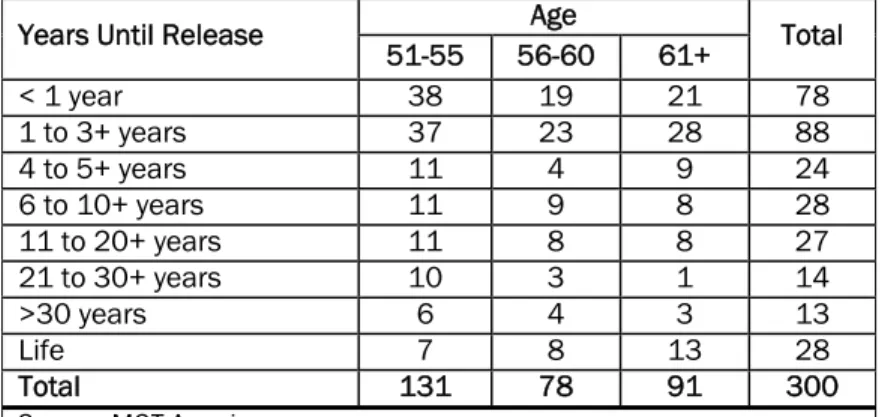
In November of 2010, MDOC reported 189 prisoners 55 years of age or older in the State prison population. This group represented 9% of the total 2,094 prisoners in the population. Table 2 includes a breakdown of MDOC prisoners by age group and number of years until release. At the present time, Maine has no method of tracking medical costs specific to geriatric prisoners regarding use of specialists, types of treatment, durable medical equipment, health care appliances and medications. As a result, the exact cost of providing care for this group is currently unknown.
MDOC has few options for providing services
to chronically ill or geriatric prisoners when the care they need is not available at the facility in which they are housed. The Department does have a Medical Supervised Community Confinement Program, which provides for community confinement of prisoners with terminal, or severely incapacitating, medical conditions when care outside a correctional facility is appropriate from a medical and security perspective. When approved by the MDOC
Commissioner, prisoners under this program live in a hospital or other appropriate care facility, such as a nursing facility, residential care facility, or a facility that has a licensed hospice program. They are essentially under the supervision of the community facility, but may also be subject to periodic probation type check-ins. Under this program, the Commissioner also can approve home placement for prisoners that are at end of life and present no
Table 2. MDOC Population: Age and Years Left Until Release as of November 19, 2010
Age Years Until Release
51-55 56-60 61+ Total < 1 year 38 19 21 78 1 to 3+ years 37 23 28 88 4 to 5+ years 11 4 9 24 6 to 10+ years 11 9 8 28 11 to 20+ years 11 8 8 27 21 to 30+ years 10 3 1 14 >30 years 6 4 3 13 Life 7 8 13 28 Total 131 78 91 300 Source: MGT America.
Information Brief – Health Care Services in State Correctional Facilities
risk to others, if appropriate services can be arranged. Funding for these alternative placements varies according to a prisoner’s individual circumstances with MaineCare or private insurance.
MDOC reports that, despite a tremendous amount of effort applied toward community placement, making it work is difficult. Since the Program’s inception, there have been three prisoners placed in alternative settings. One prisoner was approved for home placement. The prisoner’s overall health condition improved, to the extent the prisoner was re-assigned to a community facility, reached the end of his sentence and was released. Two other prisoners were placed in community facilities, but following significant problems both were returned to MDOC facilities. At present, there are no prisoners in this program.
For those prisoners not suitable for community placement, however, the MDOC often must move them to a higher security facility where the medical care they require is available. This practice is not uncommon. MGT reports that many correctional systems tend to concentrate health care services at high security facilities due to the longer stays and more intensive needs of prisoners at these facilities. However, this ties up valuable infirmary beds available for treating the remainder of the population and may result in ill or elderly patients being held in a more restrictive (and therefore more costly) environment than is necessary. The more restrictive environment may also limit prisoners’ access to programs and services that may be required for rehabilitation or which must be successfully completed prior to consideration for release or community placement. Making special accommodations to continue such programming for ill or elderly prisoners moved to high security facilities is sometimes possible, but represents yet another additional cost.
MDOC reports that currently four of the six infirmary beds at the Maine State Prison are filled, due to lack of alternatives for other appropriate placement, with prisoners who have long term care needs. Many more are also at risk of needing a bed for long term care. MDOC could be immediately facing a situation where it does not have enough infirmary beds for those needing long term care and will have to bear the expense of placing prisoners in off-site hospital beds instead. This situation would also mean there are no infirmary beds to house prisoners who have short term sicknesses. The Department has also expressed concern about housing the elder population in the future. Secure bed space, physical plant design, access to programs and services, medications, special diets, distance to emergency hospital services, and preparation for community re-entry are some of the expected challenges for this population. MDOC has contacted some other states regarding management of this population, but currently has no formal short-term or long-term plans to strategically address the issue.
Opportunities for Improvement
MGT suggests that MDOC consider the following actions to ensure appropriate planning and administration of health care services for chronically ill and elderly prisoners in the future:
1. Review MDOC’s strategic plan and revise accordingly, with specific goals, objectives and strategies listed for bed planning and health care management of the aging population, using the “right prisoner, in the right bed, for the right reason” method to utilize the best and most efficient resources.
2. Continue to analyze current data, and gather new data as needed, in order to identify:
• costs of elder care;
• medical and health care conditions most often being treated;
• medications most often being prescribed;
• prisoner demographics including gender, age, most severe crime committed, average length of sentence;
• types of disabilities being managed;
• typical kinds of accommodation requests being received and how those requests are being managed;
• use and management of health care appliances and durable medical equipment including associated security implications; and
• food service costs related to special dietary needs.
Such information will provide hard facts as a basis for MDOC and the Legislature’s future discussion of this issue.
3. Review current housing, programs, and staff supervision policies for this population. Evaluate the impact of ADAAA requirements on management of geriatric prisoners.
4. Conduct a review of end-of-life services and procedures using quality guidelines for hospice and end-of-life care in correctional settings developed by the National Hospice and Palliative Care Organization and seek opportunities for technical assistance, if possible. According to MDOC, there is a hospice program at the Maine State Prison as dying prisoners are most likely to be in the infirmary beds there.
5. Review policies, procedures, and practices related to infirmary care and associated costs.
The Legislature may also want to consider further study of issues surrounding Maine’s geriatric corrections population. MGT suggests the cost of such a study may eventually be viewed as a small, upfront investment with a large benefit in the future. Community supervision, housing, ongoing and available treatment programs,
employment, transportation, restitution, and reunification of families are some of the significant topics for consideration.
Implement Electronic Medical Records System
Overview
MDOC’s current system of record keeping associated with prisoner health care services is mostly manual and varies from one facility to another. Archival of MDOC’s prisoner health care records appears to be bulky and burdensome for storage and access. According to MDOC and CMS staff, if a prisoner returns to the custody of MDOC, there is often a significant delay in researching and acquiring the prisoner’s prior paper medical charts and records from a central archive location.
This practice is not efficient. It can result in creation of duplicate files and require additional staff effort, thus driving up unnecessary administrative costs. In addition, MDOC facilities do not have access to digital medical records used by doctors’ offices and hospitals in the community. This situation makes it difficult to obtain records for individual prisoners who have received care in non-institutional settings.
Manual records and files also limit the ability to collect and analyze data on health care service delivery that should be used for effective utilization management, monitoring of contractor performance, planning for the prison population’s health care needs and tracking costs. Performance-based health care standards also call for collecting, analyzing, and actively using performance improvement data to foster quality assessment and performance improvement in all areas of care.
Electronic Medical Record (EMR) systems offer users several benefits in the correctional setting. Centralizing the data allows access at any time, from any location by approved medical professionals. Difficulty in reading the handwriting of others is eliminated. Patient privacy is maintained. Required field completion and a defined sequence for entering notes about patient therapy, treatment and medication reduces errors and makes patient records more consistent. A link to pharmacy services is possible that could improve medication management, as well as links to daily, real-time prisoner moves, allowable property lists noting approved health care appliances and durable medical equipment, and information about special dietary needs.
In addition, paperless record keeping contributes to storage space efficiency. With appropriate backup systems, historical data can be maintained indefinitely and valuable physical space that was previously used for bulky paper files can be repurposed. When agencies opt for “certified electronic health record technology,” systems may be compatible with jails and hospitals in the community. The end result is administrative efficiencies, improvements in record keeping, and valuable stored data that can be accessed at a moment’s notice in order to report on trends, demographics, housing or security issues, and many other topics that may be of use to legislators and management in considering issues of prisoner health care.
MGT reports that correctional systems in other states have adopted EMR systems, and in some cases have leveraged health care contracts to introduce the needed technology. However, though the value of such systems is evident, the initial cost can be high, depending upon the size of the correctional system and functionality required. MGT notes
Information Brief – Health Care Services in State Correctional Facilities
that states are often able to negotiate with vendors to have the cost of EMR implementation amortized over the life of the vendor’s contract so the State does not have to absorb the full cost in one year.
Aside from financial investment, implementing an EMR system can also take a substantial investment of time and energy on the part of the Department. For an implementation to be optimally successful, the correctional system must prepare by undertaking a review of all processes, and reengineering them where necessary, to ensure procedures mesh efficiently with the new EMR system and maximize its effectiveness. This process assessment requires the involvement of stakeholders at all levels in the organization and, if substantial process change is
necessary, can also result in a need for significant training hours to ensure all staff are adequately prepared to adhere to new procedures.
MDOC has been interested in implementing an EMR system for some time and, in fact, has previously pursued obtaining this technology through an arrangement with a third party as the system CMS offered was not suitable. Those plans were disrupted, however, and until recently MDOC had not renewed efforts to get an EMR system in place. According to the Department, an EMR Task Force was activated a few months ago and is actively seeking the most cost effective medical management system. The National Institute of Corrections will be providing MDOC with assistance and guidance in this effort.
Opportunities for Improvement
The effective use of a functional and well-designed EMR system can drive improvements in the quality and efficiency of health care services delivered in Maine’s correctional system, potentially encompassing both State institutions and county jails. MDOC, with the involvement of the State’s Office of Information Technology, is again actively pursuing the selection and implementation of an EMR system. This system should be proven, compliant with federal guidelines and compatible with other systems, both public and private, with which it needs to, or should, interface.
MDOC could explore the acquisition of such a system through the upcoming RFP process for medical services by soliciting bidders’ proposals on an EMR system as well as increased use of telemedicine. Any EMR system
implemented by a MDOC vendor should be required to be non-proprietary in nature so MDOC maintains both the system and its future ability to bid out health care services. According to MGT, the integration of telemedicine and EMR systems has dramatically improved the efficiency of service delivery for a number of states’ correctional health care systems. Consequently, MDOC should also consider requiring vendors bidding on the new RFP to have experience in developing and conducting actual telemedicine services.
The Department will likely need the Legislature’s support of the initiative to implement EMR as it could represent a significant investment of both human and financial resources. The Legislature can help assure that this effort remains a priority for MDOC and that adequate resources are appropriated and well spent by the Department.