Modelling Adversaries and Security Objectives for Routing
Protocols in Wireless Sensor Networks
Gergely ´
Acs, Levente Butty ´an and Istv ´an Vajda
Laboratory of Cryptography and Systems Security (CrySyS)Department of Telecommunications
Budapest University of Technology and Economics, Hungary {acs, buttyan, vajda}@crysys.hu
ABSTRACT
The literature is very broad considering routing protocols in wireless sensor networks (WSNs). However, security of these routing protocols has fallen beyond the scope so far. Routing is a fundamental functionality in wireless networks, thus hostile interventions aiming to disrupt and degrade the routing service have a serious impact on the overall opera-tion of the entire network. In order to analyze the security of routing protocols in a precise and rigorous way, we pro-pose a formal framework encompassing the definition of an adversary model as well as the “general” definition of secure routing in sensor networks. Both definitions take into ac-count the feasible goals and capabilities of an adversary in sensor environments and the variety of sensor routing pro-tocols. In spirit, our formal model is based on the simula-tion paradigm that is a successfully used technique to prove the security of various cryptographic protocols. However, we also highlight some differences between our model and other models that have been proposed for wired networks. Finally, we illustrate the practical usage of our model by presenting the formal description of a simple attack against an authenticated routing protocol, which is based on the well-known TinyOS routing.
Categories and Subject Descriptors
C.2.2 [Computer Systems Organization]: Computer-Communication Networks—Network Protocols
General Terms
Algorithms, Design, Security
Keywords
Sensor Networks, Routing Protocols, Adversary Model, Provable Security, Simulatability
Permission to make digital or hard copies of all or part of this work for personal or classroom use is granted without fee provided that copies are not made or distributed for profit or commercial advantage and that copies bear this notice and the full citation on the first page. To copy otherwise, to republish, to post on servers or to redistribute to lists, requires prior specific permission and/or a fee.
SASN’06, October 30, 2006, Alexandria, Virginia, USA. Copyright 2006 ACM 1-59593-554-1/06/0010 ...$5.00.
1.
INTRODUCTION
Routing is a fundamental function in every network that is based on multi-hop communications, and wireless sen-sor networks are no exceptions. Consequently, a multi-tude of routing protocols have been proposed for sensor networks in the recent past. However, most of these pro-tocols have not been designed with security requirements in mind. This means that they can badly fail in hostile environ-ments. Paradoxically, research on wireless sensor networks have been mainly fuelled by their potential applications in military settings where the environment is hostile. The nat-ural question that may arise is why then security of routing protocols for sensor networks has fallen beyond the scope of research so far.
We believe that one important reason for this situation is that the design principles of secure routing protocols for wireless sensor networks are poorly understood today. First of all, there is no clear definition of what secure routing should mean in this context. Instead, the usual approach, exemplified in [10], is to list different types of possible at-tacks against routing in wireless sensor networks, and to define routing security implicitly as resistance to (some of) these attacks. However, there are several problems with this approach. For instance, a given protocol may resist a differ-ent set of attacks than another one. How to compare these protocols? Shall we call them both secure routing proto-cols? Or on what grounds should we declare one protocol more secure than another? Another problem is that it is quite difficult to carry out a rigorous analysis when only a list of potential attacktypes are given. How can we be sure that all possible attacks of a given type has been considered in the analysis? It is not surprising that when having such a vague idea about what to achieve, one cannot develop the necessary design principles. It is possible to come up instead with some countermeasures, similar to the ones described in [10], which are potentially usefully to thwart some specific types of attacks, but it remains unclear how to put these ingredients together in order to obtain a secure and efficient routing protocol at the end.
In order to remedy this situation, we propose to base the design of secure routing protocols for wireless sensor net-works on a formal security model. While the benefit of formal models is not always clear (indeed, in some cases, they tend to be overly complicated compared to what they achieve), we have already demonstrated their advantages in the context of ad hoc network routing protocols. More specifically, we developed formal security models in [4, 1, 2], and we successfully used them to prove the security of some
ad hoc network routing protocols, and to find security holes in others. The idea here is to use the same approach in the context of wireless sensor networks. The rationale is that routing protocols in sensor networks are somewhat similar to those in ad hoc networks, hence they have similar pitfalls and they can be modeled in a similar way.
Thus, in this paper, we present a formal model, in which security of routing is precisely defined, and which can serve as the basis for rigorous security analysis of routing protocols proposed for wireless sensor networks. Our model is based on the simulation paradigm, where security is defined in terms of indistinguishability between an ideal-world model of the system (where certain attacks are not possible by definition) and the real-world model of the system (where the adversary is not constrained, except that he must run in time polynomial). This is a standard approach for defining security, however, it must be adopted carefully to the specific environment of wireless sensor networks.
Similar to [4], in this paper, we develop an adversary model that is different from the standard Dolev-Yao model, where the adversary can control all communications in the system. In wireless sensor networks, the adversary uses wire-less devices to attack the systems, and it is more reasonable to assume that the adversary can interfere with communi-cations only within its power range. In addition, we must also model the broadcast nature of radio communications.
However, in addition to the model described in [4], here we take into account that there are some attacks which ex-ploit the constraint energy supply of sensor nodes (e.g., the adversary decreases the network lifetime by diverting the traffic in order to overload, and thus, deplete some sensor nodes). Hence, we explicitly model the energy consumption caused by sending a message between each pair of nodes in the network.
Another difference with respect to the model of [4] lies in the definition of the outputs of the ideal-world and the real-world models. It is tempting to consider the state stored in the routing tables of the nodes as the output, but an adversary can distort that state in unavoidable ways. This means that if we based our definition of security on the indis-tinguishability of the routing states in the ideal-world and in the real-world models, then no routing protocol would satisfy it. Hence, we define the output of the models as a suitable function of the routing state, which hides the un-avoidable distortions in the states. This function may be dif-ferent for difdif-ferent types of routing protocols, but the general approach of comparing the outputs of this function in the ideal-world and in the real-world models remain the same. For instance, this function could be the average length of the shortest pathes between the sensor nodes and the base sta-tion; then, even if the routing tables of the nodes would not always be the same in the ideal-world and in the real-world models, the protocol would still be secure given that the difference between the distributions of the average length of the shortest pathes in the two models is negligibly small.
The rest of the paper is organized as follows: In Section 2, we present the elements of our formal model, which includes the presentation of the adversary model adopted to wireless sensor networks, the description of the ideal-world and the real-world models, the general definition of the output of these models, as well as the definition of routing security. Then, in Section 3, we illustrate the usage of our model by representing in it a known insecurity of an authenticated
version of the TinyOS routing protocol. Finally, in Sec-tion 4, we report on some related work, and in SecSec-tion 5, we conclude the paper.
We must note that the work described in this paper is a
work in progress, and it should be considered as such. In particular, the reader will not find security proofs in this paper. There are two reasons for this: first, we are still developing the proof techniques, and second, we have not identified yet any routing protocols that would be secure in our model.
2.
THE MODEL OF WIRELESS SENSOR
NETWORKS
2.1
Adversary model
The adversary is represented by adversarial nodes in the network. An adversarial node can correspond to an ordi-nary sensor node, or a more resourced laptop-class device. In the former case, the adversary may deploy some cor-rupted sensor-class devices or may capture some honest sen-sor nodes. In the latter case, he has a laptop-class device with a powerful antenna and unconstrained energy supply. All of these adversarial nodes may be able to communicate in out-of-band channels (e.g., other frequency channel or direct wired connection), which may be used to create wormholes. In general, when capturing honest sensor nodes, the ad-versary may be able to compromise their cryptographic se-crets (assuming that such sese-crets are used in the system). However, in this paper, we assume that the adversary can-not compromise cryptographic material. This is certainly a simplifying assumption, and we intend to relax it in our future work.
The adversary attacking the routing protocol primarily intends to shorten the network lifetime, degrade the packet delivery ratio, increase his control over traffic, and increase network delay. Some of these goals are highly correlated; e.g., increasing hostile control over traffic may also cause the network delay to be increased.
In order to achieve the aforementioned goals, the adver-sary is able to perform simple message manipulations: fab-ricated message injection, message deletion, message mod-ification and re-ordering of message sequences. In the fol-lowings, we describe how the adversary can perform mes-sage deletion and injection in a wireless sensor network. Re-ordering of message sequences is straightforward using message deletion and insertion, thus, we do not elaborate it further.
Basically, an adversarial node can affect the communica-tion of two honest nodes in two cases: In the first case, an ad-versarial node relays messages between honest nodes which are not able to communicate directly with each other. In the second case, the honest nodes can also reach each other, and the adversarial node can also hear the nodes’ communi-cation, i.e., he can send and receive messages to/from both honest nodes. We further assume that communication range implies interference range, and vice-versa.
In case of adversarial relaying of messages between the nodes, all of the message manipulations are quite straight-forward. On the contrary, if the honest nodes can also com-municate with each other, message manipulations must be performed in a very sophisticated way. The adversarial node can inject messages easily, but deletion and modification
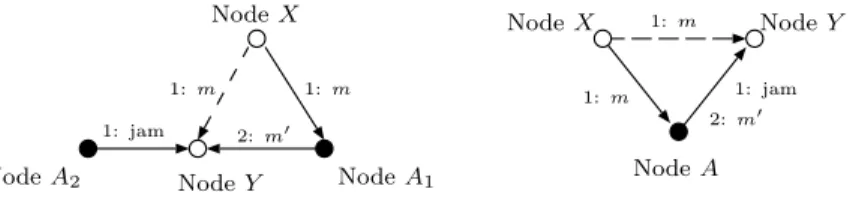
re-quire jamming capability. Message deletion may be achieved by employing various selective jamming techniques against either the sender node or the receiver node. Message modi-fication is only feasible, if both the sender and the receiver nodes are within the communication range of the adversarial node. Here, we sketch two scenarios for message modifica-tion, which are illustrated on Figure 1. By these simple examples, we intend to point out the feasibility of message modification assuming even direct communication between the sender and the receiver node.
Scenario 1: There are two honest nodesX andY, and nodeXintends to send a messagemto nodeY. A1andA2
are adversarial nodes, whereA2is able to interfere withY’s communication, but not withX’s andA1’s communication. LetA1be in the communication range ofXandY, whereas
A2 can only communicate withY. WhenX transmitsmto
Y, nodeA1 overhearsm, meanwhileA2 performs jamming to cause Y not to be able to receive m. In order to take this action, A1 and A2 are connected by an out-of-band channel, thus,A1 can send a signal to A2 whenA2 should start jammingY’s communication. It is also feasible that
A2performs constant jamming for a certain amount of time, afterwards,A1 can send the modified messagem′ toY.
Scenario 2: In this scenario, there is only one adversarial node denoted byA. We assume that transmitting a message from the routing sublayer consists of passing the message to the data-link layer, which, after processing the message, also passes it further to the physical layer. The data-link layer uses CRC in order to provide some protection against faults in noisy channels; a sender generally appends a frame check sequence to each frame (e.g., see [7]). The adversary can exploit this CRC mechanism to modify a message in the following way (illustrated on Figure 1). WhenX transmits message m to Y, node A also overhears m, in particular, he can see the frame(s) belonging tom. Aintends to mod-ify message m. Here, we must note that most messages originated from the routing sublayer are composed of only one frame per message in the data-link layer due to perfor-mance reasons, especially when they are used to discover routing topology. Upon reception of the frame correspond-ing to the message, the adversary can corrupt the frame check sequence by jamming once the data field of the frame has been received. This causes nodeY to drop the frame (and the message), sinceY detects that the last frame is in-correct, and waits for retransmission. At this point, if some acknowledgement mechanism is in use,Ashould send an ac-knowledgement toX so that it does not re-send the original frame. In addition,Aretransmits messagem′
in the name ofX, wherem′
is the modified message.
The feasibility of jamming attacks is studied and demon-strated in [17]. Although, the authors conclude in that paper that the success of jamming attacks mainly depend on the distance of the honest nodes and the jammer node, vari-ous jamming techniques has been presented there that can severely interfere with the normal operation of the network.
2.2
Network model
We assume that each honest device has exactly one an-tenna in the network. If the adversary uses several anan-tennas we represent each of them by a distinct node. The network nodes are considered to be static, and we further assume that there is a single base station in the network.
Let us denote the honest nodes in the network by
v0, v1, . . . , vk, wherev0 denotes the base station. Similarly,
vk+1, . . . , vk+mrepresent the adversarial nodes. The set of
all nodes is denoted byV. Furthermore,ndenotes the num-ber of all nodes in the network, i.e.,n =|V|=k+m+ 1. For each pair of nodesvi andvj, we defineevi,vj to be the energy level needed to transmit a message from vi to vj,
where vi, vj ∈ V. This values can be ordered in a matrix
with sizen×n, calledreachability matrix, and it is denoted byE.1 In the rest, if we intend to emphasize the distinction
between the honest and the adversarial nodes in the nota-tion, we prefer to denote the adversarial nodes byv∗
1, . . . , v
∗
m
(wherev∗
ℓ =vk+ℓ, 1≤ℓ≤m).
For the sake of simplicity, we also assume that at least energy evi,vj is needed for node vi to interfere with node
vj’s packet reception. This means that ifvi can reach vj,
thenvi can also interfere with all the communication ofvj.
Let us assume that each node uses a globally unique identifier in the network, and these identifiers are authen-ticated in some way (e.g., by symmetric keys). We de-note the set of these identifiers byL, and there is a
func-tion L : V → L ∪ {undef} that assigns an identifier to
each node, where undef ∈/ L. According to our adversary model described in Subsection 2.1, we assume that the ad-versary has no (authenticated) identifier in the network, i.e.,
L(v∗
j) =undeffor all 1≤j≤m.
We also introduce a cost functionC :V →R, which
as-signs a cost to each node (e.g., the remaining energy in the battery, or constant 1 to each node in order to represent hop-count).
Configuration: A configuration conf is a quadruple (V,L, E,C) that consists of the the set of nodes, the labelling function, the reachability matrix, and the cost function of nodes.
2.3
Security objective function
Diverse sensor applications entail different requirements for routing protocols. For instance, remote surveillance ap-plications may require minimal delay for messages, while sensor applications performing some statistical measure-ments favour routing protocols prolonging network lifetime. The diversity of routing protocols is caused by these con-flicting requirements: e.g., shortest-path routing algorithms cannot maximize the network lifetime, since always choosing the same nodes to forward messages causes these nodes to run out of their energy supply sooner. Several sensor routing protocols use a trade-off to satisfy conflicting requirements [16, 11].
This small argument also points out that one cannot judge the utility of all routing protocols uniformly. Without a uni-fied metric of utility we cannot refine our security objectives for routing protocols. By the above argument, a routing protocol that is secure against attacks aiming at decreasing network-lifetime cannot be secure against attacks aiming at increasing network delay. We model the negatively corre-lated requirements of routing, and essentially, our security objectives in a very general manner. We represent the out-put of a routing protocol, which is actually the ensemble of the routing entries of the honest nodes, with a given
con-1In this paper, the rows and the columns of all matrices are
NodeX
NodeA2 NodeY NodeA1
1:m 1: jam 1:m 2:m′ NodeX NodeY NodeA 1:m 1:m 1: jam 2:m′
Figure 1: Message modification performed by the cooperation of two adversarial nodes A1 and A2 (on the
right-hand side) in Scenario 1, and employing overhearing, jamming, and relaying with a single adversarial nodeA (on the left-hand side) in Scenario 2. Honest nodes are labelled by X and Y. Arrows between nodes illustrate the direction of communication, the sequence of message exchanges are also depicted on these arrows. Dashed arrows illustrate failed message delivery caused by jamming.
figurationconf by a matrixTconf with sizek+ 1×k+ 1.2 Tconfi,j = 1, if honest nodevisends every message to an
hon-est node identified byL(vj) in order to deliver the message
to the base station, otherwise letTconfi,j be 0. In the rest of
the paper, we shortly refer to the result of a routing protocol with a given configuration as arouting topology, which can be considered as a directed graph described by matrixTconf.
In the following, we will omit the indexconf ofT when the configuration can be unambiguously determined in a given context. In fact,Tconf is a random variable, where the
ran-domness is caused by the sensor readings initiated randomly by the environment, processing and transmission time of the sensed data, etc.
Let us denote the set of all configurations byG. Further-more,Tdenotes the set of the routing topologies of all
con-figurations. The security objective functionF:G×T→R
assigns a real number to a random routing topology of a con-figuration. This function intends to distinguish “attacked” topologies from “non-attacked” topologies based on a well-defined security objective. We note that the definition ofF
is protocol dependent. For example, let us consider rout-ing protocols that build a routrout-ing tree, where the root is the base station. We can compare routing trees based on network lifetime by the following security objective function
F(conf, Tconf) = 1 k k X i=1 E(vi,conf, Tconf)
where E :V ×G×T→R assigns the overall energy con-sumption of the path from a nodevitov0(the base station)
in a routing tree of a configuration. SinceTconf is a random
variable, the output ofF is a random variable too. If the distribution of this output in the presence of an attacker non-negligibly differs from the distribution when there’s no attacker, then the protocol is not secure. If we intend to compare routing trees based on network delay a simple se-curity objective function may be
F(conf, Tconf) = 1 k k X i=1 M(vi,conf, Tconf)
whereM:V ×G×T→Rassigns the length of the path from a node tov0 in a routing topology of a configuration.
2Of course, here we only consider the result of the protocol
with respect to the honest nodes, since the adversarial nodes may not follow the protocol rules faithfully.
2.4
Dynamic model
Following the simulation paradigm, we define a real-world model and an ideal-world model. The real-world model rep-resents the real operation of the protocol and the ideal-world model describes how the system should work ideally. Both models contain an adversary. The real-world adversary is not constrained apart from requiring it to run in time poly-nomial. This enables us to be concerned with arbitrary fea-sible attacks. In addition, the ideal-world adversary is con-strained in a way that it cannot modify messages and inject extra ones due to the construction of the ideal-world sys-tem. In other words, all attacks that modify or inject any messages is unsuccessful in the ideal-world system. How-ever, the ideal-world adversary can perform attacks that are unavoidable or very costly to defend against (e.g., message deletion).
Once the models are defined, the goal is to prove that for any real-world adversary, there exist an ideal-world ad-versary that can achieve essentially the same effects in the ideal-world model as those achieved by the real-world adver-sary in the real-world model (i.e., the ideal-world adveradver-sary can simulate the real-world adversary).
2.4.1
Real-world model
The real-world model that corresponds to a configuration
conf = (V,L, E,C) and adversaryAis denoted bysysreal
conf,A,
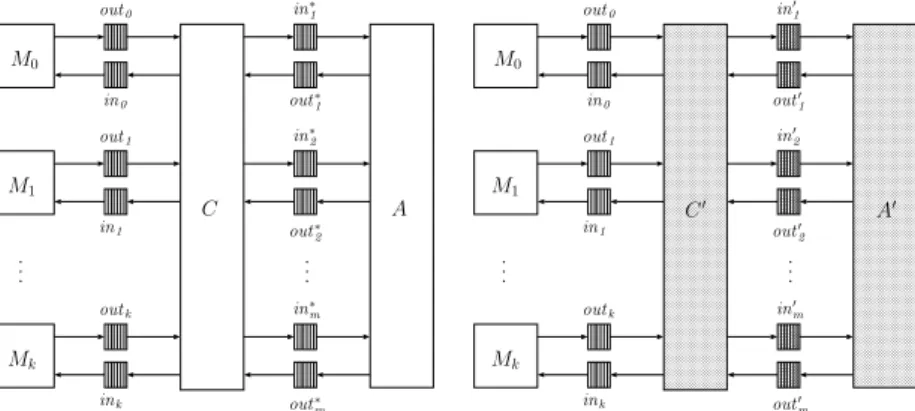
and it is illustrated on Figure 2. We model the operation of the protocol participants by interactive and probabilistic Turing machines. Correspondingly, we represent the adver-sary, the honest sensor nodes, and the broadcast nature of the radio communication by machines A, Mi, and C,
re-spectively. These machines communicate with each other via common tapes.
Each machine must be initialized with some input data (e.g., cryptographic keys, reachability matrix, etc.), which determines its initial state. Moreover, the machines are also provided with some random input (the coin flips to be used during the operation). Once the machines have been ini-tialized, the computation begins. The machines operate in a reactive manner, i.e., they need to be activated in order to perform some computation. When a machine is acti-vated, it reads the content of its input tapes, processes the received data, updates its internal state, writes some output on its output tapes, and goes back to sleep. The machines are activated in rounds by a hypothetic scheduler, and each machine in each round is activated only once. The order of activation is arbitrary with the only restriction thatCmust be activated at the end of the rounds.
Now, we present the machines in more details:
• MachineC. This machine is intended to model the ra-dio communication. It has input tapesouti andout
∗
j,
from which it reads messages written by Mi and A,
resp. It also has output tapesiniandin∗j, on which it
writes messages toMiandA, resp. Cis also initialized
by matrix Eat the beginning of the computation. Messages on tape outi can have the format
(ℓsndr,cont, e,dest), whereℓsndr ∈Lis the identifier of
the sender,contis the message content,eis the energy level to be used to determine the range of transmission, and dest is the identifier of the intended destination
dest ∈L∪ {∗}, where∗indicates broadcast message. Messages on tapeout∗
jcan have the following formats:
– (MSG, ℓsndr,cont, e,dest): MSGmessage models a
normal broadcast message sent by the adversary to machineCwith sender identiferℓsndr ∈L,
mes-sage contentcont, energy levele, and identifier of the intended destinationdest∈L∪ {∗}.
– (JAM, e): Special JAM message, that is sent by
the adversary to machineC, models the jamming capability of the adversary. When machineC re-ceives a messageJAM, it performs the requested jamming by deleting all messages in the indi-cated range e around the jamming node, which means that those deleted messages are not de-livered to the nodes (including the jammer node itself) within the jamming range.
– (DEL, ℓtar, e): SpecialDELmessage, that is sent
by the adversary to machineC, models the mod-ification capability of the adversary. When re-ceiving a message DEL with identifier ℓtar ∈ L,
machineCdoes not deliver any messages sent by nodev′ ∈V, where L(v′) = ℓtar, ifv
′
is within the indicated rangee, except the adversarial node itself that will receive the deleted messages. This models the sophisticated jamming technique that we described in Subsection 2.1.
In a more formal way, when reading a messagemsg∗
in =
(MSG, ℓsndr,cont, e,dest) fromout
∗
j,Cdetermines the
nodes which receive the message by calculating the set of nodesVe ⊆V, such that for all v′ ∈Ve evj,v′ ≤e. Finally,Cprocessesmsg∗
in as follows.
1. ifdest∈L∪ {∗}, thenCwrites
– msgout= (ℓsndr,cont,dest) to the input tapes
of machines corresponding to honest nodes in
Ve
– msg∗
out= (MSG, ℓsndr,cont,dest) to the input
tapes of machines corresponding to adversar-ial nodes inVe\ {v∗j}
2. otherwiseC discardsmsg∗
in
When reading a messagemsg∗
in= (JAM, e) fromout
∗
j,
C determines the set of nodes which receive the mes-sage by calculatingVe ⊆V, such that for all v′ ∈Ve
evj,v′ ≤e. Afterwards,Cdoes not write any messages
within the same round to the input tapes of machines corresponding toVe.
When reading a message msg∗
in = (DEL, ℓtar, e) from
out∗
j,C determines the set of nodes which receive the
message by calculatingVe ⊆V, such that for allv′ ∈
Ve evj,v′≤e. Finally,Cprocessesmsg
∗
in as follows.
1. if there exists vx ∈ Ve (1 ≤ x ≤ k), such that
L(vx) =ℓtar, thenCdoes not write any messages
within the same round from tape outx to the
in-put tapes of machines corresponding toVe\ {v∗j}
2. otherwiseCdiscards msg∗
in
When reading a message msgin = (ℓsndr,cont, e,dest)
from outi, C determines the set of nodes which
re-ceive the message by calculatingVe⊆V, such that for
all v′
∈Ve evj,v′ ≤e. Finally, C processes msgin as
follows.
1. ifdest ∈L∪ {∗}, thenC writes
– msgout= (ℓsndr,cont,dest) to the input tapes
of machines corresponding to honest nodes in
Ve\ {vi}
– msg∗
out= (MSG, ℓsndr,cont,dest) to the input
tapes of machines corresponding to adversar-ial nodes inVe
2. otherwiseCdiscards msgin
• Machine Mi. This machine models the operation of
honest sensor nodes, and it corresponds to node vi.
It has input tape ini and output tape outi, which
are shared with machine C. The format of input messages must be (ℓsndr,cont,dest), where dest ∈
L∪ {∗}. The format of output messages must be (ℓsndr,cont, e,dest), whereℓsndr must beL(vi),dest ∈
L∪ {∗}, andeindicates the transmission range of the message forC. When this machine reaches one of its final states or there is a time-out during the computa-tion process, it outputs its routing table.
• MachineA. This machine models the adversary logic. Encapsulating each adversarial node into a single ma-chine allows us to model wormholes insideA. One can imagine that the adversary deploy several antennas in the network field, which are connected to a central ad-versary logic. In this convention, nodevj∗corresponds
to an adversarial antenna, which is modelled by input tapein∗
jand output tapeout
∗
j. These tapes are shared
with machineC.
The format of input messages must be msg∗
in =
(MSG, ℓsndr,cont, e,dest), wheredest ∈L∪ {∗}.
The format of output messagesmsg∗
out can be
– (MSG, ℓsndr,cont, e,dest), where dest ∈ L∪ {∗}
andeindicates the transmission range of the mes-sage;
– (JAM, e), whereeindicates the range of jamming;
– (DEL, ℓtar, e), where e indicates the range of
se-lective jamming, andℓtar ∈L.
The computation ends, when all machinesMireach their
final states, or there is a time-out. The output ofsysreal
conf,A
is the value of the security objective functionF applied to the resulted routing topology defined in Subsection 2.3 and configurationconf. The routing topology is represented by
C M0 . . . in0 out0 in∗1 out∗ 1 in∗ 2 out∗ 2 A M1 out1 in1 Mk outk ink in∗ m out∗ m . . . C′ M0 . . . in0 out0 in′1 out′ 1 in′ 2 out′ 2 M1 out1 in1 Mk outk ink in′ m out′ m . . . A′
Figure 2: The real-world model (on the left-hand side) and the ideal-world model (on the right-hand side).
the ensemble of the routing entries of machines Mi. We
denote the output byOutreal,F
conf,A(r), wherer is the random
input of the model. In addition,Outreal,F
conf,A will denote the
random variable describing Outrealconf,F,A(r) when r is chosen
uniformly at random.
2.4.2
Ideal-world model
The ideal-world model (illustrated on Figure 2) that corre-sponds to a configurationconf = (V,L, E,C) and adversary
A′
is denoted bysysideal
conf,A′. The ideal-world model is
iden-tical to the real-world model with the exception that the ideal-world adversary cannot modify and inject extra mes-sages. However, he is allowed to simply drop any messages or perform jamming, since these attacks are unavoidable, or at least, they are too costly to defend against. Our model is considered to be ideal in this sense. Comparing to the real-world model, we replace machineC with machine C′
and machineAwith machineA′
in order to implement our restricted ideal-world adversary. Hence, we only detail the operation ofC′andA′here, sinceMiare the same as in the
real-world model.
Receiving anMSG message from machinesMi,C′
inter-nally stores that message with a unique message identifier in its internal store. Delivering any MSG message to A′
,
C′
also includes the message identifier into the message. A′
can send anMSGmessage toC′
with a different format; it only contains an identifier idand an energy level e. Upon the reception of such a message,C′
searches for the original message which is associated with identifieridin its internal store, and delivers this stored message using the energy level
e. Although A′
also receives the original message with its associated identifier fromC′
, he is not able to modify that, sinceC′
only accepts a message identifier issued by himself and an energy level fromA′
. In other words, A′
can only delete messages, sinceA′
can also send specialDELandJAM
messages toC′
. We elaborate the operation ofC′
andA′
in a more formal way as follows.
A′
andC′
communicate via tapesin′
jandout
′
j.
• Machine C′
. It has input tapesouti and out
′
j, from
which it reads messages written byMiandA, resp. It
also has output tapes ini andin′j, on which it writes
messages toMi and A, resp. C
′
is also initialized by matrixE. In addition, it sets its internal variableidC′
to 1 at the beginning of the computation.
C′ interacts with machinesMi in a similar way asC
does in the real-world model; when reading a mes-sage msgin = (ℓsndr,cont, e,dest) from outi, C′
pro-cessesmsgin identically toC in the real-world model
only with one exception: Before writing msg′
in =
(MSG, idC′, ℓsndr,cont,dest) to output tapes in′j, C
′
internally storesmsg′
in in set S. After writing msg
′
in
to output tapesin′
j,C
′
incrementsidC′ by one.
There-fore,C′
knows what messages are passed toAfromMi.
Messages onout′
j can have the formats:
– (MSG, id, e): MSG message models a normal
broadcast message sent by the ideal-world adver-sary to machineC′
, where eindicates the trans-mission range of the message identified byid.
– (JAM, e): Special JAMmessage, that is sent by
the adversary to machineC, models the jamming capability of the ideal-world adversary, where e
indicates the range of jamming.
– (DEL, ℓtar, e): SpecialDEL message, that is sent
by the adversary to machineC, models the mod-ification capability of the ideal-world adversary, whereeindicates the range of selective jamming, andℓtar ∈L.
When reading a message msg′
in = (MSG, id, e) from
out′j, machineC
′
operates differently fromC. C′
de-termines the set of nodes which receive the message by calculatingVe⊆V, such that for allv
′ ∈Veevj,v′ ≤e. Finally,C′ processesmsg′ in as follows. 1. if 1 ≤ id ≤ idC′, then C ′ searches the msg′ = (MSG, id′ , ℓ′ sndr,cont ′ ,dest′ ) in S such that id′
equals toid, andC writes – msgout = (ℓ ′ sndr,cont ′ ,dest′ ) to the input tapes of machines corresponding to honest nodes inVe – msg′ out = (MSG, id ′ , ℓ′ sndr,cont ′ ,dest′ ) to the input tapes of machines corresponding to ad-versarial nodes inVe\ {v∗j}
2. otherwiseC′
discards msg∗
in
When reading a messagemsg′
in = (JAM, e) ormsg
′
in=
(DEL, ℓtar, e) fromout ′
j, machineC
′
way as C does in case of the corresponding message formats.
• MachineA′
. It has output tapesout′
jand input tapes
in′
j. The format of messages on input tapein
′
j must
bemsg′
in = (MSG, id, ℓsndr,cont, e,dest), wheredest ∈
L∪ {∗}.
The format of output messagesmsg′
out can be
– (MSG, id, e), whereidis a message identifier and
eindicates the transmission range of the message identified byid;
– (JAM, e), whereeindicates the range of jamming;
– (DEL, ℓtar, e), wheree indicates the range of
se-lective jamming, andℓtar ∈L.
The computation ends, when all machinesMi reach their
final states, or there is a time-out. Similar to the real-world model, the output ofsysideal
conf,A is the value of the security
objective functionFapplied to the resulted routing topology and configurationconf. The routing topology is represented by the ensemble of the routing entries of machinesMi. We
denote the output byOutidealconf,F,A′(r), wherer is the random
input of the model. Moreover, Outidealconf,,FA′ will denote the
random variable describingOutidealconf,,FA′(r) when r is chosen
uniformly at random.
2.5
Definition of secure routing
Let us denote the security parameter of the model byκ
(e.g.,κis the key length of the cryptographic primitive em-ployed in the routing protocol, such as digital signature, MAC, etc.). Based on the model described in the previous subsections, we define routing security as follows:
Definition 1 (Statistical security). A routing
protocol is statistically secure with security objective func-tion F, if for any configuration conf and any real-world adversary A, there exists an ideal-world adversary A′
, such that Outreal,F
conf,A is statistically indistinguishable from
Outideal,F
conf,A′. Two random variables are statistically
indis-tinguishable if the L1 distance of their distributions is a negligible function of the security parameterκ.
Intuitively, if a routing protocol is statistically secure, then any system using this routing protocol cannot satisfy its security objectives represented by functionF only with a probability that is a negligible function ofκ.
This negligible probability is related to the fact that the adversary can always forge the cryptographic primitives (e.g., generate a valid digital signature) with a very small probability depending on the value ofκ.
3.
INSECURITY OF TINYOS ROUTING
In this section, we present an authenticated routing mech-anism based on the well-known TinyOS routing, and we show that it is not secure in our model for a given secu-rity objective function representing a very minimal secusecu-rity requirement.
3.1
Operation of an authenticated routing
protocol
Originally, the authors of TinyOS implemented a very simple routing protocol, where each node uses a globally
unique identifier. The base station periodically initiates a routing topology discovery by flooding the network by a bea-con message. Upon reception of the first beabea-con within a single beaconing interval, each sensor node stores the iden-tifier of the node, from which it received the beacon, as its parent (aka. next-hop towards the base station), and then re-broadcasts the beacon after changing the sender identi-fier to its own identiidenti-fier. As for each node only one parent is stored, the resulted routing topology is a tree. Every sensor node receiving a data packet forwards that towards the base station by sending the packet to its parent. A lightweight cryptographic extension is employed in [14] in order to authenticate the beacon by the base station. This authenticated variant of TinyOS routing usesµTesla scheme to provide integrity for the beacon; each key is disclosed by the next beacon in the subsequent beaconing interval. We remark that this protocol has only been defined informally that inspired us to present a new protocol, which provides the ”same” security as the authenticated routing protocol in [14], but due to its simplicity it fits more in demonstrating the usage of our model. Consequently, the presented attack against this new protocol also works against the protocol in [14]. We must note again that this protocol is only intended to present the usefulness of our model rather than to be considered as a proposal of a new sensor routing protocol.
We assume that the base stationB has a public-private key pair, where the public key is denoted byKpub.
Further-more, it is assumed that each sensor node is also deployed withKpub, and they are capable to perform digital signature
verification with Kpub as well as to store some beacons in
its internal memory. We note thatB never relays messages between sensor nodes.
Initially,Bcreates a beacon, that contains a constant mes-sage identifierBEACON, a randomly generated numberrnd, the identifer of the base stationIdB, and a digital signature
sigB generated on the previous elements exceptIdB.
After-wards, the base station floods the network by broadcasting this beacon:
B→ ∗ : msg1= (BEACON,rnd,IdB,sigB)
Each sensor nodeXreceivingmsg1 checks whether it has
already received a beacon with the same rndin conjuction with a correct signature before. If it is true, the node dis-cardsmsg1, otherwise it verifiessigB. If the verification is
successful, thenX setsIdB as its parent, storesmsg1 in its
internal memory, and re-broadcasts the beacon by changing the sender identifierIdB to its own identifierIdX:
X→ ∗ : msg2= (BEACON,rnd,IdX,sigB)
If the signature verification is unsuccessful, thenXdiscards
msg1. Every sensor node receivingmsg2 performs the same
steps whatX has done before.
Optionally,B can initiate this topology construction pe-riodically by broadcasting a new beacon with differentrnd. In the rest, we shortly refer to this protocol as ABEM (Authenticated Beaconing Mechanism).
3.2
Formalization of a simple attack
A simple security objective is to guarantee the correctness of all routing entries in the network. Namely, it is desirable that a sender nodeviis always able to reach nodevj, ifvi
node vi sets node L(vj) as its parent identifier, then Ei,j
should contain a finite value, orvias well asvjshould have
an adversarial neighboring nodev∗
ℓ1andv
∗
ℓ2, resp., such that
Ei,k+ℓ1 andEk+ℓ2,j are finite values, where 1≤ℓ1, ℓ2≤m
andℓ16=ℓ2may hold.
In order to formalize this minimal security requirement, we introduce the following security objective function
FABEM(conf, T) = 8 < : 1, if∀i, j: Ti,j·E ′ i,j· ·`Qm ℓ=1E ′ i,k+ℓ+ Qm ℓ=1E ′ k+ℓ,j ´ = 0 0, otherwise
where we derive matrixE′
with sizen×nfromE, so that
E′
i,j = 1, ifEi,j =∞, otherwiseE
′
i,j = 0. In other words,
E′i,j= 1, if vi cannot send a message directly to vj,
other-wiseE′
i,j= 0.
We will show that ABEM is not secure in our model for security objective function FABEM. In particular, we present a configurationconf and an adversaryA, for which there doesn’t exist any ideal-world adversary A′
, such that Outreal,FABEM
conf,A is statistically indistinguishable from
Outidealconf,,FAABEM′ . Equivalently, we show that for a real-world
adversaryA, FABEM(conf, T) = 0 with a probability that
is a non-negligible function of κ in the real-world model, whileFABEM(conf, T′
) = 0 with probability zero for every ideal-world adversary A′
in the ideal-world model, where
T′
describes the routing topology in the ideal-world model. Moreover, the success probability of the real-world adver-saryAdescribed below is independent fromκ.
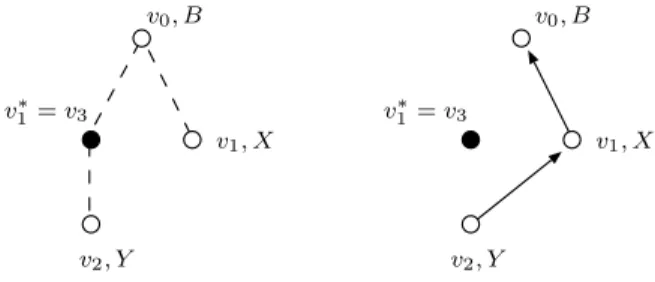
v0, B v1, X v2, Y v∗1=v3 v0, B v1, X v2, Y v∗1 =v3
Figure 3: A simple attack against ABEM. v0, v1,
and v2 are honest nodes with identifiersL(v0) = B,
L(v1) = X, and L(v2) = Y, whereas v∗
1 is an adver-sarial node. E1,0, E3,0, E2,3 are finite values, and E3,1 = E2,0 = E2,1 = ∞. Links are assumed to be symmetric, i.e.,Ei,j =Ej,i. The configuration is
il-lustrated on the left-hand side, where a dashed line denote a direct link. In the routing topology of the real-world model, on the right-hand side,v2setsXas its parent identifier, however,E2,1 =∞andE3,1=∞.
The configuration conf and the result of the attack is depicted on Figure 3. We assume that the base station broadcasts only a single beacon during the computational process, i.e., only a single beaconing interval is analyzed in our model. At the beginning, the base stationB floods the network by a beacon
B→ ∗ : msg′
1= (BEACON,rnd, B,sigB)
Both adversarial nodev∗
1 and honest nodeX receive this
beacon, and X sets B as its parent, since the verification
of the signature is successful. X modifies the beacon by re-placing sender identifierBtoX, and broadcasts the resulted beacon:
X → ∗ : msg′
2= (BEACON,rnd, X,sigB)
In parallel, v∗
1 modifies the beacon by replacing sender
identifierB toX, and broadcasts the resulted beacon:
v∗
1 → ∗ : msg
′
2= (BEACON,rnd, X,sigB)
Upon the reception ofmsg′
2, nodeY setsX as its parent,
sincesigB is correct.
In the real-world model, these actions result T2,1 = 1, which implies that FABEM(conf, T) = 0. On the contrary,
FABEM(conf, T′
) never equals to 0, whereT′
represents the routing topology in the ideal-world model. Let us assume that FABEM(conf, T′
) = 0, which means thatT′
1,2 = 1 or T′
2,1= 1. T
′
1,2 = 1 is only possible, ifX receives msg′3= (BEACON,rnd, Y,sigB)
However, it yields contradiction, since E3,1 = E2,1 = ∞,
and B never broadcastsmsg′
3. Similarly, if T
′
2,1 = 1 then Y must receivemsg′
2, which means thatv
∗
1 must broadcast msg′
2. Conversely,Bnever broadcastsmsg
′
2, andE3,1 =∞.
Therefore, v∗
1 can only broadcast msg
′
2, if he successfully
modifiesmsg′
1 or forgesmsg
′
2. However, it also contradicts
our assumption that the ideal-world adversary cannot mod-ify and inject messages in the ideal-world model.
4.
RELATED WORK
In [10], the authors map some adversary capabilites and some feasible attacks against routing in wireless sensor net-works, and they define routing security implicitly as resis-tance to (some of) these attacks. Hence, the security of sensor routing is only defined informally, and the counter-measures are only related to specific attacks. In this way, we even cannot compare the sensor routing protocols in terms of security. Another problem with this approach is the lack of a formal model, where the security of sensor routing can be de-scribed in a precise and rigorous way. While secure messag-ing and key-exchange protocols are classical and well-studied problems in traditional networks [3, 15], formal modelling of secure routing in sensor networks has not been considered so far. The adversarial nodes are also classified into the groups of sensor-class and laptop-class nodes in [10], but the capabilities of an adversarial node regarding message manipulations are not discussed.
The simulation paradigm is described in [15, 5]. These models were mainly proposed with wired networks in mind typically implemented on the well-known Internet architec-ture, and the wireless context is not focused there. In our opinion, the multi-hop nature of communications is an in-herent characteristic of wireless sensor networks, therefore, it should be explicitly modelled. In more particular, the broadcast nature of communication enables a party to over-hear the transmission of a message that was not destined to him, however, this transmission can be received only in a certain range of the sender. The size of this range is deter-mined by the power at which the sender sent the message. Another deviation from [15] is the usage of the security ob-jective function in the definition of security. In [15], the
indistinguishability is defined on the view of the honest par-ties (on their input, states, and output) in the ideal-world and in the real-world models. However, an adversary can distort the states of the honest parties in unavoidable ways, and hence, the classical definition would be too strong and no routing protocol would satisfy it. On the other hand, our model is compliant with [15] considering high-level con-nections between nodes. In [15], the standard cryptographic system allows us to define each high-level connection as se-cure (private and authentic), authenticated (only authen-tic), and insecure (neither private nor authentic). In this taxonomy, the communication channel between two honest nodes can be either insecure or secure in our model. If an adversarial node is placed in the communication range of one of the communicating nodes, then it is considered to be an insecure channel. If the adversary can reach none of the communicating nodes, the channel between that nodes is hidden from the adversary, and thus, it is considered to be secure.
Although some prior works [18, 12] also used formal tech-niques to model the security of multi-hop routing proto-cols, these ones were mainly proposed for ad hoc routing. Moreover, the model proposed in [12] is based on CPAL-ES, and the model in [18] is similar to the strand spaces model. Both of these formal techniques differ from the simulation paradigm.
Our work is primarily based on [4, 1]. Here, the authors also use the simulation paradigm to prove the security of routing protocols in wireless ad-hoc networks. However, our model differs from the models in [4, 1] in two ways:
• Adversary model: The adversary in [4] and [1] is as-sumed to have the same resources and communcation capabilities as an ordinary node in the network. There-fore, that adversary model deviates from the so-called Dolev-Yao model in [6]. In our work, the adversary also uses wireless devices to attack the systems, and it is reasonable to assume that the adversary can inter-fere with communications only within its power range. The adversarial nodes belonging to the sensor-class nodes has the same resources and communication ca-pabilities as an ordinary sensor node, but a more re-sourced adversarial node (e.g., laptops) may affect the overall communication of an entire part of the network depending on the power range of the resourced adver-sarial device. That resourced devices also make the adversary able to perform more sophisticated message manipulations.
• Modelling security objectives: In ad hoc networks, nodes contruct routes between a source and a destina-tion [13, 8], whereas sensor nodes should build a com-plete routing topology for the entire network. In case of sensor networks, the only destination for all nodes is the base station [9]. In addition, sensor nodes are re-source constrained, which implies that we also need to model the energy consumption of sensor nodes, since several attacks impacts the network lifetime. These differences from ad hoc networks has yielded a wide range of sensor applications, and thus, sensor rout-ing protocols [9] are much diverse than ad hoc routrout-ing protocols. Hence, the security objectives cannot be modelled uniformly for sensor routing protocols.
5.
CONCLUSION
In this paper, we proposed a formal security model for routing protocols in wireless sensor networks. Our model is based on the well-known simulation paradigm, but it differs from previously proposed models in several important as-pects. First of all, the adversary model is carefully adopted to the specific characteristics of wireless sensor networks. In our model, the adversary is not all-powerful, but it can only interfere with communications within its own radio range. A second important contribution is that we defined the output of the dynamic models that represent the ideal and the real operations of the system as a suitable function of the routing state of the honest nodes, instead of just using the routing state itself as the output. We expect that this will allow us to model different types of routing protocols in a com-mon framework. In addition, this approach hides the un-avoidable distortions caused by the adversary in the routing state, and in this way, it makes our definition of routing se-curity satisfiable. As an illustrative example, we considered an authenticated version of the TinyOS beaconing routing protocol, and we showed how an attack against this protocol can be represented in our formal model.
As we mentioned in the Introduction, this paper is a work-in-progress paper. In particular, we have presented nei-ther a new secure routing protocol designed with the help of our formal model, nor a detailed security proof carried out within our model. These are left for future study. We must note, however, that the generality of the simulation paradigm and the fact that we could represent a known attack against the authenticated TinyOS protocol in our model make us confident that we are on the right track.
6.
ACKNOWLEDGEMENTS
The work described in this paper is based on results of IST FP6 STREP UbiSec&Sens
(http://www.ist-ubisecsens.org). UbiSec&Sens
re-ceives research funding from the European Community’s Sixth Framework Programme. Apart from this, the Euro-pean Commission has no responsibility for the content of this paper. The information in this document is provided as is and no guarantee or warranty is given that the information is fit for any particular purpose. The user thereof uses the information at its sole risk and liability.
The work presented in this paper has also been partially supported by the Hungarian Scientific Research Fund (con-tract number T046664). The first author has been fur-ther supported by the HSN Lab. The second author has been supported by the Hungarian Ministry of Education (B ¨O2003/70).
7.
REFERENCES
[1] G. ´Acs, L. Butty´an, and I. Vajda. Provable Security of On-Demand Distance Vector Routing in Wireless Ad Hoc Networks. InIn Proceedings of the Second European Workshop on Security and Privacy in Ad Hoc and Sensor Networks (ESAS 2005), July 2005. [2] G. ´Acs, L. Butty´an, and I. Vajda. Provably Secure
On-demand Source Routing in Mobile Ad Hoc Networks. To appear in IEEE Transactions on Mobile Computing.
[3] M. Bellare, R. Canetti, and H. Krawczyk. A modular approach to the design and analysis of authentication
and key exchange protocols. InProceedings of the ACM Symposium on the Theory of Computing, 1998. [4] L. Butty´an and I. Vajda. Towards provable security
for ad hoc routing protocols. InProceedings of the ACM Workshop on Security in Ad Hoc and Sensor Networks (SASN), October 2004.
[5] R. Canetti. Universally composable security: A new paradigm for cryptographic protocols. InProc. 42nd IEEE Symposium on Foundations of Computer Science (FOCS), 2001.
[6] D. Dolev,and A. C. Yao. On the Security of Public Key Protocols.IEEE Transactions on Information Theory 29 (2), 1983.
[7] IEEE Standard for Information
technology—Telecommunications and information exchange between systems—Local and metropolitan area networks—Specific requirements. Part 15.4: Wireless Medium Access Control (MAC) and Physical Layer (PHY) Specifications for Low-Rate Wireless Personal Area Networks (LR-WPANs), 2003. [8] D. Johnson and D. Maltz. Dynamic source routing in
ad hoc wireless networks. InMobile Computing, edited by Tomasz Imielinski and Hank Korth, Chapter 5, pages 153–181. Kluwer Academic Publisher, 1996. [9] J. N. Al-Karaki and A. E. Kamal. Routing techniques
in wireless sensor networks: a survey.IEEE Wireless Communications, vol. 11, pp. 6-28, 2004.
[10] C. Karlof, D. Wagner. Secure routing in wireless sensor networks: attacks and countermeasures.Ad Hoc Networks, Vol. 1, 2003.
[11] Q. Li and J. Aslam and D. Rus. Hierarchical Power-aware Routing in Sensor Networks. In
Proceedings of the DIMACS Workshop on Pervasive Networking, May, 2001.
[12] J. Marshall. An Analysis of the Secure Routing Protocol for mobile ad hoc network route discovery: using intuitive reasoning and formal verification to identify flaws. MSc thesis, Department of Computer Science, Florida State University, April 2003.
[13] C. Perkins and E. Royer. Ad hoc on-demand distance vector routing. InProceedings of the IEEE Workshop on Mobile Computing Systems and Applications, pp. 90-100, February 1999.
[14] A. Perrig, R. Szewczyk, V. Wen, D. Culler, J. D. Tygar. SPINS: Security Protocols for Sensor Networks. InWireless Networks Journal (WINE), Volume 8, September 2002.
[15] B. Pfitzman and M. Waidner. A model for
asynchronous reactive systems and its application to secure message transmission. InProc. 22nd IEEE Symposium on Security & Privacy, 2001.
[16] S. Singh, M. Woo, and C. Raghavendra. Power-Aware Routing in Mobile Ad Hoc Networks. InProceedings of the Fourth Annual ACM/IEEE International Conference on Mobile Computing and Networking (MobiCom ’98), Oct. 1998.
[17] W. Xu, W. Trappe, Y. Zhang and T. Wood. The Feasibility of Launching and Detecting Jamming Attacks in Wireless Networks. In theProceedings of MobiHoc’05, May 2005.
[18] S. Yang and J. Baras. Modeling vulnerabilities of ad hoc routing protocols. InProceedings of the ACM
Workshop on Security of Ad Hoc and Sensor Networks, October 2003.