World Bank & Government of The Netherlands funded
Training module # WQ - 06
Understanding
Table of contents
Page1
Module context
2
2
Module profile
3
3
Session plan
4
4
Overhead/flipchart masters
5
5
Evaluation
21
6
Handouts
23
7
Additional handouts
27
8
Main text
30
1 Module context
This module is a stand-alone module and no prior training in other modules is needed to complete this module successfully. It discusses basic concepts of hydrogen ion concentration in water. Other available, related modules in this category are listed in the table below.
While designing a training course, the relationship between this module and the others, would be maintained by keeping them close together in the syllabus and place them in a logical sequence. The actual selection of the topics and the depth of training would, of course, depend on the training needs of the participants, i.e. their knowledge level and skills performance upon the start of the course..
No. Module title Code Objectives
1 Basic water quality concepts WQ -01 • Discuss the common water quality parameters
• List important water quality issues 2 Basic chemistry concepts WQ -02 • Convert units from one to another
• Discuss the basic concepts of quantitative chemistry
• Report analytical results with the correct number of significant digits.
3 How to prepare standard solutions
WQ -04 • Select different types of glassware
• Use an analytical balance and maintain it.
• Prepare standard solutions. 4 How to measure the pH of a
water sample
WQ -07 • Measure the pH of a water sample
• Observe the effect of dissolved gasses on pH
2 Module profile
Title:
Understanding hydrogen ion concentration (pH)
Target group
:
HIS function: Q1, Q2, Q3, Q5Duration
:
1 session of 90 minutesObjectives
:
After training, the participants will be able to:• Discuss about the concept of pH
• Calculate pH
Key concepts
:
• Hydrogen ion concentration• pH scale
• Buffer solution
Training methods
:
Lecture, discussion and exercisesTraining tools
required
:
OHS, flip chart
Handouts
:
As provided in this moduleFurther reading
:
• Analytical Chemistry: An introduction, D.A. Skoog and D. M. West/1986. Saunders College Publishing• Chemistry for Environmental Engineering, C.N. Sawyer, P.L. McCarty and C.F. Parkin. McGraw-Hill, 1994
3 Session plan
No Activities Time Tools
1 Preparations 2 Conceptof pH
Introduce the subject
Ask participants to state the importance of hydrogen ion concentration
Define and explain pH
Explain dissociation of water molecule, equations and pH scale.
10 min
OHS
3 Calculations
Demonstrate how to calculate pH for given concentrations of H+ & OH- ions.
25 min
OHS Board
4 pHindicators
Explain the table for different indicators Explain the features of pH indicators.
10 min
OHS
5 pH meter
Describe the working principle of pH meter Explain how to take care of electrodes.
15 min
OHS
6 Buffer solutions & instrument calibration
Define buffer solution and its significance
Explain how to prepare buffer solutions of known pH values
Explain how to calibrate the instrument.
15 min
OHS
7 Questions
Ask the participants for answers to questions listed in text section 8.7 orally
Explain the answers one by one
15 min
4 Overhead/flipchart masters
OHS format guidelines
Type of text
Style
Setting
Headings: OHS-Title Arial 30-36, Bold with bottom border line (not:
underline)
Text: OHS-lev1
OHS-lev2
Arial 26,
Arial 24, with indent maximum two levels only
Case: Sentence case. Avoid full text in UPPERCASE.
Italics: Use occasionally and in a consistent way
Listings: OHS-lev1
OHS-lev1-Numbered
Big bullets.
Numbers for definite series of steps. Avoid roman numbers and letters.
Colours: None, as these get lost in photocopying and
some colours do not reproduce at all.
Formulas/ Equations
OHS-Equation Use of a table will ease alignment over more lines (rows and columns)
Use equation editor for advanced formatting only
Hydrogen ion concentration – pH
1. The concept
2. pH scale
3. pH concentration
4. Calculating pH
5. pH indicators
6. pH meter
7. Buffer solution
1.The concept
•
Dissociation of water
H
2
O
⇔
H
+
+ OH
-•
For pure water
[H
+
] = 10
-7
moles/L
[ ] denotes moles/L
•
pH = - log[H+]
pH scale
•
[H
+
] X [OH
-
] always equals 10
-14
•
log [H
+
] + log [OH
-
] = -14
•
pH scale
Acid
Neutral
Alkaline
H
+
concentration
Concentration of H
+
can be changed
H
2
SO
4
2H
+
+ SO
4
2-FeCl
3
+ 3H
2
O
Fe(OH)
3
+
3H
+
+ 3Cl
-Calculating pH: example
Calculate the pH if [H
+
] = 0.001
pH
= - log [H
+
]
= - log [0.001]
= - log 10
-3
= - (-3) log 10
= 3 x 1
=
3
Calculating pH: example
Calculate the pH if [OH
-
] = 10
-8
[H
+
]
X
[OH
-
]
= 10
-14
or
[H
+
]
X
10
-8
= 10
-14
or
[H
+
]
=
10
-14
÷
10
-8
=
10
-6
pH
=
- log [H
+
]
=
- log 10
-6
Calculating pH: example
Calculate the pH if [OH
-
] = 0.00005
log [OH
-
] = log(5x10
-5
)
=
0.7 - 5
= - 4.3
log [H
+
]
+
log [OH
-
]
= - 14
pH indicators: features
•
Colour changes over a wide range of pH values
•
Interference due to colour of sample
pH indicators: properties
Indicator
Acid colour Base colour
pH range
Methyl orange
red
yellow orange
3.1 – 4.6
Methyl red
red
yellow
4.4 – 6.2
Litmus
red
blue
4.5 – 8.3
Thymol blue
yellow
blue
8.0 – 9.6
pH meter: features
•
Consists of potentiometer, glass electrode, reference
electrode
•
Temperature compensation devise
•
Measures potential difference
•
Meter indicates pH value or milli volts
pH meter: types of electrodes
•
Glass electrodes
pH meter: maintenance
Glass electrode
•
Do not scratch
•
Immerse in pH 4.0 buffer, for short term storage
pH meter: calibration
•
Calibration
−
Use two buffer solutions
Buffer solutions
•
Known pH
•
Mixtures
−
weak acids & their salts
−
weak bases & their salts
•
Dilution does not change pH
•
Resist change of pH upon addition of small amount of acid
Buffer solutions: preparation
Buffer solution of known pH
Buffer solution
pH
at
25
o
C
Amount of salts to be dissolved in
1000 ml freshly boiled & cooled
distilled water
1 0.05M potassium hydrogen
phthalate
4.00 10.12 g KHC
8
H
4
O
4
2 0.025M potassium dihydrogen
phosphate +
0.025M disodium hydrogen
phosphate
6.86
3.387 g KH
2
PO
4
+
3.533 g Na
2
HPO
4
Questions
1. What is the relationship between pH and H
+and between pH and OH
-?
2. What will be the pH of a solution containing 0.1008 g of hydrogen ion per litre?
3. What electrodes are used for pH measurement?
4. What is the normal range of pH of natural waters?
Hydrogen ion concentration – pH
1. The concept
2. pH scale
3. pH concentration
4. Calculating pH
5. pH indicators
6. pH meter
7. Buffer solution
The concept
•
Dissociation of water
H
2O
⇔
H
++ OH
-•
For pure water
[H
+] = 10
-7moles/L
[ ] denotes moles/L
•
pH = - log[H
+]
•
For pure water pH = 7
pH scale
•
[H
+] X [OH
-] always equals 10
-14•
log
[H
+] + log [OH
-] = -14
•
pH
scale
Acid
Neutral
Alkaline
1
2
3
4
5
6
7
8
9
10
11
12
13
14
H
+concentration
Calculating pH: example
Calculate the pH if [H
+] = 0.001
pH
=
- log [H
+]
=
- log [0.001]
=
- log 10
-3=
- (-3) log 10
=
3 x 1
=
3
Calculate the pH if [OH
-] = 10
-8[H
+]
x
[OH
-]
=
10
-14or
[H
+]
x
10
-8=
10
-14or
[H
+]
=
10
-14÷
10
-8=
10
-6pH
=
- log [H
+]
=
- log 10
-6=
6
Calculate the pH if [OH
-] = 0.00005
log [OH
-]
=
log(5x10
-5)
=
0.7 - 5
=
- 4.3
log [H
+]
+
log [OH
-]
=
- 14
or
log [H
+]
=
- 14 + 4.3
=
- 9.7
pH
=
- log [H
+]
=
9.7
pH indicators:
features
•
Colour changes over a wide range of pH values
•
Interference due to colour of sample
•
Interference due to turbidity of sample
Properties:
Indicator
Acid colour
Base colour
pH range
Methyl orange
red
yellow orange
3.1 – 4.6
Methyl red
red
yellow
4.4 – 6.2
pH meter: features
•
Consists of potentio meter, glass electrode, reference electrode
•
Temperature compensation device
•
Measures potential difference
•
Meter indicates pH value or milli volts
•
Accuracy
of
±
0.01 pH
Types of electrodes
•
Glass
electrodes
•
Calomel
electrodes
Maintenance: glass electrode
•
Do not scratch
•
Immerse in pH 4.0 buffer, for short term storage
•
Soak in water for 12 h before pH measurement
Calibration
•
Use two buffer solutions
•
Use a second buffer within 2 pH units of the sample pH
Buffer solutions
•
Known
pH
•
Mixtures
−
weak acids & their salts
−
weak bases & their salts
•
Dilution does not change pH
•
Resist change of pH upon addition of small amount of acid or alkali
Preparation: Buffer solution of known pH
Buffer solution
pH
at 25
oC
Amount of salts to be dissolved in
1000 ml freshly boiled & cooled
distilled water
1
0.05M
potassium hydrogen
phthalate
4.00
10.12 g KHC
8H
4O
42
0.025M
potassium dihydrogen
phosphate +
0.025M
disodium hydrogen
phosphate
6.86
3.387 g KH
2PO
4+
3.533 g Na
2HPO
47 Additional handouts
These handouts are distributed during delivery and contain test questions, answers to questions, special worksheets, optional information, and other matters you would not like to be seen in the regular handouts.
It is a good practice to pre-punch these additional handouts, so the participants can easily insert them in the main handout folder.
8 Main text
Page 1. General 1 2. The pH scale 1 3. Calculating pH 2 4. pH indicators 2 5. pH meter 3Understanding hydrogen ion
concentration (pH)
1. General
pH is a way of expressing the hydrogen ion concentration in water. It is related to the acidic or alkaline nature of water. Consideration of hydrogen ion concentration is important in almost all uses of water. In particular, pH balance is important in maintaining desirable aquatic ecological conditions in natural waters. pH is also maintained at various levels for efficient operation of water and wastewater treatment systems such as coagulation, disinfecting, softening, anaerobic decomposition of wastes, etc. The pH of most natural waters lies between 6.5 and 8.
2. The pH scale
Pure water dissociates to yield 10-7 moles/L of H+ at 25 °C:
H2O ⇔ H+ + OH- (1)
Since water dissociates to produce one OH- ion for each H+ ion. It is obvious that 10-7 OH
-ions are produced simultaneously.
The product of [H+] and [OH-] always remains constant even if the value for one of the
species changes
[H+] x [OH-] = 10-14 (2)
The large bracket sign, [ ], indicates molar concentration.
The concentration of H+ ions can be increased when compounds are added which release
H+ ions such as H 2SO4:
H2SO4→ 2H+ + SO42- (3)
Or preferentially combine with OH- ions when added to water, such as FeCl 3:
FeCl3 + 3H2O → Fe(OH)3 + 3H+ + 3Cl- (4)
Note that in either case the product of [H+] and [OH-] ions remains constant at 10-14.
Likewise the concentration of H+ ions can be decreased when compounds are added which
release OH- ions, such as NaOH, or preferentially combine with H+ ions, such as Na 2CO3.
pH = - log [H+] (5)
or [H+] = 10 –pH (6)
Thus the pH value of a sample of water containing 10-7.5 moles/L H+ is 7.5.
Since the product of [H+] and [OH-] is always a constant, Eq. (2) becomes
log[H+] + log[OH-] = -14
or -log[H+] - log[OH-] = +14 (7)
The pH scale is usually represented as ranging from 0 to 14, with pH 7 at 25 °C representing neutrality. Acid conditions increase as pH values decrease and alkaline conditions increase as pH values increase.
Acid range
Neutral
Alkaline range
1
2
3
4
5
6
7
8
9
10
11
12
13
14
3. Calculating pH
Example calculationCalculate the pH value for the following cases: A: [H+] = a. 0.001 b. 0.00005 and B: [OH-] = a. 10-8 b. 0.00005 c. 0.00001 A:[H+] a. 0.001 pH = -log 10-3 = 3 b. 0.00005 pH = -log 0.00005 = -log(5x10⁻⁵) = -0.7 + 5 = 4.3 B: [OH-] a. 10-8 [H+] x 10-8 = 10-14, or [H+] = 10-6 Therefore pH = 6 b. 0.00005 –log[H+] - log[OH-] = 14 Therefore pH = 14 – 4.3 = 9.7 c. 0.00001 pH = 14 + log 10-5 = 14 –5 = 9.
4. pH indicators
Table 1
Indicator Acid colour Base colour pH range
Methyl orange Red Yellow orange 3.1 – 4.6
Methyl red Red Yellow 4.4 – 6.2
Litmus Red Blue 4.5 – 8.3
Thymol blue Yellow Blue 8.0 – 9.6
Phenolphthalein Colourless Pink 8.2 – 9.8
Alizarin yellow Yellow Lilac 10.1 – 11.1
5. pH meter
The use of colour indicators for pH measurements has, to some extent, been superseded by development of glass electrode. pH meters employing glass-indicating electrodes and saturated calomel reference electrodes are now commonly used. Such meters are capable of measuring pH within ± 0.1 pH unit. The electrodes, connected to the pH meters are immersed in the sample and the meter measures the potential developed at the glass electrode due to hydrogen ion concentration in the sample and displays it directly in pH units. The pH meters are also equipped with a temperature-compensation adjustment.
The electrodes should be carefully handled and should not be scratched by butting against the sides of the beaker containing the sample. Follow the manufacturer’s instructions for their care during storage and use. For short-term storage, the glass electrode may be left immersed in pH 4 buffer solution., Saturated KCl is preferred for the reference electrode. The glass electrode needs to be soaked in water for at least 12 hours before it is used for pH measurement.
Buffer solutions & instrument calibration
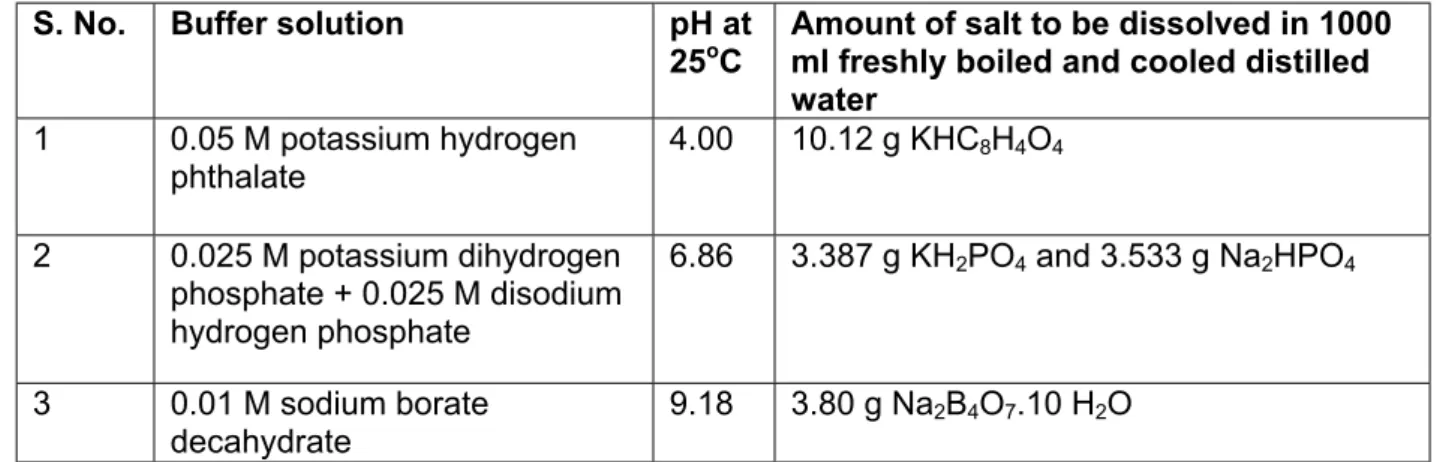
pH meters have to be calibrated against solutions of known pH values. Standard buffers are used for this purpose. Buffers are solutions of chemicals of known pH which do not change their pH value upon dilution and resist change of pH when small amounts of acid or alkali are added to them. Buffer solutions usually contain mixtures of weak acids and their salts (conjugate bases) or weak bases and their salts (conjugate acids). Buffer has importance for life forms that usually can survive only within a narrow pH range. Table 2 gives the composition of some commonly used buffers. Buffers of different pH values are also available commercially.
Table 2 Buffer solutions of known pH
S. No. Buffer solution pH at
25oC Amount of salt to be dissolved in 1000ml freshly boiled and cooled distilled
water 1 0.05 M potassium hydrogen phthalate 4.00 10.12 g KHC8H4O4 2 0.025 M potassium dihydrogen phosphate + 0.025 M disodium hydrogen phosphate 6.86 3.387 g KH2PO4 and 3.533 g Na2HPO4 3 0.01 M sodium borate decahydrate 9.18 3.80 g Na2B4O7.10 H2O
It is a good practice to calibrate the pH meter using two buffers. After calibrating with an initial buffer, use a second buffer within 2 pH units of the sample pH.