Best Practice Document
Improving DNS Reliability and Security
Produced by the RENATER-led working group on Secure DNS Authors: J. Benoit (Université de Strasbourg/GIP RENATER), O. Prins (CNRS/GIP RENATER)
© GIP RENATER 2013 © TERENA 2010. All rights reserved. Document No: GN3plus-NA3-T2-R6.1
Version / date: V1.0, 3 December 2013 Original language : French
Original title: « FIABILISATION ET SECURISATION DU DNS » Original version / date: V1.0, 3 December 2013
Contact: cbp @listes.renater.fr
RENATER bears responsibility for the content of this document. The work has been carried out by a RENATER led working group on DNS as part of a joint-venture project within the HE sector in France.
Parts of the report may be freely copied, unaltered, provided that the original source is acknowledged and copyright preserved.
The research leading to these results has received funding from the European Community's Seventh Framework Programme (FP7/2007-2013) under grant agreement n° 605243, relating to the project 'Multi-Gigabit European Research and Education Network and Associated Services (GN3plus)'.
NA3 Best Practice Document:
Improving DNS Reliability and Security iii
Table of Contents
Executive Summary 1
2 General advice 2
2.1 Context 2
2.2 Sensitivity of service to hierarchical dependencies 2
2.3 Isolation of roles of recursive resolution and authoritative server 2
2.4 Isolation of public and private zones 2
2.5 Multiple NS slaves 3
2.6 Hosting NSs on different networks 3
2.7 Hosting NSs on different geographic sites 3
2.8 Choice of an appropriate value for the TTL 4
2.9 Synchronisation of private zones on internal resolvers 4
2.10 Mixing operating systems and server types to increase resilience 4
2.11 Virtualisation 4
2.12 Separation of service and administration IP addresses 5
2.13 Server security and filtering policy 5
2.14 Chroot and restriction of privileges 5
2.15 Naming policy 5
3 Zone management 6
3.1 Zone registration and administrative management 6
3.1.1 Choice of TLD 6
3.1.2 Choice of registrar 6
3.1.3 Whois: Information transmitted by TLDs 6
3.1.4 Creation and monitoring of domain 6
3.1.5 Administrative domain transfer 7
3.2 Architecture of authoritative servers 7
3.2.1 “Stealth” or “hidden” master server 7
3.2.2 Restriction of zone transfers by IP and/or TSIG and dynamic updates 8
3.2.3 Views and split-DNS 9
3.3 Management/Supervision 10
3.3.1 Manual zone management 10
3.3.2 “Industrial” approach 12
3.3.3 Breaking up configuration files 12
3.3.4 Breaking up logs 13
3.3.5 Monitoring zone delegations 13
4.1 Reminder of recursive resolution and the server cache 14
4.2 Resolver and non-official slave (stealth) for local zones 15
4.3 Increasing reliability of DNS resolution service 16
4.3.1 Client reconfiguration 16
4.3.2 DNS Anycast 17
4.3.3 Redundancy protocol (VRRP, Heartbeat, etc.) 18
4.3.4 Problems of open resolvers 18
4.4 Resolver and private zones 20
4.5 Activation of DNSSEC validation on resolver 20
5 DNSSEC 21
5.1 Risks 21
5.1.1 Risks of expiry 21
5.1.2 Risk of compromise of keys 21
5.1.3 Risk of zone inaccessibility 21
5.2 DNSSEC implementation 22
5.3 Key rotation 22
6 Email: dependence on DNS 23
6.1 Avoidance of “phishing” 23
6.2 Publication of authoritative SMTP servers 23
6.3 Email domain signature 23
6.4 Use of local resolvers on SMTP servers 24
7 Summary of recommendations 25
Appendix A Some DNS parameters 26
A.1 Description of TTLs 26
A.1.1 Zone default TTL 26
A.1.2 SOA record TTLs 26
A.2 Reinitialisation of serial number by "overflow" (RFC1982) 27
A.3 Checking resolver EDNS compatibility (RFC2671) 28
A.4 Timeout periods during BIND resolution 29
NA3 Best Practice Document:
Improving DNS Reliability and Security v
Table of Figures
Figure 3.1: Stealth or Hidden DNS master 8
Figure 4.1: Recursive resolution of a DNS request 15
Figure 4.2: DDOS by DNS amplification attack 19
Table of Tables
Executive Summary
The DNS (Domain Name System) service is an essential component of IT architecture. During inter-machine exchanges, almost all processes make reference, not to IP addresses directly, but to names. If the conversion of names into IP addresses performed by the DNS was no longer guaranteed, all of these services would become inoperative. The same occurs for other information made available by the DNS, particularly reverse resolution, email zone relays and a growing amount of other functional information (via the TXT or SRV fields). In addition, DNS is destined to become an essential authoritative reference data provider thanks to the deployment of Domain Name System Security Extensions (DNSSEC), which ensures the integrity of the source. Making HTTPS certificates available autonomously via DANE (TLSA record) for example, unlike X509 certificates which require the involvement of third-party certification authorities.
The critical nature of the DNS and its extension to new sensitive duties make the DNS a target of choice for attacks. Its reliability and security must therefore be rigorously guarded. This document is intended to be a guide to best practice in enhancing the resilience of your DNS service.
NA3 Best Practice Document:
Improving DNS Reliability and Security
2
General advice
2.1
Context
The first section of this document will review the most important basic concepts of DNS. The following terms are used:
“NS” (Name Server) for DNS server. “Master NS” for primary name server. “Slave NS” for secondary name server.
2.2
Sensitivity of service to hierarchical dependencies
It must be noted that DNS architecture relies on a strict hierarchy. Any failure in a parent node jeopardises the resolution of a daughter zone. In the case of a top-level zone, this is not a problem because the name servers for root and top-level domains (com, net, org, etc). are based on highly redundant architectures at the international level, and are generally very reliable. For the levels below TLDs, the parent zone linked to offers must be at an elevated level of resilience.
2.3
Isolation of roles of recursive resolution and authoritative
server
It is highly recommended to compartmentalise the roles of authoritative server and recursive resolution server on discrete physical platforms.
2.4
Isolation of public and private zones
In the same way, authoritative servers for public zones and authoritative servers for private zones must be compartmentalised. These areas have very distinct purposes and opposing security needs:
Public zones are intended to be visible to the entire Internet, to guarantee the accessibility of the services that depend on them (web server, email, etc.).
Private zones contain internal addresses that are only of interest to internal clients.
Separating the data of public zones and private zones, and isolating access to these private zones at the network level guarantees that sensitive information such as internal network architecture, addressing plans, server names, etc. will not be disclosed externally:
Of course, the security that results from this obscurity is not a sufficiently effective measure; the first and foremost effective measure to protect the internal network is filtering at the network periphery by a firewall. However, isolation of public and private zones, as an addition to the principal measure, is a marginal contribution to the security level of the internal network.
2.5
Multiple NS slaves
In order to ensure the continuity of the service when the master NS fails, it is vital to provide slave Name Servers (NSs) in order to distribute the service across several NSs. The best recommended practice is to have at least three NSs (i.e. one master and two slaves).
To increase resilience, it is recommended to set up secondary servers, on both discrete IP networks and distinct sites.
It is customary to request hosting of a slave server from a partner, while offering to host the slave server of the partner as a mutual courtesy.
Communities can formalise a slave-server hosting agreement. It is very important to provide communication channels between the administrators of the master server and those of the slave server.
It is essential to be mindful of the risks presented by slave servers that are no longer authoritative. It can happen that the administrator of the master server deletes the slave from the list of slaves to be notified when there is a change, or from the list of servers authorised to transfer zones.
In this case, there is a risk that the slave server will continue to serve out-of-date data for a time. It is essential that the administrators of the master server provide notification of any change.
2.6
Hosting NSs on different networks
To improve resilience, for example in the event of the failure of one NS or a DoS attack, it is essential to host the NSs on different networks. This allows interconnection capacities to be improved (DoS attack) and for redundancy if one of these networks fails.
NA3 Best Practice Document:
Improving DNS Reliability and Security 4
2.8
Choice of an appropriate value for the TTL
The validity period – Time To Live (TTL) – of the zone records is chosen based on the following parameters: The redundancy level of the DNS architecture: the TTL must be greater than the estimated duration
of DNS service interruptions.
The load: the lower the TTL, the more frequently the DNS will be queried (this is specific to sites with high traffic).
Responsiveness when the zone is changed: the TTL must be lower than the desired expiry period for records in the resolver caches. For example, when the IP address of the web server changes; if the TTL is set at 24 hours, the old IP address must continue to function for one day before it can be deleted.
The risk of cache poisoning: the higher the TTL, the lower the risk of cache poisoning. The most common TTL values are between 3600 and 86400 seconds.
Care has to be taken to mitigate the negative cache effects associated with TTL. In fact, the resolver caches not only the records found, but also the responses indicating the non-existence of a record. This data is retained in the cache for between several minutes and several hours. For example, when a record is being modified, if there is a period of time during which the record does not exist (between the moments it is deleted and recreated), there is a risk that a resolver will cache the negative response.
2.9
Synchronisation of private zones on internal resolvers
In order to avoid zone update latencies associated with TTL, it is advisable to declare its zones as slaves on internal resolvers. These slave zones are not publicly accessible. They are used only to get active notification from the master NS (“notify-also” clause under BIND). This point is discussed in more detail in section 6.2.
2.10
Mixing operating systems and server types to increase
resilience
The use of different operating systems distributions (for example Debian Linux, RedHat Linux, OpenBSD or FreeBSD for example) and different DNS servers (ISC BIND or NSD for example) mitigates the risk of attacks by relying on a larger variety of system behaviours. This avoids being exposed to a single vulnerability that could be exploited globally.
2.11
Virtualisation
There is no reason not to host NSs on a virtualised infrastructure. To avoid the risk of circular dependency, it is nonetheless necessary to ensure that the virtualisation platform (the host) does not rely on DNS resources
published by the virtual machine (especially for private networks). It is advisable to keep at least one physical NS, whether master or slave.
2.12
Separation of service and administration IP addresses
The NS must have a dedicated IP address for administration (SSH access, supervision, remote monitoring of name server etc.) and another IP address dedicated to the DNS service, on another physical or virtual interface (possibly a loopback interface). This allows the administration of the server to be separated from access to the service, and enables different redundancy techniques (VRRP, Anycast etc.).
2.13
Server security and filtering policy
On a public server, only port 53 in TCP and UDP must be accessible from the Internet. No other service should run on the servers apart from the DNS. It is essential to keep the name server software up-to-date, to apply security patches and to limit access to this server.
2.14
Chroot and restriction of privileges
It is recommended that the DNS service be chrooted in a dedicated directory tree in order to limit the scope of the exploitation of a security flaw.
In addition, the server should not be run under a user with administration rights (“root” or “Administrator”). To restrict these privileges, it must run under the identity of a user with a minimum of privileges created specifically for that purpose (for example, a “named” user).
BIND example; starting the process under the “named” user in the chroot directory “/var/named”: /usr/sbin/named -u named -t /var/named
For further information, see “BIND Security consideration” in the [BIND_ARM].
2.15
Naming policy
Data served by DNSs is public by nature. Ensure the absence of any sensitive data that could facilitate attacks. In addition, it is recommended that a naming policy be defined and applied.
NA3 Best Practice Document:
Improving DNS Reliability and Security
3
Zone management
3.1
Zone registration and administrative management
3.1.1
Choice of TLD
As DNS functions hierarchically, the choice of a domain extension is not neutral. Specifically, Top Level Domains (TLDs) do not have a uniform level of reliability. It is best to avoid “exotic” extensions.
3.1.2
Choice of registrar
Different registrars have widely varying qualities of service. Attention must be paid to the quality, flexibility and responsiveness of update procedures (an online management interface with an API is ideal). For a top-level zone, any NS change requires the creation of a request to the registrar to change the zone delegation vis-à-vis the TLD.
3.1.3
Whois: Information transmitted by TLDs
TLDs transmit administrative and technical information regarding DNS zones via the Whois service, in particular the owner, technical contacts and list of NSs. This information is purely indicative. It is not required for the NSs to correspond to the NSs that actually have delegation. This has no practical consequences. Nevertheless, it is preferable that Whois data is kept up-to-date by the registrar.
3.1.4
Creation and monitoring of domain
In order to limit the risks of cybersquatting, it is advisable to register variations of the name (example: mydomain.com, my-domain.com, etc.) and also under different TLDs (example: mydomain.com, mydomain.net, mydomain.org etc.)
The domain information, and in particular its expiry date, must be checked regularly using Whois and the contract must be renewed to prevent domain expiry. It is recommended that monitoring and/or renewal be automated if possible.
3.1.5
Administrative domain transfer
When registering a domain, ensure that you are properly declared as the administrative owner of the domain, particularly if you acquire it through a third party such as a web agency. Where appropriate, only the owner will be able to initiate the transfer or migration of the domain. Care should also be taken to designate a legal person as owner and not a physical person who may move on.
3.2
Architecture of authoritative servers
The master server is particularly sensitive. If it is compromised and if the zones over which it is authoritative are modified, after a certain period of time, all slave servers and cache servers will eventually get and serve the modified information. Similarly, all clients performing a resolution will have the modified information. This modified information will remain until the zone is corrected and after expiration of the associated TTL. The server must be secured as described in section 2.14
3.2.1
“Stealth” or “hidden” master server
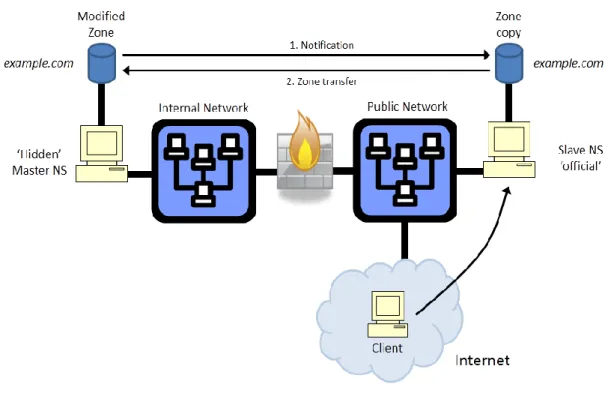
It is possible to isolate the master server in a “stealth master DNS” or “hidden master DNS” architecture: the master server on which the zones are modified is never accessible nor externally visible. The official master server, the name of which is mentioned in the SOA, is in reality a slave server that synchronises its zones from the hidden master server. Each time a zone is modified on the hidden master, the slaves are notified.
NA3 Best Practice Document:
Improving DNS Reliability and Security 8
Figure 3.1: Stealth or Hidden DNS master
In addition, the use of several slave servers is recommended. As indicated above, the recommended minimum is two slave servers. It is entirely possible to set up three or more slave servers, preferably on different sites or networks, in order to distribute the load. In this way, in the event of network or server failures, whether accidental or linked to an attack, the other slave servers are always available to respond to external requests. Take care not to configure too many name servers, as the response to the DNS request must ideally remain below 512 bytes in User Datagram Protocol (UDP) - certain firewalls filter DNS EDNS0 extensions [RFC1035, § 2.3.4 & RFC2671].
3.2.2
Restriction of zone transfers by IP and/or TSIG and dynamic updates
Activation of notifications is recommended so that zone updates between master and slaves are as fast as possible.
Example for BIND: notify yes;
The default behaviour in BIND is to notify all servers registered as NS records in the zone file.
A master NS may only authorise zone transfers (AXFR or IXFR) to its own NS slaves (“allow-transfer” directive in BIND). It is important to restrict zone transfers on all servers, whether master or slave.
Example (BIND) : options {
allow-transfer { 192.0.2.1 } }
In order to check the identity of the NSs during zone transfers, it is advisable to set up a Transaction SIGnature (TSIG) symmetrical signature [RFC2845]. This requires setting up a key on the master and slave servers and the configuration of the servers to sign zone transfers with this key.
Note: Clock synchronisation on all name servers is vital; this is usually done with Network Time Protocol (NTP).
In addition, dynamic updates should be prohibited. Normally, they are prohibited by default in BIND. Ensure there are no directives authorising them in the configuration. Authorising an IP address to perform dynamic updates is extremely dangerous. If this functionality is really necessary, TSIG must be used to authenticate the dynamic updates.
Example of TSIG configuration in BIND’s named.conf file: key "tsig_001." { algorithm "hmac-md5"; secret "IaPUtN3x+xxxxxxxxxxxxxxxxxxxxxxxxxxxxxxxxxxxxxxxxxxxxxxxxx...xxxxxS4g=="; }; server 198.51.100.1 { keys { tsig_001.; }; }; server 2001:DB8::ABCD:ABCD:1 { keys { tsig_001.; }; };
3.2.3
Views and split-DNS
The principle of separating public and private zones is implemented using either views, or an architecture known as “SplitDNS”.
It is possible to create different views for different clients. Depending on their IP address, each client will see different records. For example, for the “example.com” zone, internal clients will see all workstations, printers and internal servers displayed in the internal view, and external clients will see only the public web server and mail relay.
NA3 Best Practice Document:
Improving DNS Reliability and Security 10
view “external” {
match-clients { any; }; zone “example.com” { type master;
file “external/example.com”; # only contains “www” and “mail” }
}
The use of views presents operational risks. As different responses are received depending on source IP address, this can introduce problems that do not exist in the normal operation of the DNS and can complicate debugging. It is recommended that security risks and gains are properly evaluated before choosing to implement DNS views.
3.3
Management/Supervision
Two approaches exist for the management of zone content.
3.3.1
Manual zone management
Manual management of configuration files is recommended for zones with few entries and/or few updates. This solution could also be considered for more complex zones if a rigorous approach is taken to formatting the files. Specifically:
Systematic update of the file header. Listing in strict alphabetical order.
○ In the case of multi-level entries indent properly so that the parent record is obvious.
Tool-based syntactical check (in BIND, reloading a faulty file does not generate an error) => see example script in appendix:
○ named-checkconf for configuration files. ○ named-checkzone for zone files.
Verify that the value of the Serial field is indeed being incremented (or increment the value by a script).
Example in BIND:
;--- START OF FILE --- ; Zone example.fr
;--- ; 20130701 pdupond : update "web" from 203.0.113.1 to 203.0.113.2
; 20130627 pdupond : create zone
;--- ; TTL by default
$TTL 3600
;--- ROOT --- $ORIGIN example.com.
; Master server Technical mail contact
@ IN SOA ns1.example.com. dnsmaster.example.com. ( 2013070101 ; Version 21600 ; Refresh (6h) 3600 ; Retry (1h) 3600000 ; Expire (1000h) 3600 ; Negative caching TTL (1h) )
; Master and slave server(s)
IN NS ns1.example.com. IN NS ns2.example.com. IN NS ns3.example.com. ; Email IN MX 0 smtp1.example.com. IN MX 0 smtp2.example.com. IN TXT "v=spf1 mx mx:smtprelay.example.com ~all" ; Microsoft Office 365 IN TXT "MS=ms12345678" ;--- COLLE --- ; The NS addresses under example.com
;--- ns1 IN A 192.0.2.1 IN AAAA 2001:DB8:1234:1234:1234:1 ns2 IN A 198.51.100.1 IN AAAA 2001:DB8:ABCD:ABCD:ABCD:1 ns3 IN A 203.0.113.1 IN AAAA 2001:DB8:CDEF:CDEF:CDEF:1 ns1.branchoffice IN A 192.0.2.200 ns2.branchoffice IN A 198.51.100.200 ns3.branchoffice IN A 203.0.113.200 ;--- ; DECLARATION OF ENTRIES ;--- ; Alphabetic order on the top level (ex: xxx.yyy is sorted on yyy).
; The delegated zones are mixed with the non-delegated zones. ; Any "www." is ignored
; Separator: tab (except between MX and its weighting: use a space).
;---
abc IN CNAME web
branchoffice IN NS ns1.branchoffice
IN NS ns2.branchoffice
IN NS ns3.branchoffice
test IN CNAME web
www.test IN CNAME web
list.test IN CNAME web
www.list.test IN CNAME web
intranet.test IN CNAME web
www.intranet.test IN CNAME web
NA3 Best Practice Document:
Improving DNS Reliability and Security 12
3.3.2
“Industrial” approach
Alternatively, it is possible to manage the set of DNS information in a database external to the name server. Both free and commercial tools are available for this purpose, e.g. IPAM (IP Address Management), allowing for the maintenance of a DNS data reference framework: domain names, machine names, sub-nets, IP addresses, etc. These tools offer several advantages:
Data consistency. For example, type A records, associating an address to a name, will always have their opposite, a symmetric pointer to a canonical name (PTR) record.
Integrated management of other infrastructure services: DHCP, mail routing.
Possibility of delegating the administration: it is possible to give finely-grained rights to other administrators via a web interface.
Decoupling of the data and the name server: it is possible to change the way records are stored without depending on the ISC BIND zone file format. Also, migration to another server simply involves a modification of the zones generation scrip.
Automation of some tasks. For example, import and export to other formats, mass declaration or renaming.
Systematic application of policies. For example, it is possible to verify during input whether the names entered are consistent with a defined naming scheme (for workstations, router interfaces etc.). These tools also present a certain number of risks:
Greater complexity, and thus difficulties with debugging, due to dependencies between different elements: generation tools, web interface, user authentication, database, etc.
If there is a security flaw in the tool, whether in the web interface, the authentication or the generation, it is possible to modify the zones.
It is recommended that the zone management tool be secured with measures such as filtering at the server network level and access control.
3.3.3
Breaking up configuration files
When a large number of zones are hosted, it is advisable to break up the configuration into different files to be included into the main file (“named.conf” in BIND). This provides greater visibility and facilitates maintenance.
BIND example under /var/named/chroot/etc : named.conf options.conf controls.conf logging.conf masters.conf masters_reverse.conf slaves.conf slaves_reverse.conf
forwards.conf
3.3.4
Breaking up logs
By default, all logs are stored in a single file. It is advisable to break them up by type, for example, via the “logging” section in BIND.
BIND example: /var/log/queries/queries.log /var/log/lamers.log /var/log/xfer-out.log /var/log/xfer-in.log /var/log/client.log /var/log/default.log ClinClient requests
ReRemote DNS server errors Outgoing zone transfers Incoming zone transfers Errors when sending response Other messages
It can be worthwhile to run statistics on these logs to detect any anomaly. For example, the following command produces a list of the IPs of the 10 top host doing DNS requests:
cat /var/named/chroot/var/log/queries/queries.log* | cut -d" " -f6 | cut -d"#" -f1 | sort | uniq -c | sort -nr | head -10
Third-party utilities like dnstop or dnsperf offer complete dashboards. It is recommended that the logs be centralised on a dedicated log server. Example: named.conf: logging { channel dns_syslog { syslog local1 } } syslog.conf : loca1.* @logserver.example.com
NA3 Best Practice Document:
Improving DNS Reliability and Security
4
DNS request resolution service: resolver
4.1
Reminder of recursive resolution and the server cache
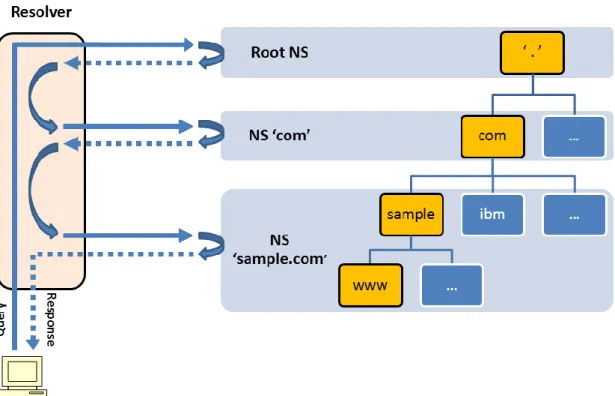
A Domain Name System server performing the function of DNS resolution for clients is sometimes erroneously referred to as a recursive server. This is due to the fact that this server performs all the requests necessary to obtain the response and does so recursively before sending back the information to the requester.
Figure 4.1: Recursive resolution of a DNS request
On the contrary, an iterative server is a name server which does not know the information and which does not perform a recursive search. Rather, it sends back a response stating that the information is held by another server.
The choice of these configuration modes has significant implications. In general, the authoritative DNS servers with authority over a zone must be configured in iterative mode. DNS servers resolving DNS names must be configured in recursive mode.
Similarly, a resolver is also sometimes erroneously referred to as a cache server. This is due to the fact that the name server will also have a cache function that will store the information it has collected until it is out-of-date. This is not only to improve the response time to requests, but also to avoid overloading the name servers with identical requests.
NA3 Best Practice Document:
Improving DNS Reliability and Security 16
cached server, which will be notified when a change is made to the DNS zone concerned. This notification can be configured via the also-notify option under ISC BIND.
4.3
Increasing reliability of DNS resolution service
Historically, the reliability of this function has been ensured by the presence of several DNS servers that could be queried by the client. For Unix systems, the list of DNS servers that can be queried is specified in the file /etc/resolv.conf, an example of which is shown below:
search example.com nameserver 192.0.2.1 nameserver 198.51.100.1 nameserver 203.0.113.1
In this way, if the first DNS server has a problem, the client queries the next DNS server and so on.
However, this solution is not necessarily the most efficient: it is dependent on the algorithm used by the operating system. It is generally observed on Unix systems (Linux, FreeBSD, etc.) that by default any request will query the first DNS server and if it does not respond, only after five seconds will the client query the following DNS server and so on. However, this delay can be modified through the “timeout” option. Although this principle has the virtue of simplicity and general availability on all systems, it is not satisfactory due to latencies perceptible by the user as soon as the first DNS server fails.
Without being exhaustive, three methods for limiting the impact of the failure of a DNS server or making it invisible are as follows:
Reconfiguration of the list of DNS servers DNS Anycast
Redundancy of the DNS name resolution service through a specific redundancy protocol (VRRP, Heartbeat etc.)
4.3.1
Client reconfiguration
A simple solution would be to delete the failing resolver from the list of DNS servers that the client is able to query. More specifically, on a Unix system, this involves deleting the entry associated with the failing DNS server in the file /etc/resolv.conf.
However, while this simple solution is practical for a client workstation, it is difficult to apply to an equipment pool of several hundreds or thousands of machines.
One way of automating the transmission of the new set of resolvers is to configure hosts with DHCP (using the “domain-name-servers” option to provide DNS). The list of servers must be updated as soon as the failure of a resolver is detected. However, this assumes that a very short DHCP lease time is set, so that the reconfiguration is carried out as quickly as possible.
option domain-name-servers 192.0.2.1, 198.51.100.1, 203.0.113.1;
4.3.2
DNS Anycast
DNS Anycast architecture is of interest when the infrastructure is distributed across several sites, preferably distant from one another. The DNS servers must be routed through different routers. Anycast architecture brings service redundancy and load distribution, and is resistant to Denial of Service attacks.
Acting at the network layer level, Anycast ensures that requests are distributed across several DNS servers. It operates according to the following principles:
The same IP address (the address of the DNS service) is configured on several different DNS servers (on a loopback interface), each located on a different site.
A routing daemon (QUAGGA, BIRD etc.) implementing a routing protocol (OSPF, BGP etc.) runs on the DNS server in addition to the name server.
The DNS service IP address (a /32 prefix) is announced to the router by the routing daemon.
The router learns the IP address of the server. The routing decision guarantees that the packets intended for the DNS are sent to the nearest server.
The redundancy mechanism is simple: if the DNS or the network no longer works, the IP address announcement is no longer sent to the router. For this to work, it is essential to link the operating status of the DNS server and the announcement sent to the router.
This is often implemented with a simple script run on the DNS server. The script regularly sends a local request to the DNS service to check the service is working. If the DNS service no longer works (for example if the BIND process is not running), the script stops the routing daemon to stop announcing the address to the router; when the DNS is working again, the script restarts the routing daemon.
It should be noted that the convergence time is often several seconds, as the addition and deletion of the route needs to propagate between the routers.
The choice of routing daemons to deploy on the DNS server is large: Quagga, Bird, openbgpd, openospfd, etc. The routing protocol can also be chosen freely according to the possibilities of the routers:
BGP requires a little more configuration, especially in setting up the peering, but it allows operation outside the limits of a routing domain (AS).
OSPF is slightly easier to configure but is limited to the routing domain.
Anycast works well because the DNS protocol is stateless: in UDP, a request generates a response. In some cases, the DNS uses TCP. Anycast also works in TCP provided the route does not change during the TCP
NA3 Best Practice Document:
Improving DNS Reliability and Security 18
4.3.3
Redundancy protocol (VRRP, Heartbeat, etc.)
Another approach exists for redundant architecture. Without relying on routing protocols, it is possible to use a redundancy mechanism directly on the server, such as Virtual Router Redundancy Protocol (VRRP) – either between redundant name servers, or between redundant frontal load-balancers.
Thanks to VRRP, a main server is chosen and all the other servers act as backup.
The election mechanism is based on regular announcements carried out by the main server, which has a higher priority than the backup servers. There are several implementations on open source Unix systems: CARP, uCARp, VRRPd, heartbeat, corosync, etc.
As with Anycast, where redundancy is linked to the routing protocols, the redundancy mechanism must be coupled to the state of the service.
4.3.4
Problems of open resolvers
A resolver open to the entire Internet is exposed to significant risks, such as: Cache poisoning.
Being a victim of a Denial of Service (DoS) attack targeted at the resolver (and impacting all internal users).
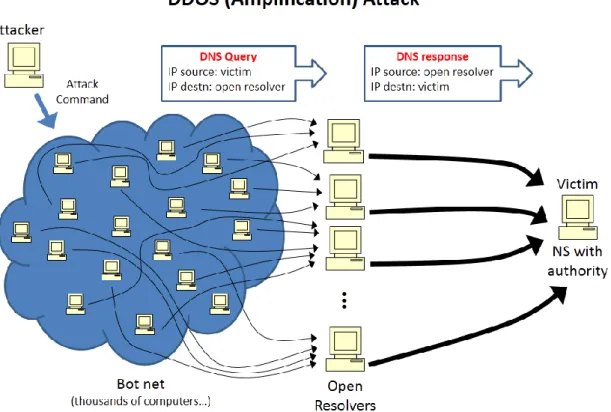
Being an indirect vector of a Distributed Denial of Service attack (DDoS), as in a DNS amplification attack by spoofing the source IP address.
Figure 4.2: DDOS by DNS amplification attack
For these reasons, it is vital that access to the recursive resolution service be restricted to its own clients. Example configuration for BIND:
options { allow-recursion { 192.0.2.0/24; 2001:db8:cafe::/48; ... }; ... };
Example configuration for Unbound: server:
access-control: 192.0.2.0/24 allow access-control: 2001:db8:cafe::/48 allow
NA3 Best Practice Document:
Improving DNS Reliability and Security 20
4.4
Resolver and private zones
Private zones, whether in internal views or on specific servers in a “Split-DNS” architecture, are not accessible by a resolver that only performs recursive resolutions. As the resolver has no knowledge of these zones, a resolution starting from the root will fail. It is recommended:
To perform specific redirection for these zones. To make the resolver a DNS slave if possible.
The first solution is relatively simple, and consists of redirecting the requests to the authoritative DNS for these private zones. However, the information cached for these zones, as stated above, are subject to Time to live (TTL) expiration, inducing latencies.
Example in unbound:
local-zone: "internal.example.com." nodefault forward-zone:
name: "internal.example.com." forward-addr: 192.0.2.1
In the second solution, the resolver is also a DNS slave and there are no information update problems: the master DNS server notifies the slaves in the event of any changes. However, the DNS becomes a hybrid server, simultaneously resolver and slave, making it more complex to manage.
4.5
Activation of DNSSEC validation on resolver
The resolution of DNSSEC requests can be authorised in the resolver configuration In recent resolvers, it is often set by default. Nevertheless, it is necessary to declare at least one “anchor” in the resolver configuration. In this case, the validity of the certification chain is checked.
Examples:
In BIND (activated by default from version 9.5 and up): options {
…
dnssec-enable yes; dnssec-validation yes; };
Declaration of the anchor via the trusted-keys or managed-keys clauses in named.conf Example DNSsec resolution of the entire certification chain:
5
DNSSEC
Domain Name System Security Extensions (DNSSEC) guarantees the integrity of information supplied by the DNS. Each record is enhanced with a cryptographic signature. At the moment of resolution, the signature is validated. As DNS is hierarchical, it is necessary to establish a chain of trust from the root to the sub zone. The parent zone must be signed and a delegation to the sub zone must exist (DS record, Delegation Signer).
5.1
Risks
The implementation of DNSSEC presents new operational risks.
5.1.1
Risks of expiry
Keys have a limited lifespan, and it is recommended that they be changed regularly. Signatures have an expiry date. If this date is passed, the records served by the DNS will be invalid for the verifying resolvers, even if the DNS infrastructure is working perfectly. In addition, it is recommended that the DNS server be synchronised with Network Time Protocol (NTP).
5.1.2
Risk of compromise of keys
In addition, the private keys used to sign the keys or the zones must be secured. This is akin to a well-known key management problem.
NA3 Best Practice Document:
Improving DNS Reliability and Security 22
5.2
DNSSEC implementation
Two types of key must be generated:
the KSK (Key Signing Key), used to sign the keys the ZSK (Zone Signing Key), used to sign the zone
The keys must then be added to the zone, then the zone must be signed and redeployed.
It is strongly recommended that key and signature management be automated by using the functions built into BIND or OpenDNSSEC.
5.3
Key rotation
Since the signatures have an expiration date, it is appropriate to anticipate the former by publishing two keys at a given time:
An active key A, expiring at an instant T.
An inactive key B, expiring at an instant T+3 months for example.
The transition from key A to key B must be completed before the expiration of key A. Key B is created on an anticipatory basis so that it is present in the resolver caches when the transition is being carried out. The rotation of the keys must be automated. From version 9.8 and up, BIND includes a certain number of automation functions. There are also tools like OpenDNSSEC. More detailed explanations are supplied in the BIND and OpenDNSSEC documentation.
6
Email: dependence on DNS
The SMTP servers for a zone are published in “MX” records, associated with a priority index that allows a round-robin type load distribution. A server has priority when its priority field has the lowest value, but note that even in this case, some requests will be assigned to the non-priority server(s).
6.1
Avoidance of “phishing”
DNS offers solutions to limit the risk of “phishing” (i.e. the attempt to acquire sensitive information by masquerading as a trustworthy entity).
6.2
Publication of authoritative SMTP servers
A DNS zone can publish SMTP servers with authority to send emails from this domain in the “FROM” clause, through a “Sender Policy Framework” record (RFC4408). This involves a “TXT” or “SPF” entry that declares the SMTP servers valid.
Example syntax:
@ IN TXT “v=spf1 mx mx:smtprelay.cnrs.fr a:sgaia1.dsi.cnrs.fr ~all"
6.3
Email domain signature
The “DomainKeys Identified Mail” (RFC4871) adds a signature to the message header to authenticate the sending domain.
NA3 Best Practice Document:
Improving DNS Reliability and Security 24
6.4
Use of local resolvers on SMTP servers
Email servers make many DNS requests. It may make sense to install a DNS resolver locally on these machines, which will allow them to take advantage of its cache and to unburden the shared resolver.
7
Summary of recommendations
Continuity and integrity of the service
Info. security
Conveni ence
Critical Important Recommen
ded
Renewal of delegation X
At least one NS slave X
Restriction of recursive resolution X
Isolation Resolver/Authority X
Isolation private/public zones X
Isolation management/public NS X
Multiple NS slaves X
NS on different networks X
Mixing OS & DNS servers X
Administration interface* X
Virtualisation * X
DNSsec ** X
Messaging: DKIM and SPF X
Chrooting service X
Breaking down config files X
NA3 Best Practice Document:
Improving DNS Reliability and Security
Appendix A
Some DNS parameters
A.1
Description of TTLs
There are two different TTL, which should not be confused: Zone default TTL and SOA TTL.
A.1.1
Zone default TTL
This specifies the amount of time before which the records in the resolver cache expire. Once this period ends, the resolvers query the NSs again, to refresh their cache for a new period.
; default TTL (3h) $TTL 10800
This TTL can be redefined specifically and independently for each record.
test 300 IN A 198.51.100.0
This allows to reduce the delay for a specific record, if you want modifications for this record to be taken into account faster than zone TTL allows.
Note: the value interpreted by the resolver is the one in its cache. In order to be certain that all resolvers will indeed be updated within 300 seconds, the TTL update must therefore be anticipated with a value at least equal to the initial value.
For example, if the initial TTL was at 10800 seconds (i.e. 3 hours): at the moment the new TTL is published, a resolver that had refreshed its cache just before will wait three hours before updating again, not five minutes.
Note: TTL values lower than 300 seconds are liable to be arbitrarily rewritten by some resolvers, in order to limit their load (particularly those of some Internet Service Providers).
A.1.2
SOA record TTLs
SOA TTL is only used when carrying out zone transfer by a slave NS.
example.com. IN SOA example.com. dnsmaster.example.com. (
2013101104 ; Version
3600 ; Retry (1h)
3600000 ; Expire (1000h)
3600 ; Negative caching TTL (1h)
) In the above example:
Refresh = Length of time before updating the zone from the master NS. * Retry = Length of time before a new attempt in case of failure.
Expire = Length of time before zone is out-of-date if not updated from the master NS. Negative caching TTL = Period before retrying “no response” requests (RFC 2308).
* Note that the dynamic notification mechanism from master NS to slave NSs has made this concept obsolete.
A.2
Reinitialisation of serial number by "overflow" (RFC1982)
Serial numbers can go up to 2^32-1, i.e. 4 294 967 295. Numbers greater than 4294967295 (2^32) correspond to 0.
For any starting serial number, half of the other possibilities are considered “higher”, and the other half “lower” (4294967295 / 2 = 2147483647.5).
Two scenarios can be encountered where the serial number must be corrected: Incorrect serial number between 0000000000 and 2147483647:
For example, if the serial number to be corrected is 2008200501: From 2008200502 to 4155684148 (2008200501 + 2147483647)
-> this new value will be “higher”
From 4155684149 (2008200501 + 2147483647 + 1) to 4294967295 (2^32 - 1) and from 0 to 2008200500 -> this new value will be “lower”
The target serial number 2008090300 is therefore lower and transmission to the slaves will not take place. (4155684148 is actually higher than 4155684149 in the context of a zone’s serial number.)
By setting the new serial number to 4155684148 (the maximum of the sliding window), it will be accepted by the slaves because it is higher. By then setting it back to 2008090300 (the target serial number), it will again
NA3 Best Practice Document:
Improving DNS Reliability and Security 28
From 3634575285 to 4294967295 (2^32 - 1) and from 0 to 1487091636 (3634575285 - 2147483647 - 2) -> this new value will be “higher”
From 1487091637 (3634575285 - 2147483647 - 1) to 3634575284 -> this new value will be “lower”
The target serial number 2012031301 is therefore lower and transmission to the slaves will not take place. By setting the new serial number to 1487091636 (max. of the sliding window) it will be accepted by the slaves because it is higher. By then setting it back to 2012031301 (target serial number), it will again be considered higher and therefore taken into account.
A.3
Checking resolver EDNS compatibility (RFC2671)
To check that the local resolver is EDNS-compatible (packets larger than 512 bytes): dig +short rs.dns-oarc.net txt
A.4
Timeout periods during BIND resolution
Resolver timeouts in BIND 4.9 to 8.2
Nameservers configured Retry 1 2 3 0 5s (2x) 5s (3x) 5s 1 10s (2x) 5s (3x) 3s 2 20s (2x) 10s (3x) 6s 3 40s (2x) 20s (3x) 13s Total 75s 80s 81s
Resolver timeouts in BIND 8.2.1 and later Nameservers configured
Retry 1 2 3
0 5s (2x) 5s (3x) 5s
1 10s (2x) 5s (3x) 3s
NA3 Best Practice Document:
Improving DNS Reliability and Security
References
BC 38 (RFC2827) http://tools.ietf.org/html/rfc2827
BIND https://www.isc.org/downloads/bind/
BIND_ARM BIND 9.9 Administrator Reference Manual (ARM)
https://kb.isc.org/article/AA-00845/0/BIND-9.9-Administrator-Reference-Manual-ARM.html
DANE (DNS-based Authentication of Named Entities) http://www.rfc-editor.org/rfc/rfc6698.txt
http://en.wikipedia.org/wiki/DNS-based_Authentication_of_Named_Entities http://www.bortzmeyer.org/6698.html
DNS RRL (DNS Response Rate Limiting) http://www.redbarn.org/dns/ratelimits http://ss.vix.com/~vixie/isc-tn-2012-1.txt
DNS security threats https://developers.google.com/speed/public-dns/docs/security
DNSSEC_deployment https://www.usenix.org/conference/usenixsecurity13/measuring-practical-impact-dnssec-deployment
DNSSEC in Unbound http://www.unbound.net/documentation/howto_anchor.html
dnstop and dnsperf (Statistical tools)
http://dns.measurement-factory.com/tools/dnstop/ http://www.nominum.com/support/measurement-tools/ EDNS_checker https://www.dns-oarc.net/oarc/services/replysizetest
Kaminsky vulnerability An Illustrated Guide to the Kaminsky DNS vulnerability http://unixwiz.net/techtips/iguide-kaminsky-dns-vuln.html
Online validation tools http://www.afnic.fr/fr/produits-et-services/services/zonecheck/ http://dnscheck.iis.se/
http://dnsviz.net/
http://dnssectest.sidn.nl/test.php http://www.nic.cz/dnssec/ http://dnssec-or-not.org/
SPF (Sender Policy Framework)
http://en.wikipedia.org/wiki/Sender_Policy_Framework
Glossary
AXFR Complete zone transfer.
DKIM (DomainKeys Identified Mail) Authentication of sender domain by email signature.
DNSSEC Domain Name System Security Extensions
IXFR Incremental zone transfer
Registrar Company that manages domain names.
SPF Sender Policy Framework. Verification of domain SMTP servers via dedicated DNS entries.
TLD (Top-Level Domain) Top-level domain, e.g. “.com” or “.arpa”.
TSIG (Transaction SIGnature) Update between NSs authenticated by symmetric key.