1
A Robotic Auto-Focus System based on
Deep Reinforcement Learning
Xiaofan Yu, Runze Yu, Jingsong Yang, Xiaohui Duan*
School of EECS, Peking University
Beijing, China
2
Background
●
Passive Auto-Focus
●
How to deal with auto-focus using vision input
Method
●
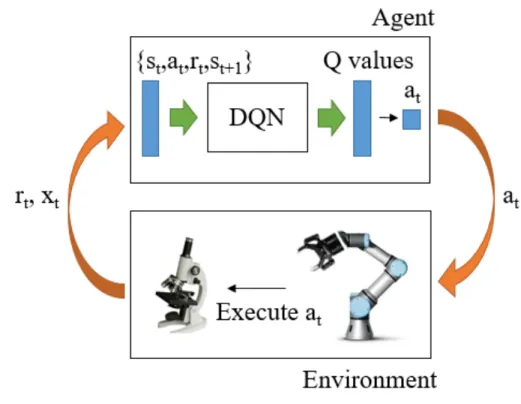
System model
●
Reward Function Design
●
Deep Q Network Design
Experiments
●
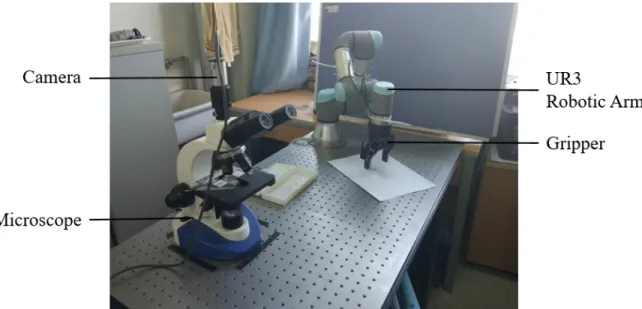
Hardware Setup
●
Training in Virtual Environment
●
Training in Real Environment
Conclusion
3
4
⬛
Passive Auto-Focus
▪
First and foremost step in cell detection
▪
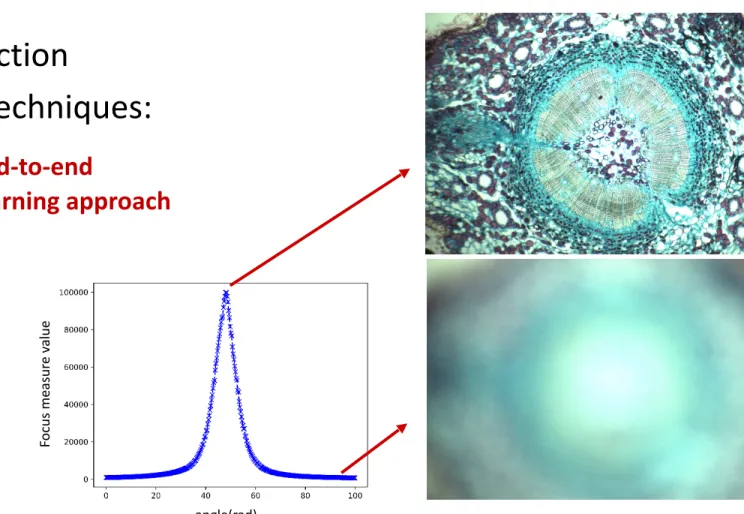
Two phases in passive auto-focus techniques:
▪
focus measure functions
▪
search algorithms
Background
Background
Method
Experiment
Conclusion
End-to-end
learning approach
angle(rad) Fo cu s m eas u re v al u e5
⬛
How to deal with auto-focus using vision input?
▪
Vision-based model-free decision-making task
▪
Deep Reinforcement Learning (DRL)
is the solution!
▪
Deep Q Network (DQN) can deal with high dimensional input
Background
Learning
Agent Screw Action Eyepiece’s ViewPictures
Figure 2: Model of end-to-end vision-based auto-focus problem.
Background
Figure 3: Atari 2600 games, which could be played by DRL-trained agent with vision input [1].
[1] V. Mnih, K. Kavukcuoglu, D. Silver, A. Graves, I. Antonoglou, D. Wierstra, and M. Riedmiller, “Playing Atari with Deep Reinforcement Learning,” arXiv preprint arXiv:1312.5602, 2013.
6
⬛
Our Contribution
▪
Apply DRL to auto-focus problems, which does not utilize human knowledge
▪
Demonstrate a general approach to vision-based control problems
▪
Discrete
state and action spaces
▪
Reward function with an active
terminal
mechanism
Background
7
8
⬛
System model
▪
State ( ): three successive images ( ) and
their corresponding actions ( )
▪
▪
Action ( ): one in the action set
▪
Action set = {coarse positive, fine positive, terminal,
fine negative, coarse negative}
▪
Reward ( )
▪
DQN
𝑠
𝑡
𝑥
𝑡
𝑎
𝑡
𝑠
𝑡= {
𝑥
𝑡,
𝑎
𝑡,
𝑥
𝑡−1,
𝑎
𝑡−1,
𝑥
𝑡−2,
𝑎
𝑡−2}
𝑎
𝑡
𝑟
𝑡
Method
Method
Figure 4: System model.
9
⬛
Reward Function Design
▪
Reward Function
▪
▪
: coefficient
▪
and
: current and max focus value
▪: termination bonus,
𝑟𝑒𝑤𝑎𝑟𝑑
=
𝑐
∙
(
𝑐𝑢𝑟
_
𝑓𝑜𝑐𝑢𝑠
−
𝑚𝑎𝑥
_
𝑓𝑜𝑐𝑢𝑠
) +
𝑡
𝑐
𝑐𝑢𝑟
_
𝑓𝑜𝑐𝑢𝑠
𝑚𝑎𝑥
_
𝑓𝑜𝑐𝑢𝑠
𝑡
𝑡
=
{
100,
−
100,
𝑠𝑢𝑐𝑐𝑒𝑠𝑠
𝑓𝑎𝑖𝑙𝑢𝑟𝑒
Method
Method
angle(rad) Fo cu s m eas u re v al u e 𝑚𝑎𝑥_𝑓𝑜𝑐𝑢𝑠 𝑐𝑢𝑟_𝑓𝑜𝑐𝑢𝑠 Success region10
⬛
DQN Design
Method
Method
Figure 5: The architecture of our DQN.
11
12
⬛
Hardware Setup
⬛
Training in
Virtual
Environment
⬛
Training in
Real
Environment
Experiment
Experiment
Figure 6: Auto-focus system implementation
13
⬛
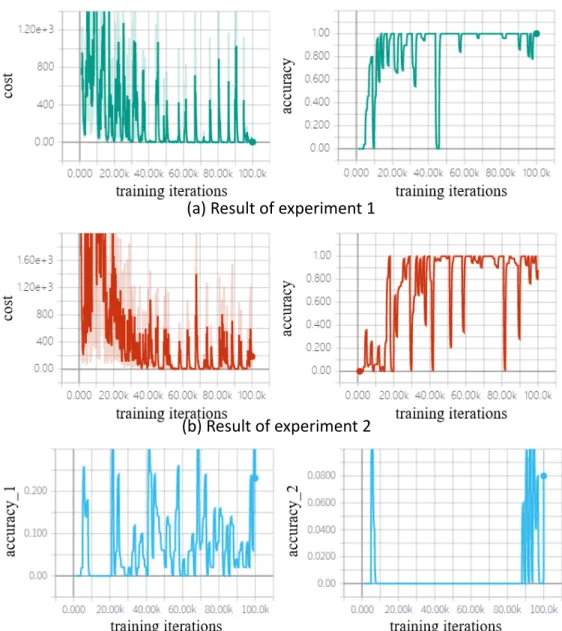
Training in Virtual Environment
▪
Save time in real training phase
▪
Before training, perform equal-spacing
sampling to construct a simulator
Experiment
Experiment
(a) Result of experiment 1
(b) Result of experiment 2
(c) Result of experiment 3
Figure 7: Result of virtual training phase.
14
⬛
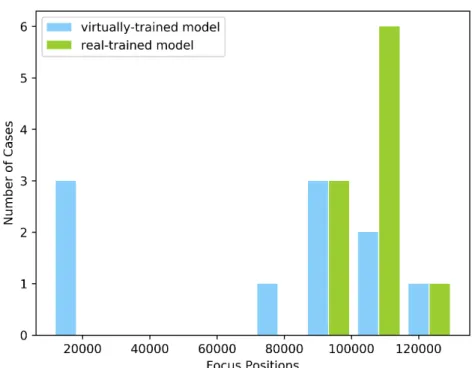
Training in Real Environment
▪
Deploy the virtual-trained model to real scenarios
▪
Apply real training phase and obtain a new model
▪
Compare
those two models by performing tests in
real world
Experiment
Figure 8: Real world testing scene. Figure 9: The histogram of focus positions.
15
⬛
Summary
▪
In virtual training phase, our model shows great viability on larger range but need
improvements on generalization capacity
▪
In real training phase, our method is feasible to learn accurate policies (100%
success rate) in real world but is susceptible to environmental factors
Experiment
16
17
⬛
In this paper, we
▪
use
DQN
to achieve
end-to-end auto-focus
▪
demonstrate that
discretization in state and action spaces
and
active
termination mechanism
could be a general approach in
vision-based control
problems
⬛
Next Step
▪
Improve generalization capacity by training with larger dataset
▪
Improve robustness towards environmental factors
▪
Reduce training time
▪
……
Conclusion
18
THANK YOU
Q & A
19
⬛ [1] G. Saini, R. O. Panicker, B. Soman, and J. Rajan, “A Comparative Study of Different Auto-Focus Methods for
Mycobacterium Tuberculosis Detection from Brightfield Microscopic Images,” in Distributed Computing, VLSI, Electrical Circuits and Robotics (DISCOVER), IEEE, pp. 95–100, IEEE, 2016.
⬛ [2] J. M. Mateos-P´erez, R. Redondo, R. Nava, J. C. Valdiviezo, G. Crist´obal, B. Escalante-Ram´ırez, M. J. Ruiz-Serrano, J.
Pascau, and M. Desco, “Comparative Evaluation of Autofocus Algorithms for a Real-Time System for Automatic Detection of Mycobacterium Tuberculosis,” Cytometry Part A, vol. 81, no. 3, pp. 213–221, 2012.
⬛ [3] C.-Y. Chen, R.-C. Hwang, and Y.-J. Chen, “A Passive Auto-Focus Camera Control System,” Applied Soft Computing, vol. 10, no. 1, pp. 296–303, 2010.
⬛ [4] H. Mir, P. Xu, R. Chen, and P. van Beek, “An Autofocus Heuristic for Digital Cameras based on Supervised Machine Learning,” Journal of Heuristics, vol. 21, no. 5, pp. 599–616, 2015.
⬛ [5] J. Li, “Autofocus Searching Algorithm Considering Human Visual System Limitations,” Optical Engineering, vol. 44, no. 11, p. 113201, 2005.
⬛ [6] K. Arulkumaran, M. P. Deisenroth, M. Brundage, and A. A. Bharath, “A Brief Survey of Deep Reinforcement Learning,” arXiv preprint arXiv:1708.05866, 2017.
⬛ [7] V. Mnih, K. Kavukcuoglu, D. Silver, A. Graves, I. Antonoglou, D. Wierstra, and M. Riedmiller, “Playing Atari with Deep Reinforcement Learning,” arXiv preprint arXiv:1312.5602, 2013.
⬛ [8] V. Mnih, K. Kavukcuoglu, D. Silver, A. A. Rusu, J. Veness, M. G. Bellemare, A. Graves, M. Riedmiller, A. K. Fidjeland, G. Ostrovski, et al., “Human-Level Control through Deep Reinforcement Learning,” Nature, vol. 518, no. 7540, p. 529, 2015. ⬛ [9] D. Silver, J. Schrittwieser, K. Simonyan, I. Antonoglou, A. Huang, A. Guez, T. Hubert, L. Baker, M. Lai, A. Bolton, et al.,
“Mastering the Game of Go without Human Knowledge,” Nature, vol. 550, no. 7676, p. 354, 2017.
Reference
20
⬛ [10] J. He, R. Zhou, and Z. Hong, “Modified Fast Climbing Search Auto-Focus Algorithm with Adaptive Step Size Searching Technique for Digital Camera,” IEEE transactions on Consumer Electronics, vol. 49, no. 2, pp. 257–262, 2003.
⬛ [11] N. Kehtarnavaz and H.-J. Oh, “Development and Real-Time Implementation of a Rule-based Auto-Focus Algorithm,” Real-Time Imaging, vol. 9, no. 3, pp. 197–203, 2003.
⬛ [12] L. Metz, J. Ibarz, N. Jaitly, and J. Davidson, “Discrete Sequential Prediction of Continuous Actions for Deep RL,” arXiv preprint arXiv:1705.05035, 2017.
⬛ [13] S. Levine, C. Finn, T. Darrell, and P. Abbeel, “End-to-End Training of Deep Visuomotor Policies,” The Journal of Machine Learning Research, vol. 17, no. 1, pp. 1334–1373, 2016.
⬛ [14] J. Schulman, S. Levine, P. Abbeel, M. Jordan, and P. Moritz, “Trust Region Policy Optimization,” in International Conference on Machine Learning, pp. 1889–1897, 2015.
⬛ [15] S. Gu, T. Lillicrap, I. Sutskever, and S. Levine, “Continuous Deep Q Learning with Model-based Acceleration,” in International Conference on Machine Learning, pp. 2829–2838, 2016.
⬛ [16] T. P. Lillicrap, J. J. Hunt, A. Pritzel, N. Heess, T. Erez, Y. Tassa, D. Silver, and D. Wierstra, “Continuous Control with Deep Reinforcement Learning,” arXiv preprint arXiv:1509.02971, 2015.
⬛ [17] S. Gu, E. Holly, T. Lillicrap, and S. Levine, “Deep Reinforcement Learning for Robotic Manipulation with Asynchronous Off-Policy Updates,” in Robotics and Automation (ICRA), 2017 IEEE International Conference on, pp. 3389–3396, IEEE, 2017.
⬛ [18] L. Ren, L. Wang, J. K. Mills, and D. Sun, “Vision-Based 2-D Automatic Micrograsping using Coarse-to-Fine Grasping Strategy,” IEEE Transactions on Industrial Electronics, vol. 55, no. 9, pp. 3324–3331, 2008.
21
⬛ [19] S. J. Ralis, B. Vikramaditya, and B. J. Nelson, “Micropositioning of a Weakly Calibrated Microassembly System using Coarse-to-Fine Visual Servoing Strategies,” IEEE Transactions on Electronics Packaging Manufacturing, vol. 23, no. 2, pp. 123–131, 2000.
⬛ [20] M. Riedmiller, “Neural Fitted Q Iteration–First Experiences with a Data Efficient Neural Reinforcement Learning Method,” in European Conference on Machine Learning, pp. 317–328, Springer, 2005.
⬛ [21] S. Levine, P. Pastor, A. Krizhevsky, and D. Quillen, “Learning Hand-Eye Coordination for Robotic Grasping with Large-Scale Data Collection,” in International Symposium on Experimental Robotics, pp. 173–184, Springer, 2016.
![Figure 3: Atari 2600 games, which could be played by DRL-trained agent with vision input [1].](https://thumb-us.123doks.com/thumbv2/123dok_us/9244257.2410852/5.1440.115.678.436.629/figure-atari-games-played-trained-agent-vision-input.webp)