Building Trust and Compliance in the Cloud
with Intel
®
Trusted Execution Technology
EXECUTIVE SUMMARY
The Taiwan Stock Exchange Corporation (TWSE) is a financial institution operating as a stock exchange that provides trading for 758 listed companies in Taiwan. Its pri-mary business drivers include developing new financial products and boosting the number of services it offers. This paper highlights the systems, solutions, and approach Intel used in a joint proof of concept (PoC) with TWSE to address its busi-ness needs and increase the overall trust and security of its cloud infrastructure using Intel® Trusted Execution Technology (Intel® TXT), Cisco Unified Computing System* (UCS*) servers, and software solutions from HyTrust, McAfee, and VMware. TWSE needed to build a more secure foundation for sensitive cloud workloads. It is using the components from these companies to establish trusted compute pools (TCP) providing the additional elements of security, visibility, and control needed to put more applications and workloads into its cloud infrastructure. From this initial proof-of-concept deployment, TWSE expects many other business units to be able to more effectively use cloud infrastructures to increase business agility, reduce costs, and improve asset utilization without compromising security considerations.
Contributors Intel Corporation James J. Greene Martin Guttmann Kou-Hui Li Jinn Parng Raghu Yeluri TWSE Cheng-Yi Wu Ken Wu HyTrust Hemma Prafullchandra Ken Sigel McAfee Ed Reynolds VMware Gargi Keeling
Developing effective,
efficient, and proven security
and trust solutions to
minimize the complexities of
managing cloud infrastructures
Trust and Security Challenges
The rapid adoption and growing deployment of cloud infrastructure and solutions—inter-nal, extersolutions—inter-nal, and/or federated—introduces new trust and security challenges.
In cloud infrastructure, systems are auto-matically provisioned. Applications are deployed and moved from system to sys-tem based on available IT resources. While this creates powerful efficiency and agility benefits, it often does so at the expense of creating new security and trust concerns.
There is very little visibility to the operat-ing state of the infrastructure in this multi-tenant environment. Depending on the organization’s industry segment, there may be many regulations that specify security controls, enforcement, and visibili-ty to enable compliance.
Organizations need effective, efficient, and proven security and trust solutions to mini-mize the complexities of managing their cloud infrastructures and the workloads they wish to host there. They also need integra-tion with existing IT systems and security tools. Finally, trust solutions need to enable automated security reviews and audits to ensure security and overall trust.
Fundamentally, organizations are searching for solutions and systems that behave in an expected way, ensuring that issues of trust are effectively addressed and managed.
A fundamental business and technical requirement for the cloud infrastructure under construction at TWSE was to provide secure systems and trusted compute envi-ronments. TWSE has established that it is crucial to integrate software application
solutions that will provide overall trust and security for its cloud infrastructure and fully use hardware-based security and provide root of trust and platform attesta-tion. The goals for the organization were to enable:
• Greater visibilityinto the security states of the hardware platforms run-ning infrastructure as a service (IaaS) for its private clouds
• Production of automated, standard-ized reportson the configuration of the physical and virtual infrastructure hosting customer virtual machines and data
• Controls based on the physical location of the server and location of the virtu-al machines and control the migration of these virtual machines onto accept-able servers, per specified policy • Collection of measured evidence
that services infrastructure complies with security policies and regulated data standards
To explore the capabilities and challenges of implementing such an infrastructure, TWSE engaged Intel and other key ecosys-tem members to develop a multi-phased proof of concept (PoC) implementation of a secure cloud based on familiar tools, plat-forms, and software. The capabilities the PoC needed to provide included:
• Measured boot for servers with plat-form attestation
• Creationof TCPs
• Security-controlled workload place-mentin the TCPs
• Security controlled workload migra-tion in TCPs
• Security and platform trust
Integrated and extended with McAfee ePolicy Orchestrator* (McAfee ePO*)
TWSE Business Needs and Priorities
To support its plans to deliver new busi-ness services for both internal and exter-nal brokers, TWSE decided to build a cloud infrastructure. A fundamental business and technical requirement for the infra-structure is to provide secure systems and trusted compute environments. Thus, it is crucial to integrate software applica-tion soluapplica-tions that will provide TWSE with overall trust and security for its cloud infrastructure and fully use hardware-based security and provide root of trust and platform attestation.
In a cloud infrastructure, systems can be automatically provisioned based on needs. Applications are deployed and moved from system to system based upon avail-able IT resources—not whether the sys-tems have the required trust policies in place. TWSE requires appropriate trust policies. But tracking migration, reporting, applying policies, and auditing where and on what systems workloads are running can be a complex undertaking.
To address TWSE's overall business requirements in its cloud PoC infrastruc-ture, solutions need integrated function-ality for cohesive and greater overall trust and support for security, policy enforcement, audits, reporting, and com-pliance. For efficient operation, solutions need to provide:
• Integrationfor existing IT opera-tional solutions including governance, risk, and compliance (GRC)
• Securityinformation and event man-agement (SIEM)
• Securityand server management
• Serversecurity risk dashboard
2
Contents
Executive Summary...1
Trust and Security Challenges...2
Business Needs and Priorities...2
Enabling Trust for Cloud Infrastructure...3
Intel TXT: A Foundation for Trust, Visibility, and Control in the Cloud...3
Enabling Platform Attestation...4
TCP Overview...5
Multi-Phased Cloud Infrastructure PoC...6
Defining PoC Use Cases...6
Trust System and PoC Solutions Architecture ...7
Measured Boot for Cisco UCS Systems: Platform Attestation ...8
Creating TCPs and Workload Migration....10
Integrated and Extended Security and Platform Trust with McAfee ePO ...11
Summary ...12
Appendix A: Overview of Steps for Intel TXT and TPM Configuration for Cisco UCS Systems ...14
Appendix B VMware Software Solutions ....15
Appendix C: McAfee ePO...15
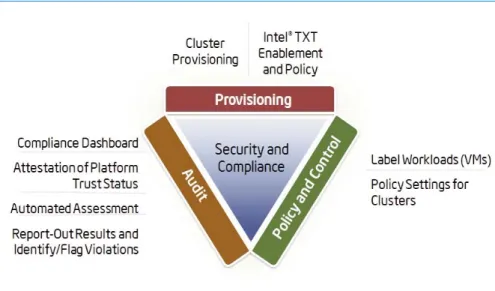
Figure 1 is an example of the integrated security and compliance elements of this PoC solution aligned to meet TWSE's busi-ness requirements, ranging from system deployment and provisioning and effec-tive policy control to trust enforcement and audits.
Enabling Trust for Cloud Infrastructure
To address business and technical requirements for TWSE's cloud infrastruc-ture, the organization worked with Intel on a joint, phased PoC. Goals were to demonstrate solutions, starting with hardware-based security, to provide root of trust platform verification and attesta-tion. This included enabled hypervisor and software solutions that effectively man-age and apply policies in the cloud infra-structure starting with known, trusted systems and a virtual machine manager (VMM) kernel.
Organizations that are using or want to use cloud services are starting to require cloud service providers to better secure the hardware layer and provide greater transparency into the system activities within and below the hypervisor. This means that cloud providers should be able to:
• Give organizations greater visibility
into the security state of the hardware platforms running the IaaS for their pri-vate clouds.
• Produce automated, standardized reportson the configuration of the physical and virtual infrastructure host-ing customer virtual machines and data
• Provide controlsbased on the loca-tion of the server and virtual machines and control the migration of these vir-tual machines onto acceptable servers per specified policy (e.g., FISMA and DPA requirements)
• Provide measured evidencethat the services infrastructure complies with security policies and regulated data standards
What is needed is a set of foundational building blocks for developing more trust-worthy clouds. These building blocks can be summarized as:
• Creating a chain of trustrooted in hardware that extends to include the hypervisor
• Hardening the virtualization environ-mentusing known best practices • Providing visibilityof assets,
con-trols, and enforcement for compliance and audit
• Using trust informationas part of the policy management for cloud activity • Using infrastructure and services to
address data protection requirements
• Using automationto bring it all together and achieve scale and man-agement efficiency
3
Intel TXT: A Foundation for Trust, Visibility, and Control in the Cloud
Overall trust and security in a cloud com-puting infrastructure must begin with the servers and base compute systems. The basic elements of this trusted platform ide-ally (and in the case of Intel TXT) span hardware, firmware, and software to pro-vide the best balance of tamper-resistance and functionality.
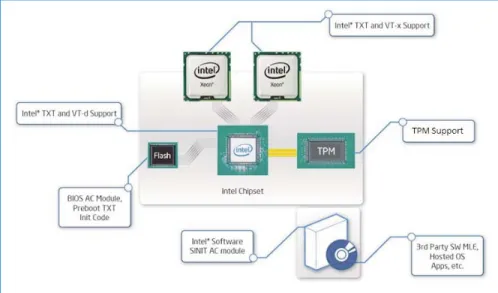
Intel TXT is available with many servers featuring the Intel® Xeon® processor E3, E5, and E7 families. Platform-level enhance-ments provide the building blocks to enable visibility, trust, and control in the cloud. As Figure 2 shows, Intel TXT includes support and capabilities in the microprocessor, chipset, I/O subsystems, and other platform components. Designed to measure the exe-cution environment and protect sensitive information from software-based attacks, it operates with Trusted Platform Module* (TPM*), an industry-standard device that can securely store artifacts used to verify integrity of the platform.
Hardware-based root of trust—when cou-pled with an enabled operating system, hypervisor, and solutions—is the founda-tion for a more secure computing platform that can ensure hypervisor and VMM integrity at boot from rootkits or other low-level attacks. It establishes the trust-worthiness of the server and host plat-forms. The hardware-based root of trust uses open industry standards developed by Trusted Computing Group (TCG) to establish and ensure platform trust and store measurements in a TPM.
The solution works by providing a root of trust—a processor-based, tamper-resistant environment that compares firmware, BIOS, and operating system or hypervisor code to known good configurations to establish a measured, trusted environment prior to launch. If integrity and trust are not verified in the launch process, Intel TXT identifies that the code has been compromised, which lets you protect the system and remediate the problem. The basic process for an Intel TXT launch process is shown in Figure 3.
Because Intel TXT can evaluate and report on platform integrity using attestation mechanisms, it can provide valuable insights and controls when used in the context of cloud computing models. This allows other key software—virtualization, cloud orchestration and management, and security policy applications—to understand and use platform integrity attributes to control workloads and data and better address security risks by keeping sensitive or regulated workloads separate from plat-forms with unknown integrity status. This is a concept that Intel and like-minded solution companies call TCPs. Numerous system and software vendors are develop-ing solutions that integrate hardware-based root of trust capabilities, supporting Intel TXT to further extend and address
4
security and trust issues for cloud infra-structure.
Enabling Platform Attestation
There are mechanisms to establish plat-form trust. The platplat-form must have:
• Root of trust for measurement (RTM).This is provided by Intel TXT
• Root of trust for reporting (RTR).
This is provided by the TPM
• Root of trust for storage (RTS).This is provided by the TPM
Figure 2. Components of Intel TXT and its Solution Stack
5 RTM, RTR, and RTS are the foundational
elements of a single platform. For use cases to be instantiated and delivered in a cloud, two key questions must be answered:
1. How would the entity needing this information know if a specific plat-form has Intel TXT enabled if a spe-cific server has a defined or compli-ant BIOS or VMM running on it (i.e., can it be trusted)?
2. Why shouldthe entity requesting this information (which, in a cloud environment, could be a resource scheduler or orchestrator trying to schedule a service on a set of avail-able nodes or servers) trust the response from the platform?
The answers to these key questions determine:
• How a given server is added to a TCP
• How a serviceis placed on a server in a TCP
• How and where a servicegets migrated in the pool
Attestation provides the definitive answers to these questions. Attestation elevates the operational value of roots of trust by making the information from the root of trust visible and usable by other entities. It is the process of provid-ing a digital signature of a set of plat-form configuration registers (PCR)—a set of registers in a TPM that are extended with specific measurements for various launch modules of the software—and having the requestor validate the signa-ture and the PCR contents. To validate, the requestor first invokes the TPM_Quote command, specifying:
• An attestation identity keyto per-form the digital signature
Platform trust status is attested at launch. If the launch is trusted, that platform can be added to the trusted pool. Within this pool, systems and workloads can be tagged with security policies. The access and execution of apps and workloads can also be moni-tored, controlled, and audited.
Creating TCPs is a way to aggregate trusted systems and segregate them from untrust-ed resources. It provides an infrastructure to support the separation of higher-value, more sensitive workloads from commodity appli-cations and data. The principle of operation is to:
• Create a part of the cloudto meet the specific and varying security requirements of users
• Control access to an identified por-tion of the cloud so that only approved workloads and applications get deployed there
• Enable auditsof that portion of the cloud so that users can verify compliance • The set of PCRs to quote
• A nonceto ensure freshness of the digital signature
Next, it validates the signature and makes a determination about the trust of the launched server by comparing the measure-ments from the TPM quote with known-good measurements. It is a critical IT opera-tions challenge to manage the known-good measurement for hypervisors, operating systems, and BIOS software to ensure they are all protected from tampering and spoof-ing. This capability can be internal to a com-pany, from a service provider, or delivered remotely as a service by a trusted third party (TTP), as shown in Figure 4.
TCP Overview
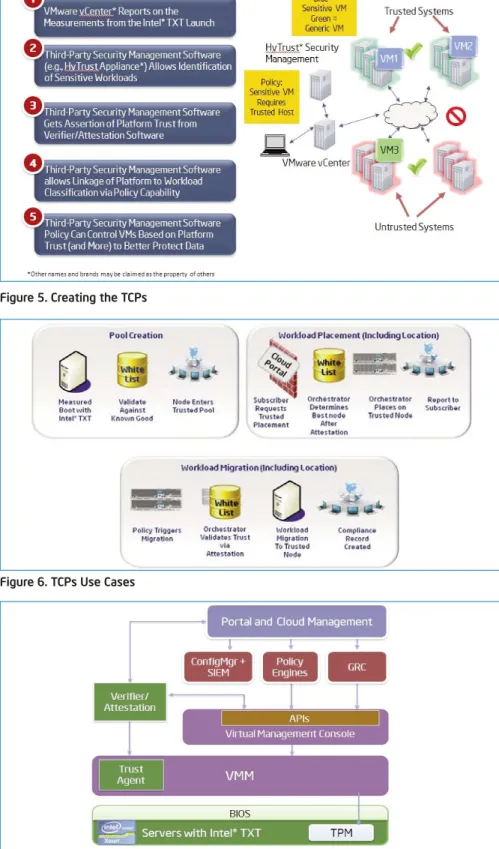
TCPs, as shown in Figure 5, are physical or logical groupings of computing platforms in a data center that have demonstrated integri-ty of key controlling components (e.g., BIOS and hypervisor) in the launch process. Intel TXT provides a hardware-based mechanism for verifying and reporting on platform trust as a foundation for creating trusted pools.
6
Such TCPs enabled by Intel TXT allow IT to gain the benefits of the dynamic cloud envi-ronment while still enforcing higher levels of protection for critical workloads. Also, use of TCPs eliminates the need for air-gapped clus-ters of servers.
Multi-Phased Cloud Infrastructure PoC
The objective of the comprehensive PoC was to highlight solutions and systems that will effectively address TWSE's needs and enable broader, policy-based trust for its planned cloud infrastructure. TWSE also needed to integrate and test solutions that would support overall trust and security for its IT and operations.
A skilled team participated in the PoC, from planning to execution. It included partici-pants from TWSE, Cisco, HyTrust, Intel, McAfee, Systex, and VMware with expert-ise from infrastructure engineers, solution experts, IT operations, security architects, and business leads.
The PoC needed to clearly define a critical set of operational use cases, which it charac-terized under an umbrella concept of creating TCPs based on Intel TXT-enabled platforms. It also wanted to showcase software solu-tions, trust, and security functionality, so a critical part of the PoC was to highlight seamless integration of hardware root of trust, platform attestation, and policy securi-ty solutions with TWSE's cloud Infrastructure to address comprehensive trust and security.
Defining PoC Use Cases
The team began by defining use cases for creating TCPs with Intel TXT. These use cases were started by enabling trust from compute platforms via Intel TXT and then extending the trust and security throughout operational software solutions and systems to create the base TCPs. From there, they established use cases that would be integral to these TCPs (Figure 6). The
Figure 5. Creating the TCPs
Figure 6. TCPs Use Cases
7 evolution of the phased approach is
described in Table 1.
Trust System and PoC Solutions Architecture
For the PoC, the team designed a system and solutions architecture and phased set of activities as defined above. The PoC exam-ined TWSE’s current solutions and systems and its overall enterprise operational and management solutions. It also examined the Intel TXT Trusted Compute Pools Cloud Solution Reference Architecture (Figure 7) as a baseline for building the PoC architecture. Since trust and security need to go from bot-tom to top, it is crucial to know the trust lev-els of the hardware platform and the hyper-visor, as discussed previously. For the PoC implementation, the team selected a number of systems and solutions based on TWSE cur-rent and future directions and business needs. As shown in Figure 4, these included:
• Cloud system and infrastructure supported by Cisco.This included a fabric-based converged UCS M3 server with the Intel Xeon processor E5 fami-ly and Intel TXT enabled, equipped with the TPM. For testing, the PoC used three blades to be able to estab-lish a mix of trusted and untrusted platforms in the PoC environment.
• Virtualization solutions supported by VMware.Managing the virtualized infra-structure was VMware vCenter Server* 5.1 with VMware ESXi* 5.1 hypervisor, which allows enterprises to use their own security certificates when securing remote sessions. VMware ESXi 5.1 also provides full, integrated support and functionality for Intel TXT and enables remote platform attestation measure-ments to detect possible malicious changes to BIOS and other critical base
STEPS
A. Measure launch of the server BIOS and VMM of Intel TXT-enabled servers.
B. Validate measured vs. expected server measure-ments as known-good values or whitelist meas-urements against measured data.
C. Report the trust status of the server as trusted or not trusted based on the results of the meas-ured launch process.
A. Add only trusted server to the TCPs of servers based on policy.
A. When a cloud service/VM is provisioned, the service owner requires (and requests via policy) a placement of the service in a trusted pool.
B. Orchestration software will place workload on servers in the trusted pool.
A. Migration of workloads is triggered (for planned or unplanned reasons); the orchestration soft-ware determines the optimal set of servers to migrate workloads.
B. Migration policies are examined for the trusted servers.
C. Allow or disallow workload migration based on policy; the migration is completed or aborted.
A. Ensure security is up-to-date to conform to secu-rity compliance
B. Verify & report on integrity of security technolo-gy in the Trusted Pool
DESCRIPTION Measure boot for servers
Perform platform attestation and create trusted complete pools Place workloads in the TCPs
Migrate workloads to compute pools
Integrate and extend security and platform trust with McAfee ePO PHASE
1
2
3
4
5
Table 1. Evolution of the Phased Approach
software components of the servers. VMware ESXi 5.1 measures the critical components of the hypervisor stack when the system boots and stores these measurements in the PCR of the
TPM on the platform. The measured ele-ments include the VMkernel*, kernel modules, drivers, native management applications that run on ESXi, and any boot-time configuration options.
8
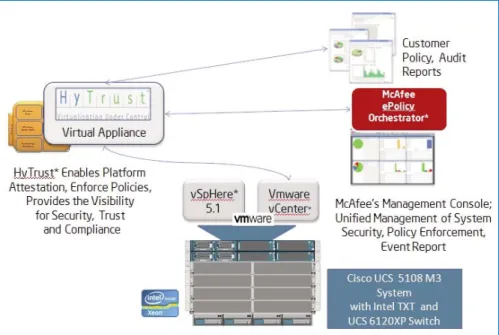
• Trust and policy solution supported by HyTrust and HyTrust Appliance*. The team used HyTrust Appliance 3.5 beta version, which provides extensive support for Intel TXT. The HyTrust Appliance veri-fies the integrity of the physical hardware of the host to ensure the underlying plat-form is fully trusted and can implement powerful policies based on this informa-tion. It can ensure that specified work-loads are only permitted to be instantiat-ed on specific hosts or clusters. It also intercepts all administrative access and change requests, determines whether a request is in accordance with the organi-zation’s defined policy, and permits or denies the request as appropriate. The HyTrust Appliance is not a physical piece of hardware; it is a VMware vSphere*-compatible virtual appliance deployed alongside the rest of the virtual infra-structure. The HyTrust Appliance uses the vSphere APIs to build out the functionali-ty and the integrated verifier that meas-ures the base software components of the servers, and also possible tampering of the hypervisor image, by comparing the measurement data provided by Intel TXT through vSphere APIs with expected known-good values. Finally, it provides direct sharing of trust and security infor-mation with McAfee ePO.
• Security management solution support-ed by McAfee. McAfee ePO unifies securi-ty management through an open plat-form, simplifies risk and compliance man-agement, and provides security intelli-gence across endpoints, networks, data, and compliance solutions. It helps to man-age security, streamline and automate compliance processes, and increase overall visibility across security management activities. McAfee with HyTrust ePO extensions enables communication with the HyTrust Appliance.
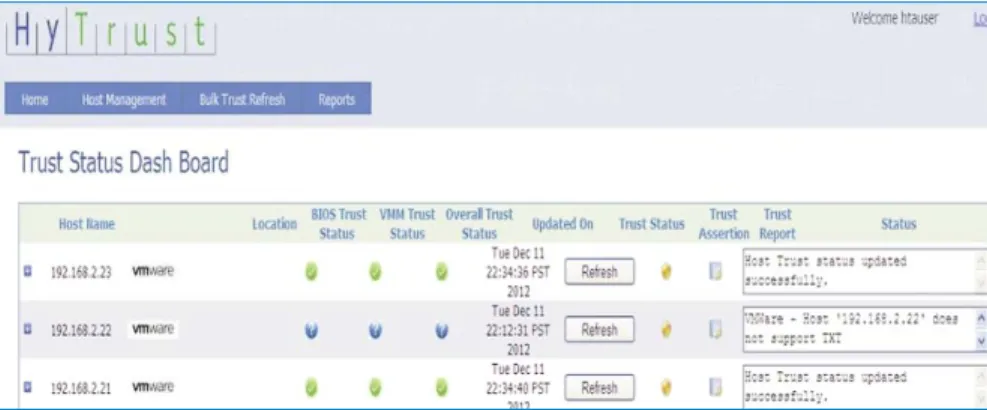
Figure 8. Trust Status Dashboard Indicating Two Trusted and One Untrusted Host
PoC, the team used a prerelease version of the HyTrust Appliance that fully integrates remote attestation capabilities. As shown in Figure 8, the trust status dashboard of the HyTrust Appliance shows an unknown BIOS trust sta-tus, unknown VMM stasta-tus, and overall unknown status for the second Cisco UCS blade, on which the team had consciously dis-abled the Intel TXT support.
For virtualization, the team used VMware vCenter Server 5.1 running on VMware ESXi 5.1, which provides full support and functional-ity for Intel TXT. As discussed earlier, Intel TXT enables platform measurements to detect pos-sible malicious changes to BIOS and other criti-cal base software components of the servers. When executed on an Intel TXT-enabled sys-tem, VMware ESXi measures the critical com-ponents of the hypervisor stack when the sys-tem boots and stores these measurements in the PCR of the TPM on the platform. The measured elements include the VMkernel, ker-nel modules, drivers, native management appli-cations that run on ESXi, and any boot-time configuration options.
The next critical component of the PoC architec-ture is the HyTrust Appliance, which provides extensive support for Intel TXT and also includes the robust policy control functionality for this use case. It essentially establishes the parameters and policies that define the TCP.
Measured Boot for Cisco UCS Systems: Platform Attestation
The PoC used the Cisco UCS M3 blade server, which is a cornerstone for TWSE's cloud com-puting infrastructure. As noted, the Cisco UCS blade systems are fully Intel TXT-enabled and can establish and provide attestation of the integrity and trust of the server and platforms.
Optionally, the TPM provides facilities for provid-ing the trust status to external entities such as management tools, security apps, etc. As dis-cussed, the process of establishing the integrity of the platform is called remote attestation. By providing evidence of the hardware and soft-ware configuration of a platform to an author-ized remote party, remote attestation allows the remote party to establish trust on an Intel TXT-enabled platform. For the PoC, the team disabled Intel TXT on one of the Cisco UCS blades to highlight this differentiation and con-trol capability. A step-by-step summary of how to enable Intel TXT on a Cisco UCS server is included in Appendix A.
Although all of the Cisco blades used in this PoC are fully Intel TXT-capable, it was important to have a contrast of trusted and untrusted servers to differentiate our trusted pools and prove the controls and status reporting mecha-nisms. For this reason, the team disabled Intel TXT in the system BIOS configuration settings in one of the Cisco UCS blades to prohibit the system from executing a trusted launch. For the
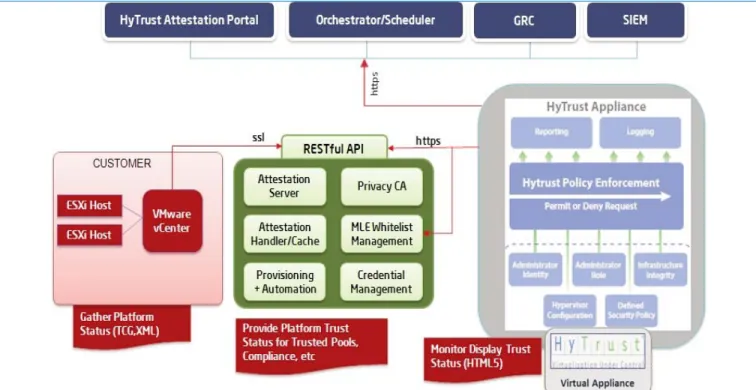
As shown in Figure 9, the HyTrust Appliance manages:
• Critical platform attestationfunctionality
• Whitelisting of known good measurements • Trust operation and report dashboards
for TCPs
• A broad setof other virtualization security controls for workloads, servers, and administrators
Ensuring security and access control instal-lation of any software—including the HyTrust Appliance and all other solutions— requires authentication and access approval. The HyTrust Appliance and solu-tions were used to detect, measure, and report the trust of both the server plat-forms and the hypervisor and to implement workload controls (e.g., VM migration) based on required platform trust attributes.
Figure 9. HyTrust Appliance with Remote Trust Attestation Architecture
9
The team used the HyTrust Appliance to execute the remote attestation process to gather trust data. The results of the platform attestation are represented in the HyTrust Appliance trust status dashboard. As described in the previous section, the remote attestation process provides an inde-pendent evaluation of the integrity measure-ments of the firmware, BIOS, and VMM against known-good (whitelist) and securely makes that assertion available to the HyTrust Appliance poli-cy enforcement and reporting components. The evaluation of the measurements is comprehen-sive and covers:
• The coreof the BIOS
• The BIOSconfigurations • The VMMkernel
• Various VMM modulesthat are loaded as part of the VMware ESXi launch Figure 10 shows a snapshot of the actual measurements of an ESXi server and the whitelist values. Finally, McAfee ePO unifies security management through an open plat-form and simplifies risk and compliance man-agement. Dashboards provide security intelli-gence across endpoints, networks, data, and compliance solutions. It helps to manage security, streamline and automate compliance processes, and increase overall visibility across security management activities. This is the final component needed to meet the security management objectives of the PoC and the business needs of TWSE.
Creating TCPs and Workload Migration
The robust software and functionality of the HyTrust Appliance enabled the team to securely measure trust for both the Cisco UCS server plat-forms and the VMware ESXi (hypervisor). The ability to measure the hypervisor software at boot time and store these measurements in the TPM proved the trustworthiness of the servers, using the inte-grated hardware root of trust and Intel TXT to com-plete the verification of the BIOS and VMM.
• Created TCPswith Intel TXT
• Identified and labeledthe sensitive work-loads that required protection
• Configured trust policiesto establish trust requirements
• Assigned and managed workload migration based on defined trust polices
• Enforced trust policies end-to-end
• Recorded all activities, including audit and compliance, and provide reporting HyTrust automatically assigns the applicable trust status to compute servers and then ensures the separation between trusted and untrusted pools by continuously enforcing policies that identify the trust status.
HyTrust Appliance assigns and manages workload migration based on the defined trust polices, check-ing to see if the predefined trust and operational policies are met before it allows workload migration. Besides displaying the denial information (Figure 11) to allow the request onto an untrusted system, it is critical to point out HyTrust Appliance also applied enforcement policy and did not allow the workload to be migrated due to the established trust security policy. All requests and actions were recorded for future policy reviews, audits, and reporting. The PoC team took a systematic approach to test
each aspect of the TCP use cases. Knowing the trust status of both the servers and hypervisors enabled the team to highlight to TWSE the platform trust information and then define a full and appro-priate set of operational policies and controls. The team applied HyTrust Appliance, which provided tight integration with VMware vSphere and McAfee ePO. This made it possible to fully demonstrate the operational details of the TCPs use cases:
• Creationof TCPs
• Workload placementin the TCPs
• Workload migrationin the TCPs • Integrationwith McAfee ePO
The robust functionality of HyTrust Appliance enables the team to:
• Interceptall administrative requests for the virtual infrastructure
• Determine whether the request was in accor-dance with defined policy
• Permit or denythe request
• Record all administrative access and change requests
To apply effective end-to-end trust policies for the cloud infrastructure, the team:
10
11 For the end-to-end enforcement of trust
poli-cies—including reporting, audit, and compli-ance—the team examined an array of function-al scenarios. It reviewed functionfunction-ality including assigning and managing policies, access level privileges to enable role-based access, hypervi-sor and guest container hardening templates, and policy resources. It also migrated work-loads of both trusted and untrusted compute systems (according to policies) and pools including extending security for overall pass-word control, with use of strong authentication and root password vaulting.
It is important to note that the HyTrust Appliance is integrated with VMware vCenter Server by using the open, plug-in architecture; however, the console for the HyTrust Appliance provides a significantly more detailed set of information for overall policy reporting, auditing, and overall compliance and management functionality. As an example, Figure 12 shows the HyTrust Appliance log viewer, including specific details related to administrator activity.
Integrated and Extended Security and Platform Trust with McAfee ePO
To address TWSE's requirements for overall policy, broader overall trust, security manage-ment, and detailed reporting of its cloud infra-structure, the team used the HyTrust Appliance, which provides extended trust information and enables direct support and reporting with the leading security informa-tion and event management (SIEM) and gov-ernance, risk management, and compliance (GRC) solutions.
The PoC used the HyTrust Appliance to extend and integrate trust information for each hypervisor and the virtualized resource functionality to the McAfee ePO console. This provided TWSE with another common and aggregated management view for its cloud infrastructure.
The direct integration of the HyTrust Appliance dashboard shows users the Intel
Figure 12. HyTrust Appliance Log Viewer in the vCenter Plug-in
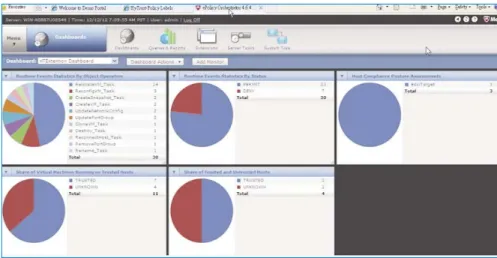
Figure 13. McAfee ePO with Host Trust Status indicated by HyTrust Appliance ePO Extension
TXT trust status of the host on which each VM is running. The HyTrust Appliance assesses compliance by comparing a host’s current configuration with a hardening con-figuration template that was customized based on TWSE requirements to meet partic-ular regulation requirements for control. It then provides assessment data into the
mas-ter McAfee ePO dashboard for reporting and analysis. HyTrust Appliance gives McAfee ePO a record of all administrative activities, including a unique user ID and operations attempted by the privileged user, including denied or failed attempts. Figures 13 through 15 show the HyTrust Appliance integration with McAfee ePO.
Figure 15. McAfee ePO Displaying Drill-Down of Administrator Activity Chart
Figure 14. McAfee ePO Displaying Administrator Activity and Trust Status Captured by HyTrust Appliance
12
McAfee ePO's flexible automation capability streamlines workflows, dramatically reducing the cost and complexity of security and com-pliance administration.
Summary
The PoC completed by a team from TWSE, Systex, Intel, HyTrust, McAfee, VMware, and Cisco successfully highlighted TCP use cases including integrated trust solutions and trust-aware, policy-driven functionality, which are an important foundation for enhanced cloud secu-rity. The outcome of the PoC helped TWSE to gain confidence that such an implementation could help it:
• Address its requirements
• Increase visibility • Gain efficiencies
• Strengthenprotection
• Significantlyincrease overall trust
McAfee ePO's flexible automation capability streamlines workflows, dramatically reducing the cost and complexity of security and com-pliance administration.
The PoC team took a systematic approach to design, implement, and test each aspect of a set of capabilities that began with establish-ing and verifyestablish-ing platform integrity and evolv-ing through incremental TCP use cases. Establishing the trust status of both the servers and hypervisors gave the TWSE team new visibility into the status of the host plat-forms in the cloud. It was then able to define and implement a new set of appropriate oper-ational policies and controls. The implementa-tion allowed for:
13 • Creation of TCPs to segregate
high-integrity servers from those with unknown integrity properties • Workload identificationand
policy-based placement of sensitive work-loads in the TCPs
• Controlled workload migration with sensitive workloads maintained within the TCPs
• Integration with McAfee ePOto pro-vide a consolidated management view of security controls and events
The PoC successfully demonstrated a fully operational, fabric-based Cisco UCS M3 server secured with a hardware root of trust enabled by the Intel TXT feature available in Intel Xeon processors. VMware vSphere 5.1 and VMware ESXi 5.1 provided a crucial foundation and base functionality for Intel’s hardware root of trust security capabilities and Intel TXT.
The built-in capabilities in vSphere 5.1 can also increase performance and streamline
businesses to address their critical business requirements by providing greater overall trust and support for security, policy enforcement, reporting, compliance man-agement, and audits.
In response to the learnings from this PoC, and to address growing demands and mandates form end users and gov-ernment entities for increased security controls for cloud deployments, cloud providers and software vendors, along with a growing ecosystem of technology vendors, are collaborating to develop sys-tems, software, and interoperable solu-tions to support deployment and enable-ment of trusted computing infrastructure. The goal of this emerging infrastructure is to provide greater visibility, control, and compliance capabilities for the cloud, with a strong, bottom-up security posture based on hardware and complemented by new, extensible software solutions. antivirus and antimalware deployment.
Policy-based solutions from HyTrust will enable organizations to address and account for the trust of systems and apply effective, comprehensive, automated poli-cies to manage the provisioning, deploy-ment, and movement of workloads.
HyTrust Appliance provided robust func-tionality and capabilities that addressed TWSE's overall trust and security require-ments. The extended functionality provides, in a secure way, direct and integrated sup-port with VMware vSphere and leading GRC, SIEM, and McAfee ePO solutions.
As it considers how to build out its cloud infrastructure to meet evolving business needs, TWSE has demonstrated with this PoC that a hardware-assisted, trust-enabled infrastructure can provide powerful new capabilities and controls to address security concerns with the cloud. Other businesses and organizations will be able to benefit from Intel TXT-enabled systems and inte-grated solutions such as TCPs that enable
Find the solution that’s right for your organization. Contact your Intel representative, visit Intel’s Business
Success Stories for IT Managers (www.intel.com/Itcasestudies), or explore the Intel.com IT Center
14
Appendix A: Overview of Steps for Intel TXT and TPM Configuration for Cisco UCS Systems
Below are primary steps to manually provi-sion Intel TXT in the BIOS and establish the appropriate TPM configuration of a Cisco UCS blade server. Please note, if this is a new Cisco blade server being deployed, you do not have to clear TPM ownership. Please go directly to Step 5. Once systems are con-figured and Intel TXT is enabled on a Cisco UCS blade server, you are ready to install a trusted hypervisor or operating system ker-nel to establish a server configuration that is rooted in hardware trust.
Step 1: F2 to Enter BIOS
Step 2: Advanced > Trusted Computing > Pending Operation > TPM Clear
Step 3: F10 Save and Exit Step 4: F2 to enter BIOS
Step 5: Advanced > Trusted Computing > TPM Support > Enable
Step 6: F10 Save and Exit
Step 7: F2 to enter BIOS
Step 8: Advanced > Trusted Computing > TPM State > Enable
Step 9: F10 Save and Exit Step 10: F2 to enter BIOS
Step 11: Advanced > Trusted Computing > Pending Operation > Enable Take Step 12: Advanced > Intel TXT (LT-SX) Configuration
15
Appendix B: VMware Software Solutions
VMware delivers a comprehensive set of customer-proven solutions that help IT organizations better manage virtual envi-ronments while protecting critical data and workloads:
• VMware ESX and VMware ESXi hypervisorsallow enterprises to use their own security certificates when securing remote sessions. The user name, password, and network packets sent to a VMware ESX server over a network connection when using the VMware Remote Console or the VMware Management Interface are encrypted in the VMware ESX server by default when medium- or high-security settings are activated for the server.
• VMware vCenter Servergives IT administrators unprecedented visibility and centralized control of every level of the VMware vSphere virtual infra-structure. It provides granular privilege management that limits who can deploy virtual machines to specific clouds and storage devices. Combined with well-defined operational process-es and work flows, thprocess-ese capabilitiprocess-es can provide maximum mobility for vir-tual machines while managing risk.
• VMware vCenter Lifecycle Manager
enables IT administrators to track own-ership of virtual machines and to keep records of when virtual machines are created, deployed, and decommissioned. • VMware vShield Zonesallow for
con-venient, centralized management by providing highly granular views of the entire virtual machine and virtual net-work deployment, easing configuration of zone-based policies and reducing the risk of errors.
Appendix C: McAfee ePO
The solution provides end-to-end visibility through a unified view of your security posture. Drillable, drag-and-drop dash-boards provide security intelligence across endpoints, data, mobile, and networks for immediate insight and faster response times. Simplified security operations help streamline workflows for proven efficien-cies. Benefits include:
• End-to-end visibility. Get a unified view of your security posture. Drillable, drag-and-drop dashboards provide security intelligence across endpoints, data, mobile, and networks for immediate insight and faster response times.
• Simplified security operations.
Streamline workflows for proven effi-ciencies. Independent studies show ePO software helps organizations of every
size streamline administrative tasks, ease audit fatigue, and reduce security management-related hardware costs. • An open, extensible architecture. Use
your existing IT infrastructure. McAfee ePO software connects management of both McAfee and third-party security solutions to your LDAP, IT operations, and configuration management tools.
Appendix D: HyTrust Appliance
The HyTrust Appliance is a virtual appli-ance. VMware vSphere-compatible, it sits between the administrators of the virtual infrastructure—the virtualization adminis-trators, the network adminisadminis-trators, the application owners—and the virtual infra-structure itself, in the management net-work.
HyTrust Appliance can verify the integrity of the physical hardware and hypervisor of the host to ensure that the platform is fully trusted. It provides the ability to label virtual machines, as well as other virtual resources, and then apply policies to those labels. Combined with hardware root-of-trust, HyTrust Appliance provides the ability to verify the trust of the hardware and hyper-visor layer using Intel TXT and ensures total platform integrity of the virtual platform.
16
Figure D1 shows the HyTrust Appliance inline deployment.
The HyTrust Appliance has a robust array of extended functionality that addresses the overall TWSE business requirements and makes it possible for TWSE to apply trust policies and security operations for its cloud infrastructure.
Besides highlighting the use cases, the team also showcased how hardware-based security enabled with the HyTrust Appliance delivers extended capabilities including:
• Verifying platform integrityis trusted via Intel TXT
• Ensuring the hypervisor is hardened
and the virtual infrastructure is trusted via Intel TXT
• Enforcing consistent administrative accessand authorization policies cov-ering all access methods
• Providing granular, user-specific, audit-quality logs of all administrative access
• Enabling strong, multi-factor authentica-tion
• Securing privileged user access of the hypervisor through root password vaulting
With the HyTrust Appliance, there are no anonymous changes to the virtual infrastruc-ture. All administrative access must first be authenticated, supporting two-factor authentication. Access to the entire environ-ment may be tied back to a specific individ-ual—a critical requirement in security and • Enabling additional oversight for
highly sensitive operations via second-ary approval
• Enforcing infrastructure segregation
for trusted compute pools and multi-tenancy use-cases
17 compliance-conscious data centers. As the
central authority over all change requests, the HyTrust Appliance provides granular, user-specific log records that can be used for regulatory compliance, troubleshooting, and forensic analysis. It offers an
unprece-information is collected. With total visibili-ty from HyTrust, organizations can accom-plish their audits and rely on their logs for forensics if needed.
Learn more at www.hytrust.com. dented level of visibility into the state of
the virtual infrastructure.
The HyTrust Appliance records all requests, which are critical for security purposes. Every request is tied to the identity of a specific user and all relevant
bined with other products.
Results have been estimated based on internal Intel analysis and are provided for informational purposes only. Any difference in system hardware or software design or configu-ration may affect actual performance.
Intel does not control or audit the design or implementation of third-party benchmark data or Web sites referenced in this document. Intel encourages all of its customers to visit the referenced Web sites or others where similar performance benchmark data are reported and confirm whether the referenced benchmark data are accurate and reflect per-formance of systems available for purchase.
INFORMATION IN THIS DOCUMENT IS PROVIDED IN CONNECTION WITH INTEL PRODUCTS. NO LICENSE, EXPRESS OR IMPLIED, BY ESTOPPEL OR OTHERWISE, TO ANY INTELLECTU-AL PROPERTY RIGHTS IS GRANTED BY THIS DOCUMENT. EXCEPT AS PROVIDED IN INTEL'S TERMS AND CONDITIONS OF SINTELLECTU-ALE FOR SUCH PRODUCTS, INTEL ASSUMES NO LIABILI-TY WHATSOEVER AND INTEL DISCLAIMS ANY EXPRESS OR IMPLIED WARRANLIABILI-TY, RELATING TO SALE AND/OR USE OF INTEL PRODUCTS INCLUDING LIABILILIABILI-TY OR WARRANTIES RELATING TO FITNESS FOR A PARTICULAR PURPOSE, MERCHANTABILITY, OR INFRINGEMENT OF ANY PATENT, COPYRIGHT OR OTHER INTELLECTUAL PROPERTY RIGHT. A "Mission Critical Application" is any application in which failure of the Intel Product could result, directly or indirectly, in personal injury or death. SHOULD YOU PURCHASE OR USE INTEL'S PRODUCTS FOR ANY SUCH MISSION CRITICAL APPLICATION, YOU SHALL INDEMNIFY AND HOLD INTEL AND ITS SUBSIDIARIES, SUBCONTRACTORS AND AFFILIATES, AND THE DIRECTORS, OFFICERS, AND EMPLOYEES OF EACH, HARMLESS AGAINST ALL CLAIMS COSTS, DAMAGES, AND EXPENSES AND REASONABLE ATTORNEYS' FEES ARISING OUT OF, DIRECTLY OR INDIRECTLY, ANY CLAIM OF PRODUCT LIABILITY, PERSONAL INJURY, OR DEATH ARISING IN ANY WAY OUT OF SUCH MISSION CRITICAL APPLICATION, WHETHER OR NOT INTEL OR ITS SUBCONTRACTOR WAS NEGLIGENT IN THE DESIGN, MANUFACTURE, OR WARNING OF THE INTEL PRODUCT OR ANY OF ITS PARTS. Intel may make changes to specifications and product descriptions at any time, without notice. Designers must not rely on the absence or characteristics of any features or instructions marked "reserved" or "undefined". Intel reserves these for future definition and shall have no responsibility whatsoever for conflicts or incompatibilities arising from future changes to them. The information here is subject to change without notice. Do not finalize a design with this information.
The products described in this document may contain design defects or errors known as errata which may cause the product to deviate from published specifications. Current characterized errata are available on request.
Contact your local Intel sales office or your distributor to obtain the latest specifications and before placing your product order.
Copies of documents which have an order number and are referenced in this document, or other Intel literature, may be obtained by calling 1-800-548-4725, or go to: http://www.intel.com/design/literature.htm