3D Problems of Rotating Detonation Wave in a Ramjet Engine
Modeled on a Supercomputer
Valeriy F. Nikitin1,2, Yurii G. Filippov1, Lyuben I. Stamov1,2, Elena V. Mikhalchenko1,2
c
The Authors 2018. This paper is published with open access at SuperFri.org
A rotating detonation engine (RDE) combustion chamber was modeled in the work numeri-cally using 3D geometry. The RDE is a new type of engines capable to create higher thrust than the traditional ones, which are based on the combustible mixture deflagration process. In the nu-merical experiment, different scenarios of the engine performance were obtained. The calculations were made at a compact supercomputer APK-5 with a peak performance of 5.5 Tera Flops.
Keywords: Mathematical Modeling, Detonation, Deflagration, RDE, Ramjet.
Introduction
The optimization of modern engines based on the traditional design is now close to its technological limit. The engines performance may be increased only with the use of radically new technical solutions [1]. One of those solutions is the development of detonation engines; we deal with an engine with a rotating detonation [2]. The rotating detonation engine is being investigated extensively during the last decades; see works [3, 4].
The numerical modeling of the processes in a combustion chamber is an important stage in the investigation of its design and further usage. The mathematical model includes equations for multicomponent gas mixture, it considers chemical reactions and turbulent transport of mass, momentum and energy. In order to resolve such events as detonation cells development and thin wave con-figurations, one should have a rather thin computational mesh, and it contributes to the complexity. Therefore, the problem should be solved using big computational resources, high precision approximation schemes, and effective parallelization methods: OpenMP, MPI, CUDA, etc. In order to solve such problems, the authors have created a parallel code with the AUSM [5], the MUSCL [6] methods incorporated. The current research uses the OpenMP version of the computer program.
1. Mathematical Model
The mathematical model contains the governing equations (differential and algebraic), boundary and initial conditions. The details of the numerical realization together with the com-putational mesh design and the placement of variables on the mesh, is a subject of the numerical model.
1.1. The Balance Equations
To model a multicomponent gas mixture, we use the following system of balance equations:
∂ρk ∂t +
∂ ∂xj
(ρkuj)− ∂Jkj
∂xj
= ˙ωk, (1)
1Lomonosov Moscow State University, Moscow, Russia 2SRISA RAS, Moscow, Russia
∂ρui ∂t +
∂ ∂xj
(ρuiuj) + ∂p ∂xi −
∂τij ∂xj
= 0, (2)
∂ET ∂t +
∂ ∂xj
((ET +p)uj)− ∂ ∂xj
(JT j +uiτij) = ˙Q. (3)
Hereρk is partial density of a speciesk,Jkj are vector components of the specieskdiffusion flux, ˙ωk is the intensity of the species k origination in chemical reactions, ρ is the gas mixture density, uj are vector components of gas velocity, p is the mixture pressure, τij are the tensor components of viscous and turbulent stresses,ET is total energy of the gas volume unit consisting of thermal, chemical, kinetic and turbulent energy, JT j are vector components of the energy diffusion flux, ˙Qis the heat flux from an external source.
1.2. Additional Algebraic Relations
Density of mixture is a sum of partial densities, and it is useful to introduce two types of concentrations: mass shares of species, and molar densities:
ρ= NC
X
k=1
ρk, Yk= ρk
ρ , Xk= ρk Wk
. (4)
Here: Ykis the mass share of the species k,Xk is the molar density (in terms of many works on chemical kinetics it is named a molar concentration), Wk is the molar mass of a species.
The pressurepis defined as the spherical part of the stresses tensor, with the opposite sign. It is a sum of thermal pressure ˆp of perfect gases mixture, and an additive corresponding to turbulent pulsations, which is modeled by means of the turbulent energy per mass unit K:
p= ˆp+2
3ρK, pˆ=RGT NC
X
k=1|
Xk. (5)
The total energy of a volume unit is the following sum:
ET =E+ρ u2
2 +ρK, u
2=u
juj. (6)
The total energyET is therefore the sum of internal (thermal and chemical) energy, kinetic, and turbulent energy. The internal energy of a volume unit is modeled as follows:
E = NC
X
k=1
XkEk= NC X k=1 Xk ˆ
Hk(T)−1
. (7)
1.3. Chemical Kinetics
In the current research, the chemical sources ˙ωk depend on temperature T and the set of molar densities Xk; the sum of those sources is zero due to the law of mass conservation in chemical reactions:
˙
ωk=Wkωˆk(T, Xj), NC
X
k=1
˙
ωk = 0. (8)
Here ˆωk is the intensity of a species mole origination in a volume unit.
Some more strict laws for chemical interactions exist, e.g. the conservation of mass for each element. Those laws are considered in the chemical mechanism, and sometimes can reduce the computation effort and increase the precisity. A general form for the chemical sources is usually complex, and it consists of many nonlinear terms; a typical expression is as follows:
ˆ ωk=
NR
X
r=1
νrkωr, ωr =Mr(Xj)
"
kF r(Mr, T) NC
Y
i=1
Xiαri−kBr(Mr, T) NC
Y
i=1
Xiβri
#
. (9)
Here, ωr is the reaction r speed (intensity), νrk is an algebraic stoichiometric coefficient for a specieskin the reactionr, this coefficient is positive for the species being produced, and negative for those being consumed. Mr is the influence coefficient of non-changing components, which is equal to unity in the lack of such an influence, kF r is the direct reaction speed coefficient; it usually depend on temperature only, but for some falloff reactions it depends onMr,kBr is the reverse reaction speed, αrk are degrees for species in a direct reaction (usually but not always they are non-zero for the input species), βrk are the degrees for the reverse reactions.
In case of elementary reactions, the degrees for species in the expression (9) are the same with the input and output stoichiometric coefficients. The reverse reaction speed coefficients were calculated to provide the reach of the dynamical chemical equilibrium in the case of zero external fluxes and constant density and internal energy; the following expression was used:
kBr=kF rexp
"NC X k=1 νrk ˙
Hk(T)−S˙k(T)−1
# RGT
pref
!νr
, νr= NC
X
k=1
νrk. (10)
The entropy dimensionless coefficients ˆSkare constructed like ˆHkfrom data in [7] using formulae from [9].
For each direct reaction, its coefficient is modeled with an extended Arrhenius formula:
kF r=ArTBrexp
−Θr
T
, (11)
where the reaction activation temperature Θr is derived from the activation energy as Θr = Ear/RG.
1.4. Turbulence Model and Transport
The current research uses the Wilcox ka-omega model [10]:
∂ρK ∂t +
∂ ∂xj
(ρKuj)− ∂ ∂xj
(µ+σ∗µT) ∂K ∂xj
!
=τijT ∂ui ∂xj −
β∗ρKω, (12)
∂ρω ∂t +
∂ ∂xj
(ρωuj)− ∂ ∂xj
(µ+σµT) ∂ω ∂xj
!
=αω Kτ
T ij
∂ui ∂xj −
µT =ρ K
ω. (14)
Here K is the kinetic energy of pulsations per mass unit, µis the molecular viscosity of the gas mixture, µT is the turbulent (eddy) viscosity, τijT is the turbulent part of the stresses tensor, ω is the intensity of the turbulent energy decay (dissipation) far away from walls and in lack of the turbulent energy input sources, parameters
α= 5
9, σ=σ
∗ = 1
2, β = 3 40, β
∗ = 9
100
are constant parameters of the standard Wilcox model. The turbulent part of the stresses tensor deviator is:
τijT =µT ∂ui ∂xj
+∂uj ∂xi −
2 3 ∂uk ∂xk δij ! − 2
3ρKδij, (15)
where δij is the Kronecker symbol.
The molecular viscosity of the gas mixture is calculated using the pure species viscosity µk(T) and molar densities Xk as:
µ= NC
X
k=1
µkXk NC
X
j=1
φkjXj
. (16)
The effective mixture viscosity is lower than the weighted average due to the binary influence coefficients φkj. A simple method to compute them was published in [11]:
φkj = 1
√
8 1 + Wk Wj
!−1 2
1 + µk µj
!1
2 W
j Wk 1 4 2 . (17)
A molecular viscosity is calculated using physical molecular constants taken from the database [12], and the method of computation was taken from [11].
To calculate the fluxes of mass and energyJkj andJT j, and the stresses tensor deviatorτij, we used a model taking into account the turbulent transport calculated by means of the Wilcox model [10]. In most cases, the turbulent transport supersedes the molecular, and the last is made using simplified technique using constant Prandtl Pr and Schmidt Sc numbers hypothesis [13]:
Jkj =
µ Sc + µT ScT ∂Y k ∂Xj , (18)
JT j =
µ Pr+ µT PrT ∂h ∂Xj
+ (µ+µT) ∂K ∂xj
, (19)
τij = (µ+µT) ∂ui ∂xj
+ ∂uj ∂xi −
2 3 ∂uk ∂xk δij ! −2
3ρKδij. (20)
Here, ScT, PrT are constant turbulent Schmidt and Prandtl numbers,his the enthalpy per mass unit; the last is computed as follows:
h= RGT ρ
NC
X
k=1
1.5. The Species List and the Kinetic Mechanism
Hydrogen, oxygen and nitrogen were the initial and the inflow mixture components. In the process of combustion, besides the main product, water vapor, numerous products (radicals) are originated; at high temperature they still persist in the mixture, and at lower temperature they decay. We used the following set of species:
{H2O, OH, H, O, HO2, H2O2;H2, O2, N2}.
The research used a kinetic mechanism described in the Maas & Pope work [14] (1992). The mechanism consisted of 20 reversible elementary reactions.
2. Results
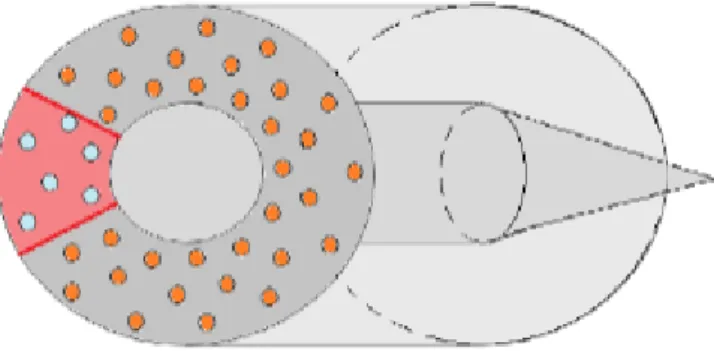
A model combustion chamber of a ramjet detonation engine was treated as a test. Geometri-cally, it is a hollow cylinder with the cylindrical internal body, which ends up as a cone. The fuel flow into the chamber through numerous injectors (premixed rich composition [H2] : [O2] = 3 : 1,
stagnant pressure 10 bar, stagnant temperature 258 K, Mach number at each orifice 1). At the initial instance, the chamber is filled with air at 1 bar pressure and 300 K temperature. The igni-tion is made by means of an external energy source into a small spherical porigni-tion: rign= 2.5 mm after a delay of 10µs from the initial instance, and duringtign= 1µs, and with power per volume as high as Q= 20 kW/mm3.
Figure 1.The combustion chamber geometry
The work area length was L = 10 cm, the maximal radius of the work area R = 2.5 cm, the inner body radius Rb = 1.5 cm, the inner body length without the terminating cone was Lb = 3 cm, the terminating cone lengthL= 3 cm, the number of injectorsNr = 72, their orifices radii were r = 0.2 cm. The test problem was solved on a structured cubic cells mesh made of
≈1.3·106 cells; the size of a cell was 0.5 mm.
In order to force detonation wave propagation in one direction, initially all the orifices were closed, then they are open in turn depending on their angular co-ordinate so that the whole ring is open by 30 µs from the beginning.
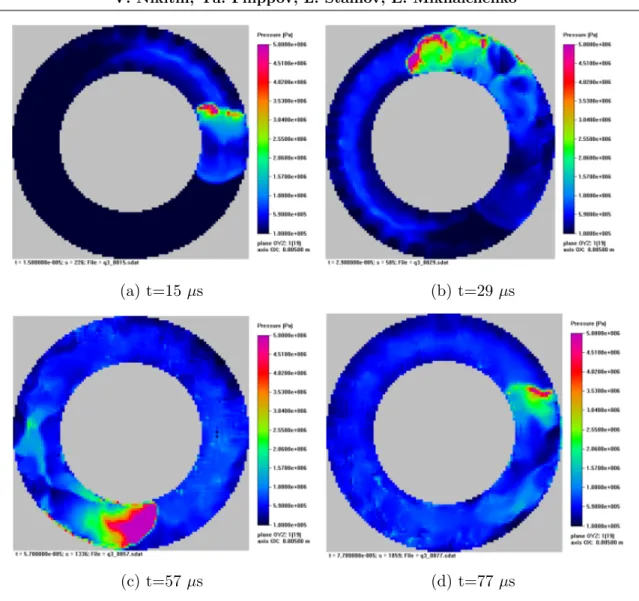
The Fig. 2 shows pressure in the ramjet engine combustion chamber for different times shown in a cross section OY Z at the distance of 0.5 cm from the injectors end.
(a) t=15µs (b) t=29µs
(c) t=57µs (d) t=77µs
Figure 2.Pressure in the cross section
it goes weaker due to lower amount of combustible mixture ahead (Fig. 2d). Still it propagates without extinguishing.
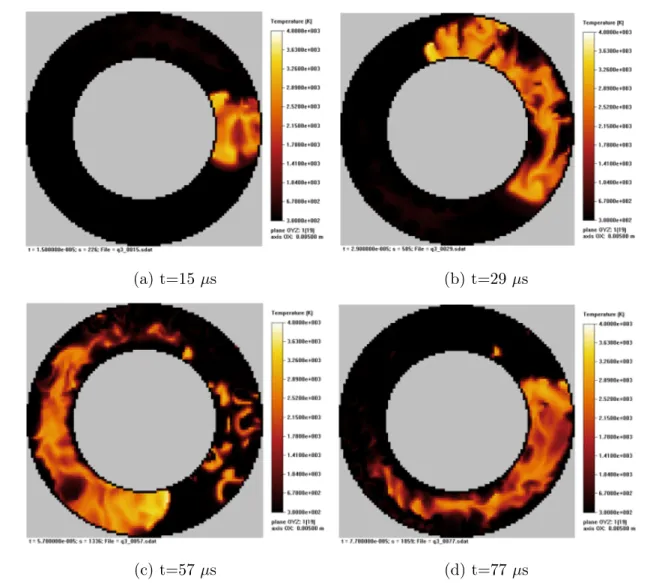
The Fig. 3 shows temperature in this cross section at the same times.
The Fig. 3 shows that a portion of high temperature propagates counter-clockwise as the detonation wave, but the high temperature goes also clock-wise with lower velocity (Fig. 3a – Fig. 3b). Then, the temperature far behind the detonation wave decreases gradually due to the displacement of hot products of combustion with a fresh combustible mixture. This process is highly turbulent, and portions of hot products of combustion still remain in this cross section (Fig. 3c). When the detonation wave rotates once, the structure of the temperature field behind the wave in this cross section becomes more regular, but there still exist hot spots ahead of the wave; however, it propagates stably in the fresh mixture (Fig. 3d).
The Fig. 4 shows 3D distribution of pressure (Fig. 4a) and temperature (Fig. 4b), att= 57µs from the beginning of the process.
(a) t=15µs (b) t=29µs
(c) t=57µs (d) t=77µs
Figure 3. Temperature in the cross section
(a) 3D view of pressure at t= 57µs (b) temperature at t= 57µs
Figure 4. 3D view of pressure and temperature att= 57µs
For the given parameter set, we obtained a detonation wave rotating around the bottom of the combustion chamber. In the beginning, a stable detonation wave originates, at first circu-lation its strength increases due to the increasing amount of fresh micture ahead of it. Then, it decreases due to much lower fresh mixture because the previous mixture was consumed one circulation before, and the new portion of it is much fewer than the initial. In some time after 70 µs the primary detonation wavet splits into two, even 3 waves, which then join into a single detonation wave. After that, in some time the process repeats: lateral waves reflections from walls contribute to it. As the result, we have obtained a galloping regime of rotating detonation.
2.1. The Calculating System
The calculations were performed at a computational system with two INTEL Xeon E5-2650 processors with 8 computational cores and 16 threads in each, and on a computational node of a native supercomputer APK-5 [15]. The fig. 5 shows the results of a computational test on both: acceleration due to the number of OpenMP threads, against a single thread. The time stepping algorithm was organized into 4 main cycles by cells and faces; the last cycle assembling all the fluxes together and creating the new state of parameters. The promotion to the 2nd order approximation in time was made repeating this algorithm once more with some modifications; the details are shown in [16] and [17].
The modeled configuration included more than 9 million cells.
(a) acceleration for the server node (b) acceleration for the APK-5
Figure 5. Acceleration for the server node and for the APK-5
It is seen that for the number of processes given, the acceleration is near linear. This is due to the explicit numerical scheme used in calculations. We obtained more than 6 times acceleration on the server system, and more than 12 times acceleration on the computer 5. The APK-5 node acceleration is better due to high frequency of processors and its new architecture in comparison with the processors of the another server node.
Conclusions
The problem is computationally complex; the mathematical model includes multi-component gas dynamics, with the addition of the transport terms, the chemical kinetics, and the turbulence modeling. The following is obtained:
• The combustion chamber is a hollow cylinder; the inner body is cylindric, transfering to a cone. In case the fresh combustible mixture is inflown via the orifices which are open in turn, and not simultaneously, we obtained a detonation wave propagating in one direction.
• The detonation wave between two coaxial cylinders rotates consuming the fresh mixture. After one circulation, the thickness of the fresh mixture is rather small, due to a high velocity of detonation, and a small enough radius of circulation so that the time of one rotation was about 50 µs.
• Due to this, the strength of the detonation wave decreases after the first rotation. However, a stable inflow of cold fresh mixture causes the detonation wave to propagate even after the initial combustible mixture is consumed.
• Some hot spots initiate detonation in the fresh mixture ahead of the main wave so that it can split in two and even more other waves. The galloping detonation originated in some time.
• The numerical scheme was explicit, and the computational acceleration using OpenMP parallelization paradigm was nearly linear on both devices we have tested.
Acknowledgements
The work was made with the support of the RFBR grant no. 18-07-00889.
This paper is distributed under the terms of the Creative Commons Attribution-Non Com-mercial 3.0 License which permits non-comCom-mercial use, reproduction and distribution of the work without further permission provided the original work is properly cited.
References
1. Bulat, P. V., Volkov, K. N.: Detonation jet engine. Part 2 construction features. In-ternational Journal of Environmental and Science Education (IJESE) 11(12), 5009–5019 (2016), https://istina.msu.ru/publications/article/42853937, accessed: 2018-05-15
2. Roy, G., Frolov, S.: Deflagrative and Detonative Combustion. Torus Press, Moscow (2010)
3. Wolanski, P., Kindracki, J., Fujiwara, T., Oka, Y., Shimauchi K.: An experimen-tal study of rotating detonation engine. 20th International Colloquium on the Dynam-ics of Explosions and Reactive Systems 31 July – 5 August, 2005, Montreal, Canada (2005), http://www.icders.org/ICDERS2005, accessed: 2018-05-15
4. Frolov, S.M., Dubrovskii, A.V., Ivanov, V.S.: Three-dimensional numerical simulation of the operation of the rotating-detonation chamber. Russian Journal of Physical Chemistry B 6(2), 276–288 (2012), DOI: 10.1134/S1990793112010071
6. Hirsch, C.: Numerical computation of internal and external flows, 2nd Edition. Wiley (1990)
7. Marinov, N.M., Pitz, W.J., Westbrook, C.K., Hori, M., Matsunaga, N.: An experimental and kinetic calculation of the promotion effect of hydrocarbons on the NO-NO2 conver-sion in a flow reactor. Symposium (International) on Combustion 27(1), 389–396 (1998), DOI: 10.1016/S0082-0784(98)80427-X
8. Kee, R.J., Miller, J.A., Jefferson, T.H.: Chemkin: a general-purpose, problem-independent, transportable Fortran chemical kinetics code package. Sandia National Laboratories Report SAND80-8003 (1980)
9. CHEMKIN. A software package for the analysis of gas-phase chemical and plasma ki-netics. CHE-036-1. Chemkin collection release 3.6. Reaction Design, September 2000
10. Wilcox, D.C.: Turbulence modeling for CFD. DCW Industries, Inc. La Canada (1993)
11. Transport. A software package for the evaluation of gas-phase, multicomponent transport properties. TRA-036-1, CHEMKIN collection, release 2000
12. Connaire, M. O., Curran, H J., Simmie, J. M., Pitz, W. J., Westbrook, C.K.: A compre-hensive modeling study of hydrogen oxidation. International Journal of Chemical Kinetics 36(11), 603–622 (2004), DOI: 10.1002/kin.20036
13. Smirnov, N.N., Nikitin, V.F., Alyari-Shourekhdeli, S.: Transitional regimes of wave prop-agation in metastable systems. Combustion, Explosion, and Shock Waves 44(5), 517–528 (2008), DOI: 10.1007/s10573-008-0080-3
14. Maas, U., Pope, S.: Simplifying chemical kinetics: Intrinsic low-dimensional manifolds in composition space. Combustion and Flame 88(3), 239–264 (1992), DOI: 10.1016/0010-2180(92)90034-M
15. APK-5 documentation. http://compcenter.org/super-evm-apk-5, accessed: 2018-05-15
16. Smirnov, N.N., Penyazkov, O.G., Sevrouk, K.L., et al.: Detonation onset following shock wave focusing. Acta Astronautica 135, 114–130 (2017), DOI: 10.1016/j.actaastro.2016.09.014