BIOMETRIC AND MORHOLOGIC OBSERVATIONS ON
PRUNUS
ARMENIACA
L. ‘MAMAIA’ (ROSACEAE) LEAVES
RODICA BERCU
Faculty of Natural and Agricultural Sciences,”Ovidius” University, Constantza, E-mail:[email protected]
Keywords: foliar biometry,measurements, lamina, mathematical calculation, Prunus armenica ‘Mamaia’
ABSTRACT
The paper discloses a research model of leaf investigation, based on biometrical measurements and morphological observations. There are only a few examples of this type of biometrical investigation and analysis model applied on spontaneous plants leaves in literature. The article comprises biometrical and morphologic investigations on a cultivar species Prunus armeniaca L.‘Mamaia’ leaves. The measurements and observations were performed on 40 mature leaves of the studied species, including linear measurements, percentage ratio, angular measurements and the leaf surface as well. The biometric measurements were the basis of a mathematical calculation of the average values on the studied species.
INTRODUCTION
The paper discloses a research model of leaf investigation, based on biometrical measurements and morphological observations. The biometrical measurements were performed onPrunus armeniacaL ‘.Mamaia’(fam. Rosaceae).
Prunusarmeniaca L. - apricot (syn. Armeniaca vulgaris Lam.) is native to North China. Some historical sources indicate that he would have been introduced into Europe by the Romans (Lu and Bartholomew, 2003). Other historical sources deemed Prunusarmeniaca were brought Alexander the Great in Greece (Ensminger et al., 1994). Growing apricot apparently began in the nineteenth century in sandy desert regions in Spain and Italy.There are tall trees from 5 to 8 m or even 12 m, with a spherical or oblong or flattened elongated crown, wide and thick. The bark is gray-brown with longitudinal recesses. The leaf is green, ovate, with both
sides hairless. The glabrous petiole is short and has 2 nectarines at the base. The flower petals are white or pale pink rarely solitary or grouped two by 2 to 4.5 in diameter. The fruit -drupe yellow orange red shade (1.5 or 2.5 in diameter) that can be covered by bristles, enclosing a single seed (Lu and Bartholomew, 2003; Savuescu, 1957; Niculescu, 2009; Web 1).
Prunusarmeniaca 'Mamaia' is a Romanian origin sort approved in 1975 at the Research and Development Fruit Growing (RDFG), ValulluiTraian (Constantza County).
Average force are trees, crown spherical diffuse and fruiting branches combined short and long (Fig. 1). The fruit is round to ovoid- shaped, with a medium to
large size and 45-60 g weight. The exocarp is yellow- orange with much carmine red on the sunny side.The mesocarp is orange, very succulent and flavorful, adhering to the
endocarp. The fruits are suitable for both fresh consumption and for industrial processing -jam and nectar.
Many sets of terms and methods have been devised for describing leaves (e.g. Dale et al. 1971; Dickinson et al., 1987; Hickely, 1973; Melville, 1976; Roth & Dilcher, 1978). In Romanian literature there are few examples of this type of leaf investigation and analysis model applied on spontaneous plants leaves (Bercu, 2005; Bercu and Bavaru, 2007; Bercu 2013a,b), mostly of them being paleontological studies (Givulescu, 1999, Givulescu & Soltesz, 2000). Some data refers to general biometric features such as lamina venation, mentioned in lectures and manuals of Anatomy and morphology of plants or Morphology of plants (e.g. Andrei, 1997; Buia & Péterfi, 1965; Ianovici et al. 2015a,b; Niculescu, 2004).
The purpose of this paper is to highlight the features of the leaf of Prunusarmeniaca 'Mamaia' and to contribute with more informationto complete the morphological knowledge concerning this species.
MATERIALS AND METHODS
The morphological observations and morphometric measurements were performed on 40 mature leaves of Prunusarmeniaca 'Mamaia', collected from Valul lui Traian Research and Development Fruit Growing, Conatanrza County in september 2015. The methods and terms for the leaves description form and venation are largely from the leaf architectural system of Mounton (1966a,b, 1976). The biometrical measurements which had been calculated are: the linear measurements: L- leaf length, l- leaf width, h- the height of the maximum width of lamina; A- the apex length, I-I’- the apex width; Lp- the petiole length, followed by the percentage ratios: L/l- the length-width ratio (the leaf finesse); A/L-the acuminate ratio, h/L- A/L-the ovality ratio; A/I-I’- A/L-the tip finesse. The angular measurements: α- the apical angle, β- the emergent angle of the secondary veins with primaries, ɣ- the emergent angle of the tertiary veins related to the primary one and finally other measurements: the number semi-sum of secondary veins pairs (Np) and the lamina surface (S).
RESULTS AND DISCUSSION
Biometrical observations. The biometrical measurements performed on
Prunusarmeniaca 'Mamaia' 40 leaves (Table 1, 2), represented the mathematical
calculation base for the values average (Tables 3 and 4):
a. Linear measurements (Fig. 2, b; Table, 3):
mm n L L n L L n n i PcM
PcM 100,225
40 101 ... ... 97 ... ... 1 1 ____
mm n l l n l l n n i PcMPcM 76,075
40 70 ... ... 55 ... ... 1 1 _____
mm n h h n h h n n i PcMPcM 48,325
40 48 ... ... 40 ... ... 1 1 ____
mm n A A n A A n n i PcMPcM 21,275
40 24 ... ... 11 ... ... 1 1 ____
mm n I I I I n I I I I n n i PcMPcM 26,75
40 26 ... ... 9 ' ... ... ' ' ' 1 1 ________
mm n Lp Lp n Lp Lp n n i PcMPcM 45.30
b. Percentage ratios (Table 3): % 075 . 1 40 44 . 1 ... ... 76 . 1 ... ... 1 1 _____
n l L l L n l L lL n n
i PcM PcM % 19 . 0 40 23 . 0 ... ... 11 . 0 ... ... 1 1 _____
n L A L A n L A LA n n
i PcM PcM % 47 . 0 40 74 . 0 ... ... 41 . 0 ... ... 1 1 _____
n L h L h n L h Lh n n
i PcM PcM % 80 . 0 40 92 . 0 ... ... 22 . 1 ' ... ... ' ' ' 1 1 _____
nI I A I I A n I I A I I
A n n
i
PcM PcM
c. Angular measurements (Fig. 2, c: Table 4):
o n n i PcM PcM n
n 40 77
65 ... ... 86 ... ... 1 1 ____
o n n i PcM PcM nn 40 45
55 ... ... 50 ... ... 1 1 ____
o n n i PcM PcM nn 40 108
11 ... ... 106 ... ... 1 1 ____
d. Other measurements (Table 4):
veins n Np Np n Np Np n n i PcM
PcM 8.80sec.
40 11 ... ... 9 ... ... 1 1 ____
cm teeth n D D n D D n n i PcMPcM 6.17 /
40 6 ... ... 5 ... ... 1 1 ____
2 1 1 ____ 87 . 51 40 39 . 62 ... ... 74 . 35 ... ... cm n S S n S S n n i PcM PcM
Size class = Mesophyll
Table 1
Liniar measurements onPrunusarmeniaca'Mamaia' leaves
Leaf No. L mm
l mm
h mm
A mm
I-I’ mm
Lp mm
L/l %
A/L %
h/L %
Table 2
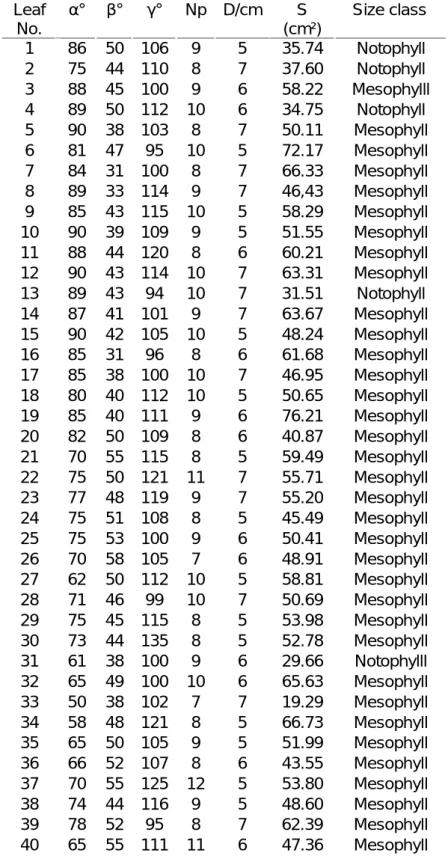
Percentage ratio, angular measurements, other measurements and the size class ofPrunusarmeniaca 'Mamaia' leaves.
Morphological observations. Laminas are framed dominant in mesophyll size class (S = 40.87 – 76.21 cm²), occasionally notophyll and microphyll (Table 2, 4). Mouton
Leaf No.
α° β° γ° Np D/cm S (cm²)
Size class
2.25 cm2), microphyll (2.25 20.25 cm²), notophyll (20.25 40 cm²), mesophyll (40 -182.25 cm2), macrophyll (182-1640.2 cm2) and megaphyll (over 1600.2 cm2). Laminas are glabrous, green adaxially and slightly light green abaxially (Fig. 2, a-c), with a large ovate shape, (the maximum width is in the upper part of the lamina), with an ovalityreport average (h/L) 0.47%, ending in a finesse (A/I-I’ = 0.80%), acuminate and sharp apex (α = 61 - 80o) (Table 1, 2). The base is cuneate with crenate serrate margin. The lamina has a coriaceous texture. The cylindrical petiole is reddish, glabrous with 15 - 28 mm length (Fig. 2, a-c; Table 1). The mid vein is right and lamina havesemicraspedodromoussecondary veins (Andrei, 1997; Buia&Péterfi, 1965; Givulescu, 1999) with a large number of secondary veins (Np = 6-7) (Fig. 2, a-c; Table 2, 4). The emergent angle between the primary and the secondary veins (β) is norrow acute to moderate for all leaves (β = 31o -58o) (Fig. 2, a-c.; Table 2). The tertiary veins (3 order) are oblique constant towards the secondary’s, forming an obtuse angle (ɣ = 94 - 135o) with the primaries (Fig. 2, a-b; Table 2, 3). Lamina size: L = 84 – 133 mm; l = 54-99 mm (Table 1).
Table 3
The average of the linear measurements and percentage ratios of
Prunusarmeniaca 'Mamaia'leaves.
Table 4
The average of angular measurements and other measurements
ofPrunusarmeniaca'Mamaia' leaves.
CONCLUSION
The usefulness of this particular study is the fact that this method of investigation and the results may be used in plant taxonomy and paleontology researches concerning the effect of environmental factors as well as in the research of evolution.
Laminas are mesophyll, occasionally notophyll and microphyll. The linear measurements of Prunusarmeniaca 'Mamaia' laminas have high values concerning the length (L) and lower for the apex length (A). The cuneate laminas have crenate-srrate margins. Prunuspersica ‘Mamaia’ laminas are fineness (L/l) with fineness apex (A/I-I’). Laminas have semicraspedodromous secondary veins. Prunusarmeniaca 'Mamaia' apex (α) is large acuminate and sharp. The emergent angle between the primary and the secondary veins (β) is norrow acute to moderate whereas the tertiary veins to the primaries (ɣ) are obtuse. Lamina s have a coriaceous texture. The petiole is reddish, glabrous, cylindrical and quite long (Lp).
The morphological and morphometric features, based on the biometrical measurements such as the ovality ratio, the coriaceous texture, the venation type and the preponderant mesophyll size class (small surface area with higher leaf mass per unit area) allow Prunuspersica ‘Mamaia’ to be adaptable for the temperate zones and for the semiarid regions as well.
Species
Linear measurements Percentage ratios
L (mm)
l (mm)
h (mm)
A (mm)
I-I’ (mm)
Lp L/l (mm) %
A/L %
h/l %
A/I-I’ %
Prunus armeniaca
‘Mamaia’
100.22 76.07 48.32 21.27 26.75 45.30 1.07 0.19 0.47 0.80
Species
Prunus armeniaca
‘Mamaia’
Angular measurements Other measurements
αo βo ɣo Np D/cm S
cm2
Size calss
BIBLIOGRAPHY
1.Andrei M., 1997 -Morfologia generală a plantelor,Edit.Enciclopedică, Bucureşti.
2. Bercu R., Bavaru A., 2007 - Biometrical and morpho-anatomical observations on Acer monspessulanum L. (Aceraceae) leaves, Contribuţii Botanice, XLII: 105-110.
3. Bercu R., 2013a - Biometrical observations on the spontaneous species Syringa vulgaris L. (Oleaceae) leaves. Annals of the Romanian Society for Cell Biology, XVIII(2): 165-171.
4. Bercu R., 2013b - Biometrical observations on Ficus benjamina L. 'Starlight' leaves. Annals of the Romanian Society for Cell Biology, XVIII(1): 217-222.
5. Bercu R., 2015 - Biometrical observations on Quercus robur L. (Fagaceae) leaves, Annals of West University of Timişoara, ser. Biology, 18(1): 19-26.
6. Buia Al., Péterfi Şt., 1965 - Botanica agricolă. Morfologia. vol. I., Edit. Agro-Silvică, București.
7. Dale M.B., Groves R.H., Hull V.J., O’Callaghan J.F., 1971 - A new method for describing leaf shape. New Phytologist, 70: 437-442.
8. Dickinson T.A., Parker W.H., Strauss R.E. 1987 - Another approach to leaf shape comparisons, Taxon, 36: 1-20.
9. Ensminger, A.H., Ensminger M.E., Konlande J.E., Robson J.E.K., 1994 - Foods & Nutrition Enciclopedia, vol. 1, 2nd ed., CRC Press, Boca Raton, London, New York,
Washington DC, Amazon Company, p. 109, 1040.
10. Givulescu R., 1999 -Flora mică ilustrată a terţiarului din România. Edit.Casa Cărţii de Stiinţă, Cluj-Napoca.
11. Givulescu R., Soltesz A., 2000 - Observaţii de ordin biometric şi anatomic asupra frunzelor unor specii de Tilia, Nymphaea, Folia nature Bihariae (Oradea), XVIII: 83-89. 12. Hickely L. J., 1973 - Classification of the architecture of dicotyledonous leaves, Amer. J. Bot., 60: 17-33.
13. Ianovici N., 2015a - Introducere în biomonitorizare. Caiet pentru practica de teren, Edit. Mirton, Timisoara.
14. Ianovici N., Vereș M., Catrina R.G., Pîrvulescu A.M., Tănase R.M., Datcu D.A., -2015b - Methods of biomonitoring in urban environment: leaf area and fractal dimension. Annals of West University of Timişoara, ser. Biology, 18(2):169-178.
15.Lu L.D., Bartholomew B., 2003 - Armeniaca Scopoli, Meth. In Wu, Z. Y., P. H. Rave, D. Y. Hong, eds.Flora of China,vol. 9 (Pittosporaceae through Connaraceae), p. 396-401. Science Press, Beijing, and Missouri Botanical Garden Press, St. Louis. Reviews, p. 331. 16.Melville R., 1976 -The terminology of leaf architecture, Taxon, 25: 549-561.
17. Mouton J.A., 1966a - Les types biologiques foliaires de Raunkiaer. Etat actuel de la question, Bull.Soc. Bot. (Paris), 125: 145-158.
18. Mouton J.A., 1966b - Sur la systématique foliaire en paléobotanique, Bull. Soc. Bot. (Paris), 113(9), 492-503.
19. Mouton J.A., 1976 - La biométrie du limbe mise au point de nos connaissances, Bull. Soc. Bot. (Paris), 113: 28-36.
20. Niculescu M., 2004 - Practicum de Botanică sistematică – Partea I, Edit. Universitaria Craiova.
21. Niculescu M., 2009 - Metode de cercetare si prezentare a florei, Edit. Sitech, Craiova.
22. Roth L.L., Dilcher D.L., 1978 - Some considerations in leaf size and leaf margin analysis in fossil leaves, Cour. Forsch.Indst.Senckenberg, 30: 265-171.