Abstract—The paper presents the results of modification of outer interfaces of oil drops of multiple emulsions W1/O/W2 for targeted drug delivery. The modification involves physical adsorption of antibodies: anti-CD15 (Hodgkin's disease marker). The effect of molecular interaction between molecules of antibody (protein) and oil phase compounds was measured using isothermal titration calorimetry (ITC). The ITC analysis also included investigation of interactions between components of emulsion and antibody buffer. Multiple emulsions were prepared by a one-step method, in a bioreactor with the Couette-Taylor flow. The inner phase of the emulsion was an aqueous solution of alginic acid, membrane phase was soybean oil, the outer phase was distilled water, appropriate surfactants were added to each phase. The influence of the structure of multiple emulsions (double emulsions with single internal drops and many internal drops) on adsorption of antibodies was investigated. The ITC analysis showed that antibodies interacted with emulsion compounds. The change in heat rates of molecular interactions suggested adhesion of protein onto oil drops interfaces.
Index Terms—Antibody adsorption, isothermal titration calorimetry, drug delivery systems, multiple emulsion.
I. INTRODUCTION
Drug delivery based on carriers took advantage of the enhanced permeability and retention (EPR) effect. In contrast, to the healthy blood vessels and tissue, the tumor blood vessels exhibit increased permeability simultaneously with the tumor tissue increased ability to accumulate substances.
Properties of blood vessels and tissue in cancer disease allowed tumors to accelerate growth but at once it is an opportunity to design drug delivery systems based on EPR effect to improve passive drug delivery to the tumor tissue [1].
However, effective drug delivery systems should provide simultaneously efficient drug delivery and uptake of a drug only by the diseased cells thus an idea of targeted active drug delivery systems has been developed. The modification of surface of drug carriers is one of the methods in drug targeting. The surface of carriers can be modified by
Manuscript received July 19, 2017; revised September 20, 2017. A. Metera, E. Dluska, and A. Markowska-Radomska are with Warsaw University of Technology, Faculty of Chemical and Process Engineering, 00-645 Warsaw, Warynskiego 1, Poland (e-mail: [email protected], [email protected], [email protected]).
B. Tudek and K. Kosicki are with University of Warsaw, Faculty of Biology, Institute of Genetics and Biotechnology 02-096 Warsaw, I. Miecznikowa 1, Poland (e-mail: [email protected], [email protected]).
T. Fraczyk is with the Institute of Biochemistry and Biophysics Polish Academy of Sciences, 02-106 Warszawa, Pawinskiego 5a, Poland (e-mail: [email protected]).
adsorption of e.g.: antibody, protein, peptides, nucleic acids aptamers and other small molecules like folic acid recognized by cancer cells [2]. Immunoemulsions are potentially interesting targeted drug carriers consist of emulsions droplets with adsorbed on the surface antibodies or other proteins.
Methods of emulsions surface modification by protein adsorption include:
1) Chemical adsorption -chemisorption [3]-[5]. 2) Physical adsorption-physisorption [6]-[8].
The modification of drops surfaces of emulsions is analyzed by: the transmission electron microscope (TEM) observation [4], [5], bicinchoninic acid assay (BCA) [4], [5], enzyme-linked immunosorbent assay (ELISA) [3], two-dimensional gel electrophoresis (2D-PAGE) [6], high-performance liquid chromatography (HPLC) [8], and isothermal titration calorimetry (ITC) [9].
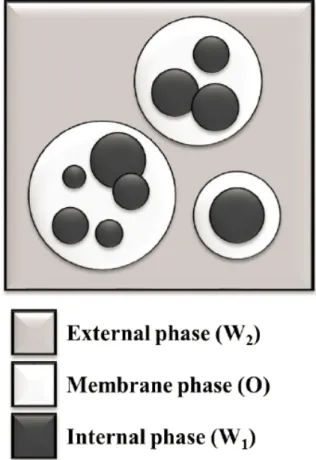
Fig. 1. The structure of double emulsions a) with single internal drops, b) with many internal drops.
The transport of drugs to targeted tissue is an important challenge in the treatment of cancer. The aim of the study was to investigate the possibility of using multiple emulsion with modified drops interfaces, as alternative platforms for targeted delivery of aggressive agents. Multiple emulsions
Functionalized Multiple Emulsions as Platforms for
Targeted Drug Delivery
A. Metera, E. Dluska, A. Markowska-Radomska, B. Tudek, T. Fraczyk, and K. Kosicki
are dispersed systems having structures of “drops in drops” (Fig. 1) which allow one or more active agents to be incorporated and then released in a controlled manner, through their size and physicochemical parameters of liquid phases.
The modification of multiple emulsion drops included adsorption on their interfaces the selected antibody specific to the cancer cells surface receptors for transport of drug directly to tumor (Fig. 2).
Fig. 2. The multiple emulsions as delivery to cancer cells (a) without a targetedsubstance, (b) antibody-based delivery agents to target and deliver.
II. MULTIPLE EMULSIONS FORMATION IN A COUETTE-TAYLOR FLOW REACTOR AND ANTIBODY
ADSORPTION EXPERIMENTS
A. Materials and Composition of the Antibody Buffer and
the Multiple Emulsion
The study was conducted for antibody anti-CD15 (SantaCruz Biotechnology, USA) suspended in the buffer recommended by a supplier. Buffer composition: PBS (Sigma Aldrich, USA) with < 0.1% sodium azide (Sigma Aldrich, USA) and 0.1% gelatin (Sigma Aldrich, USA).
The composition of double emulsion: internal phase (W1): distilled water, 2 wt.%. alginic acid (Sigma Aldrich, USA), 0.25 wt.% Poloxamer 407 (Sigma Aldrich, USA); membrane phase (O): soybean oil, 2 wt.% Span 83 (Sigma Aldrich, USA); external phase (W2): distilled water, 0.25 wt.% Tween 80 (Sigma Aldrich, USA), 0.25 wt.% Poloxamer 407, 0.2 wt.% sodium carboxymethylcellulose (CMC) (Merck, Germany).
B. Method of Formation of the W1/O/W2 Multiple
Emulsion
The one-step process of double emulsion formation was carried out in a Couette-Taylor flow (CTF) contactor (Fig. 3).
The condition of the multiple emulsion formations: the rotational frequency of the inner cylinder: 2162 rpm, the size of the annular gap between the coaxial cylinders: 1.5 mm, the volumetric flow rated of:
1) internal water phase (W1) 10 cm3/min, 2) membrane oil phase (O) 10 cm3/min, 3) external water phase (W2) 150 cm3/min.
The method of multiple (double) emulsions formation via the one-step method in the Couette-Taylor flow contactor involves mixing internal water phase with membrane oil phase at the inlet cross section of contactor where simple emulsions are created and then introducing the external water phase to formulate multiple emulsions. The method has beeen described more precisely in our previous papers [10], [11].
C. Characterization of W1/O/W2 Emulsion
The drops diameters of the internal phase and the membrane phase were determined based on analyzing of images captured during microscopic observation of emulsion samples. Microscopic observation set up contained an optical microscope (BX-60, Olympus, Japan) connected to a digital camera (SC50, Olympus, Japan) and image analyses software Image Pro Plus 4.5 (Media Cybernetics, USA). For each double emulsion sample, at least 800 drops of the membrane phase and 1000 drops of the internal phase were measured. Sauter mean diameter of internal phase drops and membrane phase drops were calculated based on the measured drop sizes.
D. Isothermal Titration Calorimetry (ITC) Experiments
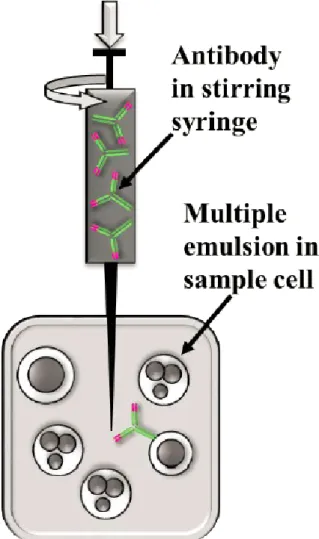
The isothermal titration calorimetry was used to evaluate adsorption of the antibody suspension on the membrane phase drops of multiple emulsion. The ITC experiments were performed at 37ºC in the Nano ITC Standard Volume (TA Instruments, USA), the volume of samples were: in the cell 950·10-6 dm3 and in the syringe 250·10-6 dm3 (Fig.4), the rotational frequency of stirring syringe 250 rpm, the references cell was filled with distilled water. All samples were vacuum degassed before the experiments .
Fig. 4. The ITC sample cell filled with multiple emulsion and the stirring syringe filled with the suspension of the antibody.
In order to determine proper conditions for ITC study 3 series of experiments were performed (Table I). The injections number are 1+9 or 1+18, first small injection enabled stabilization the ITC equipment, and 9 or 18 main injections during each ITC experiment.
TABLEI:THE CONDITIONS OF I,II AND IIISERIES OF THE ITCMULTIPLE EMULSIONS-ANTIBODY SUSPENSION EXPERIMENTS
Series I II III
The concentration of
the antibody (mM) 3.39·10
-7 3.39·10-7 3.39·10-4
The volume of the single injection (10-6
dm3)
25.14 13.14 13.14
The number of the
injections 1+9 1+18 1+18
The complex composition of each solution in ITC experiments required elimination of background molecular interactions. To achieve this goal the A, B, and C series of the experiment were performed (Table II). Additionally, to determine interactions of CMC and PBS titration of 0.2 wt.%, water solution of CMC was titrated by standard PBS solution. The injection number is 1+18, first small injection allowed to stabilize the ITC equipment, and 18 main injections during each ITC experiment.
To calculate the heat effect of interactions between the antibody and the oil membrane phase drops, heat effect of interaction between other substances in the solutions was eliminate. Elimination includes interactions between (i) the
multiple emulsion and the antibody suspension buffer (B in Table II), (ii) the external phase of the emulsion and the antibody in suspension (C in Table II). Interactions between the external phase of the emulsion and the antibody suspension buffer (A in Table II) are hidden in both eliminated sets of experiments, so it should be added to calculate proper value of the aggregate heat effect.
TABLEII:THE CONDITIONS OF A,B AND CSERIES OF THE ITCMULTIPLE EMULSIONS-ANTIBODY SUSPENSION EXPERIMENTS PROVIDED TO
ELIMINATE BACKGROUND INTERACTIONS
Series A B C
The stirred cell contents
The external phase of the emulsion
The multiple emulsion
The external phase of the emulsion
The stirred syringe contents
The antibody suspension
buffer
The antibody suspension
buffer
The antibody in suspension
Fig. 5. The W1/O/W2 double emulsions (a) microscopic image, (b) size
distribution of internal and membrane drops in a whole population of W1/O/W2 emulsions drops.
III. RESULTS AND DISCUSSION
A. W1/O/W2 Double Emulsion
with more than one small internal phase drops inside bigger oil membrane phase drops were rarely observed.
The calculated Sauter mean diameter of internal phase drops was 7.1 µm in the emulsions sample just after preparation. The calculated Sauter mean diameter of oil membrane phase drops was 11.0 µm in the emulsions sample just after preparation. Microscopic image and drop size distribution of obtained multiple emulsion are presented in Fig. 5.
Microscopic observations of the emulsions were proceeded during the preparation of isothermal titration calorimetry experiment and after ITC experiments. The calculated changes of Sauter mean diameter of internal and membrane phase drops before and after ITC experiment were less than 5% compared to the primarily calculated mean diameters of drops.
Fig. 6. The corrected heat rate profiles of interactions between the multiple emulsions and the suspension of antibody measured over time. The
experimental series I, II and III are described in Table I.
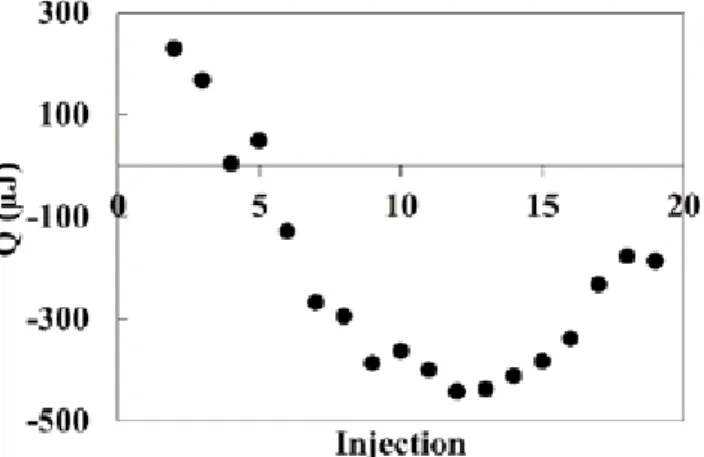
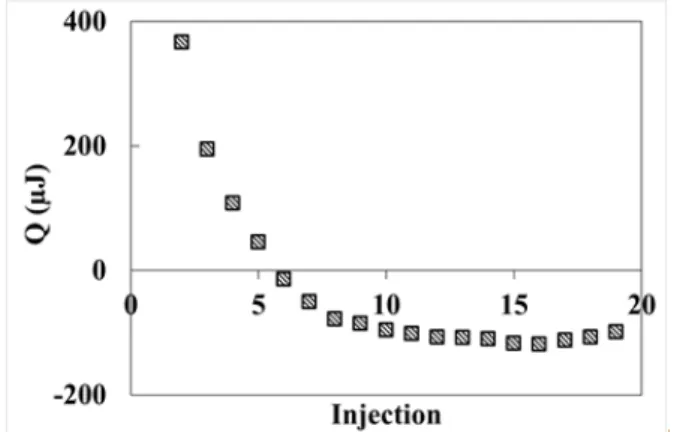
Fig. 7. The heat effect profiles of interactions between the multiple emulsions and suspension of antibody measured after each added injection.
The experimental series I, II and III are described in Table I.
B. Interactions of the Multiple Emulsion and the
Suspension of Antibody Measured by Isothermal Titration Calorimetry (ITC)
The first step in the isothermal titration calorimetry experiments was to determine the conditions of titration allowing the heat effects of interactions between the multiple emulsion and the suspension of the antibody to be measured.
The first series of the ITC experiments (I in Table I) showed significant changes in the heat rate after the injections (Fig. 6). The second series of the ITC experiments (II in Table I) were proceeded in different conditions: the number of main injections was doubled and the volume of single injection was smaller in comparison to the first series.
The observed heat rate changes were smaller but measured heat effect after single injection was too small to be considered for this experiment. The third series of the ITC experiments (III in Table I) include 103 greater concentration of the antibody (anti-CD15) in the suspension in comparison to the second series of the ITC experiments. The last third series of experiments was considered as satisfying measured changes of the heat rate and heat effect of interactions. The results of the ITC experiments are presented in Fig. 6 and Fig. 7.
C. Background of Interactions between the Multiple
Emulsion and the Suspension of Antibody Measured by Isothermal Titration Calorimetry (ITC)
The second step in the ITC experiments was determination and elimination of the all background in form of heat effect measured in the primary ITC series III experiments of titration the multiple emulsion by the suspension of the antibody (Fig. 8).
Fig. 8. The heat effect profile of the interactions between multiple emulsion and the suspension of antibody measured after each added injection for the
experimental series III (Table I).
Determination of interactions effects includes the ITC experiment with: (i) the multiple emulsion and the antibody suspension buffer (B in Table II), (ii) the external phase of the emulsion and the antibody in suspension (C in Table II). Moreover, it was necessary to determined interactions between the external phase of the emulsion and the antibody suspension buffer (A in Table II) that are hidden in both sets of experiments which should be eliminated. The results of the ITC experiments are presented in Fig. 9.
The most significant heat effect in background interaction is interactions between CMC and ions from PBS [12], [13] observed during titration of CMC solution by the PBS buffer solution (Fig. 10).
Fig. 10. The heat effect profile of the interactions between CMC and the PBS buffer solution measured after each added injection.
D. Interactions between the Antibody and Membrane
Phase Drops of the Multiple Emulsion
The heat effect of interactions between the antibody and the oil membrane phase drops after eliminating heat effect of interaction other substances in the solutions was calculated and presented in Fig. 11.
Elimination includes subtracted the heat effect of the interactions between (i) the multiple emulsion and the antibody suspension buffer (B in Table II) and (ii) the external phase of the emulsion and the antibody in suspension (C in Table II). The heat effect of the interaction between the external phase of the emulsion and the antibody suspension buffer (A in Table II) are hidden in both eliminated sets of experiments, so it was subtracted twice with previous (B and C) corrections. To calculate proper heat effect of interaction between the antibody and oil membrane phase drops the measured heat effect of the interaction between the external phase of the emulsion and the antibody suspension buffer should be added.
Fig. 11. The heat effect profile of the interactions between antibody and multiple emulsion drops after eliminating background interactions.
IV. CONCLUSION
The obtained multiple emulsions with modified drops interfaces were proposed as platforms delivering doxorubicin and temozolomide encapsulated in the internal drops for
targeted therapies of glioblastoma. The multiple emulsions may increase effectiveness of cancer chemotherapy as non-toxic and efficient platforms with high drug loading
The isothermal titration calorimetry (ITC) method is a potentially useful way to investigate and describe antibody on the oil drops surface physical adsorption process not the just final effect of the process.
ACKNOWLEDGMENT
The authors would like to thank the National Science Centre - Poland for supporting this research under Grant Number 2014/13/B/ST8/04274.
The ITC equipment used, was sponsored in part by the Centre for Preclinical Research and Technology (CePT), a project cosponsored by the European Regional Development Fund and Innovative Economy, The National Cohesion Strategy of Poland.
REFERENCES
[1] J. Fang, H. Nakamura, and H. Maeda. (2011). The EPR effect: Unique features of tumor blood vessels for drug delivery, factors involved, and limitations and augmentation of the effect. Advanced Drug Delivery
Reviews. [Online]. 63(3), pp. 136–151. Available:
http://dx.doi.org/10.1016/j.addr.2010.04.009
[5] D. Goldstein, O. Gofrit, A. Nyska, and S. Benita, “Anti-HER2 cationic immunoemulsion as a potential targeted drug delivery system for the treatment of prostate cancer,” Cancer Research, vol. 67, no. 1, pp. 269-275, 2007.
[6] S. Harnisch and R. H. Müller, “Adsorption kinetics of plasma proteins on oil-in-water emulsions for parenteral nutrition,” European Journal of Pharmaceutics and Biopharmaceutics, vol. 49, no. 1, pp. 41-46, 2000.
[7] T. Blunk, D. F. Hochstrasser, J. C. Sanchez, B. W. Müller, and R. H. Müller, “Colloidal carriers for intravenous drug targeting: Plasma protein adsorption patterns on surface‐modified latex particles evaluated by two‐dimensional polyacrylamide gel electrophoresis,”
Electrophoresis, vol. 14, no. 1, pp. 1382-1387, 1993.
[8] K. A. Britt, D. K. Schwartz, C. Wurth, H. C. Mahler, J. F. Carpenter, and T. W. Randolph, “Excipient effects on humanized monoclonal antibody interactions with silicone oil emulsions,” Journal of Pharmaceutical Sciences, vol. 101, no. 12, pp. 4419-4432, 2012. [9] A. Derksen, D. Gantz, and D. M. Small, “Calorimetry of
apolipoprotein-A1 binding to phosphatidylcholine-triolein-cholesterol emulsions,” Biophysical Journal, vol. 70, no. 1, pp. 330-338, 1996. [10] E. Dluska and A. Markowska-Radomska, “Regimes of multiple
emulsions of W1/O/W2 and O1/W/O2 type in the continuous
Couette-Taylor flow contactor,” Chemical Engineering Technology, vol. 33, pp. 113-120, 2010.
[11] A. Markowska-Radomska and E. Dluska, “An evaluation of a mass transfer rate at the boundary of different release mechanisms in complex liquid dispersion,” Chemical Engineering and Processing, vol. 101, pp. 56-71, 2016.
[12] C. Xiao and Y. Gao, “Preparation and properties of physically crosslinked sodium carboxymethylcellulose/poly (vinyl alcohol) complex hydrogels,” Journal of Applied Polymer Science, vol. 107, no. 3, pp. 1568-1572, 2008.
[13] B. Khaled and B. Abdelbaki, “Rheological and electrokinetic properties of carboxymethylcellulose-water dispersions in the presence of salts,” International Journal of Physical Sciences, vol. 7, no. 11, pp. 1790-1798, 2012.
[2] N. Bertrand, et al.(2014). Cancer nanotechnology: The impact of passive and active targeting in the era of modern cancer biology. Advanced Drug
Delivery Reviews. [Online]. 66, pp. 2–25. Available:
http://dx.doi.org/10.1016/j.addr.2013.11.009
[3] D. Goldstein, T. Nassar, G. Lambert, J. Kadouche, and S. Benita, “The design and evaluation of a novel targeted drug delivery system using cationic emulsion–Antibody conjugates,”Journal of Controlled Release, vol. 108, no. 2, pp. 418-432, 2005.
[4] D. Goldstein, O. Sader, and S. Benita, “Influence of oil droplet surface charge on the performance of antibody–Emulsion conjugates,”
Research Interests of Ewa Dluska include encapsulation of drugs/living cells, release processes, developing of emulsions with bioactive agents in a Couette-Taylor Flow bioreactor for drug delivery systems; Modelling of dmg release process from emulsions and micro/nanoparticles. Separation process in environmental protection: removal of organic compounds and heavy metals using emulsion liquid membrane (ELM), modelling of the mass transfer and experimental investigations of process efficiency. Alternative emulsion-based fuels; Chemical reactor engineering- multiphase reactors and multiphase flow: an interface polycondensation in the liquid-liquid Couette-Taylor Flow (CTF) reactor for nonlinear optical polymers synthesis, gas-liquid CTF reactor including membrane two-phase reactor for liquid contaminations oxidation using one of advanced oxidation technology, especially wet air oxidation; Flue gas cleaning: filtration of aerosols: filtration of aemsols, coagulation and deposition of aerosol panicles.
Ewa Dluskais an associate professor at Warsaw University of Technology
PhD 1997 and DSC in 2012 in chemical engineering from the Warsaw University of Technology. Research fellowship at the University of Oxford in the Institute of Biomedical Engineering in the encapsulation of stem cells in 2013.
Agata Metera is as a PhD candidate at Warsaw
University of Technology, Eng. in 2013 and MSc Eng. In 2014 in chemical engineering from Warsaw University of Technology.
She is interested in improving drug delivery system and controlled release of therapeutic agents.