229
CHEMICAL AND SENSORY PROPERTIES OF ACID-TYPE CHEESE:
YOGURT CHEESE
DILEK SAY1*, MEHMET SALIH ÇAYIR2, NURAY GÜZELER2
1* Vocational School of Pozanti, Çukurova University, Adana, Turkey, [email protected] 2 Department of Food Engineering, Faculty of Agriculture, Çukurova University, Adana, Turkey
Keywords: Yogurt cheese, acid-type cheese, chemical properties, sensory analysis
ABSTRACT
In this study, the basic chemical composition and sensory properties of Yogurt cheeses, which do not contain any additive substance obtained by addition of yogurt into boiling milk were investigated. For this purpose, seventeen of Yogurt cheese was used as sample material were collected from different cheese producers in the region of Hatay, in Southern Turkey. The minimum, maximum and mean values of the chemical parameters for Yoghurt cheese samples were 5.52, 6.37 and 5.94 ± 0.223 for pH, 0.29, 0.97 and 0.50 ± 0.212% for titratable acidity (l.a%), 43.12, 54.07 and 47.37 ± 2.654% for dry matter, 16.25, 25.75 and 21.26 ± 3.433% for fat, 35.64, 52.02 and 44.76 ± 5.839% for fat-in-dry matter, 20.99, 29.53 and 24.55 ± 2.321% for protein, 43.36, 60.30 and 51.87 ± 4.383% for protein-in-dry matter, 0.14, 1.44 and 0.60 ± 0.453% for salt, 0.30, 2.95 and 1.28 ± 0.958% for salt-in-dry matter and 1.31, 3.12 and 2.26 ± 0.513% for ash. The result of total score in the cheese samples was determined to change between the scores 61-84 with mean score of 72. The sensory evaluations showed that the Yogurt cheeses were described by a milky odour, salty taste and a semi-hard texture by panelist.
INTRODUCTION
Clotting milk is an essential step in the formation of cheese. Milk proteins are great importance in cheese formation mechanism. Milk proteins consist of casein and serum proteins. Casein is found only in milk and constitutes 80% of milk proteins. Although this protein is highly resistant to heat, it is sensitive to acidity and coagulates at pH 4.6-4.7 (Akın, 1998; Öner and Elmacı). There are different enzymatic and acidic coagulants used to provide the milk clotting (Yaşar, 2007). Besides the general coagulants used in cheese making, yoghurt starter culture or yoghurt can be used directly for the purpose of coagulation. The used coagulant must have formed at the desired level of acid and required to have proteolytic properties for milk coagulation (Yerlikaya et. al, 2011). Yogurt can provide the desired coagulation due to the its acidic structure (Yıldırım and Sarımehmetoğlu, 2006). Acid-type cheeses are usually produced by heating of acidified milk using indigenous microflora of milk, yogurt or diluted yogurt (ayran) (Güler, 2014). In Turkey, this type of cheese is traditionally made from yogurt through boiling. This cheese is known "Yoghurt cheese" in Hatay region, "Black cumin cheese" and "Kesmik, Kestirme cheese or Sut kesigi cheese" in Mersin province in Turkey (Say et al., 2015).
Yoghurt Cheese Production
230
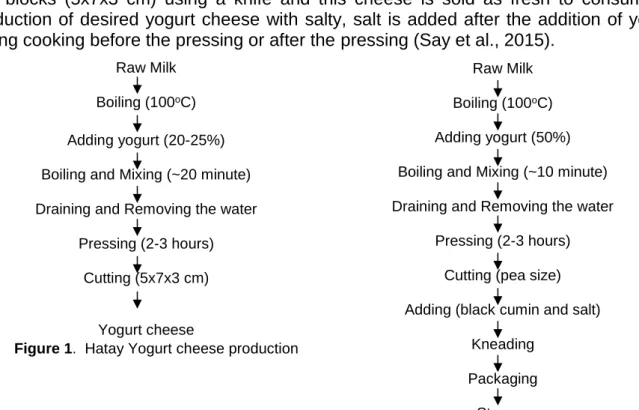
into blocks (5x7x3 cm) using a knife and this cheese is sold as fresh to consumer. In production of desired yogurt cheese with salty, salt is added after the addition of yoghurt during cooking before the pressing or after the pressing (Say et al., 2015).
Figure 1. Hatay Yogurt cheese production
Figure 2. Tarsus Yogurt cheese production
The amount of yogurt used during the production of yoghurt cheese in Tarsus (Mersin region) is up to 50%. Unsalted curd is broken into pea size by hand and added black cumin and salt in the preferred ratio with mixing well. Finally, crumbly cheese is filled into pottery, plastic container or jar tightly and the container is turned upside down. The cheese is stored in natural caves of produced areas or under refrigerated conditions (Yıldırım, 2016).
Yogurt cheese is a local product that is consumed fresh or ripe. It has white and cream-colored, high dry matter content and it has also its own characteristic flavor, non-elastic and strict structure. This cheese yield is low due to production method. 1 kg yoghurt cheese is obtained from about 8-10 kg milk.
Consumption of Yogurt Cheese in Some Regions
Yoghurt cheese is used in the breakfast, appetizers as well as the cheese is also used in various desserts such as “Kunefe”, “Tas kadayif”, ”Cheese halva”, “Semolina halva with cheese” in our the kitchen culture. Due to using of these desserts it is influential on the choice of the cheese. Black cumin cheese is also used in the breakfast and in some preparation of pastries (Say et al., 2015).
No studies have been reported on production, basic chemical properties and the unique taste and flavour of Yogurt cheese. Therefore, the objectives of this study were: (1) to present information about production of Yogurt cheese and (2) to evaluate the basic chemical composition and sensory properties of the cheese.
MATERIALS AND METHODS
Preparation of Experimental Cheese Samples
Seventeen yogurt cheese samples (~300 g) were collected from different cheese producers of Hatay province. Seven of these cheeses are salted and the remaining cheeses
are salt-free. The samples were stored at 4oC during analysis.
Raw Milk
Boiling (100oC)
Adding yogurt (20-25%)
Boiling and Mixing (~20 minute)
Draining and Removing the water
Pressing (2-3 hours)
Cutting (5x7x3 cm)
Yogurt cheese
Raw Milk
Boiling (100oC)
Adding yogurt (50%)
Boiling and Mixing (~10 minute)
Draining and Removing the water
Pressing (2-3 hours)
Cutting (pea size)
Adding (black cumin and salt)
Kneading
Packaging
231
Gross-Chemical Analysis
pH were measured with a pH meter (testo® 230, Testo, GmbH & Co, Germany) (Anonymous, 1995), titratable acidity (% lactic acid) were determined by titration using 0.1 N NaOH (Anonymous, 1995). Dry matter content was determined by gravimetric method (IDF, 1982). Fat and salt were determined by Gerber method (Anonymous, 1978) and Mohr titration method (Anonymous, 1983), respectively. Protein was measured by micro-Kjeldahl method (IDF, 1993), using the Gerhardt KB 40S digestion and Vapotest distillation systems (C. Gerhardt, Bonn, Germany). Ash content was quantitated by dry ashing the samples in a
muffle furnace at 550◦C for 24 h (AOAC, 1998). Fat-in-dry matter, protein-in-dry matter and
salt-in-dry matter values were calculated from related values.
Sensory Evaluation
Sensory evaluation was performed by 7 experienced panelists. Yogurt cheese
samples were removed from a refrigerator (4oC) 30 minute prior to sensory evaluation and
kept at room temperature (22oC ± 2oC). The samples were evaluated by criteria appearance
(scale 0-20), texture (scale 0-35), odour (scale 0-10) and flavor (scale 0-35).
RESULTS AND DISCUSSION
Basic Chemical Composition
There are no studies available with Hatay Yogurt cheese. Therefore, the results in this study were interpreted in comparison by the cheeses produced with the acid/heat combination.
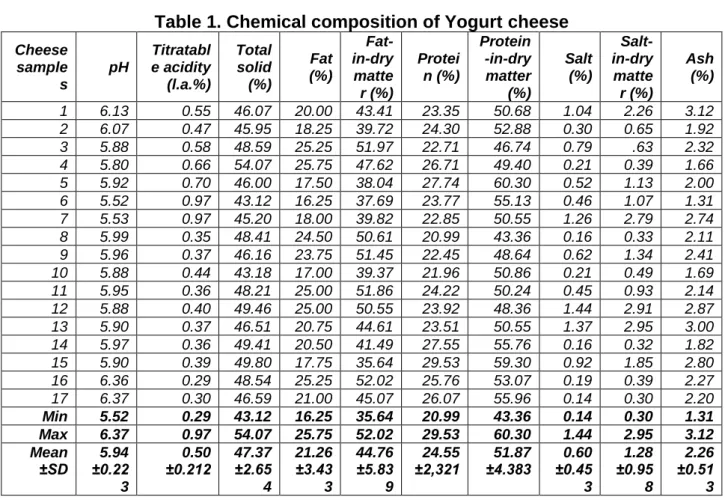
The basic chemical properties of Yogurt cheese samples are shown in Table 1. The mean value ± SD of yogurt cheese samples for pH content was 5.94 ± 0.223. Similarly, Yıldırım (2016) investigating chemical properties of Tarsus Yogurt cheeses found that it has pH 5.10 ± 0.176. Okur and Güzel-Seydim (2011), Güzeler et al. (2013a) and Güzeler et al. (2013b) reported that the mean pH contents of Dolaz cheese, Cokelek cheese and Lor cheese were determined as 4.07 - 4.53, 5.03 and 5.04, respectively. These contents are lower than those found in the present study.
Titratable acidity ranged from 0.29% to 0.97% with a mean of 0.50 %. Titratable acidity value of the samples was higher than the value reported by Yıldırım (2016), lower than the values reported by Okur and Güzel-Seydim (2011), Güzeler et al. (2013ab).
Mean dry matter level in cheese samples was determined 47.37% and the similar result was obtained by Gündüz (2010) for Tomas cheese. Previous research on four cheese types found total solids values of 37.67-41.82%, 26.07%, 31.62% and 57.60% for Dolaz, Çökelek, Lor and Tarsus Yogurt cheese types, respectively (Okur and Güzel-Seydim, 2011, Güzeler et al. 2013a, Güzeler et al., 2013b, Yıldırım, 2016).
Fat and fat-in-dry matter contents in Yogurt cheeses were ranged from 16.25% to 25.75% and 35.64% to 52.02% with mean values of 21.26% and 44.76%, respectively. Fat value was higher than the values reported by Gündüz (2010), Okur and Güzel-Seydim (2011), Güzeler et al. (2013ab), lower than the value reported by Yıldırım (2016).
Protein and protein-in-dry matter contents were comprised between 20.99% and 29.53%, 43.36% to 60.30% with mean values of 24.55% and 51.87% for Yogurt cheeses, respectively. The mean protein of the cheeses was slightly different from the findings of
Yıldırım (2016) where mean value was 25.36%.The protein content in various cheeses by
232
Table 1. Chemical composition of Yogurt cheese
Cheese sample s pH Titratabl e acidity (l.a.%) Total solid (%) Fat (%) Fat-in-dry matte r (%) Protei n (%) Protein -in-dry matter (%) Salt (%) Salt-in-dry matte r (%) Ash (%)
1 6.13 0.55 46.07 20.00 43.41 23.35 50.68 1.04 2.26 3.12
2 6.07 0.47 45.95 18.25 39.72 24.30 52.88 0.30 0.65 1.92
3 5.88 0.58 48.59 25.25 51.97 22.71 46.74 0.79 .63 2.32
4 5.80 0.66 54.07 25.75 47.62 26.71 49.40 0.21 0.39 1.66
5 5.92 0.70 46.00 17.50 38.04 27.74 60.30 0.52 1.13 2.00
6 5.52 0.97 43.12 16.25 37.69 23.77 55.13 0.46 1.07 1.31
7 5.53 0.97 45.20 18.00 39.82 22.85 50.55 1.26 2.79 2.74
8 5.99 0.35 48.41 24.50 50.61 20.99 43.36 0.16 0.33 2.11
9 5.96 0.37 46.16 23.75 51.45 22.45 48.64 0.62 1.34 2.41
10 5.88 0.44 43.18 17.00 39.37 21.96 50.86 0.21 0.49 1.69
11 5.95 0.36 48.21 25.00 51.86 24.22 50.24 0.45 0.93 2.14
12 5.88 0.40 49.46 25.00 50.55 23.92 48.36 1.44 2.91 2.87
13 5.90 0.37 46.51 20.75 44.61 23.51 50.55 1.37 2.95 3.00
14 5.97 0.36 49.41 20.50 41.49 27.55 55.76 0.16 0.32 1.82
15 5.90 0.39 49.80 17.75 35.64 29.53 59.30 0.92 1.85 2.80
16 6.36 0.29 48.54 25.25 52.02 25.76 53.07 0.19 0.39 2.27
17 6.37 0.30 46.59 21.00 45.07 26.07 55.96 0.14 0.30 2.20
Min 5.52 0.29 43.12 16.25 35.64 20.99 43.36 0.14 0.30 1.31 Max 6.37 0.97 54.07 25.75 52.02 29.53 60.30 1.44 2.95 3.12 Mean
±SD ±0.225.94 3
0.50
±0.212 47.37 ±2.65 4 21.26 ±3.43 3 44.76 ±5.83 9 24.55
±2,321 ±4.383 51.87 ±0.450.60 3 1.28 ±0.95 8 2.26 ±0.51 3
Salt and salt-in-dry matter contents in the cheeses varied from 0.14% to 1.44% and 0.30% to 2.95% with mean values of 0.60% and 1.28%, respectively. The results obtained in this study show that salt content in cheese samples was lower than the values reported by other researchers (Gündüz, 2010; Okur and Güzel-Seydim, 2011; Yıldırım, 2016; Güzeler et al. (2013a).
Ash values ranged from 1.31% to 3.12% and found to be 2.26% as mean values. The ash values obtained in this study were determined to be lower than the value reported by Gündüz (2010) for Tomas cheese and Yıldırım (2016) for Tarsus Yogurt cheese. Kumar et al. (2011), who studied chemical properties of Paneer cheese, found the mean levels of ash to be 1.45%.
Sensory Evaluation of Yogurt Cheeses
The sensory properties of Yogurt cheese samples are presented in Table 2. The minimum, maximum and mean values of the sensory properties for Yoghurt cheese samples
were 12, 19 and 16 ± 1,900 for appearance, 21, 30 and 26 ± 2,149 for texture, 4, 10 and 7 ± 1,970 for odour and 16, 29 and 22 ± 4,429 for flavour scores.
Table 2. Sensory properties of Yogurt cheese
Cheese
samples Appearance Texture Odour Flavour Total score
1 12 23 9 20 64
2 17 21 8 16 62
3 19 26 9 25 79
4 15 25 9 20 69
5 17 26 10 29 82
6 19 23 9 20 71
233
8 14 27 7 24 72
9 16 28 7 25 76
10 19 30 8 27 84
11 14 26 8 23 71
12 15 25 8 28 76
13 16 28 8 23 75
14 15 27 5 23 70
15 16 24 4 17 61
16 16 26 4 16 62
17 17 25 4 16 62
Min 12 21 4 16 61
Max 19 30 10 29 84
Mean ±SD 16 ± 1,900 26 ± 2,149 7 ± 1,970 22 ± 4,429 72 ± 7,476
During the sensory analysis, none of the samples received the maximum score of 100. The minimum and maximum scores were 61 and 84 with mean score of 72 for total score, respectively. The cheeses were characterized by a milky odour for salt free samples but salty taste and had a semi-hard texture for salted samples. In addition, yogurt cheese samples with low scores were described as too pungent, salty, rancid by panelists.
CONCLUSIONS
Significant differences were found in the chemical and sensory characteristics among Yogurt cheese samples due to the different sources of raw milk used in the manufacture of cheese and manufacture methods.
BIBLIOGRAPHY
1. Akın, N., 1998. The effect of some applied prosses on the rennetability of milk, The Journal of Food, 23(2):115-119.
2. Anonymous, 1978. Determination of the Fat (Van Gulik Method), TS 3046. Turkish Standards Institute. Necatibey Caddesi, 112. Bakanlıklar, Ankara, pp.4.
3. Anonymous, 1983.Gıda Maddeleri Muayene ve Analiz Yöntemleri. TC Tarım Orman ve Köyişleri Bakanlığı, Gıda İşleri Genel Müdürlüğü, Genel Yayın No: 65, Ankara, pp.796.
4. Anonymous, 1995. White Cheese, TS 591. Turkish Standards Institute. Necatibey Caddesi, 112 Bakanlıklar, Ankara, pp. 13
5. AOAC, 1998. Official Methods of AOAC International 16th Edition 4th Revision, USA.
6. Güler, Z., 2014. Profiles of Organic Acid and Volatile Compounds in Acid-Type Cheeses Containing Herbs and Spices (Sürk Cheese). International Journal of Food Properties, 17:1379-1392.
234
8. Güzeler, N., Say, D., Soltani, M., Gürbüz, G., 2013a. Production and Chemical Properties of Cokelek. The 2nd International Symposium on “Traditional Foods from Adriatic to Caucasus”, 24-26 October 2013, Struga-Ohrid, Macedonia, p. 151.
9. Güzeler, N., Soltani, M., Say, D., Gürbüz, G., 2013b. Production and Chemical Properties of Lor. The 2nd International Symposium on “Traditional Foods from Adriatic to Caucasus”, 24-26 October 2013, Struga-Ohrid, Macedonia, p. 150.
10. IDF, 1982. Determination of the Total Solid Content (Cheese and Processed Cheese). IDF Standart 4A, Brussels: International Dairy Federation, Brussels, Belgium.
11. IDF, 1993.Milk, Determination of Nitrogen Content. FIL-IDF 20B, International Dairy Federation, Brussels, Belgium, pp.12.
12. Kumar, S., Rai, D.C., Niranjan, K. and Bhat, Z.F., 2011. Paneer-An Indian Soft cheese Variant: A Review. J Food Sci Tech, 51(5):821-31.
13. Okur, D. and Güzel-Seydim, Z., 2011. Determination of some characteristic properties in traditional Dolaz cheese. The Journal of Ege University Faculty of Agricultural, 48(2):113-117.
14. Öner, Y., Elmacı, C., 2007.Keçilerde Süt Proteinleri Polimorfizmi, Hayvansal Üretim, 48(2):49-54.
15. Say, D., Çayır, M.S., Güzeler, N., 2015. Yoghurt Cheese Production and Consumption Types. The 3rd International Symposium on “Traditional Foods from Adriatic to Caucasus”, 01-04 October 2015, Sarajevo, Bosnia and Herzegovina, p. 210.
16. Yaşar, K., 2007. Effects of Different of Coagulants Used and Ripening Period on Properties of Kashar Cheese. University of Çukurova, Institue of Natural and Applied Sciences, Department of Food Engineering, PhD Thesis, p.134.
17. Yerlikaya, O., Torunoğlu, A., Kınık, Ö., Akbulut, N., 2011. Ülkemizde Tüketilen Çökelek Peynirleri ve Üretim Şekillerine Bir Bakış, Dünya Gıda Dergisi, Şubat 2011, s..48-52.
18. Yıldırım, Y., Sarımehmetoğlu, B., 2006. The Effects of Probiotic Use Against Listeria monocytogenes During Manufacture of Turkish White Cheese. J Fac Vet Med Univ Erciyes, 3(1) :1-7.