41
STUDY ON THE SELECTION FOR DROUGHT TOLERANCE OF SOME SEMI-LATE MAIZE HYBRIDS CULTIVATED AT A.R.D.S. SIMNIC
BONEA Dorina (1), Viorica URECHEAN (2)
(1) University of Craiova, Faculty of Agronomy, Department of Agricultural and Forestry Technology, Dolj, Romania; email: [email protected] (2) Agricultural Research and Development Station Simnic, Dolj, Romania(corresponding author); e-mail [email protected]
Keywords: MTG, number of sterile plants, ranking method, tolerance indices
ABSTRACT
Drought became a common phenomenon in Oltenia region conducting to reduced crop yields. Therefore, the identifying of genotypes with tolerance to drought and their use for high and stable productions are very important issues for plants breeding in this region. This study has been done in the experimental field of Agricultural Research and Development Station Simnic during two years (2015 and 2016) according with two levels of soil moisture (drought stress and non-stressed conditions during the anthesis-silking phase). The results of this study have shown that the drought during blooming phase has significantly reduced the yield (-60.5%), especially as a result of increasing the number of sterile plants (+220.5%). The yield obtained in drought conditions (Ys) has significantly correlated with the following indices: STI, SSI, GMP, YI and SDI and the yield obtained in non-stressed conditions (Yp) has significantly correlated with the TOL, MP and SSPI indices. The evaluation of maize hybrids by ranking method has offered a better selection method, showing that F376, Milcov and HSF 13616A-08 hybrids are the most tolerant to drought. As a result, these hybrids can be recommended for cropping in drought predisposed areas of Oltenia and in similar areas.
INTRODUCTION
The maize (Zea mays L.) is the most important crop in Romania both as surface and yield obtained (MADR, 2017). Climate change is a actuality and have an inherent risk for agriculture (Croitoru et al., 2016). The reduction of the grain yield of maize as a result of drought is variable in function of the intensity, duration and the phase of drought action (Moradi et al., 2012; Mostafavi et al., 2011; Zarabi et al., 2011).
The lack of water affects the maize yield especially when it appears during the two weeks of blooming phase (Bolaños and Edmeades, 1996). During stress periods (e.g. drought) the anthers and pollen degeneration are the first phenomena that appear to agricultural crops and which negatively influences yield (Bonciu, 2013; Bonciu, 2014).
Also, drought can lead to the degradation of natural ecosystems that, on later, are easily invaded by invasive species-allochtone (Niculescu and Cismaru, 2013; Niculescu et al., 2014).The using of genotypes with high drought tolerance is one of the main measures for mitigation of damages produced by drought (Dima, 2014).
42
(Mohammadi et al., 2011), while other ones have chosen a middle point and recommend the selection in both conditions (Sio-Se Mardeh et al., 2006; Nouri et al., 2011).
After Fernandez (1992) the best method of selection for drought is the one which is capable to separate the genotypes with high and stable yields in both conditions (drought and non-stressed) and the best indices are the ones which are strongly correlated with the yield in both conditions. This study has been done for the evaluation of the water condition (drought – ”dry year” and non-stressed – ”normal year”) on maize grain yield and other agronomic characters, as well as the investigation of drought tolerance by using some tolerance indices and the ranking method in order to identify the most adapted maize hybrids to the given conditions.
MATERIALS AND METHODS
The vegetal material, the experimental design and the applied methods
Eight maize hybrids (semi-late) from the plant breeding program of NARDI Fundulea (Romania) have been studied for their yield performances in natural conditions (2015 and 2016) that have had different rainfall. The 2015 has been considered a „dry year” (with drought during anthesis-silking phase) and 2016 was considered a „normal year” for maize crop (non-stressed conditions). Both trials have been designed as randomized blocks with three replications, at Agricultural Research and Development Station (ARDS) Simnic, Craiova. The station is located in the central zone of Oltenia region (44 019' N; 23 048' E). The sowing has been made at 17.04.2015 and respectively, 22.04.2016 and the harvesting at 31.08.2015, respectively, 12.09.2016.
The plowing was made in autumn and the seedbed preparation has been made in the spring by disking. The fertilization was made by complex fertilizers, consisting of 250 kg/ha (NPK 20:20:0), before sowing and 250 kg/ha ammonium nitrate in vegetation (8-10 leaves stage). The weed control was made by applying DUAL GOLD 960- 1.5 l/ha, just after sowing and EQUIP 1.5 l/ha + BUCTRIL 1 l/ha post emergent (6-8 leaves stage of maize). There have been made two mechanical and two manual hoeing.
The calculus of drought tolerance indices
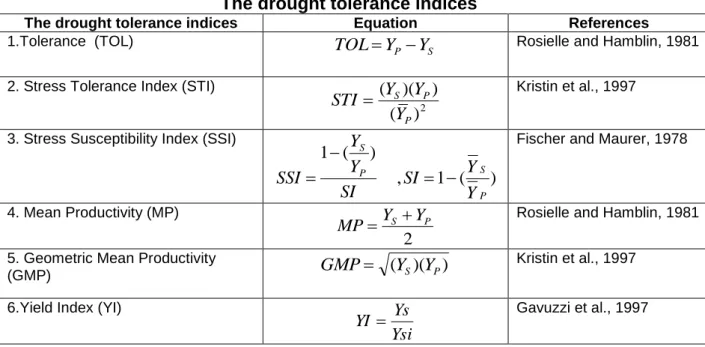
The eight drought stress tolerance indices (TOL, STI, SSI, MP, GMP, YI, SDI and SSPI) were calculated on the basis of the grain yield in non-stressed condition (Yp) and in drought stress conditions (Ys) using the formulas from Table 1.
Table 1. The drought tolerance indices
The drought tolerance indices Equation References
1.Tolerance (TOL) Rosielle and Hamblin, 1981
2. Stress Tolerance Index (STI) Kristin et al., 1997
3. Stress Susceptibility Index (SSI) Fischer and Maurer, 1978
4. Mean Productivity (MP) Rosielle and Hamblin, 1981
5. Geometric Mean Productivity (GMP)
Kristin et al., 1997
6.Yield Index (YI) Gavuzzi et al., 1997
S
P Y
Y
TOL
2 ) ( ) )( ( P P S Y Y Y STI ) ( 1 , ) ( 1 P S P S Y Y SI SI Y Y
SSI
2 P S Y Y
MP
) )( (YS YP
GMP
43
7. Sensitive Drought Index (SDI) Farshadfar and Javadinia,
2011
8. Stress Susceptibility Percentage
Index (SSPI) SSPI =
YP− YS
2 × Y̅P × 100
Moosavi et al., 2008
In order to evaluate the tolerant genotypes by ranking method there was used the formula proposed by Farshadfar and Elyasi (2012):
Rank sum (RS)= Rank mean + Standard deviation of rank (SDR) Statistical analysis
The data on the grain yield, plant height, MTG and the number of the sterile plants have been analyzed using ANOVA program with a single factor and MS Excel 2007 program. The phenotypical correlation between studied characters as well as the correlations between the obtained yields in both conditions (Yp and Ys) and the eight indices of drought tolerance has been interpreted by using simple correlation coefficients (r).
RESEARCH RESULTS The influence of drought on the agronomical characters
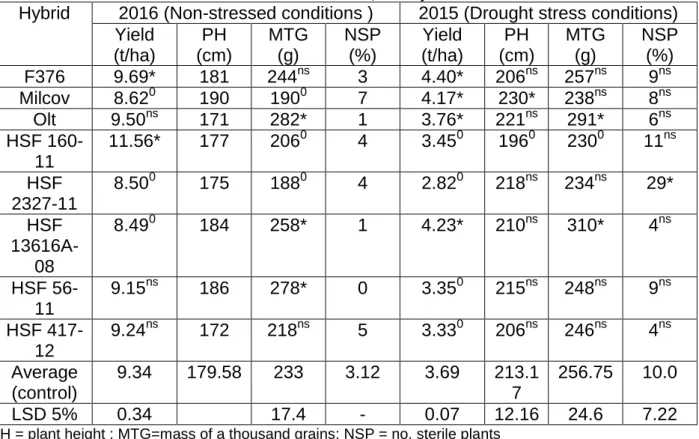
From the variance analysis that is presented in the Table 2, has resulted that in both conditions (drought and non-stressed) there are significant differences between the studied hybrids, for all characters (p=0.05%), excepting the plant height and the number of sterile plants from 2016 (in non-stressed conditions).
As regard the grain yield there was observed that the stress caused by the drought during the anthesis period has significantly reduced this character, respectively by 60.5%. However, the plant height and the MTG have recorded higher values in drought conditions, by 18.7%, respectively by 10.2%. There was noticed that the number of sterile plants has significantly increased in 2015 (drought conditions) by 220.5%. Therefore, we can say that the reduction of the grain yield in 2015 was done especially due to increasing of the sterile maize plants and that happened because of severe drought caused by water deficit during the anthesis-silking period.
Table2. The variance analysis for agronomic characters studied in both conditions at ARDS
Simnic.
Charact er
Water conditions Drought
effect % 2016 - Non-stressed
conditions
2015 - Drought stress conditions
S2 F Average S2 F Average
Yield (t/ha)
1.90* 48.13 9.34 0.60* 301.32 3.69 -60.5
PH (cm) 97.10ns 2.11 179.58 251.96* 5.14 213.17 +18.7 MTG (g) 2857.1
4*
28.50 233.00 1653.0* 8,24 256.75 +10.2
NSP (%)
11.10ns 1.85 3.12 130.28* 7.55 10.0 +220.5
PH = plant height ; MTG=mass of a thousand grains; NSP = no. sterile plants * significant at p=0.05; ns- non significant
P S P
Y Y Y
44
Table 3. The grain yield and other agronomic characters at the studied maize hybrids (ARDS
Simnic 2015, 2016)
Hybrid 2016 (Non-stressed conditions ) 2015 (Drought stress conditions) Yield
(t/ha)
PH (cm)
MTG (g)
NSP (%)
Yield (t/ha)
PH (cm)
MTG (g)
NSP (%) F376 9.69* 181 244ns 3 4.40* 206ns 257ns 9ns Milcov 8.620 190 1900 7 4.17* 230* 238ns 8ns
Olt 9.50ns 171 282* 1 3.76* 221ns 291* 6ns
HSF 160-11
11.56* 177 2060 4 3.450 1960 2300 11ns HSF
2327-11
8.500 175 1880 4 2.820 218ns 234ns 29* HSF
13616A-08
8.490 184 258* 1 4.23* 210ns 310* 4ns
HSF 56-11
9.15ns 186 278* 0 3.350 215ns 248ns 9ns HSF
417-12
9.24ns 172 218ns 5 3.330 206ns 246ns 4ns Average
(control)
9.34 179.58 233 3.12 3.69 213.1 7
256.75 10.0
LSD 5% 0.34 17.4 - 0.07 12.16 24.6 7.22
PH = plant height ; MTG=mass of a thousand grains; NSP = no. sterile plants *;0 significant at LSD 5%; ns- non significant
The comparative evaluation of maize hybrids
There have been observed significant differences as regard the studied agronomic characters (Table 3).
In 2016 the F376 and HSF 160-11 hybrids have been emphasized by a highly significant yield as compared to the control and the Olt, HSF 13616A-08 and HSF 56-11 hybrids by a significant MTG. For the height of the plants and the number of sterile plants there were recorded non-significant differences according to the variance analysis.
In 2015 the best yield has been done by F376, Milcov, Olt and HSF 13616A-08 hybrids, and the highest plants by Milcov hybrid. According to the MTG values, the highest value was recorded by Olt and HSF 13616A-08 hybrids. The results on sterile plants have shown that the maximal value for this character has been recorded with HSF 2327-11 hybrid, which recorded the lowest grain yield.
The analysis of correlations between agronomic characters
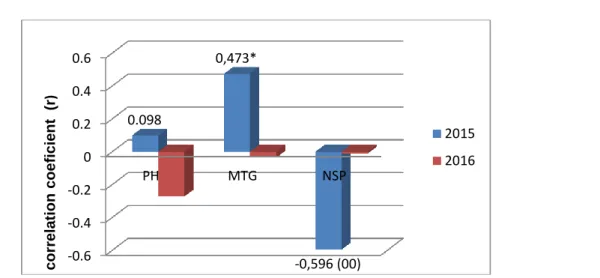
The correlation coefficients between the yield and the studied characters are different in function of the water conditions (Figure 1). In 2015 the grain yield was positively correlated with the MTG (0.473*) and distinctly negatively correlated with the number of sterile plants (-0.59600).
45
Fig. 1.The correlation coefficients between the yield and agronomic characters (2015 and 2016)
PH = plant height ; MTG=mass of a thousand grains; NSP = no. sterile plants
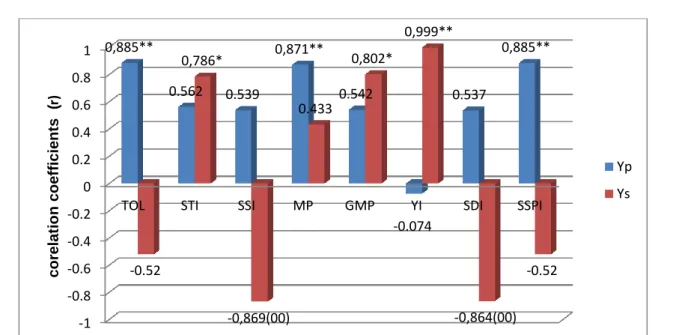
From the analysis of these correlations there was noticed that the yield in non-stressed condition (Yp) was positively distinctly significant correlated with TOL (0.885**), MP (0.871**) and SSPI (0,885**) indices, which means that these indices can be used as adequate indicators for the selection of genotypes from B group, respectively, with higher yields than the average in non-stressed conditions (according to Fernandez, 1992).
Evaluation of maize hybrids using tolerance indices
In order to determine the most adequate selection criteria there was calculated the grain yield in non-stressed condition (Yp) and drought condition (Ys) and other stress tolerance indices (Table 4) as well as the correlation between them (Figure 2).
The yield in drought condition (Ys) was positively correlated with the following indices: STI (0.786*) and GMP (0.802*), distinctly significant with YI (0.999**) and negatively distinctly significant with SSI (-0.86900) and SDI (-0.86400), which means that these indices can be used as criterion of selection of the genotypes from C group, respectively, higher yields than average in drought stress conditions (according to Fernandez, 1992).
There was noticed that there were no indicators that significantly correlate with the yield in both water conditions (Yp and Ys) and which could be used for the identification of genotypes from A group.
Table 4. Drought tolerance indices (SI = 0,605)
Hybrid
Indices
F376 Milcov Olt HSF
160-11
HSF 2327-11
HSF
13616A-08
HSF 56-11
HSF 417-12
Yp 9.69 8.62 9.50 11.56 8.50 8.49 9.15 9.24
Ys 4.40 4.17 3.76 3.45 2.82 4.23 3.35 3.33
TOL 5.29 4.45 5.74 8.11 5.68 4.26 5.80 5.91
STI 0.49 0.41 0.40 0.46 0.27 0.41 0.35 0.35
SSI 0.90 0.85 1.00 1.16 1.10 0.83 1.05 1.06
MP 7.04 6.39 6.63 7.50 5.66 6.36 6.25 6.28
GMP 6.53 5.99 5.98 6.31 4.89 5.99 5.54 5.55
YI 1.19 1.13 1.02 0.93 0.76 1.15 0.91 0.90
SDI 0.54 0.52 0.60 0.70 0.67 0.48 0.63 0.64
SSPI 28.32 23.82 30.73 43.41 30.41 22.80 31.04 31.64 Yp = yield in non-stress condition; Ys = yield in stress condition; TOL = Tolerance; STI = Stress tolerance index; SSI = Stress susceptibility index; MP = Mean Productivity; GMP = Geometric Mean Productivity; SDI = Sensitive Drought Index; SSPI = Stress Susceptibility Percentage Index
-0.6 -0.4 -0.2 0 0.2 0.4 0.6
PH MTG NSP
0.098
0,473*
-0,596 (00)
corr
ela
tion
coef
ici
ent
(
r
)
2015
46
Fig. 2. The correlation coefficients between the yield (Yp, Ys) and tolerance indices The ranking method
The evaluation on the basis of drought tolerance indices, have shown that the identification of tolerant hybrids on the basis of a single criterion can be contradictory (Table 5). For example, according to TOL, SSI, SDI and SSPI indices the HSF 160-11 hybrid is ranked in 8 places, but according to STI and GMP indices this hybrid is ranked on the second place as drought tolerance.
Therefore, for the determination of the most tolerant hybrid to drought stress according to the used indices there was used the ranking method by which there was calculated the average, the standard deviation and the sum of rankings (Table 5). According to this method, the F376, Milcov and HSF 13616A-08 hybrids which recorded the lowest value of the rankings sum (RS), have been identified as the most tolerant to drought, while the HSF 2327-11 hybrid was identified as the most sensitive.
The same method has been used by Farshadfar and Sutka, (2002), Urechean and Bonea (2017) for maize, and by Farshadfar and Elyasi, (2012); Farshadfar et al., (2014) for wheat.
Table 5. Ranking, average, standard deviation (SDR) and sum of rankings (SR) of tolerance
indices
Indices F376 Milcov Olt HSF 160-11
HSF 2327-11
HSF
13616A-08
HSF 56-11
HSF 417-12
Yp 2 6 3 1 7 8 5 4
Ys 1 3 4 5 8 2 6 7
TOL 3 2 5 8 4 1 6 7
STI 1 3 5 2 8 4 7 6
SSI 3 2 4 8 7 1 5 6
MP 2 4 3 1 8 5 7 6
GMP 1 3 5 2 8 4 7 6
YI 1 3 4 5 8 2 6 7
SDI 3 2 4 8 7 1 5 6
SSPI 3 2 5 8 4 1 6 7
Average 2 3 4.2 4.8 6.9 2.9 6 6.2
SDR 0.94 1.25 0.79 3.08 1.59 2.33 0.82 0.92
RS 2.94 4.25 7.28 7.88 8.49 5.23 6.82 7.12
-1 -0.8 -0.6 -0.4 -0.2 0 0.2 0.4 0.6 0.8 1
TOL STI SSI MP GMP YI SDI SSPI
0,885**
0.562 0.539
0,871**
0.542
-0.074
0.537
0,885**
-0.52
0,786*
-0,869(00) 0.433
0,802*
0,999**
-0,864(00) -0.52
co
relat
io
n
co
ef
fici
en
ts
(
r)
Yp
47
CONCLUSIONS
The drought from the anthesis-silking period of maize has determined a significant reduction of the grain yield (-60.5%). The high frequency of sterile plants has been the main factor of this decrease of the yield.
The yield in non-stressed conditions (Yp) was positively correlated with the TOL, MP and SSP indices and in drought condition (Ys) was positively correlated with STI, GMP, YI, SSI and SDI indices. There can be noticed that there were identified no tolerance indicators that can be used for the identification of the hybrids from A group (with higher yields than the average in both conditions). As a result, the ranking method, on the basis of used indicators, has offered the best estimation of the level of drought tolerance of maize hybrids.
The evaluation of drought tolerance using the ranking method has conducted to the identification of F376, Milcov and HSF 13616A-08 hybrids as the most tolerant ones to drought conditions. These hybrids are recommended for cropping in drought predisposed areas of Oltenia and in similar areas.
BIBLIOGRAPHY
1. Betrán F.J, Beck D., Banziger M., Edmeades G.O., 2003. Genetic analysis of
inbred and hybrid grain yield under stress and nonstress environments in tropical maize. Crop Sci., 43:807-817.
2. Bonciu E., 2013. Aspects of the pollen grains diameter variability and the pollen viability to some sunflower genotypes. JournaL of Horticulture, Forestry and Biotechnology, 17(1):161-165.
3. Bonciu E., 2014. Resurse pentru produse alimentare ecologice. Editura
Universitaria Craiova, p. 23-24, ISBN 978-606-26-0020-4; ISBN 978-606-14-0823-8.
4. Bolaños J., Edmeades G.O., 1996. The importance of the anthesis-silking interval
in breeding for drought tolerance in tropical maize. Field Crops Research, 48: 65–80. 5. Croitoru M., Diaconu A., Dima M., 2016. Researches regarding the influence of climate change on the quality of potato tubers in the conditions of sandy soils of southern Oltenia. JOURNAL of Horticulture, Forestry and Biotechnology, 20(1): 27-33.
6. Dima M. 2014., The influence of the climatic conditions on production of foreign varieties of peanuts grown on sandy soils. Annals of the University of Craiova-Agriculture, Montanology, Cadastre Series, 44:82-85
.
7. Farshadfar E., Sutka J., 2002. Screening drought tolerance criteria in maize. Acta
Agron Hung., 50(4):411–416.
8. Farshadfar E., Javadinia J., 2011. Evaluation of Chickpea (Cicer arietinumL.) genotypes for drought tolerance. Seed and Plant Improvement Journal, 27:517–537
9. Farshadfar E., Elyasi P., 2012. Screening quantitative indicators of drought
tolerance in bread wheat (Triticum aestivum L.) landraces. Eur Journ. of Exper Biol., 2(3):577-584.
10. Farshadfar E., Azadahe Sheibanirad A., Soltanian M., 2014. Screening
landraces of bread wheat genotypes for drought tolerance in the field and laboratory. International Journal of Farming and Allied Sciences, 3(3):304-311.
11. Fernandez G.C.J., 1992. Effective selection criteria for assessing plant stress tolerance. In: Kuo CG (Ed), Proceedings of the International Symposium on Adaptation of Vegetables and other Food Crops in Temperature and Water Stress, 13-18 August, Tainan, Taiwan. p. 257-270.
48
13. Gavuzzi P., Rizza F., Palumbo M., Campaline R.G., Ricciardi G.L., Borghi B.,
1997. Evaluation of field and laboratory predictors of drought and heat tolerance in winter cereals. Plant Science, 77:523-531.
14. Olaru L., Păunescu G., Oncică F., 2012. Comparative study between Romanian
and Foreign winter wheat varieties regarding yield potential, during 2004-2011. Annals of the University of Craiova-Agriculture, Montanology, Cadastre Series, 42(2):203-207.
15. Kristin A.S., Serna R.R., Perez F.I., Enriquez B.C., Gallegos J.A.A., Vallejo
P.R., Wassimi N., Kelley J.D., 1997. Improving common bean performance under
drought stress. Crop Sci., 37:43-50.
16. MADR, 2017. Date privind evoluţia suprafeţelor și a producţiei în România:
http://www.madr.ro/culturi-de-camp/cereale.html, accessed 6.10.2017.
17. Moradi H., Akbari G.A., Khorasani S.K., Ramshini H.A., 2012. Evaluation of drought tolerance in corn (Zea Mays L.) new hybrids with using stress tolerance indices. Eur. J. Sustain. Dev., 1(3):543-560.
18. Mohammadi R., Amri A., Nachit M., 2011. Evaluation and characterization of international durum wheat nurseries under rainfed conditions in Iran. Inter J Plant Breed., 5 (2): 94-100.
19. Moosavi S.S., Yazdi Samadi B., Naghavi M.R., Zali A.A., Dashti H.,
Pourshahbazi A., 2008. Introduction of new indices to identify relative drought tolerance and resistance in wheat genotypes. Desert., 12:165-178.
20. Mostafavi Kh., Shoahosseini M., Sadeghi Geive H., 2011. Multivariate analysis
of variation among traits of corn hybrids traits under drought stress. Inter J Agri Sci., 1(7):416-422.
21. Mitu D., 2003. New aspects regarding the behaviour of maize hybrids under drought and heat conditions. Romanian Agricultural Research, 19-20:31-38.
22. Niculescu M., Cismaru P.I., 2013. Plantele invazive întâlnite în culturile agricole din zona Olteniei. Analele I.N.C.D.A. Fundulea, LXXXI:103-112.
23. Niculescu M., Grecu F., Popescu C., 2014. The corology, ecology and
phytosociology of the sands plant communities and natural habitats in the sandy area from Dabuleni, Dolj county –Romania.14th SGEM Geoconference on Ecology, Economics, Education and Legislation, Conference Proceedings, June 19-25, 2:697-702 .
24. Nouri A., Etminan A., Teixeira da Silva J.A., Mohammadi R., 2011. Assessment
of yield, yield-related traits and drought toleranceof durum wheat genotypes (Triticum turgidum var. durum Desf.). Aust J Crop Sci., 5(1):8-16.
25. Pandia O, Sărăcin I., Bozgă I., Marin GH., 2013. The modification of phisyological
processes at the partizan crop hybrid depending on the doses of nitrogen and phosphorus applied to the irrigated and un-irrigated system. Annals of the University of Craiova - Agriculture, Montanology, Cadastre Series, XLIII(1): 267-271.
26. Pandia O., 2004. The study of the intensity of various physiological processes (photosynthesis) on some corn hybrids, by applying different doses of N.P. Annals University of Craiova, Vol. XXXIV.
27. Popescu C.V., Bora C., 2009. The rational use of water as main method to combat
drought. Analele Universitătii din Craiova, Seria Agricultură Montanologie Cadastru, XXXIX: 455 - 459.
28. Popescu C.V., Borleanu C., Bora C., 2016. Measurements concerning some yield
elements on sunflower cultivars in the climatic conditions of 2016 at S.C.D.A. Simnic. Annals of the University of Craiova - Agriculture, Montanology, Cadastre Series, XLVI: 235-241.
49
30. Sio-Se Mardeh A., Ahmadi A., Poustini K., Mohammadi V., 2006. Evaluation of
drought resistance indices under various environmental conditions. Field Crops Research, 98:222-229.
31. Urechean V., Bonea D., 2017. Estimate of drought tolerance at some maize
hybrids grown in the Central Oltenia zone with using stress tolerance indices.17th International Multidisciplinary Scientific GeoConference SGEM, Conference Proceedings, 29 June - 5 July, 17(61):681-688; DOI: 10.5593/sgem2017/61/S25.089.