176
REACTION OF TABLE GRAPE VARIETIES TO LOW WINTER
TEMPERATURES
Saša Matijašević1, Zoran Bešlić1, Zoran Pržić1, Dragoljub Žunić1
, Slavica
Todić1,Nebojša Marković1,Zorica Ranković-Vasić1, Bratislav Ćirković2
, Vera
Vukosavljević3,Dušica Ćirković4
,Mersija Delić5
1Faculty of Agriculture, University of Belgrade, Nemanjina 6, 11080 Zemun, Serbia
2 Faculty of Agriculture, University of Priština, Jelene Anžujske bb, 38228 Zubin potok
3Faculty of Agronomy, University of Kragujevac, Cara Dušana 34, 32000 Čačak
4 College of Agriculture and Food technology, Ćirila i Metodija 1,18400 Prokuplje
5Faculty of Agriculture and Food Sciences, University of Sarajevo, Bosnia and Herzegovina
Key words : resistance, table varieties, winter temperatures
ABSTRACT
The aim of this study was to investigate the resistance of winter buds to low winter temperatures on eight table varieties of different ripening time. The study was conducted during vine dormancy at three testing dates during winter i.e. over the last ten days of the three winter months of December, January and February. At the first, second and third dates, the air temperature in the freezing chamber was reduced to - 15 oC, -20oC, and -10oC, respectively.The analysis of the average values for the study period shows that Muscat Hamburg and Smederevo Muscat had the lowest and highest average percentage of completely frozen buds (48.97% and 58.84%, respectively). The average values for partly frozen buds ranged from 29.17 % in Afuz-Ali to 33.11 % in Muscat Hamburg. The evaluation of the data on unfrozen buds suggests that the average values were within the range of 11.15 % (Smederevo Muscat) to 17.91 % (Muscat Hamburg).
INTRODUCTION
In vine-growing areas having a continental and temperate continental climate, table grape varieties often suffer substantial damage from exposure to low temperatures. At some sites, this abiotic factor generally poses a risk to grape production. The results of many studies show higher susceptibility of table varieties to low temperatures as compared to wine varieties (Korać 1989, Žunić et al. 1998, Todić 2000).
The degree of winter cold hardiness is governed by both the underlying genetic background and cultivation conditions. Moreover, no clear estimate of cold hardiness can be provided, due to its dependence upon a range of variable biotic and abiotic factors. Therefore, the evaluation of cold hardiness is restricted to the assessment of relative cold hardiness and determination of differences between individual varieties. Typically, cold hardiness begins to increase in late summer or early autumn, well in advance of low temperatures. Differences in winter cold hardiness can be associated with tissue maturity and bud position (Wolpert et al. 1985).
Cold-hardy varieties have the ability to store sufficient amounts of natural antifreeze carbohydrates and proteins in their trunk and shoots during autumn, also exhibiting a severe tissue moisture decline during a short photosynthetic period in cold weather immediately before the onset of winter (Meiering et al. 1980).
177
temperatures on 19 February, whereas White Riesling and Cabernet Sauvignon retained the trait until 6 March. (Hubáčková, 1996 b) observed that cold hardiness considerably declined from mid-February through the beginning of March, regardless of the slight increase in temperature. The author assumed that the transient lack of correspondence between ambient temperature and cold hardiness in the latter half of February and partly in the first 10 days of March is due to activation of the growth process inside vine buds.
MATERIAL AND METHODS
The material used in this study included mature segments of shoots (cuttings) of the following varieties: Demir Kapija, Early Muscat, Radmilovac Muscat, Banat Muscat, Black Muscat, Smederevo Muscat, Italia and Dattier. The degree of bud cold hardiness was determined through exposure of mature shoot cuttings to low temperatures in vitro in a freezing chamber following a modified method of (Korać 1989). The plant material was collected from a 16-year old vineyard. The varieties tested were grafted onto Kober 5BB rootstock. The study was conducted during vine dormancy at three testing dates during winter i.e. over the last ten days of the three winter months of December, January and February. At the first, second and third dates, the air temperature in the freezing chamber was reduced to - 15 oC, -20oC, and -10oC, respectively. The cuttings of the sampled shoots were initially kept for 24 h in the freezing chamber at a temperature of – 5oC so that they could gradually acclimate to chamber conditions. Then, the temperature was gradually lowered at a rate of 3oC / h to the pre-determined freezing temperature. The cuttings were kept for 12 hours at this temperature, which was subsequently again increased to room temperature. The cuttings subjected to the above treatment were kept for 7 days under room conditions for frozen tissues to darken. Thereafter, 2-3 cross-sectional cuts were made through the winter bud using a sharp blade, the first cut serving to remove the top third of the bud, and the additional one or two cuts taken towards the base of the bud to obtain the most adequate section for close inspection. Bud colour was observed in the bud cross section. The colour of intact buds was clear light green, whereas that of cold-injured buds ranged from olive green to dark brown. The frozen bud (--) includes frozen central and secondary latent buds. Partly frozen buds (-+) had at least one live secondary latent bud. Surviving live buds suffered no injury (++). The experimental data of the three-year study were subjected to a multivariate analysis of variance (MANOVA) using the STATISTICA (Version 6.0) statistical software. The significance of differences between individual treatments was tested using the LSD test at 0.05 and 0.01 significance level.
RESULTS AND DISCUSSION
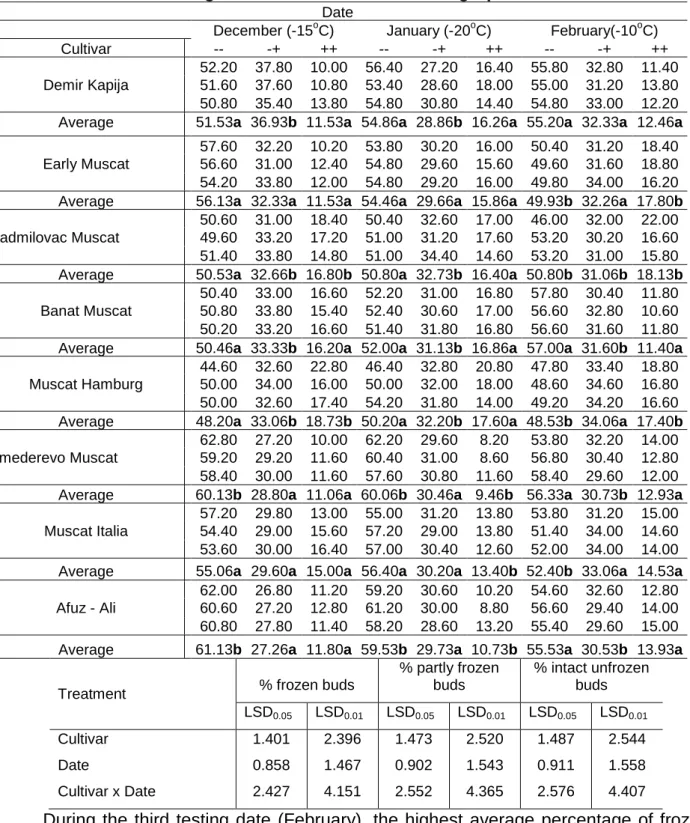
The results on bud freezing show significant variations both among the test cultivars and among testing dates (Table 1). In terms of the testing dates, the percentage of completely frozen buds in December was found to be lowest in Muscat Hamburg (48.20%) and highest in Afuz-Ali (61.13%). The percentage of partly frozen buds at this date ranged from 27.26% in Afuz-Ali to 36.93% in Demir Kapiija. Muscat Hamburg and Smederevo Muscat gave, respectively, the highest (18.73%) and lowest (11.06%) percentage of live buds at the December testing date.
178
Table 1. Percentage of frozen buds in the table grape varieties tested
Date
December (-15oC) January (-20oC) February(-10oC)
Cultivar -- -+ ++ -- -+ ++ -- -+ ++
52.20 37.80 10.00 56.40 27.20 16.40 55.80 32.80 11.40 Demir Kapija 51.60 37.60 10.80 53.40 28.60 18.00 55.00 31.20 13.80 50.80 35.40 13.80 54.80 30.80 14.40 54.80 33.00 12.20 Average 51.53a 36.93b 11.53a 54.86a 28.86b 16.26a 55.20a 32.33a 12.46a
57.60 32.20 10.20 53.80 30.20 16.00 50.40 31.20 18.40 Early Muscat 56.60 31.00 12.40 54.80 29.60 15.60 49.60 31.60 18.80 54.20 33.80 12.00 54.80 29.20 16.00 49.80 34.00 16.20 Average 56.13a 32.33a 11.53a 54.46a 29.66a 15.86a 49.93b 32.26a 17.80b
50.60 31.00 18.40 50.40 32.60 17.00 46.00 32.00 22.00 Radmilovac Muscat 49.60 33.20 17.20 51.00 31.20 17.60 53.20 30.20 16.60 51.40 33.80 14.80 51.00 34.40 14.60 53.20 31.00 15.80 Average 50.53a 32.66b 16.80b 50.80a 32.73b 16.40a 50.80b 31.06b 18.13b
50.40 33.00 16.60 52.20 31.00 16.80 57.80 30.40 11.80 Banat Muscat 50.80 33.80 15.40 52.40 30.60 17.00 56.60 32.80 10.60 50.20 33.20 16.60 51.40 31.80 16.80 56.60 31.60 11.80 Average 50.46a 33.33b 16.20a 52.00a 31.13b 16.86a 57.00a 31.60b 11.40a
44.60 32.60 22.80 46.40 32.80 20.80 47.80 33.40 18.80 Muscat Hamburg 50.00 34.00 16.00 50.00 32.00 18.00 48.60 34.60 16.80 50.00 32.60 17.40 54.20 31.80 14.00 49.20 34.20 16.60 Average 48.20a 33.06b 18.73b 50.20a 32.20b 17.60a 48.53b 34.06a 17.40b
62.80 27.20 10.00 62.20 29.60 8.20 53.80 32.20 14.00 Smederevo Muscat 59.20 29.20 11.60 60.40 31.00 8.60 56.80 30.40 12.80 58.40 30.00 11.60 57.60 30.80 11.60 58.40 29.60 12.00 Average 60.13b 28.80a 11.06a 60.06b 30.46a 9.46b 56.33a 30.73b 12.93a
57.20 29.80 13.00 55.00 31.20 13.80 53.80 31.20 15.00 Muscat Italia 54.40 29.00 15.60 57.20 29.00 13.80 51.40 34.00 14.60 53.60 30.00 16.40 57.00 30.40 12.60 52.00 34.00 14.00 Average 55.06a 29.60a 15.00a 56.40a 30.20a 13.40b 52.40b 33.06a 14.53a
62.00 26.80 11.20 59.20 30.60 10.20 54.60 32.60 12.80 Afuz - Ali 60.60 27.20 12.80 61.20 30.00 8.80 56.60 29.40 14.00 60.80 27.80 11.40 58.20 28.60 13.20 55.40 29.60 15.00 Average 61.13b 27.26a 11.80a 59.53b 29.73a 10.73b 55.53a 30.53b 13.93a
Treatment % frozen buds
% partly frozen buds
% intact unfrozen buds
LSD0.05 LSD0.01 LSD0.05 LSD0.01 LSD0.05 LSD0.01
Cultivar
Date
Cultivar x Date
1.401 0.858 2.427 2.396 1.467 4.151 1.473 0.902 2.552 2.520 1.543 4.365 1.487 0.911 2.576 2.544 1.558 4.407
During the third testing date (February), the highest average percentage of frozen buds was found in Banat Muscat (57.00%) and the lowest in Muscat Hamburg grapevines (48.53%). The percentage of partly frozen buds ranged from 30.53% in Afuz-Ali to 34.06% in Muscat Hamburg on average. The average percentage of intact unfrozen buds at this date was within the 11.40% - 18.13% range, as observed in Banat Muscat and Radmilovac Muscat, respectively.
179
and second dates that showed no statistically significant difference in mean values. It is noteworthy, however, that the freezing temperature during February was much higher than at previous dates. The percentage of partly frozen buds also showed higher variations across testing dates than across years. The analysis of data showed a significant difference between the second date relative to the first and third dates. All varieties gave a significantly lower percentage of partly frozen buds during the second date as compared to the first and third dates. Apart from the decrease in the percentage of partly frozen buds, January was also marked by an increase in the percentage of completely frozen buds and that of live buds as compared to the previous date.
The results obtained are in complete agreement with those of Meiering et al. (1980), Wolpert et al. (1985), Korać (1989, 1995), Žunić et al. (1998) and Todić (2000), who
reported that winter resistance of grapevine varieties gradually increases from the onset of winter dormancy period, reaching its maximum in mid-winter i.e. during January, and gradually declining thereafter. Interestingly, the highest cold hardiness involving the lowest percentage of completely frozen buds at the third testing date (February) was observed in Early Muscat and Muscat Hamburg, suggesting that these cultivars retain their resistance for longer periods of time as compared to the other cultivars analyzed. This complies with the findings of Proebsting et al. (1980) who found that some varieties lose the ability to adapt to freezing temperature earlier than some other varieties that manage to retain the ability much longer. An analysis of cold resistance in grapevine varieties in terms of their ripening time suggests that early ripening varieties exhibit a higher degree of cold resistance as compared to late ripening varieties. The results on the percentage of completely frozen, partly frozen and live buds are similar to or within the range of values reported by other authors Isaenko (1980), Damborska (1980), Korać (1989, 1995), Žunić, 1993, Hubáčková (1996 a), Hubáčková (1996 b) Žunić et al. (1998), Todić (2000),
Matijašević (2001).
CONCLUSION
The highest cold resistance was exhibited by Muscat Hamburg among all test varieties. Radmilovac Muscat stands out among the early ripening varieties in terms of cold hardiness. Early ripening varieties show a higher average degree of cold hardiness as compared to late ripening varieties. In terms of testing dates, cold hardiness in all varieties increased from December, reaching its maximum during January. At the end of February, the varieties tested exhibited a decline in their cold hardiness, although the February temperature the cuttings were exposed to were considerably higher than the freezing temperatures used at previous dates.
BIBLIOGRAPHY
Damborska Marta. (1980) - The effect of higher winter temperatures on changes of the frost resistance of grapevine buds. Am. J. Enol. Vitic., abstracts, Vol. 31, No.2., p. 196.
Hubáčková, M. (1996) - Cold hardiness of the grapevine buds in juvenile plants. Vitis, Vol. 35, No 3., abstract (p 69).
Hubáčková, M. (1996) - Dependence of grapevine bud cold hardiness on fluctuations in winter temperatures. Am. J. Enol. Vitic., Vol. 47, No.1., p. 100-102.
Isaenko, V.V. (1980) - Study of certain aspects of winter hardiness and development of a biological method of increasing it. Am. J. Enol. Vitic., abstracts, Vol. 31, No.2., p. 196.
180
Korać Nada, Cindrić, P. (1995) - Nove selekcije stonih sorti vinove loze Poljoprivrednog fakulteta u Novom Sadu. Zbornik naučnih i stručnih radova X Savetovanja vinogradara i vinara Srbije. Poljoprivreda, br. 375 – 378, str. 24 – 28. Beograd.
Matijašević, S.(2001) - Ampelografske karakteristike stonih sorti različitog perioda sazrevanja u uslovima gročanskog vinogorja. Magistarska teza, str. 1 – 109., Beograd.
Meiering, G. A., Paroschy, H.J., Peterson, L. R., Hostetter, G., Neff, A. (1980) - Mechanical freezing injury in grapevine trunks. Am. J. Enol. Vitic., Vol. 31, No.1., p. 81-89.
Proebsting, L. E., Ahmedullah, M., Brummund, P. V. (1980) Seasonal changes in low temperature resistance of grape buds. Am. J. Enol. Vitic., Vol. 31, No.4., p. 329-336.
Todić Slavica. (2000) - Uticaj regulatora rastenja na agrobiološka svojstva sorti Frankovka, Merlo i Kaberne sovinjon. Doktorska disertacija, str. 1 – 147., Beograd.
Wolpert, A. J., Howell, S. G. (1985) - Cold acclimation of Concord grapevines. II natural acclimation pattern and tissue moisture decline in canes and primary buds of bearing vines. Am. J. Enol. Vitic., Vol. 36, No3., p. 189 – 194.
Žunić, D. (1993) - Ampelografska ispitivanja stonih sorti vinove loze u negotinskom vinogorju. Doktorska disertacija, str. 1 – 111. Novi Sad.