Online Journal of Applied Knowledge Management
A Publication of the International Institute for Applied Knowledge Management
Volume 1, Issue 2, 2013
85
Conceptualizing knowledge culture
Bob Travica, University of Manitoba, [email protected]
Abstract
The purpose of this article is to explore a concept of knowledge culture. The discussion addresses theoretical foundations of this concept: concepts of theoretical and practitioner knowledge, knowledge management processes, knowledge technologies and systems, different organizational cultures and their corresponding kinds of knowledge, and brief evidence of exemplary knowledge management. A definition of knowledge culture is introduced and a case study of a Canadian company presented to illustrate knowledge culture.
Keywords: Knowledge management, knowledge work systems, organizational culture, knowledge culture,
process management
Introduction
In the past twenty years, knowledge has been a topic of interest in the areas of information systems (IS) and organization/management. Works of some Japanese and American authors initiated the movement (Davenport & Prusak, 1998; Nonaka & Takeuchi, 1995). Most of this research has been called knowledge management (KM). KM has been related to organizational performance. For example, Nonaka (1991) noted that successful companies created new knowledge, disseminated it widely throughout the organization, and promptly built it into new technologies and products. Consultants looking more pragmatically into the practitioner context concurred. A survey by consulting company McKinsey found that the degree of management attention to continual application, distribution, and creation of knowledge correlated with the performance of the organizations surveyed (Hauschild et al., 2001).
Developing frameworks and modeling of KM have been the mainstream topical area (e.g., Argote et al., 2003; Bock, 1999; Davenport & Prusak, 1998; Hertog & Huizenga, 2000; Nonaka & Takeuchi, 1995). A related topic that received much attention is a dichotomy of tacit versus explicit knowledge and their dynamics, which was initiated by Nonaka and Takeuchi (1995), inspired by Polanyi’s (1966) concept of tacit knowledge. Another stream of research has focused on intellectual capital (Edvinsson, & Malone, 1997). Its fundamental premise is that the knowledge in employees’ mind and materialized in organizational assets represent a new form of capital, which is as important as traditional forms of capital.
Online Journal of Applied Knowledge Management
A Publication of the International Institute for Applied Knowledge Management
Volume 1, Issue 2, 2013
86 The IS field also expressed interest in KM (e.g., Alavi & Leidner, 2001; Ardichvili et al., 2006; Durcikova et al., 2011; Ravishankar, et al., 2011; Ruppel & Harrington, 2001). This research has been inspired by both technological trends and a softer approach drawing on cognitive and management aspects, including cultural ones. Interestingly, the IS field found itself in a situation to reconceptualise some older technologies in KM terms, as in the case of expert systems (see Davenport & Prusak, 1998).
In spite of all this attention to the knowledge topic, the relationship between knowledge and organization is still an important research and practical problem. Advancing the understanding of this relationship is in order. Several questions are of interest to this discussion. First, if KM endorses process logic, is it possible to gain more from its deeper application; in particular, can design of IT/IS be turned around knowledge processes? Second, Boisot’s (1987) approach identified four organizational forms in correlation with knowledge dimensions. His organizational forms are known in organization theory, reflecting theorizing on organization in the West. In contrast, Nonaka and Takeuchi’s research (1995) emphasized the Japanese corporate context and a new form they labelled hypertext
organization. Can these two approaches be brought together in order to advance global KM
research? Related to this is the key question before this study: If practitioners talk about
knowledge culture (Hauschild et al., 2001), does this term have a theoretical grounding? Put
another way, is there a distinct organizational culture revolving around knowledge?
The discussion that follows will address the questions specified above. I will argue that advancing the process approach may result in more analytical view of KM needs and better technological support. Next, Boisot’s (1987) four-member taxonomy of knowledge-defined organizational forms and cultures will be elaborated and expanded. Finally, I will propose a concept of knowledge culture and demonstrate its applicability on literature-based evidence and my case study of a Canadian consulting company.
Views of Knowledge
For the purposes of this discussion, knowledge will be defined in terms of understanding (a) what something is (concepts, concepts’ relationships, taxonomies), (b) why something is (cause-effect relationships), and (c) how to do something (procedures, know-how). This definition pinpoints the knowledge content and is anchored in the literature on cognition (Bruning et al., 2011; Schank and Abelson, 1997).
Online Journal of Applied Knowledge Management
A Publication of the International Institute for Applied Knowledge Management
Volume 1, Issue 2, 2013
87 Among different taxonomies of knowledge it is relevant here to differentiate between scientific (theoretical) and practitioner (experiential) knowledge. These can be represented as the ends of a continuum. Scientific knowledge (whether in the physical or social domain) is focused on cause-effect relationships. It deploys concepts and procedures (of creating and testing the newly learned) as a support structure. Researchers aim at advancing theory. Although formalization and precision are the driving criteria, scientific knowledge is incoherent and even controversial as it progresses through a dialectical process involving competing models and theories. Therefore, increasing the volume of knowledge may lead a learner to the Socratic realization – “I only know that I know nothing.” In other words, certainty regarding truth can diminish as expanded knowledge horizons may reveal knowledge gaps, a lack of accuracy, and inconsistencies.
Knowledge on the practitioner side emerges from experience that professionals, managers and other occupational groups acquire in resolving practical problems in organizations. Practitioner or experiential knowledge is less general in character than scientific knowledge. Validation of its accuracy is relative to particular practice rather than formal truth criteria. Still, this knowledge is invaluable. No volume of theoretical medical knowledge can compensate for a lack of experience in diagnostics; and the better the physician knows the patient’s medical history, the better his diagnostic skills are. Learning through doing is equally essential for IS professionals occupied with system maintenance. Experiential learning about intellectual capital in people and organizational artifacts is indispensable for managers to be able to enact effective KM.
Theoretical and practical knowledge, of course, are not mutually exclusive. Experience is influenced by theory (as instantiated in formal education of professionals and managers), and theory feeds on experience (as is apparent in empirical social research). But their extent differs along the analytical continuum discussed here; one of the kinds prevails on one end, and the other on the opposite end. More of a balance between theoretical and practical knowledge exists in engineering knowledge. Concentrated on solving practical problems, engineers start with conceptual and causal knowledge and pay particular attention to know-how knowledge. Their work often results in technology creation. In applying theory to practice, engineers may find some theoretical postulates more applicable than others. The practical problem solving can motivate engineers to reach beyond theory, and thereby advance practitioner knowledge. If microelectronic components behave as their designer expects, functional computers can be built regardless of what we know theoretically about electricity. The theory of electricity was different when vacuum tubes were created than they are in present time of highly integrated circuits. Still, both the vacuum tubes and integrated circuits do work.
The last distinction relevant for this discussion is between explicit and tacit knowledge. Explicit knowledge can be verbalized, codified in various representations, and communicated. In contrast, tacit knowledge (Nonaka & Takeuchi, 1995; Polanyi, 1966) is highly individualized and difficult to express and communicate. While tacit knowledge can be placed anywhere along the practitioner-theoretical continuum, its primary source is in experience. Consequently, it has more of the practitioner character.
Online Journal of Applied Knowledge Management
A Publication of the International Institute for Applied Knowledge Management
Volume 1, Issue 2, 2013
88
Knowledge Management in the Process View
Promoted in the foundational KM literature, the process approach has been influential in KM research. Nonaka and Takeuchi (1995) explained KM through dynamics of tacit and explicit knowledge, which materializes in four conversion processes (socialization, externalization,
combination, and internalization). For example, socialization is the conversion of one’s tacit
knowledge into another person’s tacit knowledge, while externalization converts tacit to explicit knowledge. These processes can be understood as steps in a larger KM process. Davenport and Prusak (1988) also engaged process thinking, drawing on past models of managing life cycle of information resources. Their KM process includes knowledge generation, codification and coordination, and transfer (which implies knowledge absorption and use). The process approach taken in this article builds on the work of Davenport and Prusak (1988).
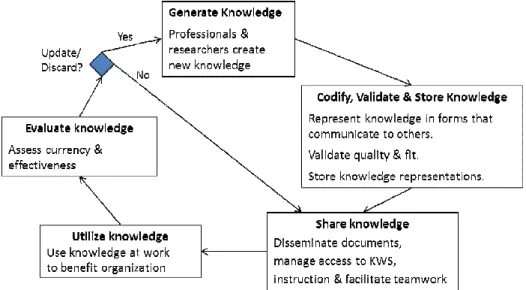
The model in Figure 1 starts with generating of knowledge as the start of an enterprise-level KM process. Then, our model expands the second step with knowledge validation to make it stand out because it is an important activity associated with codification of knowledge. New knowledge is validated for accuracy (via various tests), usefulness for the organization (e.g., patenting opportunities), and the relationship with existing knowledge (e.g., with a mainstream engineering approach). Codification refers to framing knowledge in terms that communicate to others (text in particular vocabularies, numbers, graphics, formats that fit knowledge work systems, etc.). Codification is also a manner of formalizing knowledge content (Boisot, 1987), as discussed in more detail further below. Storing of knowledge representations is closely associated with codification, especially in case of KWS.
The next step mirrors the Davenport and Prusak model. However, the term “sharing” is preferable to “transfer” for the sake of avoiding mechanical connotations inappropriate for the delicate cognitive entity that knowledge is (certainly, knowledge representations, as those in problem solving documentation, can be transferred physically, but such transfer is at best a condition for knowledge sharing). The knowledge sharing means include disseminating knowledge content, education in corporate teaching facilities, teamwork, deployment of communication systems, and managing access to KWS.
Utilizing of knowledge is split off into a separate step due to its importance. At this step, the economic purpose of all the preceding steps materializes, as the company draws a value from knowledge. The absorption of knowledge (learning) is part of this step. Since knowledge exhibits a complicated character discussed above, learning is a sub-process in itself. Another sub-process is applying repetitively what is learned.
Online Journal of Applied Knowledge
A Publication of the International Institute for Applied Knowledge Management
supporting the sharing and utilizing of existing knowledge or to initiate the start of the process for a particular piece of knowledge. This is indicated by the decision point in the model and the resulting mutually exclusive flows.
Figure 1. Knowledge Management Process (Note: KWS=knowledge work systems)
In the concept of knowledge culture advanced through this discussion, this model determines core cultural requirements.
Knowledge Work Systems
Information systems for KM
They came to the world before knowledge management became the trendy topic. This is the case with Expert Systems and Artificial Neural Network Systems (ANNS), which still m the core KWS. For example, Expert Systems encode knowledge from a specific area of expertise in the form of if-then rules, store these in a system module (“knowledge base”), and make so represented knowledge available for use of non
from artificial intelligence research in the 1960s.
Case-Based Reasoning Systems (CBRS) are younger, but still precede the current KM trend. CBRS encode knowledge in the form of rich descriptions of problems, problem solving methods, and solutions; these are stored in a “case base” and used for instructional and problem solving purposes. Furthermore, Document Management Systems could be placed in different historical periods, since these are essentially full
relational ones) with advanced indexing and retrieval capabilities. Specialized systems for government purposes may have a longer history than systems based on Lotus Notes software that dominated in the 1990s.
Communication systems also have variable history, digital technologies.
Expert systems and ANNS used to be purposed for problem solving/decision making. The KM trend re-tuned their purpose toward KM
Online Journal of Applied Knowledge Management
A Publication of the International Institute for Applied Knowledge Management
Volume 1, Issue 2
supporting the sharing and utilizing of existing knowledge or to initiate the start of the process for a particular piece of knowledge. This is indicated by the decision point in the
lting mutually exclusive flows.
Figure 1. Knowledge Management Process (Note: KWS=knowledge work systems)
In the concept of knowledge culture advanced through this discussion, this model determines
Knowledge Work Systems
Information systems for KM – knowledge work systems (KWS) – have a strange destiny. They came to the world before knowledge management became the trendy topic. This is the case with Expert Systems and Artificial Neural Network Systems (ANNS), which still m the core KWS. For example, Expert Systems encode knowledge from a specific area of
then rules, store these in a system module (“knowledge base”), and make so represented knowledge available for use of non-experts. These sys
from artificial intelligence research in the 1960s.
Based Reasoning Systems (CBRS) are younger, but still precede the current KM trend. CBRS encode knowledge in the form of rich descriptions of problems, problem solving lutions; these are stored in a “case base” and used for instructional and problem solving purposes. Furthermore, Document Management Systems could be placed in different historical periods, since these are essentially full-text databases (rather than ional ones) with advanced indexing and retrieval capabilities. Specialized systems for government purposes may have a longer history than systems based on Lotus Notes software
Communication systems also have variable history, depending on inclusion or exclusion pre
Expert systems and ANNS used to be purposed for problem solving/decision making. The tuned their purpose toward KM (see Davenport & Prusak, 1998). The only Volume 1, Issue 2, 2013
89 supporting the sharing and utilizing of existing knowledge or to initiate the start of the process for a particular piece of knowledge. This is indicated by the decision point in the
In the concept of knowledge culture advanced through this discussion, this model determines
have a strange destiny. They came to the world before knowledge management became the trendy topic. This is the case with Expert Systems and Artificial Neural Network Systems (ANNS), which still make the core KWS. For example, Expert Systems encode knowledge from a specific area of then rules, store these in a system module (“knowledge base”), and experts. These systems resulted
Based Reasoning Systems (CBRS) are younger, but still precede the current KM trend. CBRS encode knowledge in the form of rich descriptions of problems, problem solving lutions; these are stored in a “case base” and used for instructional and problem solving purposes. Furthermore, Document Management Systems could be placed in text databases (rather than ional ones) with advanced indexing and retrieval capabilities. Specialized systems for government purposes may have a longer history than systems based on Lotus Notes software
depending on inclusion or exclusion
Online Journal of Applied Knowledge Management
A Publication of the International Institute for Applied Knowledge Management
Volume 1, Issue 2, 2013
90 newer product that software designers signified as knowledge-related are various technologies called “knowledge discovery tools” (data mining, and software for various simulation purposes). Since most KWS were not developed with explicit KM needs in designer’s mind, their mapping into the KM process shows just a partial match, as displayed in Table 1.
The IS literature usually cites more liberal lists of KWS. These may include social media, groupware, various repositories, object-oriented databases, search tools, simulation, data mining for knowledge discovery, and so on. Such taxonomies, however, are usually proposed without clear mapping of systems functionality into specific steps of the KM process. For example, it can be argued that social media (blogs, for example) can support just some parts of the KM process - communication involved in knowledge sharing or storing of knowledge documents (e.g., wikis). Also, there is no good reason for placing various databases (provided they represent knowledge rather than just records of business operations) elsewhere but in the rubric of document management system. Finally, it is hard to see why “knowledge discovery tools” would be KWS rather than decision support systems. If these systems enable users to infer causal relationships, they could at best be placed at a borderline between decision making and knowledge generation systems (hence the qualifier “maybe” in the first row of Table 1).
Table 1. Knowledge Work Systems and Knowledge Process Steps
Knowledge Work System Generate Codify
Store & Use
Share
Artificial Neural Network System (ANNS) &
other systems for inferring causal relationships
maybe yes
Case Based Reasoning System (CBRS) yes yes
Expert System yes yes
Document Management System (text, graphics) yes yes
Communication Systems yes
It is apparent that KWS lag behind KM needs, particularly in supporting generation of knowledge, the first step in the KM process. In general, this crucial sub-process is least studied and publicized. And in general, there is a drought in the KWS market. To be sure, companies keep acquiring custom-built KWS, but these are confined to smaller markets.
Organizational Culture and Knowledge
Online Journal of Applied Knowledge Management
A Publication of the International Institute for Applied Knowledge Management
Volume 1, Issue 2, 2013
91 Oliver and Kandadi (2006) identified a host of aspects that should intersect to give rise to a knowledge culture (the authors did not define this term formally). However, attempts at general conceptualizations of the relationship between organizational culture and knowledge are rather rare. Boisot (1987, 1998) took on this challenging task.
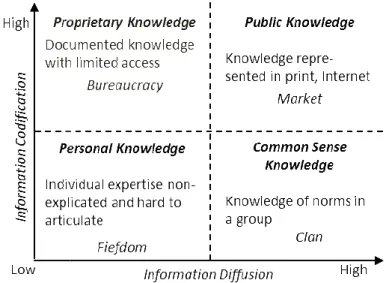
Boisot (1987) identified forms of knowledge that correspond to different forms of organization. The knowledge forms are defined by interaction of two dimensions – codification and diffusion.
Boisot conceived of diffusion in terms of dissemination of knowledge content within a population. In contrast, codification refers to the manner in which knowledge is expressed. Boisot described it in terms of formalization, classification, compression, and abstraction. For example, a patent document is highly codified as it deploys technical language, formulas, and standard diagrams. In contrast, expert notes are lower on codification since formal and personal encoding may be mixed. Boisot posited that codification influences diffusion. For example, the higher the codification (as is the case with text referencing common conceptions), the higher the diffusion. And the opposite is true: the lower the codification (as with esoteric lingoes), the smaller the diffusion. In his later work, Boisot (1998) also proposed a dimension of abstraction to refer to a reduction to salient characteristics. However, this dimension appears a spin-off from codification and would add no value to the current discussion.
Although Boisot’s work precedes theorizing of the KM gurus, similarities are obvious. His codification has similarities with the codification activity in the second step of the KM process.
Boisot’s concept complements thinking about codification in terms of shaping knowledge expressions so that they communicate to others (Davenport & Prusak, 1998). The diffusion dimension can be taken as a consequence of the knowledge sharing activity within the KM process.
In further elaboration of Boisot’s framework, the interaction of knowledge codification and dissemination charts a four-quadrant C-D model in which each quadrant is defined by a category of knowledge and its corresponding organization (Figure 2). Note that these organizational forms are widely accepted in Western organization theory (e.g., Handy, 1993; Hatch, 1997; Ouchi, 1980; Trompenaars & Hampden-Turner, 1998). Organizational forms are often thought of in terms of organizational design, which in turn implies culture as well other aspects (structure, politics, etc.). Indeed, Boisot uses the term “culture space” (C-space) to refer to the quadrants.
Online Journal of Applied Knowledge
A Publication of the International Institute for Applied Knowledge Management
Figure 2. Knowledge Forms and Corresponding Organizational Designs (Boisot, 1987)
highly distributed within its staple organization governing bodies in organization
Boisot refers to Polanyi’s (1966) concept. Personal/tacit knowledge is low on both codification and dissemination, and it resides in fiefdoms (Boisot’s example is the parliament). Lastly, high codification and dissemination spawns public knowledge, which suits market organization (Boisot’s example is the financial sector).
Boisot devoted a good part of his study to dynamics of knowledge forms. He argued that one form can lead to another, as in a
forms. For example, a small U.S. family firm historically grew in size and moved its knowledge base from the fiefdom quadrant to the bureaucracy quadrant. Codification increased and diffusion follo
Subsequently, standardization of performance measures was coupled with “data processing technologies that could chew up vast reams of well codified data” (Boisot, 1987: 136). Consequently, the trajectory curved to the American multi
market/public knowledge coupling. The author also discussed entrepreneurship and saw it as a move toward the lower quadrants, that is, the individual and group contexts. Knowledge confined exclusively to the upper quadrants characterizes a non
For the purposes of this discussion, several details will be added to the Boisot C
depicted in Figure 3. First, the dimensions are related directly to knowledge in order to avo complications of differentiating between information and knowledge. At the level of operationalization, these dimensions could be pegged to the documentation in which knowledge is represented (codification
widely knowledge documents are spread). This modification is true to Boisot’s conceptualizaitons of information, while sharpening the focus on knowledge. Second, each category of knowledge form
individual in fiefdom, group in clan, and enterprise in market and bureaucracy.
The third amendment to the Boisot model concerns re
“tacit” to resonate with the trendy vocabulary; and “group” replaces “clan” in order t broaden this category and to avoid pejorative connotations. This is in accord with similar Online Journal of Applied Knowledge Management
A Publication of the International Institute for Applied Knowledge Management
Volume 1, Issue 2
Figure 2. Knowledge Forms and Corresponding Organizational Designs (Boisot, 1987)
highly distributed within its staple organization – clan (e.g., a small entrepreneurship, and governing bodies in organizations). Personal knowledge is equivalent to tacit knowledge, and Boisot refers to Polanyi’s (1966) concept. Personal/tacit knowledge is low on both codification and dissemination, and it resides in fiefdoms (Boisot’s example is the dification and dissemination spawns public knowledge, which suits market organization (Boisot’s example is the financial sector).
Boisot devoted a good part of his study to dynamics of knowledge forms. He argued that one form can lead to another, as in a movement from less codified to more codified and diffused forms. For example, a small U.S. family firm historically grew in size and moved its knowledge base from the fiefdom quadrant to the bureaucracy quadrant. Codification increased and diffusion followed moving knowledge along an upper
Subsequently, standardization of performance measures was coupled with “data processing technologies that could chew up vast reams of well codified data” (Boisot, 1987: 136). y curved to the American multi-divisional firm, i.e., the market/public knowledge coupling. The author also discussed entrepreneurship and saw it as a move toward the lower quadrants, that is, the individual and group contexts. Knowledge
ly to the upper quadrants characterizes a non-entrepreneurial firm.
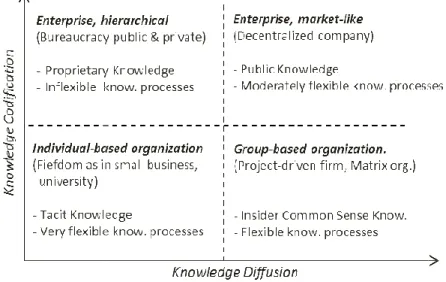
For the purposes of this discussion, several details will be added to the Boisot C
depicted in Figure 3. First, the dimensions are related directly to knowledge in order to avo complications of differentiating between information and knowledge. At the level of operationalization, these dimensions could be pegged to the documentation in which knowledge is represented (codification – how knowledge is represented; diffusion
widely knowledge documents are spread). This modification is true to Boisot’s conceptualizaitons of information, while sharpening the focus on knowledge. Second, each category of knowledge form-organization design is assigned its core agent (or carrier): individual in fiefdom, group in clan, and enterprise in market and bureaucracy.
The third amendment to the Boisot model concerns re-labeling: “personal” is replaced by “tacit” to resonate with the trendy vocabulary; and “group” replaces “clan” in order t broaden this category and to avoid pejorative connotations. This is in accord with similar
Volume 1, Issue 2, 2013
92 Figure 2. Knowledge Forms and Corresponding Organizational Designs (Boisot, 1987)
clan (e.g., a small entrepreneurship, and s). Personal knowledge is equivalent to tacit knowledge, and Boisot refers to Polanyi’s (1966) concept. Personal/tacit knowledge is low on both codification and dissemination, and it resides in fiefdoms (Boisot’s example is the dification and dissemination spawns public knowledge, which
Boisot devoted a good part of his study to dynamics of knowledge forms. He argued that one movement from less codified to more codified and diffused forms. For example, a small U.S. family firm historically grew in size and moved its knowledge base from the fiefdom quadrant to the bureaucracy quadrant. Codification wed moving knowledge along an upper-right trajectory. Subsequently, standardization of performance measures was coupled with “data processing technologies that could chew up vast reams of well codified data” (Boisot, 1987: 136). divisional firm, i.e., the market/public knowledge coupling. The author also discussed entrepreneurship and saw it as a move toward the lower quadrants, that is, the individual and group contexts. Knowledge
entrepreneurial firm.
For the purposes of this discussion, several details will be added to the Boisot C-D model as depicted in Figure 3. First, the dimensions are related directly to knowledge in order to avoid complications of differentiating between information and knowledge. At the level of operationalization, these dimensions could be pegged to the documentation in which how knowledge is represented; diffusion – how widely knowledge documents are spread). This modification is true to Boisot’s conceptualizaitons of information, while sharpening the focus on knowledge. Second, each organization design is assigned its core agent (or carrier): individual in fiefdom, group in clan, and enterprise in market and bureaucracy.
Online Journal of Applied Knowledge
A Publication of the International Institute for Applied Knowledge Management
taxonomies that identify organizations driven by team (Handy, 1993; Travica, 1998; Trompenaars & Hampden
of organizations is fixed to the economic domain, and the level of analysis is micro economic. Fifth, a dimension of flexibility is added as an additional differentiating criterion between organizational designs. This standard aspect of
terms of the extent of variation in process composition and/or execution (
Process flexibility has ramifications for KM activities (creation, codification, sharing, and evaluation). Finally, the vocabular
four organizational cultures culture (Figure 4).
This organization-knowledge taxonomy has several
• Each organizational culture contributes to KM;
• All knowledge forms matter for firm’s performance and for completing the KM process;
• The complete KM process requires moving across organization quadrants;
• Culture of complete KM is dynamic and incorporates dissimilar elements (e.g., the individualistic and bureaucratic aspects);
• Culture of complete KM can be a combination of other cultures.
These consequences are relevant for conceptualizing knowledge culture.
Excelling i
Some companies excel in managing the complete KM process as discussed above. They understand the value of creating, recording and sharing practitioner knowledge in a systematic fashion, which includes managing KWS toward clearly def
facilitate combining beliefs and behaviors that suit particular requirements of different steps Online Journal of Applied Knowledge Management
A Publication of the International Institute for Applied Knowledge Management
Volume 1, Issue 2
taxonomies that identify organizations driven by team-based project work as a distinct design (Handy, 1993; Travica, 1998; Trompenaars & Hampden-Turner, 1998). Fou
of organizations is fixed to the economic domain, and the level of analysis is micro economic. Fifth, a dimension of flexibility is added as an additional differentiating criterion between organizational designs. This standard aspect of process design is usually defined in terms of the extent of variation in process composition and/or execution (
has ramifications for KM activities (creation, codification, sharing, and evaluation). Finally, the vocabulary of organizational culture is applied to distinguish between four organizational cultures – individualistic, group (or team), bureaucratic, and market
Figure 3. Expanded C-D Model
knowledge taxonomy has several consequences as follows:
Each organizational culture contributes to KM;
All knowledge forms matter for firm’s performance and for completing the KM
The complete KM process requires moving across organization-knowledge
te KM is dynamic and incorporates dissimilar elements (e.g., the individualistic and bureaucratic aspects);
Culture of complete KM can be a combination of other cultures.
relevant for conceptualizing knowledge culture.
Excelling in Knowledge Management
Some companies excel in managing the complete KM process as discussed above. They understand the value of creating, recording and sharing practitioner knowledge in a systematic fashion, which includes managing KWS toward clearly defined objectives. They facilitate combining beliefs and behaviors that suit particular requirements of different steps Volume 1, Issue 2, 2013
93 based project work as a distinct design Turner, 1998). Fourth, the population of organizations is fixed to the economic domain, and the level of analysis is micro-economic. Fifth, a dimension of flexibility is added as an additional differentiating criterion
process design is usually defined in terms of the extent of variation in process composition and/or execution (Harmon, 2003). has ramifications for KM activities (creation, codification, sharing, and y of organizational culture is applied to distinguish between individualistic, group (or team), bureaucratic, and market
consequences as follows:
All knowledge forms matter for firm’s performance and for completing the KM
knowledge
te KM is dynamic and incorporates dissimilar elements (e.g., the
Online Journal of Applied Knowledge Management
A Publication of the International Institute for Applied Knowledge Management
Volume 1, Issue 2, 2013
94 in the KM process as the following brief evidence will show.
Minnesota Mining and Manufacturing (3M) nurtures values that motivate managers and professionals toward invention. The managers are encouraged to be open to new ideas, encourage exploration and improvisation, and provide resources for innovation (time, money). Potential inventors are supposed to take advantage of these conditions and to try out their ideas through experimenting and building prototypes. Sometimes, this may mean going against the current stream, as in the case of inventing the famous Scotch tape. A story has it that the inventor bypassed his irresponsive supervisor in order to get attention of executives, who finally approved his innovative product. (Collins & Porras, 1994; Morgan, 1986)
Microsoft prides itself of being a high intelligence quotient company. Key beliefs and practices focus on rewarding knowledge workers that expand the boundaries of software creation. The innovators get monetary rewards and placement in an exclusive part of the company called "Campus." All the campus offices are of the same size, with a desk and chair and many electric outlets. They can be used individually, so that a software expert can "sit-and-think," thereby materializing the cultural value that founder Bill Gates had formulated. He tirelessly emphasized that knowledge and intelligence are the company's key assets. These offices could also be quickly adjusted for teamwork, as project needs require, by adding movable desks and plugging in additional computers. There are cafeterias in each building, offering food and drinks at discounted prices, to accommodate informal conversations on professional issues and re-enforce a work-and-live culture of American universities. (Dearlove & Cumber, 1998; Stross, 1996)
At Accenture, a global consulting company, it is expected that knowledge is continuously generated in solving business problems for various clients. Knowledge is praised as the key resource and its contribution to financial performance is regularly assessed. KM is supported by its elaborate KWS that was developed primarily from off-the-shelf software but bent around specific system requirements. This system is expected to serve as “memory” of company knowledge. Codification of the system’s content is based on formal guidelines, introduced when the old system, which allowed for great variation in knowledge codification, was overhauled. The company’s KWS has been managed with clear profit objectives in mind. (Meister & Davenport, 2005).
Online Journal of Applied Knowledge
A Publication of the International Institute for Applied Knowledge Management
experience in a concept of hypertext organiza
layers of “text.” One layer is task force where most of new knowledge is created. Another layer is hierarchy, which suits best acquisition, accumulation and exploitation of knowledge. The third layer is “knowledge base,” which is embedded in corporate vision, culture and technologies. Members of a hypertext organization are supposed to be capable of moving through all the three layers.
Defining Knowledge Culture
The discussion so far has laid foundations following definition:
Knowledge culture is a form of organizational culture that combines elements of individualistic, group and macro
management of the entire knowledge management process.
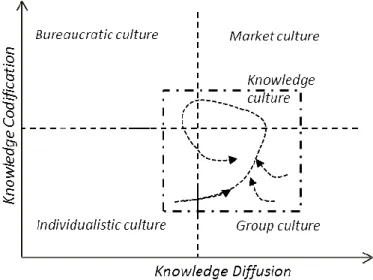
Knowledge culture is depicted
elements of the four kinds of culture identified in organization theory and discussed above. This openness of knowledge culture
culture area and its placement
individual inventiveness but it should not depend just on personal knowledge. Drawing on creative teamwork is the way to rea
principle, creativity can be further escalated. K
knowledge codification and diffusion of proprietary knowledge by bureaucratic means. Part of sharing practices can be left to free reign of market principles.
Figure 4 shows relative proportions of knowledge and organization kinds that may characterize knowledge culture in a “normal” state or equilibrium. But the domain of any piece of knowledge is rather dynamic,
over time. This idea is represented by the spiral in Figure 4.
The adjective “heedful” in the definition above should signify vivid interest, preoccupation, and mindfulness. Finally, the KM process in the definition refers to the model in Figure 1. It is also assumed that the critical first step of knowledge creation
Online Journal of Applied Knowledge Management
A Publication of the International Institute for Applied Knowledge Management
Volume 1, Issue 2
hypertext organization. This organization is characterized by three
layers of “text.” One layer is task force where most of new knowledge is created. Another layer is hierarchy, which suits best acquisition, accumulation and exploitation of knowledge. owledge base,” which is embedded in corporate vision, culture and technologies. Members of a hypertext organization are supposed to be capable of moving
Defining Knowledge Culture
The discussion so far has laid foundations for defining knowledge culture. I propose the
a form of organizational culture that combines elements of individualistic, group and macro-organizational cultures to facilitate a heedful
knowledge management process.
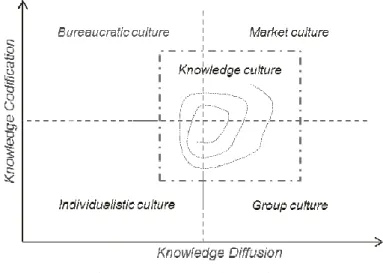
Knowledge culture is depicted in Figure 4. It is a hybrid culture category that combines elements of the four kinds of culture identified in organization theory and discussed above.
nowledge culture is signified by the dashed borderline of the k
culture area and its placement across the quadrants. Knowledge culture needs to use individual inventiveness but it should not depend just on personal knowledge. Drawing on creative teamwork is the way to reach beyond a fiefdom. Through competition as a market principle, creativity can be further escalated. Knowledge culture also
knowledge codification and diffusion of proprietary knowledge by bureaucratic means. Part n be left to free reign of market principles.
Figure 4 shows relative proportions of knowledge and organization kinds that may characterize knowledge culture in a “normal” state or equilibrium. But the domain of any piece of knowledge is rather dynamic, and therefore the mix of underlying cultures varies over time. This idea is represented by the spiral in Figure 4.
Figure 4. Knowledge Culture
The adjective “heedful” in the definition above should signify vivid interest, preoccupation, and mindfulness. Finally, the KM process in the definition refers to the model in Figure 1. It is also assumed that the critical first step of knowledge creation is not left to chance. Both 3M Volume 1, Issue 2, 2013
95 . This organization is characterized by three layers of “text.” One layer is task force where most of new knowledge is created. Another layer is hierarchy, which suits best acquisition, accumulation and exploitation of knowledge. owledge base,” which is embedded in corporate vision, culture and technologies. Members of a hypertext organization are supposed to be capable of moving
for defining knowledge culture. I propose the
a form of organizational culture that combines elements of organizational cultures to facilitate a heedful
a hybrid culture category that combines elements of the four kinds of culture identified in organization theory and discussed above. ified by the dashed borderline of the knowledge across the quadrants. Knowledge culture needs to use individual inventiveness but it should not depend just on personal knowledge. Drawing on ch beyond a fiefdom. Through competition as a market nowledge culture also needs to regulate knowledge codification and diffusion of proprietary knowledge by bureaucratic means. Part
Figure 4 shows relative proportions of knowledge and organization kinds that may characterize knowledge culture in a “normal” state or equilibrium. But the domain of any and therefore the mix of underlying cultures varies
Online Journal of Applied Knowledge Management
A Publication of the International Institute for Applied Knowledge Management
Volume 1, Issue 2, 2013
96 and Microsoft ensure, through resources and reward allocations, that innovative knowledge keeps coming. Japanese manufacturers demonstrate that the knowledge creation step represents a process in itself, which Nonaka and Takeuchi (1995) named “creative chaos.” While knowledge culture must facilitate knowledge creation, it does not stop with it. New knowledge must be codified, validated and its representations stored (patents at 3M, problem solving at Accenture and Microsoft, design solutions at Honda, KWS at Accenture). A knowledge culture pushes further the KM process. Accenture’s consultants are expected to use knowledge at work and be able to determine its contribution to financial performance. And in the hypertext organization, knowledge is continually put in use via corporate culture and technologies, in which it is embedded.
Organizational cultures at companies leading in KM exhibit openness that engenders knowledge culture. Elements of different culture categories are combined according to requirement of different steps in the KM process. Specifically, both individuals and groups play the key role in knowledge creation at 3M and Microsoft. Japanese companies emphasize group culture which facilitates sharing of tacit knowledge. As teams compete in generating new products (Japanese experience), aspects of market culture surface. Then, advances in knowledge can be raised to the enterprise level by imposing codification standards – an aspect of bureaucratic culture that surfaces in the all the examples of codification cited above. To ensure a broader diffusion of new knowledge, bureaucracy can again be instrumental in ensuring formal channels (as KWS). Also, market principles can help to match diffusion with real demand for new knowledge (see the Protegra case below).
Another way of looking at knowledge culture is from the stance of process flexibility. Flexibility creates space for exploring new venues via ad hoc methods (3M, Microsoft, Honda). This is important in the individual and group context. A unique process of critical self-examination may also be part of knowledge culture (Purser and Pasmore, 1992), as in Japanese companies. In contrast, raising knowledge to the macro-organizational (enterprise) level requires more formalized processes, as is codification and diffusion of knowledge via enterprise-wide KWS. Codification cannot be left to individual/group choices, thus making the codification process more constrained. Similarly constrained are the access privileges and use procedures of a KWS.
Online Journal of Applied Knowledge Management
A Publication of the International Institute for Applied Knowledge Management
Volume 1, Issue 2, 2013
97
Managing Knowledge Culture at Protegra
This section will discuss a case of consulting company Protegra. Largely based on Travica’s (2010) study, the Protegra case is here adjusted to a KM stance. Protegra is a management consulting and system development company. It is headquartered are in the Canadian province of Manitoba. Protegra was established in 1998, when three friends decided to deploy their rich experience from the computer software industry to build a dream company. Until 2004, the strategic direction of Protegra was in developing of-the-shelf software products. Then, the company took a new course toward developing custom software to be offered along with management consulting on business performance. This move brought Protegra in a double-consulting role. In the mid-2000s, Protegra had been one of the fastest growing small companies in Canada, expanding its client base into the United States, Europe, and Japan. It has achieved a number of awards, including the Best Small and Medium Employer in Canada in 2009, and Manitoba’s awards for the project of the year and for best business practices in 2006.
In its consulting practices, Protegra has used a Lean methodology. Dan Perron, practice leader for business performance consulting, recalled that this methodology had developed early in Protegra’s life by learning from Toyota’s lean manufacturing approach, the consulting literature, and Protegra’s practices. Essentially, Protegra’s lean methodology tends to streamline the job on the consultant side as well as to provide streamlined solutions to the client. Streamlining includes optimizing processes, eliminating waste of time and resources, and better use/improvement of IS. Put another way, both the consulting process and the result of consulting should maximize organizational efficiency.
Protegra’s typical consulting process aims at identifying a gap between goals and reality, and then improving business process design and IS support. For example, Protegra consulted a large manufacturer of windows and doors for the luxury market, and created solutions for improving both the efficiency of key organizational processes and the quality of products delivered by the manufacturing process. Timing, costs and the deliverable quality constitute the standard metric of the organizational process performance.
Protegrans generate practitioner knowledge in daily teamwork that underpins consulting projects. This is where tacit knowledge is normally created and shared. But the company has also developed dedicated processes and IS for knowledge generation and sharing. One such process and associated IS are called “Idea Funnel” (Figure 5). The front end is an online form that any employee could use to submit some innovation-relevant idea. These include improvements in business processes and organization, advances in company’s IS, and improvements in the social domain. Innovation ideas could spring from various sources. These could be project teamwork, individual self-education outside business hours, eureka elicited in informal conversations, and so on.
Online Journal of Applied Knowledge
A Publication of the International Institute for Applied Knowledge Management
Figure 5. Process diagram (partial) for Innovation Management at Protegra
The back-end of the Idea Funnel process engages a team with a changing membership. The team would receive a proposal and decide if it is acceptable or not at the time being. They would also suggest that the innovation be championed by the author or by the
are competent or directly affected by a prospective change. The selected champion of an innovation would, then, decide on taking ownership over the idea and on implementing it. If passed, this step triggers a process of realizing the innovation
brainstorming, using other information systems in the company for discussion and group authoring of knowledge documents (blogs, wikis), soliciting contributions via conferences and presentations, obtaining funding, and shaping the new pi
artifact.
A cultural value and the corresponding practice of continuous improvement are strongly encouraged at Protegra. A good professional is deemed the one who continually improves his/her professional knowledge. In the
continuous improvements are essential. Advances in individual knowledge often imply extra effort on the learner’s side because the learning time is not possible to convert into billable hours – the company’s only source of income.
Protegrans believe that thought leadership is the desirable way of facilitating knowledge development. Thought leadership emerges from professional interest and competence and it is expected to materialize in knowledge sharing. This
and experiential and is predominantly explicit in character. Jennifer Glen, employee relationship facilitator, explained: “Anyone can become a thought leader in some area. The thought leader is considered to be the go
technology.”
Online Journal of Applied Knowledge Management
A Publication of the International Institute for Applied Knowledge Management
Volume 1, Issue 2
Figure 5. Process diagram (partial) for Innovation Management at Protegra
end of the Idea Funnel process engages a team with a changing membership. The team would receive a proposal and decide if it is acceptable or not at the time being. They would also suggest that the innovation be championed by the author or by the
are competent or directly affected by a prospective change. The selected champion of an innovation would, then, decide on taking ownership over the idea and on implementing it. If passed, this step triggers a process of realizing the innovation. This may include brainstorming, using other information systems in the company for discussion and group authoring of knowledge documents (blogs, wikis), soliciting contributions via conferences and presentations, obtaining funding, and shaping the new piece of knowledge or a physical
A cultural value and the corresponding practice of continuous improvement are strongly encouraged at Protegra. A good professional is deemed the one who continually improves his/her professional knowledge. In the fast moving world of information technologies, continuous improvements are essential. Advances in individual knowledge often imply extra effort on the learner’s side because the learning time is not possible to convert into billable
nly source of income.
Protegrans believe that thought leadership is the desirable way of facilitating knowledge development. Thought leadership emerges from professional interest and competence and it is expected to materialize in knowledge sharing. This knowledge can be a mix of theoretical and experiential and is predominantly explicit in character. Jennifer Glen, employee relationship facilitator, explained: “Anyone can become a thought leader in some area. The thought leader is considered to be the go-to-person for a particular methodology or Volume 1, Issue 2, 2013
98 Figure 5. Process diagram (partial) for Innovation Management at Protegra
end of the Idea Funnel process engages a team with a changing membership. The team would receive a proposal and decide if it is acceptable or not at the time being. They would also suggest that the innovation be championed by the author or by the members who are competent or directly affected by a prospective change. The selected champion of an innovation would, then, decide on taking ownership over the idea and on implementing it. If . This may include brainstorming, using other information systems in the company for discussion and group authoring of knowledge documents (blogs, wikis), soliciting contributions via conferences ece of knowledge or a physical
A cultural value and the corresponding practice of continuous improvement are strongly encouraged at Protegra. A good professional is deemed the one who continually improves fast moving world of information technologies, continuous improvements are essential. Advances in individual knowledge often imply extra effort on the learner’s side because the learning time is not possible to convert into billable
Online Journal of Applied Knowledge Management
A Publication of the International Institute for Applied Knowledge Management
Volume 1, Issue 2, 2013
99 Ryan Caligiuri, who upon graduation became communications coordinator at Protegra, illustrated this cultural aspect and indicated its motivational power: “They looked to me for guidance on the things I was hired for. If I didn't know something, I had to get myself educated. This has really made my job fun, opened it up, and empowered me as a person because I've been in charge of my career. The world really is my oyster!”
The process leading to a thought leader involves further action by a self-motivated learner. Glenn explained that such person may present at the company’s events called “Lunch-and-Learns,” do coaching and mentoring in the subject area, and contribute to the company’s wikis and blogs. But to become a go-to-person, there needs to be acceptance by the colleagues. It is up to the judgement of the audience to assess usefulness of presented knowledge and to decide on taking advantage of it – or not. Essentially, a free play of demand for knowledge determines whether a willing learner eventually matures into a thought-leader.
Protegrans deploy their expertise through their consulting engagements (projects). They are motivated by a cultural belief that the client deserves the best possible software and business solutions resulting from advanced knowledge and technologies. The consulting service should make a beneficial difference on the client’s side. Protegrans believe that Protegra and their loyal clients had the same goals. This has been formulated through a value of three wins. If employees enjoy their project work, they win. If employees win, the client wins too, because they get the best value from such a project work. The third winner is Protegra, because a satisfied client is the best advertisement and usually returns for more.
Contrasting the case of Protegra with the concept of knowledge culture reveals that the company exhibits elements of such a culture (Figure 6). First, Protegra’s culture covers most of the KM process. It starts with the knowledge creation step (project teamwork, Idea Funnel, continuous improvement via advancing individual knowledge), and progresses through knowledge codification and storing (Idea Funnel, the content mapping system). The knowledge culture at Protegra further materializes in knowledge sharing (self-motivated thought leadership, presentations, mentoring, wikis, blogs), and culminates in the intense use of knowledge at work (serving clients with advanced knowledge, the three wins). Knowledge validation and update is managed as well, in rather a market fashion. This last step in KM process follows from the continuous individual improvement, thought leadership, and the idea Funnel process/system.
Second, Protegra’s culture manifests elements of other cultures that a knowledge culture combines. Both the individual and group cultures play the role. Sources of new knowledge can be in both, and both are responsible for knowledge sharing and using. The Idea Funnel process/system brings in elements of market culture, as innovation ideas compete for attention and resources. Innovations codified and recorded via the Idea Funnel process and system represent bureaucracy aspects in Protegra’s knowledge culture.
Online Journal of Applied Knowledge
A Publication of the International Institute for Applied Knowledge Management
Finally, the Protegra case demonstrates that a deeper process approach to KM results in KWS that are natural part of knowledge processes. Although it commands significantly smaller resources than the cited companies excelling in KM
company can leverage such resources toward knowledge culture.
Figure 6. Knowledge culture at Protegra
Summary and Conclusion
I argued in this article that study of knowledge management (KM) in the past twenty five years still has not resulted in theorizing that could satisfy both academic and practitioner needs. The relationship between knowledge and organization is still opaque and remains an important research and practical problem. On the path of conceptualizing
culture, the process approach to KM was explored in conjunction with technological support by KWS (knowledge work systems). Boisot’s (1987) four
organizational designs to knowledge forms (personal/tacit, common
proprietary) was explored and expanded. After discussing evidence of exemplary KM at 3M, Microsoft, Accenture and in Japanese manufacturing, knowledge culture was defined as a form of organizational culture that could combine elements of individu
macro-organizational cultures to facilitate a heedful management of the entire knowledge management process. Finally, the case of Protegra, a Canadian consulting company, was presented as an illustration of some aspects of knowledge cult
The work presented here is based on a limited literature background. The case evidence also bears usual limitations in term of generalizing out of single
proposed concept of knowledge culture is rested on core literat
similarities and differences. Evidence, inclusive of the case study, suffices the purpose of the article.
The knowledge culture concept awaits validation in empirical research. Case research would be a natural path to follow. Quantitative study is also warranted, as dimensions of knowledge codification and diffusion, and of process flexibility lend themselves to measurement. Creativity in operationalizing knowledge concepts and constructs is needed. For example, Online Journal of Applied Knowledge Management
A Publication of the International Institute for Applied Knowledge Management
Volume 1, Issue 2
Finally, the Protegra case demonstrates that a deeper process approach to KM results in KWS that are natural part of knowledge processes. Although it commands significantly smaller resources than the cited companies excelling in KM, Protegra demonstrates how a small company can leverage such resources toward knowledge culture.
Figure 6. Knowledge culture at Protegra
Summary and Conclusion
I argued in this article that study of knowledge management (KM) in the past twenty five years still has not resulted in theorizing that could satisfy both academic and practitioner needs. The relationship between knowledge and organization is still opaque and remains an important research and practical problem. On the path of conceptualizing
culture, the process approach to KM was explored in conjunction with technological support by KWS (knowledge work systems). Boisot’s (1987) four-member taxonomy mapping organizational designs to knowledge forms (personal/tacit, common-sense, pu
proprietary) was explored and expanded. After discussing evidence of exemplary KM at 3M, Microsoft, Accenture and in Japanese manufacturing, knowledge culture was defined as a form of organizational culture that could combine elements of individu
organizational cultures to facilitate a heedful management of the entire knowledge management process. Finally, the case of Protegra, a Canadian consulting company, was presented as an illustration of some aspects of knowledge culture.
The work presented here is based on a limited literature background. The case evidence also bears usual limitations in term of generalizing out of single-organization studies. Still, the proposed concept of knowledge culture is rested on core literature and related to it on both similarities and differences. Evidence, inclusive of the case study, suffices the purpose of the
The knowledge culture concept awaits validation in empirical research. Case research would Quantitative study is also warranted, as dimensions of knowledge codification and diffusion, and of process flexibility lend themselves to measurement. Creativity in operationalizing knowledge concepts and constructs is needed. For example, Volume 1, Issue 2, 2013
100 Finally, the Protegra case demonstrates that a deeper process approach to KM results in KWS that are natural part of knowledge processes. Although it commands significantly smaller , Protegra demonstrates how a small
I argued in this article that study of knowledge management (KM) in the past twenty five years still has not resulted in theorizing that could satisfy both academic and practitioner needs. The relationship between knowledge and organization is still opaque and remains an important research and practical problem. On the path of conceptualizing a knowledge culture, the process approach to KM was explored in conjunction with technological support member taxonomy mapping sense, public, and proprietary) was explored and expanded. After discussing evidence of exemplary KM at 3M, Microsoft, Accenture and in Japanese manufacturing, knowledge culture was defined as a form of organizational culture that could combine elements of individualistic, group and organizational cultures to facilitate a heedful management of the entire knowledge management process. Finally, the case of Protegra, a Canadian consulting company, was
The work presented here is based on a limited literature background. The case evidence also organization studies. Still, the ure and related to it on both similarities and differences. Evidence, inclusive of the case study, suffices the purpose of the
Online Journal of Applied Knowledge Management
A Publication of the International Institute for Applied Knowledge Management
Volume 1, Issue 2, 2013
101 measuring the popular concept of knowledge sharing (a sub-process in the KM process resulting in knowledge diffusion) needs to expand beyond a distribution of recorded knowledge representations toward the phenomena of communication for knowledge sharing.
The technological drought in the KM domain, on the one hand, and the here elaborated knowledge culture framework, on the other, represent opportunities for advancing design science. A more recent stream within the information systems field, design science could look more deeply into KM processes in order to identify better the technological needs behind KM. The sub-process of knowledge generation deserves a particular attention. Advances in design science might eventually reenergize the KWS industry.
It is the hope of this author that practitioners can also validate and benefit from the concept of knowledge culture. They might be particularly interested in the notion of hybrid character of knowledge culture and the implied need to carefully manage different cultural elements toward completion of the KM process. Experiential learning about intellectual capital in people and organizational artifacts is indispensable for managers to be able to enact effective KM. Indeed, being privy of such practitioner knowledge, both managers and professionals have a unique capability of creatively shaping organization-specific knowledge processes. Findings and realizations in both the academic and practitioner domains will advance our understanding of knowledge culture.
References
Alavi, M. and Leidner, D.E. (2001). Review: knowledge management and knowledge management systems: conceptual foundation and research issues. MIS Quarterly, 25(1), 107-36.
Ardichvili, A., Maurer, M., Li, W., Wentling, T., and Stuedemann, R. (2006). Cultural influences on knowledge sharing through online communities of practice. Journal of
Knowledge Management, 10(1), 94-107.
Argote, L., McEvily, B. and Reagans, R. (2003), Managing knowledge in organizations: an integrative framework and emerging themes. Management Science, 49(4), 571-82.
Bock, F. (1999).The intelligent approach to knowledge management: viewing KM in terms of content, culture, process and infrastructure. Knowledge Management Review, 7, 22-5.
Bartlett, C., & Ghoshal, S. (1989). Managing across borders: The transnational solution. Boston, MA: Harvard Business School Press.
Boisot, M. (1998). Knowledge Assets: Securing Competitive Advantage in the Information
Economy. Oxford, UK: Oxford University Press.
Boisot, M. (1987). Information and Organizations: The Manager as Anthropologist. London: Fontana.
Online Journal of Applied Knowledge Management
A Publication of the International Institute for Applied Knowledge Management
Volume 1, Issue 2, 2013
102 Boston, MA: Pearson.
Collin, C., and Porras, J. (2004). Built to Last. New York, NY: HarperCollins.
Davenport, T., and, Laurence. P. (2000). Working Knowledge: How Organizations Manage
What They Know. Harvard Business School Press.
Dearlove, D., and Cumber, S. (1998). Business the Bill Gates Way: 10 Secrets of the World's
Richest Business Leader. Chichester, UK: Capstone Publishing.
De Long, D.W., and Fahey, L. (2000). Diagnosing cultural barriers to knowledge management. Academy of Management Executive, 14(4), 113-27.
Durcikova, A., Fadel, K., Butler, B., Galletta, D. (2011). Research Note - Knowledge
Exploration and Exploitation: The Impacts of Psychological Climate and Knowledge Management System Access. Information Systems Research, December, 855-866.
Edvinsson, L., and Malone, M.S. (1997). Intellectual Capital: Realizing your Company’s
True Value by Finding Its Hidden Roots. New York, NY: Harper Business.
Harmon, P. (2003). Business Process Change. San Francisco, CA: Morgan Kaufmann.
Hertog, J.F.D. and Huizenga, E. (2000). The Knowledge Enterprise: Implementation of
Intelligent Business Strategies. London: Imperial College Press.
Hatch, M.J. (1997). Organization Theory: Modern, Symbolic, and Postmodern Perspectives. New York, NY: Oxford University Press.
Hauschild, S., Licht, T., and Stein, W. (2001). Creating a knowledge culture. McKinsey Quarterly, February issue.
King, W.R. (2008). Questioning the conventional wisdom: culture-knowledge management relationships. Journal of Knowledge Management, 12(3), 35-47.
Knapp, E. and Yu, D. (1999). Understanding organizational culture: how culture helps or hinders the flow of knowledge. Knowledge Management Review, 7, 16-21.
Lai, M.F., Lee, G.G. (2007). Relationships of organizational culture toward knowledge activities. Business Process Management Journal, 13(2), 306-322.
McDermott, R. and O’Dell, C. (2001). Overcoming cultural barriers to sharing knowledge.
Journal of Knowledge Management, 5(1), 76-85.
Meister, D. and Davenport, T. (2005). Knowledge management at Accenture. London, ON: Ivey Publishing.