ISSN 2476-7611
118
KaryoType population study in chamomile
Homa Alizadeh1*, Hamideh javadi2, Mohammad Ali alizadeh2,Parvin Salehi2
1- Department of horticulture, Islamic Azad university Karaj branch, Karaj,Iran. 2- Research institute of Foreste and rangelands p.o.box 13185-116,Tehran, Iran.
Received: 15, January, 2018 Accepted: 17, November, 2018 Online Published: 24, December, 2018
Abstract
Chamomiles (Anthemis, Matricaria, Tanacetum) are of the genus Choseni or Citrus (Compositae) whose species are precious to medicinal herbs and are distributed in different regions of Iran. In this study, the shape and structure of chromosomes by microscopic observation and using specific staining methods, was performed on 21 populations belonging to three genera of Anthemis, Matricaria and Tanacetum, collected from different parts of Iran. For this purpose, the seeds were first cultured on petri dish and transferred to 25 ° C after sterilization. After germination, the roots were pretreated with 1% Alphabromonphthalene and then fixed with Luttski solution. NaOH was used for normal hydrolysis and to stain the Sthhmothoxylin. Microscopic specimens were prepared by squash method and then studied using an optical microscope BX41 Olympus with a magnification of 1750 ×. In all samples, the chromosome base number was x = 9 and the ploidy level (diploid) = 18 = n2 = x2. In all populations, metacentric chromosomes were predominant, and in addition to metacentric Sub Metacenter and Subtwostrater chromosomes, were observed as well.
Keywords: : Chomomile, Chromosome, Anthemis, Matricaria, Tanacetum
1.INTRODUCTION
Chamomile is one of the most important medicines known to man and one of the most widely used herbs in Europe, the Middle East, North America, Australia and the African countries, which is mainly cultivated for the use of its aqueous essential oil, and with increasing use, It is very important in the pharmaceutical, cosmetic, sanitary, perfumery and food industries sectors. Accordingly, in recent decades, in many parts of the world, especially in the European countries, there are many studies about the crop and racial aspects of this plant and we are witnessing the production of this plant every year. Chamomile in different parts of our country, Iran has also wild grown and cultivated in several provinces at a limited level. Considering the medicinal value and the importance of this plant in the health of the community as well as the economic value of its production, it seems that the attempt to develop the cultivation and increase the quality of chamomile in the country would be appropriate, as it would be possible for its export and value as well [1]. The most important taxonomic problems within the Antimideae family, the existence of kinship relations between sexes, the uncertainty of the genders, in particular the subgroups of Matricarinae and the presence of polymorphic species in the genders of this sub-clan, have led to different suggestions for the classification of the Chamomile cluster [2] . For example, Tripleurospermum is very similar to the genus Matricaria in terms of morphological characteristics and has a similar growth and taxonomic similarity to certain Anthemideae species and has caused problems naming them. In the past, the main traits that were considered by botanists were morphological traits. Nowadays, with the development of biosystematics, many traits are studied, whose nature is very diverse. For this reason, cellular features such as the number and shape of chromosomes, as well as the protein and enzyme properties, and the use of the
status of chromosomes to classify the plants and help solve the problems of classical taxonomy in the last century, furthermore its importance has gradually become apparent [3].Some scientists believe that chromosomes are the only proper factors that can be used to determine the evolutionary process. Due to the variety of chamomile species, as well as the classification of this subspecies, the use of morphological characteristics and chemical properties has been a great effort to provide a satisfactory taxonomy in this clan. For this reason, the cornerstone of the systematic position and its evolution has always been the focus of attentions [4]. The difference in the chromosomal number among the genus and species of this cluster is indicative of ploidy changes and reorganization of the genome, and are a key factor in the evolution of this family. In all studies, the chromosomal number of x = 9 has been reported, which is the common base number in the Anthemideae family and the Asteraceae family. Differences in the shape and size of chromosomes (chromosomal changes) during mitosis, the presence of genetic diversity and genetic barriers among the species that emerged during the genetic flow is Such differences have always been expected since it has been shown that the populations of one species each exhibit their particular compromise in the environment in which they occur, and these compromises appear at the genome and karyotype level [5]. Ebrahim et al., In a 2012 study of different species of yarrow, reported the number of base chromosomes by x = 9 [6]. In cytogenetic studies done by Farsi et al. 2000[7], Ibrahim et al. 2012[6], and Shadyia et al. 2009[8], on Achillea millefolium, the ploidy levels of the yarrow were tetraploid 236 = x4 = n2, hexaploid 54 = x6 = n2 and octo-ovoid 72 = x8 = n2. In another study by Afshari et al. 2013, Achillea millefolium L has two diploid attachments and two tetraploid extras. Based on cluster analysis, the diabetic appendages were grouped into A2 based on the steady-state method.[9] In another
119 study, Turkoglu et al. (2004) [10]studied the number of chromosomes for Achillea sintenisii, and 36 = x4 = n2 and 15 metacentric pairs, a pair of submeta and two pairs of subtwolensterics and a total length of chromosomes of 26.24 and A. sipikorensis , 18 = x2 = n2, which has 6 pairs of metastatic chromosomes and two pairs of submetacnetric and one pairs of sub-telesteric chromosomes and the total chromosome length was from 1060/13 to 41/13%, and the total length of the chromosome was .In the study of six species of ovaries, reported chromosomal numbers of 67-7.87 and 36 = x4.18 = x2 = n2, which stated that chromosomes were often meta-metastatic and sub-metastatic. Cytogenetic studies on five species of Artemisia collected from Kashan including Artemisia scoparia, A. biennis, A. aucheri, a oliveriana and A. persica, ploidy levels of these species were different. Species of scoparia, biennis and A. persica were diploid, A. aucheri tetraploid species and A. helix virus were oliveriana. The chromosome base number in these species was 8 and 9. The studied species have a symmetric karyotype. Polyploid species had less karyotypic symmetry than diploid species. Saedi et al. (2005) In the karyotypic study of 6 species of Artemisia in western Azerbaijan, the chromosome base number was x = 8 in the three diploid populations and 9 = x (the most common base number) in the two populations of the diploid and three tetrapeptide populations[11]. In another study carried out by Tabur et al. In 2012, chromosomal numbers 8 and 9 and ploidy levels varied between x2, x4 and x6, and chromosomes were meta-type and sub-metacentric[12]. In general, cytotoxin studies, in addition to identifying the relationship between species, can provide valuable information about the gene pool available in the country for use in the gene bank. Therefore, cytogenetic studies in plant species and their populations, especially wild and native plants, are of great importance due to the provision of quantitative information on the evolutionary history of the plant, the determination of interrelationships, the determination of the characteristics of the crop, and so on. In the present study, various populations of three genera of Anthemis, Tanacetum and Matricaria chamomile have been investigated in terms of the shape and microscopic structure of chromosomes. 2.MATETIAL AND METHOD
The seeds of 6 populations of the genotypes studied from the gene bank of the Institute of Forestry and Rangeland Research Institute of Iran were prepared. In Table 1, the names of the species examined and their location are given.
Table 1: Specifications Table of Species
S
eq
.
province Species Genome Code in the ref.Bank
1 Boroujen Matricaria recutita(L.) 8959
2 Malayer Tabacetum
parthenium(L.) 9628 3 Sarein Anthemis triumfetti(l.) 11900 4 Qazvin Matricaria recutita(l.) 17052 5 Tehran Tanacetum parthenium(l.) 18833 6 Semnan Anthemis triumfetti(l.) 21605
First, seeds were disinfected with Vitawax fungicide 2 per thousand for 2 to 3 minutes, and cultured on filter paper inside Petri dish. For the removal of possible dormancy, petri dishes were kept in a refrigerator at 4 ° C for 1-3 weeks. They were then transported inside the germinator. Which has a dark to light brightness ratio of 8/16 and a temperature of 24-20 ° C. Given that roots with a length of 1.5-1.1 cm are suitable for sampling, they were ready after about 1 week. The best hours to check the roots were 8-830 in the morning, at that time they had the highest number of metaphysical cells. One of the important issues for karyotyping is to achieve a sufficient number of proto-metaphyseal or metaphysical cells. Because at this stage, the chromosomes have the shortest length and the best conditions to study. And since the various stages of cell division pass steady and continuously, it is necessary to persuade the metaphysial cells to remain in the desired stage. This is done by chemical means. The underlying principle in pre-treatment, is to change the concentration of cytoplasm. A sudden change that affects the mechanism of the cell and the chromosomes without drift polars. Actions taken on the cell:
Disrupt the activities of the Duke's fields Clear and transparent cytoplasm
Dissemination and clarity of the structure of chromosomes that have been damaged
Separation of undesirable and unwanted particles from the surface of the tissues for quicker penetration of the fixative materials.
120 normal NAOH 1 stock solution, we dissolve 4 grams of this substance in 100 cc distilled water. The study of the shape and structure of chromosomes is possible through microscopic observation and using specific colorimetric methods. Hematoxylin was used for staining. To prepare this material, first add 4 grams of hematoxylinic powder to 100 cc of acetic acid 45%, then add 1 g of ammonium sulfate of iron II to air for 1 week and then disperse the filter.to stain the specimens after washing the roots with distilled water, place the roots in a suitable container and add it to a very small amount so that it covers only the specimens. Samples are at room temperature for 3-4 hours. After several steps with distilled water to completely dispose of paint residues, samples can be stored in distilled water in the refrigerator. After coloring the roots, remove a 45% acetic acid droplet onto a clean slime and remove a small portion of the root tip, less than 1 mm in length. Then put a lamella on the root with the help of Pence and slowly in a way that does not form any bubbles. This problem can be solved by adding a small amount of acetic acid at the lateral edges as air bubbles appear in the corners of the lamella. First, examine the sample to ensure that the end of the root is under the microscope. Because of the delicacy of the roots, this root portion may have been detached during the preparation steps. smash the roots afterward, then tap the sample gently with a ball pen. This causes the cells to split apart. Then place the lamella between the filter paper and push it with the finger so that the sample is
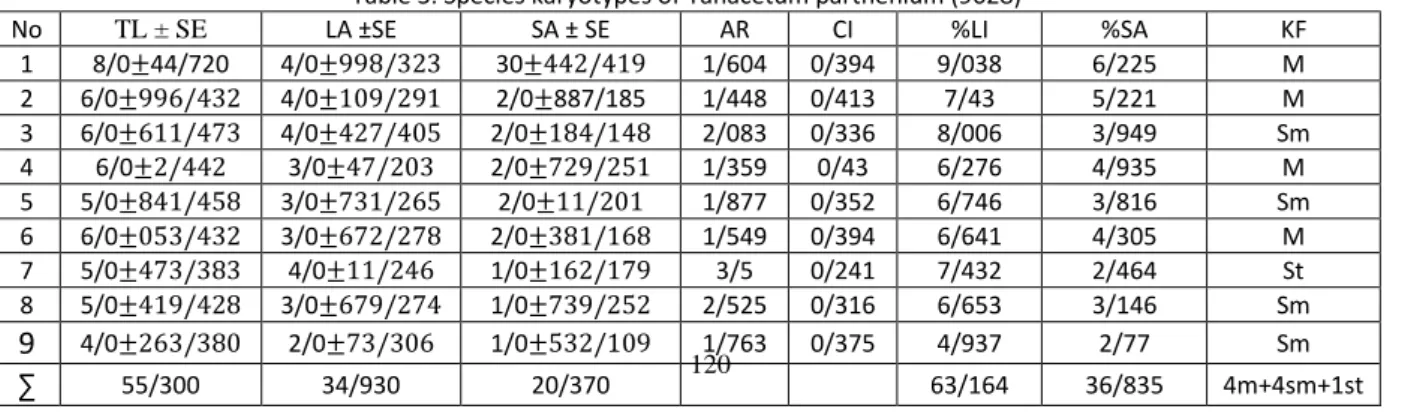
Tanacetom parthenium (9628) karyotype
Cytogenetic studies in Table 3 showed that this diapolio population is 18 n = 2 and the chromosome number is x = 9 and its karyotype formula is st1 + sm4 + m4. The
flat and the chromosomes are placed on the same surface This makes the chromosomes look better. After examining the specimens with lens 10 and 20, and if there is a chromosome, we will take a photo with 100 lens. To see samples with lens 100, you should use a very small amount of oil. The samples were studied using an optical microscope BX41 Olympus with a magnification of 1750 ×. The micro-misure program was used to measure the length of the chromosomes.
3.RESULTS AND DISCUSSION
Characteristics of the chromosomes are presented in the examples below. In the following tables: No: chromosome number, TL: total length of chromosome, LA: long arm length, SA: short arm length, SE: standard error index, AR: arm ratio, CI: centrometric index, LA percentage: long arm length ratio ,% SA: short arm length ratio, Σ: sum and KF, karyotype formula.
1. Karyotype of the population of Matricaria recutita (8959)
The cytogenetic studies in Table 2 showed that this diapolio population is 18 n = 2 and the chromosome number is 9 = x and its karyotype formula is sm 4 + m 5. The total length of the chromosomes is 48.797, the total length of the long arms is 29.99 and the total length of the articular arms is 19.68 microns. The tallest chromosome is 334.9 micrometers and the shortest is 4.03 micrometers.
total length of chromosomes is 55/305, the total length of the long arms is 930/34 and the total length of the short arms is 20/37 microns. The tallest chromosome is 434.12 μm and the shortest is 127.2 μm.
Table 2. Species of the population of Matricaria recutita (8959)
No TL ± SE LA ±SE SA ± SE AR CI %LI %SA KF
1 7/0±5/416 4/0±399/226 3/0±101/223 1/462 0/409 8/981 6/332 M
2 6/0±604/348 3/0±718/438 2/0±886/137 1/266 0/443 7/592 5/892 M
3 6/0±267/409 3/0±762/316 2/0±505/122 1/495 0/406 7/681 5/115 M
4 5/0±137/267 3/0±406/155 1/0±73/134 2/048 0/332 6/955 3/534 Sm
5 5/0±117/238 2/0±95/103 2/0±166/136 1/393 0/419 6/025 4/424 M
6 5/0±047/262 3/0±226/124 1/0±82/141 1/835 0/355 6/588 3/717 Sm
7 5/0±111/268 3/0±298/138 1/0±812/18 2/074 0/347 6/734 3/7 Sm
8 4/0±438/115 2/0±827/157 1/0±61/056 1/821 0/368 5/773 3/289 Sm
9
3/0±751/197 2/0±299/189 1/0±451/011 1/576 0/398 4/694 2/964 M∑
48/977 29/890 19/086 61/028 38/971 5m+4smTable 3. Species karyotypes of Tanacetum parthenium (9628)
No TL ± SE LA ±SE SA ± SE AR CI %LI %SA KF
1 8/0±44/720 4/0±998/323 30±442/419 1/604 0/394 9/038 6/225 M
2 6/0±996/432 4/0±109/291 2/0±887/185 1/448 0/413 7/43 5/221 M
3 6/0±611/473 4/0±427/405 2/0±184/148 2/083 0/336 8/006 3/949 Sm
4 6/0±2/442 3/0±47/203 2/0±729/251 1/359 0/43 6/276 4/935 M
5 5/0±841/458 3/0±731/265 2/0±11/201 1/877 0/352 6/746 3/816 Sm
6 6/0±053/432 3/0±672/278 2/0±381/168 1/549 0/394 6/641 4/305 M
7 5/0±473/383 4/0±11/246 1/0±162/179 3/5 0/241 7/432 2/464 St
8 5/0±419/428 3/0±679/274 1/0±739/252 2/525 0/316 6/653 3/146 Sm
9
4/0±263/380 2/0±73/306 1/0±532/109 1/763 0/375 4/937 2/77 Sm121 3.-3. Anthemis triumfettii karyotype (11900)
Cytogenetic studies in Table 4 showed that this diapolio population is 18 n = 2 and the chromosome number is 9= x and its karyotype formula is Sm6 + m3. The total
3-4. Populations of the Matricaria recutita (17052)
Cytogenetic studies in Table 5 showed that this
diapolio population is 18 n = 2 and the chromosome number is x= 9 and its karyotype formula is st1 + sm4 + m4. The
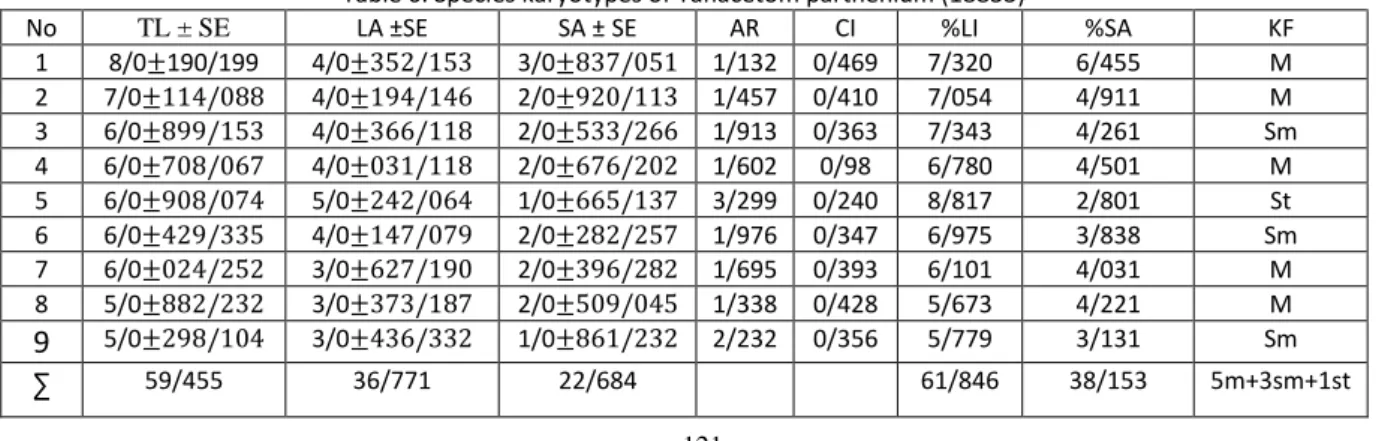
Tanacetom parthenium populations of karyotype (18833)
Cytogenetic studies in Table 6 showed that this
diapolio population is 18 n=2 and the chromosome number is x=9 and its karyotype formula is st1 + sm3 + m5.
length of the chromosomes is 155/65, the total length of
the long arms is 51/41 and the total length of the long arms is 644/23. The tallest chromosomes are 384/11 micrometers and the shortest are 302/4 micrometers.
total length of the chromosomes is 639/61, the total length of the long arms is 384.26 and the total length of the long arms is 375.235 microns. The tallest chromosome is 460/10 micrometer and the shortest is 599/3 micrometers.
The total length of the chromosomes is 59.5455, the total length of the long arms is 771.36 and the total length of the articular arms is 222.68 microns. The tallest chromosome is 877.8 μm and the shortest is 105.5 μm.
Table 4. Species karyotypes of Anthemis triumfettii (11900)
No TL ± SE LA ±SE SA ± SE AR CI %LI %SA KF
1 9/0±644/348 5/0±629/309 4/0±015/082 1/4 0/42 8/639 6/162 M
2 8/0±868/409 5/0±508/269 3/0±359/314 1/977 0/372 8/454 5/156 Sm
3 7/0±916/283 5/0±184/075 2/0±731/216 2/04 0/338 7/957 4/192 Sm
4 7/0±671/316 5/0±508/174 2/0±162/162 2/659 0/278 8/454 3/319 Sm
5 7/0±211/345 4/0±525/318 2/0±685/094 1/702 0/376 6/946 4/121 Sm
6 6/0±427/28 3/0±872/084 2/0±554/2 1/64 0/389 5/943 3/92 M
7 6/0±128/378 3/0±696/213 2/0±431/183 1/553 0/395 5/673 3/731 M
8 5/0±217/305 3/0±652/155 1/0±564/226 2344 0/299 5/895 2812 sm
9
5/0±614/459 3/0±743/325 1/0±87/172 2/093 0/335 5/745 /871 sm∑
65/155 41/510 30/644 63/71 36/289 3m+6smTable 5. Species Carriotype of Matricaria recutita (17052)
No TL ± SE LA ±SE SA ± SE AR CI %LI %SA KF
1 8/0±700/322 4/0±923/220 3/0±777/167 1/320 0/434 7/987 6/128 M
2 7/±681/393 4/0±468/274 3/0±213/176 1/410 0/421 7/249 5/212 M
3 7/0±513/295 5/0±496/283 2/0±016/172 3/010 0/268 8/917 3/270 St
4 7/0±402/353 4/0±604/282 2/0±798/332 2/150 0/373 7/470 4/539 Sm
5 7/0±626/361 4/0±126/172 3/0±500/206 1/210 0/455 6/694 5/678 M
6 6/0±450/130 3/0±927/126 2/0±523/055 1/570 0/392 6/372 4/093 M
7 6/0±145/302 4/0±101/248 2/0±044/193 2/250 0/331 6/653 3/133 Sm
8 5/0±615/270 3/0±684/186 1/0±931/215 2/150 0/336 5/977 3/133 Sm
9
4/0±502/179 2/0±930/133 1/0±571/046 1/850 0/350 4/754 2/549 Sm∑
61/639 38/264 23/375 62/080 37/920 4m+4sm+1stTable 6. Species karyotypes of Tanacetom parthenium (18833)
No TL ± SE LA ±SE SA ± SE AR CI %LI %SA KF
1 8/0±190/199 4/0±352/153 3/0±837/051 1/132 0/469 7/320 6/455 M
2 7/0±114/088 4/0±194/146 2/0±920/113 1/457 0/410 7/054 4/911 M
3 6/0±899/153 4/0±366/118 2/0±533/266 1/913 0/363 7/343 4/261 Sm
4 6/0±708/067 4/0±031/118 2/0±676/202 1/602 0/98 6/780 4/501 M
5 6/0±908/074 5/0±242/064 1/0±665/137 3/299 0/240 8/817 2/801 St
6 6/0±429/335 4/0±147/079 2/0±282/257 1/976 0/347 6/975 3/838 Sm
7 6/0±024/252 3/0±627/190 2/0±396/282 1/695 0/393 6/101 4/031 M
8 5/0±882/232 3/0±373/187 2/0±509/045 1/338 0/428 5/673 4/221 M
9
5/0±298/104 3/0±436/332 1/0±861/232 2/232 0/356 5/779 3/131 Sm122 3-6. Anthemis triumfettii karyotype (21605)
Cytogenetic studies in Table 7 showed that this
diapolio population is 18 n = 2 and the chromosome number is x= 9 and its karyotype formula is st1 + sm4
+ m4.
Table 8 summarizes the karyotype of populations
studied.
In Figures 1 to 6, the chromosome images are
presented in the samples. Based on the results, in all populations, the chromosome number was 9x = and the populations were diploid (n = 2 x2 = 18). . The highest genotype length (TLΣ = 79.123) was observed in the Anthemis triumfettii (21605) population and the lowest total length of the genome (TLΣ 48 = 977) in the population of Matricaria recutita (8959). In all
populations, metacentric chromosomes were
predominant, and in addition to metacentric
submetacnetric and sub-telomeric chromosomes. The
results are based on the results of Magdy Hussein Abd and his colleagues in 2008 that identified Matricaria recutita with 14 intermediate (metacentric), 2
intermediate (sub-metacentric) and 2 near-end
(subacrosteric) chromosomes, and Yousefzadeh Et al. (2010), which has dominated the metacentric chromosomes in four species of Anthemis, is
comparable. The results obtained with the results of
Emami's work that were used to study the Anthemis
populations in all samples were chromosome base number x = 9 and ploid level = n = 2 x2 = 18. Most populations, with the exception of three populations in the class of symmetry A1, were placed. Most of the chromosomes were metacentric, and
The total length of the chromosomes is 231/79, the total length of the long arms is 159/49 and the total length of the short arms is 301.071 microns. The tallest chromosome is 264/12 micrometer and the shortest is 219/4 micrometers.
All populations were classified in A2 and B2 in terms of the steady-state symmetry class
the cytogenetic study of Anthemis triumfetti species showed that the chromosome base number in all populations is x = 9 and the ploidy level is x = 2 x 2 =
n2. All populations, with the exception of two
populations in the class of symmetry A2, were placed. Also, these results are based on the results of chromosomal studies by various scientists such as Goldblatt (1980, 1981, 1984) on the Chamomile tribe and the chromosome base number of this tribe is 9x = and the chromosome number is x = 2 x = 18 and 36 =x2=n2 match.
Table 7. Species karyotypes of Anthemis triumfettii (21605)
No TL ± SE LA ±SE SA ± SE AR CI %LI %SA KF
1 12/0±315/357 7/0±240/184 5/0±074/370 1/473 0/409 9/138 6/404 M
2 10/0±731/691 6/0±013/646 4/0±717/09 1/270 0/448 7/589 5/954 M
3 8/0±958/071 6/0±609/245 2/0±349/208 3/042 0/262 8/341 2/965 St
4 9/0±445/165 5/0±850/208 3/0±595/102 1/641 0/381 7/384 4/537 M
5 8/0±526/205 5/0±383/298 3/0±142/281 1/841 0/368 6/794 3/966 Sm
6 8/0±157/577 5/0±134/077 3/0±022/500 2/034 0/354 6/480 3/815 Sm
7 8/0±050/312 5/0±070/404 2/0±980/368 1/847 0/373 6/399 34/762 Sm
8 7/0±357/452 4/0±705/328 2/0±651/199 1/810 0/361 5/938 3/346 Sm
9
5/0±688/448 3/0±152/253 2/0±536/239 2/265 0/445 5/978 3/201 M∑
79/231 49/159 30/071 62/046 37/953 4m+4sm+1 stTable 8. Table of karyotypic characters of various populations of Anthemis, Tanacetum and Matricaria species
code population collection n 2n TL∑ SC KF
8959 Matricaria recutita Broujen 9 18 48/977 2B 5m+4sm
9628 Tanacetom
parthenium Malayer 9 18 55/300 2A 4m+sm+1st
11900 Anthemis
triumfettii Sarein 9 18 65/155 2A 3m+6sm
17052 Matricaria recutita Qazvin 9 18 61/639 2A 4m+4sm+1st
18833 Tanacetom
parthenium Tehran 9 18 59/455 2A 5m+3sm+1st
2105 Anthemis
123 Figure 1 - Mitozy chromosomes and chromide
population Matricaria recutita (8959)
Figure2-mitotic chromosomes and population karyotypesTanacetum partehenium (9628)
Figure 3 - mitotic chromosomes and population karyotypes Anthemis triumfettii(11900)
Figure 4 - Mitosis and karyotype chromosomes of Matricaria recutita (17052)
Figure 5 - Mitosis and karyotype chromosomes of Tanacetum partehenium (18831)
Figure 6 - Mitosis and karyotype chromosomes of Anthemis triumfettii (21605)
4.CONSLUSION
In this research, different populations of three genera of Anthemis, Tanacetum and Matricaria chamomile were studied based on the chromosomal and karyotypic characteristics of the form and structure of chromosomes by microscopic observation and using specific colorimetric methods. Based on the results, in all populations, the chromosome number was 9x = and the populations were diploid (n = 2 x2 = 18).
The highest genotype length (TLΣ = 79.123) was observed in the Anthemis triumfettii (21605) population and the lowest total length of the genome (TLΣ 48 = 977) in the population of Matricaria recutita (8959). In all populations, metacentric chromosomes were predominant, and in addition to metacentric submetacnetric and sub-telomeric chromosomes. Also, all populations were classified in A2 and B2 in terms of the class of Stability symmetry. The results of this study are consistent with the results of many researchers.
FUNDING/SUPPORT
Not mentioned any Funding/Support by authors.
ACKNOWLEDGMENT
Not mentioned.
AUTHORS CONTRIBUTION
This work was carried out in collaboration among all authors.
CONFLICT OF INTEREST
124 REFERENCES
1.Berimav, A. R., Hashemabadi, D., Ghaziani, M. V.
F., & Kaviani, B. (2011). Effects of plant density and sowing date on the growth, flowering and quantity of
essential oil of Calendula officinalis L. Journal of
Medicinal Plants Research, 5(20), 5110-5115.
[Scholar]
2.Oberprieler, C., Himmelreich, S., & Vogt, R. (2007). A new subtribal classification of the tribe Anthemideae (Compositae). Willdenowia, 89-114. [Scholar]
3.Nejatzadeh-Barandozi, F., & Akbari, L. (2013). Karyotypic Variation of the Aloe vera L. and Aloe littoralis Baker in Iran. Iranian Journal of Biotechnology, 11(4), 233-237. [Scholar]
4.Oberprieler, C., & Vogt, R. (2006). The taxonomic position of Matricaria macrotis (Compositae-Anthemideae). Willdenowia, 36(1),329-338.
[Scholar]
5.Husband, B. C. (2004). Chromosomal variation in plant evolution. American Journal of Botany, 91(4), 621-625. [Scholar]
6. Ebrahim, F., Pakniyat, H., Arzani, A., & Rahimmalek, M. (2012). Karyotype analysis and new chromosome number reports in Achillea species. Biologia, 67(2), 284-288. [Scholar]
7. Farsi, M., Alhoseini-Goreishi, J., & Jafari, E. (2000). Cytological studies of some Iranian Achillea species. Journal Agricultural Knowledge, 11, 18-37. [Scholar]
8.Sheidai, M., Azanei, N., & Attar, F. (2009). New chromosome number and unreduced pollen formation in Achillea species (Asteraceae). Acta Biologica Szegediensis, 53(1), 39-43. [Scholar] 9.Afshari, F., Ebrahimi, M., Akbari, M., & Farajpour,
M. (2013). Cytological investigations and new chromosome number reports in yarrow (Achillea millefolium Linnaeus, 1753) accessions from Iran. Comparative cytogenetics, 7(4), 271. [Scholar] 10. Turkoglu, Ş., & Akpulat, H. A. (2004).
Chromosome numbers, karyotypes and 4C DNA contents of Achillea sipikorensis Hausskn. and Bornm. and Achillea sintenisii Hub.-Mor.(Asteraceae). Caryologia, 57(3), 244-249. [Scholar]
11. McArthur, E. D., & Pope, C. L. (1979).
Karyotypes of four Artemisia species: A. carruthii,
A. filifolia, A. frigida, and A. spinescens. The Great
Basin Naturalist, 419-426. [Scholar]