30
Original Article
Nonlinear Dynamic Analysis of Rectangular FGM Plates
of Variable Thickness Subjected to Mechanical Load
Khuc Van Phu
1, Le Xuan Doan
2,* 1Military Logistics Academy, Ngoc Thuy, Long Bien, Hanoi, Vietnam 2
Academy of Military Science and Technology, Hanoi, Vietnam
Received 29 November 2019
Revised 03 December 2019; Accepted 04 December 2019
Abstract: This paper establishes the governing equations of rectangular plates of variable thickness subjected to mechanical load by using the classical plate theory, the geometrical nonlinearity in von Karman-Donnell sense. Solutions to the problem are derived according to Galerkin method. Nonlinear dynamic responses, critical dynamic loads are obtained by using Runge-Kutta method and the Budiansky–Roth criterion. The effect of volume-fraction index k and some geometric factors are considered and numerical results are presented.
Keywords: Dynamic responses, nonlinear vibration, rectangular FGM plate, variable thickness.
1. Introduction
Rectangular FGM plates are used extensively in spacecraft, nuclear reactors or defense industry and in civil engineering, v.v. Today, analysis of vibration and dynamic stability of FGM plate structures has been studied by many authors.
Firstly, for dynamic problems of constant thickness plate structures, Ungbhakorn et al. [1] investigated thermo-elastic vibration of FGM plates with distributed patch mass based on the third-order shear deformation theory and Energy method. Talha et al. [2] analyzed free vibration of FGM plates by using HSDT and finite element method. Duc et al. used the Galerkin method and the higher-order shear deformable plate theory to study the post-buckling of thick symmetric functionally graded plates resting on ________
Corresponding author.
elastic foundations under thermomechanical loads [3] and buckling and post-buckling of thick functionally graded plates subjected to in-plane compressive [4]. Bich et al. [5] examined nonlinear post-buckling of eccentrically stiffened functionally graded plates and shallow shells based on the classical shell theory and the smeared stiffeners technique. Hebali et al. [6] and Mahi et al. [7] studied static and free-vibration of FGM plates under mechanical load based on hyperbolic shear deformation theory. Benferhat et al. [8] used Hamilton’s principle and higher-order shear deformation theory to study vibration of FG plates resting on elastic foundation. R. Kandasamy et al. [9] used FSDT and finite element method to investigate free vibration and thermal buckling behavior of moderately thick FGM plates in thermal environments.
Secondly, for dynamic problems of variable thickness plate structures, E. Efraim et al. [10] based on the FSDT to study vibration of variable thickness thick annular isotropic and FGM plates. S. H. Hosseini-Hashemi et al. [11] based on the classical plate theory and differential quadrature method (DQM) to deal with free vibration problem of radially FG circular and annular sectorial thin plates with variable thickness resting on elastic foundations. M. Shariyat and M. M. Alipou [12] studied vibration of variable thickness two-directional FGM circular plates resting on elastic foundations by using power series. V. Tajeddini et al. [13] employed linear elastic theory and Ritz method to investigate 3D free vibration of thick circular FG plates with variable thickness. F. Tornabene et al. [14] examined natural frequencies of FGM sandwich shells with variable thickness by using HSDT and local generalized differential quadrature method. A. H. Sofiyev [15] used Ritz method to study buckling of continuously varying thickness orthotropic composite truncated conical shell under mechanical load. A. R. Akbari and S. A. Ahmadi [16] analyzed buckling of a FG thick cylinder shells with variable thickness under mechanical load by using DQM. P. T. Thang et al. [17] investigated effects of variable thickness and imperfection on nonlinear buckling of S-FGM cylindrical panels subjected to mechanical load based on the classical shell theory and using Galerkin method. These authors also investigated effect of variable thickness on buckling and post-buckling behavior of S-FGM plates resting on elastic medium [18].
In conclusion, according to the above review reveals and author's knowledge, there were many studies on FGM plate and shell structures but has no publication on nonlinear vibration and dynamic stability of FGM rectangular plate with variable thickness under mechanical load. In this paper, we investigate nonlinear vibration and dynamic stability of rectangular plates with variable thickness subjected to mechanical load. The governing equations are established based on the classical plate theory. Nonlinear dynamic responses are obtained by using Galerkin method and Runge-Kutta method. Critical dynamic loads are obtained by using the Budiansky–Roth criterion.
2. Governing equations
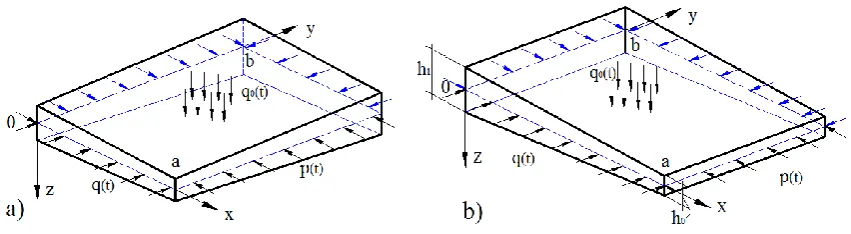
Consider a rectangular FGM plate with variable thickness subjected to mechanical load. The thickness of the plate can be expressed as: h=h(x,y) (Fig. 1a).
Assume that, plate made of FGM with the volume fraction of ceramic V zc
changes according to the following rule:1
2 ( , ) k c
z V
h x y
(1)
With the above rule, the Young’s modulus E, Poisson ratio ν of FGM plate can be expressed as:
1
( ) . .
2 ( , ) 1
( ) . .
2 ( , ) 1
( ) . .
2 ( , ) k
m m c c m c m
k
m m c c m c m
k
m m c c m c m
z
E z E V E V E E E
h x y
z
z V V
h x y
z
z V V
h x y
(2)
According to [19], the strains at a distance z from the middle surface can be expressed as: 0
ij ij zkij
with (i j= xx, yy, xy)
or xxxx0 zkxx, y0yxzkyy, xy xy0 zkxy, (3) Where: xx0; 0yy; xy0 , are the strains at the middle surface and kxx;kyy are curvatures and
k
xyis the twist. They are related to the displacement components u v w, , in the x y z, , coordinate directions as:2 2
0 0 0
2 2 2
2 2
1 w 1 w w w
; ;
2 2
w w w
; ; 2
xx yy xy
xx yy xy
u v u v
x x y y y x x y
k k k
x y
x y
(4)
Hooke's law applied to FGM plate under mechanical loads can be expressed as follows
( ) 2 ( )
1 0
1 0 .
1
1 0 0
2
xx xx
z
yy yy
z
xy xy
E
hay
.
(5)
0 ij ij ij ij .N A B
B D M k
với (i,j)=(xx ,yy, xy) (6)
In which:
( , ) 2 2 ( , ) 2; ; . 1, ,
h x y
h x y
A B D z z dz
(7)The mechanical behavior equations of FGM plate with variable thickness can be rewritten as follows 0
11 12 11 12
0
21 22 21 22
0
66 66
11 12 11 12
21 22 21 22
66 66
0 0
0 0
0 0 0 0
.
0 0
0 0
0 0 0 0
xx xx yy yy xy xy xx xx yy yy xy xy
N A A B B
N A A B B
N A B
B B D D
M k
B B D D
M k B D M k (8) in which: ( , ) ( , ) 2 2 1 1
11 22 2 2 12 21 2 2
( , ) ( , )
2 2
. ( , ) . . ( , )
( ) . ( )
. ; . ;
1 1 1 1
h x y h x y
h x y h x y
E h x y E h x y
E z E z
A A dz A A dz
( , ) ( , )2 2 2 2
2 2
11 22 2 2 12 21 2 2
( , ) ( , )
2 2
. ( , ) . . ( , )
( ). . ( ).
. ; . ;
1 1 1 1
h x y h x y
h x y h x y
E h x y E h x y
E z z E z z
B B dz B B dz
( , ) ( , )2 2 3 2 2 3
3 3
11 22 2 2 12 21 2 2
( , ) ( , )
2 2
. ( , ) . . ( , )
( ). . ( ).
. ; . ;
1 1 1 1
h x y h x y
h x y h x y
E h x y E h x y
E z z E z z
D D dz D D dz
( , ) ( , )2 2 2
2 66 66 ( , ) ( , ) 2 2 . ( , ) ( ) . ( , ) ( ). . ; .
2 1 2 1 2 1 2 1
h x y h x y
h x y h x y
E h x y
E z E h x y E z z
A dz B dz
( , )2 2 3
3 66 ( , ) 2 . ( , ) ( ). .
2 1 2 1
h x y
h x y
E h x y E z z
where: 1 ; 2
; 3
1 1 1( 1) 2( 1)( 2) 12 3 2 4( 1)
c m
c m m
m c m
E E k
E E E
E E E E E E
k k k k k k
Internal force and moment resultants in Eq (8) can be expressed as:
0 0 11 11 0 0 11 11 0 66 66 . . . . . .xx xx yy xx yy
yy yy xx yy xx
xy xy xy
N A B k k
N A B k k
N A B k
(9)
0 0 11 11 0 0 11 11 0 66 66 . . . . . .xx xx yy xx yy
yy yy xx yy xx
xy xy xy
M B D k k
M B D k k
M B D k
(10)
Based on the classical plate theory, the motion equations of variable thickness FGM plate can be given as: 2 1 2 2 1 2 2 2
2 2 2 2 2
2 2 2 2 2
2
0 1
2 . ( , )
. ( , )
w w w w
2 . 2 . ( , )
w . ( , ) . ( xy xx xy yy xy yy xx
xx xy yy
N
N u
h x y
x y t
N N v
h x y
x y t
M M
M
N N N p h x y
x y x y
x y x y x
q h x y q h
y 2 1 2 w w
, ) 2 . ( , )
x y h x y
t t (11)
here:
( , )/2
1
( , )/2
.
1
h x y
c m
m z
h x y
dz
k
Substituting Eq. (9) and Eq. (10) in to Eq. (11) and consider Eq. (4) then, Eq. (11) can be rewritten as: 2
11 12 13 1 1 2
2
21 22 23 2 1 2
2
31 32 33 3 4 5 2
2
0 1
2
( ) ( ) (W) (W) . ( , )
( ) ( ) (W) (W) . ( , )
w ( ) ( ) (W) (W) ( , W) ( , W) . ( , )
w
. ( , ) . ( ,
u
L U L V L P h x y
t v
L U L V L P h x y
t
L U L V L P P U P V p h x y
x
q h x y q h x
y 2 1 2 w w
) 2 . ( , )
y h x y
t t (12) where: 2 2 66 11
11( ) 11 2 66 2
A A
u u u u
L U A A
x x y y
2 2
66 11
12( ) 11 . 66
A A
v v v v
L V A A
x y x y x y y x
3 3 2 2 2
66 11
13 11 3 11 66 2 2 2
w w w w w
(W) 2 B . 2 B
L B B B
x y x y
x x y x y
2 2
2 2 2 2
2 11 66
3 11 2 66 2
w w w w 1 w w w w w w w w
(W )
2
A A
P A A
x x y x y x x y x y y x y y x y
2 2 2 2
66 66
11 11
21( ) 11 66 ; 22( ) 66 2 11 2
A A
A A
u u u u v v v v
L U A A L V A A
x y y x x y x y x x x y y y
3 3 2 2 3 2
66
11 11
23 11 3 11 2 2 2 66 2
w w w w w w
(W) . B B . 2 2 B
L B B B
y y x x y
y x y y x x y
2 2
2 2 2 2
2 11 11 66
2 11 2 11 66 2 66
w w w w 1 w 1 w w w w w w w
(W )
2 2
A
A A
P A A A A
y y x x y y y y x x y x x y x x y
2 2 23 3
66 11 11
31 11 3 66 11 2 2 2
2 2 2 2
66 66 11 11
2 2
( ) 2 2
2
B B B
u u u u
L U B B B
x y y x
x x y x y
B u B u B u B u
x y y x y x x y x y
32 2 2 23 3 2 2 2
66 66 66
11 11 11 11
11 3 11 66 2 2 2 2 2
( )
2 2 2 2 . 2
L V
B B B
B B B B
v v v v v v v
B B B
x x x y y y y x y x
y x y y x y x
4 4 4 3 3 3
66
11 11 11
33 11 4 4 11 66 2 2 3 3 2
2 2
3 2 2 2 2
66
11 11 11
2 2 2 2 2 2 2
w w w w w w
(W) 2 2 2 2 2 2
w w w w w
2 2 .
D
D D D
L D D D
x y x x
x y x y x y x y
D
D D D
y y x y x x y y y x
2 2 66 w 4 D
x y x y
2 3 2 2 22 2 2 2 2
66 66
11 11 11
11 66
2 2 2
3 2 2
11 66 2 66 11 2 2 66 11
(W )
1 w w w w w w w w w
2 2 2 2
2
w w w w w
2 2 2
P
B B
B B B
B B
x y x y x x y x y x x x x
x y x
B B B B B B
y x y x y x
3 3 3
11
2 3 3
2 2
2 2
2 2 2
66 11 66 11 66 11
2 2 2
w w w w w
w w w w w w w w 1 w w
2 2 2 2
2
B
x y
x y x y
B B B B B B
y y x y y x x y y y y x y x y y y x
2 2 2 2
2 2 2 2 2
3
4 11 2 2 11 2 2 66
1 w w w w 1 w w w w w w w
(W ) 2
2 2
P A A A
x y y x x y x y
x y
x y2 2 2
5 11 2 11 2 66
w w w
( , W) u u 2 u
P U A A A
x x x y y x y
;
2 2 2
6 11 2 11 2 66
w w w
( , W) v v 2 v
P V A A A
y y y x x x y
Eqs. (12) are the basic equations used to investigate the nonlinear dynamic response of variable thickness FGM plates subjected to mechanical load.
For simplicity, we only consider the simply supported rectangular FGM plate with variable thickness which linearly changes in the x-axis (Fig. 1b). Assume that, the thickness of the plate can be determined as follows:
1 0
0 ( ) h h
a
h x xh
(13)
Where: a is the length of the plate’s edge, h1 and h0 are the thickness of FGM plate at x=0 and x=a, respectively.
Then, Eqs. (12) will be rewritten as:
2
11 12 13 1 1 2
2
21 22 23 2 1 2
2
31 32 33 3 4 5 6
2 2 2
0 1
2 2
( ) ( ) (W) (W) . ( )
( ) ( ) (W) (W) . ( )
( ) ( ) (W) (W) (W ) ( , W) ( , W)
w w w
. ( ) . ( ) . ( )
u
I U I V I Q h x
t v
I U I V I Q h x
t
I U I V I Q Q Q U Q V
p h x q h x q h x
x y t
2 1
w 2 . ( )h x
t (14) in which:
2 2 1 01 1 1
11 2 2 2 2
. ( ) . ( ) ( )
2 1
1 1
h h
E h x u E h x u E u
I U
a x
x y
21 1 1 0
12 2 2
1 . ( )
( ) .
1 2 1
E h x v E h h v
I V
x y a y
2 3 3 2 2
1 0
2 2
13 2 3 2 2 2 2
. ( ) w w 2 ( ) w w
(W)
1 1
h h
E h x E h x
I
a
x x y x y
2 2 2 2
1 1
1 2 2 2
2
1 1 0
2
. ( ) w w w w . ( ) w w w w
(W) 2 1 1 w w 2 1
E h x E h x
Q
x x y x y y x y x y
E h h
x y a 2
21 1 1 0
21 2
1 . ( ) .
( ) .
2 1 2 1
E h x u E h h u
I U
x y a y
2 2
1 0
1 1 1
22 2 2 2
. ( ) . ( ) .
( ) .
2 1 1 2 1
h h
E h x v E h x v E v
I V a x x y
2 3 2 3 2
1 0
2 2 2
23 2 3 2 2
. ( ) w . ( ) w ( ) w
(W) 2
1
1 1
h h
E h x E h x E h x
I
a x y
y x y
2 2 2 2
2 1 1 1 1 0
2 2 2 2
. ( ) w w w w . ( ) w w w w . w w
(W )
2 1 2 1
1
h h
E h x E h x E
Q
y y x x y x x y y x a x y
22 3 3 2 2
1 0 1 0
2 2 2
31 2 3 2 2 2 2 2
. ( ) 2 ( )
( ) 2 2 1
1 1 1
h h h h
E h x u u E u E h x u u
I U
a x a
x x y x y
22 3 3 2 2
1 0 1 0
2 2 2
32 2 2 3 2 2 2
. ( ) ( ) 2
( ) 2 1 1
1 1 1
h h h h
E h x v v E h x v v E v
I V
a x y a y
x y y x
3 4 4 3 4 2 3 3
3 3 3 1 0
33 2 4 4 2 2 2 2 3 2
2 2 2
3 1 0
2 2 2
. ( ) w w . ( ) w 6 ( ) w w
(W) 2
1 1 1
6 ( ) w w
1
E h x E h x E h x h h
I
a
x y x y x x y
E h x h h
a x y
2 22 2 2 2 2
2 2 1 0 2 2 1 0
3 2 2 2
2 3 2 2
1 0
2 2 2
2 2 2
. ( ) . ( )
w w w w w
(W ) 3 1 2
1 1 1
. ( ) w w . ( ) w w . ( ) w 2
1 1
1
h h h h
E E h x E h x
Q
a x y x y a y x y
h h
E h x E h x E h x
y y x x y a
2 2 3 22 2 2
2 2 2 2
2 3 3 2 2
1 0
2 2 2 2 2
2 2 2 3 2 3 2 2 2
. ( )
w w w
1
( ) w w . ( ) w w . ( ) w w . ( ) . ( ) w w
4 2 2
2 1
1 1 1 1
E h x
x y x x y
h h
E h x E h x E h x E h x E h x
a x x x x y y x y
2 2 2 22 2 2
3 1 1 1
4 2 2 2 2
. ( ) w w w . ( ) w w w . ( ) w w w
(W )
1
2 1 2 1
E h x E h x E h x
Q
x y y x x y x y
x y
2 2 2
1
5 2 2 2
. ( ) w w w
( , W) 1
1
E h x u u u
Q U
x x x y y x y
2 2 2
1
6 2 2 2
. ( ) w w w
( , W) 1
1
E h x v v v
Q V
y y y x x x y
3. Solution method
Consider a variable thickness FGM rectangular plate subjected to uniformly distributed pressures p(t) and q(t) in x and y direction. The exciting force q0(t) acting on the plate’s surface.
The plate is simply supported on 4 edges, then the boundary conditions are:
0, xx 0; xx ( )
w M N ph x at x =0 and x=a.
0, y 0; yy ( )
w M N qh x at y =0 and y=b. Satisfying boundary conditions, the deflection of the plate can be chosen as:
m
n
m
n
m
n
( ) os
sin
;
( )sin
os
;
( )sin
sin
mn mn mn
x
y
x
y
x
y
u U
t c
v V
t
c
w W
t
a
b
a
b
a
b
(15)Where: m, n are the numbers of half-wave along the x and y direction, respectively.
Substituting Eq. (15) into Eq. (14) then applying Galerkin procedure, at the same time, ignoring inertial components along x and y axes (because of u<<w, v<<w) [20], we obtain:
2
11 12 13 1
2
21 22 23 2
2
2 3 0 * *
31 32 33 3 4 5 6 2 1 2 1
W W 0
W W 0
4 w dw
W W W .W .W+ 2
l U l V l R
l U l V l R
abq d
l U l V l R R R U R V
dt
mn dt
(16)
In which: *
1 0
1 1
8
ab h h
2
1 1 0 2 2 2 2
11 2 1 m 2n
16 1
E h h
l b a
ab
;
2
1 1 0
12 21
.mn 16 1
E h h
l l
2
2 2 3 2
2 1 0 2 1 0 2 2 2 2 2 1 0 2 2 2 2
13 2 2 2 2 2 2
2 3
m m n
24 1 4 1 4 1 m
E m h h E m h h E h h
l b n a b a
ma b ba a b
1 1 0 2 2 2 2
1 2 2 (3 1)n 4m
9 1
E h h
R a b
na b
;
2 2 2 2 2
1 1 0
22 2
m 1 2n
16 1
E b a h h
l
ab
;
2
2 2 3 2
2 1 0 2 1 0 2 2 2 2 2 1 0
23 2 2 2 2 2
n 2 3 n
n m
4 1
24 1 4 1
E m h h E n h h E h h
l a b
a
m b a b a
1
1 0
2 2
2 2
2 2 2 4n 3 1 m
1 9
E h h
R a b
mb a
2 2 2 2 2 2 2 3 2 2 2 2 2 2
2 1 0 2 1 0 2 1 0
31 2 2 2 2
2 3 m n m n n
1 4
24 1 4 1
E h h m b a E h h m b a E h h
l
mb
mba a b
2 2 2 2
3
2 1 0 2 1 0 2 2 2 2 2 1 0
32 2 2 2 2 2 2
2 3 n
n (1 )
24 1 4 1 4 1
E n h h m E nh h E h h
l m b a
m ab b a a
22 2 2 2 2 2 2 2 2 2 2
3 3 2 0
33 2 3 3 1 0 2 1 0 0 2 1 0
2 2
2 2
3 1 0 1 0 2 2 2 2 3 1 0 1 0 2 2 2 2
2 2 2 3
2
1 0 2 2 2 2
m n 3 2 3
3 2
4 2
1 4
3 3
m n n +m
1 4 4 1
m n
8
E b a m m h
l h h h h h h h
m m
a b
E h h h h E h h h h
b a a b
a b a b
h h
p b q a
ab
2 2 2 2
2
2 1 0 2 2 2 2 2 2 2 2 2
3 2 3 2 3 2 2 1 0 1 0
2 2 2
2 2 2 2 2
2
1 0 1 0
2 2
2 3
2 1 0 2 2 2 2
1 1 0
2
8 2 9 28
m 6 1 2
27
1 9 3 1
4 9 45
2 1 6
9 9 1
32
1 2
27 1
E h h E m m
R b n a h h h h n a m b
m
a bmn na b
E n m
h h h h m b n a
m mb a E h h
n a h m b h h mnb
2 4 4 4 4 2
1 1 0 1 1 0
4 2 3 3 2
2 n m nm
1 3 ;
9 1 9 1
E h h a b E h h
R
mna b ab
1 1
0
2 2
2 2
5 2 2
2
4b m 1+3 n 9 1
E h h
R a nba
1 1
0
2 2 2 26 2 2
2
1 3 m 4n 9 1
E h h
R b a
mab
The first two equations of Eq. (16) are two linear algebraic equations for the amplitudes Umnand Vmn. Solving Umnand Vmn in terms of Wmn then substituting into the third equation of Eq. (16), we obtain:
2
* * 2 3 0
1 2 1 1 2 3 2
4
w dw
2 W W W abq
d
a a a
dt
dt mn
(17)
In which:
31 12 23 13 22 32 13 21 11 23
1 33
11 22 12 21
-
-l l l l l l l l l l
a l
l l l l
1 32 21 31 22 2 31 12 32 11 5 12 23 13 22 6 13 21 11 23 3
11 2 2 21 2
2 1
R l l l l R l l l l R l l l l R l l l l R l l a l l
5 2 12 1 22 6 1 21 2 11 4
11 22 12 21 3
R R l R l R R l R l l l
a R l
l Vibration analysis
2
* * 2 3
1 2 1 1 2 3 2
w dw 4 sin
2 W W W
d abQ t
a a a
dt
dt mn
(18)
* Natural-vibration frequency of plate: the natural frequency of the variable thickness FGM plate can
be defined as.
* 0 a1/ 1
(19)* Nonlinear response of variable thickness FGM plate:
Nonlinear responses of variable thickness FGM plates are received from Eq. (17) by using Runger-Kutta method.
Dynamic stability analysis
For dynamic stability analysis, this paper studies a rectangular plate with variable thickness subjected to linear compression in terms of time p(t)= -c1t and q(t)= -c2t. In which, c1 and c2 are loading speed. Dynamic responses of plate can be determined by solving equation (17). The dynamic critical time tcr can be obtained by using Budiansky–Roth criterion [21]. The dynamic critical load can be expressed as pcr= c1tcr and qcr= c2tcr.
4. Numerical and discussion
Validation
According to the authors’ knowledge, there has been no publication on the nonlinear dynamic response of the FGM plate with variable thickness. Thus, the results in this paper are compared with the constant thickness plates (h x
ho h1 const). The natural frequencies of constant thickness plate are comparedwith the ones of Uymaz and Aydogdu [19] (Tab. 1). Natural frequency parameters * determined as follows:
2 2 2
*
0 4 2
12(1 )
. c
c
a b E h
In which: ω0 is nature frequency of plate and calculated from Eq. (19).
The plate made of Aluminium and Zirconia with material properties are:c m 0.3, Em = 70.109 N/m2, ρm = 2702 kg/m3 and Ec = 151.109 N/m2, ρc = 3000 kg/m3.
Table 1. Comparison of natural frequencies * of constant thickness FGM plates Source a/b=1, (m, n)=(1, 1), a/h=100
k=0 k=0.5 k=1 k=5 k=10 k=∞
Results in Table 1 show that, the comparison obtain a good agreement with above publication. There for, the results of this article are reliable.
Vibration results
Consider a rectangular variable thickness FGM plate simply supported on four edges. Geometric parameters of plate are: a=1,5m, b=0,8m, h1=0.008m, h0=0.005m, Plate made of Aluminium and Alumina with properties of the material are: Em = 70.109 N/m2, ρm = 2702 kg/m3 and Ec = 380.109 N/m2, ρc = 3800 kg/m3, respectively. Assume that, Poisson’s ratio νm=νc= 0.3.
Natural-vibration frequency of variable plate:
Table 2. Natural frequencies (1/s) of variable thickness plate k a=1,5m, b=0,8m, h1=0.008m, h0=0.005m
(m, n)=(1, 1) (m, n)= (1, 3) (m, n)=(1, 5) (m, n)=(1, 7) (m, n)=(1, 9)
0 382.70 2835,5 7739,3 15095 24902
0.5 323.94 2402,0 6556,4 12788 21097
1 291.70 2165,4 5910,8 11529 19020
3 256.64 1907,9 5208,2 10159 16759
5 251.39 1867,7 5098,4 99443 16406
Table 2 shows natural frequencies of variable thickness plate with various modes shapes (m, n). As can be seen, the lowest nature frequency corresponding to vibration mode of considered plate is (m, n) = (1, 1).
Nonlinear dynamic response of variable thickness plate subjected to exciting force q0=QsinΩt.
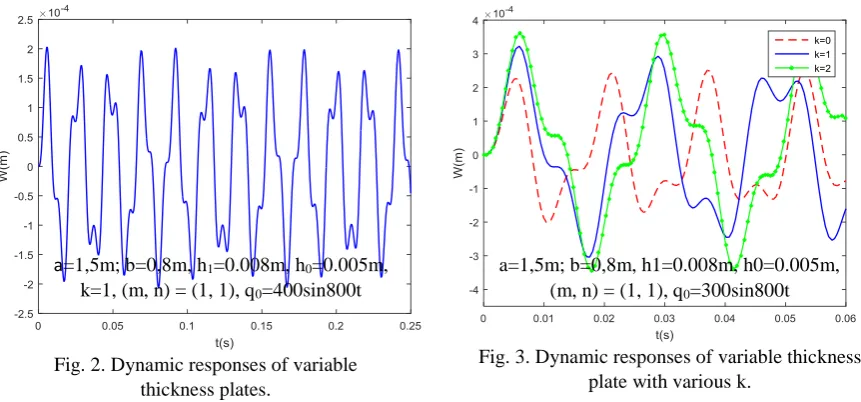
Figure 2 shows dynamic response of variable thickness plate subjected to mechanical load. As can be seen that, the bound of dynamic response amplitude changes according to sine-shape law.
Figure 3 predicts effects of volume fraction index k on nonlinear vibration of variable thickness plates. The graph shows that, amplitude of dynamic responses increase with the increasing of k. this is reasonable because when k increase, the metal constituent in the plate increase, therefore, stiffness of the plate decrease.
Fig. 2. Dynamic responses of variable thickness plates.
Fig. 3. Dynamic responses of variable thickness plate with various k.
a=1,5m; b=0,8m, h1=0.008m, h0=0.005m, k=1, (m, n) = (1, 1), q0=400sin800t
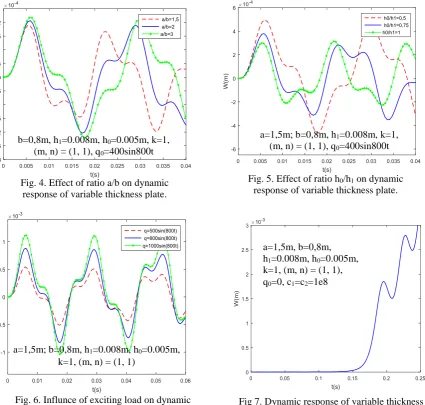
Effect of geometric factors on nonlinear dynamic responses of variable thickness are illustrated in figure 4 and figure 5.
Figure 4 shows the effect of ratio a/b on nonlinear vibration of FGM variable thickness plate. From the graph, we can see that, dynamic responses amplitude of the plate increases when increasing the ratio a/b, that means the stiffness of the plate decreases.
Figure 5 shows the effect of ratio h0/h1 on dynamic responses of plate. As can be seen that, dynamic response amplitude decrease when ratio h0/h1 increase. That means, stiffness of plate increase when h0 increase and the stiffness of plate reaches the maximum value when h0=h1 (constant thickness plate).
Figure 6 indicates the effect of excited force amplitude on nonlinear vibration of plate. When amplitude of excited force increase, the amplitudes nonlinear dynamic response of variable thickness FGM plate increase.
Fig 7. Dynamic response of variable thickness plate. a=1,5m, b=0,8m,
h1=0.008m, h0=0.005m, k=1, (m, n) = (1, 1), q0=0, c1=c2=1e8
Fig. 6. Influnce of exciting load on dynamic response of plate.
a=1,5m; b=0,8m, h1=0.008m, h0=0.005m, k=1, (m, n) = (1, 1)
Fig. 5. Effect of ratio h0/h1 on dynamic response of variable thickness plate.
a=1,5m; b=0,8m, h1=0.008m, k=1, (m, n) = (1, 1), q0=400sin800t
Fig. 4. Effect of ratio a/b on dynamic response of variable thickness plate. b=0,8m, h1=0.008m, h0=0.005m, k=1,
Dynamic buckling analysis results
In case plate subjected to linear compression in terms of time qc t1 and pc t2 . In which, c1 and c2 are loading speed. The critical time tcr can be obtained by using Budiansky–Roth criterion. The dynamic critical force qcr c t1cr = c1.tcr (or pcr c t2cr).
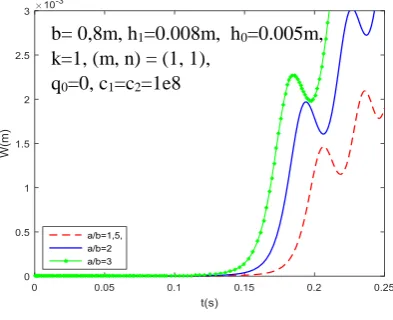
Nonlinear dynamic responses of variable thickness FGM plate are indicated in Figure 7 to Figure 11. Nonlinear dynamic response of variable thickness FGM plate is demonstrated in figure 7. The critical force obtained in this case is pcr = 19,56 Mpa. Figure 8 illustrates influence of volume fraction index k on dynamic responses of variable thickness plate. From the graph we can see that the critical forces decrease with the increasing of volume fraction index k. For k=1, k=2 and k=3, critical forces are pcr = 19,56 Mpa, pcr = 16,32 Mpa and pcr = 15,28 Mpa, respectively.
Effect of ratio a/b on dynamic responses of variable thickness plate is shown in Figure 9. As can be seen that, if the ratio a/b increases, the critical load will decrease. For a/b=1,5; a/b=2 and a/b=3, critical
Fig 8. Effect of k on dynamic response of variable thickness plates. a=1,5m, b=0,8m,
h1=0.008m, h0=0.005m, (m, n) = (1, 1),
q0=0, c1=c2=1e8
Fig 9. Effect of ratio a/b on dynamic response of variable thickness plate. b= 0,8m, h1=0.008m, h0=0.005m, k=1, (m, n) = (1, 1),
q0=0, c1=c2=1e8
Fig 10. Effect of ratio h0/h1 on dynamic response of variable thickness plate.
Fig 11. Effect of buckling mode shapes on dynamic responses of variable thickness plate. a=1,5m; b=0,8m; h1=0.008m;
k=1, (m, n) = (1, 1), q0=0, c1=c2=1e8
forces are pcr (a/b=1,5) = 20,57 Mpa, pcr (a/b=2) = 19,32 Mpa and pcr (a/b=3) = 18,43Mpa, respectively. On other words, the load-bearing capacity of the plate will decrease when the plate’s length increase.
Figure 10 illustrates the influence of ratio h0/h1 on dynamic responses of variable thickness plate. Resultsshow that, ratio h0/h1 increases, the critical forces also increase. (pcr = 16,92 Mpa in case h0/h1=0,5 and pcr = 27,62 Mpa in case h0/h1=1). That means, when ratio h0/h1 increases, the plate will work more stability.
Figure 11 shows the effect of buckling mode shapes on dynamic responses of variable thickness FGM plate subjected to mechanical load. Clearly, the smallest critical dynamic buckling load corresponds to the buckling mode shape (m, n)=(1, 1).
5. Conclusions
This paper established the governing equations of variable thickness FGM plate according to the classical plate theory and the geometrical nonlinearity in von Karman-Donnell sense. The basics of vibration and dynamic stability problems of a variable thickness FGM plate have been investigated by using Galerkin method, Runger-Kutta method and Budiansky-Roth criterion.
Some conclusions can be drawn:
i) The lowest nature frequency corresponding to vibration mode of variable thickness FGM plate is (m, n) =(1,1).
ii) The vibration amplitude of variable thickness FGM plate increases and critical load of the plate decreases with the rise of ratio a/b. That mean, the length of the plate increases reducing the stability of the plate.
iii) The dynamic critical load of plate increases and vibration amplitude of plate decreases when ratio ho/h1 increasing. On other words, the stability of the plate increases with increasing plate thickness.
Acknowledgements
This research is funded by National Foundation for Science and Technology Development of Vietnam (NAFOSTED) under Grant number 107.02-2018.324.
References
[1] V. Ungbhakorn, N. Wattanasakulpong, Thermo-elastic Vibration Analysis of Third-order Shear Deformable Functionally Graded Plates with Distributed Patch Mass Under Thermal Environment, J. Appl. Acoust. 74 (2013) 1045–1059. http://doi.org/10.1016/j.apacoust.2013.03.010.
[2] M. Talha, B.N. Singh, Static Response and Free Vibration Analysis of FGM Plates Using Higher Order Shear Deformation Theory, Appl. Math. Model. 34 (2010) 3991–4011. http://doi.org/10.1016/j.apm.2010.03.034. [3] N.D. Duc, P.H. Cong, Nonlinear Postbuckling of Symmetric S-FGM Plates Resting on Elastic Foundations Using
Higher Order Shear Deformation Plate Theory in Thermal Environments, Compos. Struct. 100 (2013) 566–574. https://doi.org/10.1016/j.compstruct.2013.01.006.
[4] N.D. Duc, H.V. Tung, Mechanical and Thermal Postbuckling of Higher Order Shear Deformable Functionally Graded Plates on Elastic Foundations, Compos. Struct. 93 (2011) 2874–2881.
https://doi.org/10.1016/j.compstruct.2011.05.017.
https://doi.org/10.15625/0866-7136/33/3/207
[6] H. Hebali, A. Tounsi, M.S. A. Houari, A. Bessaim, E.A.A. Bedia, New Quasi-3D Hyperbolic Shear Deformation Theory for the Static and Free Vibration Analysis of Functionally Graded Plates, Journal of Engineering Mechanics 140 (2014) 374-383. https://doi.org/10.1061/(ASCE)EM.1943-7889.0000665.
[7] A. Mahi, E.A.A. Bedia, A. Tounsi, A new hyperbolic shear deformation theory for bending and free vibration analysis of isotropic, functionally graded, sandwich and laminated composite plates, Applied Mathematical Modelling 39(9) (2015) 2489-2508. https://doi.org/10.1016/j.apm.2014.10.045.
[8] R. Benferhat, T.H. Daouadji, M.S. Mansour, L. Hadji, Free vibration analysis of FG plates resting on an elastic foundation and based on the neutral surface concept using higher-order shear deformation theory, Comptes Rendus Mécanique 344(9) (2016) 631-641. https://doi.org/10.12989/eas.2016.10.5.1033.
[9] R. Kandasamy, R. Dimitri, F. Tornabene, Numerical study on the free vibration and thermal buckling behavior of moderately thick functionally graded structures in thermal environments, Composite Structures, 157 (2016) 207-221. https://doi.org/10.1016/j.compstruct.2016.08.037.
[10] E. Efraim, M. Eisenberger, Exact vibration analysis of variable thickness thick annular isotropic and FGM plates. Journal of Sound and Vibration 299 (2007) 720–738. https://doi.org/10.1016/j.jsv.2006.06.068.
[11] S.H. Hosseini-Hashemi, H.R.D. Taher, H. Akhavan, Vibration analysis of radially FGM sectorial plates of variable thickness on elastic foundations, Composite Structures 92 (2010) 1734–1743.
https://doi.org/10.1016/j.compstruct.2009.12.016.
[12] M. Shariyat, M.M. Alipou, A power series solution for vibration and complex modal stress analyses of variable thickness viscoelastic two-directional FGM circular plates on elastic foundations, Applied Mathematical Modelling 37 (2013) 3063–3076. https://doi.org/10.1016/j.apm.2012.07.037.
[13] V. Tajeddini, A. Ohadi, M. Sadighi, Three-dimensional free vibration of variable thickness thick circular and annular isotropic and functionally graded plates on Pasternak foundation, Int J of Mech Sci. 53 (2011) 300–308. https://doi.org/10.1016/j.ijmecsci.2011.01.011.
[14] F. Tornabene, N. Fantuzzi, M. Bacciocchi, E. Viola, J.N. Reddy, A Numerical Investigation on the Natural Frequencies of FGM Sandwich Shells with Variable Thickness by the Local Generalized Differential Quadrature Method, Applied Sciences 7 (2) (2017) 131. https://doi.org/10.3390/app7020131.
[15] A.H. Sofiyev, The buckling of an orthotropic composite truncated conical shell with continuously varying thickness subject to a time dependent external pressure, Composites: Part B. 34 (2003) 227–233.
https://doi.org/10.1016/S1359-8368(02)00105-1.
[16] R.A. Akbari, S.A. Ahmadi, Buckling Analysis of Functionally Graded Thick Cylindrical Shells with Variable Thickness Using DQM, Arabian Journal for Science and Engineering 39 (11) (2014) 8121-8133.
https://doi.org/10.1007/s13369-014-1356-4.
[17] P.T. Thang, N.D. Duc, N.T. Trung, Effects of variable thickness and imperfection on nonlinear buckling of sigmoid-functionally graded cylindrical panels, Composite Structures 155 (2016) 99-106.
https://doi.org/10.1016/j.compstruct.2016.08.007.
[18] P.T. Thang, N.T. Trung, J. Lee, Closed-form expression for nonlinear analysis of imperfect sigmoid-FGM plates with variable thickness resting on elastic medium, Composite Structures 143 (2016)143-150.
https://doi.org/10.1016/j.compstruct.2016.02.002.
[19] D.O. Brush, Almroth, Buckling of Bars, Plates and Shells, New York, Mc Graw-Hill, Inc., 1975. [20] A.S. Volmir, Nonlinear Dynamics of Plates and Shells, Science Edition, Moscow, 1972.
[21] B. Budiansky, R.S. Roth, Axisymmetric dynamic buckling of clamped shallow spherical shells, NASA Technical Note D. 510 (1962) 597–609.
[22] B. Uymaz, M. Aydogdu, Three-Dimensional Vibration Analyses of Functionally Graded Plates under Various Boundary Conditions. Journal of Reinforced Plastics and Composites 26(18) (2007) 1847–1863.