320 | P a g e
Exploration of the Interactions between Supervisors and
their Research Scholars at University of Kashmir
Zainab Hamid
1, Dr. Shawkat Ahmad Shah
21. Ph. D Research Scholar, Department of Psychology, University of Kashmir (India)
2.Associate Professor, Department of Psychology, University of Kashmir (India)
ABSTRACT
It is very important for the supervisors and their research scholars to have healthy interactions so as to ensure completion of the research projects on time without compromising on the quality of the output. Therefore, the present study aimed to explore the dynamics of the interactions between supervisors and their research scholars so as to generate data that can serve as a feedback to the supervisors so that they can ensure more effective supervision. The sample comprised of 56 research scholars pursuing research at various departments of University of Kashmir and the tool developed by Mainhard et. al, (2009) was adopted to get their responses on a seven point Likert scale. The collected data was analyzed with the help of SPSS and AMOS software packages. As far as descriptive analysis is concerned, it was found that majority of respondents fall in average category on various aspects of their interactions with their supervisors.Pertinent to mention here that the various interactional domains that were assessed include leadership, helping nature, understanding, freedom, uncertainty, satisfaction, admonishing and strictness. Apart from exploration of the said interactions, the reliability test was conducted to assess the degree of consistency among the multiple measurements of the variables and it was found that reliability of the adopted tool is almost satisfactory as indicated by the Cronbach alpha value beyond the threshold of 0.60 .While carrying out the confirmatory factor analysis it was found that some of the model fit indices of the adopted interaction model are almost within the acceptable ranges.
Key words: Factor analysis, research scholar, reliability, Supervisor, University of Kashmir.
I. INTRODUCTION
The present study was aimed at exploration of the nature of interactions between supervisors and their research
scholars by adoption of the supervisor – doctoral student interaction scale(QSDI) developed by Mainhard et. al,
(2009). The QSDI is a very precise tool used for gathering information about research scholar’s perception of
the interpersonal style of their supervisor. The results of the study can be of tremendous importance for giving
feedback to the supervisors so that they can make their scholars more productive, effective and enthusiastic. In
most of the Indian universities, the scholars carry out their research under the supervision of one or more faculty
members of the department at which they are registered, these faculty members play an important role in
321 | P a g e
rightly said that the success of the PhD system more or largely depends on the supervisors, who must provide
their resources in the form of time and expertise so as to foster the candidate’s research skills and ensure
production of a standard thesis. Li and Seale (2007) gave importance to the meetings between research scholars
and their supervisors but Pearson (1996) believe that there has been more research on the frequency of contact
than its quality.Golde (2000) have strongly recommended the assessment of the interactions between
supervisors and their research scholars. Kam (1997), Marsh et al. (2002), McAlpine and Norton (2006), Ives and
Rowley (2005) are also on the same page regarding what Golde (2000) believes. In this backdrop this study
explores interaction between research scholars and their supervisors from an interpersonal perspective which
describes supervision in terms of the relationship between the supervisor and the doctoral student. The study
mainly focuses on interpersonal supervisor behavior model in terms of eight domains under two axes, these
domains include leadership, friendliness, understanding, freedom, uncertainty, dissatisfaction, admonishing and
strictness. The important thing about this model is that its dimensions map a degree of behavior. A behavior that
the supervisor reflects has a degree of influence and proximity. Another characteristic feature of the model is
that the dimensions are independent, it may seem that a high degree of strictness is associated with less scores
on guidance, but it is not necessarily so, because some supervisors are strict but guide too much effectively and
efficiently, same holds true in case of the other dimensions. In this sense our adopted model provides a richer
description of relationships than is provided by Gatfield (2005), who refers to poles instead of degrees of
intensity of behaviour. Pertinent to mention here the four supervisory styles identified by Gatfield (2005)
include the laissez faire type, pastoral type, contractual style and directorial type.
II. METHODOLOGY
2.1. Sample Description
The participants of the study included 56 research scholars selected purposively from the various departments of
University of Kashmir. The respondents were approached personally to get their response on the adopted scale.
2.2. Research Instrument
The Supervisor-Doctoral Student Interaction Scale developed by Mainhard et. al, (2009) was adopted to get
feedback from the respondents. It is a comprehensive scale having satisfactory reliability and validity.
III. DATA ANALYSIS
The data was analyzed, primarily, using SPSS (version 20).The analysis included an examination of means,
standard deviations, skewness and kurtosis in order to ensure normality of the data. This was followed by
reliability analysis and then a confirmatory factor analysis procedure was carried out by making use of AMOS
322 | P a g e
IV.RESULTS & DISCUSSION
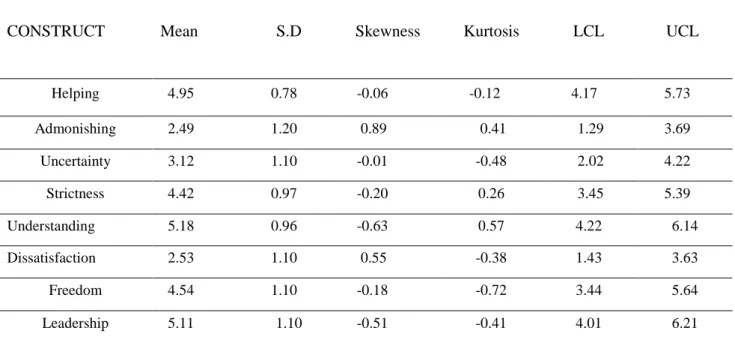
Table 4.1 Descriptive Statistics for the understudy constructs (N=56)
CONSTRUCT
Mean
S.D
Skewness
Kurtosis
LCL
UCL
Helping 4.95 0.78 -0.06 -0.12 4.17 5.73
Admonishing 2.49 1.20 0.89 0.41 1.29 3.69
Uncertainty 3.12 1.10 -0.01 -0.48 2.02 4.22
Strictness 4.42 0.97 -0.20 0.26 3.45 5.39
Understanding 5.18 0.96 -0.63 0.57 4.22 6.14
Dissatisfaction 2.53 1.10 0.55 -0.38 1.43 3.63
Freedom 4.54 1.10 -0.18 -0.72 3.44 5.64
Leadership 5.11 1.10 -0.51 -0.41 4.01 6.21
LCL= lower class limit, UCL = upper class limit.
As per the earlier table applying the criteria of Garson(2009) the sample distribution of the present study is
normal as no skewness & kurtosis value falls beyond the Garson’s range of -2.00 to +2.00. The values of
standard deviation are also very small as compared to mean thereby further improving the scope of data for
subsequent analysis.
Table.4.2.Frequency Distribution of the sample group with respect to understudy constructs
Construct f(low) % f(Average) % f (High) %
Helping 11 19.64 37 66.07 8 14.29
Admonishing 22 39.29 27 48.21 7 12.5
Uncertainty 11 19.64 36 64.29 9 16.07
Strictness 9 16.07 35 62.50 12 21.43
Understanding 8 14.29 39 69.64 9 16.07
Dissatisfaction 10 17.86 35 62.50 11 19.64
Freedom 9 16.08 34 60.71 13 23.21
323 | P a g e
The categories mentioned in the above table have been formulated on the basis of upper and lower class limits
as reported in table 4.1. Any score up to the order of lower class limit is classified in low category, a score
beyond lower class limit and up to the order of upper class limit is classified as average and rest of the scores are
clustered in the high category.
Accordingly as per the above table, 19.64 % of the research scholars perceived their supervisors as helpful to a
lower extent, 66.07 % perceived their supervisors as helpful to an average extent and 14.29 % perceived their
supervisors as helpful to a high extent.
In case of admonishing, 39.29 % of the respondents rate their supervisors as low, 48.21 % rate them average and
12.50 % rate them high.
In case of uncertainty, 19.64% of the respondents rate their supervisors as low, 64.29 % rate them average and
16.07 % rate them high.
In case of strictness 16.07 % of the respondents rate their supervisors as low, 62.50 % rate them average and
21.43% rate them high.
In case of understanding, 14.29% of the respondents rate their supervisors as low, 69.64% rate them average and
16.07% rate them high.
In case of dissatisfaction 17.86% of the respondents rate their supervisors as low, 62.50% rate them average and
19.64% rate them high.
In case of freedom 16.08% of the respondents rate their supervisors as low, 60.71% rate them average and
23.21% rate them high.
Lastly in case of leadership, 25% of the respondents rate their supervisors as low, 58.93% rate them average and
16.07% rate them high.
Table 4.3 Showing results of a reliability test
Cronbach’s alpha 0.65 Cronbach’s alpha based on standardized items 0.66
No. of items 41
As per the above table the reliability of the measuring instrument is satisfactory. Yong,Hua & Mei(2007) stated
that in case Cronbach’s alpha a value greater than 0.6 is acceptable.
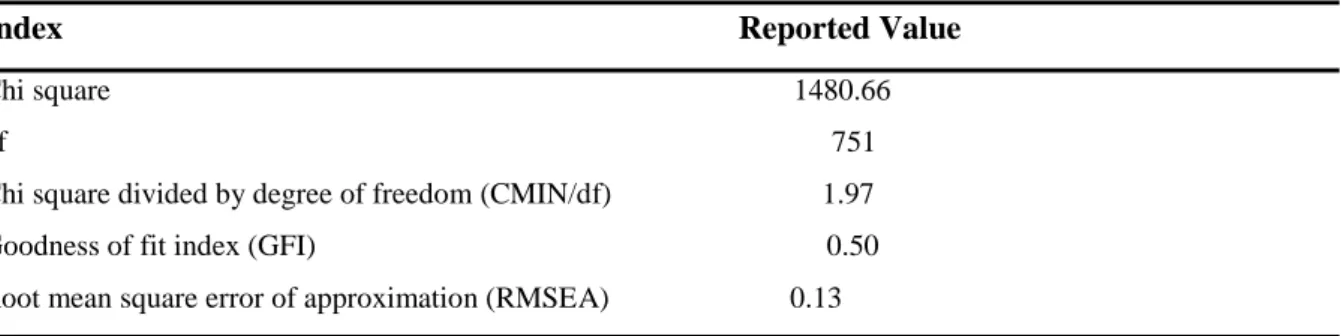
Table 4.4.AMOS generated Model fit indices
Index Reported Value
Chi square 1480.66
df 751
Chi square divided by degree of freedom (CMIN/df) 1.97
Goodness of fit index (GFI) 0.50
324 | P a g e
As per the above table the value of CMIN/df is satisfactory; however the values of GFI and RMSEA deviate
from the ideal values of 0.90 and 0.05 respectively. However as reliability of the tool is satisfactory and one of
the model fit indices in the form of CMIN/df is also satisfactory, we cannot question the validity of the tool as
the sample size was low. It is assumed that on a larger sample the model fit indices will considerably improve ,
as the AMOS is a very highly sample sensitive software.
Diagram 4.1 showing confirmatory factor analysis of the constructs.
The above diagram shows the path diagram of the measuring instrument, the circles represent the latent variables in
the form of dimensions, rectangles represent the items of each dimension and double headed arrows represent the
covariance’s, as the model is too much complex, it has impaired the visibility of the model, however after zooming
in the values in AMOS software all the convergent validity coefficients have been found to be nearer to the
325 | P a g e
V. CONCLUSION
As the main objective of the study was to explore the interactions between research scholars and their
supervisors at university of Kashmir, the same was successfully explored as revealed in the results. Apart from
this the psychometric properties of the adopted tool were also explored in depth and it can be concluded that
QSDI ( Mainhard et al., 2009) is an effective instrument in getting feedback from the research scholars
regarding the supervisory style of their guides. In the present study, it has got reflected that some research
supervisors at Kashmir are doing considerably well in terms of leadership, helping nature towards the scholars,
understanding and freedom, however as a significant number of the supervisors have been reported high on
uncertainty, dissatisfaction, admonishing and strictness, they need to pay attention to their supervisory style so
as to ensure more effective supervision. We believe that the replication of the study on a larger sample can help
in solving the supervisory problems at the grass root level. It will also help to strengthen the ideal research
climate at the institutes of interest. In connection with the research carried out by Kam(1997) , for future it
would be interesting to also explore the perceptions of supervisors towards their research scholars.
REFERENCES
[1.] Gatfield, T. (2005). An investigation into PhD supervisory management styles: Development of a dynamic
conceptual model and its managerial implications. Journal of Higher Education Policy and management,
27(3), 311–325.
[2.] Golde, C. M. (2000). Should I stay or should I go? Student descriptions of the doctoral attrition process.
The Review of Higher Education, 23(2), 199–227.
[3.] Heath, T. (2002). A quantitative analysis of PhD students’ views of supervision. Higher Education
Research & Development, 21(1), 41–53
[4.] Ives, G., & Rowley, G. (2005). Supervisor selection or allocation and continuity of supervision: PhD
students’ progress and outcomes. Studies in Higher Education, 30(5), 535–555.
[5.] Kam, B. H. (1997). Style and quality in research supervision: The supervisor dependency factor. Higher
Education, 34(1), 81–103.
[6.] Li, S., & Seale, C. (2007). Managing criticism in PhD supervision: A qualitative case study. Studies in
Higher Education, 32(4), 511–526.
[7.] Mainhard, T. , Rijst, R. , Tartwijk, T. & Wubbels, T.(2009). A model for supervisor-doctoral student
relationship. High Educ, 58, 359-373.
[8.] Marsh, H. W., Rowe, K. J., & Martin, A. (2002). PhD students’ evaluations of research supervision. The
Journal of Higher Education, 73(3), 313–348.
[9.] McAlpine, L., & Norton, J. (2006). Reframing out approach to doctoral programs: An integrative
framework for action and research. Higher Education Research & Development, 25(1), 3–17.
[10.] Pearson, M. (1996). Professionalising PhD education to enhance the quality of the student experience.