165 Abstract— In the present study, the neural network (NN) based multivariable controllers were designed as a series of single input-single output (SISO) controllers or multi variable SISO (MVSISO) controllers utilizing the classical decoupled process models. Multilayer feed forward networks (FFNN) were used as direct inverse neural network (DINN) controllers, which used the inverse dynamics of the decoupled process. To address the disturbance rejection problems, the IMC based neural control architecture was proposed with suitable choice of filter and disturbance transfer function. Multi input – multi output (MIMO) non-linear processes like interacting tank systems, temperature and level control of a mixing tank with hot and cold input streams & a (2×2) distillation process were considered as case studies for that purpose. Simplified as well as ideally decoupled process as well as disturbance transfer functions was used for neural controller design. DINN/IMC based NN controllers performed effectively well in comparison to conventional P/ PI/IMC based PI controllers for set-point tracking & regulator problems.
Index Terms— MVSISO, DINN, FFNN, NN-controller, MIMO, IMC, PI, decoupled process, decoupled disturbance.
I. INTRODUCTION
Multiloop (decentralized) conventional control systems (especially PID controllers) are often used to control interacting multiple input, multiple output processes because of their ease in understandability and requirement of fewer parameters than more general multivariable controllers. Different types of tuning methods like BLT detuning method, sequential loop tuning method, independent loop tuning method, and relay auto-tuning method have been proposed by the researchers for tuning of multiloop conventional controllers. One of the earlier approaches of multivariable control had been the decoupling control to reduce the loop interactions. The decoupler combined multivariable controllers are treated as series of SISO controllers (MVSISO) to be tuned independently without influencing the performance of other closed loops. The practical realization of the steady state or dynamic decouplers combined with conventional control systems become difficult sometimes because of model inadequacy.
In the recent years, there have been significant advances in control system design for non-linear processes. One such method is the non-linear inverse model based neural control strategy. Neural networks (NN) have the potential to
Seshu K. Damarla, M.Tech Student: e-mail: [email protected]. Madhusree Kundu, Associate Professor, Department of Chemical Engineering, National Institute of Technology, Rourkela, India.
∗Corresponding author, E-mail: [email protected], [email protected], Fax: 0661-2462999
approximate any non-linear system including their forward & inverse dynamics. Application of NN based controllers in chemical processes have gained huge momentum as a result of focused R&D activities taken up by several researchers including Donat et al. (1990); Ydstie (1990); Hernandez and Arkun (1990); Psichogios and Ungar (1991); Dirion et al. (1995); Hussain et al. (2001); Varshney et al. (2009)over the last decade. But it has been implemented so far (as per the open literature) only for dedicated SISO systems.
In this work, the inverse dynamics of the decoupled input-output pairs in a multivariable process have been used as a series of SISO controllers. For training the neural networks, the process input-output data was generated by applying a pseudo random binary signal (PRBS) to the selected non-linear open loop process (or the plant data) in combination with suitably designed decouplers; hence the decoupled process and the learning was carried out by considering the future process outputs as the reference set point. Both ideal and simplified decouplers were used. Process historical data comprising both inputs and outputs were used as inputs to the multilayer FFNN (4, 3, and 1) representing inverse dynamics of the process; hence the DINN, whose output is the control signal at a particular time instant. IMC (Internal model control) strategy integrated the NN model representing process forward dynamics and the DINN in a feedback control loop. In the present work, IMC based NN scheme was used; especially to address the disturbance rejection problems while set point remained constant. The proposed FF network (6, 3, and 1); depicting forward dynamics was effectively the decoupled disturbance transfer function (open loop) in a regulator problem.
II. MODELING
A. Decoupled Process Model
The interaction in a multiloop control system is due to the fact that one manipulated variable affects more than one control variable. The idea is to develop synthetic manipulated inputs that affect only one process output each. The relationship between synthetic input vector and the output vector is given by,
(1) Where is scaled process transfer function matrix. For a (2×2) system the following relation holds,
= (2)
Where is the target matrix. The ideal decoupler chosen is as follows,
Design of Multivariable Neural Controllers
Using a Classical Approach
166 (3)
The calculation of decoupler is dependent on the availability of the perfect process model and the inverse of it. So the relationship between synthetic input vector and the output vector becomes
= 0 0
= 0 0 (4)
The simplified decoupler chosen is as follows: 1
1 (5) 1
1 0
0 (6) , (7)
&
(8)
& (9)
So from (9) it is evident that each synthetic input affects
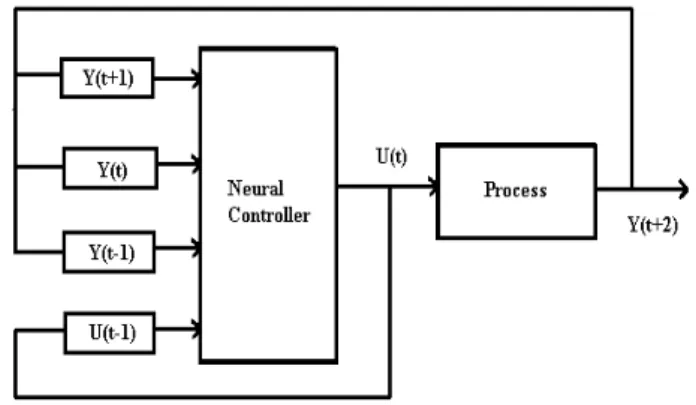
only one output, hence independent NN based SISO controllers can be designed for each decoupled control loops of the multivariable processes taken up. Hence the resulting inverse NN model can be used as a controller typically in a feed forward fashion. The proposed control configuration is presented in Fig. 1.
Figure 1. Illustration of multivariable control.
B. Neural Network model for Direct Inverse Controller In the direct method, NNs were trained with observed input-output data of the inverse dynamics of the decoupled open loop processes. Hence the inverse NN models were used as a controller typically in a feed forward fashion. The difference, if any, between the process and the network output was used as a bias (synonymous to feedback). This feedback signal was then processed by the inverse NN in the forward path. The learning phase of the network was an off-line process and the historic data base of the decoupled processes was used for training and testing the networks. In the present study, the training as well as testing database was created by exciting the decoupled open loop process with pseudo random binary signals (PRBS).
In order to develop DINN controllers, the training of the proposed multi layer FF NN (4, 3, and 1) was performed using the gradient based method. Performance criterion was MSE between the network output and target. The network predicted the outputs of the controller which actually are the manipulated input to the process. The inputs ( & and outputs ( of DINN (4, 3.1 or N1, N2 & N3) regarding the training & control phase (simulation /testing phase) were as follows,
Training Phase
1 , 1 , 2 , 2 (10)
3 1 (11) Control Phase
1 1 , , 1 , 1 (12)
3 (13) Fig. 2 presents the network architecture in the control mode. Sampling time and simulation times were problem dependent so that the offset is reduced to minimum.
Figure 2. Simulation of the trained network.
C. NN Based Internal Model Control & Disturbance Rejection
In an IMC based control scheme, the process model is placed in parallel with the actual process (plant). The difference between the actual process and the process model is used for the feedback purpose. This feedback signal is then processed by the controller in the forward path. It is to be noted that the implementation of IMC based control is limited only to open loop stable processes.
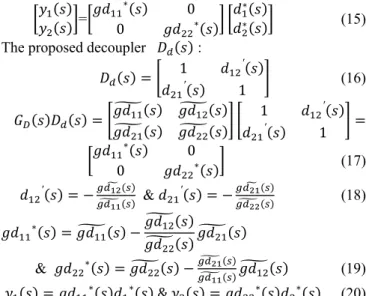
For disturbance rejection, IMC based NN control scheme was adopted. The decoupled disturbance transfer functions were perturbed to generate the design database for training the NNs representing both inverse & forward decoupled disturbance dynamics in a regulatory problem. The FFNN representing forward disturbance dynamics was kept in parallel with the decoupled disturbance process. The offset; thus produced was feedback to the inverse NN (DINN controller) to get processed in the feed forward fashion. In a regulator problem (14) prevails when 0.
(14)
167
= 0
0 (15)
The proposed decoupler :
1 ′
′ 1 (16)
1 ′
′ 1
0
0 (17)
′ & ′ (18)
& (19)
& (20)
The disturbance transfer function was chosen as same ordered to that of process transfer function. In IMC scheme for disturbance rejection, the proposed FF network (6, 3, and 1), was effectively the decoupled disturbance transfer function (forward disturbance dynamics). The following inputs & outputs used in the training and control phases were generated perturbing (20) using PRBS.
Training phase
1 3 , 2 , 3 , 2 , 1 ,
(21)
3 1 (22)
Simulation Phase
1 2 , 1 , 3 , 2 , 1 ,
(23) 3 (24)
Fig. 3 represents the block diagram of closed loop IMC scheme. The following filter transfer function was used for the closed loop simulation of the regulatory problems taken up.
Fig. 3 IMC structured neural control scheme.
(25) Where
, and (26) Here is the time constant related to the process time constant. The controller used in this IMC based scheme for disturbance rejection was effectively the decoupled inverse disturbance dynamics. The following inputs & outputs used for training and testing of the DINN which were generated by perturbation of (20).
Training Phase
1 , 1 , 2 , 2 (27)
3 1 (28) Control Phase
1 1 , , 1 , 1 (29)
3 (30)
III. CASE STUDIES A. Interacting Tank System
It was desired to control the levels of two tanks ( & ) connected in series by adjusting the flow rates & . The flow rate is the major disturbance variable. The flow-head relations are given by
& & (31)
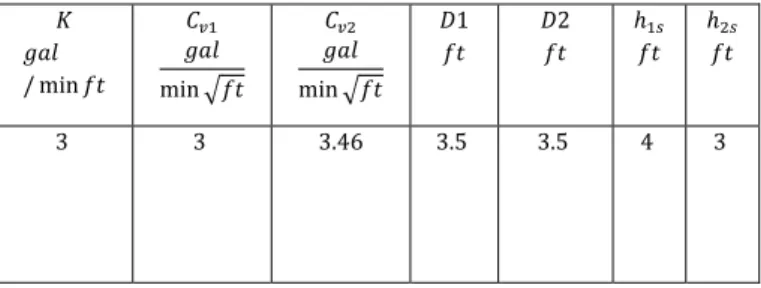
Where , and are constants. The parameters are presented in Table 1.
The following is the ideally decoupled process transfer function derived from mass balance equations:
0 0
. .
. . 0
0 . . . . (32)
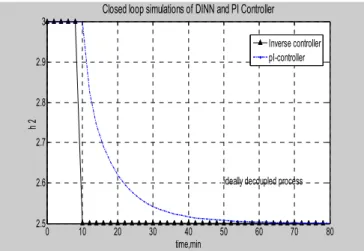
Two DINN SISO controllers were designed to maintain the levels & . The individual ideally decoupled SISO transfer functions were perturbed with PRBS signal to generate the input-output database used for training the neural networks. The performances of the two DINN controllers controlling & were compared with two PI controllers, having a gain ( ) of 2.7294 & 2.7291 and integral time constant 11.848 & 12.375, respectively. Sampling time vector of length 500 was considered for training the DINN s having sampling time interval of 0.8 min. The trained inverse networks/controllers were used for set point tracking ( changing from 4.0 3.5 and from 3.0 2.5 ). The time interval for simulation was considered as 2 min. Figs. 4 & 5 compare the performance of traditional PI controllers with DINN controllers in order to maintain levels & after being perturbed from their initial steady states by step inputs. The DINN controllers are equally efficient to that of PI controllers in set point tracking; moreover the final steady state reaches very quickly with NN controllers.
B. Mixing Tank with Hot & Cold Streams
168 the level and temperature of the tank. The flow rate out of the tank is proportional to the square root of the height of the liquid in the tank. The residence time at steady state is 10 minutes. The parameters used for simulation are presented in
Table 2.
The following are the ideal and simplified decoupled process transfer functions, respectively, for handling set point tracking.
0 0
. 0
0 . (33)
0 0
0
0
. . .
. 0
0 . . . . . . . (34)
The process transfer functions decoupled ideally & simplified way as in ( 4) & (6) were perturbed with PRBS to create the input-output database required for training the neural networks with inverse dynamics as well as forward dynamics/plant model (For IMC based ANN). DINN controllers were used for set point tracking (step change in height from 0.86 to 0.83 , and in temperature from 350 C to 320 C) and the simulation time interval was 2 min for both simplified and idealized decoupled cases. Sampling time vector of length 500 was chosen for training the DINN controlling height of the tank having sampling time interval of 0.8 min. For temperature control; the DINN was trained with a sampling time interval of 0.4 min. The performance of the NN controllers were compared with two proportional controllers, of gain ( ) 0.0667 & -0.5 for controlling height and temperature, respectively.
Fig. 4Comparison between the performance of PI controller and DINN controller in set point tracking of level of the interacting tank system.
Fig. 5Comparison between the performance of PI controller and DINN controller in set point tracking of level of the interacting tank system.
For addressing the regulatory problem in the mixing tank system the disturbance transfer function was assumed to be same as that of the process transfer function, which implied:
0 0
0
0 (35)
Disturbance as height in to the mixing tank was rejected effectively with IMC based NN scheme using decoupled disturbance transfer function matrix. As discussed earlier, two types of networks were trained in this process. A sampling time vector of length 1000 was chosen for training the DINN (representing effectively the decoupled inverse disturbance dynamics = decoupled inverse process dynamics) with a sampling time interval of 0.4 min. The FFNN here, representing effectively the decoupled forward disturbance dynamics was trained with sampling time vector of length 800 with a sampling time interval of 0.8 min. The simulation time interval for both the networks was 2 min.
Disturbance as cold stream was introduced in to the tank and rejected effectively with regular DINN when integrated with simplified decoupled process (disturbance actually). A sampling time vector of length 800 was chosen for training the DINN with a sampling time interval of 0.8 min. Simulation time interval in the closed loop was 2.25 min.
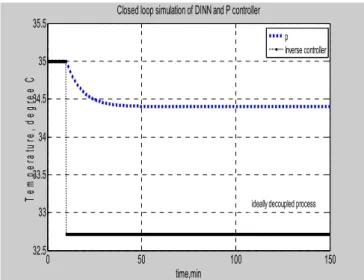
Figs. 6 & 7 shows the comparison between proportional and DINN controller performance for an ideally decoupled process while maintaining the level and temperature of the mixing tank system in servo mode. With the ideal decoupled process, & P controllers for height and temperature control of the mixing tank; the steady state values reached at 0.8599 by 20 min & 34.41 0 C by 50.6 min, respectively. The performance of the DINN controller is much better than Proportional Controller as reflected by their offsets (0.0108 & 0.71 0 C ) in reaching desired height as well as temperature (0.83 &. 320 C ) within 10 min.
With the proportional controller, for a simplified decoupled process; the steady state height reaches to 0.8597
at 68 min resulting in a constant offset of 0.0297 in height. There is an offset of 2.75 0C for P-only control of temperature (steady state temperature reaches to 34.73 0 C at 41.4 min). For the simplified decoupled process, the performance of the DINN controllers for maintaining the
0 10 20 30 40 50 60 70 80
3.4 3.5 3.6 3.7 3.8 3.9 4
time,min
h1
Closed loop simulations of DINN and PI-controller
Inverse controller PI-controller
ideally decoupled process
0 10 20 30 40 50 60 70 80
2.5 2.6 2.7 2.8 2.9 3
time,min
h2
Closed loop simulations of DINN and PI Controller
Inverse controller pI-controller
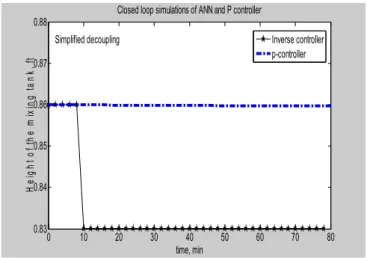
169 height at desired set point of 0.83 is presented in Fig. 8. There is no offset for control of height by the DINN controller. Fig. 9 represents the DINN temperature controller for the simplified decoupled process with no offset. The DINN controllers based on simplified decoupled process are better in their performances than DINNs based on ideally decoupled process and they are much better than proportional controllers for set point tracking.
For disturbance rejection in height for the mixing tank system, IMC based NN control scheme was found to be suitable with the filter transfer function as proposed by (25)
having 20 and n=3. Fig. 10 shows the disturbance rejection performance of IMC based NN controller with an offset of 0.0008 ft. Fig. 11 presents the comparative performance of the DINN controller based on simplified decoupled process with respect to P controller in rejecting the disturbance in temperature of the mixing tank system. DINN controller was found to reject the disturbance completely and was far suitable than P controller.
Fig. 6Comparison between the performances of P & DINN controller (based on ideally decoupled process) in set point tracking of the level for mixing
tank system.
Fig. 7 Comparison between the performances of P & DINN controller (based on ideally decoupled process) in set point tracking of temperature for mixing
tank system.
C. Distillation Process
A (2×2) binary distillation process aiming to control bottom composition ( ) and distillate composition ( ) of the lighter component was considered. The manipulated
variables were reflux flow rate and vapour boil up rate in kmol / min. In practice, the steam flow rate to the reboiler would be manipulated, but it is related to the vapour boil up by the heats of vaporization of the bottom stream and the steam. The disturbance inputs were feed flow rate ( kmol/min), and feed light component mole fraction ( ). The following process transfer function was considered:
. .
. . (36)
Table 3 represents the parameters needed for simulation of the open loop process.
The decoupled process transfer function as per (9) was derived and input-output database required for training the neural networks were generated with PRBS. Equation (37)
presents the simplified decoupled process transfer function.
0
0 (37)
Where . . . . . .
154.4 4.116 0.02744
3.704 10 1.482 10 197.5 0.878
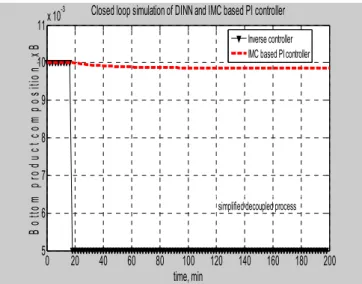
DINN controllers were used for set point tracking (step change in from 0.99 to 0.996 and in from 0.01 to 0.005) and the simulation time interval was 2 min for and 6 min for while implemented on simplified and idealized decoupled processes. Sampling time vector of length 500 was chosen for training the DINNs controlling and and the sampling time interval was 0.8 min. The conventional IMC based PID design evolved out to be a PI controller for the decoupled process transfer function considered and its performance were considered with DINNs controlling and .
For disturbance rejection problem, the (2×2) disturbance transfer function considered was as follows,
=
. .
. . (38)
The resulted decoupled disturbance transfer function is as follows:
0
0 (39)
Where . . . . . .
&
424 11.31 0.07538
1.662 10 6649 88.65 0.394
For the filter transfer functions used in IMC based NN scheme as per (25) the parameters used were
0 10 20 30 40 50 60 70 80
0.84 0.845 0.85 0.855 0.86 0.865
time, min
H
e
ight
of
the m
ix
ing t
a
nk
, f
t
Closed loop simulations of ANN and P-controller
p Inverse controller
ideally decoupled process
0 50 100 150
32.5 33 33.5 34 34.5 35 35.5
time,min
T
e
m
per
a
tur
e,
degr
ee
C
Closed loop simulation of DINN and P controller
p Inverse controller
170
75.0188 and n= 3 for outputs 1 & 2. IMC based NN
controllers only were capable to reject disturbances.
Fig. 12 shows the closed loop performance of DINN controller; based on simplified decoupled process in tracking the (from 0.99 to 0.996) of the distillation column and its comparison with the IMC based PI controller. The IMC based PI controller transfer functions for controlling &
are as follows: .
& . (40)
The DINN controller could control the without offset but the IMC based PI controller resulted in a large offset. Fig. 13 shows the closed loop performance of DINN controller in tracking the (from 0.001 to 0.005) of the simplified decoupled distillation process and its comparison with the PI controller. The DINN controller performed in much better way than the PI controller for that servo problem.
For disturbance rejection in and of the distillation column, IMC based NN controllers based on simplified decoupled process were found to be suitable with the filter transfer function as proposed by (25) having
√5.627 10 and n=3. Fig. 14 shows the disturbance
rejection performance of IMC based NN controller with an initial offset of -0.0022 and finally zero offset in , which is far better than PI controller performance. Fig. 15 presents the comparative performance of the IMC based NN controller with respect to PI controller in rejecting the disturbance in of the distillation column. PI controller is unable to reject the disturbance while NN controller shows only an offset of 0.0002.
IV. CONCLUSION
Present study proposed a novel NN based controller design for multivariable (MIMO) process. Three numbers of 2×2 processes including interacting tank system, mixing tank system, and distillation column have been taken for this development. Decoupled multi input- multi output pairs in a multivariable process were perturbed with PRBS to create design database for training multilayer FF networks. Ideal as well as simplified decoupling schemes were used. The DINNs were trained with inverse dynamics of the decoupled processes and used as controllers implemented in a feed forward fashion when integrated with the decoupled process. Multivariable controllers were designed as a series of SISO controller to be tuned independently. The developed controllers performed in closed multiple loops without any interaction among them. The controllers were efficient to deal servo problems. For disturbance rejection, IMC based NN control scheme was adopted. In a regulatory mode, the FFNN representing forward disturbance dynamics was kept in parallel with the decoupled disturbance (process) dynamics. The offset; thus produced was feedback to the inverse NN (DINN controller) to get processed in the feed forward fashion. The NN based IMC scheme performed in an efficient way for the processes taken up. The performances of DINN as well as IMC based NN controllers were compared with conventional P/PI/ IMC based PI controllers. The encouraging results obtained from this study necessitate
the need of implementing the proposed NN schemes in some more multivariable benchmark processes.
Fig.8 Comparison between the performances of P & DINN controllers (based on simplified decoupled process) in set point tracking of level for
mixing tank system.
Fig.9 Comparison between the performances of P & DINN controllers (based on simplified decoupled process) in set point tracking of
Temperature for mixing tank system.
Fig.10 Disturbance rejection in height by IMC based NN controller in the mixing tank system.
0 10 20 30 40 50 60 70 80
0.83 0.84 0.85 0.86 0.87 0.88
time, min
H
e
ig
h
t o
f th
e
m
ix
in
g
ta
n
k, ft
Closed loop simulations of ANN and P controller
Inverse controller p-controller Simplified decoupling
0 10 20 30 40 50 60 70 80
31.5 32 32.5 33 33.5 34 34.5 35 35.5
time, min
T
e
m
p
er
a
tur
e
,in
d
egr
ee
C
Closed loop response of ANN and P controller
Inverse controller p-controller
Simplified decoupled process
0 10 20 30 40 50 60 70 80
0.86 0.86 0.86 0.86 0.8601 0.8601 0.8601 0.8601 0.8601 0.8602
time, min
H
e
ig
ht
of
th
e m
ix
ing
ta
nk
, f
t
Disturbance rejection in height by IMC based NN
IMC Based NN
171 Fig. 11 Disturbance rejection in temperature by the DINN controller in the
mixing tank system and its comparison with P control.
Fig. 12 Comparison between the performances of DINN & PI controller (IMC based) in set point tracking of for Distillation column.
Fig.13 Comparison between the performances of DINN & PI controller (IMC based) in set point tracking of for Distillation column.
Fig. 14 Disturbance rejection in by IMC based NN controller in the distillation column and its comparison with IMC based PI control.
Fig. 15 Disturbance rejection in by IMC based NN controller in the distillation column and its comparison with IMC based PI control.
REFERENCES
[1] J S. Donat, N. Bhat, and T. J. McAvoy, “Optimizing Neural Net Based Predictive Contro,l” Proceedings of the American Control Conference, IEEE Service Center: Piscataway, NJ, 1990, pp. 2466-2471.
[2] B. E. Ydstie,” Forecasting and Control Using Adaptive Connectionist Networks,” Comput. Chem. Eng., vol. 14, 1990, pp. 583-599. [3] E. Hernandez, Y. Arkun, “Neural Network Modeling and an Extended
DMC Algorithm to Control Nonlinear Systems,” Proceedings of the American Control Conferenc, 1990, pp 2454-2459.
[4] C. P. Dimitris, H. U. Lyle, “Direct and Indirect Model Based Control Using Artificial Neural Networks,” Ind. Eng. Chem. Res., vol.30, 1991, pp. 2564-2573.
[5] J. L. Dirion, M. Cabassud, M. V. Le Lann, G. Casama’ita, “ Design of A Neural Controller by Inverse Modelling,” Computers Them. Engng, vol. 19, 1995, pp. S797-S802.
[6] M. A. Hussaina, P. Kittisupakornb, W. Daosud, “Implementation of Neural-Network-Based Inverse-Model Control Strategies on an Exothermic Reactor,” Science Asia, vol. 27, 2001, pp. 41-50.
[7] T. Varshney, R. Varshney, S. Sheel, “ANN Based IMC Scheme for CSTR,” International Conference on Advances in Computing, Communication and Control, (ICAC3’09), January 2009
.
TABLE1 PARAMETERS USED FOR SIMULATING INTERACTING TANK SYSTEM
0 10 20 30 40 50 60 70 80 90 100
34.8 35 35.2 35.4 35.6 35.8 36 36.2 T e m p er at u re, D egr ee C
Disturbance rejection in Temperature by DINN
Inverse controller P control
Simplified decoupled process
0 20 40 60 80 100 120 140 160 180 200
0.988 0.99 0.992 0.994 0.996 0.998 1 time,min T op p rod uc t c o m pos iti o n, x D
Closed loop simulations of DINN and IMC based PI controller
Inverse controller PI controller
Simplified decoupled process
0 20 40 60 80 100 120 140 160 180 200
5 6 7 8 9 10 11x 10
-3 time, min B o ttom pr oduc t c o m pos iti on, x B
Closed loop simulation of DINN and IMC based PI controller
Inverse controller IMC based PI controller
simplified decoupled process
0 5 10 15 20 25 30 35 40 45 50
0.96 0.965 0.97 0.975 0.98 0.985 0.99 0.995 1 1.005 ti i T o p pr oduc t c o m p o si tio n ,x D
Closed loop simulation of IMC Based NN and PI-controller
IMC Based NN PI
Simplified decoupled process
0 5 10 15 20 25 30 35 40
-1 -0.5 0 0.5 1 time,min B o ttom pr od uc t c o m pos iti o n, xB
Closed loop simulation of IMC based NN and PI controller
IMC Based NN IMC based PI
172
/ min min min
1 2
3 3 3.46 3.5 3.5 4 3
2 = Diameter of tank 2 1 = Diameter of tank 1
TABLE2 PARAMETERS USED FOR SIMULATING MIXING TANK SYSTEM
Stream Temperature Flow Rate
Liters/min
Hot manipulated stream
500 C 25
Cold manipulated stream
100 C 25
Cold stream as disturbance
100 C 25
Outlet 350 C 50
TABLE3 PARAMETERS USED FOR SIMULATING DISTILLATION PROCESS.
Streams
Value
( )=steady state bottom composition of the lighter component
0.01
( )=steady state distillate composition of the lighter component
0.99
Steady state value of the reflux flow rate, kmol/min
2.706
Steady state value of the vapor flow rate, kmol/min
3.206
Feed rate to the Distillation Column, kmol/min
1.0
Feed composition (light component)
0.5
Feed Quality
1.0
Madhusree Kundu was born in Kolkata, 21 January 1965. She did her
B.S.C. in Chemistry from university of Calcutta, India. Dr. Kundu got her B.Tech and M.Tech. in Chemical Engineering from the same university in the years 1990 & 1992, respectively. She completed her Doctoral study from Indian Institute of Technology, Kaharagpur, India and was awarded Ph.D. in the year 2005.
She served as a Process Engineer in the Simon carves India Ltd. during 1993-1998. She served as a lecturer and then Assistant Professor in The Birla Institute of Technology & Science, Pilani, India during 2004-2006. Presently, she is the Associate Professor, Department of Chemical Engineering, NIT, Rourkela, Orissa, India. She has published a couple of research articles and book chapters to her credit. Fluid Phase Equilibria, Advanced Process Control, Fault Detection and Diagnosis, & Process Monitoring are the current research interests of her.
Dr. Kundu is the life member of Indian Institute of Chemical Engineers (IIChE).
Seshu K. Damarla, M.Tech Student, Department of Chemical Engineering,