The Importance of Usability Aspect in M-Commerce Application for
Satisfaction and Continuance Intention
Yassierli
1*, Vinsensius
1, and M. S. Syed Mohamed
21. Department of Industrial Engineering, Faculty of Industrial Technology, Institut Teknologi Bandung, Bandung 40132, Indonesia
2. Faculty of Manufacturing Engineering, University Teknikal Malaysia, Melaka 76100, Malaysia
*e-mail:[email protected]
Abstract
There has been a rapid growing of m-commerce application in recent years due to the development of mobile communication technology and e-commerce business. However, only about 30% of online users, who conduct online searching, make online purchases. The low conversion rate seems to be correlated with poor usability aspect of most m-commerce applications and poor satisfaction reported by users. Research has reported that satisfaction and continuance intention in using m-commerce applications have relationships with service quality and information quality. In this study, a new model of user satisfaction and continuance intention in the context of mobile application was proposed by incorporating usability aspect. The study involved 230 respondents. To develop a new reliable and valid model, this study used Structural Equation Modelling (SEM) that include two stage evaluation, namely measurement model evaluation and structural model evaluation. Results demonstrated 34 valid and reliable indicators which can be used to measure service quality, information quality, usability, user satisfaction and continuance intention in M-commerce application. There were positive and significant relationships among service quality, information quality, usability, user satisfaction, and continuance intention. This study provide evidence on the importance of usability aspect in M-commerce application for user satisfaction and continuance intention.
Abstrak
Pentingnya Aspek Usabilitas Pada Aplikasi M-Commerce untuk Meningkatkan Kepuasan dan Niat Keberlanjutan Pengguna. Pertumbuhan aplikasi m-commerce dalam beberapa tahun terakhir sangat pesat karena perkembangan teknologi komunikasi seluler dan bisnis e-commerce. Namun, hanya sekitar 30% pengguna online, yang melakukan pencarian online, bersedia membeli online. Tingkat konversi yang rendah tampaknya berkorelasi dengan aspek usabilitas yang buruk dari sebagian besar aplikasi m-commerce dan kepuasan yang rendah dilaporkan oleh pengguna. Penelitian terdahulu telah mencatat bahwa kepuasan dan niat keberlanjutan dalam menggunakan aplikasi m-commerce memiliki hubungan dengan kualitas layanan dan kualitas informasi. Dalam studi ini, model baru kepuasan pengguna dan niat keberlanjutan dalam konteks aplikasi mobile diusulkan dengan memasukkan aspek usabilitas. Penelitian ini melibatkan 230 responden dan menggunakan structural equation modeling (SEM) yang mencakup dua tahap evaluasi, yaitu evaluasi model pengukuran dan evaluasi model struktural. Hasil penelitian menunjukkan 34 indikator yang valid dan andal yang dapat digunakan untuk mengukur kualitas layanan, kualitas informasi, usabilitas, kepuasan pengguna dan niat keberlanjutan dalam aplikasi m-commerce. Terdapat hubungan positif dan signifikan antara kualitas layanan, kualitas informasi, usabilitas, kepuasan pengguna, dan niat keberlanjutan. Studi ini memberikan bukti tentang pentingnya aspek usabilitas dalam aplikasi m-commerce untuk meningkatkan kepuasan pengguna dan niat keberlanjutan.
Keywords: m-commerce application, usability, user satisfaction, continuance intention
1.
Introduction
According to the Association of Internet Service Providers Indonesia (APJII), the number of internet users in Indonesia has reached 134 million people in 2017, an
(e-commerce) [1]. E-commerce is a general term referred to any transaction in the network (online) [2]. As a part of e-commerce, there is the term of m-commerce which is applied for any transaction accomplished using a mobile device [3].
Even though most internet users conduct online searching for product or service, but small portion of them make online purchase via mobile device. Data indicated that 95% of the main use of smartphone in e-commerce activities is only for search. Meanwhile, in 2016 purchases are made through websites accessed using desktop/laptop (64%) or direct purchase to stores (68%) [4]. This implies that the current transaction conducted through application (measured as conversion rate) is still relatively low, though the rate is greater now [4].
The relatively low conversion rate seems to be correlated with poor usability of existing m-commerce applications reported elsewhere. In the context of online transaction, usability is generally defined as the extent to which a site can be traced easily and help users to complete transaction quickly [5]. Good usability is characterized as easy to learn, having basic memorable functions, efficiency of look or design, error prevention, and finally can increase user satisfaction [6]. Poor usability has been reported to affect user satisfaction in online transaction [7]. In contrast, usability can provide great benefits because of "ease in making purchases", and this is the most powerful reason of 83% of respondents when doing online transaction [8].
The factor of usability has rarely mentioned in the context of m-commerce as an important factor affecting user satisfaction. Most of reports mentioned service attributes, such as product warranties, ease of payment, fast delivery, attractive promotions, and so on as competitive factors for m-commerce [3], [9]-[16]. More usability issues are associated to m-commerce, compared to e-commerce. The issues include the small screen size of smartphone, relatively low screen resolution, and limited processing capabilities. However, m-commerce provides better features than e-commerce in terms of ubiquity and personalization.
The model framework proposed in this study was adopted from DeLone and McLean [17] who documented a model on e-commerce information system, as shown in Figure 1. Their study clearly elaborated factors affecting continuance intention and satisfaction of e-commerce users. In addition, this model included usability aspects as part of information system quality which significantly then influenced satisfaction and continuance intention. It should be noted that in the context of e-commerce, information system quality becomes critical for business [18]. Companies that are not able to utilize the information system properly will become uncompetitive and fail to meet consumer expectation. However, there
Figure 1. Model of DeLone and McLean [17]
are several notes about the model of DeLone and McLean [17]. First, this model was only intended for e-commerce, whereas e-commerce and m-commerce clearly have different characteristics. Second, this model did not have standard measurement indicators. Therefore, in this study the model of DeLone and McLean [18] was modified to suit the context of m-commerce, and then its standard measurement indicators were proposed.
This study aimed to: (1) find out the relationships of service quality, information quality, and usability with user satisfaction and continuance intention of m-commerce applications; (2) identify important factors in m-commerce application that affect user satisfaction and continuance intention, and to define their standard indicators. It is expected this study proposes a new model which can be considered to increase conversion rate in m-commerce.
2.
Methods
Construct & Hypothesis. This section will discuss the definition of the construct used in the study, namely user satisfaction, continuance intention, service quality, information quality, and usability. This section also discussed the design of models and hypotheses that will be proven.
ability of a m-commerce application to support online transactions. Indicators of user satisfaction are adapted Kuo et al. [11].
Continuance Intention. Continuance intention is a form of loyalty after users get satisfied [13]. Cronin et al. [21] stated that loyalty is generally characterized by the behaviors of:(1) users say positive things about the service obtained, (2) users recommend the service to people around them, (3) users continue to use the service, (4) users make larger purchases, and (5) users dare to pay more for the service. In this study, continuance intention is defined as the tendency of costumers to use m-commerce applications for subsequent transactions. The indicators of this dimension are adapted from Akter et al. [13]. Several studies have found that user satisfaction has a positive effect on continuance intention [6], [11], [13], [17], [21]-[24]. Therefore, hypotheses can be formulated as follows:
Hypothesis 1 (H1): Satisfaction with m-commerce
application (SAT) has a positive impact on continuance intention (CI)
Service Quality. Kotler and Keller [19] define quality as a set of attributes or characteristics that exist in a product or service that can meet expectations and satisfy consumers. Akter et al. [13] defines service quality as a set of attributes that form consumer valuation of services offered. In this study, service quality is defined as a set of attributes that can meet consumer expectations and shape consumer ratings on services offered through m-commerce applications.
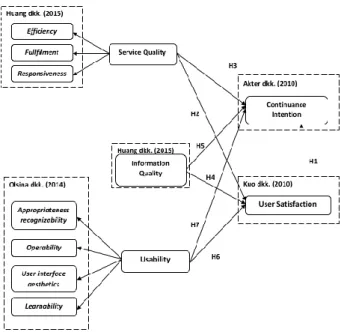
The attributes of service quality in e-commerce seems to be different than those in conventional service [9] since the level of acceptance and interaction with the application vary among users depending on their trust in technology. Therefore, Parasuraman et al. [9] introduced E-S-QUAL as the measures of service quality in the context of online transactions, instead of the common attributes of SERVQUAL. The attributes of E-S-QUAL provide the extent to which a website allows consumers to do transaction effectively and efficiently. Huang et al. [3] developed attributes to measure the quality of mobile services, namely M-S-QUAL which include efficiency, fulfilment, and responsiveness.
Efficiency is defined as the ability of a system to be used easily and quickly [3], [9], [14]. M-commerce applications must be used efficiently in supporting transactions so that enjoyable. Here, the efficiency can be measured as speed and application’s ease of use [9]. Both are reported as important factors that make online transactions to be interesting [25]. Santouridis and Trivellas [14] revealed that the efficiency is the most important dimension of electronic service quality.
Fulfillment is defined as the ability of a system to fulfill its promise regarding with delivery and availability of goods [3], [9], [14]. The fulfilment will determine whether the customer is satisfied or not to the quality of the services provided [26]. Santouridis and Trivellas [14] revealed that the fulfilment affects the assessment of service quality in the context of online transactions.
Responsiveness is defined as the ability of a system to serve users quickly, especially when problems occur in transactions [3,9]. This dimension is considered important in m-commerce applications because it reflects the company's desire to support its users when experiencing difficulties and provide special features to solve the problem.
Previous studies have illustrated the relationships among service quality, user satisfaction and continuance intention [11], [13]-[15], [17]. The results generally demonstrated that service quality has a positive impact on user satisfaction. Service quality has been considered as an important factor to maintain customers and sales [17]. Santouridis and Trivellas [14] reported that service quality has a positive impact on loyalty of mobile health services. In the same context of the mobile health application, Akter et al. [13] also found that service quality has a positive effect on continuance intention. Therefore, the following hypothesis can be formulated:
Hypothesis 2 (H2): Service quality (SQ) of m-commerce application has a positive impact on user satisfaction (SAT)
Hypothesis 3 (H3): Service quality (SQ) of m-commerce
application has a positive impact on continuance
intention (CI)
Information Quality. Information Quality is related to the content of information that is available during online transactions [25]. The indicators used in the information quality are adapted from Huang et al. [3]. The information displayed on an online site must be complete, accurate, relevant, and easy to understand to enable users to make purchases and re-make purchases regularly [17]. Wang and Liao [22] revealed that the information quality influence overall user satisfaction and affect the continuance intention and positive word-of-mouth. Previous studies have illustrated the relationships between information quality and user satisfaction as well as continuance intention in the context of electronic services [10], [17], [26], [27]. Their results in general stated that information quality has a positive effect on user satisfaction and continuance intention of a service. Therefore, hypotheses can be formulated as follows:
Hypothesis 5 (H5): Information quality (IQ) of m-commerce application has a positive impact on
continuance intention (CI)
Usability. Olsina et al. [28] defines usability as the extent to which a system or product has attributes that make the system or product easy to understand, easy to learn, easy to operate, protect from errors, attractive, and accessible to users when used in certain conditions. In the context of online transaction, usability is defined as the extent to which a site can be traced easily and can help users to complete transactions quickly because of easy to learn and easy to remember, efficiency of display or design, error prevention, and can reach a level certain satisfaction [6], [28]. Referring to these definitions, in this study usability is defined as the ability of an application to be understood, learned, operated, protected from mistakes, attractive, and accessible to users when used during m-commerce transactions.
The dimensions of usability used in this research were adapted from ISO/IEC 25010 [5] and Olsina et al. [26]. Both documents proposed various usability dimensions, including appropriateness recognizability, operability, learnability, aestethic user interface, user error protection, and accessibility. Among those dimensions, four factors seem to be the most relevance to this study, including appropriateness recognizability, operability, learnability, and user interface aestethics.
Appropriateness recognizability is defined as the ability of a system or product to be recognized and in accordance with the needs of its users [5]. This dimension can be simply recognized as ease of understanding. Its aspect is related to familiarity, icon clarity, and the availability of language choices [28]. This dimension is considered important because it helps users to be able to recognize and understand the functions, icons, and purpose of the application. During transactions, functions and icons need to be properly recognized according to user intension.
Operability is defined as the ability of a system to provide attributes that make the application easy to operate and control [5]. This aspect is related to data entry, visibility, suitability of object size, consistency of control placement, and availability of controls on each website page [28]. This dimension is considered important because if an application can be operated and controlled properly then it will create convenience for its users.
Learnability is defined as the ability of a system to be understood quickly and effectively [5]. This aspect is related to predictability, availability of feedback when errors occur, and the availability of usage instructions [28]. A good application must be easy of learn without requiring excessive effort. The learning process can be done through memorizing, understanding, and exploring.
Easy to learn means easier for users to operate so that the time needed to operate the application can be shorter.
User interface aesthetics is defined as the ability of a system to present interface designs that provide pleasant and satisfying interactions for users [5]. This aspect is related to the use of fonts and harmony between colors, writing, images and animation [28], and affect user perceptions about online transactions. Good visual presentation and interface design will attract consumers to make online purchases [27]. The indicators of this dimension are adapted from Wang and Liao [22].
Previous studies have illustrated the relationships among usability, user satisfaction and continuance intention in the context of online transaction [6], [23]-[24]. The results of these studies stated that usability has a positive effect on user satisfaction. Good usability can help users reach their goals easily and understand the information given in the application. Moreover, it can avoid users making mistakes so that they can speed up the transaction process. On the contrary, poor usability will enable users to make mistakes easily, for example in making orders and payments. This will definitely have an impact on user satisfaction [6]. A good usability will also make users loyal since their effort spent in completing the transaction is minimal. This will encourage users to make subsequent transactions [6]. Therefore, hypotheses can be formulated as follows:
Hypothesis 6 (H6): Usability (U) of m-commerce
app-lications has a positive impact on user satisfaction (SAT)
Hypothesis 7 (H7): Usability (U) of m-commerce applications has a positive impact on continuance intention (CI)
From these hypothesis, the initial research model can be seen in Figure 2 with the details of the indicators can be seen in Appendix A.
In this study, we selected an e-commerce application chosen from among the most popular e-commerce companies in Indonesia. In a month, there are more than 40 million visits on the site. In addition, the company has an application for m-commerce.
Criteria of participants involved in this study included (1) aged 18-34 years; (2) had experience in doing online transactions either through website or m-commerce application. A number of studies mentioned that most of consumers of online shopping is in this age segment [4] [7]. Since there were 46 indicators, a minimum of 230 respondents was needed [29].
Figure 2. Initial Research Model
to participate in this study. If they agreed to participate then an appointment was made. Before they filled in the questionnaire, they were asked to play with the application for about 10 minutes, and then to make an online shopping (until payment option using bank transfer selected). The respondents were then asked to provide an assessment for each of the indicators measured.
Structural Equation Modelling (SEM) was used to develop a new reliable and valid model empirically. This SEM method included two stage evaluation, namely measurement model evaluation and structural model evaluation.
3.
Results and Discussion
Respondents’ Demography. Respondents of this study were mostly female with an age range between 22-25 years (Table 1). Most of them were students with undergraduate academic background. Most of the respondents did online shopping using smartphones with the intensity about 2-3 times in the last three months. The average expenditure in one transaction was less than Rp. 250,000 (Figure 3).
Measurement Model Evaluation. Confirmatory Factor Analysis (CFA) was conducted to investigate the validity and the fitness of the measurement model. Validity was evaluated based on standardized regression weight (factor loading), Average Variance Extracted (AVE), and Construct Reliability (CR). Goodness-of-fit was evaluated based on normed chi-square values, CFI index, TLI and RMSEA. Evaluation was done up to two iterations to get a good fitness model. A model is said to have good fitness if it has a normed chi-square value
Table 1. Respondents’ Demography
Category Amount (%)
Sex Male 107 47
Female 123 53
Age
18–21 years old 65 28
22–25 years old 151 66
26–29 years old 12 5
30–33 years old 2 1
Occupation
Private workers 65 28
Students 118 51
Government Workers 2 1
Entrepreneurs 7 3
Non-employers 17 8
Education Background
Others 21 9
Diploma 1 0.4
Undergraduate 200 87
Master 28 12.2
Doctoral 1 0.4
(a)
(b)
(c)
Figure 3. Respondent’s Characteristics on a) Online Shopping Frequency, b) Device Used, c) Spending Capability
< Rp 250,000 51%
Rp 250,000 – Rp 500,000 36% Rp 500,001 –
Rp 750,000 10%
Rp 750,001 – Rp 1,000,000 1%
> Rp 1,000,000 2%
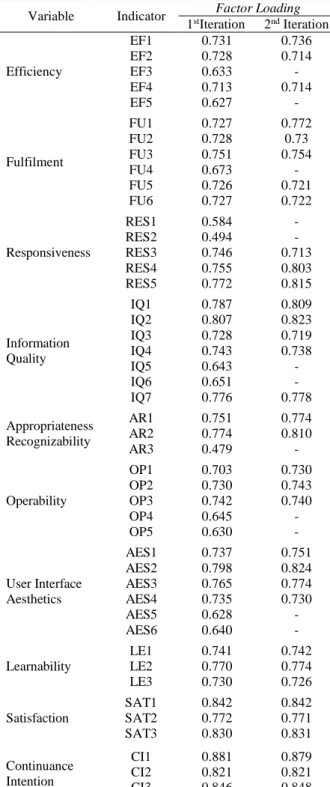
Table 2. Values of Factor Loading for Each Iteration
Variable Indicator Factor Loading
1stIteration 2nd Iteration
Efficiency
EF1 0.731 0.736
EF2 0.728 0.714
EF3 0.633 -
EF4 0.713 0.714
EF5 0.627 -
Fulfilment
FU1 0.727 0.772
FU2 0.728 0.73
FU3 0.751 0.754
FU4 0.673 -
FU5 0.726 0.721
FU6 0.727 0.722
Responsiveness
RES1 0.584 -
RES2 0.494 -
RES3 0.746 0.713
RES4 0.755 0.803
RES5 0.772 0.815
Information Quality
IQ1 0.787 0.809
IQ2 0.807 0.823
IQ3 0.728 0.719
IQ4 0.743 0.738
IQ5 0.643 -
IQ6 0.651 -
IQ7 0.776 0.778
Appropriateness Recognizability
AR1 0.751 0.774
AR2 0.774 0.810
AR3 0.479 -
Operability
OP1 0.703 0.730
OP2 0.730 0.743
OP3 0.742 0.740
OP4 0.645 -
OP5 0.630 -
User Interface Aesthetics
AES1 0.737 0.751
AES2 0.798 0.824
AES3 0.765 0.774
AES4 0.735 0.730
AES5 0.628 -
AES6 0.640 -
Learnability
LE1 0.741 0.742
LE2 0.770 0.774
LE3 0.730 0.726
Satisfaction
SAT1 0.842 0.842
SAT2 0.772 0.771
SAT3 0.830 0.831
Continuance Intention
CI1 0.881 0.879
CI2 0.821 0.821
CI3 0.846 0.848
below 3.0, the RMSEA value is below 0.08, and the CFI and TLI values above 0.9 [30]. Two iterations were conducted to obtain all indicators with factor loading > 0.7 (Table 2). Factor loading in the 1st iteration showed
12 indicators had factor loadings < 0.7, which mean that the indicators did not represent the variance of the construct variable, or simply less valid and reliable. In the 2nd iteration, those 12 indicators were eliminated.
The 2nd iteration result showed that 34 indicators were
valid and reliable with factor loading > 0.7.
The existence of indicators that were less valid in the 1st iteration have impacts on the AVE of the construct
<0.5. After elimination of the indicator (can be seen in Table 2), all constructs were valid and reliable. Table 3 demonstrates results of 2nd iteration with that AVE
values above 0.5, indicating, and CR values above 0.6.
Evaluation was done up to two iterations to get a good fitness model. A model is said to have good fitness if it has a normed chi-square value below 3.0, the RMSEA value is below 0.08, and the CFI and TLI values above 0.9 [30]. The results of the 1st iteration indicated that the
CLI and TFI values <0.9, which represented less fit model. This was due to the existence of indicators that were less valid and reliable to represent the variable construct. Table 4 indicates that 2nd iteration produced better fitness in terms of CFI, TLI and RMSEA, and all values denoted good fitness of the model.
Structural Model Evaluation. The evaluation was done by testing the goodness-of-fit model using Structural Equation Modelling (SEM). Structural model testing was carried out based on the model produced in the 2nd
iteration. The evaluation of structural model used the same indices with the measurement model were applied, as shown in Table 5.
CFI and TLI values were between 0.80 and 0.90, suggesting a medium fitness level or mediocre fit [29]. RMSEA index values were in the range of 0.08-0.1 which indicates medium fitness level or mediocre fit [31]. Overall, it can be concluded that the structural model has good fitness so that the model can be accepted.
Table 3. Values of AVE and CR for Each Iteration
Variable
AVE CR
1st Iteration 2nd Iteration 1st Iteration 2nd Iteration
Efficiency 0.473* 0.520 0.837 0.795
Fulfilment 0.522 0.548 0.881 0.872
Responsiveness 0.462* 0.606 0.811 0.823
Information Quality
0.542 0.600 0.913 0.907
Appropriateness Recognizability
0.464* 0.628 0.647 0.772
Operability 0.478* 0.544 0.852 0.806
User Interface Aesthetics
0.518 0.594 0.892 0.882
Learnability 0.558 0.559 0.808 0.808
Satisfaction 0.665 0.665 0.853 0.853
Continuance Intention
0.722 0.722 0.874 0.874
Table 4. Goodness-of-fit of Measurement Model
Index 1st Iteration 2nd Iteration
Chi Square
χ2 1668.39 826.14
Degree of Freedom
972 510
P-value <0.001 <0,001
Normed chi-square
1.72 1.62
RMSEA 0.056 0.052
CFI 0.897 0.940
TLI 0.890 0.934
Table 5. Goodness-of-fit of Structural Model
Index Value
Chi Square
χ2 1333,751
Degree of Freedom 513
P-value <0,001
Normed chi-square 2.600
RMSEA 0.084
CFI 0.844
TLI 0.830
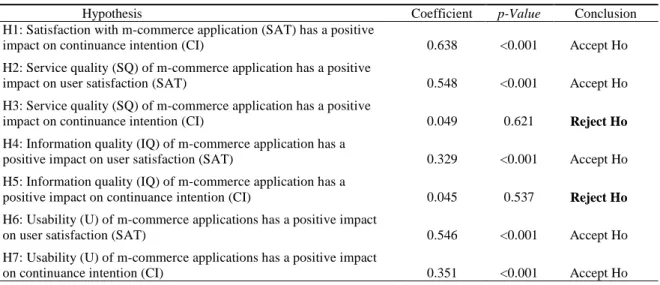
Table 6. Results of Hypothesis Testing
No. Hypothesis Coefficient p-Value Conclusion
1 H1: Satisfaction with m-commerce application (SAT) has a positive
impact on continuance intention (CI) 0.638 <0.001 Accept Ho
2 H2: Service quality (SQ) of m-commerce application has a positive
impact on user satisfaction (SAT) 0.548 <0.001 Accept Ho
3 H3: Service quality (SQ) of m-commerce application has a positive
impact on continuance intention (CI) 0.049 0.621 Reject Ho
4 H4: Information quality (IQ) of m-commerce application has a
positive impact on user satisfaction (SAT) 0.329 <0.001 Accept Ho
5 H5: Information quality (IQ) of m-commerce application has a
positive impact on continuance intention (CI) 0.045 0.537 Reject Ho
6 H6: Usability (U) of m-commerce applications has a positive impact
on user satisfaction (SAT) 0.546 <0.001 Accept Ho
7 H7: Usability (U) of m-commerce applications has a positive impact
on continuance intention (CI) 0.351 <0.001 Accept Ho
Then, hypothesis testing was done by looking at the significance value (p-values) of the relationships between variables. The results of hypothesis testing can be seen in Table 6. Based on the test results, there were five hypotheses accepted with p-value < 0.05 and two rejected hypotheses. A detailed discussion of the results of hypothesis testing can be seen in the discussion section.
Discussions. This study found that user satisfaction has a positive impact on continuance intention (p < 0.001). This finding is consistent with previous studies [6], [11], [13], [17], [21]-[24]. Users with a high level of satisfaction will have a tendency to use product/service more often [11].
To increase satisfaction, companies have to focus on service quality, information quality and usability. We found that all of these three attributes have positive impact on user satisfaction (p < 0.001). Previous studies have similarly suggested the importance of service quality on user satisfaction [11], [13], [14], [17], [32]. The better service quality provided, the higher user satisfaction will be. Similarly, the importance of information quality on user satisfaction have been previously reported [10], [17], [22]. In the context of online shopping, information
quality will determine the user's trust since there is no service personnel involved as found in direct shopping. The trust will then affect their purchasing decision and then lead to satisfaction.
Interestingly, usability has a positive impact on both user satisfaction and continuance intention in m-commerce (p <0.001). The significant effect of usability on user satisfaction in e-commerce have previously been reported [6], [23], [24]. Usability makes users have good understanding on the content and tasks that can be done through the application [23], [24], [27]. Good usability helps users reach their goals easily. Since it is easy to work with the application, transaction process can be done fast. Meanwhile, poor usability would lead users to make mistakes, commonly due to unclear homepage, confusing image, forms and buttons or poor navigation. More specifically in making orders and payments, all these difficulties will lead to dissatisfaction [24], and impact sales of the company.
between usability and continuance intention is indirectly through user satisfaction. Continuance intention depends on user's familiarity and ability to work with application. If the user feels familiar with the application, the user might not look for other application and become loyal. Due to the familiarity to application, user’s effort in completing transactions using the application is minimal [6]. The challenge then is how to come up with an optimize interface design given that there are some limitations associated with m-commerce, including small size of window, device limitation on processing capability, mobile site image issues, and network access.
In contrast to usability, service quality and information quality do not have direct significant impact on continuance intention. We found that both factors affect continuance intention with an intermediary of user satisfaction. That is, if service quality provided is good, then user satisfaction will increase which will then have a positive impact on continuance intention. Even so, service quality must still get special attention because its role is crucial in determining user satisfaction. Similar explanation is applied to information quality.
Good service quality can make a company more competitive and can generate even more profit in the future [11]. This finding is contrary to research conducted by Akter et al. [13] in which service quality directly has a positive impact on continuance intention. However, Kuo et al. [11] and Santouridis and Trivellas [14] support our findings on the existence of the intermediary of user satisfaction.
Cronin [21] states that user satisfaction can generally act as an intermediary between an attribute (quality) with behavioral intention. Even so, the relationship between the two factors can also occur directly. It should be noted that assessment of service quality is a cognitive evaluation, while the assessment of user satisfaction is an affective evaluation and involves feelings. Finally, continuance intention may involve conative aspects. Similar to service quality, if information quality provided
is acceptable, then user satisfaction will increase and have a positive impact on continuance intention. This finding is in accordance with the results of Kuo et al. [11] and Wang and Liao [22].
Main limitation of this study is the characteristics of the respondents which were mostly students, and we have limited the respondents to the aged of the 18-34 years old. However, most of the current consumers of online shopping are in this age segment.
4.
Conclusion and Implications
The rapid development of technology has increased user expectation on mobile application and its capabilities, including in online transaction. User expectation is then not only about service quality and information quality. In the context of m-commerce, usability should also be considered as an additional expectation. If user expectation is met, satisfaction will be achieved. In contrast, if expectation is ignored, dissatisfaction resulted may lead to low conversion rate.
The findings of this study provide evidence especially for e-commerce companies that they must pay attention to usability aspect in addition to service quality and information quality in order to achieve a high level of user satisfaction and continuance intention of m-commerce application. Usability means that the design of application should consider several limitations associated with the mobile device in terms of small screen size, relatively low screen resolution, and limited processing capabilities. In additions, the proposed model and its indicators can be used as a design and testing guideline for any mobile application. Service quality has three sub-dimensions, namely efficiency, fulfilment, and responsiveness with a total of 11 indicators. There are five indicators of information quality of information. Meanwhile, usability has four sub-dimensions, namely appropriateness recognisability, operation ability, user interface aesthetics, and learnability with a total of 12 indicators.
Appendices
Dimension Code Items References
Efficiency
EF1 The search engine displays search results accurately according to the word key entered
[3]
EF2 This application is easily traced by users
EF3 This application allows users to complete transaction quickly
EF4 Products are organized hierarchically, and can be searched by product name, product
type,
brand, and number or product code
EF5 Pages on this application can be opened quickly
Fulfilment
FU1 Checking the status of shipping can be done easily
[3]
FU2 Information about the delivery time and the estimation when product reaches the consumer
easy to understand
FU3 This application immediately transfers orders to shopping carts after users choose items
ordered
FU4 This application sells products that are available in stock
FU5 The promotion in this application is true
FU6 Information regarding the order is immediately given shortly after the order process is
Appendices:
Continue
Dimension Code Items References
Responsiveness
RES1 This application offers easy procedures for product return
[3]
RES2 This application offers product warranty that is easy for users
RES3 This application provides information about what to do if a transaction cannot be
processed
RES4 This application provides a telephone number that can be contacted if a problem occurs
RES5 This application offers users the option to talk to customer service personnel when a
problem occurs
Information Quality
IQ1 The information given in this application is complete
[3]
IQ2 The information contained in this application is relevant
IQ3 The information provided in this application is important
IQ4 The information given in this application is actual
IQ5 The information contained in this application is updated regularly
IQ6 Users can fully understand the information contained in this application
IQ7 The information provided in this application is accurate
Appropriateness Recognizability
AR1 Users can understand the functions and uses of this application through first impressions
[5]
AR2 Icons in this application are easy to understand and in accordance with what users want to
go to
AR3 This application provides various language choices according to user preferences
Operability
OP1 Data entry mechanism in this application is easy and efficient, and avoids users to make
repeated registrations
[5] OP2 Texts, icons, and links in this application have appropriate size so that easy to be identified
OP3 Brightness and contrast between text and background color make it easier for users to
distinguish text with links or icons
OP4 Control icons are placed in a consistent location
OP5 Control icons are always available on every page
User Interface Aesthetics
AES1 This application utilizes multimedia effectively
[5,22]
AES2 The layout in this application is appropriate and well
AES3 Placement and combination of colors, text, images, and animation produce harmonious
integration
AES4 The appearance of this application is well organized
AES5 The font type used in this application is correct
AES6 The color of the text used in this application is correct
Learnability
LE1 A short tutorial provided by this application helps users to understand how to use
application [5]
LE2 Users can predict the next steps that will appear after one activity is complete
LE3 Feedback or error message given when an error occurs enable users to know and to correct
their mistakes
Satisfaction
SAT1 I feel satisfied and pleasant when making a transaction using this application
[11]
SAT2 The added value provided by this application is greater than I expected
SAT3 I think this application successfully provide added value to its users
Continuance Intention
CI1 I will use this application again for future transactions
[13] CI2 I am more likely to use this application than other alternatives such as mobile sites
CI3 I will always use this application when making transactions
References
[1] APJII, Profil Pengguna Internet Indonesia 2018, Asosiasi Penyelenggara Jasa Internet Indonesia, Jakarta, 2018. [https://apjii.or.id/content/utama/ 39]. (In Indonesian)
[2] K. Jakimoski, Sci. Technol. 7/6 (2014) 13.
[3] E.Y. Huang, S.W. Lin, C.Y. Fan, Electron. Commer. Res. Appl. 14 (2005) 126.
[4] TechinAsia, https://www.techinasia.com/talk/5-trends-indonesian-ecommerce, 2017
[5] ISO, ISO/IEC 25010:2011(en) Systems and software engineering — Systems and software Quality Requirements and Evaluation (SQuaRE) — System
and software quality models, https://www.iso.org/ obp/ui/#iso:std:iso- iec:25010:ed-1:v1:en, 2011. [6] C. Flavian, M. Guinaliu, R. Gurrea, Inf. Manag. 43
(2006) 1.
[7] Criteo, https://www.criteo.com/insights/mobile-commerce-growth-criteo-research/.
[8] J. Nielsen, Designing web usability: The practice of simplicity, New Riders Publishing, USA, 1999. [9] A. Parasuraman, V.A. Zeithaml, A. Malhotra, J.
Serv. Res. 7/3 (2005) 213.
[10]K.C. Lee, N. Chung, Interact. Comput. 21 (2009) 385.
[12]R. Negi, Int. J. Qual. Reliab. Manag. 26/7 (2009) 699.
[13]S. Akter, J. D’Ambra, P. Ray, Electron. Markets. 20 (2010) 209.
[14]I. Santouridis, P. Trivellas, Int. J. Qual. Serv. Sci. 4/1 (2012) 86.
[15]A. Ozer, M.T. Argan, M. Argan, Soc. Behav. Sci. 99 (2013) 428.
[16]M. Nilashi, O. Ibrahim, V.R. Mirabi, L. Ebrahimi, M. Zare, J. Retailing Consum. Serv. 26 (2015) 57. [17]W.H. DeLone, E.R. McLean, J. Manag. Inf. Syst.
19/4 (2003) 9.
[18]S. Alter, Information Systems: Foundation of E-Business (Fourth Edition), Pearson Education International, New Jersey, 2002.
[19]P. Kotler, K.L. Keller, Marketing Management, Prentice Hall, New Jersey, 2012.
[20]J. Song, J. Kima, D.R. Jones, J. Baker, W.W. Chin, Decis. Support Syst. 59 (2014) 37.
[21]J.J. Cronin, M.K. Brady, G.T. Hult, J. Retailing. 76/2 (2000) 193.
[22]Y.S. Wang, Y.W. Liao, Comput. Hum. Behav. 28 (2007) 381.
[23]L. Casalo, C. Flavian, M. Guinali, Int. J. Bank Marketing. 26/6 (2008) 399.
[24]D. Belanche, L. Casalo, M. Guinali, J. Retailing Consum. Serv. 19 (2012) 124.
[25]M. Kim, J.H. Kim, S.J. Lennon, Managing Serv. Qual. 16/1 (2006) 51.
[26]Z. Yang, X. Fang, Int. J. Serv. Ind. Manag. 15/3 (2004) 302.
[27]Z. Yang, S. Cai, Z. Zhou, N, Zhou, Inf. Manag. 42 (2005) 575.
[28]L. Olsina, L. Santos, P. Lew, Lecture Notes Comput. Sci. 8541 (2014) 111.
[29]J.F. Hair, W.C. Black, B.J. Babin, R.E. Anderson, Multivariate Data Analysis: A Global Perspective (7th ed.), Pearson Education, Inc., New Jersey, 2010.
[30]S.H. Wijanto, Metode Penelitian Menggunakan Structural Equation Modeling dengan LISREL 9, Lembaga Penerbit Fakultas Ekonomi UI, Jakarta, 2015. (In Indonesian)
![Figure 1. Model of DeLone and McLean [17]](https://thumb-us.123doks.com/thumbv2/123dok_us/8074845.2139256/2.892.471.816.145.338/figure-model-of-delone-and-mclean.webp)