The Decentralized Probabilistic Method for Resource Sharing and Encrypted Data
Stored In the Cloud
T Tejeswi1, N Seetayya2
#1. M.Tech (CSE) in Department of Computer Science Engineering,
#2. Asst.Prof, Department of Computer Science and Engineering, Sri Sivani College Of Engineering, Chilakapalem, Srikakulam, A.P, India.
Abstract
Cloud computing services have turned into the worldview of vast scale framework where a provider gives shared virtual computing and storage assets to a customer. The service provider infrastructure converts into cost diminishments for the customer who does not put resources into framework and support. Be that as it may, the arrangement of Service Level Agreements (SLAs) in Infrastructure-as-a-Service (IaaS) in the cloud remains a testing issue. To guarantee the classification of tricky information while supporting the AES Encryption procedure has been proposed to encode the information beforehand outsourcing. To better guarantee information security, this paper influences the essential to try to formally address the issue of endorsed information. Not exactly the same as standard structures, the differential advantages of customers are also considered in other than the information itself. We additionally exhibit a few new supporting approved copy check in a cloud engineering. Security investigation shows that our plan is secure as far as the definitions determined in the proposed security model. As a proof of idea, we accomplish a model of our proposed approved plan and direct proving ground tests utilizing our model. We demonstrate that our proposed approved check conspire brings about insignificant overhead contrasted with typical processes.
Keywords: Data integrity, security, Authorized check duplicates, confidentially, convergent keys, Authorization.
I. Introduction
Cloud computing gives apparently illimitable "virtualized" assets to clients as services over the entire Internet, while concealing stage and implementation subtle essentials. The present cloud service providers offer both very accessible storage
data reinforcements. While cloud storage is appealing, how to give security certifications to outsourced data turns into a rising concern. One noteworthy security challenge is to give the property of guaranteed erasure, i.e., data files are forever difficult to heaps of cancellation. Keeping data reinforcements for all time is unfortunate, as delicate data might be uncovered later on in view of data rupture or incorrect administration of cloud administrators. Hence, to maintain a strategic distance from liabilities, endeavors and government organizations generally keep their reinforcements for a limited number of years and demand to erase (or demolish) the reinforcements subsequently. For instance, the US Congress is planning the Internet Data Retention enactment in approaching ISPs to hold data for a long time, while in United Kingdom, organizations are required to hold wages and compensation records for a long time. A client can download the encoded document with the pointer from the server, which must be unscrambled by the comparing data proprietors with their united keys. Subsequently, focalized encryption enables the cloud to perform deduplication on the cipher texts and the evidence keeps the unapproved client to get to the best.
II. Related Work
M. W. Storer, K. Greenan, D. D. E. Long, and E. L. Mill operator [1]developed models for secure deduplicated storage. These framework model show that security can be joined with deduplication for expelling copy duplicates of data and security is given using focalized encryption. In this procedure number of client scramble data with their focalized key that is encode with same cipher text. M. Bellare, S. Keelveedhi, and T. Ristenpartis[2] presented another cryptographic primitive, Message-Locked Encryption (MLE), where the key under which encryption and unscrambling are performed is itself gotten from the message. MLE gives an approach to accomplish secure de-duplication usind deduplication procedure. an objective as of now focused by various cloud-storage providers. They give label consistency to security and data uprightness J. Yuan and S. Yu. [3] Provide deduplication framework in the cloud storage to decrease the storage space of the labels for respectability check. To build the security of data deduplication and give data confidentiality M. Bellare, S. Keelveedhi, and T. Ristenpart.[4] It ensure the data confidentiality by changing the predicatable message into unpredicatable message. In this
framework, there is service provider called key server is acquainted with create the document tag for copy check S. Halevi, D. Harnik, B. Pinkas, and A. Shulman-Peleg.[5] Provide "confirmations of possession" (PoW) for deduplication Systems. Before transferring or downloading document customer can proficiently demonstrate to the cloud storage server that he/she has claims a record. J. R. Douceur, A. Adya, W. J. Bolosky, D. Simon, and M. Theimer[6] Convergent encryption gives data security and confidentiality in deduplication. A client gets a concurrent key from unique data duplicate and scrambles the data duplicate with the merged key. Client create document tag for expelling copy duplicates of data. Evidence of Ownership: The possibility of "Confirmation of ownership"(PoW) Halevi et al. [8] for deduplication systems, to such an extent that a client can viably demonstrate to the cloud storage server that he possesses a record without exchanging the record itself. A couple of PoW advancements built up on [8] Merkle-Hash Tree is proposed to permit client side deduplication, which incorporate the delimited spillage setting. Pietro and Sorniotti [9] proposed an other PoW design by choosing the projection of a record onto some haphazardly picked bit-positions as the record confirmation. Note that all the above plans don't consider data security. Recently, Ng et al. [11] improved PoW for encryption reports, yet they don't demonstrate to lessen the key administration overhead. Twin Clouds Architecture: Bugiel et al. [7] given a structure containing twin cloud for ensure d outsourcing of data and subjective handling to an untrusted service cloud. Zhang et al. [12] likewise acquainted the half and half cloud strategies with help security cognizant data escalated computing. The work considers pointing the approved deduplication issue over data openly cloud.
III. A Detailed Look at Data De-Duplication
long time. Recently, single-case stockpiling has empowered the expulsion of excess documents from capacity situations, for example, files. Most as of late, we have seen the presentation of sub-record duplication. These three kinds of information de-duplication are depicted underneath
A. Information Compression
Information pressure is a technique for lessening the span of records. Information pressure works inside a record to recognize and evacuate exhaust space that shows up as dull examples. This type of information de-duplication is nearby to the document and does not think about different records and information portions inside those records. Information pressure has been accessible for a long time, however being secluded to every specific record, the advantages are restricted when contrasting information pressure with different types of de-duplication. For instance, information pressure won't be successful in perceiving and wiping out copy records, yet will freely pack each of the documents.
B. Single-Instance Storage
Evacuating various duplicates of any record is one type of the de-duplication. Single-example stockpiling (SIS) situations can distinguish and evacuate excess duplicates of indistinguishable records. After a record is put away in a solitary occurrence stockpiling framework than, the various references to same document, will allude to the first, single duplicate. Single-occurrence stockpiling frameworks contrast the substance of records with decide whether the approaching document is indistinguishable to a current record in the capacity framework. Content-tended to capacity is ordinarily outfitted with single-occurrence stockpiling usefulness. While document level de-duplication abstains from putting away records that are a copy of another document, many documents that are viewed as special by single-occasion stockpiling estimation may have a colossal measure of repetition inside the records or between records. For instance, it would just take one little component (e.g., another date embedded into the title slide of an introduction) for
single-case stockpiling to view two extensive documents as being unique and expecting them to be put away without facilitate de-duplication.
C. Sub-document De-Duplication
Sub-document de-duplication identifies repetitive information inside and crosswise over records instead of finding indistinguishable records as in SIS usage. Utilizing sub-document de-duplication, repetitive duplicates of information are recognized and are killed—even after the copied information exist, inside particular records. This type of de-duplication finds the exceptional information components inside an association and distinguishes when these components are utilized inside different documents. Thus, sub-record de-duplication kills the capacity of copy information over an association. Sub-record information de-duplication has enormous advantages even where documents are not indistinguishable, but rather have information components that are as of now perceived some place in the association. Sub-document de-duplication usage has two structures. Settled length sub-record de-duplication utilizes a subjective settled length of information to look for the copy information inside the documents. Albeit basic in configuration, settled length fragments miss numerous chances to find repetitive sub-record information. (Consider the situation where an option of a man's name is added to an archive's cover sheet—the entire substance of the record will move, causing the disappointment of the de-duplication instrument to identify equivalencies). Variable-length executions are typically not bolted to any of self-assertive fragment length. Variable-length usage coordinate information section sizes to the normally happening duplication inside records, limitlessly expanding the general de-duplication proportion (In the case above, factor length de-duplication will get every single copy portion in the report, regardless of where the progressions happen). So the greater part of the associations generally utilize information duplication innovation, which is additionally called as, single-occasion stockpiling, clever pressure, and limit streamlined capacity and information decrease.
IV. Information duplication issue in cloud
better use of their stockpiling back finishes and the capacity to serve more clients with a similar framework. It is the procedure by which a capacity supplier just stores a solitary duplicate of a record claimed by a few of its clients and there are four diverse deduplication systems, contingent upon whether deduplication occurs at the customer side (i.e. before the transfer) or at the server side, and whether deduplication occurs at a document level or at a square level. Deduplication is most compensating when it is activated at the customer side, as it likewise spares transfer data transfer capacity yet For these reasons, deduplication is a basic empowering influence for various prominent and effective stockpiling administrations which offers a shabby, remote stockpiling to the expansive open by performing customer side deduplication, subsequently it will sparing both the system transmission capacity and capacity costs. To be sure, information deduplication is seemingly one of the primary reasons why the costs for distributed storage and cloud reinforcement administrations have dropped so strongly. As the world moves to advanced capacity for chronicled purposes, there is an expanding interest for frameworks that can give a protected information stockpiling in a financially savvy way. By distinguishing the normal lumps of information both inside and amongst documents and putting away them just once, by this deduplication can yield cost investment funds by expanding the utility of a given measure of capacity however Unfortunately, deduplication abuses indistinguishable substance, while encryption endeavors to make all substance seem irregular, when a similar substance scrambled with two distinctive keys brings about altogether different ciphertext. Along these lines, indistinguishable information duplicates of various clients will prompt an alternate ciphertexts, which makes deduplication unimaginable. In this manner Convergent encryption has been proposed to implement information classification while making deduplication possible.
V. Secured Duplication System with Sharing
To make information administration versatile in cloud computing, deduplication has been an understood strategy and has pulled in more consideration as of late. Information deduplication is a specific information pressure method for taking out copy duplicates of rehashing information away. The method is utilized to enhance storage use can likewise be connected to network information
exchanges to lessen the quantity of bytes that must be sent. Moreover, such unapproved clients can't unscramble the figure message even intrigue with the S-CSP. Cloud security controls are empowered to diminish the assault from insiders. These are progressively adjusted to the clients to lessen many-sided quality and to build the execution and use. Subsequently cloud security stage misrepresents path for virtualization and burden parity. The part of cloud computing is for the most part worried with information conveyability and data spillage and legitimate dangers concerning consistence. Cloud computing design must include virtualized base, versatile and dynamic application for clients. It must be organized methodologically, with the goal that it streamlines the procedure and different necessities. Investigation of existing and proposed framework is spoken to in the accompanying areas.
Security Proofs for Identity Based Identification and Signature Schemes
In this paper, the creator gave both the security confirmations or assaults for countless based distinguishing proof and mark plans characterized either expressly or certainly, hidden these is a system that on one hand investigates these plans and how it is determined and then again it empowers. In this paper, the creator talked about IBI (personality based distinguishing proof) plan and IBS (character based signature).In IBI plan the creator said that there is a power containing open key and an expert mystery key. This power can given to a client with a mystery key in view of the character. If there should be an occurrence of IBS plan, it is comparative expect that the client signs message, than distinguishing itself and checking of the mark needs learning just of the personality of the underwriter and the expert open key.
VI. Proposed Scheme
In this paper, we develop a decentralized probabilistic method for performance optimization of cloud services. We focus on Infrastructure-as-a-Service where the user is provided with the ability of configuring virtual resources on demand in order to satisfy specific computational requirements. To the
best of the authors’ knowledge this is the first unified
Specifically, we present an advanced scheme to support stronger security by encrypting the file with differential privilege keys. In this way, the users without corresponding privileges cannot perform any task. Furthermore, such unauthorized users cannot decrypt the cipher text even collude with the S-CSP. Security analysis demonstrates that our system is secure in terms of the definitions specified in the proposed security model.
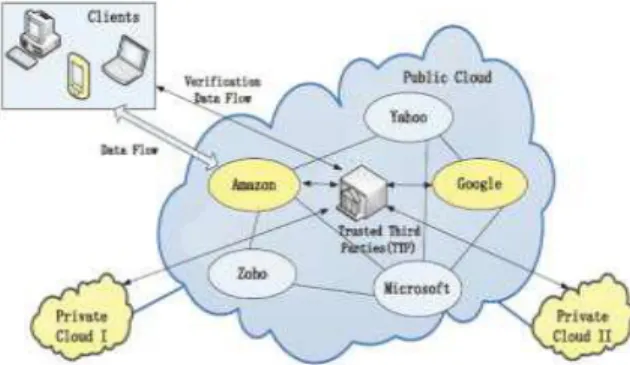
Fig. Proposed System Architecture
VII. Conclusion
We have presented a decentralized mathematical approach to optimally distribute virtual resources in the cloud amongst a set of users. This novel technique uses the notion of tail probabilities and sample complexity to design a randomized algorithm for optimal resource allocation. Moreover, we introduced a heuristic algorithm for the parallelization of the optimization process given the sometimes prohibitive number of iterations obtained from the sample complexity analysis. Security has been introduced as part of the virtual resources to be optimized. In which the duplicate-check tokens of files are generated by the private cloud server with private keys. Security analysis demonstrates that our schemes are secure in terms of insider and outsider attacks specified in the proposed security model. As a proof of concept, we implemented a prototype of our proposed authorized duplicate check scheme and conduct testbed experiments on our prototype. We showed that our authorized duplicate check scheme incurs minimal overhead compared to convergent encryption and network transfer.
References
[1] J. R. Douceur, A. Adya, W. J. Bolosky, D. Simon, and M. Theimer. Reclaiming space from duplicate
files in a serverless distributed file system. In ICDCS, pages 617–624, 2002.
[2] S. Halevi, D. Harnik, B. Pinkas, and A. Shulman-Peleg. Proofs of ownership in remote storage systems. In Y. Chen, G. Danezis, and V. Shmatikov, editors, ACM Conference on Computer and Communications Security, pages 491–500. ACM, 2011.
[3] M. Bellare, S. Keelveedhi, and T. Ristenpart. Messagelocked encryption and secure deduplication. In EUROCRYPT, pages 296–312, 2013.
[4] M. Bellare, C. Namprempre, and G. Neven. Security proofs for identity-based identification and signature schemes. J. Cryptology, 22(1):1–61, 2009.
[5] M. Bellare and A. Palacio. Gq and schnorr identification schemes: Proofs of security against impersonation under active and concurrent attacks. In CRYPTO, pages 162–177, 2002.
[6] M. Bellare and A. Palacio.Gq and schnorr identification schemes:Proofs of security against impersonation under active and concurrentattacks. In CRYPTO,2002.
[7] S. Bugiel, S. Nurnberger, A. Sadeghi, and T. Schneider.Twinclouds: An architecture for secure cloud computing.In Workshopon Cryptography and Security in Clouds (WCSC 2011), 2011.
[8] J. R. Douceur, A. Adya, W. J. Bolosky, D. Simon, and M. Theimer.Reclaiming space from duplicate files in a serverless distributedfile system. In ICDCS,
[9] D. Ferraiolo and R. Kuhn. Role-based access controls. In 15thNIST-NCSC National Computer Security Conf., 1992.
Authors
T Tejeswi completed her B.Tech (CSE), AITAM, Tekkali, Srikakulam, AP, India. She is pursuing M.tech in Sri Sivani College of engineering chilakapalem. Her areas of Interests are Cloud computing, Networking, Data base management system.