6
MINIMUM TREE ROUTING WITH SECURITY IN
WIRELESS SENSOR NETWORKS
J.SANTHOSH, Asst. Professor,
Department of computer Science, Sree Narayana Guru College of Arts & Science.
R.VIGNESH ANAND, M.PHIL SCHOLAR, Department of computer Science, Sree Narayana Guru college of arts & science.
ABSTRACT
First, we propose STR to resolve the main reasons of overall network performance degradation of ZTR, which are the detour path problem and the traffic concentration problem. Second, we prove that the 1-hop neighbor nodes used by STR improve the routing path efficiency and alleviate the traffic load concentrated on tree links in ZTR. Third, we analyze the performance of ZTR, STR, and AODV by differentiating the network conditions such as network density, ZigBee network constraints, traffic types, and the network traffic. For modification security purpose we are also encrypting the data packets during transmission. So that the intermediate nodes are not able to view the data during transmission. For Encryption process, we are using RC4 Algorithm. Short cut tree routing is used for minimizing the routing path from source to destination.
Keywords
Zigbee tree routing, Wireless network, Short cut Routing, RC4.
1. INTRODUCTION
The ZigBee network layer, which is the core of the standard, provides dynamic network formation, addressing, routing, and network management functions. ZigBee supports up to 64,000 devices in a network with the multihop tree and mesh topologies as well as star topology. Every node is assigned a unique 16-bit short address dynamically using either distributed addressing or stochastic addressing scheme. The routing protocols of ZigBee are diverse so that a system or users can choose the optimal routing strategy according to the applications. The reactive routing protocol in ZigBee is derived from AODVjr (AODV junior), which is one of the representative routing protocols in mobile ad hoc networks. Similar with other MANET routing protocols, ZigBee reactive routing protocol provides the optimal routing path for the arbitrary source and destination pair through the on-demand route discovery.
7
However, in ZTR, packets are forwarded along the tree topology to the destination even if the destination is located nearby. Thus, ZTR cannot provide the optimal routing path, while it does not require any route discovery overhead. Our objective is to provide the near optimal routing path like the reactive routing protocol as well as to maintain the advantages of ZTR such as no route discovery overhead and little memory consumption for the routing table. We propose the shortcut tree routing (STR) that significantly enhances the path efficiency of ZTR by only adding the 1-hop neighbor information. Whereas ZTR only uses tree links connecting the parent and child nodes, STR exploits the neighbor nodes by focusing that there exist the neighbor nodes shortcutting the tree routing path in the mesh topology.
In other words, in STR, a source or an intermediate node selects the next hop node having the smallest remaining tree hops to the destination regardless of whether it is a parent, one of children, or neighboring node. The routing path selection in STR is decided by individual node in a distributed manner, and STR is fully compatible with the ZigBee standard that applies the different routing strategies according to each node’s status. Also, it requires neither any additional cost nor change of the ZigBee standard including the creation and maintenance mechanism of 1-hop neighbor information.
2 RELATED WORKS
Among many useful functions in ZigBee network layer, the tree routing algorithm supports simple but reliable routing for any destination address. In ZigBee, network addresses are assigned using a distributed addressing scheme that is designed to provide every potential parent with a finite sub block of network addresses. Due to such addressing scheme, the network constructs a tree topology; each device can manage the address space of its descendant. If the destination address is in the address space that a node is
managing. Otherwise, it forwards the packet to its parent node. The parent or child node which receives the packet selects the next hop node according to the destination address in the same manner.
ZigBee network
8
3 OUR WORK
1) Tree routing algorithm
Every potential parent is provided with a finite sub-block of the address space, which is used to assign network addresses to its children. Given nwkmaxChildren (Cm), nwkcMaxDepth (Lm), and nwkmaxRouters (Rm), we can compute the function Cskip (d) as the size of the address sub-block distributed by each parent at depth d as follows:
For example, the kth router and nth end device shall be assigned the network address by their parent at depth d as in the following equation.
A kth router that has positive Cskip (d) can distribute address spaces to its child nodes. Since every device in the network is a descendant of the ZigBee coordinator and no device in the network is the descendant of any ZigBee end device, any device with address A at depth d has the destination device with address D if the following equation is satisfied.
A<D<A+ Cskip (d_1)
In tree routing, if the destination is a descendant, the device sends the data to one of its children; otherwise, it sends to its parent.
2) Neighbor table
Each device in ZigBee maintains a neighbor table which has all the neighbor information in the 1-hop transmission range. If users limit the size of the neighbor table, the selected numbers of neighbor entries are stored in the table. The contents for a neighbor entry are the network’s PAN identifier; node’s extended
address, network address, device type and relationship. Optionally, additional information such as beacon order, depth or permit joining can be included. Entries in the table are created when the node joins to an existing network. When a joining node requests a nlmenetwork- discovery, it receives response beacons from already joined nodes. The newly joined node stores neighbors’ information from the information contained in beacon packets.
Conversely, the neighbor entry is removed when the neighbor node leaves the network. Nodes can know this fact by receiving NLME-LEAVE. Indication messages. Since the information on the neighbor table is updated every time a device receives any frame from the some neighbor node, the information of the neighbor table can be said to be up-to-date all the time.
PROBLEM FORMULATION
9
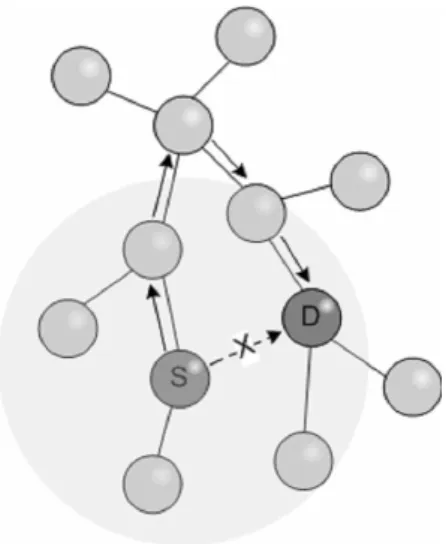
Fig. 1. Problem of Tree Routing
Fig. 2. Candidates for Next Hop
SHORTCUT TREE ROUTING ALGORITHM
We propose the shortcut tree routing algorithm that improves existing ZigBee tree routing by using the neighbor table. In other words, the proposed algorithm basically follows ZigBee tree routing algorithm, but chooses neighbor nodes as next hop nodes if the routing cost to the destination can be reduced. The neighbor table that we use in the proposed algorithm is defined in the ZigBee specification, so we don’t need to make an effort to search neighbor list. In order to choose the next hop node that can reduce the routing cost, the remaining
hop count from the next hop node to the destination is computed for all the neighbor nodes including parent and children nodes. As Fig. 2 shows, the remaining hops to the destination for each neighbor can be computed assuming that the route from the neighbor to the destination goes along the tree. In the above Fig.2, the route cost can be minimized if the sender transmits the data directly to the destination. Find_NextHopAddr() function described on table 1 is the algorithm for an intermediate or source node to select the next hop node which has the minimum remaining hop count for the given destination. Because the proposed algorithm follows fundamentally the ZigBee tree routing, the parent or child node is selected as the next hop node in lines 2-3. In addition, the remaining routing cost when we follow ZigBee tree routing is stored into minNHRouteCost. In line 4-13, intermediate or source nodes check the remaining routing cost myRouteCost when selecting a neighbor node as the next hop node. The remaining routing cost is calculated based on the remaining hop count to the destination assuming that the packet goes along the ZigBee tree routing. In order to calculate the remaining hop count, the hierarchical address structure is used.
Algorithm Implementation Steps
RC4
• A symmetric key encryption algo. Invented by Ron Rivest.
• Normally uses 64 bit and 128 bit key sizes. • Most popular implementation is in WEP for
802.11 wireless networks and in SSL.
• Cryptographically very strong yet very easy to implement.
• Consists of 2 parts: Key Scheduling Algorithm (KSA) & Pseudo-Random Generation Algorithm
10
• Read the file and xor each byte of the file with the corresponding keystream byte.
• Write this encrypted output to a file. • Transmit file over an insecure channel.
AODV Routing Protocol
The Ad-hoc On-demand Distance Vector (AODV) routing protocol is a routing protocol used for dynamic wireless networks where nodes can enter and leave the network at will. To find a route to a particular destination node, the source node broadcasts a RREQ to its immediate neighbors. If one of these neighbors has a route to the destination, then it replies back with a RREP. Otherwise the neighbors in turn rebroadcast the request. This continues until the RREQ hits the final destination or a node with a route to the destination. At that point a chain of RREP messages is sent back and the original source node finally has a route to the destination.
We proved that AODV protocol never produces routing loops by proving that a combination of sequence numbers and hop counts is monotonic along a route. This means that there can't be any loop in the routing table. The proof was done completely automatically and our algorithm was able to generate all the predicates needed. The Ad hoc On Demand Distance Vector (AODV) routing algorithm is a routing protocol designed for ad hoc mobile networks. AODV is capable of both unicast and multicast routing. It is an on demand algorithm, meaning that it builds routes between nodes only as desired by source nodes. It maintains these routes as long as they are needed by the sources. Additionally, AODV forms trees which connect multicast group members. The trees are composed of the group members and the nodes needed to connect the members. AODV uses sequence numbers to ensure the freshness of routes. It is loop-free, self-starting, and scales to large numbers of mobile nodes.
11
CONCLUSION
This paper introduces the problem of ZigBee tree routing and proposes a shortcut tree routing protocol that overcomes the overhead occurred when following the tree topology. In the proposed algorithm, the neighbor table that is originally defined in the ZigBee standard is used to find the optimal next hop node that has the smallest remaining hop count to the destination. The shortcut tree routing algorithm is efficient in terms of both routing performance and time complexity: it reduces significantly the required routing costs and it can be solved within polynomial time even when the number of neighbors is not limited. We have identified the detour path problem and traffic concentration problem of the ZTR. These are the fundamental problems of the general tree routing protocols, which cause the overall network performance degradation. To overcome these problems, we propose STR that uses the neighbor table, originally defined in the ZigBee standard. In STR, each node can find the optimal next hop node based on the remaining tree hops to the destination. The mathematical analyses prove that the 1-hop neighbor information in STR reduces the traffic load concentrated on the tree links as well as provides an efficient routing path. The network simulations show that STR provides the comparable routing performance to AODV as well as scalability respect to the network density and the network traffic volume by suppressing the additional route discovery process.
REFERENCES
[1] ZigBee Alliance, Network Layer Specification 1.0, Dec. 2004.
[2] ZigBee Alliance, www.ZigBee.org
[3] “Wireless Medium Access Control and Physical Layer Specifications for Low-Rate Wireless Personal Area Networks (LR-WPANs),” IEEE Std 802.15.4-2003, IEEE Computer Society, 01 October 2003.
[4] G. Ding, Z. Sahinoglu, P. Orlik, J. Zhang, and B. Bhargava, "Efficient and Reliable Broadcast in ZigBee Networks,” IEEE Transaction on Mobile Computing, IEEE SECON’05.
[5] D. Kim, Y. Doh, S. Yoo, K. Chang, W. Park, C. Seo, “Low Rate WPAN Technologies and Standards,” KISS Information and Communications Journal, Dec. 2004.
[6] J. Kim, H. Lee, D. Hwang, B. Kim,
“Development Trend of Standards for Low-Rate, Low-cost, and Low-Power Wireless PAN,“ Vol. 18, No. 2, pp. 37, ETRI trends, 2003.
[7] E. Callaway, P. Gorday, L. Hester, J. A. Gutierrez, and M. Naeve, “Home networking with IEEE 802.15.4: A developing standard for lowrate wireless personal area networks,”
IEEE Communications Magazine, page 70-77, August 2002.
[8] D. Han and J. Lim, “Smart Home Energy Management System Using IEEE 802.15.4 and ZigBee,” IEEE Trans. Consumer Electronics, vol. 56, no. 3, pp. 1403-1410, Oct. 2010. [9] S. Chen et al., “A Reliable Transmission