36
IMPLICATIONS OF MODERN BIOTECHNOLOGY IN THE FOOD
SECURITY AND FOOD SAFETY
Bonciu Elena1 and Sărac Ioan2
1
University of Craiova, Faculty of Agronomy, Department of Agricultural and Forestry Technology; e-mail: [email protected]
2Banat’s University of Agricultural Science and Veterinary Medicine „Regele Mihai I al
României”Timisoara, Faculty of Horticulture and Forestry, Genetic Engineering Department
Key words: biotechnology, food security, food safety
ABSTRACT
Unlike the old techniques of improvement, the modern biotechnology is much more precise and it acts quickly to improve the characteristics of the agricultural plants as raw material used for food products or to improve the food processing itself.
The agricultural biotechnologies contribute to ensure to food security and food safety through improve food quality and safety for the consumers, increasing of the variety of food available for human consumption, increasing of the production efficiency, processing and distribution of food; etc.
Due to the advanced scientific knowledge and due to control very carefully, the plants and food products obtained by the modern biotechnology may be even more secure than those produced by conventional breeding techniques.This is possibly because the characteristics that are transferred through the use of modern biotechnologies are predictable and the researchers in this field can better understand the changes that are induced, so they are better able to evaluate the safety of food.
In 2015, the countries that had the largest areas cultivated with biotech crops were USA, Brazil, Argentina, India, Canada and China and the main Biotech crops cultivated globally weresoybean, cotton, maize and canola. Biotechnology looks extremely promising in terms of increasing the amount of food available worldwide and improving the quality of such foods. The future must belong to the agricultural biotechnology,since it represents one of the most viable means by which to ensure the food security for a global population steadily increasing.
INTRODUCTION
The modern definition of biotechnology is the application of the techniques of molecular biology and/or recombinant DNA technology, or in vitro gene transfer (bioengineering), to develop products or impart specific capabilities to organisms (3).These modern molecular breeding methods are being applied by agricultural biotechnologists to introduce new crop varieties to which useful plant traits or characteristics are expressed (6).
37
MATERIALS AND METHODS
The study was aimed at highlighting the importance of modern biotechnologies for obtaining the raw material in agricultural farms and their importance for the food industry. It was made the radiography of the worldwide surfaces cultivated with biotech crops (GM) and their importance for food security and food safety. Also, it was tried explaining the full quality of food obtained through biotechnology.
For this study were consulted the latest statistics from biotechnology sector through of the various publications resource and web sites.
RESULTS
In order to improve the production characteristics and nutritional characteristics, for thousands of years the genetic map of plant has been modified by humans. The same thing happens now, but through modern biotechnology, much more accurate and faster. These changes have resulted in more resistant crops with higher yields and higher nutritional qualities.The modern biotechnology is perceived as an upgrade of the methods which have been used since ancient times to improve the characteristics of the agricultural plants and, in this context, to improve food quality.
Plant biotechnologies include two major directions, namely:
1. Microreproduction of plants and animals by genetic engineering techniques, somatic hybridization, selection, in vitro cultures, plant cell cultures and animals. Through these techniques can get intensive replication of seeds, plantlets or animals lines selected; 2. Improvement of plants and animals to obtain lines of highly productive, resistant to disease, pests and extreme weather conditions. Here is included the production of plants with increased rates of photosynthesis, plants resistant to low or high temperatures, to drought or to soil salinity. Can be also obtaining animals with increased production of meat, milk, eggs, wool, etc.Mutation breeding has been identified as a part of plant breeding and also a method for the creation of genetic diversity for further selection and hybridization (5). Subsequently, this will have a positive impact on food production of course.
The concerns of researchers to discover and improve the methods of manipulation of genetic material determined a revolutionary concept of creating new plant and animal genotypes. The genetic genius has helped to expand of knowledge of life processes, creating endless possibilities for direct intervention in the genetic material, with economic and social implications of the most promising, which can generate deep changes in agriculture.
The consumer needs a favorable living environment, unpolluted but in equal measure he needs healthy food.Food biotechnology employs the tools of modern genetics to enhance beneficial traits of plants, animals, and microorganisms for food production. It involves adding or extracting select genes to achieve desired traits. This modern technique will allow more food to be produced on less agricultural land; also, food biotechnology may contribute to combating global hunger and they are one of the most viable means by which to ensure the food security for a global population steadily increasing (the world population is expected to reach 9 billion by 2050).
38
Fig. 1. Global Area of Biotech Crops (millions hectares), 1996 to 2015 (4)
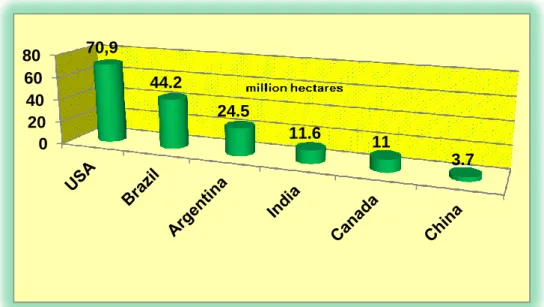
Biotech crops are cultivated for commercial purposes in all six continents of the world. In 2015, of the 28 countries who cultivate these new crops the most important in terms of the areas were USA, Brazil, Argentina, India, Canada and China (10).
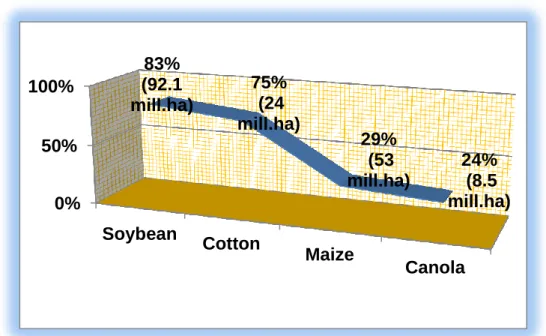
In terms of the share of the main Biotech crops from the total area cultivated globally, they were: soybean (83% or 92.1 million hectares), cotton (75% or 24 million hectares), maize (29% or 53 million hectares) and canola (24% or 8.5 million hectares) (10).
Fig. 2. The countries who cultivated the bigger surfaces with Biotech crops in 2015 (10) 0
50 100 150 200
1.7 mill.ha 44.2 mill.ha
90.0 mill.ha
148.0 mill.ha
179.7 mill.ha
0 20 40 60
80 70,9
44.2
24.5
11.6
11
39
Fig. 3. Share of the main Biotech crops from the total area cultivated globally (10)
In the long term, genetic engineering will help to increase production of the most valuable components of specific crops, to modify the amino acid composition of plant proteins in order to increase the nutritional value. Enzymes own to vegetal and animal tissues are essential in the transformations from the food products. With the help of enzymes used in food biotechnology, can improve the value of food products, can accelerate biochemical processes can improve production processes and can increase the degree of diversity in food production. By using enzymatic preparations, the traditional food technologies become biotechnology, becoming more efficient and less polluting.Biotechnology promises to bring important changes on the plant characteristics as well as livestock production. In both fields, it will affect all steps of the production chain, from agricultural inputs to final food processing.Furthermore, genetic engineering is an entirely organic procedure.
Nutritionally enhanced biotech food is currently a major area of research that has already produced a few promising products. Examples include cooking oils with unique fatty acid profiles and less than one percent trans fats and maize with higher concentrations of amino acids, certain oils and minerals ideal for animal feed. Furthermore, many products in development are being engineered to confer nutritional benefits, such as the new “golden rice” which contains added beta-carotene and iron. Scientists are conducting research on ways to make foods, such as soybean and peanuts, with fewer allergens by removing the offending proteins which cause the majority of allergic reactions in people.Future benefits include allergen modification through antisense/cosuppression techniques in plants with known allergens (7).
Many of the amino acid supplements, flavors, flavor enhancers and vitamins added to breakfast cereals are produced by microbial fermentation. Specialized high-purification systems remove all microbes prior to final food production. Biotechnology scientist’s years ago created a way for yeasts, molds and bacteria to produce chymosin, eliminating reliance on livestock for this enzyme (9). Consumers benefit by realizing foods with improved quality, processing characteristics, health, nutrition, enhanced nutritional value, better taste, and a wider variety of foods. Examples of foods with improvement qualities include delayed ripening of fruits (tomatoes), cholesterol-lowering margarines and oils, cereals with fortified minerals and vitamins, etc. (6).
0% 50% 100%
Soybean
Cotton
Maize
Canola 83%
(92.1 mill.ha)
75% (24 mill.ha)
29% (53 mill.ha)
40
An exceptional achievement is obtaining of transgenic plants that contain exogenous which can produce natural insecticides. The bacterium Bacillus thuringensis
contains 96 genes for delta endotoxins which are natural insecticides (Bt toxins), which act by perforating the intestinal of the parasitic insect larvae of various crop plants. The transfer of some of these genes in plants determines their resistance to insect concerned so it is not necessary to use an artificial insecticide, potentially harmful to human health. Another important achievement of modern biotechnology is the genetically modified potato to which has been transferred the Bacillus thuringiensis bacterium gene that destroys the Colorado beetle (Leptinotarsa decemlineata). The GM potato that received the genetic information from the Bt bacteria produces a toxin that kills the beetle when it starts to eat the potato leaves. In this way, there is no need of treatments with chemical insecticides to potatoes crop that could affect the health of consumers.
The introduction of crops produced through modern biotechnology has been a controversial topic in many countries.Scientific evidence supports the safety of meat, milk, and eggs derived from livestock raised on biotech feed (8).Similar conclusions were reached by the numerous other studies conducted by researchers from all over, including the study published by the Technical University (TU) of Munich, whereby cows fed with genetically modified maize (MON 810) give regular milk, identical to that obtained from the animals fed with conventional maize (11).
Also, in assessing how GE crops affect crop productivity, human health and the environment, the NAS - National Academies of Sciences (USA) study primarily focused on two traits that have been engineered into plants: resistance to insect pests and tolerance of herbicides.The study found that farmers who planted crops engineered to contain the insect-resistant trait - based on genes from the bacterium Bacillus thuringiensis, generally experienced fewer losses and applied fewer chemical insecticide sprays than farmers who planted non-Bt varieties. It also concluded that farms where Bt crops were planted had more insect biodiversity than farms where growers used broad-spectrum insecticides on conventional crops (12).
CONCLUSIONS
Biotechnology has tremendous potential for increasing food production and improving food processing. This modern method is proving its worth as a technology that can contribute to sustainable food industry development.The crops improved through biotechnology determines increased efficiency of world production, which would allow the fight against world hunger and ensuring food needs of a growing population. Therefore, in the context of food security, agricultural biotechnology may be the solution for solving the global food crisis and can have a positive impact on fighting hunger especially in poor countries.
In terms of food safety stands out the transgenic plants (raw material for food products) that contain exogenous which can produce natural insecticides and there is no need of the chemical treatments that could affect the health of consumers.
Nutritionally enhanced biotech food is currently a major area of research that has already produced promising products. Agricultural biotechnologies are expected to have a major role in the years to come. Anyway, already it became obvious the biotechnological revolution, which undoubtedly changed the image of the fundamental biological processes, and the results are downright spectacular.
BIBLIOGRAPHY
41
2. Bonea Dorina, Urechean Viorica, Soare Rodica,Bonciu Elena, 2014, The cross-pollination study between genetically modified and conventional corn crops in Romania. SGEM International multidisciplinary scientific Geoconferences, 14th GeoConference on Nano, Bio and Green-Technologies for a sustainable future, vol. I, p. 519-526, 17-26 june, Albena, Bulgaria.
3. Chassy BM, Abrahamson SH, Bridges A, Dyer WE, Faust MA, et al.,Evaluation of the US regulatory process for crops developed through biotechnology. Council for Agricultural Science and Technology. Available at: http://www.cast.science.org.
4.Clive James, 2015,20th Anniversary (1996 to 2015) of the Global Commercialization of Biotech Crops and Biotech Crop Highlights in 2015. ISAAA Brief No. 51. ISAAA: Ithaca, NY.
5. Iancu Paula, Soare M., Bonciu Elena, Soare Rodica, 2015, Variation of amino acids content to some irradiated groundnuts varieties. 15th International Multidisciplinary Scientific Geoconference SGEM, book 6 vol. 1, pp. 657-664.
6. Ricki M. Helm,, 2003, Food biotechnology: is this good or bad? Implications to allergic diseases. Ann Allergy Asthma Immunol. 2003;90(Suppl 3):90–98.
7. Shewry PR, Tatham AS, Halford NG., 2001,Genetic modification and plant food allergens: risks and benefits. J Chromatogr B Biomed Sci Appl. 2001;756:327–335.
8. http://www.authorstream.com/Presentation/guththila-422579-bio-technology
9. https://www.bio.org/articles/biotechnologys-impact-food-ingredients
10.http://www.isaaa.org/resources/publications/pocketk/16/
11.http://agrobiotechrom.ro/biotehnologia-in-agricultura-mit-si-realitate
12.