MANAGEMENT STYLE OF HOSPITALITY AND TOURISM
INSTITUTE
(A CASE STUDY OF THE INTERNATIONAL BALI TOURISM
INSTITUTE OF DENPASAR)
Ni Made Ayu Sulasmini. STPBI
Abstract
Understanding management style enables managers to recognize their strength and weakness. This recognition allows an arrangement of a precise development management program; this will boost management performances that should be a support in developing the quality of a school. This study aimed to assess the management style of the International Bali Tourism Institute (STPBI). STPBI is a school that offers a diploma program for the hospitality and tourism students. A self-assessment management style instrument (DiPadova, 1990 in Petrick and Quinn, 1997) was used. The study indicates that in average, the managers in STPBI are strong in the role of director, but very weak in the role of broker. The result of this research depicts the management of STPBI should focus on developing the broker and producer areas to enable a well-rounded management style.
Keywords: management style, hospitality and tourism institute
Introduction
Human resource is one of the prime aspects in elevating Indonesian economic condition. Based on a study on nation productivity by Chiang Kao, it is found out that in 1999 to 2001, Indonesia can be categorized into the high productivity cluster nation similar to Malaysia and Philippines. This productivity was generated from the labor productivity and the capital productivity among Southeast ASEAN countries. However, in 2013, the nation productivity is low in compared with other nations in ASEAN countries. With the number of productive people of 118.19 million in 2013, Indonesia occupied the two lowest level in the ASEAN. This is a fact that should initiate consideration by all elements nation.
Higher education in Indonesia should take the major role in developing the quality of human resources. The percentage of students attending the higher education is only 6 %, should be able to bring concern, not only in increasing the percentage of the students but also in its quality of the governance.
concerned to run its function in researching and delivering science and knowledge and maintaining the quality of education. Further, the higher education autonomy should accommodate the principle of good university governance.
Good university governance means focusing on the organization’s purposes and on outcomes for citizens and service users, performing effectively in clearly define function and roles, promoting values for the whole organization and demonstrating the values of good governance through behavior, taking informed, transparent decisions and management risk, developing the capacity and capability of the governing body to be effective, engaging stakeholders and making the accountability real (Chartered Institute of Public Accountancy, UK).
In the organization and governance aspect, most of the private higher education is managed by the foundation, with its main elements including the leader (director and vice directors) and the university senate. All elements are occupying specific function and are designed effectively based on the needs of the institution. A leader within this circumstances involves the aspect of academic and managerial.
Role of manager is closely tied to the management performance. Management is about people not systems; people coming together to achieve a clear objectives of their organization. Management can also be defined as the process of reaching organizational goals by working with and through human and non-human resources to continuously improve the value added to the world (Joseph a Petrick, John F Quinn, 1997). Whenever it is a puzzle, the management should be able to bring together the pieces of the puzzle into one shape. This is also a process that allowing management to know the function of each personnel to function well within the organization.
This research aimed at finding out the management style of structure in STPBI Organization. STPBI (the International Bali Tourism Institute) is a higher education on hospitality and tourism. The institution was established to accommodate the number of hospitality and tourism labor that grows rapidly following the progress of hospitality and tourism in Bali. Understanding the style of the management, can provide display the current management style and further to recommend a proper development management program.
Literature Review
strongly agree to strongly disagree and excellent to poor. Then, they analyzed the collected data using descriptive statistics and Pearson product moment correlation statistic. They found out that participative and paternalistic management styles were the predominant management styles in practice, the effectiveness of private enterprises were well above average, there was a relationship between management styles and organizational effectiveness. It was concluded that different management styles were adopted in the running of private enterprises depending on the characteristics inherent such firms.
A similar study on management styles and conflict resolution was conducted by Huan and Yazdanifard in 2012. Their work entitled “ The Difference of Conflict Management Styles and Conflict Resolution in Workplace” examinedconflict management styles and conflict resolution from the managers and supervisors’ point of view. They found out that conflict is an inevitable fact for any organization. They argue that leaders should understand and apply various conflict management techniques and conflict resolution styles in order to form strong relationships with subordinates. In their reserach paper they concluded conflict is a situation when two or more parties are in disagreement. Unresolved conflict can negatively impact the success of an organization. So, leaders must learn how to address and manage conflict depending on the situation and the party involved. While the internet has increased organizational performance, it has also added new types of conflict. Workplace conflicts may result in absenteeism and affect employee loyalty. Methodology
Since the study is aimed at assessing the management style of the managers in STPBI, the respondents were selected among managers level within STPBI organization. They were altogether 11 respondents. They were categorized into managers’ level due to the institution policy that assigning them in the weekly managerial meeting.
Management Style Assessment questionnaire (DiPadova, L in Petrick and Quinn, 1997) was used to determine the management profile of each manger. The average result of the management Style Assessment displays the position of STPBI management in 8 manager’s role including: 1) facilitator, 2) Mentor, 3) Innovator, 4) Broker, 5) Producer, 6) Director, 7) Coordinator, and 8) Monitor. Each role displays competency within the management. The broker obtains resources for the unit and the innovator identifies and facilitates adaptation. The producer motives people to take actions and the director clarifies expectations and establishes objectives. The monitor ensures compliance, tracks progress, and analyses results meanwhile the coordinator maintains order, structure, and flow of the system. The mentor engages in the development of people with care and empathy, while the facilitator fosters collective effort to build trust, cohesion and teamwork.
manager’s role. The average score of every role displayed the management profile of STPBI.
Results and Discussion
The typical manager was male with master degree of management, education and tourism discipline. On the average, managers had been employed at their current position for more than 6 years, while the institute has been established for 8 years, indicating that the respondents are not newcomers in their positions.
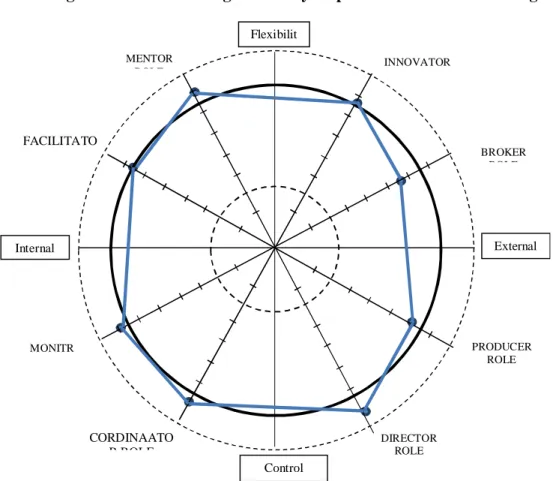
On the scale of 1 to 7, managers in this study scored themselves above middle point for all eight roles. Among the 11 managers, the average lowest score is in the role of broker (4.93). The second lowest score are found in the roles of innovator (5.48) and coordinator (5.48). Meanwhile, the highest score is in the role of director (5.8). The average managers’ scores can be seen in the following table:
Table 1 The average role competency score Respond
ent
ROLE Facilita tor
Ment or
Innova tor
Brok er
Produ cer
Direct or
Coordin ator
Monit or
1 6.2 6.52 5.75 5 6.8 6.2 5.8 6
2 7 7 7 3 7 7 7 7
3 6 5.25 5.5 3.75 5.6 6.2 5.4 6.25
4 7 5.75 6.75 6.75 6.6. 7 6.4 6.25
5 6.8 6.75 7 6.25 6.8 6.8 6.6 6.75
6 3.6 5 4 3.25 4.6 4.2 4.6 4.25
7 4.6 5.5 5.75 5.5 5.4 5.8 5.4 5.25
8 4.4 5.75 5.5 4.25 5.2 6 5 4.75
9 5.2 6.5 6 4.75 5.6 5.8 5.8 5.5
10 6 6.25 5.25 5.75 6.4 6 6.4 6.5
11 5 6 5.75 6 5.6 5.8 5.8 5.75
Average 5.62 6.02 5.84 4.93 5.36 6.07 5.84 5.84
Based on the result of the questionnaire, the managers’ style of STPBI should focus to the development of broker roles, since the area is found to obtain the lowest score.Quinn et al (2003) further associate this role into competency skill. Role of broker can be developed into key competencies of building and maintaining a power base, negotiating agreement and commitment and presenting ideas. Since the effectiveness of broker’s role is managing continues improvement, this role should be further be considered in the development program of STPBI management.
lead into effectiveness in managing competitiveness, managing employees and managing Customer Service.
Quinn (1988) in Parker (2004) suggests good managers will achieve balance in executing eight roles. Further, within the profile of STPBI Management, there are over developed areas displayed in the management style figure namely roles of director, coordinator, monitor, mentor, and facilitator, as seen in figure 1. This indicates effectiveness of STPBI Management inmanaging competitiveness, employees, customer service, acculturation, control system, coordination, team, interpersonal relationships and development of others. Although, there is no underdeveloped area in the STPBI management style profile, the development program is indicated to be developed in the roles of Broker and producer since the two roles constitute the lowest level in the management profile of STPBI. This is to recommend to create a well-rounded manager style.
Figure 1. The management style profile of STPBI managers
Based on the findings stated above can be concluded that a well-rounded management profile was significant in creating an effective management. This can be achieved by identifying the current profile of management. The profile can be reference in developing a proper management development program based on the gap competency required.
Flexibilit
Internal External
Control
PRODUCER ROLE
DIRECTOR ROLE
BROKER ROLE INNOVATOR
MENTOR ROLE
FACILITATO R ROLE
MONITR ROLE
STPBI management style profile displays weakness area in the roles of broker and the strength in the areas of director, within the eight roles of mangers. There is no under developed roles, moreover, a wee-developed areas are displayed in the role of director, coordinator, mentor, facilitator, monitor, and innovator. Further research is recommended to link this profile into a proper management development program.
REFERENCES
Parker, L. Kimberly, 2004. Leadership Style of Agricultural Communications and Information Technology Managers: What Does the Competing Values Framework Tell Us About Them? 42 (1) available at: http://www.joe.org/joe/2004february/a1.php
Trivellas, Panagiotis, Reklitis, Panagiotis, 2014. Leadership Competencies Profiles and Managerial Effectiveness in Greece.Procedia Economics and Finance 9, 380-390. Available at: www.sciencedirect.com
Uche C, Nwadukwe&Timinepere, Court Ogele, 2012. Management Styles and Organizational Effectiveness: An appraisal of Private Enterprises in Eastern Nigeria. American International Journal of Contemporary Research 9 (2) Huan, Jin Lim &Yazdanifard, 2012.The Differences of Conflict Management
Styles and Conflict Resolution in Workplace. Business & Entrepreneurship Journal 1 (1), 141-155