ISSN: 1311-1728 (printed version); ISSN: 1314-8060 (on-line version) doi:http://dx.doi.org/10.12732/ijam.v32i6.5
EXTREMAL HYPER ZAGREB INDEX FOR TRICYCLIC GRAPHS
Zheng-Qing Chu1, Muhammad Kamran Jamil2§ Aisha Javed3
1Department of General Education Anhui Xinhua University, Hefei 230088, CHINA
2Department of Mathematics
Riphah Institute of Computing and Applied Sciences Riphah International University, Lahore, PAKISTAN
3Abdus Salam School of Mathematical Sciences Government College University, Lahore, PAKISTAN
Abstract: For a graph G = (V(G), E(G)), the first hyper Zagreb index is defined as P
uv∈E(G)(d(u) +d(v))2, where d(v) is the degree of the vertex v. The hyper Zagreb index is a kind of extensions of Zagreb index. In this paper, the monotonicity of the hyper Zagreb index under some graph transformations was studied. Using these mathematical properties, the extremal graph among tricyclic graphs are determined for hyper Zagreb index. Moreover, the sharp upper and lower bounds on the hyper Zagreb index of tricyclic graphs are provided.
AMS Subject Classification: 05C07, 05C35, 05C40
Key Words: graph transformation; tricyclic graphs; hyper Zagreb index
1. Introduction
LetG be a simple, finite and connected graph, with vertex setV and edge set
E. In a graph G the number of element in V and E is called the order and
size, respectively, of G. For a vertex v ∈V(G), the degree of v is the number of vertices attached to the vertexv and denoted asd(v).
Received: June 17, 2019 c 2019 Academic Publications
Atopological index of a graphGis a numerical quantity that associated to the graph Gwith the property that all the graphs isomorphic to G have same quantity. Thefirst and second Zagrebindex of a graph Gis defined as:
M1(G) = X
v∈V
d(v)2 , M2(G) = X
uv∈E
d(u)d(v).
In 1972, these topological indices appeared for the first time to find the total π−energy of molecular graphs [9]. Later, the Zagreb indices developed significant applications in QSPR/QSAR studies and a lot of research paper have been published on these, see [1, 2, 3, 4, 5, 6].
In 2013 Shirdel and co-authors [10] proposed a new version of Zagreb indices called hyper Zagreb index HM1. The hyper-Zagreb index is for a graph G defined as:
HM1(G) = X
e∈E
d(e)2,
where d(e) = d(u) +d(v) for the edge e = uv. Recently, in 2016 Jamil et al. introduced another version of hyper Zagreb index named as second-hyper Zagreb index, defined as
HM2(G) = X
e∼f
d(e)d(f),
wheree∼f represents that the edgeseand f have a common vertex.
Recent results on the hyper Zagreb indices can be seen in [7, 8, 11, 12, 13, 14, 15].
We now define some notations which will use in later. Let Υn denotes the set of all connected tricyclic graphs with order n. For a tricyclic graph, the graph which is attained by removing its all pendent vertices is named as a
brace of the graph. Denote by Υ0n the set of all braces of tricyclic graphs as depicted in Fig. 6. Let Υ1n and Υ2n denote the sets of tricyclic graphs shown in Figs. 5 and 7, respectively.
2. Methods and definitions
In this section, we introduced some graph transformations, with the help of these transformations we will investigate the extremal graphs with the first hyper-Zagreb index in the set of all connected tricyclic graphs. First we intro-duced the transformations which strictly increases the first hyper-Zagreb index of a graph.
Transformation 1. Letuvbe an edge of connected graphGwithdG(v)≥ 2. Assume that {v, w1, w2, . . . , wt} are all the adjacent to the vertex u while
w1, w2, . . . , wt are pendant vertices. If
K =G− {uw1, uw2,· · · , uwt}+{vw1, vw2,· · ·, vwt},
we say that K is attained from Gby Transformation 1. As shown in Fig. 1.
Figure 1: Transformation 1.
Transformation 1 strictly increases theHM1 of a graph.
Lemma 1. ([8]) IfK is attained fromGby Transformation 1 as depicted in Fig. 1, then
HM1(G)< HM1(K).
Proof. Clearly, dG(v) < dK(v) and (d(u) + d(v)) is not changed during Transformation 1. Hence,
HM1(K)−HM1(G)>(t+ 1)(dG(v) +t+ 1)2−(dG(v) +dG(u))2
−t(dG(u) + 1)2
=(t+ 1)(dG(v) +t+ 1)2−(dG(v) +t+ 1)2
−t(t+ 2)2
Transformation 2. Let G be nontrivial connected graph and u, v ∈
V(G). Let Pa = (u =)v1v2· · ·va(= v) is a nontrivial a-length path of G con-necting vertices u and v. If K = G− {v1v2, v2v3,· · · , va−1va}+{(u +v = )wv1, wv2,· · · , wva}, we say that K is attained from G by Transformation 2. As, shown in Fig. 2.
Figure 2: Transformation 2.
Lemma 2. ([8]) IfK is obtained fromGby Transformation 2 as depicted in Fig. 2, then
HM1(K)> HM1(G).
Proof. From Fig. 2, let dG1(u) =xand dG2(v) =y whilew=u+v(merge
u and v to obtain w) withdK(w) =x+y+a−1, wherea≥2. Ifa= 2,
HM1(K)−HM1(G)>(x+y+ 2−1 + 1)2−(x+y+ 2)2 = 0.
Ifa≥3,
HM1(K)−HM1(G)>(a−1)(x+y+a−1 + 1)2−(x+ 3)2
−(y+ 3)2+ 16(a−3)
=(a−1)(x+y+a)2−(x+ 3)2−(y+ 3)2
−16(a−3)
>(x+y+a)2−(x+ 3)2+ (x+y+a)2
−(y+ 3)>0.
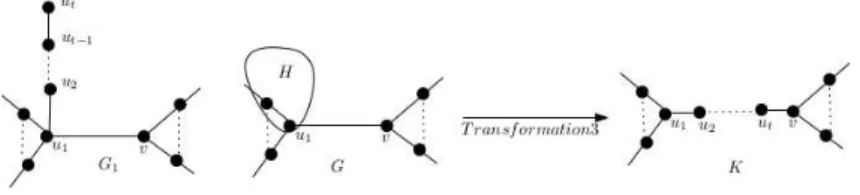
Transformation 3. Let H be a nontrivial acyclic subgraph of G with
Figure 3: Transformation 3.
different from inH. IfK =G−(H−u1) +u1u2+u2u3+· · ·+utv, we say that
K is obtained fromGby Transformation 3. As shown in Fig. 3.
Lemma 3. LetG and K be graphs, as depicted in Fig. 3, then
HM1(G)> HM1(K).
Proof. From Transformation 1 we knowHM1(G)≥HM1(G1). So, we only prove the following inequality:
HM1(G1)> HM1(K).
By definition ofHM1,
HM1(G1)−HM1(K) =(dG1(ut−1) +dG1(ut))
2 + (dG1(u1) +dG1(u2))
2 + (dG1(u1) +dG1(v))
2
−(dK(ut−1) +dK(ut))2
−(dK(ut) +dK(v))2
−(dK(u1) +dK(u2))2 =(dG1(u1) + 2)
2+ (d
G1(u1) +dG1(v))
2
−(dG1(u1) + 1)
2−(d
G1(v) + 2)
2−7>0.
This completes the proof.
Let G be a nontrivial connected graph. Two vertices u and v are said to be equivalent, if G−u∼=G−v. Clearly, |N(u)|=|N(v)|and their neighbors have the same degree sequence.
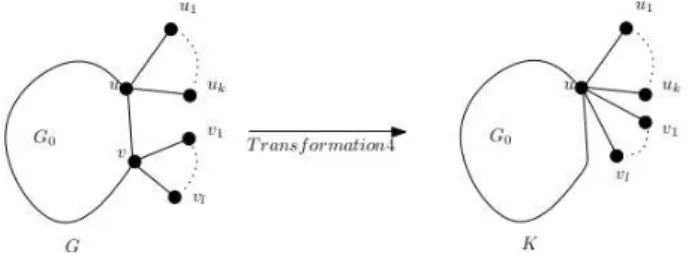
Gbe the graph obtained by attachingSk+1 and Sl+1 at the verticesu andv of
G0, respectively. IfK is the graph attained by removing thelpendent vertices at v inG and connecting them tou of G, as shown in Fig. 4. We say that K
is obtained fromG by Transformation 4.
Figure 4: Transformation 4.
Lemma 4. If K is attained from G by Transformation 4 as depicted in Fig. 4, then
HM1(G)< HM1(K).
Proof. Since, dG
0(u) = x, dG0(v) = y and NG0(v) ⊆ NG0(u). So by the
definition ofHM1,
HM1(K)−HM1(G) = k X
i=1
d2K(uui)−d2G(uui) + l X i=1
d2K(uvi)−d2G(vvi)
+ X
w∈NG0(v)
d2K(uw) +d2K(vw)
− X
w∈NG0(v)
d2G(uw) +d2G(vw)
= (k+l)(k+l+x)2−k(k+x)2−l(l+y)2
+ X
w∈NG0(v)
(k+l+x−dG0(w))
2+ (y+d G0(w))
2
X
w∈NG0(v)
(k+x+dG0(w))
+ (l+y+dG0(w))
2
>2l(k+x−y)>0.
This completes the proof.
3. Results and discussion
In this section, we found the extremal graph for the first hyper Zagreb index
HM1 among all tricyclic graphs. To obtain the required result we will use the above discussed transformations.
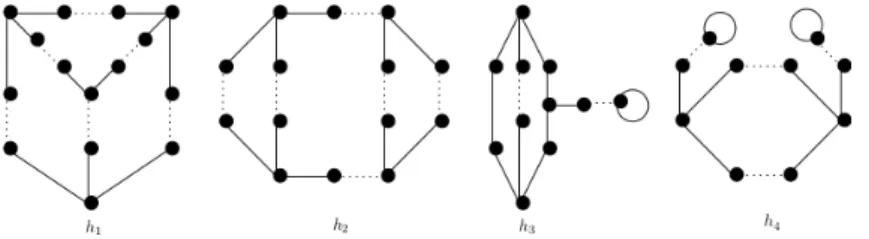
Figure 5: Thehi graphs in Υ1n.
Theorem 5. Let G be any tricyclic graph with n vertices, then 16n+ 140≤HM1(G),
where the equality holds if and only ifG∈Υ1n.
Proof. Let Gbe a connected tricyclic graph. By Lemma 2, Gcan be con-verted to the one of the fifteen braces shown in Fig. 6. Meanwhile, for every graph G there exists a graph gi ∈ Υ0n, where i ≤ 15, such that HM1(gi) ≤
HM1(G) by 3. Clearly,
HM1(hi) = 16n+ 140, for i= 1,2,3,4,5.
So, the proof is completed.
Theorem 6. Let Gbe a tricyclic graph of ordern. Then
HM1(G)≤n3−n2+ 12n+ 120,
where the equality holds if and only ifG∼=Snn+2 or SK4
Figure 6: The gi graphs in Υ0n
Figure 7: Some graphs.
Proof. For tricyclic graphG with given orderncan be transformed to the one of the five graphs shown in Fig. 5 by repeated Transformation 2I and Transformation 4. In other words, for any tricyclic graphGwith given ordern
there exists ki ∈Υ2n, where i≤6 such that HM1(G)≤HM1(gi) by Lemmas 2 and 4. Notice that,
HM1(k1) =n3−n2+ 12n+ 96,
HM1(k2) =n3−n2+ 12n+ 74,
HM1(k3) =n3−n2+ 12n+ 54,
HM1(k4) =n3−13n2+ 68n+ 130,
HM1(Snn+2) =n3−n2+ 12n+ 120,
Acknowledgements
The authors would like to express their sincere gratitude to the Natural Science Foundation for the Higher Education Institutions of Anhui Province of China (nos. KJ2019A0875 and KJ2019A0876), the Quality Engineering Projects of Anhui Xinhua University of China (no. 2017jxtdx05).
References
[1] B. Bollob`as, P. Erd¨os, Graphs of extremal weights,Ars Combin.,50(1998), 225-233.
[2] J. Devillers, A.T. Balaban (Eds.), Topologicial Indices and Related De-scriptors in QSAR and QSPR, Gordon and Breach, Amsterdam (1999).
[3] I. Gutman, K.C. Das, The first Zagreb index 30 years after, MATCH Commun. Math. Comput. Chem.,50(2004), 83-92.
[4] K.C. Das, I. Gutman, Some properties of of the second Zagreb index,
MATCH Commun. Math. Comput. Chem.,52(2004), 103-112.
[5] Y. Gao, M. Imran, M.R. Farahani, H.M.A. Siddiqui, Some connectivity indices and Zagreb index of honeycomb graphs,Int. J. Pharm. Sci. Res., 9, No 5 (2018), 2080-2087.
[6] I. Gutman, M.K. Jamil, N. Akhter, Graphs with fixed number of pendent vertices and first Zagreb index,Trans. on Combinatorics, 4(2015), 43-48. [7] W. Gao, M.K. Jamil, M.R. Farahani, The hyper Zagreb index and some
graph operations,J. Appl. Math. Comput., 54, No 1-2 (2017), 263-275. [8] W. Gao, M.K. Jamil, A. Javed, M.R. Farahani, S. Wang, J.B. Liu,
Sharp bounds of the hyper-Zagreb index on acylic, unicyclic and bicyclic graphs,Discrete Dynamics in Nature and Society,2017 (2017), Article ID 6079450, 5 pp.; DOI: doi.org/10.1155/2017/6079450.
[9] I. Gutman, N. Tirnajsti`c, Graph theory and molecular orbitals. III. Total
pi-electron energy bydrocarbons,Chem. Phys. Lett.,17 (1972), 535-538. [10] G.H. Shirdel, H. Rezapor, A.M. Sayadi, The hyper-Zagreb index of graph
[11] M.R. Farahani, The hyper-Zagreb index of Benzenoid series, Frontiers of Mathematics and Its Applications,2, No 1 (2015), 1-5.
[12] W. Gao, M.R. Farahani, The hyper-Zagreb index for an infinite family of nanostar dendrime, J. of Discrete Mathematical Sciences and Cryptogra-phy,20), No 2 (2017), 515-523.
[13] M.R. Farahani, W. Gao, M.R.R. Kanna, P.R. Kumar, J.B. Liu, General Randic, sum-connectivity, hyper-Zagreb and harmonic indices, and har-monic polynomial of molecular graphs, Advances in Physical Chemistry, 2016 (2016), Article ID 2315949, 6 pp., doi: 10.1155/2016/2315949. [14] M. Rezaei, W. Gao, M.K. Siddiqui, M.R. Farahani, Computing hyper
Za-greb index and mpolynomials of titania nanotubesT io2[m, n],Sigma J. of
Engineering and Natural Sci.,35, No 4 (2017), 707-714.