Protection Tolerate Access Manipulate Procedure for
Relational Data
Kartheek Ravula#1, Uthpala.B#2
#1Student of M.Tech (CSE) and Department of Computer Science Engineering,
#2 Assistant Professor in Computer Science & Engineering Department , Chirala Engineering College,
Abstract:
In general, security is accomplished at the expense of accuracy of approved information. In this paper, we propose a productive access control strategy. I this technique for anonymization calculations and show experimentation that the proposed methodology fulfills imprecision limits for more authorisation. Information security issues square measure more transforming into indispensable for a few applications. Access administration instruments offer insurance to our touchy business data from undesirable client. Asset and data sharing is extra and essential piece of our day by day life and business. Basically investigation inside of the information preparing or data mining with sub space of data security is inexactly arranged into access administration examination and information protection investigation. Each assumes fundamental part in data security thereupon we've coordinated these techniques to support our security on relative data. Abuse security defensive component we will sum up and smother our relative data to anonymize and fulfill protection needs against character and characteristic discourse act. We've not exclusively aggregate these procedures anyway we've conjointly given further security by abuse encryption that wasn't blessing in past framework.
I. Introduction:
Information protection issues are getting dynamically key for our general public. This can be demonstrated by the very actuality that the responsible administration of delicate information is explicitly being ordered through laws like the Sarbanes-Oaxley Act and consequently the protection versatility and answerability Act (HIPAA) [3]. Defensive individual security is an essential drawback. Access administration components region unit acclimated verify that exclusively endorsed information is possible to clients. Nonetheless, delicate information will at present be illused by affirmed clients to trade off the protection of customers. Databases inside of the globe territory unit normally gigantic and advanced. The test of questioning such imbue in an auspicious manner has been contemplated by the
accessible to the entrance control component. The consents in the entrance control arrangement are in view of choice predicates on the QI properties. The arrangement manager characterizes the consents alongside the imprecision destined for every consent/question, client to-part assignments, and part to authorization assignments [7].The imprecision bound data is not imparted to the clients in light of the fact that knowing the imprecision bound can bring about damaging the protection prerequisite. The protection security system is obliged to meet the security prerequisite alongside the imprecision headed for every authorization.
While Accessing data from database, the idea of imprecision bound is presented in every entrance from database to take care of the issue of where insignificant level of resilience is characterized for every entrance question. Present workload mindful anonymization strategies minimize the imprecision total for all question/consent. The idea of fulfilling the precision limitation for individual authorizations in an approach or workload has not been mulled over some time recently. Exactness compelled protection protecting access control component significant in the workload–aware anonymization. The idea of nonstop information distributed has been additionally examined. Numerous entrance control components are there to manage social database. Part based Access Control that permits characterizing authorization on item in view of parts in an association.
II. Related work:
Access control instruments for databases permit inquiries just on the approved piece of the database. Predicate based fine-grained access control has further been proposed, where client approval is constrained to predefined predicates. Implementation of access control and protection strategies has been considered. Notwithstanding, considering the communication between the entrance control systems and the security assurance components has been missing. As of late, Chaudhuri et al. have contemplated access control with protection systems. They utilize the meaning of differential protection whereby irregular clamor is added to unique question results to fulfill security imperatives. They have not considered the exactness limitations for authorizations. We characterize the security necessity regarding k-namelessness. It has been demonstrated by Li et al. [6] that subsequent to inspecting, k-obscurity offers comparable protection ensures as those of differential security. The proposed exactness obliged protection safeguarding access control structure permits the entrance control chairman to indicate imprecision requirements that the security assurance instrument is obliged to meet alongside
the security prerequisites. The difficulties of security mindful access control are like the issue of workload-mindful anonymization. In our examination of the related work, we concentrate on question mindful anonymization. For the cutting edge in k-secrecy systems and calculations, we allude the peruser to a late study paper [3]. Workload-mindful anonymization is initially concentrated on by LeFevre et al. [5] They have proposed the Selection Mondrian calculation [4], which is an alteration to the avaricious multidimensional dividing calculation Mondrian. In their calculation, in view of the given inquiry workload, the ravenous part heuristic minimizes the whole of imprecision for all questions. Iwuchukwu and Naughton have proposed a Rþ-tree based anonymization calculation. The creators outline by trials that anonymized information utilizing one-sided Rþ-tree in view of the given inquiry workload is more precise for those inquiries than for a fair-minded calculation. Ghinita et al. have proposed calculations in view of space filling bends for k-namelessness and l-differences [10]. They likewise present the issue of exactness obliged anonymization for a given bound of satisfactory data misfortune for every comparability class [8]. Correspondingly, Xiao et al. [9] propose to add clamor to inquiries as indicated by the measure of the questions in an offered workload to fulfill differential protection. Limits for inquiry imprecision have not been considered. The current writing on workload-mindful anonymization has a center to minimize the general imprecision for a given arrangement of inquiries. Anonymization with imprecision limitations for individual inquiries has not been examined some time recently. We take after the imprecision meaning of LeFevre et al.and present the requirement of imprecision headed for every inquiry in a given question work.
III. Problem statement:
workload-based anonymization. The Top Down Selection Mondrian (TDSM) algorithm is constructed using greedy heuristics and kd-tree model. Query cuts are selected with minimum bounds in Top-Down Heuristic 1 algorithm (TDH1). The query bounds are updated as the partitions are added to the output in Top-Down Heuristic 2 algorithm (TDH2). The cost of reduced precision in the query results is used in Top-Down Heuristic 3 algorithm (TDH3). Repartitioning algorithm is used to reduce the total imprecision for the queries.
The following problems are identified from the existing system:
• Static data based access control model • Cell level access control is not supported
• Imprecision bound estimation is not optimized • Fixed access control policy model
IV. Privacy-preserving access control model for relational data
Organizations collect and analyze consumer data to improve their services. Access Control Mechanisms (ACM) is used to ensure that only authorized information is available to users. Sensitive information can still be misused by authorized users to compromise the privacy of consumers. The concept of privacy-preservation for sensitive data can require the enforcement of privacy policies or the protection against identity disclosure by satisfying some privacy requirements. In this paper, we investigate privacy-preservation from the anonymity aspect.
The sensitive information, even after the removal of identifying attributes, is still susceptible to linking attacks by the authorized users. This problem has been studied extensively in the area of micro data publishing [3] and privacy definitions, e.g., k-anonymity, l-diversity and variance diversity. Anonymization algorithms use suppression and generalization of records to satisfy privacy requirements with minimal distortion of micro data. The anonymity techniques can be used with an access control mechanism to ensure both security and privacy of the sensitive information. The privacy is achieved at the cost of accuracy and imprecision is introduced in the authorized information under an access control policy.
We use the concept of imprecision bound for each permission to define a threshold on the amount of imprecision that can be tolerated. Existing workload aware anonymization techniques [5] minimize the imprecision aggregate for all queries and the imprecision added to each permission/query in the anonymized micro data is not known. Making the privacy requirement more
stringent results in additional imprecision for queries. The problem of satisfying accuracy constraints for individual permissions in a policy/workload has not been studied before. The heuristics proposed in this paper for accuracy-constrained privacy-preserving access control are also relevant in the context of workloadaware anonymization.
The anonymization for continuous data publishing has been studied in literature [3]. In this paper the focus is on a static relational table that is anonymized only once. To exemplify our approach, role-based access control is assumed. The concept of accuracy constraints for permissions can be applied to any privacy-preserving security policy, e.g., discretionary access control.
Example 1 (Motivating Scenario). Syndromic surveillance systems are used at the state and federal levels to detect and monitor threats to public health [7]. The department of health in a state collects the emergency symptoms, etc from county hospitals daily. Generally, each daily update consists of a static instance that is classified into syndrome categories by the department of health. Then, the surveillance data is anonymized and shared with departments of health at each county.
An access control policy that allows the roles to access the tuples under the authorized predicate, e.g., Role CE1 can access tuples under Permission P1. The epidemiologists at the state and county level suggest community containment measures, e.g., isolation or quarantine according to the number of persons infected in case of a flu outbreak. According to the population density in a county, an epidemiologist can advise isolation if the number of persons reported with influenza are greater than 1,000 and quarantine if that number is greater than 3,000 in a single day.
Fig 1: Accuracy-constrained privacy-preserving access control mechanism.
V. Experimental evaluation
The system is implemented in dreamweaver8 with JSP support. Tomcat server is used as application server and mySQL as backend database. The section describes about the experimental evaluation done in a medical dataset. The privacy preserving access control model and the multilevel access control model are used to show the experimental results. The fig. 3 shows the experimental result. The fig 3 shows that the number of tuples retrieved by the query given is increased with the increase in the predicates of the query. The blue line shows the number of tuples retrieved when the number of predicate is one, two, and three with three predicates in privacy preserving access control module. The red line shows the number of tuples retrieved by the queries with multiple predicates in multilevel access control model. It clearly shows that the proposed method performs better than the previous methods in terms if number of tuples retrieved.
FIG. Experimental results on number of query predicates and number of tuples retrieved
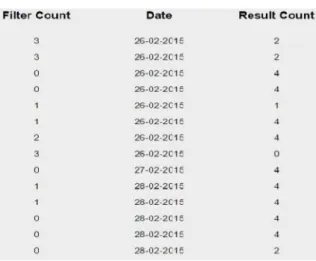
Fig . History of search in February
VI. Heuristics for partitioning
bound only and these queries are added to the Candidate Query set (CQ), while all queries satisfying the bounds are added to the query set SQ. The output partitions are all the leaf nodes in the kd-tree. For repartitioning, it only considers those pairs of partitions from the output that are siblings in the kd-tree and have imprecision greater than zero for the queries in the candidate query set.
VII. Conclusion:
The proposed system proposes an accuracy-constrained privacy-preserving access control framework for relational data has been proposed. The framework is a combination of access control and privacy protection mechanisms. The access control mechanism allows only authorized query predicates on sensitive data. The privacy preserving module anonymizes the data to meet privacy requirements and imprecision constraints on predicates set by the access control mechanism. The proposed system proposes the application specific anonymization.
Future Work
The proposed system plan to extend the proposed privacy-preserving access control to incremental data and cell level access control.
VIII. References:
[1] Bertino E. and Sandhu .(2005),“Database
Security-ConceptsApproaches, and allenges,”IEEE
Trans.Dependable and Secure Computing, vol. 2, no. 1, pp. 2-19.
[2] Chaudhuri S. et al (2011), “Database Access
Control & Privacy: Is There a Common Ground?”
Proc. Fifth Bien- nial Conf. Innovative Data Systems Research (CIDR), pp. 96-103.
[3] Fung B. et al (2010), “Privacy-Preserving Data
Publishing: A Survey of Recent evelopments,”
ACM Computing Surveys, vol. 42, no. 4, article 14, 2010.
[4] Ghinita G. et al (2009),“A Framework for
Efficient Data Anonymization Under Privacy and
Accuracy Constraints,”ACM Trans. Database
Systems, vol. 34, no. 2, article 9.
[5] Li N. et al (2011), “Provably Private Data
Anonymiza- tion: Or, k-Anonymity Meets
Differential Privacy,” Arxiv preprint
arXiv:1101.2604.
[6] LeFevre K. et al (2008), “WorkloadAware
Anonymization Techniques for Large-Scale
Datasets,” ACM Trans. Database Systems, vol. 33,
no. 3, pp. 1-47. [7] Rizvi S. et al (2004),
“Extending Query Rewriting Techniques for Fine
-Grained Access Control,” Proc. ACM SIGMOD Int’l Conf. Management of Data, pp. 551-562. [8]
ZahidPervaiz and Walid G. Aref (2014), “Accuracy
- Constrained Privacy-Preserving Access Control Mechanism for Relational Data” IEEE
Transactions On Knowledge And Data
Engineering, Vol. 26, No. 4. [9] S. Chaudhuri, T.
Dutta, and S. Sudarshan, “Fine Grained Authori
-zation through Predicated Grants,” Proc. IEEE 23rd Int’l Conf. Data Eng., pp. 1174-1183, 2007. [10] K.
Browder and M. Davidson, “The Virtual Private Database in oracle9ir2,” Oracle Technical White
Paper, vol. 500, 2002. Authors:
KartheekRavula, Presently pursuing his M.Tech in Computer Science & Engineering from Chirala Engineering College, Chirala, Prakasam District, A.P, India. Affiliated to Jawaharlal Nehru Technological University, Kakinada. Approved by AICTE, New Delhi. His B.Tech completed at VRS & YRN College of Engineering & Technology, Chirala, Prakasam District, A.P, India.