Quick Start Guide
Media Server
NSA Series
Version 4.60
Edition 1
Media Server User’s Guide
2
IMPORTANT!
READ CAREFULLY BEFORE USE.
KEEP THIS GUIDE FOR FUTURE REFERENCE.
Screenshots and graphics in this book may differ slightly from your product due to differences in your product firmware or your computer operating system. Every effort has been made to ensure that the information in this manual is accurate.
Related Documentation
• Quick Start GuideThe Quick Start Guide shows how to connect the NSA and get up and running right away. • Web Configurator Online Help
The embedded Web Help contains descriptions of individual screens and supplementary information.
Contents Overview
Contents Overview
User’s Guide ... 15
Getting to Know Your NSA ...17
NAS Starter Utility ...21
Web Configurator Basics ...29
Tutorials ...51
Technical Reference ... 135
Status Screen ...137
System Setting ...141
Storage ...151
Network ...165
Applications ...175
Packages ...215
Auto Upload ...265
Dropbox ...279
Using Time Machine with the NSA ...283
Users ...287
Groups ...293
Shares ...297
Maintenance Screens ...305
Protecting Your Data ...325
Troubleshooting ...327
Contents Overview
Media Server User’s Guide
4
Table of Contents
Table of Contents
Contents Overview ... 3
Table of Contents ... 5
Part I: User’s Guide ... 15
Chapter 1
Getting to Know Your NSA... 17
1.1 Overview ...17
1.1.1 Hard Disks for 2-Bay Models ...18
1.1.2 Hard Disks for 1-Bay Models ...18
1.1.3 COPY/SYNC Button ...19
1.1.4 RESET Button ...19
Chapter 2
NAS Starter Utility... 21
2.1 Overview ...21
2.2 Starting the NAS Starter Utility ...21
2.3 NAS Seeker Screen ...21
2.4 Main NAS Starter Utility Screen ...23
2.4.1 Directory of the NAS ...24
2.5 Import Files or Folders with zPilot ...25
2.6 Network Drive ...26
2.7 Manage the Device ...27
2.8 Configure System Settings ...27
Chapter 3
Web Configurator Basics ... 29
Table of Contents
Media Server User’s Guide
6
3.4.5 File Browser ...37
3.4.6 Share and Folder Names ...41
3.4.7 Application Zone ...42
3.4.8 System Settings ...43
3.5 Administration Screens ...44
3.5.1 Global Administration Icons ...45
3.5.2 Navigation Panel ...46
3.5.3 Main Window ...48
3.5.4 Status Messages ...48
3.5.5 Common Screen Icons ...48
3.5.6 Session Example (Windows) ...49
Chapter 4
Tutorials ... 51
4.1 Overview ...51
4.2 Windows 7 Network ...51
4.2.1 If the NSA Icon Does Not Display ...53
4.2.2 NSA Icon Right-click Options ...54
4.3 Windows 7 Network Map ...55
4.4 Playing Media Files in Windows 7 ...58
4.5 Windows 7 Devices and Printers ...58
4.5.1 Windows 7 Desktop Shortcut ...60
4.6 Creating a Volume in a 2-Bay NSA ...61
4.6.1 Creating a RAID 1 Volume ...61
4.6.2 Migrate Button ...62
4.6.3 Create an Internal Volume Button ...62
4.7 Creating a Volume in a 1-Bay NSA ...63
4.7.1 Creating a RAID 1 Volume ...64
4.7.2 Migrate Button ...64
4.7.3 Create a SATA Volume Button ...65
4.7.4 Creating a PC Compatible Volume ...67
4.8 Deleting a Volume ...70
4.9 File Sharing Tutorials ...71
4.9.1 Creating a User Account ...71
4.9.2 Creating a Share ...73
4.9.3 Creating a Group ...75
4.9.4 Accessing a Share From Windows Explorer ...76
4.9.5 Accessing a Share Using FTP ...78
4.9.6 Accessing a Share Through the Web Configurator ...79
4.10 Download Service Tutorial ...80
4.10.1 Copying/Pasting a Download Link ...80
4.10.2 Installing the Link Capture Browser Plugin ...83
Table of Contents
4.10.4 Configuring the Download Service Preferences ...90
4.10.5 Using Download Service Notification ...92
4.11 Broadcatching Tutorial ...95
4.12 Printer Server Tutorial ...99
4.13 Copy and Flickr Auto Upload Tutorial ...101
4.14 FTP Uploadr Tutorial ...102
4.15 Web Configurator’s Security Sessions ...105
4.15.1 Customizing the NSA’s Certificate ...106
4.15.2 Downloading and Installing Customized Certificate ...107
4.15.3 Turn on the NSA’s Web Security ... 111
4.16 Using FTPES to Connect to the NSA ... 118
4.17 Using a Mac to Access the NSA ... 119
4.17.1 Finder ...120
4.17.2 Go Menu ...121
4.18 How to Use the BackupPlanner ...122
4.18.1 Creating an Archive Backup ...122
4.18.2 Creating a Synchronization Backup ...125
4.18.3 Restoring Archived Files by Backup Job ...128
4.18.4 Restoring by Backup Files ...131
Part II: Technical Reference... 135
Chapter 5
Status Screen ... 137
5.1 Overview ...137
5.2 The Status Screen ...137
Chapter 6
System Setting ... 141
6.1 Overview ...141
6.2 What You Can Do ...141
Table of Contents
Media Server User’s Guide
8
7.1.1 What You Need to Know About Storage ...151
7.2 The Storage Screen ...152
7.2.1 Disk Replacement Restrictions ...152
7.2.2 Storage Screen ...153
7.2.3 Volume Status ...154
7.3 Creating an Internal (SATA) Volume ...155
7.4 Editing a Volume ...157
7.4.1 Scanning a Volume ...158
7.5 Creating an External (USB) Volume ...158
7.5.1 External Disks ...159
7.6 Storage Technical Reference ...160
7.6.1 Volumes and RAID ...160
7.6.2 Choosing a Storage Method for a Volume ...160
7.6.3 Storage Methods ...161
Chapter 8
Network ... 165
8.1 Overview ...165
8.2 What You Can Do ...165
8.3 What You Need to Know ...165
8.4 The TCP/IP Screen ...166
8.5 UPnP Port Mapping Screen ...169
8.5.1 UPnP and the NSA’s IP Address ...169
8.5.2 UPnP and Security ...170
8.5.3 The NSA’s Services and UPnP ...170
8.5.4 Configuring UPnP Port Mapping ...171
8.6 The PPPoE Screen ...172
8.7 Telnet Screen ...173
Chapter 9
Applications ... 175
9.1 Overview ...175
9.2 What You Can Do ...175
9.3 What You Need to Know ...175
9.4 FTP Server ...177
9.5 The Media Server Screens ...178
9.5.1 The Media Server Share Publish Screen ...179
9.5.2 The Media Server SqueezeCenter Screen ...180
9.6 The iTunes Server Screen ...180
9.7 The Download Service Screen ...181
9.7.1 Adding a Download Task ...184
9.7.2 Configuring General Download Settings ...186
Table of Contents
9.7.4 Edit IP Filter ...190
9.7.5 Selecting Files to Download ...191
9.7.6 Displaying the Task Information ...192
9.8 The Web Publishing Screen ...193
9.9 The Broadcatching Screen ...194
9.9.1 Adding a Broadcatching Channel ...196
9.9.2 Editing a Broadcatching Channel ...199
9.10 The Print Server Screen ...200
9.10.1 Print Server Rename ...201
9.11 The Copy/Sync Button Screen ...202
9.12 Technical Reference ...203
9.12.1 Sharing Media Files on Your Network ...203
9.12.2 Download Service ...204
9.12.3 Link Capture Browser Plugin ...205
9.12.4 Download Service Notification ...205
9.12.5 P2P Download Security ...206
9.12.6 Web Publishing Example ...208
9.12.7 Web Publishing ...209
9.12.8 Channel Guides for Broadcatching ...210
9.12.9 Printer Sharing ... 211
9.12.10 Copying Files ... 211
9.12.11 Synchronizing Files ...212
Chapter 10
Packages ... 215
10.1 Overview ...215
10.2 What You Can Do ...215
10.3 SMART Screen ...215
10.3.1 SMART Brief Summary ...216
10.3.2 SMART Full Summary ...217
10.4 DyDNS Screen ...219
10.5 NFS Screen ...220
Table of Contents
Media Server User’s Guide
10
10.8.7 Preferences ...233
10.8.8 Edit IP Filter ...236
10.8.9 Share Browsing ...236
10.8.10 Task Info ...238
10.8.11 eMule Search Screen ...239
10.9 pyLoad Screen ...240
10.10 Polkast Setup ...241
10.11 Protect Screens ...245
10.12 Backup Screens ...246
10.12.1 Backup: Step 1 ...247
10.12.2 Backup: Step 2 ...248
10.12.3 Backup: Step 3 ...250
10.12.4 Backup: Step 4 ...251
10.12.5 Edit Job Screen ...252
10.12.6 Edit Job: Step 1 ...253
10.12.7 Edit Job: Step 2 ...254
10.12.8 Restore Archive Screen ...255
10.12.9 Restore Archive: Step 1 ...255
10.12.10 Restore Archive: Step 2 ...256
10.12.11 Restore Archive: Step 3 ...257
10.13 Restore Screen ...257
10.13.1 Restore: Step 1 ...258
10.13.2 Restore: Step 2 ...259
10.13.3 Restore: Step 3 ...260
10.13.4 Restore: Step 4 ...261
10.14 Technical Reference ...261
10.14.1 S.M.A.R.T Attributes ...262
Chapter 11
Auto Upload ... 265
11.1 Overview ...265
11.2 What You Can Do ...265
11.3 What You Need to Know ...265
11.4 The Flickr/YouTube Screen ...265
11.4.1 Configuring the Flickr Settings ...266
11.4.2 Configuring the YouTube Settings ...271
11.5 The FTP Uploadr Screen ...274
11.5.1 Adding or Editing an FTP Server Entry ...275
11.5.2 The FTP Uploadr Preferences Screen ...276
Chapter 12
Dropbox ... 279
Table of Contents
12.2 Dropbox Screen ...279
12.3 How to Use Dropbox with the NSA ...281
Chapter 13
Using Time Machine with the NSA ... 283
13.1 Overview ...283
13.2 Time Machine Screen ...283
13.3 Using Time Machine ...283
Chapter 14
Users... 287
14.1 Overview ...287
14.2 What You Can Do ...287
14.3 The Users Screen ...287
14.3.1 User Icons ...289
14.3.2 Adding or Editing an Account ...289
14.3.3 Usernames ...291
14.4 Displaying User Info ...292
Chapter 15
Groups ... 293
15.1 Overview ...293
15.2 What You Can Do ...293
15.3 The Groups Screen ...293
15.3.1 Adding or Editing a Group ...294
15.3.2 Group Names ...295
Chapter 16
Shares... 297
16.1 Overview ...297
16.2 What You Can Do ...297
16.3 The Shares Screen ...297
Table of Contents
Media Server User’s Guide
12
17.1 Overview ...305
17.2 What You Can Do ...305
17.3 The Power Screen ...305
17.3.1 Notes on NSA-310 ...305
17.3.2 Editing the Power Control Schedule Screen ...308
17.4 The Log Screen ...309
17.4.1 Report Config Screen ...310
17.4.2 Email Setting ... 311
17.4.3 Report Setting ...312
17.4.4 Syslog Server Setting ...312
17.5 The Configuration Screen ...313
17.6 SSL Certification ...314
17.6.1 Modifying or Creating a Certificate ...315
17.7 The Shutdown Screen ...316
17.8 Technical Reference ...317
17.8.1 Log Classes ...317
17.8.2 Log Severity Levels ...318
17.8.3 Log Messages ...318
Chapter 18
Protecting Your Data ... 325
18.1 Overview ...325
18.2 Protection Methods ...325
18.3 Configuration File Backup and Restoration ...325
Chapter 19
Troubleshooting... 327
19.1 Troubleshooting Overview ...327
19.2 Power, Hardware, Connections, and LEDs ...327
19.3 NAS Starter Utility ...329
19.4 NSA Login and Access ...330
19.4.1 Enabling Scripting of Safe ActiveX Controls ...332
19.5 I Cannot Access The NSA ...334
19.6 Users Cannot Access the NSA ...334
19.7 External USB Drives ...336
19.8 Firmware ...336
19.9 File Transfer ...336
19.10 Networking ...337
19.11 Some Features’ Screens Do Not Display ...337
19.12 Media Server Functions ...338
19.13 Download Service and Broadcatching Functions ...340
19.14 Web Publishing ...341
Table of Contents
19.16 Package Management ...342
19.17 Backups ...343
Chapter 20
Product Specifications ... 345
20.1 LEDs ...345
20.2 Supported Media Server Content Formats ...346
20.3 Supported iTunes Server Content Formats ...346
Appendix A Legal Information... 347
Table of Contents
Media Server User’s Guide
14
P
ART
I
C
H A P T E R
1
Getting to Know Your NSA
1.1 Overview
This chapter covers the main features and applications of the NSA. Use the NSA to do the following.
• Share files between computers on your network. • Back up files from your computers to the NSA.
• Use the COPY/SYNC button to copy or synchronize files between the NSA and USB devices like card readers, MP3 players, mass storage devices, and digital cameras without using a computer. • Have the NSA handle large file downloads.
• Automatically download files from website feeds for convenient viewing.
• Play the NSA’s video, music and photo files on your computers using the included media client software.
• Play the NSA’s video, music and photo files on hardware-based media players. • Use the NSA’s website to share files with remote users.
• Use iTunes on your computer to play video and music files stored on the NSA. • Share printers.
• Automatically upload photo and video files to your FTP server, Flickr and YouTube accounts.
Chapter 1 Getting to Know Your NSA
Media Server User’s Guide
18
Above is the NSA in a home network. Users back up and share data on the NSA. The media player plays the NSA’s media files on the TV. A USB hard drive provides extra storage space and files are copied directly from the USB mass storage device to the NSA.
Place the NSA behind a firewall and/or IDP (Intrusion Detection and Prevention) device to protect it from attacks from the Internet.
Note: See Chapter 20 on page 345 for a more detailed list of NSA features.
Refer to the Quick Start Guide for hardware connections and how to install and remove hard drives from the disk trays.
Note: Turn off and disconnect the NSA before you install or remove the internal hard disk or disks.
1.1.1 Hard Disks for 2-Bay Models
The 2-bay NSA models have two internal hard disk bays. Install one or two SATA (Serial Advanced Technology Attachment) hard disks. Note that both SATA hard disks are treated as internal or SATA volumes in the Storage > Volume screen (Section 7.3 on page 155). Any hard disk connected to the USB port(s) is considered an external or USB volume.
1.1.2 Hard Disks for 1-Bay Models
The 1-bay NSA models have one internal hard disk bay and one external SATA (eSATA) port. This allows you to connect one internal SATA (Serial Advanced Technology Attachment) hard disk and one eSATA hard disk (optional).
Initializing the internal hard disk configures it as a JBOD volume by default. JBOD stands for Just a Bunch Of Disk and in this storage method, all disk space is used for your data - none is used for backup. If you are not using an eSATA hard disk, JBOD is the only storage method you can use. If you attach an eSATA (external SATA) hard disk, you can create a RAID 1 volume. RAID 1 allows data recovery in case your hard disk fails. To create a RAID 1 volume on the NSA, you must delete the JBOD volume created by the firmware. Refer to Section 7.3 on page 155 for the Storage screen where you can create the RAID 1 volume.
The eSATA hard disk can also be configured as a JBOD or a PC Compatible Volume. See Section 7.1.1 on page 151 for more information on these storage methods.
Table 1 Model-specific Features FEATURE MODELS
2 hard disk bays NSA320, NSA325, NSA325 v2 1 hard disk bay NSA310, NSA310S
Telnet NSA310S, NSA325, NSA325 v2 Power Control
Schedule NSA310S, NSA320, NSA325, NSA325 v2 Power On After Power
Chapter 1 Getting to Know Your NSA
Note that both SATA and eSATA hard disks are treated as internal or SATA volumes in the Storage screen (Section 7.3 on page 155). Any hard disk connected to the USB port(s) is considered an external or USB volume.
1.1.3 COPY/SYNC Button
Use the COPY/SYNC button on the front panel to copy or synchronize files between a connected USB device and the NSA. See Section 9.11 on page 202 for more details on how to configure the copy/sync settings.
1.1.4 RESET Button
Use the RESET button on the rear panel to restore the NSA’s default settings.
Figure 2 The RESET Button
• Press the RESET button until you hear one beep (after about two seconds), then release it. You will hear one more beep after you release the button.
This resets the NSA’s IP address and password to the default values.
• Press the RESET button until you hear two beeps. After the second beep, continue pressing the button for five more seconds, then release it. You will hear three quick beeps after you release the button.
This resets the NSA to the factory default configuration. All settings you have configured on the NSA, including IP address, password, user accounts, groups, and so on will be reset to the factory defaults.
The reset process does NOT affect the volume settings, nor data stored on the NSA.
You should periodically back up your configuration file to your computer (see Section 17.5 on page 313 for details about managing the NSA’s configuration file). You could then restore your
configuration in the event that you or someone else reset the NSA to the factory defaults.
Press 1 Beep 2 Beeps
IP Address
Password Clear All Settings
5 more seconds Release to Release to Reset
Chapter 1 Getting to Know Your NSA
Media Server User’s Guide
20
C
H A P T E R
2
NAS Starter Utility
Note: Installing this version of the NAS Starter Utility will uninstall previous versions.
2.1 Overview
Use the NAS Starter Utility to find, set up, and manage the NSA as well as copy files to it and access the files on it.
Make sure you have a backup of any existing data in the hard disk before
installing it in the NSA. Using the initialization wizard formats the hard
disk and deletes all data in the process.
The NAS Starter Utility supports Windows XP, Windows Vista, Windows 7, and Windows 8. Click
Help to open a web help page about the NAS Starter Utility screens. NAS Starter Utility screens are
shown here as they display with the Windows platform.
Note: Refer to the Quick Start Guide for your NSA’s hardware connections and the steps for installing the NAS Starter Utility.
2.2 Starting the NAS Starter Utility
• The NAS Starter Utility broadcasts a request packet when you first run it. Each NSA has an NAS Starter Utility Agent that always listens and responds to requests from the NAS Starter Utility. The NAS Starter Utility receives the response packet that contains information, such as host name, IP, and so on.
• If you plan to use more than one NSA in your network, configure them with unique server names. This enables you to identify each NSA in the NAS Starter Utility screens.
Chapter 2 NAS Starter Utility
Media Server User’s Guide
22
Start the NAS Starter Utility (click the icon in your Desktop or in Start > Programs > ZyXEL >
NAS Starter Utility). The first time you open the NAS Starter Utility the discovery screen appears
as follows.
Figure 3 NAS Seeker
The following table describes the labels in this screen.
Table 2 NAS Seeker
LABEL DESCRIPTION
Connect Select a NSA and click this to connect to it.
Refresh Click this to refresh the screen. The NAS Starter Utility does not automatically refresh. Status This shows whether the NSA is Online, Unreachable, Configuring, or Config Failed. Server Name This is the server name you configured for the NSA. If you have more than one NSA in
your network, it is recommended that you give each one a unique name for identification purposes.
Chapter 2 NAS Starter Utility
2.4 Main NAS Starter Utility Screen
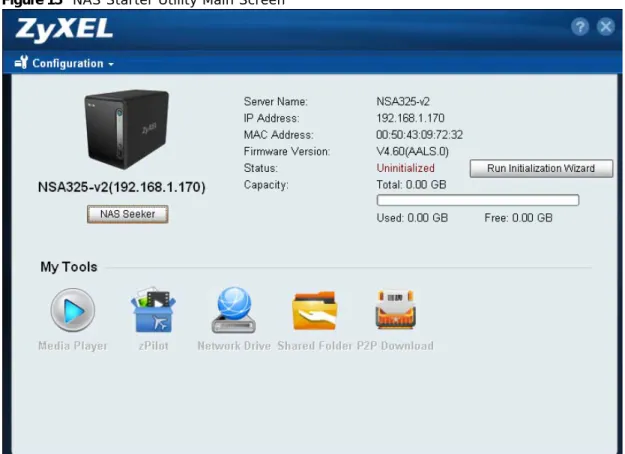
The main NAS Starter Utility screen displays after you select an NSA in the NSA Seeker screen.
Figure 4 NAS Starter Utility Main Screen
The following table describes the labels in this screen.
Table 3 NAS Starter Utility Main Screen LABEL DESCRIPTION
? Click this to display the utility help.
Configuration Click this to run the initialization wizard (see the utility help for details), configure system settings (see Section 2.8 on page 27), or go to the NSA’s Web Configurator login screen (see Section 3.3 on page 31).
NAS Seeker Click this to use the NSA Seeker screen (Section 2.3 on page 21) to find and connect to a different NSA on your network.
Chapter 2 NAS Starter Utility
Media Server User’s Guide
24
2.4.1 Directory of the NAS
Click Shared Folder to log into the NSA’s file directory in Windows Explorer. Enter the administrator user name and password and click Login.
Figure 5 Login
Capacity This shows the NSA’s total, in-use, and remaining storage capacity.
Media Player Click this to go to the Home screens where you can play media files. See Section 3.4 on page 32 for details on the Home screen.
zPilot Click this to launch the zPilot to drag and drop files onto the NSA.
Network Drive Click this to add the NSA as a network drive in your computer’s Windows Explorer. Shared Folder Click this to log into the NSA’s file directory in Windows Explorer.
P2P Download Click this to use the NSA to manage file downloads, including P2P downloads. Dropbox Click this to use your Dropbox account to move files to the NSA and have the NSA
download *.torrent files.
SMART This displays when the NSA has the SMART package installed. Click this to view hard disk health and performance details.
WordPress This displays when the NSA has the WordPress package installed. Click this to create and manage a blog or website. Use the NSA administrator credentials to log in. The
administrator can then create accounts for other users.
eMule This displays when the NSA has the eMule package installed. Click this to use the NSA’s eMule peer-to-peer (P2P) file-sharing console to download and share files from the Internet. See Section 10.8 on page 226 for details.
Gallery This displays when the NSA has the Gallery package installed. Click this to use your NSA to host pictures. You can upload images in your local computer or shares to this
application. Use the NSA administrator account to log in to the Gallery console.
pyLoad This displays when the NSA has the pyLoad package installed. Click this to use pyLoad to have the NSA manage your downloads, including those from one-click hosting sites.
Table 3 NAS Starter Utility Main Screen LABEL DESCRIPTION
Chapter 2 NAS Starter Utility
The utility opens the NSA’s directory in Windows Explorer.
Figure 6 Directory
2.5 Import Files or Folders with zPilot
In the main NAS Starter Utility screen click zPilot to be able to drag and drop files from your computer to the NSA.
Enter the administrator user name and password and click Login.
Figure 7 Login
The zPilot icon displays. zPilot
Chapter 2 NAS Starter Utility
Media Server User’s Guide
26
Public folder. For folders of files you are prompted to choose the target destination. The zPilot icon
shows the transfer rate.
Figure 9 zPilot Showing Transfer Rate
Double-click the zPilot icon to display status details about the file transfers. Select an entry and click Pause, Resume, or Remove to control the transfer. After the transfer finishes you can select the entry and click Open Destination Folder to see the file on the NSA. Click Clear Completed to clear completed transfers from the list.
Figure 10 zPilot Transfer Details
2.6 Network Drive
In the main NAS Starter Utility screen click Network Drive to add the NSA as a network drive in your computer’s Windows Explorer.
Enter your user name and password and click Login to be able to add the NSA’s shares to which you have access as network drives. Otherwise select Guest and click Login to be able to add the NSA’s public shares as network drives.
Figure 11 Login
Select a share on the NSA and the drive letter on your computer to which you want to map it. The shares that each user can select to map depends on the user’s permissions. For example, if share1 is private to user1, then only user1 is allowed to map share1. The table displays the NSA shares that are already mapped to drive letters on your computer. After you click Apply you can see the
Chapter 2 NAS Starter Utility
new drive in Windows Explorer (My Computer) where you can access and use it like your computer’s other drives.
Figure 12 Network Drive
2.7 Manage the Device
In the main NAS Starter Utility screen click Configuration > Administration to log into the NSA’s administration screens where you can manage the NSA.
Enter the administrator user name and password and click Login.
Chapter 2 NAS Starter Utility
Media Server User’s Guide
28
Click Configuration > System Setting in the main utility screen to display the following screen.
Figure 14 NAS Starter Utility > Configuration > System Setting
The following table describes the labels in this screen.
Table 4 NAS Starter Utility > Configuration > System Setting LABEL DESCRIPTION
Server Name Specify a name to uniquely identify the NSA on your network. You can enter up to 15 alphanumeric characters with minus signs allowed but not as the last character. The name must begin with an alphabetic character (a-z) and is case sensitive.
Time Zone Choose the time zone of your location. This will set the time difference between your time zone and Greenwich Mean Time (GMT).
Enable PPPoE
Connection Click this if your Internet connection requires you to enter a user name and password to connect to the Internet. Enter your user name and password Automatically get
IP address Select this if the NSA is automatically assigned an IP address from the ISP or a DHCP server in your network. Manually assign IP
address Select this if you want to assign the NSA a fixed IP address, subnet mask and default gateway.
Note: Do not configure an IP address that is already in use in your network. This results to a network IP address conflict and makes the NSA inaccessible.
Use from DHCP
server Domain Name System (DNS) is for mapping a domain name to its corresponding IP address and vice versa. Select this if the NSA is automatically given DNS information from the ISP or a DHCP server in your network.
DNS Domain Name System (DNS) is for mapping a domain name to its corresponding IP address and vice versa.
Select Use from DHCP server if the NSA is automatically given DNS information from the ISP or a DHCP server in your network.
Select Manually assign DNS server if you were given specific IP address(es) of the DNS server(s). Enter the primary and secondary DNS in the corresponding fields.
C
H A P T E R
3
Web Configurator Basics
3.1 Overview
This chapter describes how to access the NSA web configurator and provides an overview of its screens.
The web configurator is an HTML-based management interface that allows easy NSA setup and management using an Internet browser.
Use Internet Explorer 7.0, Mozilla Firefox 3.6, Safari 5, Google Chrome 10, or later versions of these browsers. The recommended screen resolution is 1024 by 768 pixels or higher.
In order to use the web configurator you need to allow:
• Web browser pop-up windows from your device. Web pop-up blocking is enabled by default in Windows XP SP (Service Pack) 2.
• JavaScript (enabled by default).
3.2 Accessing the NSA Web Configurator
Make sure your NSA is properly connected and that your computer is in the same subnet as the NSA (refer to the Quick Start Guide or the appendices).
Chapter 3 Web Configurator Basics
Media Server User’s Guide
30
3.2.1 Access the NSA Via NAS Starter Utility
If you don’t know the IP address of the NSA, then use the NAS Starter Utility to find it. Refer to the Quick Start Guide for how to install and run the NAS Starter Utility. See Chapter 2 on page 21 for more information on the NAS Starter Utility.
Figure 15 NAS Starter Utility Main Screen
3.2.2 Web Browser Access
Configure the server name of your NSA using the Network Configuration screen (Section 2.8 on page 27) of the NAS Starter Utility. Open your browser and type in the server name of the NSA. The default is ‘nsa’ followed by the number of your model (‘nsa320’ for example).
Chapter 3 Web Configurator Basics
3.3 Login
The default username and password are ‘admin’ and ‘1234’ respectively. Enter your username and password. See Chapter 14 on page 287 for how to create other user accounts. If you use the option to stay logged in for two weeks (assuming you do not log out), make sure you keep your computer secure from unauthorized access. Click User Login to go to the Home screens where you can play media files. Click Administrator Login to go to the advanced administration screens.
Chapter 3 Web Configurator Basics
Media Server User’s Guide
32
If you have not done so yet, you should see a screen asking you to change your password (highly recommended) as shown next. Type a new password (and retype it to confirm) and click Apply or click Ignore.
Figure 18 Change Password Screen
3.4 Home Screens
The Home screen after you log in using User Login.
Chapter 3 Web Configurator Basics
Note: If you did not select the option to stay logged in for two weeks when you logged in, the web configurator management session automatically times out if it is left idle for 15 minutes. Simply log back into the NSA if this happens to you.
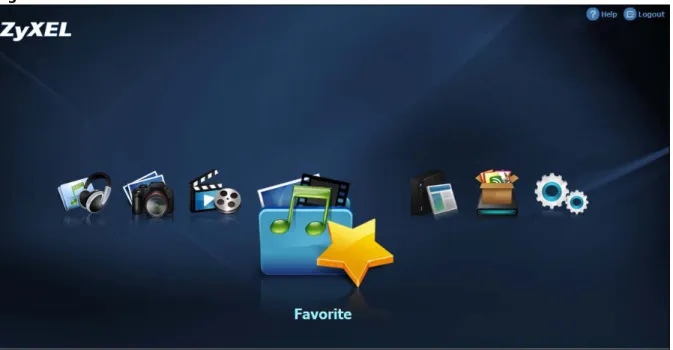
The main Home screen displays icons for the various features you can access.
Note: Your browser may need Windows Media Player and VLC plugins installed to play music and video files. To get the VLC plugins, you have to download and install VLC (use the .exe file). To install a VLC plugin for Firefox, when you install VLC, you have to select the Mozilla plugin option.
Current VLC plugins may not support srt file format subtitles when playing videos. The icons at the top-right of the screen are visible from most screens. Use them to navigate between the screens and menus. The following table describes the icons.
Table 5 Main Home Screen Icons ICON DESCRIPTION
Use Music, Photo, and Video to play and organize your music, picture, and video files.
Use Favorite to view lists of commonly played, recently played, and recently added music files.
Use File Browser to see your files in a tree-folder structure.
Administrators can use Application Zone to install, access, and manage the NSA’s applications.
Use System to edit general system settings or log into the administrator advanced configuration screens.
Chapter 3 Web Configurator Basics
Media Server User’s Guide
34
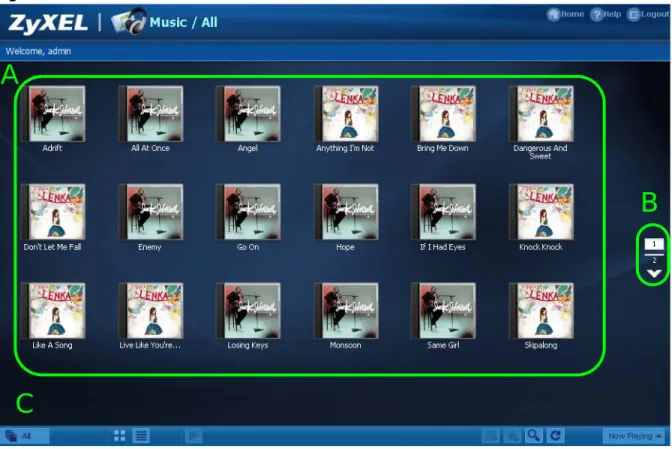
Here are some Home screen descriptions. A music screen is shown here as an example. Other screens work in a similar way.
Figure 20 Music Screen
This table describes common labels in the Home media screens. Not every item displays in every screen.
Table 7 Home Media Screens LABEL DESCRIPTION
A View files. Double-click an item to play it.
B Shows which page is displaying and the total number of pages of entries. Click an arrow or type a number to go to another page of entries.
C Select the sorting criteria:
Artist - Sort music by artist.
All - All of the menu’s files display here. Folder - List the folders containing music files.
Current Playlist - Show the playing and queued songs.
Thumbnail Click this to view the files as thumbnails. List Click this to view the files as a list.
Play Click this to play the currently selected file. You can also double-click a file to play it. Add to Current
Playlist Click this to add the selected music file to the currently playing playlist. Search Click this to look for a file or folder by name.
A
C
Chapter 3 Web Configurator Basics
3.4.1 Now Playing (Music)
A Now Playing link displays when a song is playing. Click it to display a panel like the following. This screen displays the name of the current song and it’s play progress and lets you control the playback.
Figure 21 Now Playing
3.4.2 Exif and Google Maps (Photos)
Click a photo’s EXIF button to display or hide the photo’s Exchangeable image file format (Exif) data.
Figure 22 Exif Information
Refresh Click this to update the display in the screen.
Now Playing This link is available when a song is playing. Click it to see details about the song that is currently playing.
Table 7 Home Media Screens LABEL DESCRIPTION
Chapter 3 Web Configurator Basics
Media Server User’s Guide
36
If a photo’s Exif data includes GPS location data, click the latitude or longitude link to display the location in Google Maps. Click Clear to delete the markers of other photos and only display the current photo’s marker.
Figure 23 Google Maps
3.4.3 Slideshow (Photos)
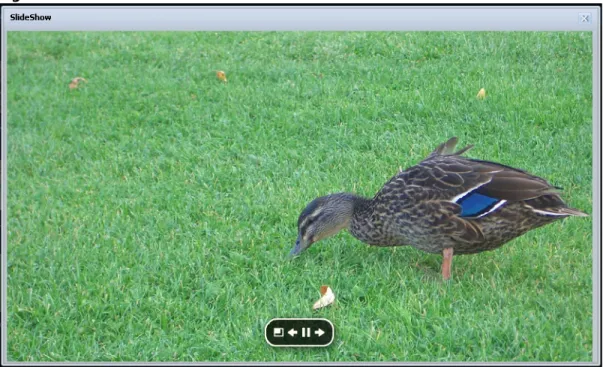
In a Photo menu click the SlideShow button to display the menu’s files as a slideshow. Move your cursor over the slideshow’s screen to display full screen, previous, pause, and next buttons for controlling the slideshow.
Note: Your browser must have the Flash Player plug-in installed to view slideshows.
Chapter 3 Web Configurator Basics
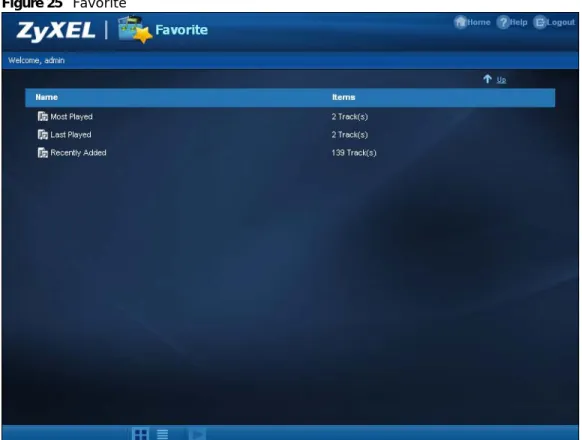
3.4.4 Favorite
Use the Favorite menu to view lists of commonly played, recently played, and recently added music files.
Figure 25 Favorite
3.4.5 File Browser
Click File Browser to open the following screen. Use the file browsing screens to play, open, upload, and download files. A share is a set of user access permissions for a specific folder on a volume (gives someone access to a folder). It is equivalent to the Windows concept of a shared folder, but the access rights are independent of the folder (you configure the share and the folder separately). You can map a share to a network drive for easy and familiar file transfer for Windows users.
Chapter 3 Web Configurator Basics
Media Server User’s Guide
38
• You can download individual files of up to 4 GB in size with Mozilla Firefox and Internet Explorer 7 and later or up to 2 GB in size with Internet Explorer 6.
Figure 26 File Browser
The following table describes the labels in this screen.
Table 8 File Browser
LABEL DESCRIPTION
Up Click this to go to the next higher layer in the share’s folder tree.
Name This column identifies the names of folders and files in the share. Click a file’s file name to open the file or save it to your computer. Click a folder’s name to display the folder’s contents. Size This column displays a file’s size in bytes.
Last Modified This column displays the last time the file or folder was changed (in year-month-day hour:minute:second format).
Create New
Folder Click this to open the following screen where you can create a new folder within the share.
Specify a name to identify the folder. See Section 3.4.6 on page 41 for more information on folder names. Click Apply to create a folder or click Cancel to exit this screen.
Configure
Share Select a share and click this link to open a screen where you can see and configure share management details. Delete Select a file or folder and click this to delete it from the NSA.
Chapter 3 Web Configurator Basics
Upload Click this to open the following screen where you can add files to the share.
Use the Browse button to locate your file/s and click Apply to upload the file. Click Cancel to close this screen.
Note: Do not refresh the screen while an upload is going on.
Download Select a file and click this to save the file to your computer.
Note: Do not refresh the screen while a download is going on.
Compress Select files or folders and click this to compress them into a zip file.
Decompress Select a zipped file and click this to create a folder named after the zip file and save the decompressed files into the folder.
Restore When you are in a recycle bin folder, select a folder or file and click this to restore it. Refresh Click this to update the information displayed in the screen.
Note: Do not refresh the screen while an upload or download is in progress.
Table 8 File Browser (continued) LABEL DESCRIPTION
Chapter 3 Web Configurator Basics
Media Server User’s Guide
40
3.4.5.1 Configure Share Screen
In the File Browser screen, select a share and click Configure Share to open the following screen where you can see and configure share management details.
Figure 27 File Browser > Configure Share
The following table describes the labels in the this screen.
Table 9 File Browser > Configure Share LABEL DESCRIPTION
Share Name Configure a name to identify this share. Type a share name from 1 to 239 single-byte (no Chinese characters allowed for example) ASCII characters. The name cannot be the same as another existing local share. See Section 3.4.6 on page 41 for more information on share names. This is not configurable for the NSA’s default admin, music, photo, public, and video shares.
Volume This shows the volume the share is on. It is read-only. Make this share
owned by Select the administrator or user account that is to own (manage) this share. The share owner controls access rights to the share. This is not configurable for the NSA’s default admin and public shares.
Enable This Share Select this option to allow users to access this share. When this option is not selected, you cannot see and access this share.
Enable Recycle Bin Select this option to keep deleted items in a recycle bin. When you delete an item, a recycle folder is created within the share, and the deleted item is stored in the recycle bin. Later if you want to retrieve a deleted item, you can select the item from the recycle folder and move/copy the item to another share.
Publish this share
to Media Server Select this option to make the share’s files available to media clients. When you publish a share, you can also select whether or not to publish music tracks, photos, and videos. Publish this share
Chapter 3 Web Configurator Basics
3.4.6 Share and Folder Names
The name can only contain the following characters: • Alphanumeric (A-z, 0-9) and Unicode.
The NSA allows FTP access to shares, folders or files with names encoded in the UTF-8 (8-bit UCS/Unicode Transformation Format) format. So your FTP client must support UTF-8 in order to access shares, folders or files on the NSA with Unicode names.
• Spaces
• _ [underscores] • . [periods] • - [dashes]
Other limitations include:
• All leading and trailing spaces are removed automatically. • Multiple spaces within names are converted to a single space.
• Share names must be unique (they cannot be the same as other share names).
• The NSA creates automatic volume names for external (USB) disk volumes. These are a type of share, so the share name you configure cannot conflict with the external (USB) disk volume names. “ExtVol1” or “ExtVol2” are examples of external (USB) disk volume names.
• Folder names must be unique (they cannot be the same as other folder names).
• The minimum character length of a name is one character, that is a name cannot be blank.
Share Access Select who can access the files in the share and how much access they are to be given. If you publish the share to the media server or the web, all users will have at least read-only access to the share, regardless of what you configure here.
Select Keep it private to owner to allow only the share owner to read files in the share, delete files in the share and save files to the share.
Select Make it public to allow anyone (with or without a user account on the NSA) to read files in the share, delete files in the share and save files to the share.
Select Advanced to select which individual users can read the share’s files, which users can delete the share’s files, and which users are blocked from doing either.
Apply Click this to save your changes.
Cancel Click this to return to the previous screen without saving.
Table 9 File Browser > Configure Share (continued) LABEL DESCRIPTION
Chapter 3 Web Configurator Basics
Media Server User’s Guide
42
3.4.7 Application Zone
Administrators can click Application Zone to go to a screen where you can enable or disable various applications for file sharing and downloading.
Figure 28 Application Zone
The following table describes the labels in the this screen.
Table 10 Application Zone LABEL DESCRIPTION
Name This is the name of the application.
Description This is a brief description of the application. See Chapter 9 on page 175 for more information. Management
Page Click this link to go the application’s management page where you can configure settings for it. See Chapter 9 on page 175 for more information. Enable Select a disabled application and click this to turn on the application. Some applications are
always enabled and cannot be disabled.
Disable Select an enabled application and click this to turn off the application. Select the Flickr or Youtube Uploadr entry and click this to cancel all uploading. Some applications are always enabled and cannot be disabled.
Pause Select the Flickr or Youtube Uploadr entry and click this to pause current uploading. Resume will resume current uploading.
Chapter 3 Web Configurator Basics
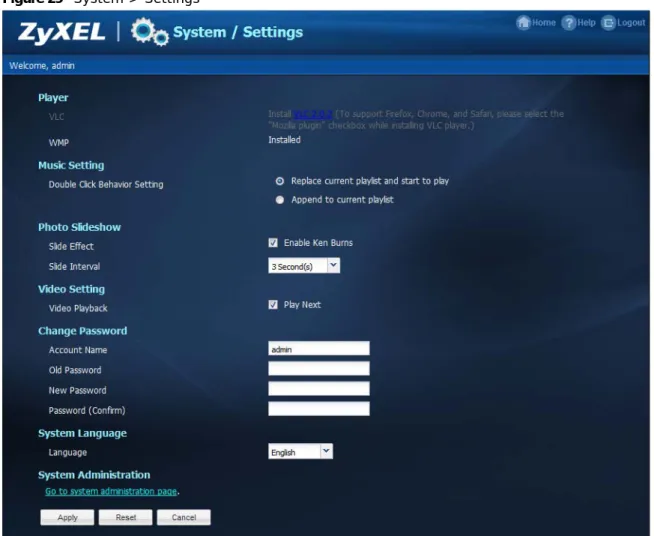
3.4.8 System Settings
Click System > Settings to open the following screen. Use this screen to change general settings and an account password.
Figure 29 System > Settings
The following table describes the labels in this screen.
Table 11 System > Settings LABEL DESCRIPTION
Chapter 3 Web Configurator Basics
Media Server User’s Guide
44
3.5 Administration Screens
The System > Administration link displays when you log in as the administrator. Click System >
Administration in the Home screen to open the advanced administration screens.
Video Playback Select Play Next to play the rest of the video files in a folder. So for example, a folder has video files 1~10 and you play video 3. When video 3 finishes the device continues playing the rest of the videos in the folder (4~10). It does not loop back and play videos 1 and 2.
Account Name Type the user name of the account for which you want to change the password. Old Password Type the user’s current password.
New Password Create a new password for the user. You can type from one to 14 single-byte (no Chinese characters allowed for example) ASCII characters.
Password (Confirm) You must type the exact same password that you just typed in the above field. Language Select the web configurator language from the drop-down list box.
Go to system
administration page This link appears when you are logged in as the administrator. Click it to open the advanced administration screens. See Section 3.5 on page 44 for more on the advanced administration screens.
Apply Click this to save your changes. Reset Click this to refresh the screen.
Cancel Click this to exit the screen without saving your changes.
Table 11 System > Settings (continued) LABEL DESCRIPTION
Chapter 3 Web Configurator Basics
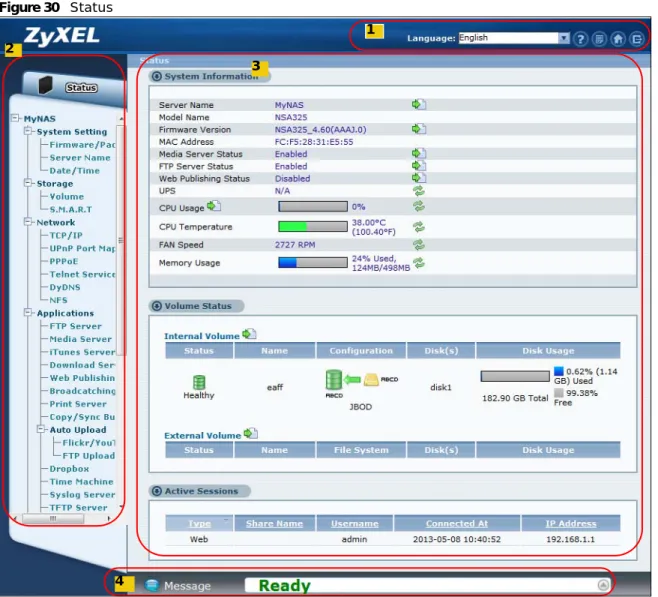
The Status screen is the first advanced administration screen that displays.
Figure 30 Status
3.5.1 Global Administration Icons
The icons and language label at the top-right of the screen ( ) are visible from most of the administration screens. The following table describes the ‘global’ icons and labels.
3
4
1 2
Chapter 3 Web Configurator Basics
Media Server User’s Guide
46
3.5.2 Navigation Panel
The navigation panel on the left of the Web Configurator screen ( ) contains screen links. Click a link to display sub-links. There are no sub-links for the Status screen. Certain screens also contain hyper links that allow you to jump to another screen.
The following table describes the navigation panel screens.
Table 13 Screens Summary
LINK SCREEN FUNCTION
Status This screen shows system information, the status of the volumes, and the users who are currently using the NSA.
System
Setting Firmware/Packages Upload/upgrade new firmware to your NSA and add useful applications. The NSA can download multiple packages/files at once and automatically goes through all the installation steps.
Server Name Specify the NSA’s server name and workgroup name.
Date / Time Chose a time zone and/or allow the NSA to synchronize with a time server. Storage Volume View volume and disk information and create and edit volumes. A volume is a
storage area that can span one or more internal disks or a single external (USB) disk.
S.M.A.R.T Install the SMART package to display this screen you can use to monitor hard disks.
Network TCP/IP Assign the NSA a dynamic or static IP address and DNS information. UPnP Port
Mapping
Configure your Internet gateway to allow access from the WAN (Internet) to services on the NSA.
PPPoE Configure PPPoE settings for a direct Internet connection.
Telnet Service Enable or disable Telnet access. This applies to the NSA310S, NSA325, and NSA325 v2.
DyDNS Install the DyDNS package to use Dynamic DNS (DDNS) services to use a domain name with a dynamic IP address.
NFS Install the NFS package to display this screen where you can configure NFS (Network File System) file-sharing.
Chapter 3 Web Configurator Basics
Applications FTP Server Enable FTP file transfer to/from the NSA, set the number of FTP connections allowed, an FTP idle timeout, and the character set.
Media Server Enable or disable the sharing of media files and select which shares to share. iTunes Server Use the iTunes server to share media files with iTunes users on your network. Download
Service Have the NSA handle large file downloads. Web
Publishing Let people use a web browser to access files in shares without logging into the Home screens. Broadcatching Subscribe the NSA to feeds to download frequently updated digital content like TV programs, radio talk shows, Podcasts (audio files), YouTube videos, or even P2P downloads.
Print Server View and manage the NSA’s list of printers and print jobs. Copy/Sync
Button Copy or synchronize files between a USB device and the NSA. Auto Upload -
Flickr/YouTube Upload files in selected shares to your Flickr and/or YouTube accounts. Auto Upload -
FTP Uploadr Upload files in selected shares to FTP servers.
Dropbox Use your Dropbox account to easily move files to your NSA and have the NSA download *.torrent files.
Time Machine Use Time Machine in OS X to use your NSA as a backup volume.
Syslog Server Enable the syslog server and select the categories to include in the log report. TFTP Server Configure the NSA to accept log files from TFTP clients.
eMule - Server Configure the eMule server. eMule - Task Manage eMule tasks. eMule -
Search Search for files available in an eMule server using keywords and other parameters, such as file type, file size, and extension names. pyLoad Configure the NAS to use pyLoad to manage your downloads, including those
from one-click hosting sites.
Sharing Users View, create and edit administrator and user accounts to let people use the NSA.
Groups View, create and edit groups. Groups allow you to organize users into specific groups. You can create shares accessible only by the group members. Shares View, create and edit shares. Shares are shared folders to which you can allow
specific users read/write access rights.
Maintenance Power Configure power saving settings for the NSA and have the NSA turn itself off and on or reboot according to the schedules you configure.
Table 13 Screens Summary (continued) LINK SCREEN FUNCTION
Chapter 3 Web Configurator Basics
Media Server User’s Guide
48
3.5.3 Main Window
The main window
(
)
shows the screen you select in the navigation panel. It is discussed in the rest of this document.The Status screen is the first administration screen to display. See Chapter 5 on page 137 for more information about the Status screen.
3.5.4 Status Messages
The message text box at the bottom of the screen
(
)
displays status messages as you configure the NSA.3.5.5 Common Screen Icons
The following table explains some icons that appear in several configuration screens.
3
4
Table 14 Common Configuration Screen Icons ICON DESCRIPTION
Edit
Click this to go to a screen where you can change the configuration settings of an entry.
Delete
Click this to delete an entry from the list.
Edit
Click this to jump to related item’s configuration screen.
Refresh
Click this to refresh the data for the field or value with which it is associated.
User
See the chapter on user accounts for detailed information on variants of this icon.
Share
See the chapter on shares for detailed information on variants of this icon.
Healthy
This represents a healthy volume.
Degraded
This represents a degraded RAID 1 volume. Replace the faulty disk. If the replacement disk does not contain any partition, the NSA automatically restores the volume. If the replacement disk already contains a volume, you need to delete the volume and then click the Repair icon to fix the degraded RAID volume.
Down
This represents a down volume.
Scan Disk
Click this to scan a hard disk for file system errors.
Eject
Click this before you remove an external hard drive so that you do not lose data that is being transferred to or from that hard drive.
Chapter 3 Web Configurator Basics
3.5.6 Session Example (Windows)
Open Windows Explorer and type two back slashes followed by the NSA name or IP address. Initially you can only read and write to the Public, Video, Music, and Photo folders until you create other shares on the NSA. This session is then displayed as shown in the following figure.
Session Example (Windows)
Locate
Click this to cause the LED on the external storage device to blink.
Repair
If you replace a faulty disk with a disk that contains a volume, you need to delete the volume and then click this to fix the degraded RAID volume.
Table 14 Common Configuration Screen Icons (continued) ICON DESCRIPTION
Chapter 3 Web Configurator Basics
Media Server User’s Guide
50
C
H A P T E R
4
Tutorials
4.1 Overview
This chapter provides tutorials that show how to use the NSA. • Windows 7 Network, see page 51
• Windows 7 Network Map, see page 55
• Playing Media Files in Windows 7, see page 58 • Windows 7 Devices and Printers, see page 58 • Creating a Volume in a 2-Bay NSA, see page 61 • Creating a Volume in a 1-Bay NSA, see page 63 • Deleting a Volume, see page 70
• File Sharing Tutorials, see page 71 • Download Service Tutorial, see page 80 • Broadcatching Tutorial, see page 95
• Copy and Flickr Auto Upload Tutorial, see page 101 • FTP Uploadr Tutorial, see page 102
• Web Configurator’s Security Sessions, see page 105 • Using FTPES to Connect to the NSA, see page 118 • Using a Mac to Access the NSA, see page 119 • How to Use the BackupPlanner, see page 122
4.2 Windows 7 Network
Chapter 4 Tutorials
Media Server User’s Guide
52
1 Click Start > Control Panel. Set View by to Category and click Network and Internet.
Chapter 4 Tutorials
3 The NSA icon displays twice because the NSA is both a media server and a storage device.
Double-click either NSA icon to open the Web Configurator login screen.
4.2.1 If the NSA Icon Does Not Display
The network containing the NSA must be set as a home or work network in order for the NSA icons to display. If the network containing the NSA displays as “Public”:
Chapter 4 Tutorials
Media Server User’s Guide
54
2 Use the Set Network Location screen to set the network’s location to home or work.
4.2.2 NSA Icon Right-click Options
Right-click the NSA’s icon to see these options:
• Install/Uninstall: Click Install to add the NSA as a device in your computer. After you install the NSA you can see it in the computer’s list of devices (see Section 4.5 on page 58. Click
Uninstall to remove the NSA from the list of devices installed in your computer.
• View device web page opens the Web Configurator login screen.
Chapter 4 Tutorials
• Properties opens a window of NSA details and troubleshooting information.
• Manufacturer identifies the company that produced the NSA. • Model identifies the NSA model.
•
Model number
identifies the NSA model number.• Device webpage shows the IP address for accessing the Web Configurator. • Serial number is unavailable because the NSA does not have one.
• MAC address is the NSA’s unique physical hardware address (MAC). You need the MAC address to register the product at myZyXEL.com. Customer support may also request it for troubleshooting purposes.
• Unique identifier is a unique UPnP ID that the NSA generated.
• IP address is the NSA’s IP address. It is also the IP address for accessing the Web Configurator.
4.3 Windows 7 Network Map
Chapter 4 Tutorials
Media Server User’s Guide
56
1 Click Start > Control Panel > View network status and tasks (or Network and Sharing
Center if you view the Control Panel by icons).
2 Click See full map (1 in the figure).
The network containing the NSA must be set as a home or work network in order to use the full map feature. If the network containing the NSA displays as “Public”, click the network’s link (2 in the figure, although it is already set to home here) and use the Set Network Location screen to set the network’s location to home or work (see page 54).
2
Chapter 4 Tutorials
3 Double-click the NSA’s icon to open the Web Configurator login screen. See Section 4.2.2 on page
Chapter 4 Tutorials
Media Server User’s Guide
58
4.4 Playing Media Files in Windows 7
In Windows 7, the NSA automatically displays as a library in Windows Media Player.
Figure 31 NSA in Windows Media Player
4.5 Windows 7 Devices and Printers
After you use the NSA’s network icon’s install option you can manage the NSA from the Windows 7
Chapter 4 Tutorials
Click Start > Control Panel > Hardware and Sound > Devices and Printers. Select the NSA icon to display information about the NSA. Double-click the NSA icon to open a properties window (see page 55). Right-click the icon to display these options:
• Download NAS Starter Utility downloads the NSA’s Starter Utility. It lets you find, set up, and manage the NSA as well as copy files to it and access the files on it. See Chapter 2 on page 21 for details.
• Create shortcut has Windows make a desktop shortcut to this screen. • Troubleshoot opens Windows’ device troubleshooting wizard.
• Remove device removes the NSA from the Windows 7 Devices and Printers folder. • Properties opens a window of NSA details and troubleshooting information (see page 55).
Chapter 4 Tutorials
Media Server User’s Guide
60
4.5.1 Windows 7 Desktop Shortcut
This is the NSA’s desktop shortcut. Double-click it to open a properties window (see page 55).
1 Right-click the NSA’s desktop shortcut icon to see these options:
• Open file location takes you to the Windows 7 Devices and Printers folder.
• Download NAS Starter Utility downloads the NSA’s Starter Utility. It lets you find, set up, and manage the NSA as well as copy files to it and access the files on it. See Chapter 2 on page 21 for details.
• Restore previous versions is the Windows 7 option for restoring a file or folder. It does not apply to this shortcut.
• Send to give you options for copying the shortcut to another location. • Cut removes this shortcut so you can paste it somewhere else. • Copy copies the shortcut so you can paste it somewhere else. • Create shortcut has Windows make a desktop shortcut to this icon.
Chapter 4 Tutorials
• Delete sends the shortcut to the recycle bin. • Rename lets you change the name of the shortcut.
• Troubleshoot opens Windows’ device troubleshooting wizard.
• Remove device removes the NSA from the Windows 7 Devices and Printers folder. • Properties opens a window of details about the shortcut.
4.6 Creating a Volume in a 2-Bay NSA
This section shows you how to create a volume in your 2-bay NSA.
Creating a volume deletes all existing data in the hard disk. Make sure
you have a backup of your existing data before following the steps in this
section.
Your NSA has two bays for Serial Advanced Technology Attachment (SATA) hard disks. The JBOD storage method is used if you are using a single hard disk for your NSA.
This JBOD volume shows up in the Storage > Volume screen (Section 7.3 on page 155) as follows.
Chapter 4 Tutorials
Media Server User’s Guide
62
4.6.2 Migrate Button
Do the following steps to create a RAID 1 volume.
1 Once you install a second SATA hard disk in the NSA, the Storage > Volume screen shows the
Migrate button.
2 Click the
Migrate
button and you can see the following progress bar. Wait for the RAID 1 volume to be created. This may take quite a while depending on how much data you have in the original volume.4.6.3 Create an Internal Volume Button
If you do not have an existing volume in the Storage > Volume screen, do the following steps to create a RAID 1 volume.
1 In the Storage > Volume screen, click Create an Internal Volume.
2 In the Disk Configuration screen, you can select the storage method.
• Type in the Volume Name for your RAID 1 volume. The volume name can be 1 to 31 characters (a-z, 0-9, " " [spaces], "_", and ".").
Chapter 4 Tutorials
This deletes all existing data in the SATA hard disk. Make sure you have
a backup of any existing data in the hard disk.
The NSA starts creating the volume and you can see the following progress bar. Wait for the RAID 1 volume to be created.
Chapter 4 Tutorials
Media Server User’s Guide
64
Your NSA has a single bay for a SATA (Serial Advanced Technology Attachment) hard disk. JBOD is the only storage method for the NSA310S and the default storage method if you are using a single hard disk in the NSA310.
This JBOD volume shows up in the Storage > Volume screen (Section 7.2 on page 152) as follows.
When you attach an eSATA hard disk to your NSA, you can configure this volume as: 1) a backup to your SATA hard disk (RAID 1); or 2) as a separate storage drive (either another JBOD or a PC
Compatible Volume).
4.7.1 Creating a RAID 1 Volume
This applies to the NSA310. This storage method allows recovery of data if your hard disk fails. To create a RAID 1 volume, you must connect an eSATA hard disk to your NSA. There are two ways to create a RAID 1 volume:
• Click the Migrate button - This is a quick way to create a RAID 1 volume. Use this to automatically synchronize data in the internal hard disk to the eSATA hard disk.
• Click the Create a SATA volume button - Use this if there are no existing volumes in your NSA.
4.7.2 Migrate Button
Do the following steps to create a RAID 1 volume.
1 Once you attach the eSATA hard disk to the NSA, the Storage > Volume screen shows the
Chapter 4 Tutorials
2 Click the
Migrate
button and you can see the following progress bar. Wait for up to 10 minutes for the RAID 1 volume to be created.4.7.3 Create a SATA Volume Button
If you do not have an existing volume in the Storage > Volume screen, do the following steps to create a RAID 1 volume.
1 In the Storage > Volume screen, click Create a SATA Volume.
Chapter 4 Tutorials
Media Server User’s Guide
66
The NSA starts creating the volume and you can see the following progress bar. Wait for 2 minutes for the RAID 1 volume to be created.
Chapter 4 Tutorials
4.7.4 Creating a PC Compatible Volume
You can use your eSATA hard disk as a separate storage volume. The following section shows you how to create a PC Compatible Volume. Use this storage method if you have an eSATA hard disk that will be connected to a Windows computer when it is not connected to the NSA. However, the computer’s platform (for example, Windows XP SP2) should support the file system you selected for the eSATA hard disk.
1 Connect the eSATA hard disk to your NSA and go to the Storage > Volume screen. Click Create a
SATA Volume.
2 In the Disk Configuration screen, you can select the storage method.
• Type in the Volume Name for your PC Compatible volume. The volume name can be 1 to 31 characters (a-z, 0-9, " " [spaces], "_", and ".").
• Choose PC Compatible Volume.
• Select the File System you want to use (NTFS in this example). Make sure this file system is supported by the Windows platform you are using in your computer. Refer to Table 26 on page 159 for file systems supported by your NSA. Click Apply.
This deletes all existing data in the eSATA hard disk. Make sure you have
a backup of any existing data in the hard disk.
Chapter 4 Tutorials
Media Server User’s Guide
68
The NSA starts creating the volume and you can see the following progress bar. Wait for 2 minutes for the volume to be created.
Chapter 4 Tutorials
4.7.4.1 Checking Your PC Compatible Volume
The files in the eSATA hard disk that you configured as a PC Compatible Volume should be accessible when you connect the eSATA hard disk to your computer.
You can configure the features of your NSA to save files to your eSATA hard disk. For example, you can refer to Section 4.11 on page 95 to use the Broadcatching feature of your NSA to download files to your eSATA disk.
1 When asked for the Location of Downloaded Files, make sure you save the completed files to
the eSATA hard disk (Volume 2 in this example).
2 The files downloaded by the NSA should be in the Volume 2 folder. You can check this when you
Chapter 4 Tutorials
Media Server User’s Guide
70
3 Disconnect the eSATA hard disk from the NSA. Connect the eSATA hard disk to your computer. On
some systems, you can see the following notification.
4 The computer assigns a letter to the eSATA hard disk (drive F in this example) that is accessible
from the My Computer screen. Double click the eSATA drive and check your files. They should be the same files that are in the My NSA > Share Browser screen.
4.8 Deleting a Volume
Chapter 4 Tutorials
1 In the Storage > Volume screen, select the volume you want to delete and click the delete icon.
2 A confirmation window appears as follows. Click Yes.
This deletes all existing data in the volume. Make sure you have a
backup of any existing data in the hard disk.
4.9 File Sharing Tutorials
The following sections cover using the NSA for file sharing. This chapter assumes you have already followed the Quick Start Guide instructions to perform initial setup and configuration (so you have a working volume). See the rest of this User’s Guide for details on configuring the NSA’s various screens.