CRITERION
2
.
Instructional Program
2.1. Master of Public Health Degree
2.1. Master of Public Health Degree. The program shall offer instructional programs reflecting its stated mission and goals, leading to the Master of Public Health (MPH) or equivalent professional master’s degree. The program may offer a generalist MPH degree or an MPH with areas of specialization. The program, depending upon how it defines the unit of accreditation, may offer other degrees, professional and academic, if consistent with its mission and resources.
The areas of knowledge basic to public health include:
• biostatistics – collection, storage, retrieval, analysis and interpretation of health data; design and analysis of health-related surveys and experiments; and concepts and practice of statistical data analysis;
• epidemiology – distributions and determinants of disease, disabilities and death in human populations; the characteristics and dynamics of human populations; and the natural history of disease and the biologic basis of health;
• environmental health sciences – environmental factors, including biological, physical and chemical factors that affect the health of a community;
• health services administration – planning, organization, administration, management, evaluation and policy analysis of health and public health programs; and
• social and behavioral sciences – concepts and methods of social and behavioral sciences relevant to the identification and solution of public health problems.
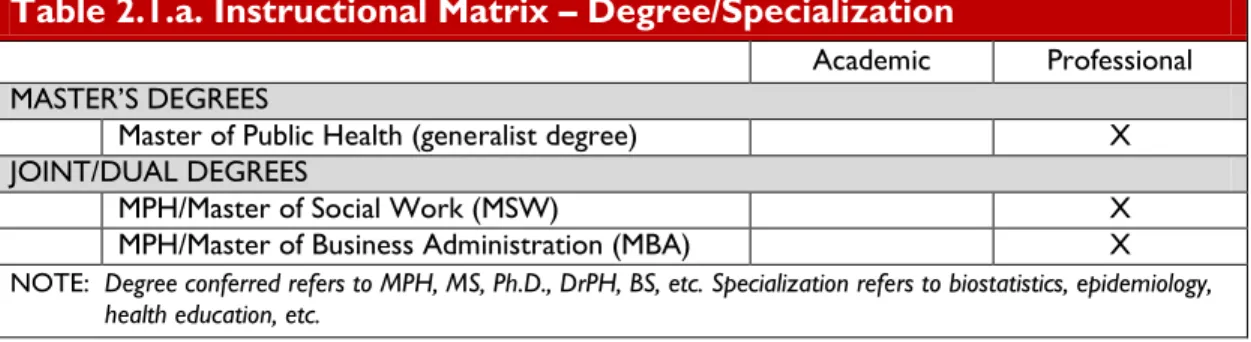
Required Documentation. The self-study document should include the following: 2.1.a. An instructional matrix (See CEPH Data Template C) presenting all of the
program’s degree programs and areas of specialization, including
undergraduate, master’s and doctoral degrees, as appropriate. If multiple areas of specialization are available, these should be included. The matrix should distinguish between professional and academic degrees and identify any programs that are offered in distance learning or other formats. Non-degree programs, such as certificates or continuing education, should not be included in the matrix.
Table 2.1.a. Instructional Matrix – Degree/Specialization
Academic Professional
MASTER’S DEGREES
Master of Public Health (generalist degree) X
JOINT/DUAL DEGREES
MPH/Master of Social Work (MSW) X
MPH/Master of Business Administration (MBA) X
NOTE: Degree conferred refers to MPH, MS, Ph.D., DrPH, BS, etc. Specialization refers to biostatistics, epidemiology, health education, etc.
The MPH program at Washington University in St. Louis has developed an innovative curriculum for its Master of Public Health (MPH) program focused on the principles of transdisciplinary public health. To our knowledge, this is the first MPH program in the United States to put a primary focus on a transdisciplinary approach to research and practice as a core element of its curriculum. While other public health programs have put a focus on transdisciplinary public health in their curriculum, the Brown MPH program appears to be the only one with transdisciplinary public health as its major and central focus. This approach offers students the opportunity to organize their thinking and practice around transdisciplinary research and practice as a means of promoting term and long-lasting solutions to complex problems in human health.
The MPH program’s Public Health Committee approved an initial version of the school’s MPH curriculum in Fall 2008 and approved the final version in Spring 2010. A schematic outlining the curriculum is displayed in the Appendix. The program draws upon the interaction of the core foundations of public health and applies these to complex public health problems. The curriculum provides students with a common base of knowledge, skills and values on public health issues, as well as additional skills in the areas of transdisciplinary science and cross-cutting themes in public health. The 45-credit-hour curriculum includes the following elements:
• S55-5001 through S55-5005: Foundations in Public Health (15 credit hours, required): Five courses (3 credit hours each) covering the five core areas of public health:
epidemiology biostatistics behavioral health environmental health
health policy and management
• S55-5010. Cross-Cutting Themes in Public Health (3 credit hours, required)
2.1.b. The bulletin or other official publication, which describes all curricula offered by the program. If the university does not publish a bulletin or other official publication, the program must provide for each degree and area of
specialization identified in the instructional matrix a printed description of the curriculum, including a list of required courses and their course
• S55-53XX. Transdisciplinary Problem Solving in Public Health (3 credit hours each, two of these are required, 6 credit hours total)
• Research Methods Sequence(9 credit hours, required) - S55-5000. Research Methods (3 credits)
- S55-5230. Applied Linear Modeling (3 credits)
- S55-5240. Program Planning, Implementation and Evaluation (3 credits)
• Electives: (9 credit hours) A range of public health courses offered through the Brown School and other schools across the Washington University campus. One
transdisciplinary course may be taken as an elective.
• Practicum(3 credit hours)
• Culminating Experience(0 credit hours)
Course descriptions, as well as course syllabi, can be found in the Resource File or on the Brown School’s intranet website (InsideBrown). Course descriptions can be found at: https://insidebrown.gwb.wustl.edu/students/MPH/Documents/MPH%20Curriculum%20 Overview.pdf).
Transdisciplinary Approach to Public Health Practice
A unique aspect of the Brown School’s MPH program is its major focus on transdisciplinary public health. For this, the MPH program brings together disciplinary approaches and faculty from not only other areas of public health (e.g., health policy, international health), but also biomedical approaches as well as perspectives on additional areas of behavioral and social science (e.g., economics, political science, business, sociology, anthropology, social work). The transdisciplinary approach in this MPH curriculum is woven through the curriculum – from an introductory cross-cutting themes course to delivering
transdisciplinary public health competencies in Foundations and research methods courses to a set of transdisciplinary problem-solving courses. The Cross-Cutting Themes in Public Health course provides not only a detailed introduction to transdisciplinary methods, but also an introduction to public health in general, with an overview of three other areas covered by the mission of the MPH program: health disparities, translation and dissemination science, and evidence-based public health.
In addition, Brown MPH students are exposed to a large number of guest speakers from the community, most involved in public health practice, to illustrate the application of core public health principles and transdisciplinary methods to public health. Table 2.3.b at the end of this section presents a partial list of guest speakers used in the past two years in the MPH program.
For many years, analysts have drawn the conclusion that public health graduate students can benefit from a foundation of collaborative thinking to guide problem identification, solutions and analysis. Traditional educational methods in public health have favored unidisciplinary approaches (e.g., epidemiology, behavioral science, economics) that teach students to focus on the individual pieces of the puzzle that define population health. This may lead to scientific silos that can limit knowledge and understanding of the complex systems that influence population health. In contrast, transdisciplinary methods require an understanding of the interaction of not only basic biomedical research and public health
sciences but also basic behavioral and social science research (b-BSSR) (Daniel Stokols. 2006. “Toward a Science of Transdisciplinary Action Research,” American Journal of Community Psychology 38: 63–77). As such, transdisciplinary approaches draw not only from biomedical or natural sciences (not limited to the physical sciences, engineering and
mathematics), but from behavioral and social sciences (e.g., behavioral health, public health, economics, law, business, anthropology, sociology and other social sciences).
The essence of the innovation in the MPH curriculum is that each student becomes a transdisciplinary-oriented investigator, well grounded in science as supplemented by the core areas of public health. Transdisciplinary work does not mean that each investigator masters the content and perspectives of each of the disciplines involved, but rather by identifying the colleagues from the needed disciplines, determining what professional and personal qualities are consistent with recruiting team members who can work in boundary-crossing areas of work, respecting other perspectives, yet holding their own views, and to aid in creating an innovative perspective. Transdisciplinary methods use not only shared disciplinary frameworks in analyzing health problems, but also use the integration and evaluation of transdisciplinary solutions to complex public health problems. The practical application of transdisciplinary concepts across real-world case studies, as well as evaluation of these approaches, provides students the opportunity to practice transdisciplinary public health methods through their application to the analysis of complex problems in public health.
Transdisciplinary Problem Solving (TPS) Courses
Transdisciplinary Problem Solving (TPS) Courseshave been developed specifically for this curriculum by the faculty to provide for the practical application of transdisciplinary concepts across real-world case studies, as well as evaluation of these approaches. The program uses structured didactic experiences as well as team-based experiences to broaden the foundational approach to a problem by identifying the needed perspectives,
understanding their importance, and using the professional communicative structure and exchange from these different intellectual perspectives to create a more integrated intellectual synthesis of the problem at hand. This process is specifically focused on a specified set of competencies (see Criterion 2.7) that articulates the skills and perspectives needed to work intellectually across disciplinary boundaries (e.g., merging findings from epidemiological studies with biomedical studies). Insights about how these courses are designed come from how research teams themselves interact, with the synthesis of
knowledge occurring through the interaction of the team of researchers with each other, not within the mind of a single investigator. The faculty has developed several criteria to guide the development of the TPS courses:
• The courses should be based on real-world and timely public health issues or problems, drawn from topics the instructors are engaging in through community-based research (e.g., obesity, tobacco treatment and prevention, violence, poverty and health, access to health care services). Thus, the topics chosen for the courses will be based on the research projects of the faculty, providing a real-life relevancy and hands-on experience to the education. The notion of transdisciplinary work emerges naturally from the work of several research centers, which form the investigative heart of the MPH program at the Brown School. These centers have long incorporated the talents of professionals drawn from a range of disciplines to form the funded core of the projects composing the centers. (See Table 2.1.b for examples of these interactions in the classroom.)
outside of public health, including, but not limited to: medicine, biology, anthropology, statistics, communication, economics, education, epidemiology, law, psychology, public health, sociology, social policy and social work. The ability of the MPH program to draw on a myriad of appropriate fields is enhanced by a broader initiative in public health at Washington University, identified and unified under the campus-wide Institute for Public Health, which has the goal of facilitating groundbreaking research by orchestrating thought leaders from a broad range of different disciplines to develop evidence-based solutions that positively impact public health in the St. Louis region and around the globe.
• The courses should be based on a cells-to-society approach, where appropriate. In other words, the courses build from the biomedical approach to public health problems familiar to clinicians, and take this approach to the societal level, incorporating the public health perspective.
• The courses are participatory, with students engaged in experiential, active, team-based learning. In particular, many practice and research teams struggle with issues of
teamwork. So the focus here is on group/team dynamics training, how
cross-disciplinary teams communicate, and how transcross-disciplinary approaches are developed and applied.
• The courses are developed using a common pedagogy, around a problem-solution framework (described above).
In the first two years of the program, six transdisciplinary problem-solving courses have been developed for the MPH program at Washington University, focusing on:
• Chronic Disease (especially obesity);
• Livable Lives (in particular, the need to develop a society that has adequate public health, education, housing, economic opportunity and social services);
• Tobacco Policy and Prevention;
• Health Disparities;
• Implementing Interventions in Developing Countries; and
• Violence and Injury Prevention for Children.
These courses have led to very unique and special experiences for the MPH students, providing an educational experience that is innovative and directly tied as well to the skills MPH students need in the modern public health sector. Table 2.1.b presents some more in-depth descriptions of these educational experiences.
In addition to repeats of some of these courses, new transdisciplinary problem-solving courses will be introduced in AY2011-12 to address these five additional public health topics:
• Environmental Health Approaches to the Built Environment;
• Under Nutrition in International/Global Health Environments;
• Violence and Injury Prevention for Adolescent Youths (with an emphasis on understanding adolescent development, health, mental health, well-being, family systems, and the causes of injury and death in this population);
• Interrogating Health, Race and Inequalities (exploring the global intersection of race/ethnicity, inequalities and health); and
• Transdisciplinary Perspectives in Geriatric Care.
To cite an example of how transdisciplinary problem-solving provides a valuable approach to understanding public health, consider the perplexing problem of improving the use of preventive health care to improve health outcomes for individuals with chronic disease (e.g., using prevention to lower obesity). Students in this course focus on the behavioral factors leading to obesity, while medicine brings in biophysical factors leading to obesity, an anthropological approach identifies cultural barriers contributing to obesity, economics identifies market forces or market failures that are barriers to optimal outcomes, and architecture brings in the role of the built environment. All of these factors create a transdisciplinary approach to reorganize thinking and bring new dimensions to a problem not captured by the typical biomedical approach.
Table 2.1.a.
Public Health Practitioners: Participation in MPH Curriculum
MPH faculty members make significant use of public health practitioners in their courses as guest lecturers, to further expose Brown MPH students to public health practice. A partial list of guest lecturers, along with the course name and topic lectured on, includes:Transdisciplinary Problem Solving: Health Disparities, Fall 2010 (Instructor: Kreuter)
• Beatrix Carlini, Ph.D., Research Scientist at Free & Clear Inc. (October 7, 2010). “Quitlines – a public health approach to smoking cessation.” (35 attendees).
• Brian Southwell, Ph.D., Associate Professor and Director of Graduate Studies at the University of Minnesota’s School of Journalism Mass Communication. (October 12, 2010). “Social Networks and Public Health: Opportunities and Challenges for Intervention Design.” (27 attendees).
• Dan Morris, Ph.D., Evaluation Lead, Oregon’s Health Promotion and Chronic Disease Prevention program. (September 29, 2010). “Community-based chronic disease prevention, data for public health policy, and why to consider becoming a bureaucrat: lessons from a progressive state public health program.” (25 attendees).
• Michelle Kegler, Ph.D., Director and PI, Emory Prevention Research Center. (October 14, 2010). “Smoke-Free Homes: Rationale, Strategies and Future Directions.” (30 attendees).
• Linda Squiers, Ph.D., Sr. Health Communication Analyst at RTI International. “Development and Testing of the Telling Your Child You Have Cancer Tool.” (November 5, 2010). (30 attendees).
• Victoria Fehrmann Warren, MS, Program Coordinator, Missouri Department of Health & Senior Services, “Missouri Tobacco Quitline Past, Present, and Future.”
• Tonie Briguglio and Terri Brown, Missouri Department of Social Services (Matt’s TPS class, Fall 2010). “Supplemental Nutrition Assistance Program (SNAP), smoking, food insecurity and tobacco control.”
Cross-Cutting Themes, Fall 2009 and Fall 2010 (Instructor: Brownson)
• Mike Williams, St. Louis County Health Department. “Infectious Disease.”
Table 2.1.a.
Public Health Practitioners: Participation in MPH Curriculum
“Epidemiology and Health Information.”Cancer Epidemiology, Spring 2011 (Instructor: K. Johnson)
• Graham Colditz, WUSTL University Medical School. “Timing of lifetime exposures and breast cancer prevention.”
• Lauren Arnold, WUSTL Medical School. “The HPV story: Cervical Cancer and Beyond.”
• Rick Wilson, WUSTL, Genome Institute. “Adventures in the Cancer Genome.” Foundations of Biostatistics, Fall 2010 (Instructor: J. Harris)
• Angela Recktenwald, Infection Control, BJC. Lecture on two public health interventions and role of analysis using chi-squared and other non-parametrics.
• Kathleen McMullen, BJC. Lecture on collection and management of data to evaluate how new processes for reducing surgical site infections are working, and the use of logistic regression. Research Methods, Fall 2009 (Instructor: A. Hipp)
• Cheryl Wingbermuehle, LCSW, Alzheimer’s Association. “Research and Evidence Base in Practice.”
• Pamela Roa Hipp, MPH, former Senior Epidemiologist, County of Orange, CA; current Senior Statistical Data Analyst, Department of Psychiatry, Washington University School of Medicine. “Research and Evidence Base in Practice.”
Geographic Information Systems, Fall 2010 (Instructor: A. Hipp)
• Matt Steiner, MPH/MSW, Epidemiologist, Center for Health Information, Planning and
Research, City of St. Louis Department of Health. “GIS in practice and lead exposure in North St. Louis.”
Environmental Health, Spring 2011 (Instructor: A. Hipp)
• Richard Grucza, PhD/MPE, Assistant Professor, Department of Psychiatry, Washington University School of Medicine. “Epigenetics, genetics and environmental health.”
• Daniel A. Goldstein, M.D., Senior Science Fellow, Director, Medical Sciences and Outreach, Monsanto Company. “Food production, pesticides, and genetically modified organisms.”
• Carolina Fojo, East Coast Fellow, Bon Appétit Management Company Foundation. “Local food and sustainability.”
Table 2.1.b.
Exemplary Transdisciplinary Problem-Solving Education
Innovations in the MPH Curriculum
The Brown MPH program has implemented a number of unique transdisciplinary problem-solving educational experiences for the MPH students. A few exemplary courses are illustrative of the approach, and how the innovation is enhancing the education of MPH students:
Cross-Cutting Themes, Fall 2009 and Fall 2010 (Instructors: Brownson and Gehlert)
• In a totally new course led by internationally-known professors Ross Brownson and Sarah Gehlert, the new cohort of MPH students is introduced to a range of topics, covering most broadly:
- An introduction to transdisciplinary public health; - The evidence-based approach to public health;
- Translation and dissemination of public health research to practice; - The importance of health disparities as a core public health topic; - Public health ethics.
• Brownson and Gehlert in particular are internationally-known experts in the areas of evidence-based public health, health disparities, transdisciplinary public health and translation and dissemination of public health.
Transdisciplinary Problem Solving: Implementing Interventions in Developing Countries, Summer 2011 (Instructor: Raghaven)
• In this course, 14 Brown MPH students were flown to Channai, India to participate in a course focused on interventions to help residents of developing countries.
• The host agency is the ICTPH;
• During this course students are being exposed to a transdisciplinary approach to
understanding development, as well as a range of hands-on experiences with implementing, planning and evaluating public health interventions.
Transdisciplinary Problem Solving: Chronic Disease Prevention, Spring 2010 and Spring 2011 (Instructor: Haire-Joshu)
• In this course, Brown MPH students are being exposed to a transdisciplinary approach to analyzing chronic disease, with a special focus on obesity.
• Led by one of the nation’s leading experts on obesity (Dr. Haire-Joshu), students are exposed to a cells-to-society approach to understanding the obesity issue. In particular, guest lectures from renowed faculty in medicine expose students to the medical and genetic factors behind the problem; nationally-known guest speakers provide the students with the policy and research perspective on approaching the problem.
• Students are expected to work on team-based projects to approach the obesity problem, including for example, a range of projects designed to be presented to the Parents as Teachers (PAT) national organization.
Strength
s
• The Brown MPH program has a very strong curriculum and degree program, unique in the country for the centrality of applying transdisciplinary public health to MPH education, and the program is already showing great success in delivering meaningful skills and competencies to its students.
Challenges
• Since the Brown School’s MPH program is at this point a “generalist” MPH program, it does not deliver concentrations in public health. This can create challenges in helping students and their prospective employers understand how the unique skill sets our students have make them incredibly well qualified to tackle public health issues and problems.
Future
Plans
• The MPH program is exploring the addition of specializations, now that the program has been in existence for two years, and we have enough faculty to deliver these specializations.
Criterion 2.1 is met.
2.2. Program Length
At the Brown School, three credit hours equals 45 contact hours per semester. Currently, almost all courses in the MPH program are three credit hours in length (with the exception of the culminating experience).
The programs of study identified in the instructional matrix require:
• a minimum of 45 semester hours of credit for the MPH program;
• a minimum of 78 credit hours for the dual MPH/MSW degree; and
• a minimum of 87 credit hours for the dual MPH/MBA degree.
Details and curriculum schematics for these academic programs, providing more detail for these programs, are found in Appendix 2.2.b1-3.
No MPH degrees have been awarded with less than 42 credit hours of coursework earned.
Criterion 2.2 is met.
2.2. Program Length. An MPH degree program or equivalent professional master’s degree must be at least 42 semester credit units in length.
Required Documentation: The self-study document should include the following: 2.2.a. Definition of a credit with regard to classroom/contact hours.
2.2.b. Information about the minimum degree requirements for all professional degree curricula shown in the instructional matrix. If the program or university uses a unit of academic credit or an academic term different than the standard semester or quarter, this should be explained and an equivalency presented in a table or narrative.
2.2.c. Information about the number of MPH degrees awarded for less than 42 semester credit units, or equivalent, over each of the last three years. A summary of the reasons should be included.
2.3. Public Health Core Knowledge
As noted in Criterion 2.1.b, the Master of Public Health (MPH) program at Washington University in St. Louis has developed a unique and innovative curriculum, focused on the principles of transdisciplinary public health.
It is imperative in this curriculum that the students start with a common base of knowledge, skills and values on public health issues, obtained through a solid grounding in the
knowledge basic to public health, delivered in fiveFoundations in Public Health courses (15 credit hours, required, 3 credit hours each):
• epidemiology
• biostatistics
• behavioral health
• environmental health
• health policy and management
Students also obtain additional skills in the areas of transdisciplinary science, evidence-based public health, ethics, and dissemination and implementation methods in a course called Cross-cutting Themes in Public Health.
Complete course descriptions, as well as course syllabi, can be found in the Resource File or on the Brown School’s intranet website (InsideBrown):
https://insidebrown.gwb.wustl.edu/students/MPH/Documents/MPH%20Curriculum%20 Overview.pdf
2.3. Public Health Core Knowledge. All professional degree students must demonstrate an understanding of the public health core knowledge.
Required Documentation. The self-study should include the following: 2.3.a. Identification of the means by which the program ensures that all
professional degree students have a broad understanding of the areas of knowledge basic to public health. If this means is common across the program, it need be described only once. If it varies by degree or specialty area, sufficient information must be provided to assess compliance by each.
Strengths
• The MPH program delivers the core public health knowledge its students need, in a set of strong Foundations courses. In addition, the program enhances the students’ abilities to process and use this knowledge to tackle important public health problems through its set of research sequence courses and transdisciplinary problem-solving courses.
Challenges
• The creation of a curriculum that delivers a unique set of transdisciplinary public health skills, while also delivering the key core competencies in public health, is a balance for any curriculum that has “only” 45 credit hours. However, the faculty has carefully crafted a curriculum that achieves this balance and is constantly monitoring the curriculum to make sure the students are receiving the best education possible.
Future Plans
• The MPH program plans to continue to develop its unique transdisciplinary public health curriculum, especially the resource-intensive transdisciplinary problem-solving courses. We have plans to develop a remarkable six new transdisciplinary problem-solving courses in AY2011-12, increasing our set of TPS courses to a total set of 11.
• Associate Deans Debra Haire-Joshu and Timothy McBride are jointly editing a textbook for the public health field, on the issue of transdisciplinary public health, due for release in 2012.
Criterion 2.3 is met.
2.4. Practical Skills
Practicum Overview
The MPH practicum experience is an integral part of professional public health education. Through the demonstration of specific professional competencies, students apply theoretical knowledge and concepts from the classroom to the concrete demands of authentic practice situations in the practicum setting. The competencies to be covered in the practicum were determined by the MPH program Public Health Committee before the program was established, and are aligned with the program’s overall competencies.
The purpose of the graduate-level public health practicum at the Brown School is threefold: 1. To provide challenging, innovative and experiential learning experiences to
students
2. To prepare students to assume responsibilities as public health professionals exhibiting ethical and professional behavior
3. To ensure skilled supervision by experienced field instructors who have been affiliated with the Brown School based on demonstrated knowledge in the field Practicum is a course requirement, and students must register for MPH practicum course S55-5701 to receive credit for fieldwork. Students are required to complete 360 hours of fieldwork (practicum) at an affiliated practicum site under the supervision of an affiliated field instructor. Students earn one (1) academic credit for each 120 hours worked in the field for a total of three (3) academic practicum credits. The practicum may be completed locally, out of state or internationally, but must be completed in a public health setting or at an organization with a public health focus or mission.
The Office of Field Education is responsible for the administration, support and monitoring of practica. The MPH Field Site Coordinator is responsible for support of students in preparation for and during practicum, as well as for the coordination of affiliating public health field sites.
2.4. Practical Skills. All professional degree students must develop skills in basic public health concepts and demonstrate the application of these concepts through a practice experience that is relevant to the students’ areas of specialization.
Required Documentation
2.4.a. Description of the program’s policies and procedures regarding practice placements, including selection of sites, methods for approving preceptors, approaches for faculty supervision of students, means of evaluating practice placement sites, preceptor qualifications and criteria for waiving the
Dual Degree MPH/MBA Practicum
Dual degree MPH/MBA students are required to complete an MPH practicum to fulfill the requirements of the dual degree MPH/MBA program. The MPH/MBA practicum
requirements are the same as the MPH practicum. The MPH practicum must be a separate experience with a different organization from the summer internship, which is required of all MBA students through Olin Business School.
Dual Degree MPH/MSW Practicum
Dual degree MPH/MSW students are required to complete three practica experiences: MSW foundation practicum (360 hours of fieldwork for three credits), MPH practicum (360 hours of fieldwork for three credits), and MSW concentration practicum (240 hours of fieldwork for two credits), for a total of eight (8) practicum credits to graduate. The MSW foundation practicum must be completed prior to the student starting the MPH practicum or MSW concentration practicum. The MPH and MSW concentration practica may be completed in succession or concurrently.
Practicum Prerequisites. Students are required to complete seven courses prior to beginning the public health practicum:
• S55-5000 – Research Methods
• S55-5001 – Foundations of Public Health: Health Behavior and Health Education
• S55-5002 – Foundations of Public Health: Epidemiology
• S55-5003 – Foundations of Public Health: Biostatistics
• S55-5004 – Foundations of Public Health: Health Administration and Policy
• S55-5005 – Foundations of Public Health: Environmental Health
• S55-5010 Cross-Cutting Themes in Public Health
Timing of the practicum (when the practicum is scheduled and whether it is to be taken full time, i.e., up to 40 hours a week, or concurrently with classwork) is contingent upon each student’s individualized curriculum plan. Following the Brown School’s academic
sequencing for the MPH program, most students begin the MPH practicum in the summer after their first year of courses.
Professional Behavior and Responsibilities of Students in the Field. Consistent with the knowledge, values, ethics and skills of the public health profession, students in practica are expected to adhere to the profession’s values and ethics in all aspects of the field instruction experience and demonstrate professional comportment in compliance with organizational policies and procedures. Responsibilities of students in the field include:
• Arranging and maintaining a schedule with their field instructor for weekly field supervision
• Keeping a time sheet of field instruction hours; this document must be signed by the field instructor
• Fulfilling all the obligations and expectations set forth in the Educational Learning Agreement (see Practicum Requirements) and assuming responsibility for
demonstrating all competencies and practice behaviors through learning activities
• Communicating with the field instructor regarding the student’s learning needs and interests, conflicts regarding field instruction and challenges to develop as a
professional public health practitioner
• Participating in the mid-semester site visit, self-evaluation and final evaluation of performance in the field
• Completing a PowerPoint presentation
• Contacting the Office of Field Education if problems arise in the field that may need support, clarification and resolution
Practicum Selection. Students are not assigned to specific practicum sites. The student shares the responsibility for selecting a field site with the advice and support of the MPH Field Site Coordinator, and in consultation with his/her Academic Advisor. Practicum selection is made from a list of affiliated practicum sites that includes local, out-of-state and international organizations. Students may also seek out new sites for affiliation, based on their specific public health interests. This model of self-selection allows each student to consider learning experiences that contribute to professional identity; provide a
comprehensive base of theory, knowledge and skills; and build upon his/her short- and long-term career objectives.
Affiliated Practicum Sites and Field Instructors. To be eligible for affiliation as a practicum site or field instructor the following criteria must be met:
Organizational Criteria for Affiliation as a Practicum Site
• Commitment to the values and ethics of the public health profession
• Commitment in philosophy, policy and practice to the provision and delivery of public health services
• Commitment to public health education
• Current employment of an affiliated field instructor
• Willingness of organization to support the field instructor/student relationship
• Ability to provide graduate-level learning opportunities that are consistent with the student’s educational development and the organization’s public health mission and services
• Competent staff (including at least one affiliated field instructor) sufficient to maintain program services without relying on student’s help
• Ability to provide the resources necessary for students to carry out assignments, (e.g., telephone, desk, computer, Internet access, administrative support)
• Willingness to invest necessary resources in student learning, including adequate release time for field instructors to attend School-sponsored meetings and to supervise the student (defined as sufficient time for adequate review of the student’s assignments and learning goals); the requirement is at least one hour of individual supervision per student per week
• Clear differentiation between the student’s role as an employee and the student’s role as a graduate-level learner if student is employed at site (a Petition to Complete Practicum at Place of Employment form is required)
• Organization must have existed for a minimum of one year and have received an affiliation site visit by an OFE staff member, when feasible
Professional Criteria for Affiliation as a Field Instructor
• Organization’s support of employee’s status as a field instructor
• Organization’s support of the field instructor/student relationship
• Public health professional with a Master of Public Health degree or a master’s degree in a related field
• Two years of postgraduate professional work experience and demonstrated expertise in public health or a related field
• Employed a minimum of one year at the organization
• Willingness to consult with the student in the development of the Educational Learning Agreement
• Ability to provide a weekly supervisory meeting with student for a minimum of one hour
• Ability to meet or consult with Brown School representatives who monitor the student’s practicum progress
• Commitment to graduate-level professional field education as evidenced by
providing attention to individual student needs and abilities, and by a willingness to share expertise and time
• Willingness to complete and submit the required practicum evaluations in a timely manner and to share evaluations with the student
When an organization and professional meet the criteria for approval as an affiliated practicum site and field instructor, affiliation applications and agreements for the
of an organization’s mission, administration and staff, population(s) served, organizational structure, and the field instructor’s degree(s), expertise, etc. After review of applications by the MPH Field Site Coordinator and Director of Field of Education, an on-site visit
(affiliation site visit) may be arranged to tour the organization (if local). Upon completion of the affiliation site visit and a mutually agreed upon description of the practicum tasks and projects by the field instructor and the MPH Field Site Coordinator, the site is officially approved as an affiliated practicum site, and students are notified of the practicum opportunity.
Field Instructor Training. Field instructors are oriented to practicum requirements, processes and professional expectations of their role as mentors and educators through affiliation site visits, mid-semester site visits, conferences, email communications, the MPH Field Instructor Handbook and other materials distributed throughout the practicum partnership.
Practicum Requirements. Students must meet the following requirements and submit all relevant documents to the Office of Field Education to receive a grade for practicum (see the Resource File for related documents):
Mandatory Field Preparation Session. Prior to entering the field, each student is required to attend a Mandatory MPH Field Preparation Session. This session is designed to prepare students for fieldwork. During the session, information on practicum requirements,
procedures and policies is provided and reviewed.
Practicum Registration Form. In addition to registering for the practicum course, a Practicum Registration form is required and must be submitted to the Office of Field Education no later than two weeks prior to the start of practicum or by the specified due date each semester. A completed Practicum Registration form is required every semester a student is in practicum. The Practicum Registration form will be approved if both the organization and field instructor are currently affiliated.
Educational Learning Agreement (ELA). The ELA is a contract that guides the student’s learning tasks and projects in the context of gaining competency during the field
experience. The ELA also focuses on the MPH Interdisciplinary/Cross-Cutting
Competencies identified by the Association of Schools of Public Health and that have been adapted by the Office of Field Education to operationalize in the field. There are seven (7) professional competencies in the ELA and each competency is supported by three (3) corresponding practice behaviors. Students must address all competencies and practice behaviors during each field experience. The ELA must be submitted to the Office of Field Education within the first 40 hours of each practicum or by the designated deadline, whichever occurs first.
Practicum Time Sheet. Students are required to document all field hours accumulated during the practicum. Completion of the time sheet is governed by Brown School’s policies regarding academic and professional integrity. No more than 40 hours per week may be accumulated in practicum. The time sheet must be monitored by the field instructor, signed by the student and field instructor, and submitted to the Office of Field Education at the end of each semester the student is registered for practicum.
Practicum Presentation. Students are required to submit a practicum PowerPoint presentation to the Office of Field Education at the end of their practicum experience
(students completing practicum at more than one field site are required to submit only one presentation). The presentation should critically highlight and summarize the practicum learning experience or project through quantifiable outcomes or qualitative analyses. The presentation should substantiate the student’s learning activities in regard to improving public health outcomes for the practicum organization’s field of service and must meet all of the following criteria:
• The presentation must be developed in Microsoft PowerPoint.
• The presentation must be between a minimum of 10 slides and a maximum of 20 slides.
• The content of the presentation should summarize a substantive learning experience or project from the practicum that has incorporated the student’s professional contribution to the organization and/or that has enhanced the student’s professional public health development.
• The content of the presentation must include:
- Title Page – The project title, student’s name, practicum organization’s name and field instructor’s name must be included on the title page.
- Overview – The project overview should address the history or background information for the project, including the purpose of the project, why it was developed and/or what problem the project intended to resolve. The overview should include clear and concise statements about the goals and objectives of the project.
- Methodology – The methodology should explain the basic techniques and procedures used to derive the project outcomes through evidence-based public health decision making and/or practice. This may include and incorporate relevant data collection methods such as literature reviews, observations, analyses, benchmarking or other methodologies used to research and develop quantifiable results.
- Results – The results section of the presentation should highlight what was achieved by the project. This section may include pictures, graphs, tables, statistics or other information relevant to the outcomes of the project. - Conclusion – The conclusion should summarize the key findings and lessons
learned from the project experience, and provide recommendations for
implementation or how the project can be processed for further development by the organization.
- References– Any references used for the project should be acknowledged where applicable on each slide or at the end of the presentation.
- Scripted Notes– Notes or talking points that detail a summary of each slide’s contents and that are suitable for publishing as a handout must be included in the presentation.
• The field instructor must review and approve the presentation prior to submission, to ensure content pertaining to the organization is suitable for public viewing or display as a poster.
Assessment of Practicum Experience
Students are required to thoughtfully and critically assess their practicum experiences by completing the Student Assessment of Practicum Experience survey at the end of every semester. Survey results are anonymously made available to Brown School students engaged in the practicum search process. Field instructors are also provided the results of the survey (a semester after students’ grades have been assigned) to use as feedback to evaluate, for example, their personal effectiveness as a mentor, or the organization as a learning environment.
Monitoring and Evaluation. Monitoring and evaluation is viewed as a continuous process, occurring throughout the course of the practicum experience in various ways (see the Resource File for related documents):
Mid-Semester Site Visit. The student’s academic advisor or MPH Field Site Coordinator monitors the student’s progress in the field by conducting a minimum of one site visit per semester, each semester the student is in practicum. The site visit is to occur on site at the organization (out-of-state or international site visits are conducted via email and/or phone conference). The objectives of the site visit include:
• Ensuring weekly, well-organized supervision meetings are occurring
• Facilitating productive educational relationships between student and field instructor
• Monitoring students’ learning activities and tasks
• Monitoring and facilitating integration of course and field learning
• Identifying support needed from the School and curriculum development trends from the field instructor’s perspective
Feedback from the site visit is documented by the site visitor (i.e., academic advisor or MPH Field Site Coordinator) on the MPH Mid-Semester Site Visit Evaluation form, including an assessment on the student’s progress toward demonstrating professional public health competency as a practitioner.
Student Self-Evaluation of Competencies and Performance. Students are required to complete the Student Self-Evaluation of Competencies and Performance. Using a five-point rating scale, students evaluate their performance and progress toward gaining competency in all seven (7) competencies and 21 practice behaviors. Students also summarize their progress toward demonstrating overall professional public health competency, using learning activities and practicum projects as the bases for their summaries. Each student is required to share and discuss his/her self-evaluation with his/her field instructor.
Field Instructor Evaluation of Practicum. Field instructors are required to complete the Field Instructor Evaluation of Practicum. At the end of the practicum, for each semester the student is enrolled, the field instructor evaluates the student’s overall performance based on the seven competency areas, practice behaviors, and the student’s professionalism. Field instructors also provide feedback to the Office of Field Education regarding the practicum program and the student’s preparation for practicum. The field instructor is responsible for
sharing the results of the evaluation with the student and suggesting a grade to the Office of Field Education.
Practicum Grades
Practicum grades are based on the demonstration of competencies, through the application of knowledge, skills and abilities. Upon review of the student’s self-evaluation, the field instructor’s evaluation and suggested grade, the PowerPoint presentation and Practicum Time Sheet, the Director of Field Education will assign a final practicum grade. Final practicum grades are PASS/FAIL. In order to graduate, a student must achieve a “PASS” grade for practicum.
Nontraditional Practicum Sites, Petitions and Waivers
Students may request to complete their practicum at a nontraditional public health practicum site, alter the sequencing of the standard practicum timing, terminate a practicum or forgo the practicum requirement through the submission of petition and wavier forms (see the Resource File for forms).
On-Campus Practicum
The Office of Field Education allows students the flexibility to complete on-campus practica on a case-by-case basis, provided the learning activities and projects coincide with a public health research project or focus. Students wanting to complete an on-campus practicum must submit a Petition to Complete an On-Campus Practicum form to the Office of Field Education and receive approval for the practicum experience.
Practicum at Place of Employment. The Office of Field Education does not recommend that a student complete practicum at his/her place of employment. An exemption from this policy may be requested by students through submission of the Petition to Complete Practicum at Place of Employment form. Students approved to complete practica at their place of employment must ensure the site and field instructor meet all criteria required of the practicum.
Class Prerequisites Waiver
Prior to registering for a practicum, students must have completed seven prerequisite public health courses: all five (5) Foundations of Public Health courses, Cross-Cutting Themes in Public Health and Research Methods. Students may request an exemption from this policy to begin practicum hours without completing one or two of the prerequisite courses by completing the MPH Practicum Class Prerequisite Waiver Request Form.
Petition to Terminate Practicum
The Petition to Terminate Practicum form must be completed by the student and/or field instructor to request approval to end a practicum experience. Submission of the petition initiates a review of the practicum situation, but the decision to approve the petition and terminate a practicum is determined by the Director of Field Education.
Practicum Waiver
Students with substantial professional public health experience, who have completed a public health practicum or internship through another program, or who are completing a medical residency concurrently with the MPH program, may request to waive the
practicum requirement by submitting the MPH Practicum Waiver Request Form. Students must seek approval to waive the practicum experience, and the three (3) academic practicum credits are replaced with three (3) elective credits. To date, no students have been granted a practicum waiver, and the MPH program anticipates this will be used very rarely.
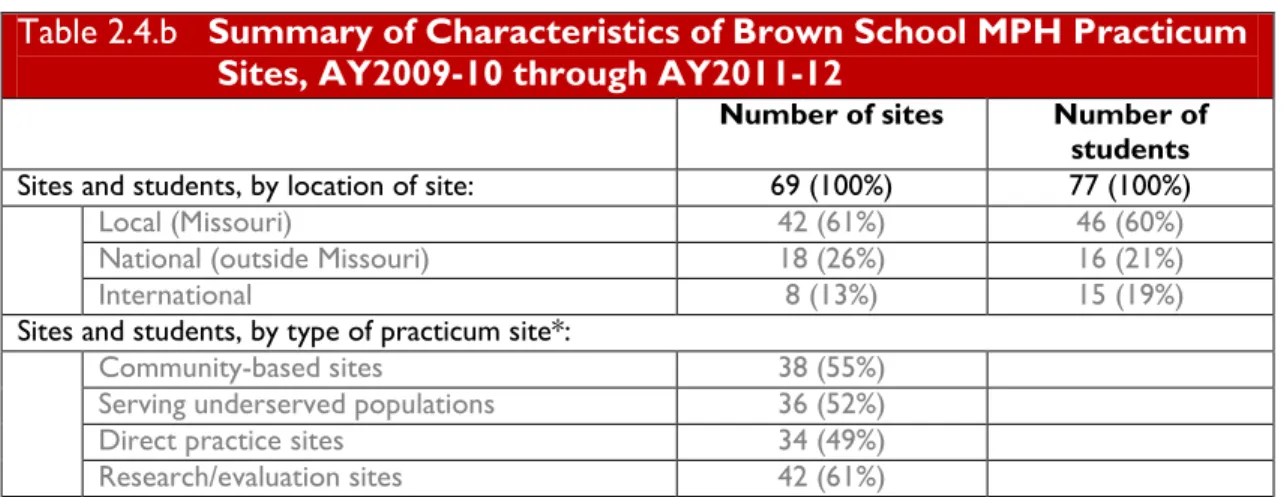
A comprehensive listing of practicum sites, field instructors (preceptors), degrees and corresponding public health specialty areas is summarized Table 2.4.b (a full list of practicum sites, by location and type of practicum site, is provided as Appendix Table 2.4.b.1). As indicated in the table, the Brown School’s practicum sites range across an impressive array of locations, with 18 sites (20%) located nationally (outside of Missouri) and 8 sites located internationally. The sites are of various types, providing students a wide range of practical experiences, including: community-based sites (55%), direct practice sites (49%), research/evaluation sites (61%) and sites serving underserved populations (52%). Appendix Table 2.4.b.2 provides further details on this enumeration.
Table 2.4.b
Summary of Characteristics of Brown School MPH Practicum
Sites, AY2009-10 through AY2011-12
Number of sites Number of
students
Sites and students, by location of site: 69 (100%) 77 (100%)
Local (Missouri) 42 (61%) 46 (60%)
National (outside Missouri) 18 (26%) 16 (21%)
International 8 (13%) 15 (19%)
Sites and students, by type of practicum site*:
Community-based sites 38 (55%)
Serving underserved populations 36 (52%)
Direct practice sites 34 (49%)
Research/evaluation sites 42 (61%)
NOTE: *Percentages add to more than 100%, since for several sites, one or more categories may apply to each site.
To date, no student has requested a waiver from practicum since the program began in Fall 2009.
2.4.b. Identification of agencies and preceptors used for practice experiences for students, by specialty area, for the past two academic years.
2.4.c. Data on the number of students receiving a waiver of the practice experience for each of the past three years.
To date, no student meeting the stated criteria for residency has enrolled in the program.
Strengths
• The Brown School MPH program delivers a practical experience to its students that helps them develop skills in basic public health concepts and demonstrate the application of these concepts through a practice experience.
• Even though the MPH program is relatively new, the students have had a wide array of practical experiences, including, not insignificantly, a dozen students who had
international health practical experiences in Africa, Asia and Europe.
• The MPH program has had the benefit of adding its practical experience program to the infrastructure of an Office of Field Education that has existed for decades at the Brown School. The program places an emphasis on skills in delivering great practical experiences for its students, and a huge array of relationships with many organizations that translate well from social work to public health.
Challenges
• The MPH program has faced some challenges in implementing a new practical
experience, appropriate for the MPH degree, into a School that has policies and practices adapted for a different degree program, and professional standards appropriate for that field, social work. However, the MPH program has benefited greatly from the many existing relationships that the Brown School has with health agencies, and so largely the MPH program has navigated this institutional change with few difficulties.
Future Plans
• The Brown School will continue to develop a wide array of relationships with employers seeking practicum students, as the demand for these relationships increases with the size of the student body.
• The program will continue to develop policies and procedures for the practical experience that maximize the quality of the experience for the students, their careers and the
preceptors supervising the students.
Criterion 2.4 is met.
2.4.d. Data on the number of preventative medicine, occupational medicine, aerospace medicine, and public health and general preventative medicine residents completing the academic program for each of the past three years, along with information on their practicum rotations.
2.5. Culminating Experience
Through Fall 2011, the culminating experience for the MPH program uses a model of a paper and an oral presentation on a public health topic identified by the student and approved by his/her advisor. In Fall 2011, the faculty approved a revision to this
culminating experience process, now put in place for students completing the culminating experience in Spring 2012 and beyond. This discussion first outlines the culminating experience in place during AY2010 and AY2011 through Fall 2011, and then briefly describe the newly-adopted culminating experience model.
Culminating Experience, Fall 2009-Fall 2011
After a lengthy discussion of the Brown Public Health Committee, the faculty decided that this method is the best and most efficient way of evaluating students’ attainment of the program competencies. Students are required to complete the culminating experience in the final semester of the MPH program. MPH students must have completed, or must be concurrently completing, their Public Health practicum in order to enroll in the MPH Culminating Experience course.
The culminating experience is based on a paper and presentation, summarizing a student’s work on a public health problem identified. The topic can involve data analysis and research, hypothetical program development or policy analysis, among other options. As outlined below, the work presented can build upon projects completed in a Transdisciplinary Problem-Solving (TPS) course, projects started as part of the student’s practicum or independent work completed in other experiences, but must be a unique and independent project completed by the study.
Students must present a proposal for their culminating experience topic and receive
approval by their advisor and the MPH Program Office. After that initial meeting, the MPH Program Office schedules regular check-in meetings for the students throughout the
semester.
Through the culminating experience, students will demonstrate their ability to communicate orally and in writing the lessons learned about a public health problem, integrating the tools learned throughout the MPH curriculum, as well as their experience working in a community or public health setting. Table 2.5.a presents the anticipated
2.5. Culminating Experience. All professional degree programs identified in the instructional matrix shall assure that each student demonstrates skills and integration of knowledge through a culminating experience.
Required Documentation. The self-study document should include the following: 2.5.a. Identification of the culminating experience required for each degree program.
If this is common across the program’s professional degree programs, it need be described only once. If it varies by degree or specialty area, sufficient information must be provided to assess compliance by each.
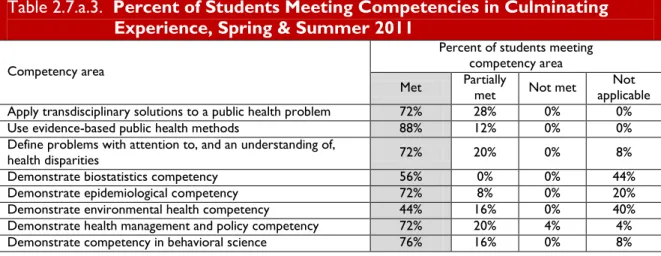
competencies and knowledge gained to be demonstrated by students in the culminating experience.
Culminating Experience Paper
The culminating experience paper shall be submitted by an individual student summarizing his/her work on a public health problem identified. The work presented as part of the culminating experience can be based on a project completed in a Transdisciplinary Problem-Solving (TPS) course, linked to projects started as part of his/her practicum, or independent work completed in other experiences but must build upon these experiences. If the work is based in part on team-based collaborative work prepared with peers, the work should reflect the individual’s contribution to this team’s work. Students can supplement the team’s work if they wish.
To ensure that students will be working on topics that will be approved by the program, students submit a proposal, not exceeding two pages, outlining their topic, to their advisor early in the semester. This must be approved by the advisor and the MPH Program Office for the student to be approved for completion of the culminating experience.
Table 2.5.a. Competencies and Knowledge Gained in the Culminating
Experience
Through the culminating experience, MPH students should be able to:
• apply transdisciplinary solutions to a public health problem, in a defined project, using appropriate analytical tools drawn from public health or other disciplines;
• define problems in a transdisciplinary way and develop shared conceptual frameworks from discipline-specific theories and models;
• describe how social, behavioral, environmental and biological conditions contribute to health outcomes using theoretical approaches drawn from diverse disciplines;
• demonstrate the ability to plan for the design, development, implementation or evaluation strategies or policies to improve individual and community health;
• develop and apply processes that integrate and promote transdisciplinary perspectives, contributions and collaboration;
• demonstrate professional demeanor in behavior and appearance; and
• demonstrate the ability to communicate transdisciplinary research evidence to key stakeholders to influence policy and practice.
Assessment
The culminating experience paper is assessed by the MPH student’s advisor (or a faculty member designated by the MPH program, if the student’s advisor is not a faculty member). Papers will be assessed as acceptable or unacceptable. Students who do not prepare a paper that is deemed to be acceptable shall have the opportunity to rewrite the paper, and
resubmit it. But in all cases, an acceptable paper needs to be completed before the scheduling of the oral examination.
Oral Presentation
In addition to producing a paper, each student prepares a brief presentation of his/her project to a panel of three individuals that includes a combination of MPH faculty, staff, community stakeholders or other interested parties. Specific guidelines for the oral presentation include the following:
• Presentations must not exceed 20 minutes with an additional 10 minutes of time for questions.
• In general, the format for the oral presentation should include the following: - Title
- Overview/Outline - Background - Project Methods - Results/Findings - Discussion/Conclusion
Assessment of Oral Presentation
Presentations are graded on the following criteria:
• The purpose for the project is clearly stated.
• The methods are clearly described and appropriate for the purpose of the project and draw upon the Foundations of Public Health.
• The results are presented clearly, using tables and figures if appropriate.
• The discussion relates the findings to the existing literature, identifies strengths and limitations, and describes implications for public health.
• The presentation is well organized and presented within the time allotted and the degree to which the student meets the competencies for the culminating experience.
• Meeting the five core public health areas, as well competencies in evidence-based public health, dissemination and implementation, and health disparities.
Presentations are assessed as pass or fail based on these criteria, by a majority vote of the panel observing the presentation. Students who do not pass the oral portion of the
culminating experience will have an opportunity to make the presentation again, before the end of the semester. Students will have only two opportunities to pass the culminating experience, but can appeal to the Associate Dean’s office for a third attempt under unique or unusual circumstances.
New Culminating Experience Process, Spring 2012 and Beyond
In Fall 2011, the faculty approved a new culminating experience for the MPH program after spending the summer reviewing the existing process, and seeking input from faculty,
administrators and students.
Under the new process (outlined in detail in a document provided in the Resource File), students must choose a Culminating Experience (CE) project that meets three guiding principles:
• the CE is a new, distinctive learning experiencefor students during their final semester of graduate study;
• The CE requires students to invest thought and effort in the practical application of Transdisciplinary Problem Solving using an integrative opportunity to develop a better understanding and/or solutions to complex public health challenges; and
• The CE is a forum for students to advance and display knowledge gainedin the Brown School MPH Program.
In addition, the CE project must follow at least one of the following tracks: (a) evidence-based program evaluation or promotion, (b) evidence-evidence-based policy analysis or promotion, (c) primary or secondary data collection and analysis. Students will work independently to produce a project and poster of professional conference standard. Finally, students complete the following path to a successful CE that incorporates four required steps:
• writing a two-page project proposal,
• completing a 500-word project abstract,
• development of a poster for the presentation of the work, and
• completion of a poster presentation.
Further details are provided in the Resource File. No students to date have completed their CE using this new process.
Strengths
• The culminating experience allows the students to show their ability to integrate and apply knowledge gained during the program to a topic of interest to them, while incorporating transdisciplinary public health skills and competencies.
• The culminating experience allows students to gain experience writing and presenting in a professional format.
Challenges
• Because topics are student-selected, not every competency in public health appears to apply to every topic selected.
• The grading rubric chosen has not been as clear to reviewers and advisors as it could have been for the completion of successful culminating experiences.
Future Plans
• The Brown School MPH program plans to provide students with more detailed information regarding the culminating experience, its guidelines and expectations during the middle of the semester prior to their enrollment in the culminating experience in order to allow more time for students to develop their ideas.
• The faculty plan completed plans to create a new format for the culminating experience and will monitor the implementation of the new Culminating Experience for AY2012.
2.6. Required Competencies
The Brown School’s MPH program uses competency‐based planning to drive curriculum development. The curriculum ensures that students will achieve these
competencies through coursework, the practice experience and the culminating experience. In this curriculum, MPH students must satisfy competency requirements in the five core public health areas. In addition, the faculty devised program competencies to capture the key elements of our mission statement, including transdisciplinary problem-solving and evidence-based public health, and diversity, culture and health disparities. Finally, students are required to obtain competencies in communication and informatics; leadership,
professional and ethics; and program planning.
MPH Core Competencies
Transdisciplinary Problem SolvingThe ability to develop and apply a transdisciplinary approach in identifying public health problems and solutions is increasingly critical to public health practice. Transdisciplinary problem-solving methods require applying a shared disciplinary framework to the analysis of complex public health problems, drawing from an understanding of the interaction of disciplinary approaches from the biological, behavioral, social and public health sciences. Competencies: Upon graduation, a student with an MPH should be able to:
• Explain why the complex, multifactorial nature of problems in public health and health disparities requires a transdisciplinary approach.
• Describe how social, economic, behavioral, environmental and biological conditions contribute to health outcomes using theoretical approaches drawn from diverse disciplines.
• Distinguish the features of transdisciplinary collaboration.
• Develop and apply processes that integrate and promote transdisciplinary perspectives, contributions and collaboration.
2.6. Required Competencies. For each degree program and area of specialization within each program identified in the instructional matrix, there shall be clearly stated competencies that guide the development of educational programs.
Required Documentation. The self-study document should include the following: 2.6.a. Identification of core public health competencies that all MPH or equivalent
professional master’s degree students are expected to achieve through their courses of study.
• Define problems in a transdisciplinary way and develop shared conceptual frameworks from discipline-specific theories and models.
• Apply transdisciplinary solutions to public health problems using appropriate analytical tools drawn from public health or other disciplines.
• Explain how genetics and genomics affect disease processes and their role in public health policy and practice.
Evidence-Based Public Health
Evidence-based public health is the process of integrating science-based interventions with community preferences to improve the health of populations.
Competencies: Upon graduation, a student with an MPH should be able to:
• Identify sources of evidence-based information related to public health research, policy and practice.
• Evaluate the quality of evidenced-based public health information.
• Identify the various types of evidence that influence decisions in public health practice.
• Understand the barriers encountered when translating scientific evidence to practice in public health settings.
• Recognize effective methods for translating evidence-based interventions in practice and policy settings.
• Understand the importance of obtaining community input before planning and implementing evidence-based interventions.
• Explain the importance of leadership from public health professionals regarding the need for and relevance of evidence-based interventions.
Biostatistics
Biostatistics is the development and application of statistical reasoning and methods in addressing, analyzing and solving problems in public health; health care; and biomedical, clinical and population-based research.
Competencies: Upon graduation, a student with an MPH should be able to:
• Describe how biostatistics is used in public health.
• Understand the basic concepts of probability, variation and inference.
• Apply descriptive and inferential techniques according to the type of study design for answering a particular research or practice question.