Earth Observation and Geomatics Engineering 3(1) (2019) 34–42
__________
* Correspondingauthor
E-mail addresses:[email protected](S.Gholinejad);[email protected]
(
A. Alizadeh Naeini);[email protected](A.R. Amiri-Simkooei)DOI: 10.22059/eoge.2019.282476.1049
34
ABSTRACT
The existence of both ill-posedness and overparameterization phenomena in the rational function model (RFM), makes it difficult to determine rational polynomial coefficients (RPCs). In this regard, Meta-heuristic algorithms have been widely used. Despite the extensive efforts in this field, it is still challenging to find optimum structures of RFM due to the above-mentioned phenomena. The existing meta-heuristic methods focus on overparameterization and try to remove some unnecessary RPCs using binary particles. Although solving overparameterization can automatically address the ill-posedness phenomenon, meta-heuristics do not achieve desired results by solely focusing on overparameterization. Therefore, it seems necessary to consider both ill-posedness and overparameterization phenomena to achieve an optimum structure of the RFM. Accordingly, in this study, a bi-objective particle swarm optimization (PSO) algorithm, namely BOPSO-RFM, is proposed to determine the optimum RFM structure. This method has two objective functions that should be minimized: 1) the Root Mean Square Error (RMSE) over some of the ground control points (GCPs), and 2) the maximum Pearson correlation coefficient between the columns of the design matrix, each of which corresponding to one of RPCs. While binary meta-heuristic algorithms mostly address the overparameterization phenomenon by considering binary particles and calculating the RMSE over some GCPs, the added objective function tries to address ill-posedness. Experiments conducted on three high-resolution datasets show that the proposed method has led to average improvements of 95% and 29% in terms of accuracy and RMSE values and 99% and 76% improvements in terms of stability, over well-known PSORFO and the state-of-the-art PSO-KFCV method, respectively. Moreover, the analysis of the final design matrix obtained from the final RFM structure revealed that the average of condition numbers corresponding to the BOPSO-RFM results had been 1.14e+9 and 7.39e+4 times lower than those of PSORFO and PSO-KFCV.
S
KEYWORDS
Rational Function Models (RFMs)
Particle Swarm Optimization (PSO)
Ill-posedness and over-parameterization phenomena
Multi-objective optimization
1. Introduction
Obtaining accurate spatial information from satellite images is very important for a wide range of remote sensing applications that requires the use of appropriate models for mapping between image and earth spaces. In this regard, Rational Function Models(RFMs) are widely used in remote sensing communities for georeferencing of satellite images. These models use polynomials, usually of order three, to
apply image-to-earth mapping and vice versa. These models are independent of the sensor type and are also compatible with any coordinate and projection system (Tao & Hu, 2001). In addition, since there is no explicit relationship between the RFM parameters, known as Rational Polynomial Coefficients (RPCs), and sensor orbital information, this information will be confidential using RFM (Valadan Zoej et al., 2007).
The RFMs are divided into two main categories:
terrain-w e b s i t e : h t t p s : / / e o g e . u t . a c . i r
Handling ill-posedness and overparameterization of rational function
model using Bi-objective particle swarm
optimization
Saeid Gholinejad 1, Amin Alizadeh Naeini 1*, AliReza Amiri-Simkooei 1, 2
1 Department of Geomatics Engineering, Faculty of Civil Engineering and Transportation, University of Isfahan, Isfahan, Iran
2 Acoustics Group, Faculty of Aerospace Engineering, Delft University of Technology, P.O. Box 5058, 2600 GB Delft, The Netherlands
Article history:
35 independent models and terrain-dependent models. In
terrain-independent models, vendor-provided RPCs that are obtained using GPS, INS information, and stellar cameras mounted on the sensor (Alizadeh Naeini et al., 2017) are available to satellite images users. In terrain-dependent models, which is the main focus of this study, RPCs are determined using some ground control points (GCPs). Existing a lot of unnecessary and highly correlated RPCs, estimating accurate RPCs in the latter models encounters with two overparameterization and ill-posedness phenomena (Long et al., 2015; Alizadeh Moghaddam et al., 2018a; Gholinejad et al., 2019). Finding the optimum number of parameters allows for solving these two problems simultaneously. A wide range of regularization-based methods have been presented in the literature to solve these problems. These methods can be categorized into 𝑙2, 𝑙0, and
𝑙1 regularized approaches.
The 𝑙2-regularization methods try to reduce the effect of ill-posedness of the design matrix in determining the RPC coefficients. In the procedure of estimating RPCs through the least-squares method, the values of RPCs are enlarged unreasonably due to the ill-posedness of the design matrix. Hence, in the methods mentioned earlier, the 𝑙2 norm of RPCs is imposed on the main RFM problem to handle the enlargement of RPCs. The most important methods available in this category are L-curve based ridge estimation (Yuan & Lin, 2008), the Levenberg–Marquardt (LM) algorithm (Zhou et al., 2012), and a combinatorial method based on LM and QR factorization with element pivoting (Wu & Ming, 2016). As previously mentioned, RFM contains a large number of unnecessary parameters. Consequently, it seems necessary to remove some of the RPCs to improve the RFM structure. Accordingly, 𝑙0 regularization based methods, which impose the 𝑙0 norm of RPCs to the objective function of the RFM problem, are proposed. Resulting in a sparse solution, the 𝑙0 norm minimization can indirectly detect and eliminate unnecessary RPCs. Despite the excellent capability in detecting optimum RPCs, this minimization problem is a non-convex NP-hard one. Therefore, it cannot be solved by computational convex solvers. To solve this problem, one of the strategies presented is the replacement of the 𝑙0 norm with its relaxation alternative, the 𝑙1 norm, in which the problem is convex and has many deterministic solvers (Long et al., 2015). However, in order to directly achieve the 𝑙0 regularization, there are two general categories of methods in the RFM literature: computational variable selection methods and meta-heuristic methods (Gholinejad et al., 2019).
As their name implies, the methods that select computational variables seek to eliminate a number of RPCs based on computational techniques. The most important computational variable selection methods include direct removal of the third-order coefficients from an RFM
structure (Li-ping et al., 2007), the use of scatter matrices and the elimination transformation to detect optimum coefficients (Zhang et al., 2012), the nested regression-based optimal selection method (Tengfei et al., 2014), t-student based statistical models (Alizadeh Moghaddam et al., 2017) and their improved versions, and finally the uncorrelated and statistically significant RFM (USS-RFM) methods.
Meta-heuristic algorithms are nature-inspired methods, dealing with non-convex, nonlinear, and multimodal problems subject to linear or nonlinear constraints with continuous, discrete, or binary decision variables (Cuevas et al., 2018). These algorithms are of great attention among researchers in different sciences because they are capable of obtaining results close to a global optimum. These algorithms are essentially applied in problems with high computational complexities. Accordingly, they can be useful in determining optimum RPCs in the RFM structure. The binary version of meta-heuristic algorithms, especially genetic algorithm (GA) (Sastry et al., 2005) and particle swarm optimization (PSO) (Kennedy, 2010), are the widely used form in the RFM literature. A wide range of methods have been presented for RFM optimization based on GA (Valadan Zoej et al., 2007;Jannati & Valadan Zoej, 2015; Jannati et al., 2017) and PSO (Yavari et al., 2013;Alizadeh Moghaddam et al., 2018b; Gholinejad et al., 2019) algorithms.
In all of the meta-heuristic methods used for RFM optimization, each agent contains 78 bits (equal to the number of RPCs in the third-order RFM problem). These bits are filled with zero and one values, indicating the absence and presence of the corresponding RPC in the RFM structure. Then, RPCs’ values are calculated via the least squares method. The cost value for that agent is determined by calculating the root mean squares error (RMSE) over a group of ground control points (GCPs), called dependent checkpoints (DCPs). In this way, by focusing on the over-parameterization phenomenon, some unnecessary RPCs are eliminated during an iterative procedure in meta-heuristic algorithms. Although achieving the optimal number of RPCs solve the ill-posedness phenomenon automatically, focusing just on one of the phenomena, i.e., overparameterization, cannot lead to the optimal solution. Therefore, it seems necessary to simultaneously focus on both over-parameterization and ill-posedness phenomena. Therefore, in this regard, a bi-objective PSO algorithm for RFM optimization, namely BOPSO-RFM, has been proposed.
PSO improved version of is an
This method -KFCV
Earth Observation and Geomatics Engineering 3(1) (2019) 34–42
36 problem of ill-posedness, while the use of binary particles
reduces the effect of the overparameterization phenomenon.
The flow diagram of the proposed method is shown in Figure (1).
The remaining of this paper is organized as follows; the basis of the RFM, PSO, and MOPSO are introduced in section 2. In section 3, the details of the BOPSO-RFM are presented. Implementation and experimental results are described in section 4. The concluding remarks of this study are presented in section 5.
2. Preliminaries
2.1. Rational Function Model (RFM)
RFM is a mathematical model, consisting of two equations, in which image pixel coordinates are defined as functions of ground coordinates as follows:
1
2 , , , ,
P X Y Z
P X Y Z
(1)
3
4 , , , ,
P X Y Z
s
P X Y Z
(2)
where (𝑙‚𝑠) are normalized image coordinates, (𝑋‚𝑌‚𝑍) are normalized ground coordinates, and (𝑃1‚ … ‚ 𝑃4) are usually third-order polynomials. There are 20 coefficients in each polynomial and 80 RPCs in the RFM structure. Since the constant coefficients of the 𝑃2 and 𝑃4 are dependent, their values are considered to be equal to 1, and therefore there exist 78 RPCs in the third-order RFM.
After linearizing equations (1) and (2) using GCPs, the final form of the RFM is as follows:
lAxe (3) where 𝐴 ∈ 𝑅2𝑛×78, 𝑙 ∈ 𝑅2𝑛×1, and 𝑒 ∈ 𝑅2𝑛×1 are design matrix, observations vector, and residuals vector, respectively. Moreover, 𝑥 ∈ 𝑅78×1 is the vector of RPCs. RPCs are determined using the least-squares method in the bellow form:
37
T
1 Tx A A A l
(4)
2.2. Particle Swarm Optimization (PSO)
PSO, which is a swarm intelligent computational algorithm, optimizes a problem by iteratively improving a candidate solution according to a cost function (Kennedy, 2010). In order to move toward the global optimum solution, each particle should move according to its best memory
(lBest), the best particle among all particles (gBest) and its
current velocity. Mathematically, the new position of each particle is calculated as follows:
1 1
k k k
i i i
T T V (5)
where 𝑇𝑖𝑘, 𝑇𝑖𝑘+1, and 𝑉𝑖𝑘+1 are respectively current position, new position, and updated velocity of the 𝑖th particle in the 𝑘th iteration. The 𝑉𝑖𝑘+1 is calculated as follows:
1
1 1( ) 2 2( )
k k k k
i k i i i
V V c r lBestT c r gBestT (6)
where 𝑐1 and 𝑐2 are two constant acceleration values, 𝑟1 and 𝑟2 are uniform random values, and 𝜔𝑘 is the time-varying inertia weight function calculated as:
max
min max min
max
( )
k
k k
k
(7)
In equation (7), 𝜔𝑚𝑖𝑛 and 𝜔𝑚𝑎𝑥 are two predefined values, maximum values of the respectively, for minimum and
inertia weight. Furthermore, 𝑘𝑚𝑎𝑥 is the number of iterations in the PSO algorithm.
2.3.Multi-Objective PSO (MOPSO)
The MOPSO algorithm is a generalized form of the PSO algorithm for multi-objective problems, inspired by the idea of PESA-II(Corne et al., 2001). In the MOPSO algorithm, a new concept is introduced, calledrepository. This repository is an archive of non-dominant solutions; in other words, there is no solution among the extracted ones that is better than the solutions in the repository. The repository is a limited size space, and its members form the Pareto front (i.e., is an approximation of the Pareto front).
The position and velocity updating equations for MOPSO particles are similar to those of the PSO. However, the process differs for some of the parameters. The velocity parameters and the constant acceleration coefficients are the same. However, the processes of selecting gBest and updatinglBestare different as well. In this algorithm,gBest is not a constant particle. Moreover, each of the particles chooses one of the repository members as gBest at the moment of the movement. In the MOPSO algorithm, gBest is known as the leader.
In MOPSO, a region-based process is used to select a
leader. Among the solutions in the repository, the solution that leads to more regularization and more uniform distribution of points on the Pareto front is more suitable than the other solutions. In order to find this solution, the MOPSO algorithm should segment the solution space into several regions. An inflation rate (𝛼) is usually used for determining the size of regions in the segmentation process. After segmenting the solution space, the roulette wheel selection algorithm (Goldberg, 1989) is used to select the leader. Since the roulette wheel selection approach deals with probabilities, a probability value must be determined for each solution within the repository. These probabilities are obtained according to the regions of the solutions using the Boltzmann probability function (Landau & Lifshitz, 1980) as follows:
Leader N
i
P e (8)
where 𝑃𝑖𝐿𝑒𝑎𝑑𝑒𝑟 is the probability value of the 𝑖th solution within the repository to be selected as the leader. 𝛽 and 𝑁 are, respectively, the leader selection pressure and the number of members in the solution region.
Another point about the MOPSO algorithm is the repository overflow. Since the size of the repository is limited, some non-dominant responses should be removed when the repository space is full. Similarly, to determining the leader, the solutions that increase the regularization and uniform distribution of the Pareto front are preferable to be maintained. Therefore, their deletion probabilities should be lower than those of others. Then, the Boltzmann probability function is re-applied to calculate the deletion probabilities of the solutions within the repository as follows:
Deletion N i
P e (9)
where 𝑃𝑖𝐷𝑒𝑙𝑒𝑡𝑖𝑜𝑛 is the deletion probability of the 𝑖th solution and 𝛾 is the deletion selection pressure.
For updating the lBest value, among the updated position of the particles and the previous lBest, the one that dominates another is assigned as the new lBest. If none of them are dominant, one of them is randomly selected as the new lBest.
3.Bi-Objective PSO for RFMOptimization
Meta-heuristic algorithms are used to determine the
Earth Observation and Geomatics Engineering 3(1) (2019) 34–42
38 using equation (4). They are evaluated using the control
points, called DCPs. DCPs are either initially separated from TCPs or, as in the PSO-KFCV method (Gholinejad et al., 2019), they can be a part of the TCPs. RMSE commonly evaluates the particles. In other words, the obtained RMSE values are the costs of the particles. During an iterative procedure, the algorithm tends to the particle with the lowest cost value. Finally, some control points, called independent checkpoints (ICPs), are applied to the final evaluation of the meta-heuristic algorithm.
In such RPC determination approaches, the main goal is to deal with the problem of overparameterization. However, a sole focus on this problem cannot lead to desirable results. Accordingly, this paper proposes a BOPSO-RFM method. In this method, the structure of the particles is the same as those of traditional methods. However, in the proposed method, two cost functions are used: 1) RMSE over DCPs, and 2) the maximum 𝑟 value between the design matrix columns. These two functions are not compatible, i.e., minimizing the first function dominates the minimization of the second one. Therefore, one has to consider these two functions separately in different objective functions.
In the proposed method, for a particle, the RMSE value is exactly calculated as what was conducted in the PSO-KFCV. To calculate the second cost value, after the formation of the design matrix with the remaining RPCs corresponding to the particle, the 𝑟 values are calculated between their columns. The maximum 𝑟 value is considered as the second cost value. After completing the algorithm and forming the Pareto front, the non-dominant solutions are determined. In the last step of the algorithm, the difference between RMSE and 𝑟 values is not significant. Therefore, the total cost of the non-dominant solutions is the sum of RMSE and 𝑟 values. Finally, among the non-dominant solutions, the solution with the minimum total cost is chosen as the final solution.
4. Experimental Results
In this study, the experiments conducted on three high-resolution datasets, whose details are provided in Table 1. These datasets were acquired by different high-resolution satellite imageries over the Isfahan province, Iran.
The well-known PSORFO(Yavari et al., 2013)and state-of-the-art PSO-KFCV (Gholinejad et al., 2019) methods were considered as the competing methods for evaluating the proposed BOPSO-RFM. PSORFO was the first PSO-based method presented in the RFM literature, in which binary particles were used to determine the presence or absence of the RPCs in the RFM structure. Before PSORFO, GA based methods were applied for RFM optimization. PSORFO showed the superiority of PSO against GA in both accuracy and the computational load. Since PSO-based algorithms were significantly sensitive to the initial values and GCPs distribution, PSO-KFCV has been recently used to improve
Table 1. Details of Datasets used in this study.
Data set Sensor GSD (m) No. of GCPs
Geo-ISF GeoEye-1 0.5 70
PL-ISF Pleiades 0.5 70
WV-ISF WorldView-3 0.41 65
Table 2. Parameters of the competing and proposed methods.
Population Size 30
V 𝑣𝑚𝑖𝑛
-3
𝑣𝑚𝑎𝑥 3
𝜔 𝜔𝑚𝑖𝑛 0.02
𝜔𝑚𝑎𝑥 1
Number of Iterations 200
𝑐1 1.5
𝑐2 1.5
Repository Size 100
Inflation Rate (𝛼) 0.1
Leader Selection Pressure (𝛽) 2 Deletion Selection Pressure (𝛾) 2
the accuracy and stability of the PSO-based algorithm. Its results showed that it is more reliable than other previously proposed PSO-based methods such as PSORFO and FCA-PSO(Alizadeh Moghaddam et al., 2018b).
The parameters of the competing methods are listed in Table (2). A number of these parameters are applied in all methods, but some of them are specific to the BOPSO-RFM method, including𝛼,𝛽, and𝛾.
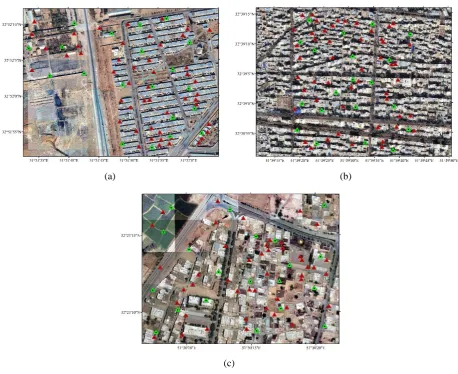
The RMSE metric was used to evaluate the results of different methods. Since the meta-heuristic algorithms have different results in different repetitions, each experimental method was executed 10 times. The average RMSE value (Avg-RMSE) of these ten repetitions was calculated as the accuracy criterion, and the standard deviation (Std-RMSE) was calculated as the stability criterion for each algorithm. In the experiments, conducted on each dataset, 10, 15 and 20 well-distributed GCPs were used for training (i.e., as TPCs+DCPs) and the rest as ICPs. The distributions of training GCPs, along with ICPs for different datasets, are shown in Figure (2). In each experiment, 80% of training GCPs have been considered as TCPs and the rest as DCPs.
The results obtained from the implementation of different
39 accuracies. In most cases, BOPSO-RFM reported higher
accuracies compared to PSO-KFCV (6 out of 9 cases). In all cases, the BOPSO-RFM method reported less than 2 pixels.
In cases that PSO-KFCV outperformed BOPSO-RFM, the differences between their Avg-RMSE values were very low
and almost negligible. The overall analysis of Avg-RMSE values shows average improvements of 95% and 29% in BOPSO-RFM results compared to those of the PSORFO and PSO-KFCV methods, respectively.
Table 2. Result obtained from the implementation of different methods on different datasets.
Data Set Training GCPs\ICPs
Avg-RMSE Std-RMSE Condition Number
PSORFO PSO-KFCV
BOPSO-RFM PSORFO
PSO-KFCV
BOPSO-RFM PSORFO
PSO-KFCV
BOPSO-RFM
Geo-ISF
10\60 28.1096` 3.0294 1.3428 37.3389 2.2885 0.5476 1.76E+11 1.77E+11 5.82E+04 15\55 17.3729 2.0247 1.1046 20.5941 1.0473 0.2715 4.65E+12 7.20E+09 3.37E+04 20\50 7.7916 0.7912 0.7823 6.5033 0.1823 0.1590 6.95E+12 1.16E+06 6.66E+04
PL-ISF
10\60 135.5845 1.6768 1.9274 247.8914 0.5867 0.4907 4.82E+12 1.04E+11 5.59E+04 15\55 2.1587 0.9858 1.1745 0.9658 0.1300 0.3397 5.65E+09 4.32E+09 3.93E+04 20\50 18.7525 1.3520 1.2378 26.4801 0.5356 0.5791 3.61E+11 9.84E+06 2.86E+06
WV-ISF
10\55 17.4745 3.4616 1.4122 19.7434 7.3195 0.1859 2.33E+11 5.64E+08 9.38E+04 15\50 15.0276 1.2757 0.9898 34.4586 0.7553 0.1725 4.48E+15 1.32E+06 1.15E+05 20\45 25.4278 1.0506 1.1113 22.1870 0.2878 0.3401 6.82E+12 9.13E+05 6.43E+05
(a) (b)
(c)
Earth Observation and Geomatics Engineering 3(1) (2019) 34–42
40 From the stability viewpoint, as for accuracy analysis,
PSORFO had poor performance compared to the other two methods. However, the PSO-KFCV and BOPSO-RFM methods both produced proper results, and in most cases, reported Std-RMSE values less than 1 pixel. These values indicate the high stability of these two methods against the initial values. In two cases, i.e., Geo-ISF with 10 training GCPs and WV-ISF with 10 training GCPs, PSO-KFCV reported almost high Std-RMSE values, while BOPSO-RFM provided Std-RMSE values less than 0.6 pixels in all cases indicating the high stability of this algorithm to initial values. Finally, a general analysis of the Std-RMSE values showed that BOPSO-RFM led to an average improvement of 76% compared to the PSO-KFCV method.
The third part of the experiments was assigned to condition number analysis. A condition number, which is the ratio of the largest Eigenvalue of a matrix to the smallest one, is a parameter that represents the degree of ill-posedness of that
matrix. The closer this value to one is, the lower the degree of ill-posedness will be. As shown in Table (3), the BOPSO-RFM method succeeded in reducing the amounts of condition numbers of the final design matrix to a large extent. In other words, BOPSO-RFM successfully alleviated the ill-posedness phenomenon compared to PSORFM and PSO-KFCV. In general, the average of condition numbers of BOPSO-RFM was 1.14e+9 and 7.39e+4 times lower than those of PSORFO and PSO-KFCV.
Furthermore, Figure (3) illustrates the maximum 𝑟 values between the columns of the final design matrices, which correspond to the final solutions of the different methods. As shown in the figure, there were 10 repetitions per experiment. Same as the condition number, the maximum 𝑟 value is also a metric of ill-posedness of the final design matrix. As seen in Figure (3), in most cases, the maximum 𝑟 value for the BOPSO-RFM method was better than that of the other two competing methods.
4.Conclusions
The existence of two overparameterization and ill-posedness phenomena in the RFM problems significantly affects the accuracy of the georeferencing process of satellite images. These two phenomena are highly dependent, such that solving an overparameterization problem resolves the ill-posedness phenomenon automatically. In recent years,
meta-heuristic algorithms, especially GA and PSO, have
been widely considered for finding the optimum structure of the RFM method. The presented methods in the literature mainly focus on solving overparameterization by considering binary versions of meta-heuristic algorithms. Although these methods have been somewhat successful in removing some unnecessary RPCs, as the condition numbers and maximum correlation analysis of PSORFO and PSO-KFCV have shown, the problem ofill-posedness still exists
(a) (b) (c)
41 in RFM problems. These two methods are considered as two
powerful tools for RFM optimization.
Regarding the problem mentioned above, a bi-objective PSO-based RFM optimization method, called BOPSO-RFM, was presented in this study to alleviate the ill-posedness phenomenon in RFM problems. As the method’s name implies, two objective functions were used in this method: RMSE over DCPs and the maximum correlation between the columns of the final design matrix. While the first objective function is common between different meta-heuristic based methods, the second objective function solely focuses on the ill-posedness to reduce the impact of this phenomenon.
The experiments were conducted on three high-resolution satellite datasets from three different sensors. The condition numbers of the final design matrices, formed by extracted particles of different methods, showed that the BOPSO-RFM method was significantly effective in alleviating the ill-posedness problem in the RFM optimization compared to the PSORFO and PSO-KFCV methods. Moreover, involving both overparameterization and ill-posedness phenomena, the BOPSO-RFM method provided higher accuracies, whose results were closer to the global optimum. Furthermore, the results demonstrated that the proposed method was more stable and reliable than the PSORFO and PSO-KFCV methods.
Although the proposed method could somewhat overcome the problem of optimization in the RFM optimization and increase the accuracy of final results, its reported condition numbers were still far from the ideal condition number, i.e., the condition number equal to 1. Accordingly, in the future works, one should focus on incorporating other suitable objective functions or other optimization procedures into the RFM optimization problem to further reduce the ill-posedness, and subsequently, increase the accuracy of the RFM optimization results.
References
Alizadeh Moghaddam, S. H., Mokhtarzade, M., Alizadeh Naeini, A., & Amiri-Simkooei, A. (2018a). A Statistical Variable Selection Solution for RFM Ill-Posedness and Overparameterization Problems. IEEE Transactions on
Geoscience and Remote sensing, 56 (7),3990-4001.
Alizadeh Moghaddam, S. H., Mokhtarzade, M., Alizadeh Naeini, A., & Moghaddam, S. A. (2017). Statistical method to overcome overfitting issue in rational function models.International Archives of the Photogrammetry,
Remote Sensing\& Spatial Information Sciences, 42,
1-4.
Alizadeh Moghaddam, S. H., Mokhtarzade, M., & Moghaddam, S. A. A. (2018b). Optimization of RFM's Structure Based on PSO Algorithm and Figure Condition Analysis.IEEE Geoscience and Remote Sensing Letters, 15 (8), 1179-1183.
Alizadeh Naeini, A., Alizadeh Moghaddam, S. H., Mirzadeh, S. M. J., Homayouni, S., & Fatemi, S. B.
(2017). Multiobjective Genetic Optimization of Terrain-Independent RFMs for VHSR Satellite Images. IEEE
Geoscience and Remote Sensing Letters, 14 (8),
1368-1372.
Coello, C. A. C., Pulido, G. T., & Lechuga, M. S. (2004). Handling multiple objectives with particle swarm optimization. IEEE Transactions on evolutionary
computation, 8 (3), 256-279.
Corne, D. W., Jerram, N. R., Knowles, J. D., & Oates, M. J. PESA-II: Region-based selection in evolutionary multiobjective optimization. In: Proceedings of the 3rd Annual Conference on Genetic and Evolutionary Computation, 2001. Morgan Kaufmann Publishers Inc., pp 283-290.
Cuevas, E., Zaldívar, D., & Pérez-Cisneros, M. (2018) Advances in Metaheuristics Algorithms: Methods and Applications. Springer.
Gholinejad, S., Alizadeh Naeini, A., & Amiri-Simkooei, A. (2019). Robust Particle Swarm Optimization of RFMs for High-Resolution Satellite Images Based on K-Fold Cross-Validation. IEEE Journal of Selected Topics in
Applied Earth Observations and Remote Sensing,
Goldberg, D. E. (1989). Genetic algorithms in search, optimisation and machine learning. Reading, Addison,
Wesley,
Jannati, M., & Valadan Zoej, M. J. (2015). Introducing genetic modification concept to optimize rational function models (RFMs) for georeferencing of satellite imagery. GIScience \& Remote Sensing, 52 (4), 510-525. Jannati, M., Valadan Zoej, M. J., & Mokhtarzade, M. (2017). A Knowledge-Based Search Strategy for Optimally Structuring the Terrain Dependent Rational Function Models. Remote Sensing, 9 (4), 345.
Kennedy, J. (2010). Particle swarm optimization.
Encyclopedia of machine learning, 760-766.
Landau, L., & Lifshitz, E. (1980) Statistical physics, part 1: Volume 5 (course of theoretical physics, volume 5). third edn. Butterworth-Heinemann.
Li-ping, Z., Feng-de, L., Jian, L., & Wei, W. (2007). Research on reducing term of higher order in RFM model [J]. Science of Surveying Mapping, 4, 007.
Long, T., Jiao, W., & He, G. (2015). RPC Estimation via $\ell_1 $-Norm-Regularized Least Squares (L1LS).
IEEE Transactions on Geoscience and Remote sensing,
53 (8), 4554-4567.
Sastry, K., Goldberg, D., & Kendall, G. (2005) Genetic algorithms. In: Search methodologies. Springer, pp 97-125
Tao, C. V., & Hu, Y. (2001). A comprehensive study of the rational function model for photogrammetric processing.
Photogrammetric Engineering \& Remote Sensing, 67
(12), 1347-1358.
Tengfei, L., Weili, J., & Guojin, H. (2014). Nested regression based optimal selection (NRBOS) of rational polynomial coefficients. Photogrammetric Engineering
\& Remote Sensing, 80 (3), 261-269.
Valadan Zoej, M., Mokhtarzade, M., Mansourian, A., Ebadi, H., & Sadeghian, S. (2007). Rational function
using genetic algorithms.
optimization International and Observation Earth Applied of Journal
42 Wu, Y., & Ming, Y. (2016). A fast and robust method of
calculating RFM parameters for satellite imagery.
Remote Sensing Letters, 7 (12), 1112-1120.
Yavari, S., Zoej, M. J. V., Mohammadzadeh, A., & Mokhtarzade, M. (2013). Particle swarm optimization of RFM for georeferencing of satellite images. IEEE
Geoscience and Remote Sensing Letters, 10 (1), 135-139.
Yuan, X., & Lin, X. (2008). A method for solving rational polynomial coefficients based on ridge estimation.
Geomatics Information Science of Wuhan University, 33
(11), 1130-1133.
Zhang, Y., Lu, Y., Wang, L., & Huang, X. (2012). A new approach on optimization of the rational function model of high-resolution satellite imagery. IEEE Transactions
on Geoscience and Remote Sensing, 50 (7), 2758-2764.
Zhou, Q., Jiao, W., & Long, T. (2012). Solution to the rational function model based on the Levenberg-Marquardt algorithm. Paper presented at the Fuzzy Systems and Knowledge Discovery (FSKD), 2012 9th
International Conference on,