Implementation of a skilled nursing
facility readmission review process
Mallika L Mendu,1,2 Constantinos I Michaelidis,3 Michele C Chu,1 Jasdeep Sahota,4 Lauren Hauser,4 Emily Fay,4 Aimee Smith,5 Mary Ann Huether,5 John Dobija,6 Mark Yurkofsky,6 Charles T Pu,7 Kathryn Britton1,8
To cite: Mendu ML, Michaelidis CI, Chu MC, et al. Implementation of a skilled nursing facility readmission review process.BMJ Open Quality 2018;7:e000245. doi:10.1136/ bmjoq-2017-000245
►Additional material is published online only. To view please visit the journal online (http:// dx. doi. org/ 10. 1136/ bmjoq- 2017- 000245).
Received 1 November 2017 Revised 28 May 2018 Accepted 30 June 2018
For numbered affiliations see end of article.
Correspondence to Dr Mallika L Mendu; mmendu@ partners. org © Author(s) (or their employer(s)) 2018. Re-use permitted under CC BY-NC. No commercial re-use. See rights and permissions. Published by BMJ.
AbstrAct
30-day readmissions for patients at skilled nursing facilities (SNF) are common and preventable. We implemented a readmission review process for patients readmitted from two SNFs, involving an electronic review tool and monthly conferences. The electronic review tool captures information related to preventability and factors contributing to readmission. The study included 128 patients, readmitted within 30 days from 1 October 2015 through 1 May 2017, at a tertiary care academic medical centre in Boston, MA, and two partnering SNFs. There was a discrepancy in preventability rating between SNF and hospital reviewers, with 79.7% of cases rated not preventable by the SNF, and 58.6% by the hospital. There was moderate positive correlation between the hospital’s and SNFs’ preventability ratings (rs=0.652, p<0.001). In most cases, the SNF reviewers felt that no factors contributed (57.8%), and hospital reviewers felt that issues with end-of-life planning (14.1%) and medical complexity (12.5%) were major factors. Despite the lack of strong correlation between SNF and hospital responses, several cross-continuum quality improvement projects were developed. We found that implementation of a SNF readmission review process employing bidirectional review by SNF and hospital was feasible, and facilitated systems-based improvement in the transition from hospital to postacute care.
InTroducTIon
Readmission within 30 days of hospital discharge is common, affecting 20% of Medi-care beneficiaries,1 and skilled nursing facili-ties (SNF) are the most common setting for postacute care in the USA.2 Medicare patients discharged to a SNF have a 25% likelihood of readmission within 30 days.2 In a review of 200 discharges to SNFs, 67% were rated as poten-tially preventable.3 A survey of SNF sions showed that patients felt that readmis-sion was avoidable in 34% of cases, and that inadequate SNF treatment contributed to the majority of readmissions.4 Reducing potential preventable readmissions is critical because these hospitalisations are known to be asso-ciated with adverse events, higher health-care costs and, most importantly, deleterious effects on quality of life.5–7 Publicly reported SNF performance measures have not been
shown to be associated with hospital read-mission rates reliably.8 There is evidence that discharge to a SNF with a strong linkage to the hospital is associated with lower readmis-sion rates,9 10 and organisations have invested in developing high-quality SNF networks to foster collaboration.11
Most studies investigating the volume and preventability of SNF readmissions have focused on either administrative data or root cause analyses performed by SNFs.1–11 These studies have identified wide variation in readmission rates based on geography,2 and have attempted to quantify the proportion of potentially preventable readmissions.3 4 Meehan et al implemented a quality improve-ment (QI) project aimed at decreasing read-missions from SNFs that involved training SNF staff in QI and providing structured QI tools (Interventions to Reduce Acute Care Transfers).12 The study resulted in a decrease in readmissions in two of the five SNFs involved, and highlighted barriers to implementation including competing staff responsibilities, technology challenges and inadequate communication. To date, no study has been published presenting quan-titative data that involves engagement and coordination of both hospital and SNF staff in QI efforts related to SNF readmissions.
In this manuscript, we describe the imple-mentation of a QI initiative to review SNF read-missions by engaging both acute (hospital)
and postacute (SNF) teams.11 Our hospital
was involved in identifying ‘high quality’ SNFs based on publicly reported measures (Centers for Medicare & Medicaid Services five-star scores, and Massachusetts Depart-ment of Health scores) as well as self-reported quality metrics such as clinical capabilities and involvement in QI efforts; this interven-tion included two SNFs identified as high quality. We describe the multidisciplinary and multisite QI team that we created to inves-tigate readmissions, and key initiatives that arose based on review of readmissions from
on September 12, 2020 by guest. Protected by copyright.
two SNFs to an acute care hospital. We also captured the perspective of the staff of both SNFs and the acute care hospital as to the degree of preventability and contrib-uting factors related to readmissions, and measured the degree of concordance.
MeThods
description of snF readmission review process
We designed a readmission review process for patients readmitted to Brigham and Women’s Hospital (BWH) from two SNFs (after discharge from BWH to SNF) included in the Partners SNF Quality Collaborative Network, a group of SNFs identified by Partners Health-care as meeting specific standards for quality of Health-care.11
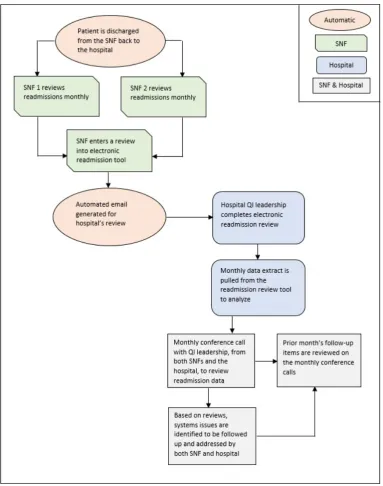
The two SNFs were Spaulding Nursing and Therapy Center West Roxbury and Hebrew Rehabilitation Center, both located in Boston, MA. Readmissions within a 30-day period (patients were discharged from BWH to SNF, and readmitted back to BWH from SNF within 30 days) were included. The goal of the review was to, in the short term, understand factors that contributed to readmissions in order to, in the long term, ultimately address these factors to reduce readmissions. The review process had two main components: an electronic review tool and monthly conferences (see figure 1 for process map). Every week when an SNF reviewed readmissions to BWH, SNF QI lead-ership (comprising two to three nurses and physicians) would complete an electronic review. The completion of
Figure 1 Readmission review process map. QI, quality improvement; SNF, skilled nursing facility.
on September 12, 2020 by guest. Protected by copyright.
a review by the SNFs would prompt an email to QI lead-ership at BWH (comprising four to five nurses and physi-cians) with a link to complete a readmission review from the hospital’s perspective. Reviewers were not involved in the initial care of the patient, providing objectivity to the review process, but were encouraged to reach out to those participating in clinical care in order to understand the facts of the case as needed. Both SNF and hospital electronic review data were reviewed and discussed at monthly hour-long webinar conferences with QI leader-ship from all facilities. Reviews from either the SNF or hospital that indicated that the readmission was prevent-able or potentially preventprevent-able were discussed. Particular attention was paid to cases for which there were discrep-ancies between the SNF and hospital reviews, with a focus on preventability.
The hospital and SNF electronic review tools were designed and implemented within the Research Elec-tronic Data Capture (REDCap) platform (see online supplementary figures 1 and 2). Prior to designing the tool hospital leadership met with both SNFs included in this initiative to determine their current process for reviewing readmissions. Both SNFs reviewed readmis-sions for patients admitted to BWH on at least a monthly basis. One SNF used a standardised questionnaire to review readmissions, and the other SNF had a less formal process. Both institutions were open to incorporating a more formal electronic review process, due to the oppor-tunity to discuss and learn from hospital feedback. Over the course of 4 months, several iterations of the read-mission review tool were evaluated by QI leadership at all institutions. We incorporated a subjective assessment of preventability based on the reviewers’ understanding of the clinical situation, as well as specific questions addressing clinical circumstances, decision-making and communication. These questions were vetted with both hospital and SNF QI leadership and potential reviewers to mitigate bias and defensiveness with responses. Inclusion of contributing factors was based on commonly encoun-tered reasons for readmission detailed by QI leadership. All reviewers participated in a training session regarding how to use the REDCap platform and complete the read-mission review instrument.
Monthly review meetings included QI leadership, involved in completing the readmission reviews, from both SNFs and the hospital. Data on the completed reviews were abstracted directly from the REDCap database for review. Systems issues related to preventable readmissions and contributing factors were identified and potential solutions were discussed. Areas of care deficiencies were identified and assigned to QI leadership from both SNFs and the hospital to address and follow-up at subsequent monthly conferences. Discussion of follow-up items took place at the end of each monthly conference.
study design and patient population
The readmission review process was implemented as a QI initiative at BWH, a tertiary care academic medical centre
in Boston, MA. Institutional review board formal review and approval was not required as this initiative was imple-mented as a QI project. Reviews were collected from 3 November 2015 through 31 May 2017, which included readmissions from 1 October 2015 through 1 May 2017. Patients were identified by the SNFs weekly, based on internal tracking of readmissions to BWH. Patients initially admitted or readmitted to other hospitals were excluded. Reviews were completed the month after the readmission occurred.
data sources and collection
REDCap was used to capture and abstract data related to demographics, comorbidities, admitting diagnoses, reasons for transfer, clinical stability, functional status, preventability and factors contributing to readmission. As applicable, additional clinical data were obtained from the BWH electronic medical record at the time of the completion of the electronic review by reviewers at the hospital. The SNFs obtained additional clinical informa-tion as needed from internal medical records. Compli-ance with completing the electronic readmission reviews was monitored by a project manager; 100% of reviews were completed.
statistical methods
Patient demographic, clinical and readmission character-istics are reported as counts and percentages or median and IQR, as appropriate. Data regarding readmission preventability and contributing factors are presented as counts and percentages, and compared between SNF and hospital responses. A Spearman's rank-order correlation was conducted to determine the relationship between the hospital’s and SNFs’ responses related to perceived preventability (preventable, potentially preventable or unpreventable) of a particular readmission.
resulTs
clinical and readmission characteristics
Table 1 shows the characteristics of the 128 patients included in the study, most of whom were discharged from the hospital to SNF 1 (86.7%). Only unplanned readmis-sions were reviewed (12.4% of total SNF admisreadmis-sions). The mean age was 73 (SD 14.9) years and 75.8% were male. Hypertension (60.2%), malignancy (35.9%) and coronary artery disease (29.7%) were the most common comor-bidities. Most patients were discharged from surgery (23.4%), general medicine (23.4%), oncology (15.6%) or cardiology (12.5%). The significant majority (86.7%) of patients were thought to be clinically stable at the time of SNF admission by the accepting SNF providers. In most cases, a follow-up appointment did not occur or an acute care provider was not contacted prior to readmission (approximately 80%). The mean days to hospital read-mission was 10.9 (SD 11.3). The most common primary reasons for readmission were infection (21.1%), gastroin-testinal (16.4%) and respiratory (14.8%) issues.
on September 12, 2020 by guest. Protected by copyright.
Preventability and contributing factors
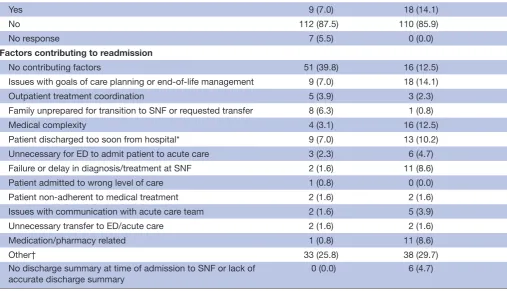
Responses from the SNF providers and hospital providers related to preventability and contributing factors are depicted in table 2. There was a discrepancy in rating of preventability between the SNF and hospital providers; 79.7% of cases were rated not preventable, 18.8% poten-tially preventable, 1.6% preventable by the SNF, and 58.9% of cases were rated not preventable, 35.9% poten-tially preventable, 5.5% preventable by the hospital. The hospital more often felt that improved communication with the clinical team and acute care stakeholders could have possibly prevented readmission (hospital 14.1%, SNF 7.0%) and felt that if readmission were known before-hand management could have been different to prevent readmission (ie, there was an action that could have been undertaken to prevent the readmission) (hospital 29.7%, SNF 20.3%). As shown in table 3, there was moderately positive correlation between the hospital’s and SNFs’ responses, which was statistically significant (rs=0.652, p<0.001).
The SNF reviewers felt in the majority of cases that there were no contributing factors to the readmission (57.8%), whereas the hospital reviewers felt that there were no contrib-uting factors in 28% of cases. The hospital reviewers felt that issues with goals of care planning/end-of-life management, medical complexity and being discharged too soon from the hospital were other common contributing factors. With less frequency, the most common contributing factors from the SNF perspective were issues with goals of care planning
Table 1 Patient demographics, clinical characteristics and readmission characteristics
Patient characteristics, n=128 Value (n, %)
Age (mean±SD) 73 (14.9)
Male 97 (75.8)
Comorbidities
Hypertension 77 (60.15)
Other* 51 (39.8)
Malignancy 46 (35.9)
Coronary artery disease 38 (29.7)
Diabetes† 37 (28.9)
Heart failure 32 (25.0)
Other cardiac 30 (23.4)
Chronic obstructive pulmonary disease 20 (15.6)
End-stage renal disease 13 (10.2)
Dementia 13 (10.2)
Failure to thrive 14 (10.9)
Stroke 18 (14.1)
Total joint replacement 9 (7.0)
Discharging service
General surgery 30 (23.4)
General medicine 30 (23.4)
Oncology 20 (15.6)
Cardiology 16 (12.5)
Orthopaedics 13 (10.2)
Other surgery 12 (9.4)
Neurology 6 (4.7)
Accepting short-term nursing facility
Short-term nursing facility 1 111 (86.7)
Short-term nursing facility 2 17 (13.3)
Clinically stable SNF admission as determined by SNF providers
Yes 111 (86.7)
No
Readmission characteristics, n=128 Value (n, %) Clinically stable at time of SNF admission as determined by SNF providers
Yes 111 (86.7)
No 17 (13.3)
Did follow-up appointment occur between date of SNF admission and transfer from SNF to acute care?
Yes 26 (20.3)
No 102 (79.7)
Mean days to hospital readmission (±SD)
10.9 (11.3)
Acute care provider contacted prior to readmission
Yes 24 (18.8)
No 101 (78.9)
Continued
Readmission characteristics, n=128 Value (n, %)
Unknown 3 (2.3)
Primary reason for readmission
Infection 27 (21.1)
Gastrointestinal 21 (16.4)
Respiratory 19 (14.8)
Neurologic 14 (10.9)
Other‡ 21 (16.4)
Cardiac 13 (10.2)
Fall 4 (3.1)
Renal 2 (1.6)
Psych 7 (5.5)
*Included anxiety, depression, Parkinson's disease, seizure disorder, hyperlipidaemia, peripheral arterial disease, deep vein thrombosis, pulmonary embolism, chronic kidney disease, hypercalcaemia, diabetes (prior to inclusion in data collection form as described below), hypothyroidism, HIV and anaemia.
†Included only in second iteration of data collection (68 of 128 patients) and percentages are not representative of entire sample. ‡Included arm swelling, knee pain, hyperglycaemia, anaemia, poor wound healing, patient admitted from scheduled appointment at Brigham and Women’s Hospital (BWH), possible lower extremity acute thrombus, hypotension, patient admitted from haemodialysis and patient brought himself to emergency room (ER).
SNF, short-term nursing facility. Table 1 Continued
on September 12, 2020 by guest. Protected by copyright.
or end-of-life management, outpatient treatment coordina-tion and family being unprepared for transicoordina-tion.
readmission rates and outcomes
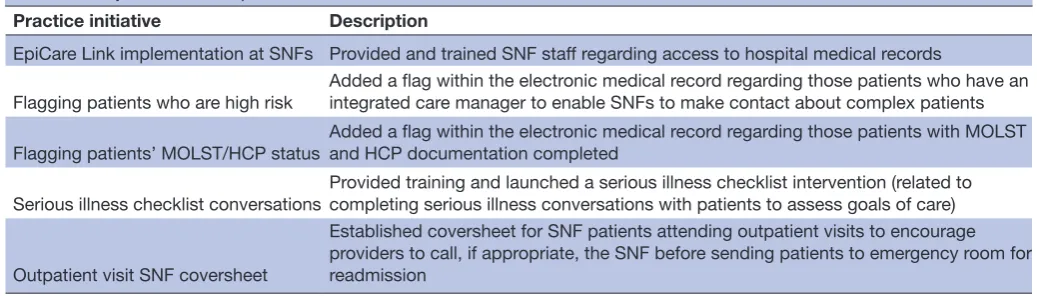
The total number of readmissions and readmission rates at both SNFs (preventable, unpreventable and both, see online supplementary figures 3 and 4) was unchanged over the course of the implementation period. SNF 1 readmis-sions per month ranged from 2 to 11, SNF 2 readmisreadmis-sions per month ranged from 0 to 3. We have focused on five
major initiatives identified as a result of the readmission review pilot as outlined in table 4; these initiatives were designed based on specific contributing factors identified and discussed during monthly review sessions with both hospital and SNF teams. First, we organised tailored train-ings for SNF staff on how to remotely access the hospital electronic record via a pre-existing provider portal to have a more complete understanding of the patient’s inpatient care. We requested a specific flag within this electronic
Table 2 Preventability of readmission and factors contributing to readmission
n=128 SNF providers (n, %) Hospital providers (n, %)
Preventability of readmission
Not preventable 102 (79.7) 75 (58.6)
Potentially preventable 24 (18.8) 46 (35.9)
Preventable 2 (1.6) 7 (5.5)
Did the patient have a clinical condition(s) that clearly required the patient to be cared for in an acute setting?
Yes 112 (87.5) 111 (86.7)
No 16 (12.5) 17 (13.3)
If the patient's readmission was known 24–48 hours beforehand, was there anything that could have been done differently that might have prevented the readmission from occurring?
Yes 26 (20.3) 38 (29.7)
No 97 (77.6) 90 (70.3)
No response 7 (5.47) 0 (0.0)
Could better, proactive, timely communication with the clinical team (moonlighter, covering MD, RN, therapist, and so on) as well as acute care clinical stakeholders (ED, consultant, PCP, surgeons) have possibly prevented this readmission from happening?
Yes 9 (7.0) 18 (14.1)
No 112 (87.5) 110 (85.9)
No response 7 (5.5) 0 (0.0)
Factors contributing to readmission
No contributing factors 51 (39.8) 16 (12.5)
Issues with goals of care planning or end-of-life management 9 (7.0) 18 (14.1)
Outpatient treatment coordination 5 (3.9) 3 (2.3)
Family unprepared for transition to SNF or requested transfer 8 (6.3) 1 (0.8)
Medical complexity 4 (3.1) 16 (12.5)
Patient discharged too soon from hospital* 9 (7.0) 13 (10.2)
Unnecessary for ED to admit patient to acute care 3 (2.3) 6 (4.7)
Failure or delay in diagnosis/treatment at SNF 2 (1.6) 11 (8.6)
Patient admitted to wrong level of care 1 (0.8) 0 (0.0)
Patient non-adherent to medical treatment 2 (1.6) 2 (1.6)
Issues with communication with acute care team 2 (1.6) 5 (3.9)
Unnecessary transfer to ED/acute care 2 (1.6) 2 (1.6)
Medication/pharmacy related 1 (0.8) 11 (8.6)
Other† 33 (25.8) 38 (29.7)
No discharge summary at time of admission to SNF or lack of accurate discharge summary
0 (0.0) 6 (4.7)
*Included only in second iteration of data collection (64 of 128 patients) and percentages are not representative of entire sample. †Included two falls at SNF, four Foley catheter-related infections and one suboptimal monitoring of oral intake at SNF.
ED, emergency department; MD, medical doctor; PCP, primary care provider; RN, registered nurse; SNF, short-term nursing facility.
on September 12, 2020 by guest. Protected by copyright.
provider portal, similar to the hospital electronic health record version, which provides easy access to advanced care planning documentation as well as information about whether patients have a care manager (who can be contacted for assistance with care needs). Both SNFs imple-mented a coversheet for SNF patients attending outpatient visits to encourage providers to call the SNF before read-mission. Finally, a group of SNF and hospital staff imple-mented a serious illness conversation checklist, previously developed at BWH, to be used at the SNFs to address goals of care with patients. These initiatives arose as a result of the contributing factors identified from the structured readmis-sion review process, and we believe will have a long-term impact on reducing readmissions and improving care for patients.
dIscussIon
In this QI initiative study, we found that implementation of a structured readmission review process involving completion of an electronic review tool and monthly conferences by the hospital and SNFs was feasible, and enabled both groups to obtain data and work on systems issues related to preventability and contributing factors to readmission. Our study is unique in that it involves a timely standardised review process employed by both acute and postacute staff, and provides an opportunity to compare responses across the care continuum.
Preventability associated with readmission is by nature subjective. Studies to date that have illustrated that a significant number of readmissions are potentially preventable have been retrospective and conducted by SNF staff alone.2 12 The Protecting Access to Medicare Act and the Skilled Nursing Facility Value-Based Purchasing Program are based largely on the SNF 30-day all-cause readmission measure, which highlights the need for further study related to preventability and the need for more expansive tools that extend across the acute and postacute care continuum.13 Based on this legisla-tion, both hospitals and SNFs will be accountable for SNF readmissions, aligning some incentives. However, without coordination and communication between acute and postacute facilities, alignment of payment for performance may not meaningfully improve care for patients.
conclusIons
The findings of our study related to preventability high-light that there is a lack of clear agreement between providers across the care continuum about what consti-tutes a preventable readmission. The SNFs felt that cases were not preventable significantly more often than the hospital. There were two common themes that arose during monthly conference discussions. First, that the hospital staff had greater access to the patients’ health
Table 3 Hospital and skilled nursing facility responses to preventability
Skilled nursing facility
Unpreventable Potentially preventable Preventable Total
Hospital Unpreventable 69 6 75
Potentially preventable 30 14 2 46
Preventable 3 4 7
Total 102 24 2 128
Spearman’s correlation=0.256, p=0.021
Spearman's rank-order correlation was conducted to determine the relationship between hospital's and skilled nursing facilities' responses related to perceived preventability (preventable, potentially preventable or unpreventable) of a particular readmission (n=128). There was a weak, positive correlation between hospital's and skilled nursing facilities' responses, which was statistically significant (rs=0.256, p=0.021).
Table 4 Major initiatives implemented as a result of the readmission review
Practice initiative Description
EpiCare Link implementation at SNFs Provided and trained SNF staff regarding access to hospital medical records
Flagging patients who are high risk Added a flag within the electronic medical record regarding those patients who have an integrated care manager to enable SNFs to make contact about complex patients
Flagging patients’ MOLST/HCP status Added a flag within the electronic medical record regarding those patients with MOLST and HCP documentation completed
Serious illness checklist conversations Provided training and launched a serious illness checklist intervention (related to completing serious illness conversations with patients to assess goals of care)
Outpatient visit SNF coversheet
Established coversheet for SNF patients attending outpatient visits to encourage providers to call, if appropriate, the SNF before sending patients to emergency room for readmission
HCP, healthcare proxy; MOLST, Medical Orders for Life-Sustaining Treatment; SNF, short-term nursing facility.
on September 12, 2020 by guest. Protected by copyright.
records (across the care continuum) and could foresee issues that the SNF was unable to. For example, the ability to review medication lists at the time of hospital admis-sion and discharge enabled hospital staff to discover medication discrepancies that contributed to readmis-sion. Second, hospital reviewers were not familiar with SNF capabilities and did not have access to SNF medical records, which influenced the perception of preventa-bility. For example, a lack of palliative care resources at the SNFs made it challenging to address challenging goals of care situations. Regardless of the reasons for divergent views on preventability, it was valuable to discuss discrepancies and identify potential contrib-uting factors to readmissions. Surprisingly, improved communication between the acute and postacute teams was thought to have potentially prevented readmission in a minority of cases, which may reflect already strong communication channels between institutions. Some important contributing factors were highlighted as a result of this review process: goals of care planning, medical complexity, premature discharge from the hospital and suboptimal outpatient treatment coordi-nation. These are areas that we have or are planning to address to potentially reduce future readmissions. The fact that we did not see a drop in readmissions during the implementation period is important to highlight. This may reflect the fact that: (1) with high-quality SNFs, the cases that are preventable are challenging to address as ongoing process improvements at these institutions largely mitigate readily preventable read-missions; (2) the focus in this pilot phase was on the process itself as opposed to the lessons learnt; (3) an assessment of the lessons learnt and implementation of quality initiatives will result in readmission reduction in the future. We feel that the latter is most likely, and will continue to trend readmission rates as the initiatives we have outlined are fully implemented.
Our QI initiative has several strengths. We lever-aged our high-quality SNF network, and piloted this process with two of our highest performing SNFs with a significant volume of BWH patients, who already had programmes committed to improving their quality of care on an ongoing basis (eg, continuous physician or nurse practitioner coverage and internal review meet-ings). In addition, we conducted reviews in a timely, prospective manner, within a month’s time frame from initial admission to readmission. This timeliness of review enabled more accurate and less biased reflec-tion regarding preventability and contributing factors. Also, reviewers had not been involved in the care of the patients and thus may be more subjective. Input from both the hospital and SNF was central to our review process, and provided the opportunity to obtain a fuller picture of contributions to a readmission. Finally, the opportunity to discuss cases after a structured review offered the ability to converse about cases in detail and learn from sometimes disparate opinions; we feel that this is a particularly important element of postacute to
acute readmission care and should be considered for future QI initiatives in light of upcoming regulations.
lIMITaTIons
There are a number of limitations of this QI initia-tive. First, we implemented this readmission review process at a single academic medical centre with two high-quality SNFs. It is important to test the feasibility of implementation at additional sites, and at commu-nity-based hospitals. In addition, the SNFs involved were greatly motivated to improve their process of care based on their inclusion in the Partners SNF Quality Collaborative Network, and trialling a similar process with less motivated SNFs could be more challenging. Second, the reviews submitted were inherently subjec-tive, likely shaped by the reviewers’ own clinical expe-riences. However, we aimed to mitigate biases by estab-lishing the monthly review sessions during which open, bidirectional feedback was employed. Third, during discussions we found that the SNF reviewers were often focused on preventability at the SNF as opposed to the entire system of care, whereas the hospital reviewers were focused on the latter. Finally, this current process outlined does not include any direct feedback from the patient or involved family, which is often a key factor in cases of readmission. A future version would include a survey option for patients and families.
IMPlIcaTIons
Our study provides evidence of the importance of implementing a structured QI process for readmissions from SNF back to hospital, involving both acute and postacute staff, in order to identify areas of disagree-ment and agreedisagree-ment with respect to preventability and contributing factors. Further study is needed to illus-trate whether such a formalised process could effec-tively reduce readmissions and improve care.
Author affiliations
1Department of Quality and Safety, Brigham and Women’s Hospital, Harvard Medical School, Boston, Massachusetts, USA
2Division of Renal Medicine, Brigham and Women’s Hospital, Harvard Medical School, Boston, Massachusetts, USA
3Internal Medicine Residency Program, Brigham and Women’s Hospital, Harvard Medical School, Boston, Massachusetts, USA
4Brigham and Women's Physician's Organization, Brookline, Massachusetts, USA 5Hebrew Rehabilitation Center in Boston, Boston, Massachusetts, USA
6Spaulding Nursing and Therapy Center West Roxbury, Boston, Massachusetts, USA 7Partners Healthcare Center for Population Health Management, Boston, Massachusetts, USA
8Department of Cardiovascular Medicine, Brigham and Women’s Hospital, Boston, Massachusetts, USA
Contributors MLM and KB take responsibility for the integrity of the data and the accuracy of the data analysis. Study concept and design: MY, CTP, MLM, AS, JS, LH, KB. Study implementation: MLM, JS, LH. Acquisition of data: EF, JS, LH. Analysis and interpretation of data: CIM, MLM, KB. Drafting of the manuscript: MY, JD, CTP, MCC, EF, CIM, AS, MLM, JS, LH, KB, MAH. Critical revision of the manuscript for important intellectual content: MLM, JS, LH, KB. Statistical analysis: MCC, CIM, MLM. Administrative, technical or material support: KB. Study supervision: KB.
on September 12, 2020 by guest. Protected by copyright.
Funding The authors have not declared a specific grant for this research from any funding agency in the public, commercial or not-for-profit sectors.
Competing interests None declared. Patient consent Not required.
Provenance and peer review Not commissioned; externally peer reviewed. Data sharing statement There are currently no unpublished data available. The published data presented have been deidentified. Unpublished data contain PHI and cannot be shared.
Open access This is an open access article distributed in accordance with the Creative Commons Attribution Non Commercial (CC BY-NC 4.0) license, which permits others to distribute, remix, adapt, build upon this work non-commercially, and license their derivative works on different terms, provided the original work is properly cited, appropriate credit is given, any changes made indicated, and the use is non-commercial. See: http:// creativecommons. org/ licenses/ by- nc/ 4. 0/.
references
1. Jencks SF, Williams MV, Coleman EA. Rehospitalizations among
patients in the Medicare fee-for-service program. N Engl J Med
2009;360:1418–28.
2. Mor V, Intrator O, Feng Z, et al. The revolving door of
rehospitalization from skilled nursing facilities. Health Aff
2010;29:57–64.
3. Ouslander JG, Lamb G, Perloe M, et al. Potentially Avoidable
Hospitalizations of Nursing Home Residents: Frequency, Causes,
and Costs. J Am Geriatr Soc 2010;58:627–35.
4. Jacobsen JML, Schnelle JF, Saraf AA, et al. Preventability of
Hospital Readmissions From Skilled Nursing Facilities: A Consumer
Perspective. Gerontologist 2016;17:gnw132.
5. Burke RE, Rooks SP, Levy C, et al. Identifying Potentially Preventable
Emergency Department Visits by Nursing Home Residents in the
United States. J Am Med Dir Assoc 2015;16:5e399:395–9.
6. Grabowski DC, Stewart KA, Broderick SM, et al. Predictors of
nursing home hospitalization: a review of the literature. Med Care
Res Rev 2008;65:3–39.
7. Ehlenbach WJ, Hough CL, Crane PK, et al. Association between
acute care and critical illness hospitalization and cognitive function in
older adults. JAMA 2010;303:763–70.
8. Neuman MD, Wirtalla C, Werner RM. Association between skilled
nursing facility quality indicators and hospital readmissions. JAMA
2014;312:1542–51.
9. Rahman M, Foster AD, Grabowski DC, et al. Effect of
hospital-SNF referral linkages on rehospitalization. Health Serv Res
2013;48:1898–919.
10. Schoenfeld AJ, Zhang X. Grabowski DC3, Mor V, Weissman JS, Rahman M. Hospital-skilled nursing facility referral linkage reduces readmission rates among Medicare patients receiving major surgery.
Surgery 2016;159:1461–8.
11. Lage DE, Rusinak D, Carr D, et al. Creating a network of
high-quality skilled nursing facilities: preliminary data on the postacute care quality improvement experiences of an accountable care
organization. J Am Geriatr Soc 2015;63:804–8.
12. Meehan TP, Qazi DJ, Van Hoof TJ, et al. Process Evaluation of a
Quality Improvement Project to Decrease Hospital Readmissions
From Skilled Nursing Facilities. J Am Med Dir Assoc 2015;16:648–53.
13. CMS. gov. The Skilled Nursing Facility Value-Based Purchasing Program (SNF VBP). 2018. https://www. cms. gov/ Medicare/ Quality- Initiatives- Patient- Assessment- Instruments/ Value- Based- Programs/ Other- VBPs/ SNF- VBP. html
on September 12, 2020 by guest. Protected by copyright.