Http://www.ijetmr.com©International Journal of Engineering Technologies and Management Research [73]
AN ANALYTICAL STUDY ON CLOUD COMPUTING
Mr. Anand K. Sisodiya 1, Mrs. Khushbu N. Yadao 2, Professor Dr. V.R. Dhawale 3
1, 2 MCA-III, Department of Research and P.G. Studies in Science & Management, Vidyabharati
Mahavidyalaya, Amravati, India
3 Department of Research and P.G. Studies in Science & Management, Vidyabharati
Mahavidyalaya, Amravati, India Abstract:
Cloud computing is regarded as massively extensible, an on-demand configurable resources computing model. It approaches the cloud infrastructure in a distributed rather than dedicated infrastructure where users can have full access to the extensible, reliable resources. Data generated by IoT attached objects is high, cloud is a key to store the incalculable data generated by these attached devices and it is the forward stepped towards the green computing, it removes the setups and installation steps as the cloud user accessing the hardware resources co-exist on different platform in distributed way.
Cloud computing environment furnished a great flexibility and availability of computing resources at a very lower cost. This arriving technology opens a new era of e-services in different disciplines. In this paper, we seen cloud computing with its applications, most common Cloud Service Provider such as Google, Microsoft, Amazon, HP, and Sales force and we present innovative applications for cloud computing in Enterprise Resource Planning.
Keywords: Cloud Computing; On-Demand; Utility; Energy Optimization; Service-Oriented
Architecture; Saas; Paas; Iaas.
Cite This Article: Mr. Anand K. Sisodiya, Mrs. Khushbu N. Yadao, and Professor Dr. V.R. Dhawale. (2019). “AN ANALYTICAL STUDY ON CLOUD COMPUTING.” International Journal of Engineering Technologies and Management Research, 6(12), 73-77. DOI: https://doi.org/10.29121/ijetmr.v6.i12.2019.557.
1. Introduction
Http://www.ijetmr.com©International Journal of Engineering Technologies and Management Research [74] devices such as laptops and cell phones. Platform as a Service: In PaaS, a CSP provides, runs and maintains both system software and computing resources. The customer manages and runs the application software under the operating system and on the virtual resources provided by the CSP. The customer has no control over the operating system and hardware resources. Unlike Software as a Service that provides the customer with complete applications, Platform as a Service gives user the opportunity to design, model, develop and test applications directly on the cloud. Therefore user can control the software lifecycle.
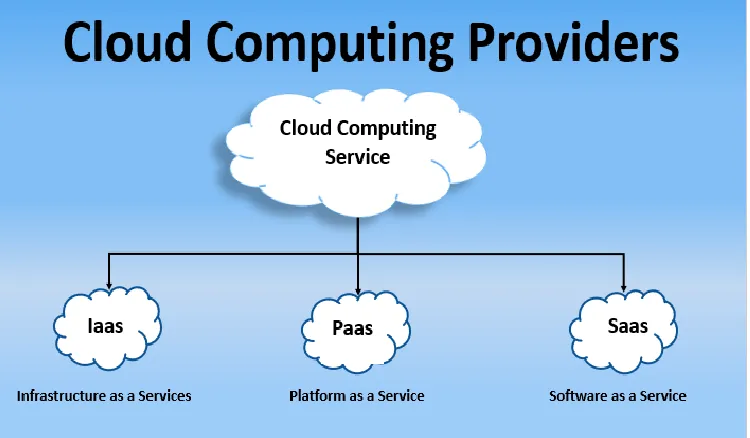
Figure 1: Cloud Computing Providers
The cloud computing provides these services as shown in the above figure. Cloud Computing Services is divided into 3 parts:
• IaaS: This service offers rental infrastructures such as servers, operating systems, virtual machines, networks, and storage.
• PaaS: This service is used in software development, testing, and maintenance. PaaS is the same as IaaS, but also includes other tools such as BI and DBMS.
• SaaS: This service provides customers with a subscription connection to apps via the internet.
2. How Does Cloud Computing Works?
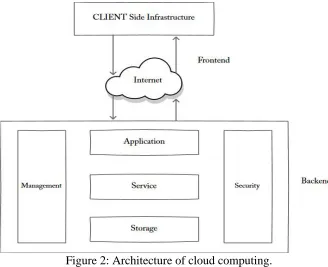
Http://www.ijetmr.com©International Journal of Engineering Technologies and Management Research [75] Figure 2: Architecture of cloud computing.
This technology users can use the data centre through the internet facilities. This technology also provides various advantages like as users can access the cloud from anywhere, but the network bandwidth should have to be more. This technology not only aid desktop and laptop users. As we know that cloud computing is fast, applications running on the cloud take advantages of flexibility and computing power, the speed of processing a task. Number of computers of a single organization work similarly along with their application on the cloud as if all the applications were running on a single machine. In the Cloud computing system architecture, there is mechanism for shifting the workload. When it comes to run applications, Local machines don't have to perform massive lifting operations. This technology can handle those heavy loaded tasks automatically and efficiently. The only thing that the users have to think is this technology interface software of the system, which works hardly as a web-browser in the front end of the user. The cloud's network takes care of the rest along with the back-end. The back-end is connected via internet. There are more components like Middleware, cloud resources that are includes the cloud computing architecture.
The back-end has two principal responsibilities:
1) It Provides traffic control mechanisms, security postures & governing the protocols. 2) To employ those internet protocols that are connected to the network computer for
communication.
Http://www.ijetmr.com©International Journal of Engineering Technologies and Management Research [76] 3. Applications
This technology run every software and It can provide us with number of applications which are free of cost.
Storing File Online
Cloud Computing provides a benefit to store and access the software to the cloud with the help of internet.
Video Making and Editing Software
There are many software which helps to create and modify the videos. The videos created are stored in the cloud itself and we can access anytime.
File Converters
There are many more applications which can change format of the file. This software is applicable at cloud and which is access from anywhere by using internet.
Anti-Virus Applications
There are software’s which are stored and fix the system from there. All the viruses and the malware are detected by software and analysed.
E-commerce Application
With the help of this application in the cloud, user allow responding quickly to the opportunities. It also allows the user to respond quickly to the market opportunities and the challenges. Cloud-based e-commerce applications allow the companies to evaluate new opportunities and making things done with the low cost possible.
Backup and Recovery
The cloud computing used as a backup option also in which we can store the data. This data is stored will be protected much security. When the data is lost the user can recover the data which user has stored in the cloud.
4. Limitations of Cloud Computing
Since the use of the Internet connection to both applications and documents, so without a high-speed internet connection, access to the resources is not possible. Limitations of cloud computing are:
1) Cloud computing not run without the connection of internet. Slow Internet connection is not sufficient to access the cloud services.
2) Hacking of accounts is one of the bad scenarios of cloud computing.
3) Malware violations are ephemeral as the malicious software as a valid SaaS, once run these software harm and damage the cloud clients vital data.
Http://www.ijetmr.com©International Journal of Engineering Technologies and Management Research [77]
5. Conclusion
Cloud computing is an emerged trend as a combination of many already existing and computer technologies like the internet, networking, operating systems, hardware, software, middleware, virtualization, etc. It gets maximum utilization these technologies. It is finding the place in every aspect of life, it is empowering the business of small and large-scale companies, organizations, by providing them with challenges are proving to be platform where they can run their services with fewer charges and get maximum benefits.
References
[1] Nagaraju Kilari, “Cloud Computing - An Overview & Evolution”, Vol 3, No. 1, 2018, pp.149-152.
[2] Chetan M Bulla, Satish S Bhojannavar and Vishal M Danawade, “Cloud Computing: Research Activities and Challenges”, International Journal of Emerging Trends & Technology in Computer Science, Vol 2, No. 5, 2013, pp.206-21.
[3] 3.Palvinder Singh, Er. Anurag Jain, “Survey Paper on Cloud Computing”, International Journal of Innovations in Engineering and Technology, Vol. 3 Issue 4 April 2014.
[4] Dimpi Rani, Rajiv Kumar Ranjan, “A Comparative Study of SaaS, PaaS and Issue ,6June 2014 in International Journal of Advance research of science and Engineering IaaS in Cloud Computing”, Volume 4.
[5] 5.H.R. Semsar, P. Daneshjoo, M.H. Rezvani, “Cloud Computing Security Solution Based on GRC Method and Fully Homomorphic Encryption Algorithm in a Private Cloud”. vol. 6, issue 69, October 2017 in International Journal of Science and Engineering Investigations.
[6] Mr. Amol Kale, Dr. Rajivkumar Mente, “Impact of Cloud Computing on Education System”, International Journal of Electronics, Electrical and Computational System.
[7] R.M. Sharma, “The Impact of the Virtualization in Cloud Computing”, International Journal of Recent Development in Engineering and Technology Volume 3, Issue 1, July 2014.
Authors Biography
[1] Anand K. Sisodiya is the student of MCA final year during acadamic year 2019-2020 in the institute of Department of Research and P.G. Studies in Science & Management, Vidyabharati Mahavidyalaya, Amravati.
[2] Khushbu N. Yadao is the student of MCA final year during acadamic year 2019-2020 in the institute of Department of Research and P.G. Studies in Science & Management, Vidyabharati Mahavidyalaya, Amravati.
[3] Dr. V. R.Dhawale is the head of Departement and he is area of reasearch includes Artificial intelligency, Machine learning, Image processing.
*Corresponding author.