R E S E A R C H
Open Access
Computer game-based upper extremity training
in the home environment in stroke persons:
a single subject design
Angelique Slijper
1,2, Karin E Svensson
1,2, Per Backlund
3, Henrik Engström
3and Katharina Stibrant Sunnerhagen
1*Abstract
Background:The objective of the present study was to assess whether computer game-based training in the home setting in the late phase after stroke could improve upper extremity motor function.
Methods:Twelve subjects with prior stroke were recruited; 11 completed the study.
Design:The study had a single subject design; there was a baseline test (A1), a during intervention test (B) once a week, a post-test (A2) measured directly after the treatment phase, plus a follow-up (C) 16–18 weeks after the treatment phase. Information on motor function (Fugl-Meyer), grip force (GrippitR) and arm function in activity (ARAT, ABILHAND) was gathered at A1, A2 and C. During B, only Fugl-Meyer and ARAT were measured. The intervention comprised five weeks of game-based computer training in the home environment. All games were designed to be controlled by either the affected arm alone or by both arms. Conventional formulae were used to calculate the mean, median and standard deviations. Wilcoxon’s signed rank test was used for tests of dependent samples. Continuous data were analyzed by methods for repeated measures and ordinal data were analyzed by methods for ordered multinomial data using cumulative logistic models. A p-value of < 0.05 was considered statistically significant.
Results:Six females and five males, participated in the study with an average age of 58 years (range 26–66). FMA-UE A-D (motor function), ARAT, the maximal grip force and the mean grip force on the affected side show significant improvements at post-test and follow-up compared to baseline. No significant correlation was found between the amount of game time and changes in the outcomes investigated in this study.
Conclusion:The results indicate that computer game-based training could be a promising approach to improve upper extremity function in the late phase after stroke, since in this study, changes were achieved in motor function and activity capacity.
Keywords:Stroke, Upper extremity, Community living, Home-based rehabilitation, Computer games, Neurological rehabilitation
Introduction
Stroke is a leading cause of disability and is often associ-ated with impaired motor function. Although most stroke survivors regain the ability to walk, many fail to regain functional use of their impaired upper extremity (UE) [1]. At six months, it is reported that only 11.6% of
patients had achieved complete functional recovery, while dexterity in the paretic arm was found in 38% [2]. The impairment limits an individual’s ability to perform various activities of daily living (disability) and affects participation in everyday life situations [3].
After discharge from the stroke unit, there is still room for improvement that can be achieved with rehabilitation
]
4 ]. As rehabilitation is time-consuming, demanding and often tedious for the patient, it seems to be important to sustain the motivation for training [5]. Being given the possibility to choose where, when, what and how much * Correspondence:[email protected]
1Rehabilitation Medicine, The Institute of Neuroscience and Physiology,
Sahlgrenska Academy at the University of Gothenburg, Per Dubbsgatan 14 3rd floor, SU/Sahlgrenska, Göteborg SE-413 45, Sweden
Full list of author information is available at the end of the article
rehabilitation are ways to stimulate empowerment, which may be a way to keep motivation. There is an awareness that self-controlled practice seems to enhance motor learning [6].
The main general recommendation to promote UE motor recovery after stroke is to focus on high-intensity; repetitive task-specific practice with feedback on per-formance, however there is no specific state of the art for training [7]. One suggestion is bilateral arm training, which is simultaneous active movement of the paretic and the non-affected arm [8-10]. Today methods are used and tested that combine computer technology and games for UE rehabilitation [11-14]. The game compo-nent is used as a motivational factor in terms of enjoy-ment, challenge and feedback [15]. The concept of using games for purposes other than entertainment is referred to as serious games [16,17]. There are serious games that have been specially developed for recovery and rehabili-tation [11].
There is evidence that guided home rehabilitation pre-vents patients from deteriorating in their ability to undertake activities of daily living [18]. When guided home rehabilitation has a technology that allows patients to perform training with minimal therapist time the pa-tients have the opportunity to practice more often, which may lead to functional improvement [19-21]. An advantage of rehabilitation in the home, is that it saves time and transportation.
There is a need to provide methods for UE rehabilita-tion overall. Considering that high intensive repetitive practice, bilateral arm training, feedback, self-controlled practice and motivation are important factors, a solution could be computer game-based training.
A benefit is if it can be used in the home environment. The experiences from a pilot study using computer game-based training in home environment suggested that it could be an alternative [22].
The aim of this exploratory study was to investigate if there is an intervention effect of computer game-based training in the late phase after stroke on upper extremity motor function.
Material and methods
The single subject design [23] was chosen for this ex-ploratory trial since this design is sensitive to individual differences and the individual variations after the stroke are large. A convenience sample of 12 subjects with prior stroke was recruited from a rehabilitation clinic. Inclusion criteria were diagnosis of stroke at least six months prior to the study, affected motor function in the upper extremity, National Institutes of Health Stroke Scale [24] (NIHSS) < 15 at study start and a minimum age of 18 years. Exclusion criteria were other neuro-logical disease, diagnosed dementia or epilepsy, joint
problems or pain in the upper extremity or language dif-ficulty that would affect the capacity to receive informa-tion about the training procedure.
Twelve subjects fulfilled the criteria and gave their written informed consent to participate. One subject dropped out due to medical complications before the intervention started. Due to the design of the trial (single subject) no data could be that person (only first assess-ment was available from the baseline).
Prior to the baseline test the subjects were given an introduction to the system at the clinic to see whether they were able to use the equipment. This was done by letting the subject try the game that required the least motor function for 15 minutes.
Research design
The study had a single subject design [23]; a baseline (A1) phase, a phase during intervention (B), a post-test (A2), and a follow-up (C). After the assessments for the baseline (A1), the treatment phase (B) started and con-tinued for five weeks. The post-intervention (A2) was measured directly after the treatment phase and a follow-up (C) assessment was made 16–18 weeks later with the same assessment procedure as used in the pre-intervention. For practical reasons, since there were only 6 computers with games, 6 persons were able to train at a time. The study included 2 therapists, who both had participated in the pilot test and were familiar with the equipment. One of the therapists conducted all the as-sessment for 5 persons, the other therapist delivered the game based computer at home and coached the subject once a week during the treatment phase. Their roles were switched for the following 6 persons. Details on tests and timing are presented below.
Computer equipment
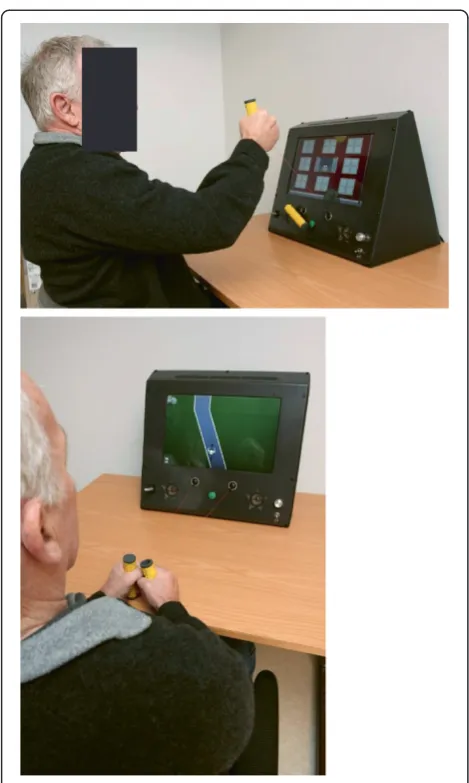
The training was performed using a game console con-trolled by arm movements. The game console was based on a laptop computer and had two handles attached to it by strings. The handles were held with a transverse cy-lindrical grip and were connected to a mechanism that registered the position and movement of the arm. The game console (Figure 1) had a simple interface com-posed of an on/off button, a volume control, a game re-set button and a USB plug for personal activity logs. The user log system captured rich information about a player’s activities in the system. Hand position in X, Y and Z axis was logged 25 times per second. Other sys-tem events such as which game was played, all game events and scores were also logged. The game console was programmed according to the affected side of the subject.
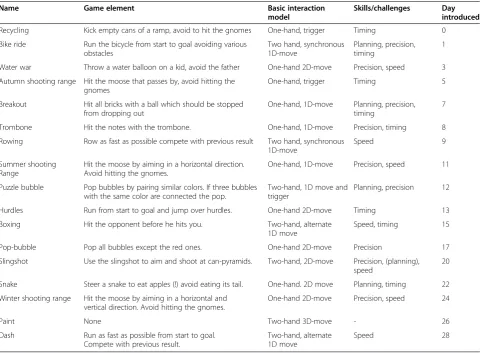
games in the library, games inspired by classic video games (such as Breakout, Snake and Puzzle) and newly developed ones (Table 1). The games were tailored to the intended users in terms of speed, challenge, toned down colour schemes and sounds. Prior to each game, verbal and visual instructions were given in the form of an animated film.
All games started at an easy level and difficulty in-creased with improved results demanding greater speed, precision and range of motion. The different games were delivered a few at the time throughout the experiment. All players received a very easy game called Recycling first in order to learn initial operations. As the number of games increased the participants were allowed to choose their own games. Visual and auditory feedback on how the games succeeded was given by the game console during game time and after a game was com-pleted. A five-minute break was scheduled after 15 mi-nutes of play.
Outcome measures Game time
The time that each console had been used was recorded.
Body function
Grip forceTo record the handgrip force, the peak max-imum grip force for each hand and the mean value over 10 s, as measured by the GrippitR, was evaluated in a standardized manner. The grip force was compared to age- and sex-matched reference values [25]. This test has been shown to have good reliability [26,27].
The motor function was assessed with the Fugl-Meyer Assessment of sensorimotor function, using the upper extremity part (FMA-UE) [28]. The FMA-UE, which is composed of 33 items related to movements of the prox-imal and distal parts of the UEs. Fugl-Meyer is one of the most frequently measures used in trials to evaluate UE. Several studies evaluating the psychometric proper-ties of the FMA-UE in people with stroke have demon-strated satisfactory reliability, validity and responsiveness [29,30]. The items of the FMA-UE are mainly scored on a three-point scale, from 0 to 2 and the total score ranges from 0 to 66. The assessment was performed in a standardized manner. The Fugl-Meyer scale assesses motor function (A-D), sensation (H) and passive joint motion and joint pain (J).
Activity capacity
The Action Research Arm Test (ARAT) is a standard-ized ordinal scale designed to assess UE disability through the assessment of four basic movements: pri-mary grasp, grip, pinch, and gross movements of flexion and extension at the elbow and shoulder [31]. The reli-ability, validity and responsiveness of the ARAT for people with stroke have been established [31]. The ARAT comprises 19 test of arm function in a standard-ized approach. Each test is graded on a four-point scale, from 0 (unable to complete any part of the hand or arm movement components) to 3 (normal performance), yielding a maximum for the test of 57. The test was per-formed in a standardized manner with a dedicated set-up of the test equipment. For example in the category grip the subject is asked to pour the water from one cup to another cup and have to manage that within 5 seconds without spilling and without compensating movements like later flexion in the trunk.
Activity performance
ABILHAND measures the patient’s perceived difficulty in performing everyday manual activities [32]. Recent studies from other researchers have demonstrated satis-factory reliability, validity and responsiveness [33,34]. ABILHAND is an inventory of manual activities that the
patient is asked to judge on a three-level scale: 0 (impos-sible), 1 (difficult) and 2 (easy). The test explores both unimanual and bimanual activities done without human or technical help. For each question the patient provided his/her feeling of difficulty irrespective of the limb(s) ac-tually used to perform the activity. For example is the subject asked to judge “cutting one’s nails, fastening the zipper of a jacket”. According to the manual, activities not attempted in the last three months were encoded as missing responses. The Swedish version was used [35] and the responses were entered into the program of http://www.rehab-scales.org/abilhand.html and trans-formed into logits [32].
Procedures regarding data gathering and intervention Fugl-Meyer, GrippitR, ARAT and ABILHAND was gath-ered at baseline (A1), post-test (A2) and follow-up (C). During the intervention (B), only Fugl-Meyer and ARAT were measured.
The intervention comprised five weeks of game-based computer training in the home environment. A game console was delivered to the participants’ home by a
member of the development team and one of the thera-pists. The place where the subject intended to place the game console for playing was reviewed for ergonomics and suggestions were given. The subjects went through the game console once more and were given a short manual in order to be able to handle the game console on their own. They were told to play as much as they liked during this five week period; no specific recom-mendations were made as to how much they should play. During this five week period, the subjects went once a week (four times) to the clinic to see the therapist for testing and the therapist for coaching. On these oc-casions, which also included a game session, the coach-ing therapist checked that movements were performed in an optimal manner without risk of injury, that the subjects could manage the system and that they under-stood how to play the games.
Ethics and statistics
The study was approved by the Regional Ethical Review Board in Gothenburg (Dnr 643–07). All subjects gave their written informed consent. Statistical analyses were
Table 1 The games used in the study, interaction model, skills and introduction timing
Name Game element Basic interaction
model
Skills/challenges Day introduced
Recycling Kick empty cans of a ramp, avoid to hit the gnomes One-hand, trigger Timing 0
Bike ride Run the bicycle from start to goal avoiding various obstacles
Two hand, synchronous 1D-move
Planning, precision, timing
1
Water war Throw a water balloon on a kid, avoid the father One-hand 2D-move Precision, speed 3
Autumn shooting range Hit the moose that passes by, avoid hitting the gnomes
One-hand, trigger Timing 5
Breakout Hit all bricks with a ball which should be stopped from dropping out
One-hand, 1D-move Planning, precision, timing
7
Trombone Hit the notes with the trombone. One-hand, 1D-move Precision, timing 8
Rowing Row as fast as possible compete with previous result Two hand, synchronous 1D-move
Speed 9
Summer shooting Range
Hit the moose by aiming in a horizontal direction. Avoid hitting the gnomes.
One-hand, 1D-move Precision, speed 11
Puzzle bubble Pop bubbles by pairing similar colors. If three bubbles with the same color are connected the pop.
Two-hand, 1D move and trigger
Planning, precision 12
Hurdles Run from start to goal and jump over hurdles. One-hand 2D-move Timing 13
Boxing Hit the opponent before he hits you. Two-hand, alternate 1D move
Speed, timing 15
Pop-bubble Pop all bubbles except the red ones. One-hand 2D-move Precision 17
Slingshot Use the slingshot to aim and shoot at can-pyramids. Two-hand, 2D-move Precision, (planning), speed
20
Snake Steer a snake to eat apples (!) avoid eating its tail. One-hand. 2D move Planning, timing 22
Winter shooting range Hit the moose by aiming in a horizontal and vertical direction. Avoid hitting the gnomes.
One-hand 2D-move Precision, speed 24
Paint None Two-hand 3D-move - 26
Dash Run as fast as possible from start to goal. Compete with previous result.
Two-hand, alternate 1D move
performed using PASW v.18 (SPSS). Conventional for-mulae were used to calculate the mean, median and standard deviations. Wilcoxon’s signed rank test was used for tests of dependent samples.
Continuous data were analyzed by methods for repeated measures using the SAS-procedure PROC MIXED. Means of measurements during intervention, post-test and follow-up respectively were compared to measurements of data from baseline. The deviations from baseline were tested by t-tests. In order to get more symmetric distribu-tion log transformed data were used in the calculadistribu-tions. Ordinal data were analyzed by methods for ordered multi-nomial data using cumulative logistic models. The SAS-procedure PROC GLIMMIX was used. Deviations from baseline as above were tested. A p-value of <0.05 was con-sidered statistically significant.
Results
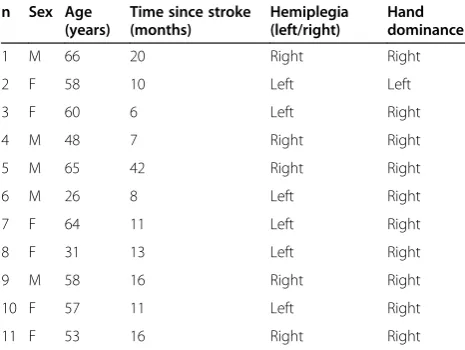
The eleven subjects in the study (six females and five males), had an average age of 58 years (range 26–66). All subjects were in the so called“chronic”stage after stroke; the median time since stroke onset was 11 months. Five subjects had an ischemic and six had a haemorrhagic stroke. Six subjects were impaired in the dominant hand (Table 2). At discharge from hospital, the Modified Rankin Scale (MRS) was 3 for six subjects and 4 for five subjects. All subjects lived (in the community) in their own homes, three were single, and two had minor children in the home. Eight subjects were retired or on disability pension, two subjects worked part-time and one subject worked full-time.
The mean time at the game-based computer was 1070 min (range 267–4727). The mean time of days of play out of a maximum of 35 was 24.5 (range 19–35) (Table 3). One subject completed the protocol but did not return for the follow-up due to a medical problem. One person (n 8) was away for one week during the intervention.
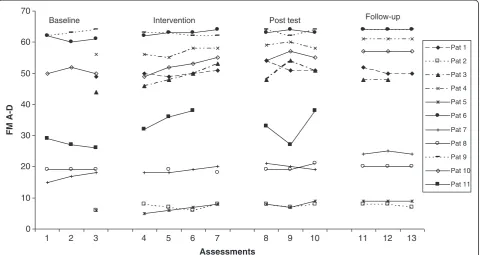
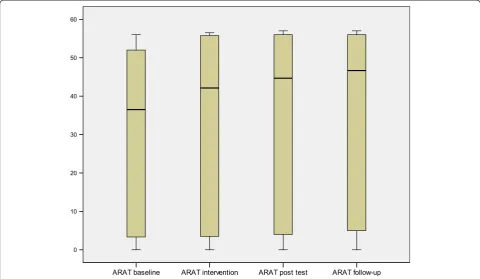
The median value and range for Fugl-Meyer Assess-ment upper extremity (FMA-UE), ARAT, ABILHAND and GrippitR for all subjects during each phase are shown in Table 4. An improvement in motor function was noted in the affected upper limb. FMA-UE A-D (motor function) (Figure 2), showed significant improve-ments in upper extremity function between baseline (A1) and post-test (A2) (0.005) as well as at follow-up (<.0001). The changes in ARAT (Figure 3) improved sig-nificantly (<.0001) both at post-test (A2) and at the four-month follow-up compared to baseline.
Median of measurements post-test and follow-up re-spectively were compared to measurements of data from baseline, and showed significant improvement (0.005- < .0001) in max Grip force on the affected side as well as the mean Grip force. This was not the case for the un-affected side. The ratio between affected and non-affected maximal grip force (% of reference value) showed a mean value of 0.41 at baseline (A1), 0.44 at post-test (A2) and 0.47 at follow-up (C).
No significant correlation was found between the amount of game time and changes in the outcomes in-vestigated in this study.
Discussion
The objective of the present study was to assess whether computer game-based training in the late phase after stroke could improve upper extremity motor function. The intervention improved upper extremity motor func-tion and also improved activity capacity, and this im-provement was maintained at follow-up. Motor function assessed by the Fugl-Meyer scale has been suggested to have a minimal detectable change for FMA-UE of 5.2 points [29] and according to another author, the min-imal clinical important difference is 10 points [36]. In the present study, 7 points between pre-intervention and post-intervention and 5 points between pre-intervention
Table 2 Subject characteristics at the time of the study
n Sex Age (years)
Time since stroke (months)
Hemiplegia (left/right)
Hand dominance
1 M 66 20 Right Right
2 F 58 10 Left Left
3 F 60 6 Left Right
4 M 48 7 Right Right
5 M 65 42 Right Right
6 M 26 8 Left Right
7 F 64 11 Left Right
8 F 31 13 Left Right
9 M 58 16 Right Right
10 F 57 11 Left Right
11 F 53 16 Right Right
Table 3 Time with game console
Time with game console (minutes)
Days of playing out of max 35
Number of sessions
1 1012 22 43
2 1283 27 83
3 4727 35 170
4 267 26 28
5 545 23 39
6 464 25 36
7 862 24 52
8 316 19 22
9 704 19 46
10 762 25 49
and follow-up. Having a statistically significant improve-ment in FMA-UE and at the same time no clinical dif-ference has been seen also in other studies [37,38] .
There was a statistically significant improvement on the ARAT. According to the literature, there must be a difference of at least six points to define a minimal clin-ical important difference [39]. In this study, the median difference was 11 points between baseline and post-test and 21 points between baseline and follow-up, which shows a clinical definable difference. In the present case, ARAT showed a clinical important difference and FMA-UE did not. These results support the findings of other studies [29,40], suggesting that ARAT has the highest re-sponsiveness in a comparison with FMA-UE.
The perceived number of problems as assessed with ABILHAND showed no difference. This is not surpris-ing since the actual performance is not necessarily
reflected in perceived functions. Michielsen et al. [41] reported that function and capacity must reach a cer-tain threshold level before actual performance also starts to increase.
The participants in this study were interested in the games. The game factors, such as challenges and scores, had an important impact. Data about player’s behavior and interest in the games were collected through log files, observations and interviews. The results reveal a positive attitude towards the games as well as a substan-tial time spent on playing the games. Results regarding the attitudes were analyzed in detail in the pilot study and have been presented in detail in Alklind Taylor et al. [42]. The participants seemed to develop a taste for cer-tain games as their favorites. Interestingly, remakes of classic games such as Breakout and Puzzle bubble were the most popular.
Table 4 The median value and range for the different assessments
Pre-intervention Intervention Post-intervention Follow up
Median Median Median Median
Fugl-Meyer A-D 44 (6–63) 49 (6.50-63) 51 (7.67-63.33) 49 (7.67-64)
ARAT 26 (0–56) 34 (0–56.2) 37 (0–57) 47 (0–57)
ABILHAND 0.36 (−.26-2.64) 0.86 (−.78-3.6) 1.13 (−.47-4.69)
Maximal grip A (% of normal) 27 (2–72) 26 (5–80) 39 (12–81)
Maximal grip NA 78 (59–118) 78 (56–110) 89.50 (59–113)
A = Affected. NA = Non affected.
0 10 20 30 40 50 60 70
1 2 3 4 5 6 7 8 9 10 11 12 13
Assessments
FM A-D
Pat 1
Pat 2
Pat 3
Pat 4
Pat 5
Pat 6
Pat 7
Pat 8
Pat 9
Pat 10
Pat 11
Post test Intervention
Baseline Follow-up
Feedback through the games repeatedly encouraged the users to improve their performance. Not only arm movements but also concentrating on the games was important. The player was required to attend, compre-hend, recall and plan and execute appropriate responses to the visual and auditory cues provided. The challen-ging component of the games could be at the expense of carrying out tasks correctly but is required to retain motivation.
Study limitations
It is reasonable to suggest that the ultimate aim is to promote restoration of function to the point at which the stroke patient can use the arm in everyday tasks. The games in this computer-based training were not specifically designed to increase the use of the arm in everyday tasks, and changes in activities are thus not to be taken for granted. As always in single subject design, the subject serves as their own control. The single sub-ject design only makes it possible to assess whether there is a change achieved by an intervention. The re-sults are similar to another small study where similar outcome measures were used [43]. A strength in this study is that assessments were made that cover different domains of the ICF. The selections of assessments are seen by others as good [44,45].
Conclusion
The results indicate that computer game-based training appears to be a promising approach to improving upper extremity function in the late phase after stroke.
Consent
Written informed consent was obtained from the pa-tients for the publication of this report and any accom-panying images.
Competing interests
All authors state that they have no competing interests.
Authors’contribution
AS and KES carried out the study and wrote the first draft. PB and HE constructed the ELINOR, contents of the games etc and were responsible for extracting data from the computer. KSS designed the study and supervised AS and KES in the process, analyses and writing. All authors contributed in the writing process. All authors read and approved the final manuscript.
Acknowledgements
This work was supported by the Health & Medical Care Committee of the Regional Executive Board, Region Västra Götaland.
Author details
1
Rehabilitation Medicine, The Institute of Neuroscience and Physiology, Sahlgrenska Academy at the University of Gothenburg, Per Dubbsgatan 14 3rd floor, SU/Sahlgrenska, Göteborg SE-413 45, Sweden.2Department of Occupational Therapy and Physiotherapy, Skaraborg Hospital Skövde, Skövde, Sweden.3School of Informatics, University of Skövde, Skövde, Sweden.
Received: 16 September 2012 Accepted: 4 March 2014 Published: 13 March 2014
References
1. Nakayama H, Jorgensen HS, Raaschou HO, Olsen TS:Recovery of upper extremity function in stroke patients: the Copenhagen Stroke Study. Arch Phys Med Rehabil1994,75(4):394–398.
2. Kwakkel G, Kollen BJ, van der Grond J, Prevo AJ:Probability of regaining dexterity in the flaccid upper limb: impact of severity of paresis and time since onset in acute stroke.Stroke2003,34(9):2181–2186. 3. WHO:International Classification of Functioning, Disability and Health: ICF.
Geneva: WHO Library Cataloguing-in-Publication Data; 2001. 4. Outpatient Service Trialists:Therapy-based rehabilitation services for
stroke patients at home.Cochr Datab Syst Rev2003(1). Art. No.: CD002925. doi:10.1002/14651858.CD002925.
5. Finley M, Combs S:User perceptions of gaming interventions for improving upper extremity motor function in persons with chronic stroke.Physiother Theory Pract2013,29(3):195–201.
6. Wulf G:Self-controlled practice enhances motor learning: implications for physiotherapy.Physiotherapy2007,93(2):96–101.
7. Langhorne P, Coupar F, Pollock A:Motor recovery after stroke: a systematic review.Lancet Neurol2009,8(8):741–754.
8. Luft AR, McCombe-Waller S, Whitall J, Forrester LW, Macko R, Sorkin JD, Schulz JB, Goldberg AP, Hanley DF:Repetitive bilateral arm training and motor cortex activation in chronic stroke: a randomized controlled trial. Jama2004,292(15):1853–1861.
9. Stoykov ME, Lewis GN, Corcos DM:Comparison of bilateral and unilateral training for upper extremity hemiparesis in stroke.Neurorehabil Neural Repair2009,23(9):945–953.
10. Whitall J, McCombe Waller S, Silver KH, Macko RF:Repetitive bilateral arm training with rhythmic auditory cueing improves motor function in chronic hemiparetic stroke.Stroke2000,31(10):2390–2395. 11. Bach-y-Rita P, Wood S, Leder R, Paredes O, Bahr D, Wicab Bach-y-Rita E,
Murillo N:Computer-assisted motivating rehabilitation (CAMR) for institutional, home, and educational late stroke programs.Top Stroke Rehabil2002,8(4):1–10.
12. Broeren J, Claesson L, Goude D, Rydmark M, Sunnerhagen KS:Virtual rehabilitation in an activity centre for community-dwelling persons with stroke. The possibilities of 3-dimensional computer games.Cerebrovasc Dis2008,26(3):289–296.
13. Saposnik G, Mamdani M, Bayley M, Thorpe KE, Hall J, Cohen LG, Teasell R:
Effectiveness of Virtual Reality Exercises in STroke Rehabilitation (EVREST): rationale, design, and protocol of a pilot randomized clinical trial assessing the Wii gaming system.Int J Stroke2010,5(1):47–51. 14. Saposnik G, Teasell R, Mamdani M, Hall J, McIlroy W, Cheung D, Thorpe KE,
Cohen LG, Bayley M:Effectiveness of virtual reality using Wii gaming technology in stroke rehabilitation: a pilot randomized clinical trial and proof of principle.Stroke2010,41(7):1477–1484.
15. Sweetser P, Weyth P:A model for evaluating player enjoyment in games. ACM Comp Entertain2005,3:1–24.
16. Zyda M:From visual stimulation for visual games.Computer2005,38:25–32. 17. LoPiccolo P:Serious games.Computer Graphics World2004,27:4–6. 18. Legg L, Langhorne P:Rehabilitation therapy services for stroke patients
living at home: systematic review of randomised trials.Lancet2004,
363(9406):352–356.
19. Duncan P, Richards L, Wallace D, Stoker-Yates J, Pohl P, Luchies C, Ogle A, Studenski S:A randomized, controlled pilot study of a home-based exercise program for individuals with mild and moderate stroke. Stroke1998,29(10):2055–2060.
20. Duncan P, Studenski S, Richards L, Gollub S, Lai SM, Reker D, Perera S, Yates J, Koch V, Rigler S, Johnson D:Randomized clinical trial of therapeutic exercise in subacute stroke.Stroke2003,34(9):2173–2180.
21. Legg L, Langhorne P:Therapy-based rehabilitation for stroke patients living at home.Stroke2004,35(4):1022.
22. Backlund P, Alklind Taylor A-S, Engström H, Johannesson M, Lebram M, Poucette J, Slijper A, Svensson K, Sunnerhagen K:Evaluation of usefulness of the Elinor console for home-based stroke rehabilitation. InIEE Third International Conference on Games and Virtual Worlds for Serious Applications: 2011.Athens: IEEE; 2011:98–103.
23. Zhan S, Ottenbacher KJ:Single subject research designs for disability research.Disabil Rehabil2001,23(1):1–8.
24. Lyden P, Lu M, Jackson C, Marler J, Kothari R, Brott T, Zivin J:Underlying structure of the national institutes of health stroke scale: results of a factor analysis. NINDS tPA stroke trial investigators.Stroke1999,30(11):2347–2354.
25. Nordenskiold UM, Grimby G:Grip force in patients with rheumatoid arthritis and fibromyalgia and in healthy subjects. A study with the Grippit instrument.Scand J Rheumatol1993,22(1):14–19.
26. Hammer A, Lindmark B:Test-retest intra-rater reliability of grip force in patients with stroke.J Rehabil Med2003,35(4):189–194.
27. Lagerstrom C, Nordgren B:On the reliability and usefulness of methods for grip strength measurement [published erratum appears in Scand J Rehabil Med 1998 Sep;30(3):192].Scand J Rehabil Med1998,30(2):113–119. 28. Fugl-Meyer AR, Jaasko L, Leyman I, Olsson S, Steglind S:The post-stroke
hemiplegic patient. 1. a method for evaluation of physical performance. Scand J Rehabil Med1975,7(1):13–31.
29. Lin JH, Hsu MJ, Sheu CF, Wu TS, Lin RT, Chen CH, Hsieh CL:Psychometric comparisons of 4 measures for assessing upper-extremity function in people with stroke.Phys Ther2009,89(8):840–850.
30. Platz T, Pinkowski C, van Wijck F, Kim IH, di Bella P, Johnson G:Reliability and validity of arm function assessment with standardized guidelines for the Fugl-Meyer test, action research arm test and Box and block test: a multicentre study.Clin Rehabil2005,19(4):404–411.
31. Yozbatiran N, Der-Yeghiaian L, Cramer SC:A standardized approach to performing the action research arm test.Neurorehabil Neural Repair2008,
22(1):78–90.
32. Penta M, Tesio L, Arnould C, Zancan A, Thonnard JL:The ABILHAND questionnaire as a measure of manual ability in chronic stroke patients: Rasch-based validation and relationship to upper limb impairment. Stroke2001,32(7):1627–1634.
33. Ekstrand E, Lindgren I, Lexell J, Brogardh C:Test-retest reliability of the ABILHAND questionnaire in persons with chronic stroke.PM R2013. doi: 10.1016/j.pmrj.2013.09.015. [Epub ahead of print].
34. Wang TN, Lin KC, Wu CY, Chung CY, Pei YC, Teng YK:Validity, responsiveness, and clinically important difference of the ABILHAND questionnaire in patients with stroke.Arch Phys Med Rehabil2011,
92(7):1086–1091.
35. Gustafsson S, Sunnerhagen K, Dahlin-Ivanoff S:Occupational therapist’s and patients’perception of ABILHAND, a new assessment tool for measuring manual ability.Scand J Occup Ther2004,11:107–117. 36. Gladstone DJ, Danells CJ, Black SE:The fugl-meyer assessment of motor
recovery after stroke: a critical review of its measurement properties. Neurorehabil Neural Repair2002,16(3):232–240.
37. Sampson M, Shau YW, King MJ:Bilateral upper limb trainer with virtual reality for post-stroke rehabilitation: case series report.Disabil Rehabil Assist Technol2012,7(1):55–62.
38. Yong Joo L, Soon Yin T, Xu D, Thia E, Pei Fen C, Kuah CW, Kong KH:A feasibility study using interactive commercial off-the-shelf computer gaming in upper limb rehabilitation in patients after stroke.J Rehabil Med2010,42(5):437–441.
39. Lang CE, Wagner JM, Dromerick AW, Edwards DF:Measurement of upper-extremity function early after stroke: properties of the action research arm test.Arch Phys Med Rehabil2006,87(12):1605–1610.
40. van der Lee JH, Beckerman H, Lankhorst GJ, Bouter LM:The responsiveness of the action research Arm test and the Fugl-Meyer assessment scale in chronic stroke patients.J Rehabil Med2001,33(3):110–113.
41. Michielsen ME, de Niet M, Ribbers GM, Stam HJ, Bussmann JB:Evidence of a logarithmic relationship between motor capacity and actual performance in daily life of the paretic arm following stroke.J Rehabil Med2009,41(5):327–331.
42. Alklind Taylor A-S, Backlund P, Engström H, Johannesson M, Lebram M:
Gamers agains all odds. InProceedings of Edutainment 2009.Banff: Springer-Verlag Berlin and Heidelberg GmbH & Co; 2009.
43. Bovolenta F, Goldoni M, Clerici P, Agosti M, Franceschini M:Robot therapy for functional recovery of the upper limbs: a pilot study on patients after stroke.J Rehabil Med2009,41(12):971–975.
44. Ashford S, Slade M, Malaprade F, Turner-Stokes L:Evaluation of functional outcome measures for the hemiparetic upper limb: a systematic review. J Rehabil Med2008,40(10):787–795.
45. Baker K, Cano SJ, Playford ED:Outcome measurement in stroke: a scale selection strategy.Stroke2011,42(6):1787–1794.
doi:10.1186/1743-0003-11-35