The occurrence of extended-spectrum β-lactamase producing
Shigella
spp. in Tehran, Iran
Reza Ranjbar1, Farzaneh Mirsaeed Ghazi2, Shohreh Farshad3, Giovanni Maurizio Giammanco4, Aurora Aleo4, Parviz Owlia5, Nematollah Jonaidi6,
Nourkhoda Sadeghifard7, Caterina Mammina4*
1Molecular Biology Research Center, Baqiyatallah University of Medical Sciences, Tehran, Iran.
2Department of Biochemistry, Payam Noor University, Tehran, Iran. 3Professor Alborzi Clinical
Microbiology Research Center, Shiraz University of Medical Sciences, Shiraz, Iran. 4Department of
Sciences for Health Promotion‘G. D’Alessandro’’, University, Palermo, Italy. 5Department of Microbiology,
Faculty of Medicine, Shahed University, Tehran, Iran. 6Health Research Center, Baqiyatallah University
of Medical Sciences, Tehran, Iran. 7Clinical Microbiology Research Center, Ilam University of Medical
Sciences, Ilam, Iran.
Received: November2012, Accepted: February2013.
ABSTRACT
Background and Objectives: The emergence of extended-spectrum β-lactamase (ESBL)-producing Shigella spp. is of increasing clinical concern specially in children worldwide. The aim of this study was to investigate the occurrence of extended-spectrum β-lactamase producing Shigella spp. in Tehran, Iran.
Materials and Methods: The study included all Shigella isolates recovered from pediatric patients aged less than 12 years admitted to a major pediatric hospital in Tehran, Iran, from 2008 to 2010. Bacterial identification, antimicrobial susceptibility testing, extended spectrum β-lactamases (ESBLs) screening and confirmatory tests were performed according to the standard guidelines. Conjugal transfer experiments and plasmid analysis were also carried out. Polymerase chain reaction and sequencing were used to identify the genetic determinants responsible for ESBL production.
Results: Four out of 55 Shigella isolates, including three S. sonnei and one S. flexneri, showed an ESBL-positive phenotype. Plasmid transfer of the ESBL phenotype was successful for the S. flexneri isolate only. By PCR and sequencing, one S. sonnei isolate tested positive for the CMY-59 gene, while the other two S. sonnei and the S. flexneri isolates tested positive for the blaTEM-1 and blaCTX-M-15 genes.
Conclusion: We found the prevalence of ESBL producing Shigella isolates was higher than detection rates observed in many other countries. Our finding raise concerns about the dissemination of ESBL among the strains of endemic S. sonnei throughout the country, because this species is now the most frequently isolated Shigella species in Iran and shigellosis by such strains in the community can pose a significant threat to patients and presents a challenge for disease management.
Keywords: ESBLs, Shigella spp, Antibiotic resistance
INTRODUCTION
Infections caused by Shigella species remain a major cause of diarrheal disease associated with high morbidity and mortality in developing countries, such as Iran (1). Among the four Shigella spp., S. sonnei,
is the most commonly isolated species particularly in industrialized countries (2).
* Corresponding author: Caterina Mammina M.D. Ph.D. Address: Department of Sciences for Health Promotion ‘‘G. D’Alessandro’’ University of Palermo,Via del Vespro 133, I-90127Palermo, Italy.
Tel: +39- 91-6553623 Fax: +39-91-6553641
Adequate antibiotic therapy is helpful in shigellosis because it may shorten the clinical course of illness, significantly reduce the risk of transmission and prevent also potentially lethal complications. However, high frequencies of resistance to commonly used antimicrobial agents have been reported worldwide in
Shigella spp. Moreover, the emergence of resistance to third-generation cephalosporins (3GC) in Shigella
spp. is a matter of great public health concern, mainly in developing countries (3).
Since the initial report of SHV-11–type β-lactamase in S. dysenteriae from India in 1999, Shigella species producing CTX-M, SHV, and TEM-type extended spectrum β-lactamases (ESBLs) have been identified worldwide from different regions (4). Indeed, an increasing number of countries, including United States, France, Turkey, Lebanon, Bangladesh, Hong Kong and China have recently notified the isolation of ESBL-producing Shigella isolates (5-11).
There are several reports showing that the frequency of resistance against different antibiotic groups other than third-generation cephalosporins is increasing
among the Shigella strains isolated in Iran (12-15). Here we report the identification and characteriza-tion of ESBL producing Shigella strains in Tehran, Iran.
MATERIALS AND METHODS
Bacterial isolates and antimicrobial susceptibility.
The study included all Shigella isolates recovered from pediatric patients aged less than 12 years and admitted to Children’s Medical Center in Tehran, Iran, from November 2008 to May 2010. A single specimen was obtained from each patient, and rectal swabs were collected from patients on the day of admission at the hospital. All strains were identified at a genus level by conventional methods according to previously described procedures (16). Serotyping of the isolates was performed by slide agglutination (Shigella Antisera, Denka Seiken, Tokyo, Japan).
Antibiotic susceptibility testing was performed according to CLSI guidelines (17) using the following antibiotic disks (Oxoid, Basingstoke, Hampshire, UK): ampicillin (AM, 10 μg), amoxicillin–clavulanic acid (AMC, 20–10 μg), cephalotin (CF, 30 μg), cefixime (CFM, 5 μg ), cefotaxime (CTX, 30 μg), ceftizoxime (CT, 30 μg), ceftriaxone (CRO, 30 μg), ceftazidime (CAZ, 30 μg), ciprofloxacin (CIP, 5 μg), chloramphenicol (C, 30 μg), doxycycline (D, 30 μg),
gentamicin (GN, 10 mg), kanamycin (K, 10 μg), nalidixic acid (NA, 30 μg), neomycin (N, 30 μg), nitrofurantoin (FD, 300 μg), piperacillin (PIP, 100 μg), streptomycin (S, 10 μg), tetracycline (TE, 30 μg), ticarcillin (TIC, 75 μg), tobramycin (TOB, 10 μg), trimethoprim–sulfamethoxazole (SXT, 1.25-23.75 μg).
Detection and characterization of ESBLs.
Screening of 3rd generation cephalosporins (3GC)
resistant Shigella isolates was performed by disk diffusion method using ceftazidime, cefotaxime, ceftriaxone and cefepime disks. According to CLSI criteria for detection of ESBL producers, each isolate with inhibition zone diameter ≤22 mm for ceftazidime or ≤27 mm for cefotaxime was considered as a potential ESBL-producer. Phenotypic confirmation of ESBL production was done by double disk synergy and combination disk tests (18).
Escherichia coli ATCC 25922 and previously characterized ESBL-positive E. coli, Klebsiella-pneumoniae and AmpC-positive Enterobacter cloacae strains were used as controls for antibiotic susceptibility testing and the following ESBL analysis. Phenotypic detection of AmpC enzymes was performed by using cefoxitin supplemented with cloxacillin and E. coli ATCC 25922 according to the previously described method (19). In brief, the 30 μg cefoxitin disk was supplemented with 200 μg of cloxacillin (Sigma-Aldrich, Singapore). A strain was considered to be an AmpC producer when it showed an increase in diameter around the antibiotic disk with added cloxacillin compared to that with the cefoxitin disk alone.
A multiplex PCR assay approach was used for a rapid screening of frequently encountered β-lactamases according to the procedure previously described by Dallenneet al. (20). DNA of the isolates under study was subjected to the multiplex PCR reactions I to III in 50 µL reaction mixtures containing variable concentrations of specific-group primers and 1 U of Taq polymerase (20). Amplification was carried out as follows: initial denaturation at 94°C for 10 min; 30 cycles of 94°C for 40 s, 60°C for 40 s and 72°C for 1 min; and a final extension step at 72°C for 7 min. Amplicons were visualized on 2% agarose gels.
deduced protein sequences were analyzed with the BLAST and Clustal W programs (multiple sequence alignment, pairwise comparisons of sequences and dendrograms).
Resistance transfer experiments were performed for all four isolates as previously described with the rifampicin resistant Escherichia coli K12J5 as the recipient. Briefly, mixed cultures of the donors and the rifampicin resistant recipient E. coli strain were incubated at 37°C overnight. The transconjugants were selected on MacConkey agar plates supplemented with ceftazidime or cefotaxime- 30 µg/ml - and
rifampicin - 250 µg/ml.
A confirmatory test for ESBL and AmpC phenotypes and PCR detection for ESBL genes were performed on transconjugant colonies by the above mentioned procedures. Plasmids from Shigella isolates and
E. coli transconjugants were extracted by an alkaline lysis extraction method (21).
RESULTS
Fifty five Shigella isolates were isolated during the study period. Of theses, 51 strains (92.7%) were susceptible to 3GC. As shown in Table 1, four strains (7.3%), including three S. sonnei and one S. flexneri showed concomitant resistance to these 3GC antibiotics and were selected for ESBL production.
Double disk synergy and combination disk tests confirmed that these four strains had ESBL-positive phenotype (Table 1). blaTEM andblaCTX-Msequences
were detected in the S. flexneri and two S. sonnei
isolates, whereas the third S. sonnei isolate showed a
blaCMY sequence. DNA sequencing revealed that the blaTEM and blaCTX-M sequences were blaTEM-1 and bla CTX-M-15, respectively, whilst the CMY ESBL was identified
as CMY-59.
Based on the conjugation assay, only the
S. flexneri isolate was able to transfer the bla gene
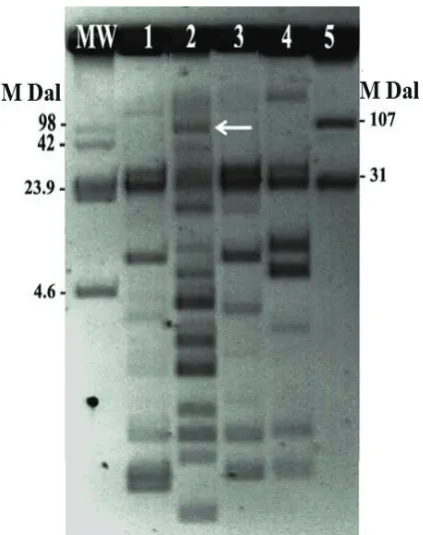
to transconjugant, confirming that it was mediated by a plasmid of approximately 107MDa (Fig. 1). Only resistance to trimethoprim was co-transferred along with the ESBL encoding sequence.
DISCUSSION
Ampicillin and sulfamethoxazole-trimethoprim are generally indicated as the first-line drugs for therapy of shigellosis. However, in the event of disease caused by a multidrug resistant strain, second-line 12
Fig. 1. Plasmid patterns of the Shigella clinical isolates and the transconjugantEscherichia coli from the S. flexneri isolate.
Lanes: MW, molecular weight, Escherichia coli 39R861; 1, S. sonnei n.1; 2, S. flexneri n.2; 3, S. sonnein. 3; 4, S. sonnei n.4; 5, E. coli K12J5 transconjugant from the S. flexneri isolate n.2.
Fig. 1. Plasmid patterns of the Shigella clinical isolates and the transconjugant Escherichia coli from the S. flexneri isolate.
Lanes: MW, molecular weight, Escherichia coli 39R861; 1, S. sonnei n.1; 2, S. flexneri n.2; 3, S. sonnei n. 3; 4, S. sonnei n.4; 5, E. coli K12J5 transconjugant from the S. flexneri isolate n.2.
Strain No. Time of isolation Serotype Antibiotic resistance pattern* Type of β-lactamase
1 June 12, 2009 S. sonnei AMC- AM-NA-CAZ- TIC-CTX-CRO-CT-PIP-D-TE-S-SXT-CF CMY-59
2 July 23, 2009 S. flexneri AMC- AM-NA-CAZ- TIC-CTX-CRO-D-TE-S-SXT-C-CF TEM-1, CTX-M-15
3 September 3, 2009 S. sonnei AMC-AM-NA-CAZ- TOB-TIC-CTX-CRO-PIP-D-TE-S-SXT TEM-1, CTX-M-15
4 November 10, 2009 S. sonnei AMC-AM-CZA-TOB-TIC-CTX-CRO-D-TE-S-SXT-CF TEM-1, CTX-M-15
Table 1. Characteristics of the ESBL-producing Shigella strains under study.
drugs including 3GC and fluoroquinolones are used for treatment of children and adults, respectively (7). Unfortunately, it has been recently reported that the prevalence of resistance to some commonly used antibiotics is increasing in Shigella species in Iran (22). Class 2 integrons have proved to be at least in part responsible for the antibiotic resistance spectrum (12).
Beta-lactams are the most frequently used antimicrobial agents in Iran and the ESBL producer’sorganisms have been reported frequently in several bacterial species in this country (23). Recently Tajbakhsh and her colleagues have documented the
presence of blaCTX-M-15 and blaCMY-2in six Shigella
strains isolated from patients admitted to Milad Hospital, Tehran, Iran (24).
An increase in the occurrence of antimicrobial resistance, including resistance to 3GC and fluoroquinolones among Shigella spp. has been
observed in several countries. To date, blaCTX-M-15, blaCTX-M-14, blaCTX-M-3 and blaCMY-2 genes have been
reported in Shigella spp. isolates (7, 25, 26).
In our study, the prevalence of ESBL producing
Shigella isolates, accounting for 7.3% of all Shigella
isolates identified in the period under study, is higher than detection rates observed in many other countries (5, 7, 9). Moreover, CMY-59 has never been reported in Shigella, whereas CMY-2-typeAmpC ß-lactamases has been previously detected, but infrequently. Recently, the detection of AmpC β-lactamase producer strains in Shigella spp. has been reported in Iran (24).
Among all ESBL producing strains, only the
S. flexneri isolate was able to transfer the bla gene
to transconjugant, indicating it was mediated by a plasmid however we did not make further attempts to obtain the transfer of resistance determinants. This could have resulted from the presence of chromosomally-mediated β-lactamase genes in the parental strains that could not be transferred to the recipients. Alternatively, they can be located on large low-copy number plasmids with a low transfer
frequency.
A ceftriaxone resistant Shigella strain with a plasmid mediated CMY-2 AmpC type ESBL was also responsible for a dysentery outbreak in Taiwan (26). On the contrary, CTX-M-15 are the most commontypes
of cefotaximases identified among Shigella isolates (3, 5, 6, 27, 28). Of special concern, plasmid mediated production of this β-lactamase is widely disseminated
in Enterobacteriaceae, particularly among strains isolated from nosocomial infections, but more and more frequently from community-acquired cases.
Our findings raise concerns about the dissemination of ESBL among the strains of endemic S. sonnei throughout the country, because S. sonnei is now the most frequently isolated Shigella species in Iran and shigellosis by such strains in the community can pose a significant threat to patients and presents a challenge for disease management. Thus, active and continued surveillance of antibacterial drug resistance appears to be needed as the first step, along with a judicious use of antibiotics, to minimize the spread of ESBL producing Shigella isolates. This is especially critical for the pediatric patients for whom antibiotic therapeutic options are inherently limited.
ACKNOwLEDGMENTS
This research was supported in part by a grant from Iranian Ministry of Health and Medical Education, Deputy of Research and Technology. The authors would like to thank Dr. Haghi- Ashtiani and Mrs. Mina Abedini from Microbiology Laboratory of the Children’s Medical Center for their kind Cooperation.
REFERENCES
Ranjbar R, Hosseini MJ, Kaffashian AR, Farshad S.
1. An
outbreak of shigellosis due to Shigella flexneri serotype 3a in a prison in Iran. Arch Iran Med 2010; 13: 413-416. Filliol-Toutain I, Chiou CS, Mammina C, Gerner-Smidt 2.
P, Thong KL, Phung DC, et al. Global distribution of
Shigella sonnei clones. Emerg Infect Dis 2011; 17: 1910-2.
Zhang
3. R, Zhou HW, Cai JC, Zhang J, Chen GX, Nasu M, et al. Serotypes and extended-spectrum β-lactamase types of clinical isolates of Shigella spp. from the Zhejiang province of China. Diagn Microbiol Infect Dis
2011; 69: 98-104.
Ahamed J, Kundu M. Molecular characterization of 4.
the SHV-11 β- lactamase of Shigella dysenteriae.
Antimicrob Agents Chemother 1999; 43: 2081-2083. Folster J
5. P, Pecic G, Krueger A, Rickert R, Burger K, Carattoli A, Whichard JM. Identification and characterization of CTX-M-producing Shigella isolates in the United States. Antimicrob Agents Chemother
2010; 54: 2269-2270.
Lartigue MF, Poirel L, Decousser JW, Nordmann P. 6.
infection in France. Clin Infect Dis 2005; 40: 1069-1071. Acikgoz ZC, Gulay Z, Bicmen M, Gocer S, Gamberzade 7.
S. CTX-M-3 extended-spectrum beta-lactamase in a
Shigella sonnei clinical isolate: first report from Turkey.
Scand J Infect Dis 2008; 35: 503-505.
Matar GM, Jaafar R, Sabra A, Hart CA, Corkill JE, 8.
Dbaibo GS, Araj GF. First detection and sequence analysis of the bla-CTX-M-15 gene in Lebanese isolates
of extended-spectrum-lactamase-producing Shigella sonnei. Ann Trop Med Parasitol 2007; 101: 511-517. Rahman M, Shoma S, Rashid H, Siddique AK, Nair GB, 9.
Sack DA. Extended-spectrum beta-lactamase-mediated third-generation cephalosporin resistance in Shigella
isolates in Bangladesh. J Antimicrob Chemother 2004; 54: 846-847.
Cheung TK, Chu YW, Tsang GK, Ngan JY, Hui IS, Kam 10.
KM. Emergence of CTX-M-type beta-lactam resistance in Shigella spp. in Hong Kong. Int J Antimicrob Agents
2005; 25: 350-352. Xiong
11. Z, Li T, Xu Y, Li J. Detection of CTX-M-14 extended-spectrum beta-lactamase in Shigella sonnei
isolates from China. J Infect 2007; 55: e125-128. Ranjbar R, Aleo A, Giammanco GM, Dionisi AM, 12.
Sadeghifard N, Mammina C. Genetic relatedness among isolates of Shigella sonnei carrying class 2 integrons in Tehran, Iran, 2002 – 2003. BMC Infect Dis 2007; 22: 62. Ranjbar R, Soltan-Dallal, MM, Pourshafie MR. 13.
Antibiotic resistance among Shigella serogroups isolated in Tehran, Iran (2002-2004). J Infect Dev Ctries 2009; 3: 647-648.
Hosseini MJ, Ranjbar R, Ghasemi H, Jalalian HR. The 14.
prevalence and antibiotic resistance of Shigella spp. recovered from patients admitted to Bouali Hospital, Tehran, Iran during 1999-2000. Pak J BiolSci 2007; 10: 2778-2780.
Soltan-Dallal MM, Ranjbar R, Pourshafie MR. The 15.
study of antimicrobial resistance among Shigella
flexneri strains isolated in Tehran, Iran. J Pediatr Infect
Dis 2011; 6 : 125-129.
Murray PR, Baron EJ, Pfaller MA, Tenover FC, Yolken 16.
FC, editors. Manual of clinical microbiology. 6th ed. Washington, DC: American Society for Microbiology; 1995. p. 1, 482.
Clinical and Laboratory Standards Institute (CLSI). 17.
(2008): Performance standards for antimicrobial susceptibility testing: 17th informational supplement (M100-S17). Wayne, PA: CLSI.
Clinical and Laboratory Standard Institute, 2006. 18.
Performance standards for antimicrobial susceptibility
testing: sixteenth informational supplement. CLSI document M100-S16. CLSI, Wayne, Pa.
Tan TY, Ng LS, He J, Koh TH, Hsu LY. Evaluation of 19.
screening methods to detect plasmid-mediated AmpC in Escherichia coli, Klebsiella pneumoniae, and Proteus mirabilis. Antimicrob Agents Chemother 2009; 53: 146-149. Dallenne C, Da Costa A, Decré D, Favier C, Arlet G. 20.
Development of a set of multiplex PCR assays for the detection of genes encoding important beta-lactamases in Enterobacteriaceae. J Antimicrob Chemother 2010; 65: 490-495.
Birnboim HC, Doly J. A rapid alkaline extraction 21.
procedure for screening recombinant plasmid DNA.
Nucleic Acids Res 1979; 7 : 1513-1523.
Ranjbar R, SoltanDallal MM, Talebi M, Pourshafie 22.
MR. Increased isolation and characterization of Shigella sonnei obtained from hospitalized children in Tehran, Iran. J Health Popul Nutr 2008; 26: 426-430.
Mohammadi-Mehr
23. M, Feizabadi MM. Antimicrobial resistance pattern of Gram-negative bacilli isolated from patients at ICUs of Army hospitals in Iran. Iran J Microbiol 2011; 3: 26-30.
Tajbakhsh M,
24. GarcíaMigura L, Rahbar M, Svendsen CA, Mohammadzadeh M, Zali MR, Aarestrup FM, Hendriksen RS. Antimicrobial-resistant Shigella
infections from Iran: an overlooked problem? J Antimicrob Chemother 2012 ;67: 1128-1133.
Hong SJ, Lee CH, Wang JH,
25. Song W, Jung SH. Clinical
characteristics of extended-spectrum β-lactamase producing Shigella sonnei infection outbreaked in Chungju area. Korean J Lab Med 2006; 26: 168-73. Huang IF, Chiu CH, Wang MH, Wu CY, Hsieh KS, 26.
Chiou CC. Outbreak of dysentery associated with ceftriaxone-resistant Shigella sonnei: first report of plasmid-mediated CMY-2-type AmpC - lactamase resistance in S. sonnei. J Clin Microbiol 2005; 43: 2608-2612.
Sabra A
27. H, Araj GF, Kattar MM, Abi-Rached RY, Khairallah MT, Klena JD, et al. Molecular charac-terization of ESBL-producing Shigella sonnei isolates from patients with bacilliary dysentery in Lebanon. J Infect Dev Ctries 2009;3: 300-305.
Upton