Copyright © 2013 CTTS.IN, All right reserved
Performance Overview, Comprehensive Assessment and
Review of Image Segmentation Techniques for Natural
Images
Arpit Maheshwari
M.Tech Student, MPSTME, SVKM’s NMIMS Shirpur, [email protected]
Sachin Sonawane
Assistant Professor, MPSTME, SVKM’s NMIMS Shirpur, [email protected]
Shashikant Patil
Associate Professor, MPSTME, SVKM’s NMIMS Shirpur, [email protected]
Abstract — Image segmentation is an important
research area in the field of computer vision as well as image processing. It divides an image into its constituent parts. Image segmentation is mainly applied in analysis of an image, object detection, image matching and so on. Techniques for image segmentation can be classified into pixel based, region based, and edge based. Its main purpose is to get meaningful results, effective storage, and fast retrieval. In this paper performance overview and comprehensive assessment of various image segmentation techniques has been conducted. This paper also enlists different areas to enhance the performance of existing image segmentation techniques and various performance measures to evaluating them.
Keyword — Classification of Image Segmentation
Techniques Image Segmentation, Performance Measures
.
1. I
NTRODUCTIONIn general, Researchers focus on improving certain parameter of an image. These parameters are normally related to some specific feature stated as a foreground other splinter is called background, they generally resemble to the image in a specific and unique nature of the area [1], so the technique of feature extraction is image segmentation. Image segmentation is a process of separating an image into sub area which has different characterstics.Image segmentation is an important part for image analysis, because by which some one extract the feature for further image processing. This technique is used to get the meaningful result, for effective storage as well as fast retrieval of sub image. Image can be called as array of pixel which is arranged in row or column manner, each pixel shows the color at a single point on image.
Natural images consist of greater numbers of patterns which are produced by stochastic processes in nature this images are usually noisy due to environmental effects. Somehow natural image segmentation is a perplexing
task and it is one of the conventional problems in the field of computer vision as well as image processing [19]. Image segmentation is crucial function for understanding the image and plummeting the contents of an image for analyzing an image accurately. Image segmentation can be used to locate objects and boundaries in an image. There are many application of natural image segmentation such as iris recognition, fingerprints recognition, medical imaging and so on [19].
2. A
NALYSIS ANDC
LASSIFICATION OFI
MAGES
EGMENTATIONT
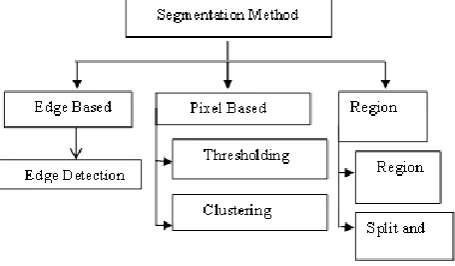
ECHNIQUESegmentation techniques can be classified as.
Fig 1: Classification of image Segmentation method
2.1 Edge Based Segmentation
Edge based segmentation fetches spatial information by detecting the edges in an image. Edge in an image is detected as a discontinuity [10]. Edge detection operators rule the precision of results [8].
2.1.1 Edge detection
detection, for this Laplacian and sobel operators are used but both the operator gives high false edges to improve it, a new method and set of filters are proposed to enhance the quality of segmented result [16].
Advantages
Detection of edges and there orientation is simple
Area of improvement
Result of edge detection is sensitive to the noise. 2.2 Pixel based segmentation:-
Pixel based segmentation is classified into various techniques:
Threshoding Clustering 2.2.1 Threshoding
Histogram Threshoding is one of the most popular segmentation technique, histogram can prepared on the basis of intensity value of pixel, corresponds to an image for example f(x,y) which is composed of light object on dark background. Now there is way to extract the object from the background by selecting the threshold T that separates histogram ,if any point in image like (x,y) for which f(x,y) ≥ T is called an object point that point is known as background point, thresholding image g(x,y)can be define as[2]
2.2.2 Clustering
Clustering is the grouping of the pixel which have same characteristics, Clustering is used for the image segmentation in this approach centroid represents the each of the cluster. If an image pixel is closer to the centroid then it will be included in the group, and the group of pixel is known by cluster, according to the characteristics of clustering algorithm it can be divided into “Hierarchical “and “partitional” clustering [3][4]. The hierarchical clustering is top down approach, as their name suggest the idea of building hierarchy of cluster, which are showing relation between the individual member and merging clusters of data based on similarity .and this hierarchy known by dendrogram. This hierarchical algorithm can be understood by Hierarchical agglomerative algorithm.
2.2.2.1 Hierarchical agglomerative algorithm
Hierarchical agglomerative algorithm can be implemented by three ways using single- linkage, average-linkage, and complete-linkage agglomerative algorithm.
Agglomerative clustering Algorithm
Begin with n cluster, each consisting of one sample.
Repeat step 3 a total of n-1 times.
Find the most similar cluster ci and cj and merge
them into one cluster, the first pair found. There are different methods of determining similarity of clusters, one way to measure the similarity between cluster is to define a function that measure distance between the cluster.
Single-linkage algorithm
This is also known as minimum method and the nearest neighbor method the single linkage algorithm is obtained by defining the distance between the points such that one point is in each cluster. For example ci and cj are two
cluster, and the distance between them can be define as [3] [20].
Where, Dsl = Distance by single linkage algorithm, d (a,
b) = distance between sample a and b, this method will allows the cluster to grow long.
Complete-linkage algorithm
This algorithm is also known as maximum method,
this algorithm provide more compact cluster. For
example c
iand c
jare two clusters, and the distance
between them can be defined as [3] [20].
Where D
cl=Distance by complete-linkage algorithm,
d (a, b) = distance between sample a and b.
Average-linkage algorithmThe average-linkage algorithm is compromise between single linkage as well as complete linkage algorithm.in this method distance between the cluster can be
determine as [3
] [20]
Where Dal = distance by average-linkage, ni = number of
members in ci cluster, nj= number of members in cj
cluster, d (a, b) = distance between sample a and b. Advantages of Hierarchical clustering
In Hierarchical clustering we can understood the relationship between the cluster by checking the dendrogram.
The result produces by the hierarchical clustering offers high correlation with the characteristics of original database.
Copyright © 2013 CTTS.IN, All right reserved Improvement areas
Hierarchical clustering involves in detailed level, the fatal problem is the computation time.
2.2.2.2 Partition clustering
In the hierarchical clustering we are concentrating on the structure of cluster but the aim of partition clustering is to obtained a single partition of data ,it is useful for the implementing large dataset[3].there are many portioning clustering algorithm in these literature we are more focused on k mean clustering algorithm, which is based on partitioning.
K-means clustering
k-means clustering is most popular partition based clustering it is extensively used for cluster analysis.it has greater efficiency and scalability when we are dealing with large datasets.it also has many deficits like in it we have to initialize number of cluster k, initial cluster is randomly selected[5].
Algorithm
Initialize the number of cluster k, and also pick initial centroid randomly.
The squared Euclidean distance will be calculated from each object to each cluster is computed, and each object is assigned to the closest cluster.
For each cluster, the new centroid is computed and each seed value is now replaced by the respective cluster centroid [3].
Euclidean distance from an object to each cluster is calculated, and the object is allotted to the cluster with the smallest Euclidean distance. This process will be continue until object is in same cluster at every iteration [3] [6] [7].
Advantage
K-means clustering algorithm is easy to implement.
It is faster than the hierarchical clustering. Improvement areas
The result is sensitive to the selection of the initial random centroids.
We cannot show the clustering details as hierarchical clustering does.
Selection of number of cluster in image will be user dependent.
K-means clustering has problems when the data contains outliers.
2.3
Region Based SegmentationRegion in an image is group of pixel which has similar properties. That can be categorized into various techniques
Region growing
Region splitting and merging 2.3.1 Region Growing
It is an approach of image segmentation in which each pixel is examined and added to the region if no edge is found this process is restated for each pixel within region [8]. Before starting the process of region growing we have to select one seed pixel and threshold value, now check the every pixel with threshold if threshold is greater than pixel value then put into the one region if pixel value is greater than threshold then that pixel will be put into the another region. This process will be continue until all the pixels are covered into the region [3].
Advantage
Region growing methods can provide accurate separation with respect to properties of pixel [9]. Region growing approach can give good
segmented result with clear edges.
The idea is simple. So to implement it, we only need a small numbers of seed point to represent the property we want, then grow the region.
Improvement area
Algorithm is very sensitive to noise. 2.3.2 Region splitting and merging
This technique is also used for image segmentation, it is a top-down approach used for dividing an image. Splitting is insufficient alone for reasonable segmentation. Hence merging technique is used after splitting technique [8]. Splitting and merging algorithm is as follows:
Let R represent the entire image.
Subdivide an image successively into smaller quadrant.
Here in Quad tree representation R Represents an image and R1, R2, R3, R4, Represents Subdivision of image R,
and R41, R42, R43, R44 are sub division of R4 region.
In Merging following steps are follows Begin with whole image.
If the variance of image is too high than split an image into quadrants.
Merge two regions which have same properties. Repeat 2nd and 3rd step until no more splitting
and merging occurs. Area of improvement
It is difficult to find point of splitting. It does not provide the unique solution.
3. R
ELATEDW
ORKIn this field most of the work is done some of them are discussed here, study of comparison of various image edge detection techniques [15] In this paper author Raman Maini, Himanshu Aggrawal, had identifies that edge detection is a primary step for image analysis, but it has some problem of false edge detection, absence of true edges, generating thin or thick lines and all these problems occur due to noise in this paper all such problems are analyzed and they gave a solution on that. In gradient based detection algorithm like prewitt filter have major drawback because it is very sensitive to the noise, and the size of kernel filter and coefficients are fixed , all this parameter cannot be accepted for a certain image.so there may have an edge detection technique which provide the robust solution which is acceptable to the varying noise level, and help to distinguish valid contents of the image.by comparing the performance of all operator found that the performance of canny operator is better than the performance of all operator because performance of canny operator depends on following adjustable parameter such as standard deviation for the Gaussian filter ,and threshold value. Standard deviation controls the size of Gaussian filter, when S.D is larger then size of Gaussian filter also large that shows more blurring ,and when the S.D is less, then smaller Gaussian filter are used which confines the amount of blurring, some of all above problem can be resolved by adjusting this parameter.
Image segmentation using graph cut technique for outdoor scene images.[11] in this paper author purnashti Bhosale, Aniket Gokhale, yogesh motey ,had given a technique to improve the performance of image segmentation technique, In this paper graph cut method are used for an image segmentation, and given a comparison With different image segmentation techniques. Segmentation by graph cut method is done on the basis of color and there texture information. In graph cut method we have to identify the foreground and
background of an image by seeing an image then made background as black and keep foreground as it is, by which we can clearly observe foreground from back ground.it takes single computation and produce good result as compared to other segmentation technique. Automatic Segmentation of vocal tract MR images [12], in this paper author Zeynab Raeesy, Sylvia Rueda, Jayaram K. Udupa, and John Coleman had identified some problem that is in biomedical field for the analysis of hidden mechanism of human speech production system MRI technique usually used. But automatic segmentation of vocal tract figure is challenging task in MRI, because of dynamic nature of articulation, and the shape of vocal tract is changes according to the different sound.To resolve the problem of automatic segmentation in MRI technique author proposed a new method which is an automatic landmark tagging by recursive boundary subdivision method. This method is used for obtaining landmark on contour of vocal tract, and for recognition of the shape of vocal tract, oriented active shape model is used in MRI technique.
Segmenting Digital images using edge detection [16] in this paper author Amit Chaudhary, Tarun Gulati had identifies the problem which are:Edge detection are used for the image segmentation it filters out the useless information from an image, for the edge detection generally Laplacian and sobel edge detector are used And we found that the result which is produces by sobel edge detection algorithm is better than Laplacian edge detector, but in both cases false edges are high for low resolution images. To minimize the number of false edges of low resolution image after segmentation. Author proposed a new method and set of filters. for this mask used by proposed operators are:
Copyright © 2013 CTTS.IN, All right reserved area of interest, based on application, area of interest is
changes according to the user and none of the segmentation algorithm satisfies the global application. To solve the problem of image segmentation for global application author proposed a new method which is based on region growing and region merging, in region growing process initial point is selected on the basis of Euclidian distance, and similarity of pixel, and merging of region is based on size and homogeneity function.in this method author uses HIS color model because this model break the pair of intensity component from color carrying information. This method allows control over the degree of segmentation by changing the power of HIS in its Euclidian distance. An Improved clustering method based on K-means [13] In this paper aim of author is to improve the clustering algorithm using combination of K-means clustering and split and merge technique. For this author had suggested a method for image segmentation which is based on the split and merge as well as k-means clustering technique. In this method initially K-means clustering algorithm is performed on dataset. Than as a result we get clusters and in split stage, if clusters are sparse then clusters is divided into smaller cluster with k mean repeatedly, after that in merge stage clusters are merged according to the concept of average distance. Finally experimental results validate that the method suggested by author can detect the clusters having different size, shape and density.
An improved K-means clustering algorithm [5] In this paper author had suggested a method to improve the performance of k-means clustering algorithm. Improved clustering algorithm proposed by author:
1. Take input data set, and calculate local outlier factor can be represented by Lof(p),
If lof (p) is much greater than 1 remove the point p else leave the p. and get new data set N. 2. Calculate the initial center of the cluster by
taking a mean of data set N
3. Calculate next center of a cluster, for this calculate the distance between remaining seed and cluster center.
4. Calculate the mean of object in every cluster as a new cluster centroid.
5. Repeat the step 3 and 4 until criteria function converged.
An Accurate Thresholding-based Segmentation Technique for Natural Images [17] in this paper author Sharifah Lailee Syed Abdullah, Hamirul Aini Hambali , Nursuriati Jamil, says that Otsu and k-means clustering method are widely used for image segmentation but both the techniques are failed for producing good result for natural images. So the aim of author is to give an algorithm which produce better solution then above two methods. For this author had suggested a new algorithm which is based on Thresholding, Titled as “improved thresholding based segmentation with inverse technique (TsTN)” by the analysis of experimental result finally author conclude that Proposed algorithm is able to produce good result as compared to Otsu and K-means algorithm [17].
4. P
ERFORMANCEE
VALUATIONM
EASURES MSE (Mean Square Error): The MSE (mean squareerror) is defined as average squared difference between a reference image and a distorted image. It is calculated by the formula given below,
PSNR (Peak Signal-to-Noise Ratio): PSNR, Peak Signal-to-Noise Ratio, a term used to define objectively the quality of data, which is the result of decompressing encoded data. It is calculated by the formula given below,
NPCR (Number of Pixel Change Rate): It should be maximum for high quality images. It can be calculated by the formula is given below,
MAE (Mean Absolute Error): MAE can be obtained by the formula given below ,
5.
D
ISCUSSION ANDC
ONCLUSIONThis paper presents discussion on image segmentation techniques and their lacunas and analyzes that Image segmentation is an essential process used in various fields such as biomedical field, computer vision and image processing. The review shows, performance overview and comprehensive assessment of image segmentation techniques. Mainly image segmentation was done with the help of clustering mechanism but there is no standard way for initial centroid selection, so they may affect the performance of image segmentation algorithm. So as a future, I want to provide a new improve k-mean clustering algorithm using the mechanism of initial centroid selection which will give better performance than existing k-mean clustering algorithm.
Acknowledgment
This research paper is made possible through the help and support from everyone, including: parents, teachers, family, friends, and in essence, all sentient beings. Especially, please allow me to dedicate my acknowledgment of gratitude toward the Following significant advisors and contributors: First and foremost,
I would like to extend my gratitude to Hon. Shri Amrish Patel, Chancellor SVKMs NMIMS for his most support and encouragement by providing excellent infrastructure and research faculties in Tribal area like Shirpur. I would like to extend my gratitude to Dr. Tapan Bagchi, Director Shirpur Campus, Dr. M. V. Deshpande Associate Dean, MPSTME Shirpur and Dr. N. S. Choubey, Head of the department for constant and unconditional support. Finally, I sincerely thank to my parents, family, and friends, who provide the advice and financial support. The product of this research paper would not be possible without all of them.
6.
R
EFERENCES[1] Jun Tang, “A Color Image Segmentation algorithm Based on Region Growing”.
[2] Huiyu Zhou, Jiahua Wu, Jianguo Zhang. “Digital image processing’’ book.
[3] Yu-Hsiang Wang Tutorial “Image Segmentation’’. [4] Morteza Jalalat evakilkandi, Abdolreza Mirzaei, “A
New Hierarchical-Clustering Combination scheme Based on Scatter Matrices and Nearest Neighbor Criterion’’, 5th International Symposium on Telecommunications,978-1-4244-8185-9, (2010).
[5] Juntao Wang, xiaolong Su, “An improved K-Means clustering algorithm", Communication Software and Networks (ICCSN), ISBN: 978-1-61284-485-5(2011).
[6] Dr. Majidul Ahmed, Saiful Islam, “Implementation of Image Segmentation for Natural Images using Clustering Methods” , International Journal of Emerging Technology and Advanced Engineering, ISSN 2250-2459(2013).
[7] H. P. Ng, S. H. Ong , K.W.C. Foong , P.S. Goh , W.L. Nowinski, “image segmentation using k-means clustering and improved watershed algorithm”, IEEE 2006.
[8] S. Jayaraman, S. Esakkirajan, T. veerakumar , Book, “Digital image processing”.
[9] Shilpa Kamdi , R. K. Krishna, “Image Segmentation and Region Growing Algorithm”, International Journal of Computer Technology and Electronics Engineering, ISSN 2249-6343(2011). [10] N. Senthilkumaran and R. Rajesh, “Edge Detection
Techniques for Image Segmentation – A Survey of Soft Computing Approaches”, International Journal of Recent Trends in Engineering Vol. 1, No. 2, (2009).
Copyright © 2013 CTTS.IN, All right reserved for outdoor Scene Images” ,International
conference on Communication and Signal Processing, 978-1-4673-4866-9 (2013).
[12] Zeynab Raeesy, Sylvia Rueda, Jayaram K. Udupa, John Coleman, “Automatic segmentation of vocal tract MR images”, International Symposium on Biomedical Imaging, 978-1-4673-6455-3 (2013). [13] Yujun Lin, Ting Luo, Sheng Yao, Kaikai Mo,
Tingting Xu, Caiming Zhong, “An Improved Clustering Method Based on K-means”, International Conference on Fuzzy Systems and Knowledge Discovery, 978-1-4673-0024-7(2012). [14] J. selvakumar, A. Lakshmi, T. Arivoli, “Brain
Tumor Segmentation and Its Area Calculation in Brain MR Images using K-Mean Clustering and Fuzzy C-Mean Algorithm”, IEEE-International Conference On Advances In Engineering, Science And Management, ISBN: 978-81-909042-2-3 (2012).
[15] Raman Maini, Dr. Himanshu Aggrawal, “Study and Comparison of Various Image Edge Detection Techniques” , International Journal of Image Processing (IJIP), Volume 3 (2009).
[16] Amit Chaudhary, Tarun Gulati, “Segmenting digital images using edge detection”, International Journal of Application or Innovation in Engineering & Management, ISSN 2319 – 4847,(2013).
[17] Sharifah Lailee Syed Abdullah, Hamirul Aini Hambali, Nursuriati Jamil, ” An Accurate Thresholding-based Segmentation Technique for Natural Images”, IEEE Symposium on Humanities, Science and Engineering Research, 978-1-4673-1310-0 (2012).
[18] M. Mary Synthuja Jain Preetha, Dr. L. Padma Suresh, M.John Bosco, “Image Segmentation Using Seeded Region Growing”, International Conference on Computing, Electronics and Electrical Technologies, 978-1-4673-0210-4 (2012).
[19] Saiful Islam, Dr. Majidul Ahmed, “Implementation of Image Segmentation for Natural Images using Clustering Methods”, International Journal of Emerging Technology and Advanced Engineering, ISSN 2250-2459 ( 2013).
[20] Madhuri A. Tayal, M. M. Raghuwanshi, “Review on Various Clustering Methods for the Image Data”, Journal of Emerging Trends in Computing and Information Sciences, ISSN 2079-8407 (2010-11)
A
UTHOR’
SP
ROFILEMr. Arpit Maheshwari received degree Bachelor of Engineering from RGPV University, Bhopal in 2012. Currently, pursuing Master of Technology in Computer Engineering at Mukesh Patel School of Technology Management and Engineering, Shirpur Campus, Maharashtra of SVKM’s NMIMS (Deemed to be University).
Mr. Sachin Sonawane, Assistant Professor, Department of Electronics & Telecommunication Engineering, MPSTME, SVKM’s NMIMS, Shirpur campus, Maharashtra, India. Qualification: M. Tech (Electronics & Telecommunication). Experience: 5 years, Research area: Image Processing.