ENHANCEMENT OF FRESH WATER PRODUCTION ON TRIANGULAR
PYRAMID SOLAR STILL USING PHASE CHANGE MATERIAL AS
STORAGE MATERIAL
Ravishankar Sathyamurthy
a,*, P.K. Nagarajan
b, Hyacinth J. Kennady
a, T.S. Ravikumar
a, V. Paulson
c, Amimul Ahsan
da Department of Mechanical Engineering, Hindustan Institute of Technology and Science, Chennai, Tamil Nadu, 603103, India b Department of Mechanical Engineering, S.A. Engineering College, Chennai, Tamil Nadu, India
c Department of Aeronautical Engineering, Hindustan Institute of Technology and Science, Chennai, Tamil Nadu, 603103, India
d Department of Civil Engineering, Green Engineering & Sustainable Technology Lab, Institute of Advanced Technology, University Putra Malaysia, Selangor, Malaysia
ABSTRACT
This paper presents the method of improvement of enhancing the performance of triangular pyramid solar still with and without latent heat energy storage. For comparing the productivity of solar still with and without LHTESS a solar still is designed, fabricated. Experiments are conducted in hot and humid climate of Chennai, India. Paraffin wax is used as LHTESS due to its feasible general and economic properties. The hourly productivity is slightly higher in case of solar still without LHTESS during sunny days. There is an increase of about 35% in production of fresh water with LHTESS than that of solar still without LHTESS. Also it was found that during the off shine period the fresh water produced from the still is higher. The solar still with and without LHTESS were found to be 4.5 L/m2day and 3.5 L/m2day during summer and in the winter the productivity was found
to be 3.4 L/m2day and 2.3 L/m2day for the still with and without LHTESS respectively.
Keywords: Enhancement, Phase change material, hourly variation, Efficiency.
* Corresponding author. Email: [email protected]
1.
INTRODUCTION
Solar energy is the earliest source of energy, inexhaustible and non-pollutant in nature, solar distillation can provide an alternative source to generate clean water. Solar distillation exhibits a considerable economic advantage over other salt water distillation processes because of its use of free energy and its insignificant operating costs. This process removes salt impurities. Solar stills suffer from low efficiencies due to loss of heat of condensation to the surroundings from the glass cover. In order to improve the productivity, it is planned to incorporate partial thermal energy storage (Farell et al., 2006; Tabrizi et al., 2010).
The thermal energy storage system has become an important issue in the global energetic scene and has been widely used to increase energetic efficiency of different applications (El-Sebaii et al., 2009). These systems may be either sensible or latent heat systems. This method utilizes the heat dissipated from the bottom of the still. The latent heat storage system has many advantages over sensible heat storage systems including a large energy storage capacity per unit volume and almost constant temperature for charging and discharging. Here, phase change materials will act as a thermal energy storage medium. It is a substance with a high heat of fusion which, melting and solidifying at a certain temperature, is capable of storing and releasing large amount of energy. It changes its phase by absorbing latent heat during sun shine hours and it discharges the stored energy which is suitable for distillation purpose during off sunshine hours (Jinjia Wei at al, 2005) (Naim, 2002). With a thin layer of PCM under the basin liner of a solar still, a considerable amount of heat will be stored within PCM
during sunshine hours instead of wasting it to surroundings. During freezing of PCM, the stored heat discharges to keep the basin water at a temperature enough to produce fresh water during night even thin layers of basin water. This causes enhancement of still productivity especially during night period (Demirbas, 2006).
Tabrizi et al. (2010) investigated the effect of built-in latent heat thermal energy storage on a weir-type cascade solar still. The hourly production of fresh water of solar still with PCM is relatively low when compared to solar still without PCM on summer. It has been reported that the solar still without PCM is well suited for sunny days and still with PCM was suited for cloudy conditions. (Tabrizi et al., 2010) experimentally investigated the effect of water flow on internal heat and mass transfer on a weir cascade solar still. It has been reported that the increase in mass flow on the basin of weir there will be a decrease in fresh water production. Results show that an accumulated yield of 7.4 and 4.3 kg/m2 were achieved for minimum and maximum flow rates
respectively. A triangular pyramid solar still with built-in latent heat thermal energy storage system was fabricated to improve the still productivity by (RaviShankar et al., 2013).
It was been found that the solar still with PCM and without PCM were found to be 4.2 kg/m2.Another still with the same characteristics
without PCM was also constructed for investigation of the internal convective heat transfer coefficient. In this paper an attempt has been made to find the use of paraffin wax as a heat storage material. Paraffin wax acts as a reliable, less expensive and non-corrosive heat storage medium (Naim, 2002).
Frontiers in Heat and Mass Transfer
2.
EXPERIMENTATION
Fig. 1 shows the experimental setup of triangular pyramid solar distiller. Experiments were carried out from 7 am- 6 pm. The plastic storage tank of capacity 50 l was used in order to avoid corrosion. Water from the storage tank enters the still through flexible hoses and a valve V, to maintain constant water level in the still. The valve ‘V’ can control the mass flow rate. Poly vinyl chloride (PVC) hoses were used for greater flexibility. The black painted still basin was placed inside the wooden box at a predetermined height. The area below the basin was filled with saw dust for insulation purpose. A small glass piece obstruction was fixed on the inside surface of the glass cover, to facilitate the deflection of the condensate return in to the collection channel, which in turn affixed with the still. The gliding water from the channel was transferred in to the measuring jar through the flexible piping. A heat reservoir is integrated with the still and filled by a phase change materials (PCM) that acts as a latent heat storage subsystem (LHTESS). Paraffin wax was selected as a LHTESS due to its thermal storage, safety, reliability and low cost. During the sunshine, when the absorber temperature is higher than the temperature of PCM, the heat is transferred to PCM and charging process is started to store solar energy as a sensible heat till PCM reaches its melting temperature. Additional charging heat is stored as the latent heat during the melting process. When the absorber temperature is lower than PCM (after sunset), reverse process is occurred (discharging process) till the PCM layer is fully solidified. Table 1 physical property of paraffin wax which is used as heat recovery. Calibrated NiCr-Ni thermocouples connected to a FLUKE 73 digital multimeter with accuracy 0.5oC were used to
measure the temperatures of the still elements, e.g. basin liner Tb, basin
water Tw and the inner Tgi and outer Tgo surfaces of the still cover every
half an hour starting at 8:00 am until sunset. The experiments were continued until 8:00 am of the next day. The yield from the still was collected and measured every 1 h. The productivity of the still during the night period was also collected and measured using a measuring jar. The ambient temperature had been also measured. The horizontal global solar radiation was measured using an Epply EPSP pyranometer coupled to an Epply instantaneous solar radiation meter with sensitivity of 8.79x10⁻⁶ (V/Wm2) and accuracy better than 5% in the range from 0
to 2000 W/m2. The wind speed V was also measured using the
Environmental Products Anemometer.
The thermocouples are used to measure the temperature of the glass plate, absorber plate, and water and phase change materials temperatures. Also the quantity of distilled water was measured. This experimental setup was designed, installed and tested at Hindustan Institute of Technology and Science, Chennai, Tamil Nadu, India.
Table 1. Thermo physical properties of paraffin wax (Haji-Sheikh, 1982)
Property Value
Melting temperature (°C) 40-60
Specific heat of solid/liquid (kJ/kg °C) 2.95/2.51
Density of solid/liquid (kg/m3) 818/760
Thermal conductivity of solid/liquid (W/m °C) 0.24/0.24
Heat of fusion (kJ/kg) 226
Table 2. Relevant parameters for calculation (Wong, 1977) and (Duffie, 1991)
Parameter Value Parameter Value
Ab (m2) 1.0 αg 0.05
τg 0.90 ks(W/m2K) 0.059
τw 0.95 xs (m) 0.05
αb 0.90 Cw (J/kgK) 4190
αw 0.05 kg (W/m2K) 1.05
σ(W/m2K4) 5.66x10⁻⁸ x
g (m) 0.003
V m/s 0-20 kw(W/m2K) 0.628
Fig. 1 Pyramid type distiller
3.
ENERGY BALANCE
The energy received by the saline water in the still I (t) solar radiation and Qcb-w convective heat transfer between basin and water are equal to
the summation of energy lost by Qcw-g convective heat transfer between
water and glass, Qrw-g radiative heat transfer between water and glass,
Qew-g evaporative heat transfer between water and glass and energy
gained by the saline water: The remaining is by evaporation, due to partial vapour pressure difference between the water surface and lower surface of the glass cover. Water evaporated condenses at the distillate collector through the glass cover. A small part of heat is lost to atmosphere through basin bottom and side wall by conduction and convection. For shallow basin still, the basin bottom surface and water are assumed as single element (Prakash, 1986) and the temperature is taken as constant for basin and water. Raw water is continuously supplied to the basin to keep the water mass in the basin always constant. This compensating water mass takes sensible heat to attain equilibrium with basin water.
4.
RESULTS AND DISCUSSIONS
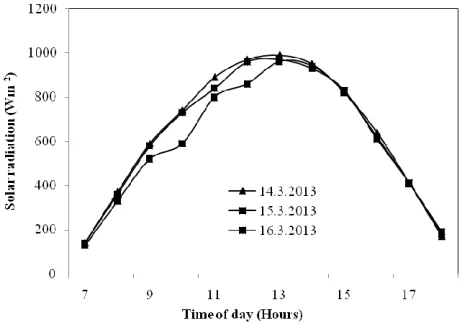
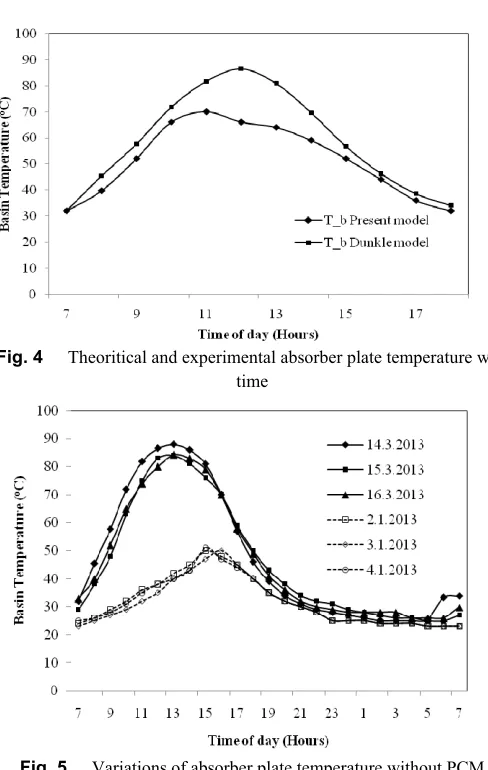
Fig. 2 and 3 show the variation of solar intensity from which it is observed to be maximum at the mid-noon. The observation shows that the solar radiation profile seems to be the same on the experimental days. Fig. 4 shows the hourly variation of experimental and theoretical temperatures of basin of a pyramid type solar still. The theoretical and experimental values are found to be very close during the morning and reach the maximum of 82oC. The RMS error for basin temperature is
found to be 12% between theoretical and experimental values and these errors are minimized by proper insulation and higher wind velocity over the still which reduces the heat loss from water to ambient conditions.
Fig. 2 Variation of solar radiation on summer day on Chennai
Fig. 3 Variation of solar radiation on winter day on Chennai climatic condition
Fig. 4 Theoritical and experimental absorber plate temperature with
time
Fig. 5 Variations of absorber plate temperature without PCM
Fig. 5 and Fig. 6 show the variation of absorber plate with respect to time of solar still with and without use of LHTESS. The absorber plate temperature increases gradually with increase in solar intensity and have peak around 1 pm. The maximum obtained values for plate are 90 °C for still without LHTESS. Similarly for solar still with LHTESS, maximum obtained values for Tb is found to be 65°C.
Temperature of plate is higher for still with LHTESS, due to the fact that some of energy was observed as phase change energy. It is cleared that in the early hours of the day the plate temperature is slightly higher than water temperature because in that period’s glass is directly faces the solar radiation and its temperature rises faster in comparison with water temperature. Then, the increase in water temperature is faster in
comparison with glass plate temp due to higher heat losses from the glass plate to the ambient.
Fig. 6 Variations of absorber plate temperature with PCM
Fig. 7 Variations of water temperature without PCM
Fig. 7 and Fig. 8 show the hourly variation of water temperature with and without PCM. From the theoritical analysis the maximum acheivable temperature of water is about 75oC. In the present model the
temperatuer of water in the still with and without PCM achieved is about 70 and 85oC respectively. During the winter days, for the same
solar still temperatue of water inside the still with and without PCM found to be 45oC and 48oC respectively.
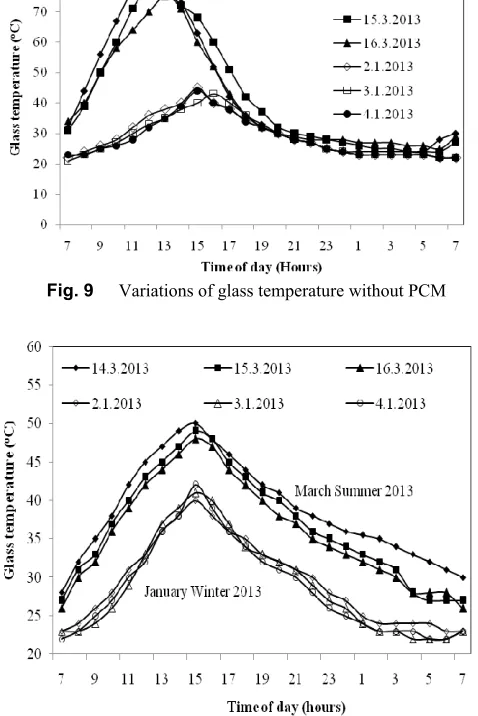
Fig. 9 andFig. 10 show the diurnal variation of glass temperatures. It is observed that the driving force between water and glass acts as the prime source for fresh water production. Due to the forcing of wind over the surface reduces the temperature of glass for better enhancement.
Fig. 9 Variations of glass temperature without PCM
Fig. 10 Variations of glass temperature with PCM
Fig. 11 and Fig. 12 show the diurnal variation of fresh water producureion from the solar still with and without phase change material. It is clear obvious that the fresh water production from the solar still depends on solar intensity during the sunshine hours. And the results shows that the solar intensity is directly proportional to yield from the solar still. The yield obtained from the still without PCM shows a higher output compared to still with PCM. It is due to the amount of partial recovery of heat from the water to PCM in the basin. During the off shine period the heat which is recovered during the charging mode, discharges its heat to water.
Fig. 11 Variations of distillate output without PCM
Fig. 12 Variations of absorber plate temperature with PCM
Fig. 13 Variations of cumulative yield on different experimental days
in summer
fabricated to improve the still productivity. Another still with the same characteristics without LHTESS was also constructed for investigation on hourly production of fresh water. Using a 1m2 area of solar still the
average production of fresh water about 3.4 liters/m2 without LHTESS
effect is possible. The effect of introducing PCM in the above setup shows an increase of 20% in the production of fresh water.
5.
CONCLUSIONS
The daily efficiency was found to be 53% with LHTESS and 45% without LHTESS. Solar radiation on the test days reveals that the maximum intensity occurred during the mid-day, and the productivity shows that the solar radiation and production rate are directly proportional. The temperature difference between water and glass varies from 10-15.5oC during the off-shine period. Experimental results
concludes that with PCM the production of fresh water improved to about 4.3 liters/day for a 24 hour operation, its due to the higher specific heat capacity, better latent heat of fusion, and thermal conductivity of wax.
ACKNOWLEDGEMENTS
The authors are extending their sincere thanks to Mr. A.P. Arun Pravin and Mrs. M. Jeyashree of St. Peters College of Engineering and Technology Chennai for their technical support.
REFERENCES
Demirbas, F., 2006, “Thermal Energy Storage and Phase Change Material: An Overview” Taylor & Francis, Part B, 1:85-95.
http:dx.doi.org/10.1080/009083190881481
Duffie JA., Beckman WA., 1991, “Solar Engineering of Thermal Processes”. New York: Wiley.
Dunkle, R.V., 1961, “International development in heat transfer”. In: ASME Proceedings. Inter. Heat Transfer, Part V, University of Colorado; p. 895.
El-Sebaii, A.A., Al-Ghamdi, F.S., Al-Hazmi, Adel S. Faidah, 2009, “Thermal Performance of A Single Basin Solar Still with PCM as Storage Medium,” Journal of Applied Energy, 86, 1187 -1195.
http:dx.doi.org/10.1016/j.apenergy.2008.10.014
Farell, A.J., Norton.B., Kennedy, D.M., 2006, “Corrosive Effects Of Salt Hydrated Phase Change Materials Used With Copper And Aluminum,” Journal of Material Processing and Technology, 175 ,198-205.
http:dx.doi.org/10.1016/j.jmatprotec.2005.04.058
Haji-Sheikh, A., Eftekhar, J., Lou, D.Y.S., 1982, “Some Thermo Physical Properties of Paraffin Wax As A Thermal Storage Medium,” 3rd Joint Thermophysics, Fluids, Plasma and Heat Transfer Conference, St. Louis, MO.
Jinjia, W., Kawaguchi, Y., Hirano, S., Takeuchi, H., 2005, “Study on A PCM Heat Storage System for Rapid Heat Supply,” Journal of Applied Thermal Energy, 25, 2903 – 2920.
http:dx.doi.org/10.1016/j.applthermaleng.2005.02.014
Malik, M.A.S., Tiwari G.N., Kumar, A., Sodha M.S., “Solar Distillation”.UK: Pergamon Press; 1982.
Naim, M.M., 2002, “Non-Conventional Solar Stills with Energy Storage Element” Desalination, 153, 71-80.
http:dx.doi.org//10.1016/S0011-9164 (02)01095-0
Prakash. J, Kavathekar, A.K., 1986, “Performance Prediction of A Regenerative Solar Still,” Solar & Wind Technology, 3(2), 119–125
Radhwan AM., 2004, “Transient Performance of a Steeped Solar Still with Built-in Latent Heat Thermal Energy Storage,” Desalination, 171, 61–76.
http:dx.doi.org/10.1016/j.desa1.2003.12.010
RaviShankar, S., Nagarajan, P.K., Vijayakumar, D., and Jawahar, M.K. 2013, “Phase Change Material on Augmentation of Fresh Water Production Using Pyramid Solar Still,” Int. Journal of Renewable Energy Development, 2(3), 115-120.
Sharma, V.B., Mullick, S.C., 1993, “Calculation of hourly output of a solar still,” J. Solar Energy Eng, 115, 231–236.
http://dx.doi.org/10.1115/1.2930055
Tabrizi, F.F., Dashtban, M., Moghaddam, H., 2010, “Effect of Water Flow Rate on Internal Heat and Mass Transfer and Daily Productivity of a Weir- Type Cascade Solar Still,” Desalination, 260(1-3), 248-253.
http://dx.doi.org/10.1016/j.desal.2010.03.033
Tabrizi, F.F., Dashtban, M., Moghaddam, H., 2010, “Experimental Investigation of a Weir – Type Cascade Solar Still with Built-in Latent Heat Thermal Energy Storage,” Desalination, 260(1-3), 239-247.
http://dx.doi.org/10.1016/j.desal.2010.03.037
Wong, H.Y., 1977, Handbook of Essential Formula and Data on Heat Transfer for Engineers, Longman, London.
Zurigat, Y.H., Abu-Arabi M.K., 2004, “Modelling and Performance Analysis of A Regenerative Solar Desalination Unit,” Applied Thermal Engineering, 24, 1061-72.