2019, Vol. 3, No. 2, 165 –178 ISSN 2587-0130
Corresponding Author: Vasiliki Georgoulas-Sherry, Teachers College, Columbia University, 525 West 120th St. New York, NY 10027
Email: [email protected] © 2019 JPPW. All rights reserved
Resilience, Grit, and Hardiness: Determining the Relationships amongst these
Constructs through Structural Equation Modeling Techniques
Vasiliki Georgoulas-Sherry
Dennis R. Kelly
Columbia University,New York, NY, United States
United States Military Academy, West Point, NY, United States
Abstract
A significant body of research has demonstrated the need to better understand character constructs that are integral in influencing and predicting human performance, specifically investigating resilience, grit, and hardiness. However, limited studies have examined the relationships that exist within these constructs. The current research addresses this gap by utilizing numerous structural equation modeling techniques to report on the relationships among resilience, grit, and hardiness. Employing a sample from the United States Military Academy (N = 1205), participants were asked to complete the Response to Stressful Experiences Scale, the Grit Scale, and the Dispositional Resilience Scale as part of the Reception Day battery of tests. Correlations matrixes reported positive relationships amongst resilience, grit, and hardiness. Confirmatory factor analyses (CFAs) revealed a six-factor model structure of resilience and a bi-factor model of grit and hardiness. Additional CFAs revealed a three-factor model structure among the three constructs resilience, grit, and hardiness. Implications for further work are presented.
Keywords: Resilience, hardiness, grit, military, leadership
Introduction
In recent years, a significant body of research has demonstrated the need to better understand constructs that are integral in influencing and predicting human performance (Duckworth, Peterson, Matthews, & Kelly, 2007; Kelly, Matthews, & Bartone, 2005; Maddi, Matthews, Kelly, Villarreal, & White, 2012; Matthews, Eid, Kelly, Bailey, & Peterson, 2006). Previous research has shown that such constructs have been essential in predicting academic success and retention rate (Duckworth et al., 2007; Maddi et al., 2012), adaptability (Bartone, Kelly, & Matthews, 2013), effective military performance and leadership (Hystad, Eid, Laberg, & Bartone, 2011; Maddi et al., 2012), long-term health (Gavidia-Payne, Denny, Davis, Francis, & Jackson, 2015), and neuro-immunological responses to stress
(Sandvik et al., 2013). Better comprehension of the relationship among these constructs is necessary to understand, especially in situations that are physically and mentally taxing (Hannah, Campbell, & Matthews, 2010). Particularly, as our soldiers are exposed to adverse environments (e.g., combat, war), we must place an emphasis in understanding resilience, grit, and hardiness as these constructs are critical protective factors in the mental health and well-being of individuals. The value of understanding these constructs is immeasurable as these experiences continue to produce irreversible psychological and physiological wounds in both military personnel and civilians.
traumatic event, or as characterized, an experience separate from what is considered a typical human experience. Similarly, American Psychological Association (APA, 2014) has reported that most individuals, at some point in their life, will be exposed to at least one, if not more, traumatic event that can impact an individual’s well-being and their mental health status or condition. Since most individuals experience some sort of life-threatening or violent encounter, there is justified rationale to further understand the necessary constructs that protect us from such adverse situations (Bonanno, 2004); furthermore, individuals who are in the Armed Forces are more likely to be exposed to adverse environments. Specifically, previous research has shown that resilience, grit, and hardiness produce an array of protective mechanisms that shield individuals from stressful and adverse environments and situations (Maddi et al., 2012; Matthews et al., 2006; Masten, 2001). These constructs are particularly critical in helping individuals maintain equilibrium during those challenging times, which allows for increased well-being in mental and physical health and decrease in risk-taking behaviors and maladaptive attitudes(Agaibi & Wilson, 2005; Bonanno, 2004; Bonanno, Galea, Bucciarelli, & Vlahov, 2007; Friborg, Barlaug, Martinussen, Rosenvinge, & Hjemdal, 2005; Masten, 2001). Resilience, grit, and hardiness are essential in overcoming such stressors that are inevitable in life (e.g., familial challenges, financial hardships, medical concerns, workplace issues), and therefore, research, such as this one, is integral to the comprehension of these constructs.
To our knowledge, while there are several research projects that have investigated all constructs, both solely and together, limited studies have examined the relationships that exist within resilience, grit, and hardiness. In Parthasarathy and Chakraborty’s (2014) study investigating grit as a dominant leadership trait, findings showed a strong positive correlation between grit and resilience (r = .59, p < .001). This strong association was also found in a study investigating sportspersons’ and non-sportspersons’ goal attainment (r = .53, p < .001) (Shrivastava & Mishra, 2016). A 2015 study that examined whether measures of resilience, grit, and hardiness predicted both general and sport-specific quality of life, revealed positive relationships amongst all constructs correlated (r = .40, .41, and .53, respectively) (Martin, Byrd, Watts, & Dent, 2015). Maddi et al. (2012) investigated the role of grit and hardiness on retention and performance at United States Military Academy (USMA) and found a moderate
correlation between these two constructs (r = .46, p < .001); similar findings by Kelly, Matthews, and Bartone (2014) who also investigated hardiness and grit as performance predictors among USMA cadets were shown (r = .34, p < .001). In summary, such research has illustrated the mechanism of qualifying these psychological constructs beyond baseline indicators.
These aforementioned studies have only begun investigating the relationships among these constructs. The existing need to conceptualize psychological constructs that have shown to be beneficial during challenging experiences, have produced an increased interest in examining not only the psychological constructs independently, but to discover potential relationships amongst these constructs. The current research not only attempts to address this gap, but further provides a more current understanding of the constructs, solely. In better comprehending resilience, grit, and hardiness, as separate constructs, we can then understand the interplays amongst these psychological constructs that are integral in promoting mentally healthy individuals as well as how people perform and behave. These complex relationships will be reviewed through a number of structural equation modeling (SEM) techniques.
The Construct of Resilience
mental stability and psychological health (Harel, Kahana, & Wilson, 1993; Wilson, & Drozdek, 2004).
Resilience has been shown to predict decreases in pain catastrophizing through positive emotions (Ong, Zautra, & Reid, 2010), increases in mental health in older adults (Gooding, Hurst, Johnson, & Tarrier, 2012) and in relative absence of depressive symptoms (Dias et al., 2015). The Response to Stressful Experiences Scale (RSES) was utilized as this an assessment that has been validated with a military sample to be a reliable measure of resilience (Besterman-Dahan et al., 2012; Johnson et al., 2013, 2014). Through the RSES, this proposed study defines resilience in terms of behavioral, cognitive, and emotional behavioral responses to stressful life events - this includes the six processes that promote resilient responses to highmagnitude stressors: positive appraisal (i.e., rethinking), spirituality (i.e., believing), active coping (i.e., problem solving), self-efficacy (i.e., embracing), meaning making and learning (i.e., advancing), and acceptance of limitation (i.e., understanding) (Johnson et al., 2013).
The Construct of Grit
Grit has been defined as a psychological construct established through an individual’s passion for a long-term goal, fixed with a strong desire to attain that individualized aim (Duckworth et al., 2007; Robertson-Kraft & Duckworth, 2014). Grit promotes a perseverance of effort in prevailing over challenges that individuals must face toward the path to success and is utilized as a motivating mechanism in goal attainment. Grit has been identified as the trait that allows an individual to perform vigorously and persistently toward any challenges without losing any energy or effort over a long period of time regardless of disappointment or failure. While most individuals might perceive failures as indications to walk away and start something new, gritty individuals persist; gritty individuals are more likely to self-maintain and self-regulate their feelings of commitment and willpower over a long time, regardless of any challenges or failures they might face (Duckworth et al., 2007).
Research has shown that gritty people are more likely to be successful and accomplished than non-gritty people; gritty individuals are also more characteristically likely to possess traits that are above a normal person’s ability (Duckworth et al., 2007; Laursen, 2015; Robertson-Kraft & Duckworth, 2014). While many studies such as this particular research utilized Western based samples, a number of projects that have used non-Western-based samples have also promoted grit as a predictor of workplace success (DeVera, Gavino, & Portugal, 2015) and well-being (and its facets such as life
satisfaction, meaning in life, and positive affect) (Datu, King, Valdez, & Eala, 2018; Datu, Valdez, & King, 2016). Grit has shown to predict retention in at least three other contexts: the military, high school, and marriage (Eskreis-Winkler, Duckworth, Shulman, & Beal, 2014). Additionally, grit has predicted psychological well-being and burnout among surgical residents (Salles, Cohen, & Mueller, 2016), academic success among Ivy League undergraduates (Duckworth et al., 2007), and self-efficacy in grade school children (Rojas, Reser, Usher, & Toland, 2012). While numerous studies support the presence of grit and the distinction amongst similar constructs, a recent contrasting opinion has been given attention, which suggests that the validity of assertions made by grit literature might need to be re-examined (Credé, Tynan, & Harms, 2017).
The Construct of Hardiness
Hardiness has been defined as the ability to adapt and perform under stressful conditions while remaining emotionally healthy and stable (Bartone, 1999, 2000, 2007; Maddi et al., 2012). According to Maddi et al. (2012), hardiness encompasses a mindset that is necessary in gaining the courage and knowledge to persevere through hardships. A hardy individual is able to take an adverse experience and turn it into a learning opportunity. This personality construct evolves from an early age, and maintains consistency throughout time, although it has shown to be amenable to change under specific circumstances (Kelly et al., 2014).
According to Bartone et al. (2013), the main features of hardiness are challenge (i.e., possessing an ability to be open to change in order to gain more knowledge), commitment (i.e., an ability to engage and participate in a community and feeling a sense of purpose), and control (i.e., an ability to believe that impact can happen). Hardiness has shown to predict success in US Army Special Forces candidates (Bartone et al., 2008), neuroimmunological reactions to stress(Sandvik et al., 2013), adaptability in military leaders (Bartone et al., 2013), soldier adjustment to combat stress (Bartone, Marlowe, Gifford, & Wright, 1992), and retention and graduation rates at USMA (Maddi et al., 2012).
Current Distinctions amongst Psychological Constructs
comprehend the necessity of this study. The existence of grit does not demand an adverse environment or situation as it is not dependent upon sustaining effort through a critical incident (Maddi et al., 2012); however, this is not the case with resilience. More so, hardiness is characterized with a positive mindset that allows for homeostasis during adverse circumstances (Kelly et al., 2014), while resilience is categorized as an active process of positive adaptation where an effort is made to continue and maintain homeostasis during traumatic or challenging circumstances (Luthar et al., 2000). Furthermore, according to Duckworth et al. (2007), grit is different from hardiness and resilience due to the degree of perseverance and passion placed on achieving a goal regardless of hardship– in both hardiness and resilience, there is no goal attainment. Importantly, while many have used these constructs interchangeably, some research has shown that regardless of the similar associations amongst them, each construct is operationally distinct (Kelly et al., 2014; Maddi et al., 2012). However, no work has looked at the relationship amongst resilience, grit and hardiness. To the authors’ knowledge, this is the first of its kind.
Present Study
Resilience, grit, and hardiness have shown to be integral in overcoming challenges, failures, and hardships. However, to the authors’ knowledge, there are no studies that have examined the relationships that exist amongst these constructs. For that reason, the main objective of the present study is to examine the related, but distinct psychological constructs. Through the utilization of SEM techniques such as confirmatory factor analyses (CFA) and correlation matrixes, this study will investigate numerous models that best describe the relationship and structure amongst these constructs. These questions will be based on the theoretical frameworks in articulating empirical indicators across the three constructs. We
endeavor to answer:
1. What are the empirical relationships among these constructs, and more specifically, what
are the factor structures of the three psychological constructs? To determine the unique structure of each construct, we hypothesize that the best fit model for hardiness and grit, respectively, would be the three-factor model structure and the best fit model for resilience would be the six-factor model structure. 2. How are then, resilience, grit, and hardiness
associated to one another, and more specifically, are there significant covariances amongst resilience, hardiness, and/or grit? As this question is exploratory
in nature, we hypothesize a three-factor model structure that denotes the similar, but separate constructs and the relationship to one another. We hypothesize that significant covariance exists between resilience, grit, and hardiness.
Method Participants
Participants (N = 1205) from the US Corp of Cadets at the USMA were recruited. Approximately 82% of the participants were males (N = 986) while the rest were females (N = 219). The average age of participants was 18.3 years old with 66% of those participants (N = 793) at 18 years of age and 34% of the participants (N = 412) at 19 years of age. As this study was held during USMA’s Reception week, all participants were newly entered cadets or freshmen, or as coined at USMA, “plebes.” Most participants self-categorized as Caucasian (74%) while the rest self-categorized as African American (8%), Hispanic (8%), and Asian (7%). Out of this sample, 82% of the participants (N = 988) graduated USMA while the rest separated.
Materials
Response to Stressful Experiences Scale (Johnson et al., 2013). The Response to Stressful Experiences Scale (RSES) is a 22-item self-report scale that measures differences in behavioral, cognitive, and emotional responses to stressful life events. This scale measures six processes that promote resilient responses to high-magnitude stressors: (a) positive appraisal, (b) spirituality, (c) active coping, (d) self-efficacy, (e) meaning making and learning, and (f) acceptance of limitation. Associations with other measures support convergent, concurrent, and discriminant validity. The RSES demonstrated internal consistency (= 0.91 – 0.93) and test–retest reliability (r = 0.87) (Johnson et al., 2013). Findings revealed the RSES to be highly reliable (22 items; = .89). The positive appraisal and meaning making and learning subscale each consisted of 5 items (= .67 and .77, respectively), the spirituality, self-efficacy, and acceptance of limitations subscale each consisted of 2 items (= .87, .67, and .50, respectively), and the active coping subscale consisted of 6 items (= .71).
cadets(Duckworth et al., 2007). Consistent to previous findings, the Grit Scale was found to be highly reliable (17 items; = .81). Additionally, the consistency of interest subscale and the perseverance of effort subscale each consisted of 6 items (= .77 and .65), respectively, and the ambition subscale consisted of 5 items (= .65). Dispositional Resilience Scale-15 (Bartone, 1999). The Dispositional Resilience Scale (DRS-15) is a 15-item self-report scale that measures hardiness and its subfacets: challenge, control, and commitment (Bartone, 1995). DRS-15 revealed high internal consistency (= .82) for the assessment overall, and for the three subfacets: (1) commitment (= .77), (2) control (= .68), and (3) challenge (= .69) (Bartone, 1999). It should be noted that the name of this scale, which is intended to measure hardiness and its subfacets, can be misleading, as the name of the scale can be seen as circular measurement; this study can potentially show the inaccuracy of this scale’s title and potential faulty logic. In this study, Cronbach’s alpha reliability coefficients for DRS-15 shows high reliability (15 items; = .65), lower than previous research. Additionally, the challenge, control, and commitment subfacets each consisted of 5 items (= .77, .62, and .63, respectively). All three hardiness subfacets measured lower in reliability than previous research.
Procedure
The study obtained data from USMA cadets during the week of Reception (either the second or the third day at USMA). USMA cadets were first informed about the study and then, asked to volunteer. Participants, who volunteered to participate, completed the three
assessments: RSES, the Grit Scale, and the DRS-15 as part of the Reception Day battery of tests.
Results Data Analysis
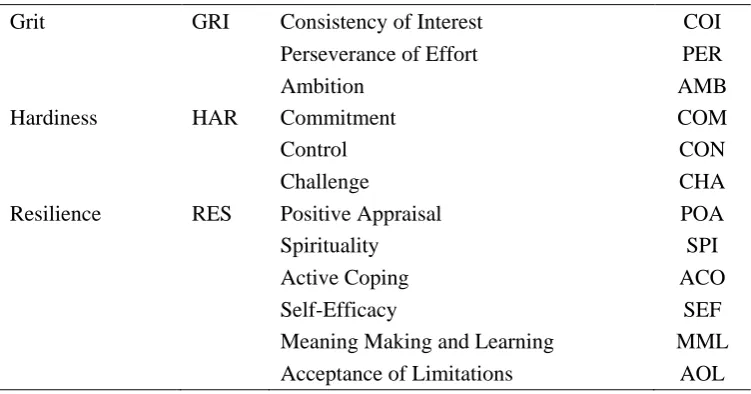
To examine the related, but distinct constructs of resilience, grit, and hardiness, SEM techniques were utilized to investigate the single-, bi-, and multiple-factor model (i.e., hierarchical model) structures for best fit; we endeavored to examine the factor structures and the associations amongst these constructs (see Table 1). Through SPSS’ Analysis of Moment Structures (AMOS), CFA models tested the structures that best describe the constructs. To describe the relationship amongst these constructs, CFA models were also used. Pearson r correlations computed the direction and strength amongst the constructs. Assumptions were satisfactorily met; the skewness ranged from -2.84 to 1.45 and kurtosis ranged from -.46 to 1.57, and the assumption of multivariate normality was not violated. No multivariate outliers were presented (Finney & DiStefano, 2006).
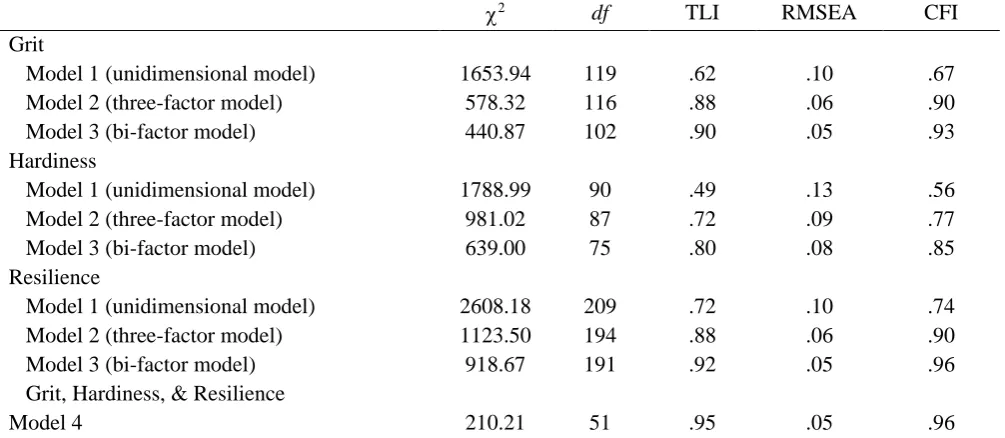
For each construct, three CFA models via maximum likelihood (ML) estimation were implemented: (1) Model 1 was a unidimensional model of each construct wherein all the items loaded onto a single latent factor, (2) Model 2 was a multi-factor model (three-factor (full mediation) model for grit, three-factor model for hardiness, or six-factor model for resilience) with no hierarchical structure, and (3) Model 3 was a bi-factor model of each construct. Traditional model-fit indices were employed: (1) Comparative Fit Index (CFI), (2) Tucker-Lewis Index (TLI), and (3) Root Mean Square of Approximation (RMSEA).
Table 1. Dimensions of the psychological constructs
Grit GRI Consistency of Interest COI
Perseverance of Effort PER
Ambition AMB
Hardiness HAR Commitment COM
Control CON
Challenge CHA
Resilience RES Positive Appraisal POA
Spirituality SPI
Active Coping ACO
Self-Efficacy SEF
Meaning Making and Learning MML
Table 2. Model fit statistics and indexes associated with the models
2 df TLI RMSEA CFI
Grit
Model 1 (unidimensional model) Model 2 (three-factor model) Model 3 (bi-factor model)
1653.94 578.32 440.87
119 116 102
.62 .88 .90
.10 .06 .05
.67 .90 .93 Hardiness
Model 1 (unidimensional model) Model 2 (three-factor model) Model 3 (bi-factor model)
1788.99 981.02 639.00
90 87 75
.49 .72 .80
.13 .09 .08
.56 .77 .85 Resilience
Model 1 (unidimensional model) Model 2 (three-factor model) Model 3 (bi-factor model)
2608.18 1123.50 918.67
209 194 191
.72 .88 .92
.10 .06 .05
.74 .90 .96 Grit, Hardiness, & Resilience
Model 4 210.21 51 .95 .05 .96
Notes. CFI = Comparative Fit Index; TLI = Tucker-Lewis Index; RMSEA = Root Mean Square Error of Approximation; all models were statistically significant (p < .05)
CFA Hardiness Models
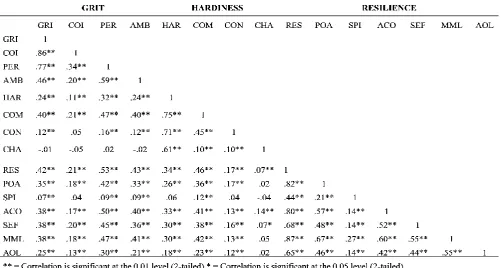
Model 1 examined a unidimensional model of hardiness, however, results revealed poor fit indices. All fifteen items loaded significantly on hardiness with a factor loading ranging from -.26 to .77. Model 2 investigated a three-factor model of hardiness (which consisted of control, commitment, and challenge); this measurement model produced poor fit indices. In this three-factor model, all items significantly loaded on commitment, challenge, and control domain, except for item 9 (I enjoy the challenge when I have to do more than one thing at a time) which did not load on the control domain (β = -.06, p = .07). Model 3 tested a bi-factor model of hardiness, which consisted of hardiness as the higher-order factor and commitment, challenge, and control as the first order factors. Like the following models, Model 3 generated poor fit indices even though RMSEA was .08. The bi-factor model of hardiness was chosen as the better model (see Table 2). Overall hardiness significantly correlated to overall grit (r = .244, p < .001), consistency of interest (r = .106, p < .001), perseverance of effort (r = .319 p < .001), ambition (r = .241, p < .001), commitment (r = .752, p < .001), control (r = .706, p < .001), and challenge (r = .612, p = .028) (see Table 3).
CFA Grit Models
In reviewing the CFA grit models examined within this study, Model 1 investigated a unidimensional model of
grit which presented with poor fit indices, with significant factor loadings between .22 and .60 in all seventeen items. Unlike Model 1, Model 2 asssessed a three-factor model of grit (which was comprised of ambition, consistency of interest, and perseverance of effort). While results generated appropriate fit indices, Model 2, presented a TLI of .88, suggesting that this model might not be a good fit model; all items loaded significantly onto the three factors of ambition, consistency of interest, and perseverance of effort with factor loadings ranging from .39 to .79. Model 3 reviewed a bi-factor model of grit, which was comprised of grit as the higher-order factor and ambition, consistency of interest, and perseverance of interest as the first order factors. Model 3 revealed suitable fit indices with the exception of not meeting the TLI benchmark. All items loaded significantly on the higher-order factor of grit with factor loadings between .13 and .48. Model 3, the bi-factor model of grit, was selected as the preferred model out of the three (see Table 2). Overall grit correlated significantly consistency of interest (r = .863, p < .001), perseverance of effort (r = .768, p < .001), ambition (r = .458, p < .001), overall hardiness (r = .244, p < .001), commitment (r = .399, p < .001), and control (r = .120, p < .001) (see Table 3).
Table 3. Covariance matrix of the psychological constructs
CFA Resilience Models
To investigate the construct of resilience, three models were analyzed. The first model, Model 1, assessed a unidimensional model of resilience. Findings showed overall poor fit indices. All items (N = 22) significantly loaded on resilience with a range of factor loadings from 22 to .89. A six-factor model of resilience, Model 2, which comprised of spirituality, positive appraisal, active coping, self-efficacy, acceptance of limitations, and meaning making and learning was reviewed. Model 2 was appropriately identified excluding TLI indicating that Model 2 might not produce a good fit model. All twenty-two items significantly loaded on the six factors with a factor loading ranging from .24 to .90. A bi-factor model of resilience, Model 3, which consisted of resilience as the higher-order factor and spirituality, positive appraisal, active coping, self-efficacy, acceptance of limitations, and meaning making and learning as the first order factors was tested. Appropriate fit indices were generated, however, similar to Model 2, the TLI benchmark was not met in Model 3. All items loaded significantly on the factor of resilience. The six-factor model of resilience, Model 2, was selected as the better of the three models (see Table 2). Overall resilience significantly correlated to overallgrit (r = .423, p < .001), consistency of interest (r = .206, p < .001), perseverance of effort (r = .526, p < .001), ambition (r = .429, p < .001), overall hardiness (r = .337, p < .001), commitment (r = .456, p < .001), control (r = .170, p < .001), and challenge (r = .065, p = .028) (see Table 3).
CFA: Resilience, Grit, and Hardiness
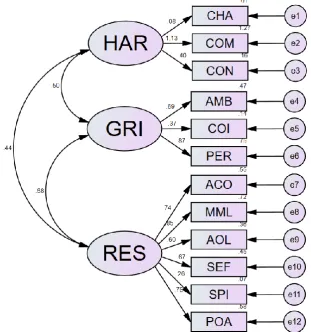
A CFA model was employed to determine model structures that can sufficiently describe the best fit relationship amongst these constructs. Model 4 examined a three-factor model which consisted of three latent factors: (1) resilience, (2) grit, and (3) hardiness. The latent factor of resilience comprised of six indicators (spirituality, positive appraisal, active coping, self-efficacy, acceptance of limitations, and meaning making and learning). The latent factor of hardiness comprised of three indicators (challenge, control, and commitment). The latent factor of grit comprised of three indicators (ambition, perseverance of effort, and consistency of interest). Model 4 generated appropriate fit indices (see Table 2). Model 4 was chosen as the better of the three models (see Figure 1).
indicator was accounted for by grit. Figure 1 further depicts the correlations among the latent factors and each item’s residual variance terms.
Discussion
The psychological constructs of grit, resilience, and hardiness play an integral role in the overcoming of challenges, failures, and hardships. The main objective of the present study was to examine the related, but distinctive psychological constructs — grit, resilience, and hardiness — utilizing numerous structural equation modeling techniques to report the factor structures and the associations amongst these constructs. Several CFA models were constructed to examine the model structures that can sufficiently describe the best fit. Findings revealed that a bi-factor model best fit grit and hardiness, while a six-factor model structure was the best fit model for resilience. Additional CFAs were utilized to determine the best model structure that can sufficiently describe the relationship amongst resilience, grit, and hardiness; the three-factor model which consisted of three latent factors: (1) resilience, (2) grit, and (3)
hardiness with six, three, and three indicators, respectively, depicted the best model.
Furthermore, results of this study show that resilience was correlated to grit and subscales and hardiness and its subfacets. Interestingly, challenge was the only variable that was not correlated with grit or resilience. As findings revealed, the bi-factor model was the best fit model for hardiness and grit. As such, as Gignac (2008) expressed, direct effects were assessed within this model, suggesting that each observed variable (the items on each scale) were able to contribute variance directly to the factors of hardiness or grit. Particularly, through the bi-factor model structure, showed that hardiness and grit were defined by the observed variables, not the subfacets. While we hypothesized that hardiness and grit would be best defined by a three-factor model structure, direct effects within each items of the scales contributed to hardiness and grit. Particularly, the bi-factor model of grit generated better model indexes than the three-factor model structure – the items loaded on to grit better than ambition, perseverance of effort, or consistency of interest.
Figure 1. Confirmatory factor analysis of hardiness, grit, and resilience
These findings were similarly found in hardiness. However, we correctly hypothesized a six-factor model structure for resilience. First, these results suggest that (1) positive appraisal, (2) active coping, (3) self-efficacy, and (4) meaning making and learning, (5) spirituality, and (6) acceptance of limitations are distinguishable from one another. Factor loadings were substantial; specifically, both items of spirituality loaded on the spirituality value, five items of positive appraisal loaded on the positive appraisal value, six items of active coping loaded on the active coping value, five items of meaning making and learning loaded on the meaning making and learning value, two items of acceptance of limitations loaded on the acceptance of limitations value, and two items of self-efficacy loaded on the self-efficacy value.
Furthermore, CFAs revealed a three-factor model structure among the three constructs. These results propose that resilience, grit, and hardiness are distinct from one another. Factor loadings were substantial; the three subfacets of hardiness (challenge, commitment, and control) loaded on the hardiness value, three subfacets of grit (perseverance of effort, consistency of interest, and ambition) loaded on the grit value, and six subfacets of resilience, (spirituality, positive appraisal, active coping, self-efficacy, acceptance of limitations, and meaning making and learning), loaded on the resilience value. Prior to this study, these structures were not tested empirically together and numerous implications can be drawn from this finding. Importantly, the three-factor model structure promoted the necessary distinction of the three similar but separate constructs. Through the three-factor model, results showed the need to eliminate the synonymous use of these constructs.
As reflected in Model 4, each construct and their respective subfacets were conceptually related, closely aligning with one another. Notwithstanding the conceptual similarities found throughout these constructs and their subfacets, none fully captured the constructs of grit, resilience, or hardiness. For example, the ability of a positive mindset, during adverse circumstances, necessary elements in conceptualizing hardiness, is not evident in grit, resilience, or their respective subfacets. Another example, the perseverance of effort and consistency of interest, crucial elements in defining grit, is not evident in hardiness, resilience, or their respective subfacets. While previous research has characterized resilience as an “umbrella term” as it integrates a broad variety of psychological elements, these current findings
demonstrate the distinctive capacity of these constructs, not potential subordinate relationships amongst them.
While findings showed numerous moderate and strong relationships amongst these con tructs, there were some interesting results to note. First, perseverance of effort was strongly positively correlated to resilience as well as positive appraisal, active coping, self-efficacy, and meaning making and learning; while the other resilience subfacets correlated to perseverance of effort these four appeared to be strongest in association. This finding suggests that each resilience subfacet skill is associated with the persistence of overcoming setbacks and obstacles. Second, commitment was also significantly correlated to overall resilience and all six resilience subfacets. This finding seems reasonable in real–life application; individuals who are high on spirituality and active coping are committed to the belief system and their ability to cope after external or internal stress factors. Third, along with perseverance of effort, ambition was shown to correlate with overall resilience and all six resilience subfacets. As resilience emerge during the presence of trauma, it would make sense that ambition, which is the determination and effort to achieve success, would be related to resilience; resilient individuals are ambitious to overcome trauma and meet homeostasis.
In a military environment, the shaping and predicting of human performance is essential in successful military leadership (Cosentino & Solano, 2012) and officer development (Matthew et al., 2006). Therefore, it would be vital to understand the constructs that play an integral role in influencing and affecting human performance, specifically, grit, hardiness and resilience. An individual’s character is essential for any military occupation, as a sound character is imperative in how an individual behaves and acts (Gayton & Kehoe, 2015). For example, soldiers must be able to become accustomed and acclimate rapidly to changing conditions (i.e., be hardy), persevere and continue with effort regardless of failure (i.e., be gritty), and recover quickly from difficult situations and environments (i.e., be resilient skilled). While this study utilized a military sample, this can be seen in other general populations.
Limitations
Additionally, as participants were members of the Corps of Cadets, this sample of participants did not provide a broad sample of resilience, hardiness, and grit. Due to potential lack of variability, these results are not generalizable for a broader population, where individuals report slightly resilient and/or gritty. Further analyses with non-military cadet samples need to be investigated. However, this study is important as a military sample offers a unique sample for investigating leader performance under extremely demanding and challenging circumstances (Bartone et al., 2013). Additionally, the military sample that was utilized in this study could also influence the applicability of these constructs as this is dependent upon the context and circumstances of the population that was investigated.
Second, cadets volunteered to complete this study during the week of Reception (either the second or third day at USMA). The recruiting process could have also been a limitation since participants completed this as part of a few assessments. Furthermore, each scale was self-report; while self-reports are a common methodology in many behavioral science disciplines there are many experimental dangers including potential bias. As we utilized a military population, many cadets might have felt that they should report as more resilient, grittier, or hardier because they are starting their military life.
Third, even though this study reported significant results, findings did reveal low levels of reliability, which could limit the applicability of the conclusions yielded from this work. Particularly, these results might not be consistent or reproduced under comparable conditions. Similar limitations though, have been found in studies that have investigated the theoretical structures of psychological constructs (Duckworth & Quinn, 2009; Muenks, Wigfield, Yang, & O’Neal, 2017; Ryff & Keys, 1995). Specifically, in their study, Ryff and Keys (1995) indicated that low levels of reliability could suggest that items were selected to reflect the theoretical framework within each psychological construct instead of attempting to benefit reliability. Despite this limitation, this study does add value to the current literature. Research in this field should continue to investigate the consistency of findings across items within such measures, and the degree to which these assessments are distinguishable from one another.
Lastly, this study suffered from a lack of true experimental design. Research focusing on these constructs can benefit from non-correlational studies. While these constructs were highly correlated with one another, as shown in this research, it would be interesting to see how these constructs relate once variables are
manipulated and isolated in an experimental study. Experimental research might produce meaningful results that might not be found in correlational research. For example, grit has been grounded on a person’s passion for a specific goal or objective, over a long period of time. This correlational study might not have been able to create the passion that is needed to provoke the true grit that individuals possess, instead of the self-reported grit. For instance, Duckworth and Quinn (2009) were able to attain significant findings on grit with the same population but their stimulus included the execution of USMA's rigorous summer training program, not completing a survey. This can also be said about participants’ self-report resilience and hardiness. Additionally, while this was beyond the scope of this project, we did look to determine if an individual’s grit, resilience, or hardiness predicted graduation or retention; unlike previous work (Duckworth et al., 2007; Eskreis-Winkler et al., 2014) no significant findings were revealed suggesting that these constructs did not predict cadets’ graduation rates. This finding is a bit perplexing since hardiness and grit have both shown to be predictors of retention rates for USMA cadets (Maddi et al., 2012), however, much of those results looked at only the first year of USMA, not all the years leading to graduation. Due to the number of limitations in this study, more work, especially with an experimental design, must be conducted to better understand this lack of significance.
Implications
The value of comprehending grit, resilience, and hardiness is incalculable as these psychological constructs are integral factors in promoting positive and stable mental health in individuals, in shaping human performance, and in producing a number of protective mechanisms that shields individuals from stressful and adverse environments and situations (Agaibi, & Wilson, 2005; Masten, 2001; Bonanno, 2004; Bonanno et al., 2007; Friborg et al., 2005). This study was critical in understanding these psychological constructs.
As this study helped better comprehend hardiness, grit, and resilience and its similarities and distinctions, these findings can be integral in constructing and facilitating the framework for assessments and training; this study can play an integral role towards the improvement of such assessments and training in order to build the framework for better assessments and tests that target these constructs. While there are a few assessments that have been validated, it might be important to reassess these scales to confirm that each construct is measured correctly. This study can also be integral in the construction of different training and programs, and in advancing and furthering the development of these interventions (Bartone et al., 2008). If we can better identify these constructs, more effective trainings or interventions can facilitate more improved well-being and mental health outcomes. This can help eliminate potential burden and deficiencies and prevent potential adverse outcomes. More studies need to be conducted to better understand these constructs to create better training and assessments.
Acknowledgements
We thank our research colleague, Dr. Michael Matthews in the Behavioral Science & Leadership Department at the United States Military Academy for his assistance in conducting the study. Any opinions, findings, and conclusions expressed in this paper are those of the authors and do not necessarily reflect the views of the U.S. Army or U.S. Military Academy.
Declaration of Conflicting Interests The author(s) declared no conflicts of interest with respect to the research, authorship, and/or publication of this article.
Funding
The author(s) received no financial support for the research, authorship, and/or publication of this article.
ORCID
Vasiliki Georgoulas-Sherry https://orcid.org/0000-0003-2009-4959
Dennis R. Kelly https://orcid.org/0000-0001-5847-9120
Received: March 24, 2019 Accepted: May 14, 2019 Published Online: May 28, 2019
References
Agaibi, C. E., & Wilson, J. P. (2005). Trauma, PTSD, and resilience: A review of the literature. Trauma, Violence, & Abuse, 6(3), 195-216. doi: 10.1177/1524838005277438
Ayala, J. C., & Manzano, G. (2014). The resilience of the entrepreneur. Influence on the success of the business. A longitudinal analysis. Journal of Economic Psychology, 42, 126-135. doi: 10.1016/j.joep.2014.02.004
Bartone, P. T. (1995, July). A short hardiness scale. In Proceedings of the July 1995 Annual Convention of the American Psychological Society. New York, NY. Retrieved from
https://apps.dtic.mil/dtic/tr/fulltext/u2/a298548.pdf Bartone, P. T. (1999). Hardiness protects against war-related stress in Army Reserve forces. Consulting Psychology Journal: Practice and Research, 51(2), 72-82. doi: 10.1037/1061-4087.51.2.72
Bartone, P. T. (2000). Hardiness as a resiliency factor for United States forces in the Gulf War. In J. M. Violanti, D. Paton, & C. Dunning (Eds.), Posttraumatic stress intervention: Challenges, issues, and perspectives (pp. 115-133). Springfield, IL, US: Charles C Thomas Publisher.
Bartone, P. T. (2007). Test-retest reliability of the dispositional resilience scale-15, a brief hardiness scale. Psychological Reports, 101(3), 943-944. doi: 10.2466/pr0.101.3.943-944
Bartone, P. T., Kelly, D. R., & Matthews, M. D. (2013). Psychological hardiness predicts adaptability in military leaders: A prospective study. International Journal of Selection and Assessment, 21(2), 200-210. doi: 10.1111/ijsa.12029
Bartone, P. T., Marlowe, D. H., Gifford, R. K., & Wright, K. M. (1992, October). Personality hardiness predicts soldier adjustment to combat stress. In Proceedings of the34th Annual Conference of the Military Testing Association (pp. 257-262). San Diego, CA: Navy Personnel Research and Development Center. Besterman-Dahan, K., Barnett, S., Hickling, E., Elnitsky,
C., Lind, J., Skvoretz, J., & Antinori, N. (2012). Bearing the burden: Deployment stress among army National Guard chaplains. Journal of Health Care Chaplaincy, 18(3-4), 151-168. doi: 10.1080/08854726.2012.723538
Bonanno, G. A., Galea, S., Bucciarelli, A., & Vlahov, D. (2007). What predicts psychological resilience after disaster? The role of demographics, resources, and life stress. Journal of Consulting and Clinical Psychology, 75(5), 671-682. doi: 10.1037/0022-006X.75.5.671
Cicchetti, D., & Garmezy, N. (1993). Prospects and promises in the study of resilience. Development and Psychopathology, 5(4), 497-502. doi: 10.1017/S0954579400006118
Cosentino, A. C., & Solano, A. C. (2012). Character strengths: A study of Argentinean soldiers. The Spanish Journal of Psychology, 15(1), 199-215. doi: 10.1007/978-94-017-9035-2_6
Credé, M., Tynan, M. C., & Harms, P. D. (2017). Much ado about grit: A meta-analytic synthesis of the grit literature. Journal of Personality and Social Psychology, 113(3), 492-511. doi: 10.1037/pspp0000102
Datu, J. A. D., King, R. B., Valdez, J. P. M., & Eala, M. S. M. (2018). Grit is associated with lower depression via meaning in life among Filipino high school students. Youth & Society. Advance online publication. doi: 10.1177/0044118X18760402 Datu, J. A., Valdez J. P., & King, R. B. (2016). The
successful life of gritty students: Grit leads to optimal educational and well-being outcomes in a collectivist context. In R. King & A. Bernardo (Eds.), The psychology of asian learners. Singapore, Springer. doi: 10.1007/978-981-287-576-1_31
De Vera, M. J., Gavino Jr, J. C., & Portugal, E. J. (2015). Grit and superior work performance in an Asian context. Paper presented at the Proceedings of 11th International Business and Social Science Research Conference, Crowne Plaza Hotel, Dubai. Retrieved from
https://wbiworldconpro.com/pages/paper/dubai-conference-2015-january/2392
Dias, R., Santos, R. L., Sousa, M. F., Nogueira, M. M., Torres, B., Belfort, T., & Dourado, M. C. (2015). Resilience of caregivers of people with dementia: a systematic review of biological and psychosocial determinants. Trends in Psychiatry and Psychotherapy, 37(1), 12-19. doi: 10.1590/2237-6089-2014-0032
Duckworth, A. L., & Quinn, P. D. (2009). Development and validation of the Short Grit Scale (GRIT–S). Journal of Personality Assessment, 91(2), 166-174. doi: 10.1080/00223890802634290
Duckworth, A. L., Peterson, C., Matthews, M. D., & Kelly, D. R. (2007). Grit: Perseverance and
passion for long-term goals. Journal of Personality and Social Psychology, 92(6), 1087-1101. doi: 10.1037/0022-3514.92.6.1087
Eid, J., & Morgan III, C. A. (2006). Dissociation, hardiness, and performance in military cadets participating in survival training. Military Medicine, 171(5), 436-442. doi: 10.7205/milmed.171.5.436 Eschleman, K. J., Bowling, N. A., & Alarcon, G. M.
(2010). A meta-analytic examination of hardiness. International Journal of Stress Management, 17(4), 277-307. doi: 10.1037/a0020476
Eskreis-Winkler, L., Duckworth, A. L., Shulman, E. P., & Beal, S. (2014). The grit effect: Predicting retention in the military, the workplace, school and marriage. Frontiers in Psychology, 5(36), 1-12. doi: 10.3389/fpsyg.2014.00036
Finney, S. J., & DiStefano, C. (2006). Non-normal and categorical data in structural equation modeling. In G. R. Hancock and R. O. Mueller (Eds.), Structural equation modeling A second course, (pp. 269-314). Greenwich, CT: Information Age Publishing. Friborg, O., Barlaug, D., Martinussen, M., Rosenvinge,
J. H., & Hjemdal, O. (2005). Resilience in relation to personality and intelligence. International Journal of Methods in Psychiatric Research, 14(1), 29-42. doi: 10.1002/mpr.15
Gayton, S. D., & Kehoe, E. J. (2015). A prospective study of character strengths as predictors of selection into the Australian army special force. Military Medicine, 180(2), 151-157. doi: 10.7205/MILMED-D-14-00181
Gavidia-Payne, S., Denny, B., Davis, K., Francis, A., & Jackson, M. (2015). Parental resilience: A neglected construct in resilience research. Clinical Psychologist, 19(3), 111-121. doi: 10.1111/cp.12053 Gignac, G. E. (2008). Higher-order models versus direct hierarchical models: gas superordinate or breadth factor?. Psychology Science Quarterly, 50(1), 21-43. Retrieved from https://www.psychologie-aktuell.com/fileadmin/download/PschologyScience/ 1-2008/04_Gignac.pdf
Gooding, P. A., Hurst, A., Johnson, J., & Tarrier, N. (2012). Psychological resilience in young and older adults. International Journal of Geriatric Psychiatry, 27(3), 262-270. doi: 10.1002/gps.2712
Hannah, S. T., Campbell, D. J., & Matthews, M. D. (2010). Advancing a research agenda for leadership in dangerous contexts. Military Psychology, 22(S1), S157-S189. doi: 10.1080/08995601003644452 Harel, Z., Kahana, B., & Wilson, J. P. (1993). War and
remembrance: The legacy of Pearl Harbor. In J. P. Wilson & B. Raphael (Eds.), International handbook of traumatic stress syndromes (pp. 263-274). New York, New York: Springer.
Hystad, S. W., Eid, J., Laberg, J. C., & Bartone, P. T. (2011). Psychological hardiness predicts admission into Norwegian Military Officer Schools. Military Psychology, 23(4), 381- 389. doi: 10.1080/08995605.2011.589333
Johnson, D. C., Thom, N. J., Stanley, E. A., Haase, L., Simmons, A. N., Shih, P. A., Thompson, W. K., Potterat, E. G., Minor, T. R. & Paulus, M. P. (2014). Modifying resilience mechanisms in at-risk individuals: a controlled study of mindfulness training in Marines preparing for deployment. American Journal of Psychiatry, 171(8), 844-853. doi: 10.1176/appi.ajp.2014.13040502
Johnson, D. C., Polusny, M. A., Erbes, C. R., King, D., King, L., Litz, B. T., Schnurr, P. P., Friedman, M., Pietrzak, R. H., & Southwick, S. M. (2013). Development and initial validation of the Response to Stressful Experiences Scale. Military Medicine, 176(2), 161-169. doi: 10.7205/milmed-d-10-00258 Kelly, D. R., & Bartone, P. T. (2005). Personality
hardiness, attrition, and leader performance at West Point. Poster presented at the American Psychological Association Annual Convention. Washington, DC.
Kelly, D. R., Matthews, M. D., & Bartone, P. T. (2005). Hardiness predicts adaptation to a challenging military environment. Poster presented at the International Applied Military Psychology Symposium. Washington, DC.
Kelly, D. R., Matthews, M. D., & Bartone, P. T. (2014). Grit and hardiness as predictors of performance among West Point cadets. Military Psychology, 26(4), 327-342. doi: 10.1037/mil0000050
Laursen, E. K. (2015). The power of grit, perseverance, and tenacity. Reclaiming Children and Youth, 23(4), 19-24.
Luthar, S. S., Cicchetti, D., & Becker, B. (2000). The construct of resilience: A critical evaluation and guidelines for future work. Child Development, 71(3), 543-562. doi: 10.1111/1467-8624.00164 Maddi, S. R., Matthews, M. D., Kelly, D. R., Villarreal,
B., & White, M. (2012). The role of hardiness and grit
in predicting performance 591 and retention of USMA cadets. Military Psychology, 24(1), 19-28. doi: 10.1080/08995605.2012.639672
Martin, J. J., Byrd, B., Watts, M. L., & Dent, M. (2015). Gritty, hardy, and resilient: predictors of sport engagement and life satisfaction in wheelchair basketball players. Journal of Clinical Sport Psychology, 9(4), 345-359. doi: 10.1123/jcsp.2015-0015
Masten, A. S. (2001). Ordinary magic: Resilience processes in development. American Psychologist, 56(3), 227-238. doi: 10.1037//0003-066X.56.3.227 Matthews, M. D., Eid, J., Kelly, D., Bailey, J. K., &
Peterson, C. (2006). Character strengths and virtues of developing military leaders: An international comparison. Military Psychology, 18(S1), S57-S68. doi: 10.1207/s15327876mp1803s_5
Muenks, K., Wigfield, A., Yang, J. S., & O'Neal, C. R. (2017). How true is grit? Assessing its relations to high school and college students’ personality characteristics, self-regulation, engagement, and achievement. Journal of Educational Psychology, 109(5), 599-620. doi: 10.1037/edu0000153
Ong, A. D., Zautra, A. J., & Reid, M. C. (2010). Psychological resilience predicts decreases in pain catastrophizing through positive emotions. Psychology and Aging, 25(3), 516-523. doi: 10.1037/a0019384
Parthasarathy, N., & Chakraborty, P. (2014). Grit as a dominant leadership trait in the corporate world. In I. C. Patranabis (Ed.), Globysn Mangement Conference (pp. 189-199). India: Allied Publishers Private Limited.
Robertson-Kraft, C., & Duckworth, A. L. (2014). True grit: Trait-level perseverance and passion for long-term goals predicts effectiveness and retention among novice teachers. Teachers College Record, 116(3),
1-27. Retrieved from
https://www.ncbi.nlm.nih.gov/pmc/articles/ PMC4211426/
Rojas, J. P., Reser, J. A., Toland, M. D., & Usher, E. L. (2012, March). Psychometrics of the Grit scale. Poster presented at the 2012 Spring Research Conference, Louisville, KY. Retrieved from https://sites.education.uky.edu/motivation/files/2013 /08/PojasPeser TolandUsher.pdf
Salles, A., Mueller, C. M., & Cohen, G. L. (2016). A values affirmation intervention to improve female residents' surgical performance. Journal of Graduate Medical Education, 8(3), 378-383. doi: 10.4300/JGME-D-15-00214.1
Sandvik, A. M., Bartone, P. T., Hystad, S. W., Phillips, T. M., Thayer, J. F., & Johnsen, B. H. (2013).
Psychological hardiness predicts
neuroimmunological responses to stress. Psychology, Health & Medicine, 18(6), 705-713. doi: 10.1080/13548506.2013.772304
Shrivastava, M. U., & Mishra, V. (2016). Grit, resilience and agency in sportspersons and non- sportspersons. International Journal of Humanities and Social Science Invention, 5(10), 1-4. Retrieved from
http://www.ijhssi.org/papers/v5(10)/version-4/A051040104.pdf
Southwick, S. M., Bonanno, G. A., Masten, A. S., Panter-Brick, C., & Yehuda, R. (2014). Resilience definitions, theory, and challenges: interdisciplinary
perspectives. European Journal of
Psychotraumatology, 5. doi: 10.3402/ejpt.v5.25338 Wilson, J. P., & Drozdek, B. (2004). Broken spirits: The