Information Technology and Control 2019/2/48 316
Automatic Test Set
Generation for Event-Driven
Systems in the Absence of
Specifications Combining
Testing with Model Inference
ITC 2/48Journal of Information Technology and Control
Vol. 48 / No. 2 / 2019 pp. 316-334
DOI 10.5755/j01.itc.48.2.21725
Automatic Test Set Generation for Event-Driven Systems in the Absence of Specifications Combining Testing with
Model Inference
Received 2018/09/28 Accepted after revision 2019/04/08
http://dx.doi.org/10.5755/j01.itc.48.2.21725
Corresponding author: [email protected]
Luigi Novella, Manuela Tufo, Giovanni Fiengo
Università degli Studi del Sannio, Department of Engineering, Piazza Roma 21, 82100 Benevento, Italy, e-mail: {luigi.novella,manuela.tufo,gifiengo}@unisannio.it
The growing dependency of human activities on software technologies is leading to the need for designing more and more accurate testing techniques to ensure the quality and reliability of software components. A recent lit-erature review of software testing methodologies reveals that several new approaches, which differ in the way test inputs are generated to efficiently explore systems behaviour, have been proposed. This paper is concerned with the challenge of automatically generating test input sets for Event-Driven Systems (EDS) for which nei-ther source code nor specifications are available, nei-therefore we propose an innovative fully automatic testing with model learning technique. It basically involves active learning to automatically infer a behavioural model of the System Under Test (SUT) using tests as queries, generates further tests based on the learned model to systematically explore unseen parts of the subject system, and makes use of passive learning to refine the cur-rent model hypothesis as soon as an inconsistency is found with the observed behaviour. Our passive learning algorithm uses the basic steps of Evidence-Driven State Merging (EDSM) and introduces an effective heuristic for choosing the pair of states to merge to obtain the target machine. Finally, the effectiveness of the proposed testing technique is demonstrated within the context of event-based functional testing of Android Graphical User Interface (GUI) applications and compared with that of existing baseline approaches.
1. Introduction
Guaranteeing the quality and reliability of software components is often a key factor for business. It be-comes even crucial for human safety in the context of safety-critical systems. To achieve qualitative and ro-bust software, an intensive testing phase must be per-formed. Our interest concerns with testing black-box event-driven systems at the system level, where sys-tems behaviour is checked with specific input event sequences. This testing process requires SUT formal specifications or test models to automatically gener-ate test cases that capture the system behaviour and to determine whether a test has passed or failed (test oracle problem). However, such specifications are rarely written out because developers cannot design and maintain system models in the actual agile con-text in which requirements and implementation are constantly in flux. In this scenario, testing software elements becomes very challenging because there is no basis upon which to select suitable test inputs for the subject system. To deal with this problem, test en-gineers can use both their intuition and background to drive the testing process or, more often, a random test input generation approach. Both of these approach-es have several disadvantagapproach-es in the sense that they often cannot lead to build a representative set of test input event sequences capable of investigating all the facets of software behaviour. Moreover, the absence of specifications and test models makes it difficult to estimate the quality and the adequacy of a test set. To address this problem, new academic research has fo-cused on several learning-based approaches that in-vestigate the use of Machine Learning in the software testing domain [17, 18, 9, 1, 33, 37, 16]. These tech-niques automatically infer models from the observed system behaviour and generate new tests based on the learned model.
The idea of combining model inference with software testing was first introduced by Weyuker [42], but it is only recently that the topic has become very popular. Remarkable success has been obtained in the area of testing reactive systems by combining active learning and model checking to infer a black-box SUT model using tests as queries [17, 30]. An alternative to this approach is to use model synthesis techniques to automatically derive behavioural models via passive learning from pre-recorded execution traces and to
guide the generation of new tests based on the in-ferred models [37, 39].
In this paper, we address the problem of automatically generating test input sets for event-based Graphical User Interface (GUI) systems, for which we have nei-ther an existing model of the GUI nor a complete spec-ification, to achieve significant functional coverage. In recent years, both researchers and practitioners have investigated different approaches for testing event-based systems through their GUI. These techniques mainly differ in the way they generate test inputs and for the strategy they adopt to discover the SUT be-haviour. In particular, much effort has been focused on applying these techniques on mobile applications. In this field, automated GUI exploration techniques aim to detect the set of events that can be fired at each screen to guide the execution of the application. These events may be chosen either randomly or via a systematic exploration strategy of the GUI.
In this context, this paper proposes a fully automatic online black-box testing technique that combines ac-tive learning, a systematic exploration of the GUI and passive learning. The testing approach effectiveness is demonstrated by applying it to Android applica-tions. The proposed approach proceeds in a similar way as described in [9], however it introduces some relevant innovations that will be highlighted in the rest of the paper.
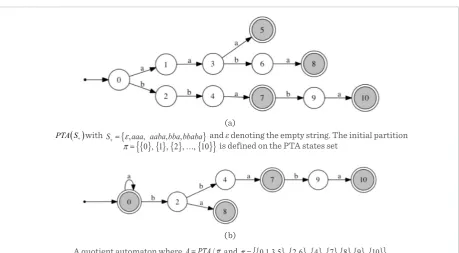
Based on SUT interface descriptions and domain knowledge, our testing technique probes the system behaviour with tests, uses the test results to on-the-fly learn an Extended Labelled Transition System (ELTS) model of the SUT, generates further tests on the learned model and refines it via inductive infer-ence as soon as an inconsistency is found between the current ELTS model hypothesis and the set of execu-tion traces observed so far. With reference to the pro-posed ELTS inductive algorithm, it adopts the basic steps of the Evidence-Driven State Merging (EDSM) algorithm in the “blue fringe” framework [24, 39] and introduces a novel heuristic approach according to the order in which state pairs are chosen for merging during the generalization process.
Information Technology and Control 2019/2/48 318
a consequence, the proposed testing technique ter-minates by approximating the equivalence check be-tween the ELTS model and the SUT.
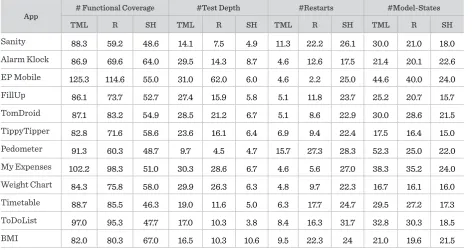
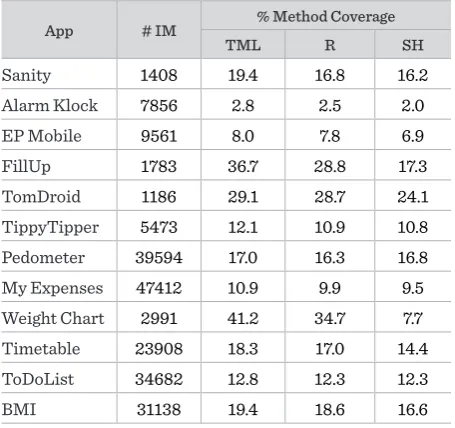
The effectiveness of our testing with model learning technique is demonstrated by measuring the extent to which the generated test set covers the functional-ities of the SUT in terms of the observed behaviour. The learned model represents the result of what we have observed during the test execution process, therefore we use it as a basis for estimating the func-tional coverage in a similar way as in [37]. To confirm the analysis, we also measure the method coverage via app bytecode instrumentation. We highlight that our testing technique does not need app bytecode instru-mentation to work; this is implemented just to per-form this kind of measurement.
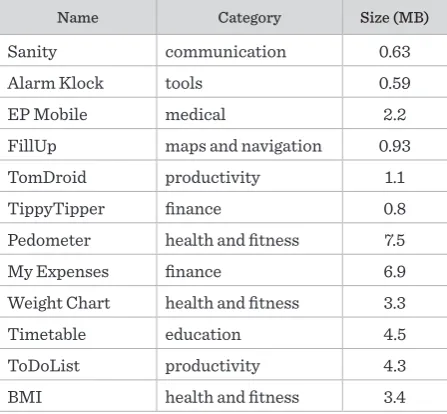
The experimental results show that our solution can outperform current baseline approaches in terms of test set adequacy. Moreover, the statistical signifi-cance of the results has been evaluated via rank-based statistical testing. The rest of the paper is organized as follows. Section 2 gives a brief overview of the ex-isting automated GUI exploration strategies for An-droid GUI apps. The third section provides the math-ematical definitions related to model inference and introduces the trace encoding process used to infer the sequential behaviour model of an Android GUI App. In Section 4 the proposed fully automatic on-line black-box testing technique is described. Section 5 and 6 give an overview of the Deterministic Finite Automaton induction problem in the learning from an informant setting and describe the proposed passive learning algorithm used to refine the ELTS model re-spectively. Technical details regarding the implemen-tation of our solution and the experimental results obtained in the context of event-based functional testing of Android applications are given in Section 7. Finally, our conclusions are drawn in the last section.
2. Related Work
In the last few years, the ever-growing demand for mo-bile applications has led to the development of a set of frameworks and methods for automating GUI testing. In particular, several studies have been conducted to highlight the strengths and weaknesses of different
testing frameworks and automated GUI exploration strategies for Android apps [2, 10, 29, 11, 21, 26, 34]. Android mobile applications are Event-Driven Sys-tems (EDS) that can sense and react to events of different types. They may be either events generat-ed through the application user interface, or system events produced by the device hardware platform and other running applications. Existing test input gen-eration approaches are able to generate such events either randomly or systematically. In the first case, a random event is chosen at each GUI screen to navi-gate the app [20, 3, 44, 41, 28, 31, 27]. On the other hand, systematic exploration strategies select new actions to be executed based on the app GUI model [9, 5, 4, 6, 43, 7, 40, 25, 8, 32].
The remainder of the current section briefly describes these two main approaches along with the most popu-lar Android GUI testing tools.
2.1. Random Exploration Strategy
Random testing represents the most popular ap-proach to automatically explore GUI-based software systems in the absence of specifications and test models. It consists of randomly selecting events (GUI events or system events) during the execution of the application to probe the system behaviour. However, the approach effectiveness strictly depends on the characteristics of the SUT; therefore, a random ex-ploration strategy may be generally weak at selecting specific inputs resulting in a poor or partial coverage of the system behaviour. Moreover, when both speci-fications and source code are missing, it becomes re-ally difficult to determine a stop termination criterion and define the success or not of the exploration strate-gy. The common practice is to manually specify a time budget limit for the testing procedure.
that, according to a distance metric, are farthest from the already executed ones. The approach results in a better distributed generation of events sequences if compared with pure random testing. Dynodroid, proposed by Machiry et al. [28], performs a random selection of events considered to be relevant for the app. The authors state that an event is relevant to an application if it registers a listener for that event by means of the Android framework.
Finally, Morgado et al. [31] propose a random testing approach within the iMPAcT tool that automatically analyses a mobile application with the aim of iden-tifying and testing its recurring behaviour (UI Pat-terns). To achieve the goal, the iMPAcT tool explores the current state of the application, identifies all the events that can be fired and then uniformly selects at random one of them to verify if the specific UI Pattern is correctly implemented.
2.2. Systematic Exploration Strategy
Most of the systematic exploration approaches gen-erally build a behavioural model of the application under test during its activity. Then, based on the ob-tained model, new test input events are generated and executed to discover the app behaviour. According to various systematic traversal strategies, several An-droid GUI exploration tools have been developed. In [5, 4, 6], Amalfitano et al. propose several contri-butions to the field of Android GUI app exploration. The designed approach builds a GUI model of the app and uses ripping to automatically explore it. For each newly visited GUI state, the procedure keeps all the events that could be fired in the current state and sys-tematically executes them. The process terminates as soon as all the GUI app states have been explored. Yang at al. [43] implement a grey-box exploration strategy for automatically obtaining a model of the app under test in the Orbit tool. It is composed by an action detector module and a dynamic crawler. The first module automatically extracts the relevant GUI events by statically analysing the app source code and the manifest file. The second module builds a model of the GUI app by exercising the detected events on the live application. The systematic exploration of the GUI app is obtained via a modified depth-first strat-egy. In [7], the authors describe Automatic Android App Explorer (A3E). The approach consists of two
dif-ferent exploration strategies, a Targeted Exploration and a Depth-First one. The Targeted Exploration first performs a static bytecode analysis to build a Static Activity Transition Graph. Such graph is then used to systematically explore the running app. Differently from the first one, the second approach automatically explores all the activities and the Android GUI ele-ments in a depth-first manner to infer a dynamic Ac-tivity Transition Graph model. For each acAc-tivity, the procedure extracts the GUI components and system-atically exercises them by firing their corresponding event handlers. The procedure stops when no more activities are found.
A different systematic GUI exploration strategy is the one proposed by Choi at al. in the SwiftHand tool [9]. It aims to learn a behavioural model of the GUI app in the form of a deterministic Extended Label Tran-sition System (ELTS) using tests as queries. Further tests are then generated based on the learned model to discover new states of the application. If an in-consistency between the learned model and the app is found, the ELTS is rebuilt from scratch using the set of execution traces observed so far. Wang et al. [40] introduce the DroidCrawle tool to automatically traverse an application’s GUI and achieve high GUI coverage. The crawler technique consists of automat-ically exploring the application under test via a depth-first approach and of inferring a GUI tree model at the same time. In [25], the authors introduce DroidBot, a lightweight UI-guided test input generator. It is able to generate UI-guided test inputs based on a transi-tion model generated on-the-fly, and allows users to integrate their own testing strategies.
Information Technology and Control 2019/2/48 320
3. Background
The automatic inference of state-machine models has been intensively investigated within the machine learning domain of grammar inference. The problem of grammar inference is concerned with the process of identifying a language from positive (valid) strings that belong to the language and negative (invalid) ones that do not. Several inference techniques have been devel-oped to reduce human effort in automatically generat-ing state machine models from examples of software behaviours. These examples can either be in the form of scenarios extracted from models created during the development stage of a software system, or execution traces from the current implementation of a program. The aim of this section is to provide the reader with the mathematical definitions related to model infer-ence. It also introduces an example of the specific trace-encoding process used to infer the sequential behaviour model of an Android GUI application. 3.1. Definitions
In this paper, we restrict the discussion to those sys-tems that can be modelled as an Extended determin-istic Labelled Transition System (ELTS) [33]. A La-belled Transition System (LTS) [37] is an instance of a state machine often used to represent the behaviour of software systems. In intuitive terms, an ELTS mod-el augments a conventional LTS with a state labmod-elling function λ defining the set of enabled transitions at each model-state.
Most of the techniques used to infer software be-haviour models take as input a set of program execu-tion traces that consist of sequences of input events to which the system responds with actions. In this work, we adopt the same trace-encoding process described in [33] in which we assume that the interactions with the SUT can be characterised in terms of event labels be-longing to the ELTS finite alphabet ∑. The definitions of trace and trace projection are formally given below. Definition 1 [Trace]. An execution trace, or simply a trace t is a finite sequence of pairs of input events and sets of possible events at each traversed state q, starting from the initial state q0. Formally a trace t is an element of
model to increase the probability of selecting an event that rarely or never occurs when users use the application.
3. Background
The automatic inference of state-machine models has been intensively investigated within the machine learning domain of grammar inference. The problem of grammar inference is concerned with the process of identifying a language from positive (valid) strings that belong to the language and negative (invalid) ones that do not. Several inference techniques have been developed to reduce human effort in automatically generating state machine models from examples of software behaviours. These examples can either be in the form of scenarios extracted from models created during the development stage of a software system, or execution traces from the current implementation of a program.
The aim of this section is to provide the reader with the mathematical definitions related to model inference. It also introduces an example of the specific trace-encoding process used to infer the sequential behaviour model of an Android GUI application.
3.1. Definitions
In this paper, we restrict the discussion to those systems that can be modelled as an Extended deterministic Labelled Transition System (ELTS) [33]. A Labelled Transition System (LTS) [37] is an instance of a state machine often used to represent the behaviour of software systems. In intuitive terms, an ELTS model augments a conventional LTS with a state labelling function defining the set of enabled transitions at each model-state.
Most of the techniques used to infer software behaviour models take as input a set of program execution traces that consist of sequences of input events to which the system responds with actions. In this work, we adopt the same trace-encoding process described in [33] in which we assume that the interactions with the SUT can be characterised in terms of event labels belonging to the ELTS finite alphabet
. The definitions of trace and trace projection are formally given below.Definition 1 [Trace] An execution trace, or simply a tracet is a finite sequence of pairs of input events and sets of possible events at each traversed state q, starting from the initial state q0. Formally a trace t is an element of
* where
is a subset of
.Definition 2 [Trace Projection] A trace projection
t denotes the sequence of input event labels in the trace t. Formally, if t
a1,1 , ,
an,n
, then
t a1,, an. The set of traces projections is denoted by
T .We define a trace t to be consistent with an ELTS if and only if it can trigger in order the input event labels of the trace and passes through the same states labelled as in the trace. This concept is formally defined below.
Definition 3 [Consistency] A trace t
a1,1
, ,
an,n
is consistent with a given ELTS M
Q,q0,,,
if and only if:Moreover, a trace t is said to be a positive trace of a system if it represents a feasible behaviour that the given system may exhibit, otherwise it is said to be negative. The rest of the manuscript will also refer to the language of the ELTS. It can be defined as the set of labels sequences accepted by M and represents the behaviour permitted by M.
Definition 4 [The Language of an ELTS] Given some ELTS M, for a given state qQ, L M
,q
, is the language of M in state q, and can be defined as: L M
,q
w | ˆ isdefined for
q,w
. The language of an ELTS M is defined as:L M
w | ˆ isdefined for
q0,w
.3.2. Illustrative Example
Let us consider the scenario where we are required to learn a model of the sequential behaviour exhibited by an where
model to increase the probability of selecting an event that rarely or never occurs when users use the application.
3. Background
The automatic inference of state-machine models has been intensively investigated within the machine learning domain of grammar inference. The problem of grammar inference is concerned with the process of identifying a language from positive (valid) strings that belong to the language and negative (invalid) ones that do not. Several inference techniques have been developed to reduce human effort in automatically generating state machine models from examples of software behaviours. These examples can either be in the form of scenarios extracted from models created during the development stage of a software system, or execution traces from the current implementation of a program.
The aim of this section is to provide the reader with the mathematical definitions related to model inference. It also introduces an example of the specific trace-encoding process used to infer the sequential behaviour model of an Android GUI application.
3.1. Definitions
In this paper, we restrict the discussion to those systems that can be modelled as an Extended deterministic Labelled Transition System (ELTS) [33]. A Labelled Transition System (LTS) [37] is an instance of a state machine often used to represent the behaviour of software systems. In intuitive terms, an ELTS model augments a conventional LTS with a state labelling function defining the set of enabled transitions at each model-state.
Most of the techniques used to infer software behaviour models take as input a set of program execution traces that consist of sequences of input events to which the system responds with actions. In this work, we adopt the same trace-encoding process described in [33] in which we assume that the interactions with the SUT can be characterised in terms of event labels belonging to the ELTS finite alphabet . The definitions of trace and trace projection are formally given below.
Definition 1 [Trace] An execution trace, or simply a tracet is a finite sequence of pairs of input events and sets of possible events at each traversed state q, starting from the initial state q0. Formally a trace t is an element of
* where
is a subset of .Definition 2 [Trace Projection] A trace projection
t denotes the sequence of input event labels in the trace t. Formally, if t
a1,1 , ,
an,n
, then
t a1,, an. The set of traces projections is denoted by
T .We define a trace t to be consistent with an ELTS if and only if it can trigger in order the input event labels of the trace and passes through the same states labelled as in the trace. This concept is formally defined below.
Definition 3 [Consistency] A trace t
a1,1
, ,
an,n
is consistent with a given ELTS M
Q,q0,,,
if and only if:Moreover, a trace t is said to be a positive trace of a system if it represents a feasible behaviour that the given system may exhibit, otherwise it is said to be negative. The rest of the manuscript will also refer to the language of the ELTS. It can be defined as the set of labels sequences accepted by M and represents the behaviour permitted by M.
Definition 4 [The Language of an ELTS] Given some ELTS M, for a given state qQ, L M
,q
, is the language of M in state q, and can be defined as: L M
,q
w | ˆ isdefined for
q,w
. The language of an ELTS M is defined as:L M
w | ˆ is defined for
q0,w
.3.2. Illustrative Example
Let us consider the scenario where we are required to learn a model of the sequential behaviour exhibited by an is a subset of ∑.
Definition 2 [Trace Projection]. A trace projection
π(t)denotes the sequence of input event labels in the trace t. Formally, if
model to increase the probability of selecting an event that rarely or never occurs when users use the application.
3. Background
The automatic inference of state-machine models has been intensively investigated within the machine learning domain of grammar inference. The problem of grammar inference is concerned with the process of identifying a language from positive (valid) strings that belong to the language and negative (invalid) ones that do not. Several inference techniques have been developed to reduce human effort in automatically generating state machine models from examples of software behaviours. These examples can either be in the form of scenarios extracted from models created during the development stage of a software system, or execution traces from the current implementation of a program.
The aim of this section is to provide the reader with the mathematical definitions related to model inference. It also introduces an example of the specific trace-encoding process used to infer the sequential behaviour model of an Android GUI application.
3.1. Definitions
In this paper, we restrict the discussion to those systems that can be modelled as an Extended deterministic Labelled Transition System (ELTS) [33]. A Labelled Transition System (LTS) [37] is an instance of a state machine often used to represent the behaviour of software systems. In intuitive terms, an ELTS model augments a conventional LTS with a state labelling function defining the set of enabled transitions at each model-state.
Most of the techniques used to infer software behaviour models take as input a set of program execution traces that consist of sequences of input events to which the system responds with actions. In this work, we adopt the same trace-encoding process described in [33] in which we assume that the interactions with the SUT can be characterised in terms of event labels belonging to the ELTS finite alphabet . The definitions of trace and trace projection are formally given below.
Definition 1 [Trace] An execution trace, or simply a tracet is a finite sequence of pairs of input events and sets of possible events at each traversed state q, starting from the initial state q0. Formally a trace t is an element of
* where
is a subset of .Definition 2 [Trace Projection] A trace projection
t denotes the sequence of input event labels in the trace t. Formally, if t
a1,1 , ,
an,n
, then
t a1,, an. The set of traces projections is denoted by
T .We define a trace t to be consistent with an ELTS if and only if it can trigger in order the input event labels of the trace and passes through the same states labelled as in the trace. This concept is formally defined below.
Definition 3 [Consistency] A trace t
a1,1
, ,
an,n
is consistent with a given ELTS M
Q,q0,,,
if and onlyif:
Moreover, a trace t is said to be a positive trace of a system if it represents a feasible behaviour that the given system may exhibit, otherwise it is said to be negative. The rest of the manuscript will also refer to the language of the ELTS. It can be defined as the set of labels sequences accepted by M and represents the behaviour permitted by M.
Definition 4 [The Language of an ELTS] Given some ELTS M, for a given state qQ, L M
,q
, is the language of M in state q, and can be defined as: L M
,q
w | ˆ isdefined for
q,w
. The language of an ELTS M is defined as:L M
w | ˆ isdefined for
q0,w
.3.2. Illustrative Example
Let us consider the scenario where we are required to learn a model of the sequential behaviour exhibited by an
, then
model to increase the probability of selecting an event that rarely or never occurs when users use the application.
3. Background
The automatic inference of state-machine models has been intensively investigated within the machine learning domain of grammar inference. The problem of grammar inference is concerned with the process of identifying a language from positive (valid) strings that belong to the language and negative (invalid) ones that do not. Several inference techniques have been developed to reduce human effort in automatically generating state machine models from examples of software behaviours. These examples can either be in the form of scenarios extracted from models created during the development stage of a software system, or execution traces from the current implementation of a program.
The aim of this section is to provide the reader with the mathematical definitions related to model inference. It also introduces an example of the specific trace-encoding process used to infer the sequential behaviour model of an Android GUI application.
3.1. Definitions
In this paper, we restrict the discussion to those systems that can be modelled as an Extended deterministic Labelled Transition System (ELTS) [33]. A Labelled Transition System (LTS) [37] is an instance of a state machine often used to represent the behaviour of software systems. In intuitive terms, an ELTS model augments a conventional LTS with a state labelling function defining the set of enabled transitions at each model-state.
Most of the techniques used to infer software behaviour models take as input a set of program execution traces that consist of sequences of input events to which the system responds with actions. In this work, we adopt the same trace-encoding process described in [33] in which we assume that the interactions with the SUT can be characterised in terms of event labels belonging to the ELTS finite alphabet . The definitions of trace and trace projection are formally given below.
Definition 1 [Trace] An execution trace, or simply a tracet is a finite sequence of pairs of input events and sets of possible events at each traversed state q, starting from the initial state q0. Formally a trace t is an element of
* where
is a subset of .Definition 2 [Trace Projection] A trace projection
t denotes the sequence of input event labels in the trace t. Formally, if t
a1,1 , ,
an,n
, then
t a1,, an. The set of traces projections is denoted by
T .We define a trace t to be consistent with an ELTS if and only if it can trigger in order the input event labels of the trace and passes through the same states labelled as in the trace. This concept is formally defined below.
Definition 3 [Consistency] A trace t
a1,1
, ,
an,n
is consistent with a given ELTS M
Q,q0,,,
if and onlyif:
Moreover, a trace t is said to be a positive trace of a system if it represents a feasible behaviour that the given system may exhibit, otherwise it is said to be negative. The rest of the manuscript will also refer to the language of the ELTS. It can be defined as the set of labels sequences accepted by M and represents the behaviour permitted by M.
Definition 4 [The Language of an ELTS] Given some ELTS M, for a given state qQ, L M
,q
, is the language of M in state q, and can be defined as: L M
,q
w | ˆ is defined for
q,w
. The language of an ELTS M is defined as:L M
w | ˆ isdefined for
q0,w
.3.2. Illustrative Example
Let us consider the scenario where we are required to learn a model of the sequential behaviour exhibited by an
. The set of traces projections is denot-ed by π(T).
We define a trace t to be consistent with an ELTS if and only if it can trigger in order the input event labels of the trace and passes through the same states labelled as in the trace. This concept is formally defined below. Definition 3 [Consistency]. A trace t
a1,1
, ,
an,n
t
a1,1
, ,
an,n
is consistent with a given ELTS model to increase the probability of selecting an event that rarely or never occurs when users use the application.3. Background
The automatic inference of state-machine models has been intensively investigated within the machine learning domain of grammar inference. The problem of grammar inference is concerned with the process of identifying a language from positive (valid) strings that belong to the language and negative (invalid) ones that do not. Several inference techniques have been developed to reduce human effort in automatically generating state machine models from examples of software behaviours. These examples can either be in the form of scenarios extracted from models created during the development stage of a software system, or execution traces from the current implementation of a program.
The aim of this section is to provide the reader with the mathematical definitions related to model inference. It also introduces an example of the specific trace-encoding process used to infer the sequential behaviour model of an Android GUI application.
3.1. Definitions
In this paper, we restrict the discussion to those systems that can be modelled as an Extended deterministic Labelled Transition System (ELTS) [33]. A Labelled Transition System (LTS) [37] is an instance of a state machine often used to represent the behaviour of software systems. In intuitive terms, an ELTS model augments a conventional LTS with a state labelling function defining the set of enabled transitions at each model-state.
Most of the techniques used to infer software behaviour models take as input a set of program execution traces that consist of sequences of input events to which the system responds with actions. In this work, we adopt the same trace-encoding process described in [33] in which we assume that the interactions with the SUT can be characterised in terms of event labels belonging to the ELTS finite alphabet . The definitions of trace and trace projection are formally given below.
Definition 1 [Trace] An execution trace, or simply a tracet is a finite sequence of pairs of input events and sets of possible events at each traversed state q, starting from the initial state q0. Formally a trace t is an element of
* where
is a subset of .Definition 2 [Trace Projection] A trace projection
t denotes the sequence of input event labels in the trace t. Formally, if t
a1,1 , ,
an,n
, then
t a1,, an. The set of traces projections is denoted by
T .We define a trace t to be consistent with an ELTS if and only if it can trigger in order the input event labels of the trace and passes through the same states labelled as in the trace. This concept is formally defined below.
Definition 3 [Consistency] A trace t
a1,1
, ,
an,n
is consistent with a given ELTS M
Q,q0,,,
if and only if:Moreover, a trace t is said to be a positive trace of a system if it represents a feasible behaviour that the given system may exhibit, otherwise it is said to be negative. The rest of the manuscript will also refer to the language of the ELTS. It can be defined as the set of labels sequences accepted by M and represents the behaviour permitted by M.
Definition 4 [The Language of an ELTS] Given some ELTS M, for a given state qQ, L M
,q
, is the language of M in state q, and can be defined as: L M
,q
w | ˆ is defined for
q,w
. The language of an ELTS M is defined as:L M
w | ˆ isdefined for
q0,w
.3.2. Illustrative Example
Let us consider the scenario where we are required to learn a model of the sequential behaviour exhibited by an if and only if:
model to increase the probability of selecting an event that rarely or never occurs when users use the application.
3. Background
The automatic inference of state-machine models has been intensively investigated within the machine learning domain of grammar inference. The problem of grammar inference is concerned with the process of identifying a language from positive (valid) strings that belong to the language and negative (invalid) ones that do not. Several inference techniques have been developed to reduce human effort in automatically generating state machine models from examples of software behaviours. These examples can either be in the form of scenarios extracted from models created during the development stage of a software system, or execution traces from the current implementation of a program.
The aim of this section is to provide the reader with the mathematical definitions related to model inference. It also introduces an example of the specific trace-encoding process used to infer the sequential behaviour model of an Android GUI application.
3.1. Definitions
In this paper, we restrict the discussion to those systems that can be modelled as an Extended deterministic Labelled Transition System (ELTS) [33]. A Labelled Transition System (LTS) [37] is an instance of a state machine often used to represent the behaviour of software systems. In intuitive terms, an ELTS model augments a conventional LTS with a state labelling function defining the set of enabled transitions at each model-state.
Most of the techniques used to infer software behaviour models take as input a set of program execution traces that consist of sequences of input events to which the system responds with actions. In this work, we adopt the same trace-encoding
process described in [33] in which we assume that the interactions with the SUT can be characterised in terms of event labels
belonging to the ELTS finite alphabet . The definitions of trace and trace projection are formally given below.
Definition 1 [Trace] An execution trace, or simply a tracet is a finite sequence of pairs of input events and sets of possible events at each traversed state q, starting from the initial state q0. Formally a trace t is an element of
* where
is a subset of .Definition 2 [Trace Projection] A trace projection
t denotes the sequence of input event labels in the trace t. Formally, if t
a1,1, ,
an,n
, then
t a1,, an. The set of traces projections is denoted by
T .We define a trace t to be consistent with an ELTS if and only if it can trigger in order the input event labels of the trace and passes through the same states labelled as in the trace. This concept is formally defined below.
Definition 3 [Consistency] A trace t
a1,1
, ,
an,n
is consistent with a given ELTS M
Q,q0,,,
if and onlyif:
Moreover, a trace t is said to be a positive trace of a system if it represents a feasible behaviour that the given system may exhibit, otherwise it is said to be negative. The rest of the manuscript will also refer to the language of the ELTS. It can be defined as the set of labels sequences accepted by M and represents the behaviour permitted by M.
Definition 4 [The Language of an ELTS] Given some ELTS M, for a given state qQ, L M
,q
, is the language of M in state q, and can be defined as: L M
,q
w | ˆ is defined for
q,w
. The language of an ELTS M is defined as:L M
w | ˆ isdefined for
q0,w
.3.2. Illustrative Example
Let us consider the scenario where we are required to learn a model of the sequential behaviour exhibited by an
(1)
Moreover, a trace t is said to be a positive trace of a system if it represents a feasible behaviour that the given system may exhibit, otherwise it is said to be negative. The rest of the manuscript will also refer to the language of the ELTS. It can be defined as the set of labels sequences accepted by M and represents the behaviour permitted by M.
Definition 4 [The Language of an ELTS]. Giv-en some ELTS M, for a givGiv-en state qQ, L M
,q
, is the language of M in state q, and can be de-fined as:model to increase the probability of selecting an event that rarely or never occurs when users use the application.
3. Background
The automatic inference of state-machine models has been intensively investigated within the machine learning domain of grammar inference. The problem of grammar inference is concerned with the process of identifying a language from positive (valid) strings that belong to the language and negative (invalid) ones that do not. Several inference techniques have been developed to reduce human effort in automatically generating state machine models from examples of software behaviours. These examples can either be in the form of scenarios extracted from models created during the development stage of a software system, or execution traces from the current implementation of a program.
The aim of this section is to provide the reader with the mathematical definitions related to model inference. It also introduces an example of the specific trace-encoding process used to infer the sequential behaviour model of an Android GUI application.
3.1. Definitions
In this paper, we restrict the discussion to those systems that can be modelled as an Extended deterministic Labelled Transition System (ELTS) [33]. A Labelled Transition System (LTS) [37] is an instance of a state machine often used to represent the behaviour of software systems. In intuitive terms, an ELTS model augments a conventional LTS with a state labelling function defining the set of enabled transitions at each model-state.
Most of the techniques used to infer software behaviour models take as input a set of program execution traces that consist of sequences of input events to which the system responds with actions. In this work, we adopt the same trace-encoding process described in [33] in which we assume that the interactions with the SUT can be characterised in terms of event labels belonging to the ELTS finite alphabet . The definitions of trace and trace projection are formally given below.
Definition 1 [Trace] An execution trace, or simply a tracet is a finite sequence of pairs of input events and sets of possible events at each traversed state q, starting from the initial state q0. Formally a trace t is an element of
* where
is a subset of .Definition 2 [Trace Projection] A trace projection
t denotes the sequence of input event labels in the trace t. Formally, if t
a1,1 , ,
an,n
, then
t a1,, an. The set of traces projections is denoted by
T .We define a trace t to be consistent with an ELTS if and only if it can trigger in order the input event labels of the trace and passes through the same states labelled as in the trace. This concept is formally defined below.
Definition 3 [Consistency] A trace t
a1,1
, ,
an,n
is consistent with a given ELTS M
Q,q0,,,
if and only if:Moreover, a trace t is said to be a positive trace of a system if it represents a feasible behaviour that the given system may exhibit, otherwise it is said to be negative. The rest of the manuscript will also refer to the language of the ELTS. It can be defined as the set of labels sequences accepted by M and represents the behaviour permitted by M.
Definition 4 [The Language of an ELTS] Given some ELTS M, for a given state qQ, L M
,q
, is the language of M in state q, and can be defined as: L M
,q
w | ˆ is defined for
q,w
. The language of an ELTS M is defined as:L M
w | ˆ isdefined for
q0,w
.3.2. Illustrative Example
Let us consider the scenario where we are required to learn a model of the sequential behaviour exhibited by an . The
language of an ELTS M is defined as:
model to increase the probability of selecting an event that rarely or never occurs when users use the application.
3. Background
The automatic inference of state-machine models has been intensively investigated within the machine learning domain of grammar inference. The problem of grammar inference is concerned with the process of identifying a language from positive (valid) strings that belong to the language and negative (invalid) ones that do not. Several inference techniques have been developed to reduce human effort in automatically generating state machine models from examples of software behaviours. These examples can either be in the form of scenarios extracted from models created during the development stage of a software system, or execution traces from the current implementation of a program.
The aim of this section is to provide the reader with the mathematical definitions related to model inference. It also introduces an example of the specific trace-encoding process used to infer the sequential behaviour model of an Android GUI application.
3.1. Definitions
In this paper, we restrict the discussion to those systems that can be modelled as an Extended deterministic Labelled Transition System (ELTS) [33]. A Labelled Transition System (LTS) [37] is an instance of a state machine often used to represent the behaviour of software systems. In intuitive terms, an ELTS model augments a conventional LTS with a state labelling function defining the set of enabled transitions at each model-state.
Most of the techniques used to infer software behaviour models take as input a set of program execution traces that consist of sequences of input events to which the system responds with actions. In this work, we adopt the same trace-encoding process described in [33] in which we assume that the interactions with the SUT can be characterised in terms of event labels belonging to the ELTS finite alphabet . The definitions of trace and trace projection are formally given below.
Definition 1 [Trace] An execution trace, or simply a tracet is a finite sequence of pairs of input events and sets of possible events at each traversed state q, starting from the initial state q0. Formally a trace t is an element of
* where
is a subset of .Definition 2 [Trace Projection] A trace projection
t denotes the sequence of input event labels in the trace t. Formally, if t
a1,1, ,
an,n
, then
t a1,, an. The set of traces projections is denoted by
T .We define a trace t to be consistent with an ELTS if and only if it can trigger in order the input event labels of the trace and passes through the same states labelled as in the trace. This concept is formally defined below.
Definition 3 [Consistency] A trace t
a1,1
, ,
an,n
is consistent with a given ELTS M
Q,q0,,,
if and onlyif:
Moreover, a trace t is said to be a positive trace of a system if it represents a feasible behaviour that the given system may exhibit, otherwise it is said to be negative. The rest of the manuscript will also refer to the language of the ELTS. It can be defined as the set of labels sequences accepted by M and represents the behaviour permitted by M.
Definition 4 [The Language of an ELTS] Given some ELTS M, for a given state qQ, L M
,q
, is the language of M in state q, and can be defined as: L M
,q
w | ˆ isdefined for
q,w
. The language of an ELTS M is defined as:L M
w | ˆ isdefined for
q0,w
.3.2. Illustrative Example
Let us consider the scenario where we are required to learn a model of the sequential behaviour exhibited by an
. 3.2. Illustrative Example
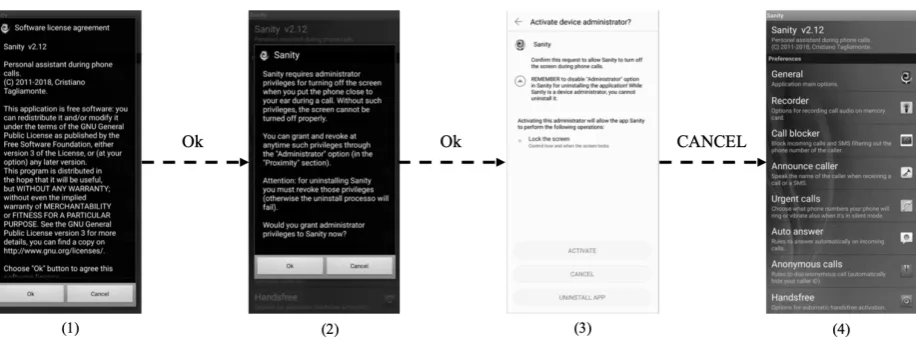
Let us consider the scenario where we are required to learn a model of the sequential behaviour exhibited by an Android GUI application without the availability of the app source code. In this setting, we assume that we are able to detect the GUI components at each visit-ed app screen and, as a consequence, to automatically navigate the application through the generation of GUI events [2]. It is during such exploration that both the given input event sequences and the corresponding app behaviour are encoded in a set of execution traces. As a running example we use the Sanity Android ap-plication to better explain the trace-encoding process needed to set up the behavioural model inference challenge.
Figure 1 shows one of the possible input sequences that, once given to the SUT, let the automatic explo-ration reach the main Sanity app screen starting from the initial one. This scenario of execution is encoded in the trace below:
...
(a, set of available GUI events from screen 2) (b, set of available GUI events from screen 3) (c, set of available GUI events from screen 4) ...
Figure 1
An automatic GUI exploration
Table 1
GUI events labels
GUI event label GUI input action
‘a’ Click on Button Ok of screen 1 ‘b’ Click on Button Ok of screen 2 ‘c’ Click on Button CANCEL of screen 3
of the GUI to build an ELTS behavioural model of the SUT. The learned model is then used with the aim of guiding the generation of new test inputs to discover as quickly as possible unseen parts of the subject sys-tem. Generally speaking, an active learning algorithm for inferring finite state machines iteratively asks for additional observations to complete its task and often implies a teacher-student relationship [12]. In our scenario, indeed, the designed testing with model learning procedure is thought to act as a teacher. It ex-ecutes the SUT on specific test event sequences to get answers to two kind of different queries, membership and equivalence queries. Membership queries aim to realize whether the GUI app can trigger in order a particular sequence of events, whereas equivalence queries are intended to check if the current model hypothesis is consistent with the observed system behaviour, without the aid of formal specifications. Moreover, according to the taxonomy presented by Utting et al. [36], the overall testing procedure is de-fined as online in the sense that test generation and test execution are iteratively performed on-the-fly. The testing with model learning process is described by Algorithm 1. It is based on the following practical assumptions:
_ it is possible to detect the set of available user inputs at each app screen,
_ the testing algorithm is able to restart the SUT, send events to the subject system and record its reaction.
According to Definition 1 this execution trace con-sists of a sequence of pairs (shown on a different line) of input event labels and GUI events available in the current app screen. Each event label represents a spe-cific GUI event sent to the SUT as detailed in Table 1.