This is an open access journal, and articles are distributed under the terms of the Creative Commons Attribution-Non Commercial-ShareAlike 4.0 License, which allows others to remix, tweak, and build upon the work non-commercially, as long as appropriate credit is given and the new creations are licensed under the identical terms.
© 2019 Journal of Advanced Pharmacy Education & Research | Published by SPER Publication
108
Personal profile of women subjected to domestic violence in
Kazakhstan
Assem Makhadiyeva
1*, Kadisha Shalgynbayeva
2, Tolkyn Slambekova
2, Nazymgul Albytova
2, Gulazira
Akymbek
21 2nd year doctoral student of the specialty 6D012300- “Social pedagogy and self-knowledge”, Eurasian national University named after L.N. Gumilyov, Yanushkeevich street,6, Astana 010000, Kazakhstan. 2Social pedagogy and self-knowledge Department, Eurasian national University named after L.N. Gumilyov, Yanushkeevich street,6, Astana 010000, Kazakhstan.
Correspondence:Assem Makhadiyeva, 2nd year doctoral student of the specialty 6D012300- “Social pedagogy and self-knowledge”, Eurasian national University named after L.N. Gumilyov, Yanushkeevich street,6, Astana 010000, Kazakhstan.
ABSTRACT
The purpose of the study is to determine the personality psychological characteristics of women subjected to domestic violence and to draw up a psychological profile of women in Kazakhstan. 70 women participated in the present study who have currently reported domestic violence in the Crisis Center" Umit” in Astana in the period from November 2017 to January 2019. Quantitative research method was used in terms of survey model by implementing a psychological test “The Minnesota Multiphasic Personality Inventory” (MMPI) that assesses personality traits and psychopathology of participants. Also, in the course of the study, the participants were interviewed, the main questions of which were related to socio-demographic characteristics of the ill-treatment to which the respondents were subjected. Descriptive statistics were used to analyze the answers in terms of their levels of the participants’ psychopathology and Spearman's rank correlation coefficient was used to reveal whether there is any correlation between the components of the scale. The results revealed that the level of depression, personal anxiety, post-traumatic stress symptoms, as well as indicators of paranoia and schizophrenia were found to be higher than normal. The obtained results make it possible to identify the correct work for the subsequent psycho-correctional and counseling work with women who have been subjected to ill-treatment and helped to draw up a psychological profile of women subjected to domestic violence in Kazakhstan.
Keywords: family, domestic violence, aggressor, victim, self-esteem, marital relationship, psychological peculiarities of women.
Introduction
Violence is a frightening phenomenon by nature, and it is therefore not surprising that victims of domestic violence tend to feel anxiety and fear even after a long time after it prevented. Violence as an action represents a real physical threat, causes natural fear for one’s life. According to Merriam-Webster dictionary (2013) violence is “the use of psychical force to harm someone, to damage property” and domestic violence is “the inflicting of physical injury by one
family or household member on another; also: a repeated/habitual pattern of such behavior.” Coady (1986) stated the term “violence” is in terms of interpersonal acts of force usually involving the infliction of physical injury [1]. Geras
(1990) stated that violence be defined simply as “the exercise of psychical force so as to kill or injure, inflict direct harm or pain on human beings” (p22) [2]. The World Health
Organization (2002) [3] defines violence as: intentional use of
physical force or power, threatened or actual, against oneself, another person, or against a group or community that either results in or has a high likelihood of resulting in injury, death, psychological harm, male development or deprivation.
•
Domestic violence
Domestic violence is the intentional infliction of physical or psychological damage, the threat of such acts as coercion, and deprivation of personal liberty [4]. In other words, violence is
an action by means of which one attains power over a person, complete control of behavior, thoughts, and feelings. Ways to achieve such power and control are: humiliation, insult,
Access this article online
Website: www.japer.in E-ISSN: 2249-3379
How to cite this article: Assem Makhadiyeva, Kadisha Shalgynbayeva, Tolkyn Slambekova, Nazymgul Albytova, Gulazira Akymbek. Personal profile of women subjected to domestic violence in Kazakhstan. J Adv Pharm Edu Res 2019;9(1):108-117.
threats, intimidation, manipulation, blackmail, the threat of physical abuse, excessive restraint and the using of physical, psychological and economic violence.
Domestic violence can be defined as a pattern of behavior in any relationship that is used to gain or maintain power and control over an intimate partner [5].
The World Health Organization [6] defines domestic violence as
an Intimate –partner violence, which means a woman has encountered any of the above types of violence, at the hands of an intimate partner or sex-partner (p.4).
•
The typology of violence against
women
Relationship violence, including physical, sexual, and psychological abuse, affects millions of people all around the world.
World Health Organization (2002, Geneva) was developed typology of violence which characterized the different types of violence. The typology of violence consists of three broad categories, such as self-directed violence, interpersonal violence and collective violence. Violence against women takes place in all universe of society and women experience all forms of violence.
Self-directed violence – that is when the women to attain the other end, need help; do it to get results, use to regulate mood, to punish others; This type of violence is subdivided: suicidal behavior and self-abuse.
Interpersonal refers to the violence when the women are inflected by husband, small group or another people; Interpersonal violence is subdivided into family partner and community. Family partner violence takes at home with the members of family. Community violence takes outside, between the people who are unrelated to each other. Family partner violence includes forms of violence such as children abuse, young girls and adolescents and women of reproductive age.
Collective violence is when the women are inflected by people of a larger group. This type of violence is subdivided: social, political and economic.
Figure 1: A typology of violence against women, world report on violence and health, WHO 2002.
The present research focuses on women of reproductive age. The consequences of abuse are varied. It is based on when, in what form and at what age a person has experienced abuse. At the same time, according to a number of researchers, psychological abuse only seems to be less harmless - in fact, it has an equally destructive effect on a person [7]. People who
have been abused as a child, in adulthood show a higher level of personal and situational anxiety, a pronounced level of depression, a violation of self-concept, an increased level of guilt and suspicion [8, 9]. Adults who have survived the fact of
abuse in childhood, are characterized by the inability to build a trusting relationship with others, especially the opposite sex. Women who survived the fact of abuse, regardless of the type (physical, sexual, psychological or combined) are characterized by poor mental health, show higher rates of depression, use antidepressants and tranquilizers more often [10].
The studies regarding these issues state that women who have experienced the issue of domestic violence have a number of psychological characteristics that impede their social adaptation and adversely affect their overall psychological state. For building effective psycho-correctional work with women in Kazakhstan who have experienced domestic violence, an important aspect is the study of psychological characteristics (personal characteristics, coping strategies, level of aggression and hostility, personal anxiety, level of depression, and severity of post-traumatic stress reactions).
• Researches related domestic violence
Until 1960s due to cultural norms domestic violence was not considered as an issue in the families, and generally thought as a private case (matter). Couples usually solved their problems and conflicts themselves [11].
In 1971, by initiation of Erin Pizzey “Women’s Liberation Movement” was developed. The first shelter established for women who were beaten and subjected to violence at home. Women shared their experiences of their life and the different violent acts such as a physical violence, rape, and insects. As the results women started to develop different types of shelters and to write books [12]. From that moment, numerous authors
began to investigate the problems of domestic violence; scholars focused on changing judicial systems to reform in the criminal codes defining sexual assault, domestic violence, and child abuse.
Studies confirm that lawyer services, legal services have a positive effect on the ability of women to leave their husband and remain free from abusive relationships, as well as improve their well-beings [13, 14] The direction services are aimed at
providing the mandatory support, encouragement and resources that enable women to make an independent choice and build selections regarding themselves and their life. Kilpatrick (2004) [15] emphasized three necessary aspects within
intentional acts don't seem to be needed to provide injury, hurt or deprivation so as to be outlined as violence (p.1214). Qualitative studies are considered to be one of the important and necessary methods of data collection in domestic violence. The qualitative research studies conducted by Michau & Kilonza (2002); Sagat, Zimmerman (2000), Ellsberg and Heise (2005) [16] were based on in-depth interviews, focus groups and
participatory research.
An interviewing process is also an important step for collecting the disclosure of violence by sharing the stories of abuse and recovery. Walby and Myhill (2001) [17] stated 3 important
aspects: 1) privacy, 2) interviewing skills, and 3) gender of the interviewer. In the research of Sorenson (1978), he found that in interview about sexual assault, it was 1.27 times more likely to reveal a sexual assault if they were interviewed by a woman than by a man.
In the research of Houskamp and Foy (1991), Khan, Welch, and Zher (1993), Rhodes (1992), Rosewater (1992) they revealed women's symptoms in terms of depression, posttraumatic stress disorder, paranoia, low self-esteem, confusion, and anger [18-21]. Other researchers have stated that
subjected women were characterized by personality disorders and high general psychopathology [22].
The most common measure of emotional and behavioral squealer of domestic violence is the Minnesota Multiphasic Personality Inventory (MMPI) and its revision, the MMPI-2. Back et al. (1982) and Rosewater (1988) noted major elevations on MMPI scales F, 4, 6, and 8, as well as low scores on the Ego-strength scale for victims of abuse. Similarly, Khan, et al. (1993) concluded that scores on Scales F, 4, 6, 8, and the Posttraumatic Stress Disorder (PTSD) scales were highly elevated among battered women.
Previous research studies conducted by Kapoor, Leonardsson & San Sebastian (2017) and Pickover et al., (2017) state that the women subjected to domestic violence, were affected apart from the psychical violence but also mental violence such as fear, depression, anxiety, low self-esteem, and post-traumatic stress disorder [23, 24]. The consequences are more serious and
for a long time affect the victim, their children and close family members. Emotional stress leads to sadness and loss of motivation.
The problem of Domestic violence is not so rare, and not only in socially disadvantaged families; according to surveys, there are also representatives of low-status professions (cleaners and salespeople) and high-status ones (doctors, engineers, etc.) [7].
Annually, more than 4 million women suffer from abuse in the United States [25]. According to statistics, in the Russian
Federation 30-40 % of women were subjected to one or another type of violence from a partner [26]. According to the
UN Women's Fund, every year about 400 women in Kazakhstan die from domestic violence. According to the Prosecutor General’s Office, Kazakhstan has increased statistics on violence against women. In 2016, criminal offenses in the family increased by 2.8%, and in 2017 the increase was 4.7%. Compared to 2015, the crime against women and children increased to 90%. Most professionals
involved in the problem of domestic violence agree that the ill-treatment between close people is caused by a number of factors, among which it is difficult to single out the dominant one. These include the socioeconomic status of the aggressor and the victim, experience and monitoring of childhood violence, low self-esteem of family members, alcohol abuse in the family, etc. Although the family is experiencing an increase in violence, however, these manifestations and methods of their diagnosis, despite the relevance, remain insufficiently understood and require in-depth study.
By taking into consideration all these factors the present research study is aimed to investigate the psychological profile of women who lived in the shelter “Umit” in Astana. The main reason for investigating this issue is that the problem of domestic violence in the Republic of Kazakhstan was not investigated enough to date. As it can be seen from the review of related literature, there is a the need for comprehensive care which main objectives are prevention of family violence against women, protection in order to ensure the safety of women and the provision of professional assistance and counseling.
Aims of the study
The purpose of the study is to determine the personality psychological characteristics of women subjected to domestic violence and to draw up a psychological portrait of women. In line with these objectives the following research questions are examined:
• What is the level of personal anxiety of women subjected to violence?
• What was the level of depression of women subjected to violence at the time of the study?
• What are the general characteristics of women subjected to violence?
Method
Setting and participants
The crisis center “Umit” was opened in 2013 on the basis of the Resolution of the Government in Astana. The work of the Crisis Center is carried out in accordance with the “Standards of social services for victims of domestic violence” of December 21, 2016, No. 1079. The crisis center accepts victims of domestic violence from the age of 18-58 years, including their minor children who have been subjected to ill-treatment, who have applied both on their own initiative and by the direction of the education, health care and internal affairs agencies. Terms of stay in the center are from 1-6 months by decision of the commission at the office of employment and social protection of the city of Astana. The main goal of the Crisis Center is to provide special social services in 8 areas:
diapers, four meals a day, women with children under 3 years of age - compulsory supplementary baby food.
2. Socio-medical services: The medical staff of the crisis center provides first-aid medical care, conducts daily health checks, living conditions for cleanliness, and takes preventive measures for a healthy lifestyle. Together with the specialists of the AIDS Center, the TBs (tuberculosis) Dispensary, lectures are conducted on the prevention of diseases and the observance of healthy lifestyles.
3. Socio-psychological services: Psychologist works with women and children. Specialist conducts individual psychological sessions, to remove fear, aggression and anxiety. Psychologist helps to solve family problems and avoid their recurrence.
4. Socio-economic services: Assistance for recipients of services in obtaining benefits, allowances, compensation and other benefits, housing issues provides timely, complete, qualified and effective assistance in solving issues of interest to recipients of services.
5. Social and legal services: Legal advice in the provision of special social services and on issues related to civil, family, property and real rights, restoration of documents, recovery of alimony, compensation for damage, and social security in accordance with the legislation of the Republic of Kazakhstan.
6. Socio-cultural: Cultural and leisure activities are organized for service providers and children.
7. Socio-labour: This includes carrying out activities to survey the existing work skills of service recipients, assistance in vocational guidance and counseling, assistance in conducting training activities for recipients of services in accessible professions and practical skills. The center has an occupational therapy office in which service providers can master the skills of knitting, embroidery, sewing, and weaving. For classes there are the necessary equipment including sewing machines, kits for creativity, and knitting.
8. Social and pedagogical service: This includes conducting of classes aimed at the developing family values, and assistance in obtaining education recipients of services. Conducting lessons on the transformation of values, attitudes, and behavioral skills ensures the prevention of repetitive incidents of violence, and assistance in obtaining textbooks and school supplies when necessary.
The distribution of participants according to their social-demographic characteristics information are given in Table 1.
Table 1: The distribution of Social –demographic characteristics of victims
Social-demographic characteristics %
Age 18-28 37%
29-38 45%
39-48 17%
49-58 1%
Family status
Single 6,25%
Married 42,5%,
Civil marriage 38,75 %
Divorced 12,5%
Children Have 100%
Have not -
Education
High School graduates 45%
College 40%
Higher education 15%
Employment Employed 13%
Unemployed 87%
Drug
Don not use 100%
Seldom 0%
Regular 0%
Alcohol frequency
Don not drink 80%
Seldom 20%
Regular 0 %
Seventy women who have lived in the Crisis Center "Umit" in Astana in the period from November 2017 to January 2019 participated in the current study. The participants are aged between 18 to 58 years. The average age of this group is 35. In addition, according to the analysis, the number of unmarried service participants is 42.5%, the number of unmarried civilians is 38.75%, the number of divorced persons is 12.5%, and the number of unmarried participants is 6.25%. Only 13 % of women are employed, whereas 87% are unemployed. Victims do not use drug, and 20% of women drink alcohol seldom. Most women living in the center do not have a permanent job. In most cases, marriages are not officially registered.
The distribution of participants according to their forms of violence information are given in Table 2.
Table 2: The distribution of forms of violence of victims
Forms of violence Sum %
Psychical violence 63 91.25%
Economic violence 54 80%
Psychological violence 64 92.5 %
Sexual violence 10 12.5%
(more often a husband/roommate) to alcohol, gambling and other hypertrophied needs.
Data Collection Tools
For the implementation of the objectives of the study standardized psychometric test MMPI was used, which was developed by Starke R Hathaway and J.C. McKinley (1943). The psychometric test used to investigate the participant`s normal and pathological personality. The MMPI is widely used in various branches of science and practices including general and forensic psychiatry, the selection of special contingents, the aviation and space medicine, general and social psychology.
It consists of overall 567 within 10 dimensions.
Dimension Hypochondriasis (Hs) is designed to identify the symptoms of hypochondria in participants. This dimension helps to assess neurotic anxiety and relation of participants to the functioning of body. It consists of 32 items.
Depression(D)- The purpose of dimension is to identify level depression of the participant. Very high scores indicate the depression, moderate score dissatisfactions with one`s life. The dimension contains 57 items.
Hysteria (Hy)- It is used to detect hysteria in stressful situations. This dimension contains 60 items.
Psychophatic derivate (Pd)- This dimension is developed to identify the psychopathic patients; it measures the general social adaptation of the participant. It consists of 50 items. Masculinity/Femininity (Mf) – This is intended to reflects the degree of identification with the traditional cultural and social role of a man or a woman. This dimension has 56 items. Paranoia (Pa)- It is designed to identify the paranoid symptoms. This dimension consists of 40 items.
Psychastenia (Pt)- It is designed to measure a person’s severity of anxiety reaction as a situationally conditioned state of mind, and on the other hand, reflects persistent psychasthenic character traits. It has 48 items.
Schizophrenia (Sc)- It aims to diagnose a schizoid personality type. This scale has 78 items.
Hypomania (Ma)-This dimension is designed to determines the degree of "proximity" of the examined hyperthymic personality type. This dimension consists of 46 items.
Social Introversion (Si)- It determines the degree of personal involvement in the social environment. This dimension has 69 items.
Moreover, for the validity of the participants’ responses three subscales are also included which are labeled as L,F,K. The purpose of the first “L” dimension is to measure participants’ attitude who tries to make themselves look like a better person. This dimension consists of 15 items. “F” dimension is used to detect deviant test taking behaviors which, in turn, includes 60 items. The last “K” dimension was designed to identify defensiveness of the participant. It measures self-control and interpersonal relations with surrounding environment. This subscale consists of 30 items.
The participants’ answers were distributed among “True”, “False” and “Can not say”. It took participants approximately 60 to 90 minutes to complete the scale.
Distribution of the scores
The scores are distributed according to 5 levels: high level (above 70 points); higher than mid-level (56 – 70 points); medium level (45 – 55 points); lower than mid-level (44 – 30 points); low level (below 30 points).
An increase in the scales within the limits of average scores and a particular increase most often are positively associated with the adaptive characteristics of the personality, while high or low values of the scales usually reflect pathological phenomena and indicate a decrease in adaptability.
Data analysis
Since the primary objective of the present study was to explore the psychopathological condition of subjected women, descriptive statistics were used. Further, since it was revealed according to the results of the normality test that the data was not normally distributed, in order to find out whether there are any correlations between the ten dimensions of the scale, Spearman Rank order correlation coefficient was conducted.
Results
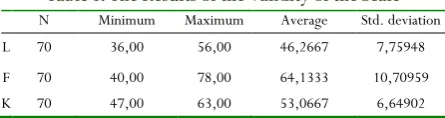
The MMPI test was used for women who have been victims of domestic violence and the statistics of the results are given below (Table 3).
Table 3: The Results of the Validity of the Scale
N Minimum Maximum Average Std. deviation
L 70 36,00 56,00 46,2667 7,75948
F 70 40,00 78,00 64,1333 10,70959
K 70 47,00 63,00 53,0667 6,64902
As shown in the table 3, the results of the “Lie” dimension which examined the validity of the scale revealed that the average score of 70 women was found to be 46.26, which suggests that participants answered confidently to the scale questions.
The next F dimension’s average score was 64.13.
Women victims seek to draw the attention of the environment to their complex inner world in order to get help, sympathy, or put themselves in the spotlight. They have excessive congestion of consciousness with internal problems, anxiety, tension, and increased activation of the nervous system (stress). The victims are unsure of themselves and positively appraised by their surroundings, passive, timid, impractical not only in real affairs, but also in imagination.
Scale Kshowed 53 points. Women do not deny and know that they have problems, and are sensitive to the assessments of the environment of their personality and their behavior.
Following, to analyze the results according to the responses of participants, the descriptive statistics were performed (Table 4).
Table 4: The Results of the Descriptive Statistics
N Minimum Maximum Average deviation Std.
Hs 70 48,00 78,00 64,9333 11,33557
D 70 45,00 95,00 67,8667 15,90537
Hy 70 50,00 79,00 65,2000 11,51521
Pd 70 51,00 89,00 68,2000 12,90736
Mf 70 41,00 71,00 60,7333 8,53118
Pa 70 56,00 94,00 72,0000 12,32883
Pt 70 54,00 80,00 67,2000 8,02852
Sc 70 48,00 90,00 79,6000 11,39423
Ma 70 43,00 72,00 62,0000 12,08896
Si 70 42,00 71,00 59,9333 8,34494
In the first dimension hypochondriasis, the average score was found to be 64.93. This means that victims are prone to fix attention on the state of their body and their health, absorbed in an abundance of disturbing sensations.
The average scale of the depression was found to be 67.86, which showed unrest and underestimation of their capabilities, fixing attention to their failures and disappointments, and having a passive stance. High rates may be associated with a situation of sharp disappointment after a failure that has been experienced, or with a disease accompanied by emotional depression. Victims have a health below normal. Victims feel unwell (frequent tiredness, blues, poor sleep, lack of appetite, nausea, constipation, and sweating); intellectual processes are stalled.
Regarding the scale of hysteria, the indicator was found 65.20. Victims are not critical enough to themselves, prone to declarations, surfaces in contacts and feelings.
Psychopathic Deviate scale was 68.20. High values of the scale may indicate a violation of social adaptation, marked tension, dissatisfaction, short temper and incontinence in interpersonal relations.
Masculinity-femininity scale was 60.73. Victims in evaluations and behavior try to avoid rudeness, emphasizing subtlety of interests, sensitivity to emotional nuances of relationships, some sentimentality, trustfulness, willingness to help, and compliance.
Paranoia scale in average was revealed to be 72. It means that the victims prone to "stagnant", long-lasting self-defense experiences in the mind, affecting the interests of his personality (touchy, vindictive, and suspicious). Women who have suffered assault, for a long time can not forget about what happened. We noticed this during conflict situations among women in the crisis center. It manifests itself in quarrels and squabbles between women, not the ability to share common furniture and accessories of the center, conflicts also arise because of children,
The average score of Psychastenia subscale was found to be 67.20. It is characterized by extremely strong self-defense mechanisms, holding from contact with unfamiliar or overly strong, and dangerous irritants of victims. Conscious fears and fears that make it difficult to carry out activities and reduce
social activity may be present in the mind. By the nature of anxiety, they are extremely indecisive, timid, prone to unacceptably long deliberation of forthcoming actions and reinsurance.
In this case, because of the fear of the husband, women lose confidence and are afraid to write a statement to the court about the fact of beating or to file for divorce. If he finds me, he will kill me, women with such thoughts and fear live long before they divorce. When their husbands call them, they do not disclose their location, but they tell us that their husbands asked not to write a statement about them otherwise they would threaten to take away the children.
The average score of Schizophrenia was 79.60. Victims are inclined to distance themselves and become isolated from the environment in their inner, original and quite satisfactory world. Contacts are either selective or pseudo-wide, without disclosing their real I. When planning behavior, they are guided mainly by their intrinsic values and criteria, which are often quite peculiar. Perhaps fantasized and formulated affective ideas that are divorced from reality and closed in themselves.
Women do not go out for a long time, thinking that their husband is waiting for her. There is a fear that he will find them. They take the children to school and lead them back themselves. They believe that after 6 months they will be left without protection.
With a high rate of hypomania (62.00) and schizophrenia, the victims have, without reason, a manic state and heightened mood.
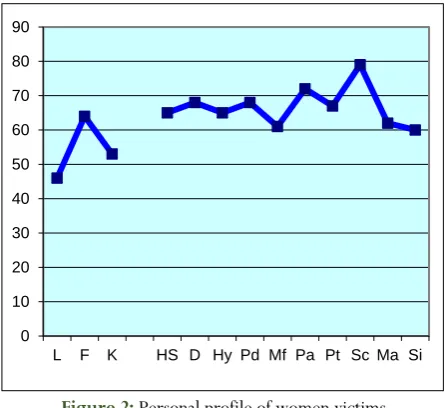
The average score of social introversion was 59.93. It is inclined to limit the "extra" contacts with the environment, without showing special interest in what does not concern her directly. Outside communication, alone with herself, she feels more confident and calmer. They do not feel the need to express outside their feelings, intentions, or share their plans. Also notice the figure above the norm in the figure below.
Figure 2:Personal profile of women victims
As shown above, the highest rate was found in paranoia and schizophrenia, which shows that women who are victims of
0 10 20 30 40 50 60 70 80 90
domestic violence are characterized by a paranoid schizophrenic personality type.
Individuals with this type of profile are not characterized by aggressive asocial behavior, but by asocial acts committed as a result of misunderstandings, inability to certain conditions, inability to clearly understand the social norm as a result of a peculiar approach to the situation. This is evident in the asocial actions of victims of violence, such as suicide and murder of husband.
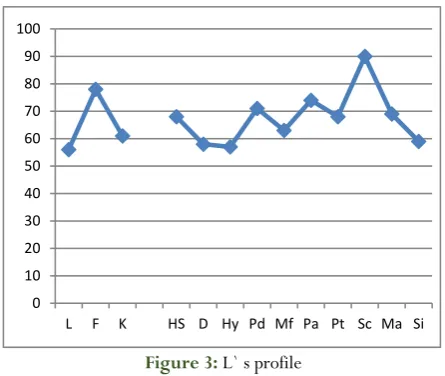
In order to confirm these results, the personal profile of one participant was discussed. An example is a 22-year-old woman who has one child. L's parents divorced when she was 2 months old. The woman was raised by her grandmother. Grandmother was strict, beat her, and showed indirect aggression. Since she was 10 years old, she brought up by her mother, who often beat her, made remarks, criticized when she went out for a walk and locked her at home tied to a battery. Mother led a wild lifestyle. Beat the daughter for the fact that she is similar to the father. L received a secondary special education accountant in college. Later married at age 18, in the hope of getting away from this situation and family. It turned out that the husband suffers from alcohol dependence and there is a dependency on gambling. In everyday life, she constantly lowered her self-esteem with stories about other beautiful women and how she meets them. He beat her and said that she had nowhere to go, that her mother led a wild lifestyle and she herself was not a virgin. The victim was subjected to economic, physical, verbal and sexual abuse by her husband. Upon arrival, he dragged his hair, beat her in the bathroom and sexually abused her. He asked for forgiveness when a woman came to her senses. I wanted to strangle for the last time, but her neighbors helped her escape and directed her to the crisis center. The violence was repeated in cycles. Mother, a woman with higher education worked for some time at school. After the dismissal, she began to drink alcohol and lead a riotous lifestyle, which refers to the hystero-schizoid type. After the death of her father, she received post-traumatic stress and was treated for neurosis, but in the psychiatric register was not a member. In 2018, on April 7, she entered a mental hospital as a socially dangerous type. On the street she could not control her behavior, scattered garbage, in the evenings she went out onto the road and tried to control the traffic, like a traffic police. Sometimes she kicked out on the road. Schizophrenia was diagnosed. The figure below represents the results revealed about the participant discussed above.
Figure 3:L` s profile
The following indicators are very high regarding victim profiles: depression 95, psychopathy 90, and schizophrenia 88. People of this type are distinguished by the greatest vulnerability in relation to the hardships of life, the desire to comprehend and “retard” their own immediate impulses, to avoid confrontation with the cruel laws of real life due to the pessimistic assessment of their capabilities when confronting others.
The structure of this personality is such that the fate-realizing tendency bears the imprint of a certain passivity, and circumstances may be dominant over character. Apparently, therefore, fatalism is characteristic of this type, i.e. the tendency to rely on how things “add up by themselves”, “where the curve will take out”, and “how lucky” it will be, rather than trying to influence fate, heightened impulsiveness, and manifest difficulty in self-control.
There is a tendency to increased aggressiveness, interpersonal conflict, frequent changes of mood, interests and affections, and touchiness especially in situations of self-esteem. In the course of decision making, impulsiveness prevails, often disregard for social and corporate norms and values. We identify psychopathic variants of the schizoid type of response. Such psychopathic traits include closure, passivity, introversion, incommunicability, significant originality of judgments and actions, stiffness of gestures, poses, awkwardness in interpersonal contacts, detachment and emotional coldness, incomprehensibility of motives for others, impracticality and detachment from real life problems, as well as tendency to mysticism.
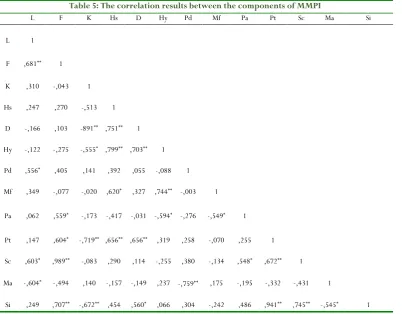
In order to show complete confidence, the interrelation between the components of MMPI, a mathematical analysis was made. Statistical data was analyzed by performing SPSS (statistical software package of social sciences) version 19.0. The Spearman's rank correlation coefficient was conducted to identify the relationship between the values. The result of Spearman's rank correlation coefficient was illustrated in table 5.
0 10 20 30 40 50 60 70 80 90 100
Table 5: The correlation results between the components of MMPI
L F K Hs D Hy Pd Mf Pa Pt Sc Ma Si
L 1
F ,681** 1
K ,310 -,043 1
Hs ,247 ,270 -,513 1
D -,166 ,103 -891** ,751** 1
Hy -,122 -,275 -,555* ,799** ,703** 1
Pd ,556* ,405 ,141 ,392 ,055 -,088 1
Mf ,349 -,077 -,020 ,620* ,327 ,744** -,003 1
Pa ,062 ,559* -,173 -,417 -,031 -,594* -,276 -,549* 1
Pt ,147 ,604* -,719** ,656** ,656** ,319 ,258 -,070 ,255 1
Sc ,603* ,989** -,083 ,290 ,114 -,255 ,380 -,134 ,548* ,672** 1
Ma -,604* -,494 ,140 -,157 -,149 ,237 -,759** ,175 -,195 -,332 -,431 1
Si ,249 ,707** -,672** ,454 ,560* ,066 ,304 -,242 ,486 ,941** ,745** -,545* 1
As a result of identifying the presence of a correlation between the scales, the following information was obtained.
Increasing of hypochondria affects the increasing of depression (r = .751; p <0.01) and hysteria (r = .799; p <0.01). It is characterized by a feeling of uncertain threat, tension, and instability of mood on the verge of collapse. Outwardly, self-withdrawal, isolation, limited contact, irritability and tension in communication, indecision and passivity can be noticeable. This state significantly limits intellectual and creative possibilities. Moreover, it reflects the tendency to a quick change of experiences, instability to stress, demonstrative behavior with a tendency to gain recognition and a positive assessment of others. In some cases, high rates on this scale correspond to the hysterical variant of personality with a tendency to the method of protection by the type of repression, as well as with the presence of conversion symptoms, manifested by painful disorders.
The increase in the schizophrenia scale affects the following scales: F scale (r = 0.989; p <0.01), paranoia (r = 0.548; p <0.05), Psychoastania (r = 0.672; p <0.01), and social introversion (r = 0.745; p <0.01); that is attracting the attention of the environment to its complex inner world in order to get help, sympathy, or put yourself in the spotlight. There is no doubt that the consciousness is overloaded with internal problems, anxiety, tension, and increased activation of the nervous system. Even in conditions of medium complexity, failures of blocks of intellectual functions are possible, leading to a sharp drop in the reliability of activity.
An increase in the social introversion scale leads to an increase in the depression scale (r = 0.560; p <0.01), psychastasis (r = 0.941; p <0.01), and schizophrenia (r = 0.745; p <0.01).
Thus, women victims tend to limit “extra” contacts with the environment, without showing much interest in what does not directly concern them. Outside communication, alone with herself, she feels more confident and calmer. This woman is characterized by extremely strong self-defense mechanisms, and keeping in mind the specific fears that impede the implementation of activities and reduce social activity. She is incapable of independent activities related to the adoption of responsible decisions with a lack of information. Victims tend to distance themselves from the environment in their inner and original and quite satisfactory world. Contacts are either selective or pseudo-wide, without disclosing one's real I. The fencing does not allow her to feel others subtly. As a result, her emotional reactions sometimes seem inadequate, and her actions are strange.
Discussion
The findings of the study suggest that there are various problems that necessitate specific work in terms of psychological counseling and rehabilitation. High rates of paranoia and schizophrenia indicate the existence of psychopathology. This indicates that women are victims of domestic violence, suffer from anxiety, depression, and there are no exceptions to post-traumatic stress and suicidal behavior.
In determining the victims of domestic violence, Back (1982) stated that in the clinic they are more often diagnosed as borderline personality disorder, dependent personality disorder and passive-aggressive personality disorder (psychopathy). In an investigation two groups were compared; women who do not have the fact of abuse in their experience are two times less likely to have such diagnoses [22]. In addition,
the features of obsessive-compulsive disorder of antisocial personality disorder were also more frequently diagnosed in women with the syndrome of ill-treatment [27]. A study on the
personal characteristics of women who have experienced the fact of abuse has shown that their level of psychopathization is much higher than that of women who do not have such experience. So, in terms of its performance, the experimental group shows a significant increase in the level of the scales psychopathy, paranoia, schizophrenia and hypomania (the MMPI questionnaire was used for diagnosis) compared to the control one [19]. As a result, it was concluded that abuse
syndrome (IPV) may underlie psychopathology [28, 29]. In our
research also the highest rates are paranoia (72) and schizophrenia (80), which are above normal. This means that women who are victims of domestic violence are characterized by a paranoid and schizophrenic personality type. Victims were revealed to have "stagnant", self-protective experiences affecting the interests of their personality for a long time in consciousness (touchy, vindictive, and suspicious). They are extremely persistent, stubborn, inflexible in behavior, categorical and biased in assessments. Women have specific fears in their minds that make it difficult to carry out the activity and reduce social activity. They are incapable of independent activities related to making responsible decisions with a lack of information. In the conditions of guaranteed security, they are very thorough, performing and careful. It is inclined to advance new ideas and approaches, which sometimes may not seem very practical and divorced from the real situation and the possibilities of today. Women in this case after the conflict that led to the beating leaving the family return since they can not analyze the reality. According to Umit city Astana, 28.9% of women returned to their husbands again, and 10.5% of them divorced.
According to the correlation analyses, following personal characteristics were revealed among the participants:
• tension, mood instability, self-withdrawal, isolation, and limited contacts.
• irritability and tension in communication, indecision and passivity.
• instability to stress.
• attracting the attention of the environment to its complex inner world in order to get help, sympathy or put themselves in the spotlight.
• excessive congestion of consciousness with internal problems.
• vindictive and suspicious.
• conflicting relations with the environment.
• the presence of specific fears and concerns in their minds.
• problems with analyzing the real situation in life.
• extremely strong self-defense mechanisms.
• extremely indecisive, long-term thinking about upcoming actions and reinsurance.
• emotional reactions sometimes seem inadequate, and actions are strange.
Conclusion
We should pay attention to the education of women subjected of domestic violence, that they know their rights and responsibilities, to be able to find ways to solve conflict situations in the family or if she decided to leave her partner, to find ways to help her get out of the circle of violence, and to help the victims bring up their children. Social pedagogy and psychologists should carry out rehabilitation work with assisting victims of violence and minimize the risk of recurrence in the victim’s future family. We should teach parents to properly interact with children at certain stages of their lives. The negative experience of cruelty in childhood is often reproduced in subsequent generations; therefore, it is important to identify child abuse during the early stages and to help these children and their families. More research studies both qualitative and quantitative with more participants should be conducted in order to get more in depth information regarding the violence against women. For the further researches in terms of corrections of rejected personality characteristics it can be suggested to carry out the following psychological correctional work:
• changing self-awareness and self-concept of a woman.
• revising life values and priorities.
• working on motivation.
• changing the behavior of women "victims".
• forming the right position in the decision.
• reduction of responsive aggressiveness to children and other family members.
References
1. Coady, C. A. J. (1986). The idea of violence. Journal of Applied Philosophy, 3(1), 3-19.
2. Geras, N. (1990). Our morals. N. Geras, Discourses of Extremity. London: Verso, 21-58.
3. World Health Organization. (2002). The world health report 2002: reducing risks, promoting healthy life. World Health Organization.
4. Malkina-Pykh I.G.(2006). Psikhologiya povedeniya zhertvy: spravochnik prakticheskogo psikhologa. M.: EKSMO,1008.
5. National Domestic Violnce Hotline. (2013). US Department of Health and Human Services (HHS).
Report on domestic violence.
6. World Health Organization. (2005). Addressing violence against women and achieving the Millennium Development Goals (No. WHO/FCH/GWH/05.1). Geneva: World Health Organization.
7. Pashina A.Kh.(2002). Psikhologiya i praktika vzaimodeystviya razlichnykh vidov nasiliya v otnoshenii zhenshchin i osobennostey ikh emotsional'noy sfery//Psikhologicheskiy zhurnal, t.23№6, 98 — 105.
8. Il'ina S.V. (1997). Vliyaniye perezhitogo v detstve nasiliye na vozniknoveniye lichnostnykh rasstroystv // Voprosy psikhologii,.64-77 s.
9. Johnson, D. M., & Zlotnick, C. (2009). HOPE for battered women with PTSD in domestic violence shelters. Professional Psychology: Research and Practice,
40(3), 234.
10. Ruiz-Pérez, I., & Plazaola-Castaño, J. (2005). Intimate partner violence and mental health consequences in women attending family practice in Spain. //J. Sex Medicine, 12, 54-59.
11. Hotaling, G. T., Straus, M. A., & Lincoln, A. J. (1989). Intrafamily violence, and crime and violence outside the family. Crime and Justice, 11, 315-375. 12. Tjaden,P.(2005). Violence agains women: A statistical
overview, challenge and gaps in data collection and methodology and approaches for overcoming them.
Geneva: World Health Organization, UN Division for the Advancement of women.
13. Tan, C., Basta, J., Sullivan, C. M., & Davidson, W. S. (1995). The role of social support in the lives of women exiting domestic violence shelters: An experimental study. Journal of Interpersonal Violence,
10(4), 437-451.
14. Tutty, L. M., Weaver, G., & Rothery, M. A. (1999). Residents' views of the efficacy of shelter services for assaulted women. Violence against women, 5(8), 898-925.
15. Kilpatrick, D. G. (2004). What is violence against women: Defining and measuring the problem. Journal of interpersonal violence, 19(11), 1209-1234.1209. 16. Ellsberg, M., & Heise, L. 2005: Researching Violence
Against Women. A Practical Guide for Researchers and Activists. In by World Health Organization (WHO), Geneva. See also: www. path. org/files/GBV_rvaw_complete. pdf Marie-France Hirigoyen, 2006: Warum tust du mir das an? Gewalt in Partnerschaften. 17. Walby, S., & Myhill, A. (2001). New survey
methodologies in researching violence against women.
British Journal of Criminology, 41(3), 502-522.
18. Houskamp, B. M., & Foy, D. W. (1991). The assessment of posttraumatic stress disorder in battered women. Journal of Interpersonal Violence, 6(3), 367-375. 19. Khan, F. I., Welch, T. L., Zillmer, E. A. (1993)
MMPI-2 profiles of battered women in transition. Journal of Personality Assessment, 60, 100–111. 20. Rhodes, N. R. (1992). Comparison of MMPI
psychopathic deviate scores of battered and nonbattered women. Journal of Family Violence, 7(4), 297-307.
21. Rosewater, Lynne B. "Battered or schizophrenic? Psychological tests can’t tell." (1988): 200-16.
22. Malone Back, S., Post, R. D., & D'Arcy, G. (1982). A study of battered women in a psychiatric setting.
Women & Therapy, 1(2), 13-26.
23. Kapoor, S. (2000). Domestic Violence against Women and Girls. Innocenti Digest 6.
24. Leonardsson, M., & San Sebastian, M. (2017). Prevalence and predictors of help-seeking for women exposed to spousal violence in India–a cross-sectional study. BMC women's health, 17(1), 99. http://doi.org/10.1186/s12905-017- 0453-4.
25. Flitcraft A., Hadley S.M., Hendricks-Matthews M.K. (1992). Diagnostic and Treatment Guidelines on Domestic Violence: American Medical Association, 25.
26. Krasnenkov V.L., Rudnev A.O. (2014). Semeynoye nasiliye v otnoshenii zhenshchin kak mediko-sotsial'naya problema// Tverskoy meditsinskiy zhurnal
№6, 44-52.
27. Pico-Alfonso, M. A., Echeburúa, E., & Martinez, M. (2008). Personality disorder symptoms in women as a result of chronic intimate male partner violence.
Journal of Family Violence, 23(7), 577-588.
28. Martinez M, Garcia-Linares MI, Pico-Alfonso M.A. (2004). Women victims of domestic violence: Consequences for their health and the role of the health system.Vienna: Studien-Verlag; 78-88.