Volume 02, No. 2, February 2016
P
age
8
The Performance Analysis of Location Based Multipath Routing
Strategy in MANETS
Dr. Asha T.S* and Dr. Geetha G**
*Associate Professor, NSS College of Engineering, Palakkad **Associate Professor, NSS College of Engineering, Palakkad
ABSTRACT
A mobile ad hoc network consists of wireless nodes that move frequently. Movement of nodes results in a change in routes, requiring some mechanism for determining new routes. In this paper we propose an approach to utilize location information to improve performance of routing protocols for ad hoc networks. We propose a node-disjoint location based multipath routing protocol (Location-BMP) for mobile ad hoc networks to reduce the number of broadcast multi-path route discoveries and the average hop count per path from the source to the destination. During route discovery process, the intermediate nodes include their location information along with the distance in the Route-Request (MP-RREQ) packet. The destination node selects a set of node disjoint paths from the MP-RREQ packet received and sends a Route-Reply packet on each of the node-disjoint paths.
Key words:- node disjoint, location BMP
1. INTRODUCTION
Volume 02, No. 2, February 2016
P
age
9
a single route discovery process and maintaining multiple paths simultaneously helps in routing. If one path fails the secondary path will always be available in the route cache. It is needless to say that reducing of control overheads is extremely important in developing efficient reactive routing protocols. Using location awareness and GPS enabled ness of the nodes, we have tried in the proposed protocol to limit the flooding of the control packets in the direction of the destination node. Moreover we have also used shortest as well as alternate paths for transmission of the data packets to improve the performance of the proposed routing protocol. The performance of these protocols tends to increase with node density; at higher node densities, a greater number of alternate paths are available. In such protocols, link failures in the primary path, through which major data transmission takes place, cause the source to switch to an alternate path instead of initiating another route discovery process. A new route discovery process becomes necessary only when all recomputed paths break. This approach results in reducing end-to-end delay since packets donot need to be buffered at the source when an alternate path is available. Therefore, we have attempted to provide an approach which gives optimized multiple stable routes considering the location of the destination thereby reducing flooding in the network providing low network overhead. Thus, we propose Based stable Multipath reactive routing protocol namely, Location-BMP routing protocol.
2. RELATED WORK
The commonly used routing protocols in the wired networks are Routing Information Protocol (RIP) and Open Shortest Path First (OSPF). RIP is a distance vector protocol while OSPF is based on the link-state routing philosophy. The two protocols, although quite efficient for routing data in the wired networks are entirely unsuitable for applications in the mobile ad-hoc networks. The dynamic nature of MANET causes random and unpredictable changes in the routes of the network. The slow update rate of the wired protocols diminishes their ability to converge to a steady state for finding routes in the ever-changing topology. The routing overhead incurred by the distance vector and link state protocols in terms of protocol control messaging becomes much of a factor in the ad-hoc network environment. Finally, the computationally expensive operations of the traditional wired protocols would be highly taxing on the scarce CPU, memory and battery power resources of the mobile nodes in an ad-hoc network.
2.1 Classification of routing protocols
The routing infrastructures in MANET's should be established in a distributed self organized way due to node mobility. Different routing protocols have been proposed and are classified into two major categories as Proactive and Reactive.[1]The task of routing involves making forwarding decisions for data packets depending on the routing state of the network. The routing protocol thus has a two-fold operation. The first is to collect information about the state of the network and secondly to use this information to create routes through which data packets are forwarded.
2.1.1 Ad Hoc on Demand Distance Vector (AODV)
Volume 02, No. 2, February 2016
P
age
10
as they are being used. Routes are discovered through a route discovery cycle, whereby the network nodes are queried in search of a route to the destination node. When anode with a route to the destination is discovered, that route is reported back to the source node that requested the route. Marina M. K. and Samir R Das [2] proposed routing protocols using multiple link disjoint paths computed from the source node to destination node through a modified route discovery process. The destination node responds to only those unique neighbors from which it received a route request packet (RREQ). Each node in the network maintains a list of alternate next hops that are sorted based on the hop count. During routing if one of the links between two nodes breaks, then the immediate upstream node switches to the next node in its list of next hops. If the upstream node does not have an alternate next hop, it sends a RERR to its upstream neighbor. The source node then initiates a route request when all its alternate paths fail. The main drawback of this protocol is that the alternate paths that are computed during route discovery may not be available during the course of data transfer. Thus the paths could become stable and outdated by the time they are actually utilized whereas these do not help. The multipath approach in this protocol is therefore not adaptive to the changes in the network topology.
2.1.2 AODV-BR: Backup routing
Lee Sung-Ju and Mario Gerla [3] proposed a scheme to calculate alternate paths such that when a link failure occurs, the intermediate node searches for an alternate path to circumvent the broken link. The basic assumption made in this protocol was that all the nodes are in promiscuous mode and that they could overhear every transmission within their range. This protocol, however, has a number of limitations. First, it assumes that several nodes are within transmission range of each other. Also, constant mobility of the nodes is not taken into account. Further, the protocol assumes that a node that offers the alternate route around a broken link does not move away and remains within range of the two nodes between whom the link has broken. Moreover, the utilization of promiscuous mode greatly increases the power consumption of each node.
2.1.3 Split Multipath Routing Protocol (SMR)
The main objective of SMR is to reduce the frequency of route discovery processes and thereby reduce the control overhead in the network. This protocol is proposed by Lee S. J.and M. Gerla. [4]The protocol uses a per packet allocation scheme to distribute a load into multiple paths. When a destination node receives route request packets from different paths, it chooses multiple disjoint routes and sends replies back to the source. The basic route discovery mechanism of the DSR protocol is used in the SMR protocol, but an intermediate node is not allowed to reply from its route cache if it has some routes available to that destination.
2.1.4 Location Aided Routing (LAR)
Volume 02, No. 2, February 2016
P
age
11
zone (zone in which the destination node lies). They proposed two request zone schemes. The first scheme is a rectangular geographic region. In this case, node forwards the route discovery packet only if they are within that specific region. In LAR scheme 2, the source or an intermediate node forwards the message to all nodes that are closer to the destination than itself. Thus the node that receives the route request message checks if it is closer to the destination than it was inthe previous hop. If so, it retransmits the route request message otherwise, it drops the message. In order to find the shortest path in the network level, instead of selecting a single node as the next hop, several nodes are selected for managing the route request message and each of them puts its own IP address in the header of the request packet. Therefore, the route through which the route request packet passes is saved in the header of the message; message size thus grows for far from the source resulting in increase in the routing overhead.
2.1.5 Tactical On Demand Distance Vector (TAODV)
To overcome the blind flooding technique used in route discovery process Mueen Uddin, Azizah Abdul Rahman, Abdul rahman Alarifi Muhammad Talha, Asadullah Shah, Mohsin Iftikhar and Albert Zomaya [6] proposed Tactical On Demand Distance Vector (TAODV) protocol which uses a query localization technique that significantly reduces the network traffic and increases the performance of network.
2.1.6 Most Forward within distance R (MFR)
Wang C and Yuanapos Liu [7] proposed position-based routing protocols, such as Most Forward within distance R (MFR), in which they attempted to minimize the number of hops by selecting the node with the largest progress from the neighbors. Wherein, they defined the progress as nearness to the destination node. In MFR source S will choose the node say A as the next hop since it has the largest progress to the destination D. As other greedy forwarding protocols, MFR has the shortcomings of either not guaranteeing to find a path to the destination or finding a path which is much longer than the shortest path. Moreover, nodes should broadcast periodically the beacons to announce their positions and enable the other nodes to maintain a one-hop neighbor table. MFR is an important progress based algorithm competitive in terms of hop count.
2.1.7 Location Based Opportunistic Routing Protocol (LOR)
Volume 02, No. 2, February 2016
P
age
12
node is introduced. At each hop, the node that forwards the packet will check its neighbor list to see whether the destination is within its transmission range. If yes, the packet will be directly forwarded to the destination.
2.1.8 Dynamic Source Routing (DSR)
Dynamic Source Routing (DSR) allows nodes in the MANET to dynamically discover a source route across multiple network hops to any destination. In this protocol, the mobile nodes are required to maintain route caches or the known routes.[9] Routing in DSR is done using two phases: route discovery and route maintenance. The existing protocols are vulnerable to the attacks of fake routing packets or denial of-service (DoS) broadcasting. AODV uses a simple request–reply mechanism for the discovery of routes. Disadvantages are Overhead will be increase due to broadcasting and Data Loss may occur due to broken path.
3. PROPOSED METHOD
We have proposed the multipath variant of Location Aware Routing protocol using reactive protocol approach of AODV and the protocol is referred to as Efficient Location-BMP protocol. In Location-BMP routing protocol we cache all received routes in the order of occurrence and stability. The reason for this is that in the cases of high mobility, the most recently received route having higher stability value is likely to be more successful. Of the two routes in the Location-BMP cache, the stable route will be selected as the primary route if it was a newer route. If both the routes enter in cache at approximately the same time, the route having higher stability value is preferred. Here we also check for the degree of link or node disjointedness of two different paths, and also apply checks for loop free route or whether one route is a sub-route of another, or if one route is identical to the route already in the cache. The multi-path extension of Location-BMP works as follows: When a source node wants to send data to the destination node D and does not know any path to reach the destination, the source broadcasts a Multi-path Route Request (MRREQ) message throughout the network. The location and mobility information of the intermediate forwarding nodes are recorded in the MRREQ messages as a sequence of Position Update Information (PUI).When the destination node receives several MRREQ packets and it uses local node disjoint path selection algorithm to identify the set of node-disjoint paths, and re-orders the min the decreasing order of their stability. The destination sends out the Multi-path Route Reply (MRREP) messages to the source node along reverse path of each of the chosen node disjoint paths. The source receives these MRREPs and stores the set of node-disjoint paths (NDP-Set) in its local cache for further reference. For data propagation, the source uses the stable path in the NDP-Set discovered and continues to use the path until it exists. If an intermediate node is unable to forward a data packet, it sends any MRERR message back to the source node.
Volume 02, No. 2, February 2016
P
age
13
graph and a set of predicted node-disjoint paths are determined. The destination sends a sequence of Location-BMP-RREP messages to the source along each of these predicted paths. If a predicted path does not exist, an intermediate node (on the predicted path) cannot forward the Location-BMP-RREP message further towards the source and instead sends a BMP-RERR message back to the destination. If the destination receives Location-BMP-RREP-RERR messages for all the Location-BMP-RREP messages sent, it discards the PUI and waits for the source to initiate a new broadcast route discovery procedure. If the destination does not receive the Location-BMP-RREP-RERR message for a particular Location-BMP-RREP message, it means the corresponding predicted path does actually exist at the current time. If the source receives at least one Location-BMP-RREP message, it stores them the corresponding path in its NDP-Set. For data propagation, the source follows the same procedure of using the paths in its updated NDP-Set in the decreasing order of stability. If the source does not receive even one Location- BMP-RREP message within a certain timeout period, the source then initiates anew broadcast discovery procedure. Simulation Mobile ad hoc networks (MANETs) consist of a collection of wireless mobile nodes which dynamically exchange data among themselves without the reliance on a fixed base station or a wired backbone network. For implementing the protocol we should first try to simulate this protocol. Simulation software used here is Network Simulator-2 (NS-2).In our simulation; we have included only 42 nodes. So maximum of three node disjoint paths can be found out. So we have programmed to find out three nodes disjoint as well as a shortest path from the source node to the destination node. The shortest distance from the source to the destination node is obtained by using the formula
y = (y2-y1)2-(x2-x1)2 where y2,y1, x2,x1are coordinates of nodes. Next the source node will
send data packets through primary path.
4. PERFORMANCE MATRICES
In order to evaluate the performance of the proposed Location-BMP routing protocol,it is compared with the existing protocols : AODV and Dynamic Source Routing (DSR), with respect to the parameters of transmission such as Throughput, Packet Delivery Ratio (PDR),Average Energy, and Packet Drop. These parameters are explained in detail below:
4.1 Throughput:
Throughput is the number of messages successfully delivered per unit time. Throughput is controlled by available bandwidth, as well as the available signal-to-noise ratio and hardware limitations. Throughput is the actual rate that information is transferred.
4.2 Packet Delivery Ratio (PDR):
Packet Delivery Ratio is the ratio between the number of data packets that are sent by the source and the number of data packets that are received by the sink. This illustrates the level of delivered data to the destination. Σ Number of packet receive / Σ Number of packet send
4.3 Average Energy:
Volume 02, No. 2, February 2016
P
age
14
4.4 Packet Drop:
Packet drop is the failure of one or more transmitted packets to arrive at their destination. This event can cause noticeable effects in all types of digital communications. The effect of packet drop in data is that it produces errors. Packet drop is typically caused by network congestion. When content arrives for a sustained period at a given router or networks egment at a rate greater than it is possible to send through, then there is no other option than to drop packets. The lower value of the packet drop means the better performance of the protocol. Packet lost = Number of packet send – Number of packet received.
5. RESULTS
Packet Drop:
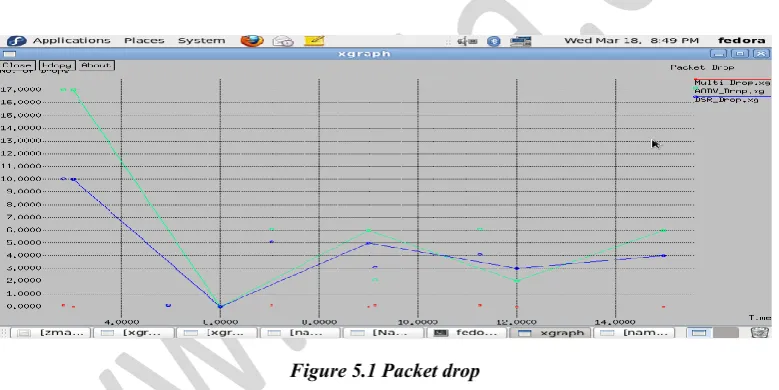
The first metric for comparison is Packet Drop. Packet drop occurs when one ormore packets of data travelling through a network fail to reach their destination.
Figure 5.1 Packet drop
In figure 5.1, Location-BMP routing protocol is compared with AODV and DSR routing protocols. Number of drops versus time is plotted in the above graph. The packet drop rate of Location-BMP protocol is almost the same throughout the time but that of others are increasing with respect to our protocol. Thus the proposed routing protocol results in much better performance on the basis of packet drop than AODV and DSR.
Throughput:
Volume 02, No. 2, February 2016
P
age
15
Figure 5.2 Throughput
As we know throughput is the number of messages successfully delivered per unit time. Time versus the number of bits send, graph is plotted above. From graph, we can see that initially throughput is same for all the protocols, but as the time proceeds throughput of all the three protocols gradually increases, but the rate of increase is higher for our proposed Location BMP protocol. Thus throughput is better than AODV and DSR for our proposed routing protocol.
Average energy:
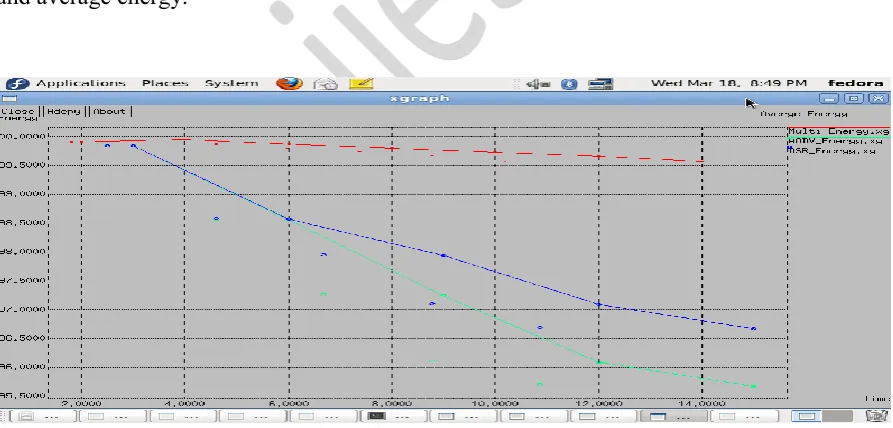
Each and every data packet transmitted by node posses an initial energy. As it gets transmitted from node to node, its energy gradually decreases. Graph is plotted between time and average energy.
Figure 5.3 Average energy
Volume 02, No. 2, February 2016
P
age
16
Packet Delivery Ratio (PDR):
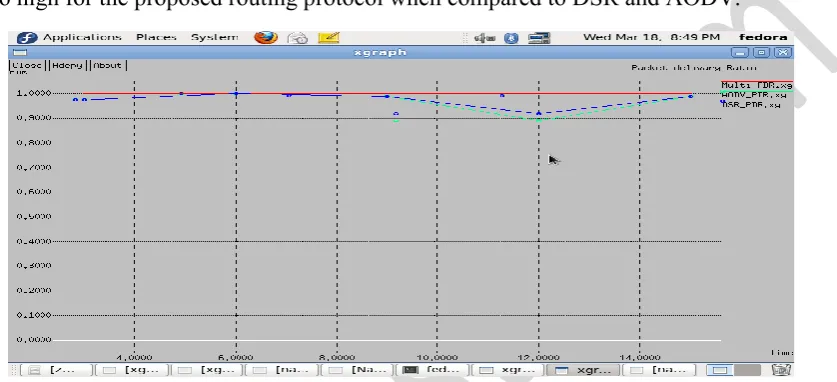
In the figure 5.4, we can see that the packet delivery ratio for the proposed Location BMP protocol is almost constant throughout the time. For the other two protocols, initially PDR is almost constant but as time proceed; PDR is very low compared to the proposed protocol.
We know Packet Delivery Ratio is the ratio between the number of data packets that are sent by the source and the number of data packets that are received by the destination. So we can say that destination node receives almost all the packets send by the source node. Hence PDR is also high for the proposed routing protocol when compared to DSR and AODV.
Figure 5.4 Packet delivery ratio
From this comparison of our Location BMP protocol with AODV and DSR shows better performance of our proposed protocol in terms of parameters such as throughput, average energy, packet drop and packet delivery ratio.
The proposed protocol has been compared with the existing protocols AODV and DSR. The simulation results prove that the proposed protocol have much higher performance than AODV and DSR in terms of the parameters Throughput, Packet Drop, Average energy and Packet Delivery Rate (PDR).
REFERENCES
i. M. Uddin and A. A. Rahman, Reliability of mobile ad hoc networks through performance Analysis of TCP variants over AODV, Journal of Applied Sciences Research, vol.7, no.4, pp.437-446, 2011.
ii. Marina M. K. and S. R. Das: On-demand Multipath Distance Vector Routing for Adhoc Networks.Proc. of the 9th IEEE Inter. Conf. on Network Protocols, pp. 14-23, 2001.
iii. Lee S. J. and M. Gerla: AODV-BR: Backup routing in Ad Hoc networks. Proceedings of IEEE WCNC 2000. Chicago, IL, 2000.
Volume 02, No. 2, February 2016
P
age
17
v. Ko Young and N. Vaidya: Location-Aided Routing in mobile ad hoc networks. Wireless Networks, Vol. 6, pp: 307-321, 2000 .
vi. MueenUddin, Azizah Abdul Rahman, Abdul rahman Alarifi Muhammad Talha, Asadullah Shah, Mohsin Iftikhar and Albert zomaya :Improving Performance of mobile ad hoc networks using efficient tactical on demand distance vector (TAODV) routing algorithm . International Journal of Innovative Computing, Information and Control, Volume 8, Number 6, June 2012.
vii. Wang C. and Yuanapos Liu: The Performance Analysis of MFR Routing Strategy in Adhoc Networks. Proceedings of Network and Communication Technology (ICCT 2003), Vol.2, pp: 1274-1277, 2003.