Optimization of PID Tuning Using Genetic Algorithm
Tengku Ahmad Faris Ku Yusoff
1, Mohd Farid Atan
2, Nazeri Abdul Rahman
3, Shanti
Faridah Salleh
4and Noraziah Abdul Wahab
51,2,3,4,5
Department of Chemical Engineering and Energy Sustainability, Faculty of
Engineering, Universiti Malaysia Sarawak, Kuching, Sarawak, Malaysia.
1Email: [email protected],
2Email: [email protected],
3
Email: [email protected],
4Email: [email protected],
5Email: [email protected]
Abstract
Controller tuning is one of the important aspect in industry. With a good tuning method, it can ensure the quality of the process and product produce. Apart from that, it can protect the environment and help the company to reduce the cost. Genetic algorithm is one of the tuning method that increase usage and awareness in industry. Thus, the objective of this research is to compare the performance of the conventional tuning method with the performance of tuning method by using genetic algorithm can be seen. Optimization was done on stripping section of distillation column by using genetic algorithm with population size of 20, 40, 60 and 80 and comparing the result with previous optimization using Ziegler-Nichols method. The result obtain showed large improvement in the process response especially on rise time from 1.33 s to 1.31s and settling time from 4.56 to 4.46. Finally, population size of 40 deliver the fastest rise time and settling time.
Keywords
: tuning method, genetic algorithm
1.
Introduction
Proportional, Integral and Derivative (PID) controller is a common form of feedback (Astrom, 2002). It has been widely used in process industries due to their simple structure which can be easily understood and implemented in practice (Awouda, 2010). A good PID controller can ensure the process to work efficiently and help the industries to reduce the environmental issues while maintaining the quality of the product that being process. For PID controller to work properly, it has to be tuned. Genetic algorithm is a modern optimization technique that being studied by most researchers in searching the optimal PID parameters. It is inspired by Darwin’s theory of evolution which states that the survival of an organism is affected by rule “the strongest species that survives” (Hermawento, 2013). Genetic algorithm can provide solutions for highly complex search space and perform well approximately solution for all types of problems because they do not make any assumption about the underlying fitness landscape (Zvirgzdina & Tolujevs, 2013).
e-ISSN 2289-7771 Copyright © 2015 JASPE
98
To determine the controller, the transfer function of the system must be determine and is use to generate a better parameter for the proportional time, integral time and derivative time. This project will optimize stripping section in distillation column with the following transfer function (Samah, 2014).
(𝑠) = −0.3654𝑠 + 0.657
𝑠2+ 1.642𝑠 + 1.982 (2)
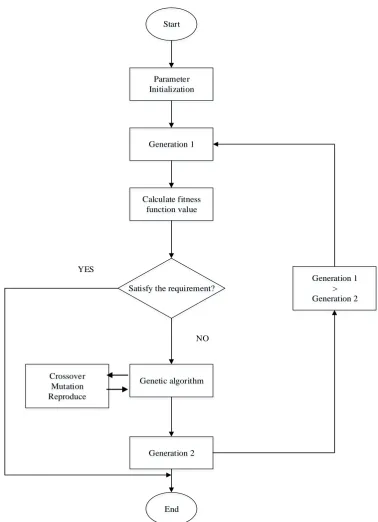
The basic process of genetic algorithm that being used in MATLAB can be outlined into 6 basic steps as follow:
Step 1: [Start] Generate random population of chromosomes which represent the number of solutions that is suitable for the problem.
Step 2: [Fitness] Evaluate the fitness of each chromosome in the population.
Step 3: [New population] create a new population by repeating following steps until the new population is complete:
a) [Selection] Select two parent chromosomes from a population according to their fitness. Better the fitness, the bigger chance to be selected to be the parent.
b) [Crossover] With a crossover probability rate of 4, crossover the parents to form new offspring that is children. If no crossover was performed, offspring is the exact copy of parents.
c) [Mutation] With a mutation probability of 8, mutate new offspring at each locus.
d) [Reproduction] Place new offspring in the new population.
Step 4: [Replace] Use new generated population for a further run of the algorithm.
Step 5: [Test] If the end condition is satisfied, stop, and return the best solution in current population.
Step 6: [Loop] Go to step 2. The generation is repeat for 100 times.
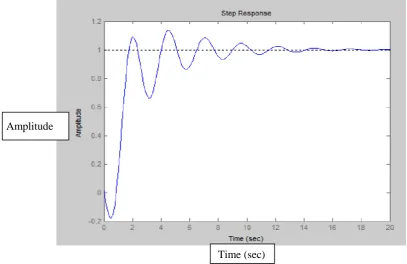
Figure 1: Step Response by Using Ziegler Nichols (Samah , 2014)
3.
Results and Discussion
From Figure 2, the responses of the system has fast rise time which is 0.66 seconds. Rise time is defined as the time required for the response to raised from10% to 90% of its final value. However, the peak amplitude is 1.11 and produce oscillation that increase the time for the system to reach steady state. The overshoot of the response is 13.6%. The maximum overshoot is increase as the damping ratio increase. Based on the result showed, the overshoot produce does not fall in the required range and the robustness of the response showed uncertainty which result in the increase of time for the system to achieve steady state. The result will be compared against the controller that been optimize using GA.
Amplitude
e-ISSN 2289-7771 Copyright © 2015 JASPE
100 Generation 1
Crossover Mutation Reproduce
Calculate fitness function value
Satisfy the requirement?
Generation 2
Generation 1 > Generation 2
End Genetic algorithm
NO YES
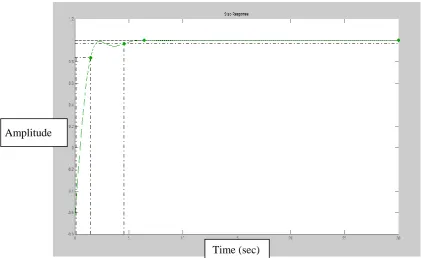
Figure 3: Step Response with Population Size of 20.
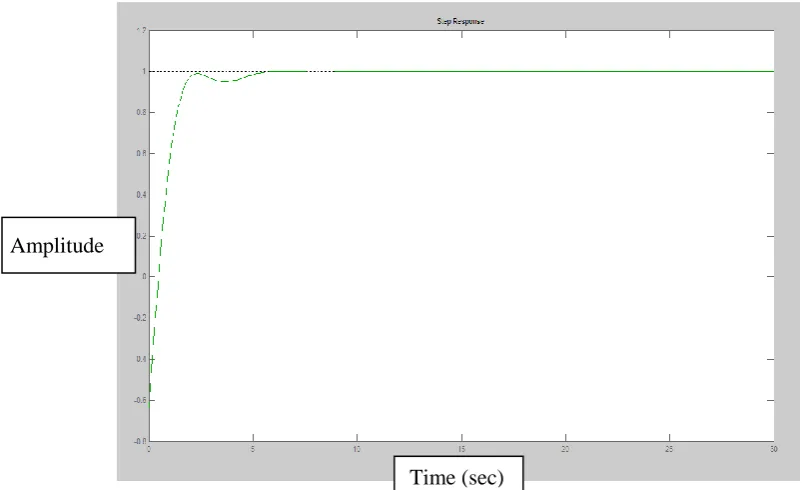
Figure 4: Step Response with Population Size of 40. Time (sec)
Time (sec) Amplitude
e-ISSN 2289-7771 Copyright © 2015 JASPE
102
Figure 5:Step Response with Population Size of 60.
Figure 6: Step Response with Population Size of 80. Time (sec)
Time (sec) Amplitude
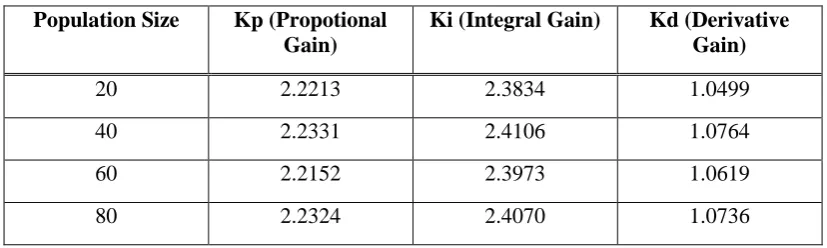
Table 1: Gain Value Obtain by using GA
Population Size Kp (Propotional
Gain)
Ki (Integral Gain) Kd (Derivative
Gain)
20 2.2213 2.3834 1.0499
40 2.2331 2.4106 1.0764
60 2.2152 2.3973 1.0619
80 2.2324 2.4070 1.0736
Table 2: Details of System Response by Optimizing using GA
No. of Population Rise Time
(seconds)
Maximum Overshoot (amplitude/percent)
Settling Time (seconds)
20 1.32 1/0.197 4.56
40 1.31 1/0.183 4.46
60 1.33 1/0.195 4.5
80 1.31 1/0.183 4.47
Based on the Figure 4 to Figure 6, the step response showed a faster response compare to using the conventional optimization method. The result from the graph obtain based on the gain value that are tabulated in Table 1 which are different and more consistent compare to the data from Ziegler-Nichols method. The data from Table 2 showed that by optimizing using GA, the best response can be obtain even at population size of 20. It can be seen that there is no significant difference in the response obtain at different population size. Apart from that the overall system stability also increase compare to using Ziegler-Nichols method. Although the rise time is longer than Ziegler-Nichols method, the time for the system to reach steady state is faster.
The table showed that as the population size increase from 20 to 40, the rise time, and settling time become faster and it reduce the maximum overshoot. However, when the population size is increase to 60, the response of the system is reduce and increase again when the population size is further increase to 80. This is due to the properties of the GA itself that can cause a poor premature convergence and loss of best solution found.
4.
Conclusions and Recommendations
e-ISSN 2289-7771 Copyright © 2015 JASPE
104
can be improved by introduced suitable constraint. There are several constraint that can be used such as penalty function, search of feasible solution, preserving feasibility of solutions and hybrid method.
Acknowledgement
The author wishes to thanks to all individuals who contributed to the production of this thesis for their continuous moral support, advices, and guidance. An appreciation is also extended to Mr Mohd Farid bin Atan for his encouragement, guidance, supports and also advices toward the completion of this study. A sincere appreciation goes to Final Year Project Coordinator, Mdm Noraziah Abdul Wahab, for her guidance. Last but not least, the author would like to thank her parents, Ku Yusoff bin Tuan Pa and Zamilah binti Zakaria and friends for their supports, helps and encouragements throughout of the course of his study.
References
Arturo, Y. J. C., Rene, D. J. R. T., Luis, M. V., & Roque, A. O. R. (2013). PID- Controller Tuning Optimization with Genetic Algorithms in Servo Systems. doi:10.5772/56697
Astrom, K. J. (2002). PID Control. In Control System Design (pp. 216–251). Bansal, H. O., Sharma, R., & Shreeraman, P. R. (2012). PID Controller Tuning Techniques : A Review, 2(October), (pp. 168– 176).
A Awouda, A Eldin, R Mamat (2010). New PID tuning rule using ITAE criteria. International Journal of Engineering 3 (6), 597-608
B. Anandaraju, M., Puttaswamy, P. S., & Singh Rajpurohit, J. (2011). Genetic Algorithm: An approach to Velocity Control of an Electric DC Motor. International Journal of Computer Applications, 26(1), 37–43. doi:10.5120/3066-4191
Beasley, D., & Bull, D. R. (1993). An Overview of Genetic Algorithms : Part 1, Fundamentals 1 Introduction 2 Basic Principles, 1–16.
Chipperfield, A., Fleming, P., Pohlheim, H., & Fonseca, C. (n.d.). Genetic Algorithm Toolbox.
Chopra, V., Singla, S. K., & Dewan, L. (2014). Comparative Analysis of Tuning a PID Controller using Intelligent Methods, 11(8), 235–249
Coa, Y. J., & Wu, Q. H. (1999). TEACHING GENETIC ALGORITHM USING MATLAB, 36, (pp. 139–153).
Engineering, C. (2011). Tuning of Pid Controller By Bioinspired Techniques Tuning of Pid Controller By Bioinspired Techniques. Technology.
Hermawanto, D. (2013). Genetic algorithm for solving simple mathematical equality problem. arXiv Preprint arXiv:1308.4675. Retrieved from http://arxiv.org/abs/1308.4675
Hussain, K. M., Allwyn, R., & Kumar, S. M. G. (2014). Comparison of PID Controller Tuning Methods with Genetic Algorithm for FOPTD System Rajendran, 4(2), 308–314.
Ibrahim, S. M. (2005). THE PID CONTROLLER DESIGN USING GENETIC ALGORITHM. Ii, A. (2004). MATLAB Code. N/a, 211–232. doi:10.1201/9781420035636.axd
Jones, G. (n.d.). Genetic and Evolutionary Algorithms
Kanthalakshimi, S., & Manikandan, V. (2010). Genetic Algorithm Based Self Tuning Regulator, 2(12), (pp. 7719–7728).
Kaushal, J. (2012). Controller Tuning for Speed Control of DC Motor Drives.
Khatri, P., & Dalal, M. (2013). Implementation of Genetic Algorithm to Temperature Control System, 3(6), 1868–1871.
Konak, a, Coit, D. W., & Smith, a E. (2006). Multi-objective optimization using genetic algorithms: A tutorial. Reliability Engineering and System Safety, 91(9), 992–1007. doi:10.1016/j.ress.2005.11.018 Mantri, G., & Kulkarni, N. R. (2013). DESIGN AND OPTIMIZATION OF PID CONTROLLER USING
GENETIC ALGORITHM, (1), (pp. 926–930).
Melanie, M. (1996). An Introduction to Genetic Algorithms (5th ed.). London, England: The MIT Press. Mirazal, A., Yoshii, S., & Furukawa, M. (n.d.). PID Parameters Optimization by Using Genetic
Algorithm.
Ohri, J., Kumar, N., & Chinda, M. (n.d.). An Improved Genetic Algorithm for PID Parameter Tuning. Saad, M. S., Jamaluddin, H., & Darus, I. Z. M. (2012). Implementation of PID Controller Tuning Using
Differential Evolution and Genetic Algorithm. International Journal of Innovative Computing, Information and Control, 8(11), (pp. 7761–7779).
Science, I. (2012). PID Parameters Optimization by Using Genetic Algorithm Andri Mirzal, Shinichiro Yoshii, Masashi Furukawa.
Sekaj, I., & Technology, I. (n.d.). Genetic Algorithms for Control System Design Applications, 31–37. Seyedkazemi, M. (2008). Designing Optimal PID controller with Genetic Algorithm In view of controller
location in the plant, 160–164.
Tolujevs, J. (2013). EVOLUTIONARY OPTIMIZATION OF A FLOW LINE USED ExtendSim BUILT-IN OPTIMIZER, (October), 155–162.
Saad, M. S., Jamaluddin, H., & Darus, I. Z. M. (2012). PID Controller Tuning Using Evolutionary Algorithms, 7(4), (pp. 139–149).
Samah Sir Elkhtem., Gasmelseed, G. A., Karama, B. A. (2014). Transfer Function Identification and Tuning of Crude Distillation Unit Controller at Khartoum Refinery- Sudan, Journal of Applied and Industrial Sciences.
Samanta, S. (2014). Genetic Algorithm : An Approach for Optimization (Using MATLAB ), 3(3), 261– 267.
Srinivas, P., Lakshmi, K. V., & Kumar, V. N. (2013). Design of GA based PID Controller for three tank system with various Performance Indices, (5), (pp. 206– 209).
Authors
Tengku Ahmad Faris Ku Yusoff
Tengku Ahmad Faris Ku Yusoff was a student in Department of Chemical Engineering and Energy Sustainability, Faculty of Engineering, Universiti Malaysia Sarawak (UNIMAS). He received his B.Eng (Hons) in Chemical Engineering from UNIMAS.
Mohd Farid Atan
e-ISSN 2289-7771 Copyright © 2015 JASPE
106 Shanti Faridah Salleh
Shanti Faridah Salleh is a Senior Lecturer at Department of Chemical Engineering and Energy Sustainability, Faculty of Engineering, Universiti Malaysia Sarawak (UNIMAS). She received her PhD in Chemical Engineering from Universiti Putra Malaysia (UPM). Her areas of specialization are renewable energy.
Noraziah Abdul Wahab