Introduction
Constipation in children is a common problem, occurring in up to one third of children at some stage during their development, with functional constipation being the most common, accounting for 95% of cases.1-4 It is considered a symptom rather than a disease or a sign.3,5,6 However, it leads to emotional and physical suffering, decreasing the child’s quality of life.7
In the hospital setting, constipation in children accounts for 3% of all referrals to paediatric practice and up to 25% of cases to paediatric gastroenterologists. It is one of the 10 most common problems seen by general paediatricians.1,3,8,9
Constipation in children is commonly defined as a delay or difficulty in defecation (two or fewer bowel movements per week), present for two or more weeks and sufficient to cause significant distress to the patient.3,10 It is associated with abdominal pain, soiling, faecal impaction, a poor appetite, stool withholding and overflow incontinence, all of which have an impact on the child’s development.3 If these symptoms are present for less than four weeks, it is classified as “acute” constipation.10 Symptoms of longer duration are classified as “chronic” functional constipation, if these symptoms cannot be explained by another condition.10
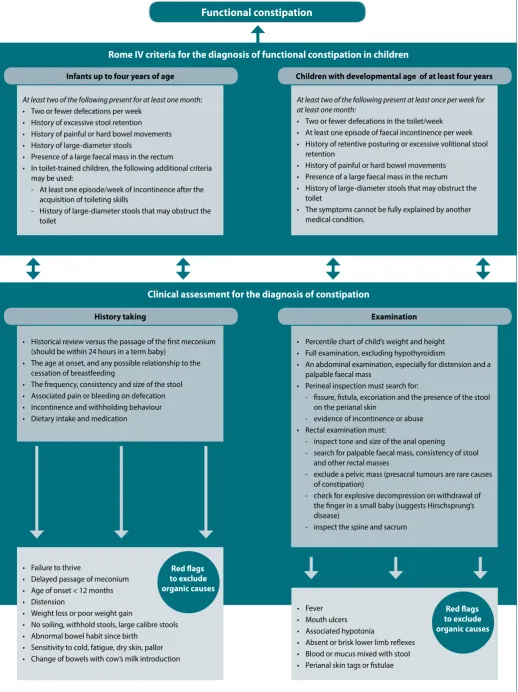
The Paris Consensus on Childhood Constipation Terminology (PaCCT) Group has proposed a simplified terminology that clearly defines the criteria for chronic constipation (Box 1), which also informs the Rome IV criteria for functional constipation and diagnosis (Figure 1).1,11
Epidemiology
The prevalence rate for constipation in children varies between geographical regions, but is estimated to be between 0.7% and
29.6%, with a median of 12%.7,12,13 Prevalence also varies according to age groups, with peak incidence between two and four years of age, usually when potty training starts.7
Some studies have reported no difference in the prevalence of constipation between girls and boys, while others found a significantly higher prevalence in girls.6 A positive family history has been identified in 28–50% of constipated children and a
Functional constipation in children
Johanna C Meyer, BPharm, MSc(Med) Pharmacy, PhD (Pharmacy) Tsakane Mashaba, BPharm
Letlhogonolo Makhele, BPharm
Mncengeli Sibanda, BPharm, MPharm, MSc Pharmacology, MBA
School of Pharmacy, Faculty of Health Sciences, Sefako Makgatho Health Sciences University Correspondence to: Hannelie Meyer, e-mail: [email protected]
Keywords: functional constipation, children, disimpaction, treatment, dietary modification, behaviour modification
Abstract
Constipation is one of the most common digestive complaints that affects children. Often the exact cause is unknown and no obvious anatomical, biochemical or physiological abnormalities can be identified in the majority of cases. However, the symptoms of constipation may interfere with the quality of life of the child, as well as his/her family. This article provides an overview of functional constipation in children and the management thereof.
© Medpharm S Afr Pharm J 2017;84(5):51-57
Box 1. Terminology for childhood constipation as recommended by the Paris Consensus on Childhood Constipation Terminology (PaCCT) Group1,11
Chronic constipation: Defined as the occurrence of two or more of the following characteristics during the last eight weeks:
• Frequency of bowel movements less than three times per week • More than one episode of faecal incontinence per week
• Large stools in the rectum or palpable mass on abdominal examination • Passing of stools so large that they may obstruct the toilet
• Retentive posturing and withholding behaviours • Painful defecation
Faecal incontinence: Passage of stools in an inappropriate place • Organic faecal incontinence: Faecal incontinence resulting from
organic disease (for example neurological damage or anal sphincter abnormalities).
• Functional faecal incontinence: Non-organic disease which can be sub-divided into:
• Constipation associated faecal incontinence: Functional faecal incontinence associated with the presence of constipation. • Non-retentive faecal incontinence: The passage of stools in an
inappropriate place, occurring in children aged four years and older, with no evidence of constipation by history or examination. Faecal impaction: Severe constipation with a large faecal mass in either the rectum or the abdomen, which is unlikely to be passed on demand. The faecal impaction can be shown by abdominal or rectal examination or other methods.
higher incidence reported in monozygotic than dizygotic twins, suggesting the role of genetic factors.8
Constipation and faecal incontinence are more prevalent in obese children. There is also a higher incidence of constipation among children with a birth weight under 750 g, associated with neurodevelopmental impairment.14
Main causes and risk factors
In over 90% of paediatric constipation cases, there is a functional rather than organic cause, hence only 5–10% of childhood constipation has an underlying organic cause. Organic causes relate to anatomical malformations, metabolic or endocrine causes, gastrointestinal, neuropathic conditions, intestinal nerve or muscle disorders, abnormal abdominal musculature, connective tissue disorder and drugs.3,6 Hirschsprung's disease, cystic fibrosis, anorectal abnormalities, and metabolic conditions such as hypothyroidism are rare organic causes of childhood constipation.14
Although there is no evidence for a difference between bottle-fed and breastbottle-fed babies, it is generally accepted that bottle-bottle-fed babies are more at risk of relative water deficiency while breastfed babies frequently have delays of many days between passing normal stools.14
Many constipated children have functional constipation resulting from intentional withholding of stool. An unpleasant event may have been the precipitating factor for the desire to withhold stool in some children. Forceful toilet training in a toddler not ready for toilet training may lead to withholding of stool resulting in passage of dry hard stools with discomfort. In older children, unpleasant toilet facilities at school or anal pain resulting from streptococcal anusitis or sexual abuse, precipitate the tendency to withhold due to discomfort and inconvenience.5
Recognised risk factors of childhood constipation include psychological stress, parental rearing style, dietary factors such as cow’s milk protein, diet low in fibre, fast food consumption and not having regular meals with parents, as well as a lack of physical activity, obesity, abuse, either physical, sexual or emotional, familial predisposition and psychological co-morbidities.15
Diagnosis
Constipation is diagnosed by clinical history and examination (Figure 1). History should include a detailed exploration of symptoms and look for ‘red flags’ to exclude any organic cause. A physical examination should include an abdominal examination to assess the degree of faecal loading, as well as neurological assessment of the spine and lower limbs. With perianal examination, perianal cellulitis and anorectal anomalies can be identified. Constipation should be considered as a differential diagnosis in all children presenting with abdominal pain.8
Rome IV criteria have been used widely and updated by international societies for diagnosis of functional constipation
(Figure 1). In infants and children up to a developmental age of four years, these symptoms must be present for at least one month; in children over four years old, symptoms should be present for at least two months, with insufficient criteria for the diagnosis of irritable bowel syndrome.
Management of constipation in children
A thorough history and physical examination of the infant or child with constipation is essential, to be able to recommend an appropriate treatment approach (Figure 2). Furthermore, it is important to manage acute constipation or intervene as soon as it is observed, to prevent this from getting worse or leading to chronic constipation.17 A follow-up plan is essential to ensure that the constipation has been resolved and the child presents with regular bowel movement and faecal continence.17
The overall management process for children with constipation is divided into three stages of therapy, i.e. disimpaction, maintenance therapy and behavioural modification (Figure 2).18 The basic principles applied during this process, include evacuation of the colon, elimination of pain and establishing regular bowel habits, using pharmacological treatment (Table I) as well as dietary modification.10,19
Disimpaction
Severe constipation can result in a solid, immobile large faecal mass in either the rectum or the abdomen which may require disimpaction.10 Colon evacuation or disimpaction would be the first step in the management of constipation where faecal impaction is present.19 Disimpaction involves the use of one or more different treatment regimens using orally or rectally administered medication.20
In infants, disimpaction can be done through the use of glycerine suppositories. In addition, juices that contain sorbitol (e.g. prune, pear, or apple) and stool softeners (Barley malt extract, corn syrup, lactulose, or sorbitol) can also be used.20 Rectal disimpaction with enemas in infants is not recommended. Although the onset of enemas is rapid, they are also invasive and possibly traumatic for the infant.20 Mineral oils and stimulant laxatives should be avoided in infants.20 In older children, rectal disimpaction can be managed through the use of oral or rectal medication, including enemas. Osmotic laxatives (such as lactulose and magnesium hydroxide) are safe and effective.20 Senna and bisacodyl (stimulant laxatives) can be useful in selected patients who are more difficult to treat. Low dosage polyethylene glycol electrolyte solution is recommended for constipation that is difficult to manage.20
Maintenance therapy
Functional constipation
Rome IV criteria for the diagnosis of functional constipation in children
Clinical assessment for the diagnosis of constipation
At least two of the following present for at least one month: • Two or fewer defecations per week
• History of excessive stool retention • History of painful or hard bowel movements • History of large-diameter stools
• Presence of a large faecal mass in the rectum
• In toilet-trained children, the following additional criteria may be used:
- At least one episode/week of incontinence after the acquisition of toileting skills
- History of large-diameter stools that may obstruct the toilet
• Historical review versus the passage of the first meconium (should be within 24 hours in a term baby)
• The age at onset, and any possible relationship to the cessation of breastfeeding
• The frequency, consistency and size of the stool • Associated pain or bleeding on defecation • Incontinence and withholding behaviour • Dietary intake and medication
• Failure to thrive
• Delayed passage of meconium • Age of onset < 12 months • Distension
• Weight loss or poor weight gain
• No soiling, withhold stools, large calibre stools • Abnormal bowel habit since birth
• Sensitivity to cold, fatigue, dry skin, pallor • Change of bowels with cow’s milk introduction
• Fever • Mouth ulcers • Associated hypotonia
• Absent or brisk lower limb reflexes • Blood or mucus mixed with stool • Perianal skin tags or fistulae
At least two of the following present at least once per week for at least one month:
• Two or fewer defecations in the toilet/week • At least one episode of faecal incontinence per week • History of retentive posturing or excessive volitional stool
retention
• History of painful or hard bowel movements • Presence of a large faecal mass in the rectum • History of large-diameter stools that may obstruct the
toilet
• The symptoms cannot be fully explained by another medical condition.
• Percentile chart of child’s weight and height • Full examination, excluding hypothyroidism
• An abdominal examination, especially for distension and a palpable faecal mass
• Perineal inspection must search for:
- fissure, fistula, excoriation and the presence of the stool on the perianal skin
- evidence of incontinence or abuse • Rectal examination must:
- inspect tone and size of the anal opening
- search for palpable faecal mass, consistency of stool and other rectal masses
- exclude a pelvic mass (presacral tumours are rare causes of constipation)
- check for explosive decompression on withdrawal of the finger in a small baby (suggests Hirschsprung’s disease)
- inspect the spine and sacrum Infants up to four years of age
History taking
Children with developmental age of at least four years
Examination
Figure 1. Clinical assessment for the diagnosis of functional constipation3,8,16 Red flags
to exclude organic causes
of a local anaesthetic such as lidocaine may provide symptomatic relief in the case of anal fissures.19
Establish regular bowel movements: After disimpaction, it is necessary to avoid recurrence of faecal impaction through the use of stool softeners. The duration of the maintenance phase needs to be individualised and may vary from a few weeks to several months. Although there are a number of pharmacological treatment options available for the management of constipation
in children (Table I), there is still a paucity of evidence in terms of the best maintenance therapy option for children.20
The main pharmacological agents used for maintenance are osmotic and stimulant laxatives given orally.6,21 In infants, lactulose has been shown to be safe for maintenance therapy while older children can benefit from orally administered osmotic laxatives. Rescue therapy with short-term administration of stimulant laxatives can be useful in selected patients.20
6
*See Figure 1 for more detailed information
Figure 2. Treatment of functional constipation in children19,20
Is disimpaction effective?
Refer for consultation with paediatric gastroenterologist Maintenance therapy
Daily oral medication
Eliminate pain with defecation
Dietary modification
Behaviour modification
Caregiver and patient education
Is maintenance therapy effective?
NO YES
NO
YES
Any red flags (common symptoms and signs) to suggest organic
causes of constipation?*
Perform further clinical evaluation
Diagnose constipation by history or physical
examination*
Functional constipation likely Perform further examination to
confirm
Evacuation of colon using disimpaction therapy
Enema or suppositories
Oral medication
Is there a faecal impaction?
NO
YES NO
YES
Prescribe ongoing maintenance
Rome IV criteria for the diagnosis of functional constipation in children*
*See Figure 1 for more detailed information
Table I. Phar mac olog ical tr ea tmen
t of c
onstipa
tion in childr
en 21,22 Class Laxa tiv e Dosage f orm Examples Dosage Side -eff ec ts Con tr aindic
ations and sp
ecial pr ec autions Osmotically ac ting laxativ es Lac tulose Or al , liquid Aculax® D uphalac® Lax ett e® Lacson® Liquilax®
Under 1 y
ear
: 2.5 ml
2–5 y
ears: 5 ml
6–12 y
ears: 10 ml t
wic e daily Fla tulenc e, abdominal dist
ension and cr
amping a
t
the outset of tr
ea
tmen
t
•
Per
iodic serum elec
tr olyt e det er mina tions when using f or pr olonged per iods • Contr aindic at ed: G alac tosaemia M ag nesium sulpha te Or al , liquid Be -lax® 2–6 y
ears: 2.5–5 ml daily
6–12 y
ears: 5–15 ml daily
Abdominal pain, elec
tr olyt e distur banc es Adequa
te fluid in
take should be enc
our aged t o av oid deh ydr ation M ag nesium hy dr oxide Or al , liquid Phipps M ilk of M ag nesia® 2–12 y
ears: 2.5–5 ml up t
o f
our times daily
Abdominal cr amping M ay in ter fer
e with absor
ption of c
er
tain medicines
Take other medicines a
t least t
w
o hours bef
or
e or
af
ter M
ilk of M
ag nesia® Poly eth ylene gly col (PEG) 3350 Or al , po w der Peg ic ol® Chr onic c
onstipation and f
aec
al impac
tion:
2–6 y
ears: One sachet daily
7–11 y
ears:
Tw
o sachets daily
Incr
ease t
o maximum 4 sachets/da
y
Faec
al impac
tion:
Take up t
o 7 da
ys
, with number of sachets/
da
y taken in divided doses
, all c
onsumed within a 12-hour
per
iod
. I
ncr
ease number of sachets per da
y as f
ollo
w
s:
2–4 y
ears: Da
y 1: 2 sachets; Da
ys 2–7: 4, 4, 4, 6, 6, 8, 8 sachets/
day
;
5–11 y
ears: Da
y 1: 4 sachets; Da
ys 2–7: 6, 8, 10, 12, 12, 12
sachets/da
y
St
op onc
e disimpac
tion has oc
cur
red
Common side
-effec
ts:
Abdominal pain, nausea, diar
rhoea or loose st
ools
,
vomiting Major adv
erse
effec
ts:
R
ar
e but aller
gic
reac
tions ha
ve been r
epor ted • Not r ec ommended:
< 2 y
ears; pr
esenc
e of
abdominal pain, nausea or v
omiting • Contr aindic at ed: In testinal per for ation or obstruc
tion due t
o struc
tur
al or func
tional
disor
der of the gut w
all; ileus; gastr
ic r et en tion; peptic ulc er ation; sev er e inflamma tor y disor ders
of the in
testinal tr
ac
t including C
rohn ’s disease , ulc er ativ e c
olitis and t
oxic
mega-colon
Sodium phospha
te Rec tal , enema Lenolax paedia tr ic enema® 2–12 y
ears: 64 ml or one enema r
ec tally onc e Elec tr olyt e distur banc es , abdominal cr amping Contr aindic at ed: Nausea, v
omiting or abdominal
pain Gly cer ol Rec tal , supposit or ies Lennon Gly cer in supposit or ies for infan ts and childr en® 2–6 y
ears: One supposit
or
y t
o one and a half paedia
tr ic supposit or ies inser ted r ec
tally in a single daily dose
, when
nec
essar
y
Abdominal cr
amps or bo
w el irr ita tion Aller gy t o gly cer in Stimulan t laxativ es Bisac odyl Or al , tablets D ulc olax® F reshen Bisac odyl laxa tiv e® O
ver 6 y
ears: 5 mg daily
Abdominal cr amps , elec tr olyt e distur banc es Long-t er
m use ma
y r
esult in
loss of nor
mal bo w el func tion Contr aindic at ed: In testinal obstruc tion or undiag
nosed abdominal pain
Restr ic t t o shor t-t er m use Rec tal , supposit or ies D ulc olax®
Under 2 y
ears: 5 mg r
ec
tally
O
ver 2 y
ears: 5–10 mg r
ec
tally
Senna glycosides
Or
al
Soflax®
O
ver 6 y
ears: 1 tablet onc
e daily Restr ic t t o shor t t er m use Bulk-f
orming laxativ
es Ispaghula Gr anules seeds Ag iobulk® O
ver 5 y
ears: 1 medicine measur
e (1 hour bef
or e bedtime) sw allo w ed unchew
ed with plen
ty of fluid
Abdominal dist ension, cr amps , fla tulenc
e and bor
bor yg mi ma y oc cur initially • Contr aindic at ed: In testinal obstruc tion, st enosis , ulc er
ation or adhesions of the gastr
o-in testinal tr ac t • M ay in ter fer
e with absor
ption of c
er
tain
medicines
. T
ake other medicines a
t least 3 hours
bef or e/af ter ispaghula Gr anular po w der Fybogel® 1 lev
el medicine measur
e, stir
red in a glass of w
at
Dietary modification: The treatment plan for children with constipation commonly includes dietary modification such as an increase in fluid intake, dietary fibre and carbohydrates.19,23 Dietary fibre, complex carbohydrates and unabsorbable sugars (e.g. sorbitol), increase the frequency of stools, by increasing faecal water content. These are found in many fruit juices e.g. prune, pear, apple.19,23 It is important to increase fluid intake with increased fibre intake.17
A balanced diet that includes whole grains, legumes and nuts, fruits, vegetables, and plenty of fluids is common and considered appropriate for children with constipation. However, scientific evidence from randomised controlled trials, on the effects of these dietary changes on childhood constipation in improving treatment success, is not strong.19,23
Cow-milk proteins can precipitate constipation, hence it would be appropriate to remove cow-milk from the diet for a period of time, especially in infants and younger children.19 Switching the child to a low-iron milk formula is not necessary, as evidence has shown that iron-supplemented formulas are not associated with an increased incidence of constipation.19
Behaviour modification: Long-term success in the management of constipation often depends on the ability of the child to establish regular and routine toilet times.19 Behavioural modification for constipation is designed to normalise and sustain toilet routines, discourage stool withholding and improve understanding of defecation dynamics amongst the children and their caregivers.6
The following stepwise approach is recommended19,24:
• Promotion of successful defecation through the reduction of anxiety towards defecation by educating caregivers about the causes of constipation and the precipitating factors. This can be done by the use of pictograms and models.
• Bowel training which involves creating a schedule for trying to have a bowel movement (bowel chart). Encourage the child to attend the toilet twice daily for five to ten minutes, after breakfast and supper, to benefit from the gastrocolic reflex. • Biofeedback with the teaching of straining techniques and
posture, which encourages bowel movement.
• Reinforcing behavioural modification through motivation and a reward system so as to encourage regular toilet routine without avoidance.
• Sustenance, through encouraging a balanced diet containing whole grains, fruits, and vegetables.
Caregiver and patient education: Proper planning for maintenance treatment as well as education of the caregiver and age-appropriate education of the child should take place following a diagnosis of functional constipation.20 Caregiver and patient education on the treatment of constipation mainly includes dietary management, particularly to include additional fibre and fluid intake for the rest of their lives. The prognosis in children for whom dietary changes have been implemented is very positive.25
Treatment of constipation often fails because of poor parental or caregiver education and a false expectation from them of the time to resolution.20 Oral medication is often used only when necessary or only as rescue therapy when the child shows signs of faecal impaction. Hence, it is important to also explain the pathophysiology to the caregiver and emphasise the benefits of consistent maintenance therapy and behaviour modification.20 Provide parents or caregivers with information about signs and symptoms which should alert them to seek medical assistance (Box 2).26
Box 2. Information for caregivers: When to seek help26
• Immediately (during the day or night): Severe abdominal or rectal pain • No bowel movement within 24 hours of starting constipation treatment • Infant (< 4 months) with no bowel movement within 48 hours of their
normal pattern (e.g. if an infant who normally has a bowel movement every two days goes three days without a bowel movement). Call earlier in case of other symptoms such as vomiting or pain
• Infant (< 4 months) has hard (rather than soft or pasty) stools • Infant or child does not want to eat or loses weight • Blood in the child's bowel movement or diaper • Repeated episodes of constipation
• Child complains of pain with bowel movements • Questions or concerns about your child's bowel habits
Consultation
A paediatric gastroenterologist or paediatric surgeon should be consulted if an underlying organic cause of constipation is suspected, or if the child fails routine therapy or when management is complex.19
Long-term monitoring
Long-term assessment and monitoring of constipation is important to verify that prescribed treatment after disimpaction is effective. Once a regular routine has been maintained for weeks or months, without the child experiencing any difficulties, discontinuation of laxative therapy can be considered. Parents and caregivers should, however, be made aware that relapses are common, especially with a change in the child’s routine or during times of stress.19
Conclusion
References
1. Rubin G, Dale A. Chronic constipation in children. BMJ. 2006;333:1051-5.
2. Loening-Baucke V. Prevalence, symptoms and outcome of constipation in infants and tod-dlers. J Pediatr. 2005;146(3):359-363.
3. Brown RA, Wood RJ. Constipation in children. S Afr Fam Pract. 2013;55(4):350-353. 4. Tabbers M, Boluyt N, Berger M, et al. Clinical practice: diagnosis and treatment of functional
constipation. Eur J Pediatr. 2011;170(8):955-963.
5. Croffie JM. Constipation in children. Indian J Pediatr. 2006;73(8):697-701.
6. Rajindrajith S, Devanarayana NM. Constipation in children: novel insight into epidemiol-ogy, pathophysiology and management. J Neurogastroenterol Motil. 2011 Jan;17(1):35-47. doi:10.5056/jnm.2011.17.1.35.
7. Levy EI, Lemmens R, Vandenplas Y, et al. Functional constipation in children: challenges and solutions. Dovepress. 2017;8:19-27. doi:10.2147/PHMT.S110940.
8. Afzal NA, Tighe MP, Thomson MA. Constipation in children. Riv Ital Pediatr. 2011;37:28. 9. Blackmer A, Farrington E. Constipation in the pediatric patient: an overview and
pharma-cologic considerations. Glob Pediatr Health. 2010;24(6):400-402.
10. Sood MR. Prevention and treatment of acute constipation in infants and children. In: Li BU, Hoppin AG (Eds), UpToDate, Waltham, MA, 2017. Available from: https://www.uptodate. com/contents/prevention-and-treatment-of-acute-constipation-in-infants-and-children (Accessed 10 September 2017).
11. Benninga M, Candy D, Catto-Smith A, et al. The Paris Consensus on Childhood Constipa-tion Terminology (PACCT) Group. Journal of Pediatric Gastroenterology and NutriConstipa-tion. 2005;40:273-5.
12. Mugie S, Benninga M, Di Lorenzo C. Epidemiology of constipation in children and adults: a systematic review. Best Pract Res Clin Gastroenterol. 2011;25(1):3-18.
13. Koppen I, Lammers L, Benninga M, et al. Management of functional constipation in chil-dren: therapy in practice. Paediatr Drugs. 2015;17(5):349-360.
14. Tabbers MM, Boluyt N, Berger MY, et al. Constipation in children. BMJ Clin Evid. 2010 Apr 6;04:303. PMCID: PMC29075952010. Available from: https://www.ncbi.nlm.nih.gov/pmc/ articles/PMC2907595/ (Accessed 3 September 2017).
15. Rajindrajith S, Devanarayana NM, Crispus Perera BJ, et al. Childhood constipation as an emerging public health problem. World J Gastroenterol. 2016 Aug 14;22(30):6864-75. doi:10.3748/wjg.v22.i30.6864.
16. Benninga M, Nurko S, Faure C, et al. Childhood functional gastrointestinal disorders: neo-nate/toddler. Gastroenterology. 2016;150(6):1443-1455.
17. Sood MR. Constipation in infants and children: Evaluation. In: Li BU, Hoppin AG (Eds), UpTo-Date, Waltham, MA, 2017. Available from: https://www.uptodate.com/contents/constipa-tion-in-infants-and-children-evaluation?source=search_result&search=constipation%20 in%20children&selectedTitle=2~150 (Accessed 10 September 2017).
18. Constipation Committee of the North American Society for Pediatric Gastroenterology, Hepatology, and Nutrition. Evaluation and treatment of constipation in children: recom-mendations of the North American Society for Pediatric Gastroenterology, Hepatology, and Nutrition. J Pediatr Gastroenterol Nutr. 2006;43:e1-e13.
19. Borowitz SM. Pediatric constipation treatment and management. Medscape. Drugs and Diseases, Pediatrics: General Medicine. Available from: http://emedicine.medscape.com/ article/928185-treatment (Accessed 7 September 2017).
20. Carr BC. The evaluation and management of constipation in the pediatric emergency de-partment. Pediatric Emergency Medicine Practice. 2012 Feb;9(2). EB Medicine. Available from: http://www.ebmedicine.net/topics.php?paction=showTopic&topic_id=293 (Ac-cessed 7 September 2017).
21. Rossiter D (Ed). South African Medicines Formulary. 2016. Rondebosch, South Africa, Health and Medical Pub. Group of the South African Medical Association.
22. Amayeza Drug Information Centre. Pegicol™—Oral treatment for chronic constipation and faecal impaction in children. S Afr Fam Pract. 2007;49(4):46-46. doi:10.1080/20786204.20 07.10873544
23. Yang J, Wang HP, Zhou L, et al. Effect of dietary fiber on constipation: a meta analysis. World J Gastroenterol. 2012 Dec 28;18(48):7378-83. doi:10.3748/wjg.v18.i48.7378.
24. Van Dijk M, Bongers M, de Vrie G, et al. Behavioral Therapy for Childhood Constipation: A Randomized, Controlled Trial. Pediatr. 2008;121(5):1334-1341.
25. Basson MD. Constipation. Medscape. Drugs and Diseases, Gastroenterology. Available from: http://emedicine.medscape.com/article/184704-overview#showall (Accessed 7 Sep-tember 2017).