Volume – 2, Issue -2, March - April – 2016, Page No. 42 - 46
42
Underwater Wireless Communication
Shivasheesh Khare
M.Tech student
E-Mail ID: [email protected]
Abstract
Underwater wireless Communication is the wireless communication in which acoustic signal waves carry digital
information through an underwater channel. The signals that are used is to carry digital information through an
underwater channel known as acoustic channels. It is the science of underwater acoustics began in 1490. In 1687, Isaac
Newton wrote his mathematical principles of natural philosophy which included the first mathematical treatment of sound
in water. Wired underwater is not feasible in all situations like in temporary experiments, breaking of wires, significance
cost of deployment, and experiment over long distances so to cope up with all these situations we require under less wire
communication. Radio waves do not propagate well under water due to the high energy absorption of water. Therefore,
underwater communications are based on acoustic links characterized by large propagation delays. Acoustic channels
have low bandwidth. The propagation speed of acoustic signals in water is typically 1500m/sec.
Key Words: Acoustic signals, Acoustic channels, Acoustic Links, Bandwidths, Sensors, Underwater autonomous
vehicles, Vector sensors, Electromagnetic waves, optical waves
1. Introduction
Underwater wireless Communication as suggested by the words is the technique by which one can send and receive the
message below water. There is various method which helps in measuring underwater communication such as
hydrophones. Here in this research paper we use vector sensors to detect underwater communication. The main problem
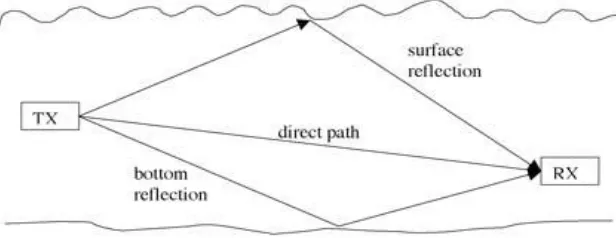
which persist in underwater communication is multi path propagation, time variant of the channels, signal attenuation,
high energy absorption etc. the signals that are used underwater communication is acoustic signals instead of radio signals
because radio signals are made up of electromagnetic waves and electromagnetic waves propagate over short distances
only. To overcome this problem we use acoustic wave’s signals which can carry over long distances.
43
43
43
43
43
43
43
43
43
43
43
43
43
43
43
43
43
43
43
43
43
The different protocols used in underwater wireless communication are:-
2. Medium Access Control Protocol
Due to the unique characteristics of the propagation of acoustic waves in the underwater environment, existing terrestrial
MAC solutions are unsuitable for this environment. Channel access control in wireless underwater networks, in fact poses
additional challenges due to the limited bandwidth, very high and variable propagation delays, high bit error rates,
temporary losses of connectivity, channel asymmetry, and heavy multipath and fading phenomena. Current underwater
MAC solutions are mainly focused on carrier-sense multiple access (CSMA) or code-division multiple access (CDMA).
This is because frequency-division multiple access (FDMA) is not suitable for the underwater environment due to the
narrow bandwidth in underwater acoustic (UW-A) channels and the vulnerability of limited band systems to fading and
multipath. Moreover, time-division multiple accesses (TDMA) shows a limited channel utilization efficiency in
large-scale networks because of the long time guards required in long-haul UWA links. Furthermore, the variable delay caused
by multipath makes it very challenging to implement a precise synchronization with a common timing reference. CDMA
is a promising physical and MAC layer technique in this environment because it is robust to frequency-selective fading, it
compensates for the effect of multipath by exploiting Rake filters at the receiver, and it enables receivers to distinguish
among signals simultaneously transmitted by multiple devices. In two spread-spectrum physical layer techniques, namely,
direct-sequence spread spectrum (DSSS) and frequency-hopping spread spectrum (FHSS), were compared for shallow
water communications. Whereas in DSSS, data is spread to minimize the mutual interference; in FHSS, simultaneous
communications use different frequency hopping sequences, thus transmitting on different frequency bands. Interestingly,
it is shown that in the underwater environment, FHSS leads to a higher bit error rate than DSSS. Another attractive
physical layer technique (whose properties can be leveraged to design a MAC as well) combines DSSS CDMA with
multicarrier transmissions, which may offer higher spectral efficiency than its single-carrier counterpart. In this way, high
data rate can be supported by increasing the duration of each symbol, which reduces the ISI. Multicarrier transmissions,
however, may not be suitable for low-end underwater devices because of their high complexity. Therefore, in, we propose
UW-MAC, a distributed single carrier CDMA solution that keeps the complexity of resource-limited transceivers lower.
3. Routing Protocol
There are several drawbacks with respect to the suitability of the existing terrestrial routing solutions for underwater
wireless communications. Routing protocols can be divided into three categories, namely, proactive reactive, and
geographical. Proactive protocols (e.g., destination-sequenced distance vector [DSDV], optimized link state routing
[OLSR]) provoke a large signaling overhead to establish routes for the first time and each time the network topology is
modified because of mobility, node failures, or channel state changes because updated topology information must be
propagated to all network devices. In this way, each device can establish a path to any other node in the network, which
may not be required in underwater networks. Also, scalability is an important issue for this family of routing schemes. For
these reasons, proactive protocols may not be suitable for underwater networks. Reactive protocols (e.g., ad hoc
on-demand distance vector [AODV], dynamic source routing [DSR]) are more appropriate for dynamic environments but
44
44
44
44
44
44
44
44
44
44
44
44
44
44
44
44
44
44
44
44
44
amplified underwater by the slow propagation of acoustic signals. Geographical routing protocols (e.g.,
greedy-face-greedy [GFG], partial-topology knowledge forwarding [PTKF]) are very promising for their scalability feature and limited
signaling requirements. However, global positioning system (GPS) radio receivers do not work properly in the underwater
environment. Still, underwater sensing devices must estimate their current position, irrespective of the chosen routing
approach, to associate the sampled data with their 3D position
4. Cross-Layer protocols
Although most of the research on underwater communication protocol design so far has followed the traditional layered
approach, which was originally developed for wired networks, improved performance in wireless networks can be
obtained with a cross-layer design, that is, by violating a strictly layered architecture, especially in a harsh environment
such as underwater. As presented in the previous sections, several protocols were developed for underwater acoustic
communication at different layers of the protocol stack. However, most of the existing protocols for underwater wireless
communications do not consider cross-layer interactions, which play a crucial role in the design of wireless networks,
especially in harsh environments.
5. Methodology
For measuring non scalar components of the acoustic field such as the wave velocity we use vector sensor as it cannot be
used by single scalar pressure sensor. The sensor target detection, object classification and localization, sub bottom
geological mapping and profiling, ocean topography, bathyvelocimeter, acoustic holography, seismic simulation and
measurement as well as tsunami detection are several applications where sensors are utilized. The factors which effect
acoustic communications are:
• Path loss:- Due to attenuation and geometric spreading.
• Noise:- Man-made noise and ambient noise ( due to hydrodynamics ).
• Multi-path propagation
• High propagation delay
• Doppler frequency spread.
To overcome these factors we use hardware platform interface like:
• Sensor Interface:-
- Must develop common interface with different sensors (chemical, optical, etc.) and communication elements (transducer).
- Wide (constantly changing) variety of sensors, sampling strategies.
• Communication Interface:-
- Amplifiers, Transducers
- Signal modulation
45
45
45
45
45
45
45
45
45
45
45
45
45
45
45
45
45
45
45
45
45
- Software defined acoustic modem (SDAM)
The acoustic MODEM helps as follows:
• Channel equalization for improved signal to noise ratio.
• Employ high performance error detection and correction coding scheme which reduces bit error rate to less than 10-7
6. Results And Discussion
When no data is been transmitted, the modem stays in sleep mode, it periodically wakes up to receive possible data being transmitted by far end modem. This results in low power consumption. Similarly, when the data is to be transmitted, the modem receives data from its link in sleep mode and then switches to transmit mode and transmit the data. It can be used as follows:
• Can be used to provide early warnings of Tsunamis generated by undersea earthquakes.
• It avoids data spoofing.
• It avoids privacy leakage.
• Pollution monitoring.
Despite much development in this area of the underwater wireless communication, there is still an immense scope so more research as major part of the ocean bottom yet remains unexploded. The main objective is to overcome the present limitations and implement advanced technology for oceanographic research and cope up with the environmental effects on the noise
7. References
[1]. John Wiley & Sons Ltd., “Wireless Communications and Mobile Computing” in special issue: Underwater Sensor Networks, Architectures and Protocols: Volume 8, pages 977-994 October 2008
[2]. J. Heidemann; Wei Ye; J.Wills;A. Syed, “IEEE Wireless Communications and Networking Conference, 2006. Las Vegas,NV Volume 1, pages 228-235, ISBN No.1525-3511
[3]. D. Pompili;Rutgers;I.F. Akyilidiz, “Overview of Networking protocols for underwater wireless communications” in IEEE Communications Magazine: Volume 47, Issue 1, page 97-102, ISBN No. 0163-6804
[4]. M. Stojanovic: “Recent advances in high-speed underwater acoustic communications” in IEEE journal of ocesnic engineering;Volume:21, Issue: 2, ISBN No. 0384-9049
[5]. J. Catipovic,” Performance limitations in underwater acoustic telemetry”, IEEE J. Oceanic Eng.; Volume 15, page 205-216
[6]. Jun Hong Cui; Jiejun Kong; M. Gerla; Shengli Zhou, “the challenges of building mobile underwater wireless networks for aquatic applications” in IEEE Network; Volume 20, Issue: 3, page no. 12-18, ISBN No.: 080-8044
[7]. J.G. Proakis, E.M. Sozer, J.A Rice, M. Stojanovic, “Shallow water acoustic networks, IEEE Communications Magzine; Volume 39, Issue 11, Page No. 114-119, November 2001
46
46
46
46
46
46
46
46
46
46
46
46
46
46
46
46
46
46
46
46
46
[9]. W. Wang, J. Kong, B. Bhargava and M. Gerla, “Visualization of Wormholes in Underwater Sensor Networks: A Distributed Approach”, International Journal of Security and Networks, vol. 3, no. 1, 2008, pp. 10–23
[10]. T. B. Gabrielson, “Design problems and limitations in vector sensors,” in Proc. workshop Directional Acoustic Sensors (CD-ROM), New Port, RI, 2001
[11]. J. Gomes, A. Silva, and S. Jesus, "Joint Passive Time Reversal and Multichannel Equalization for Underwater Communications," in OCEANS 2006,2006, pp. 1-6
[12]. Mari Carmen Domingo, “Securing Underwater Wireless Communication Networks”, IEEE Wireless Communications, February 2011
[13]. M. Badiey, B. G. Katsnelson, J. F. Lynch, and S.Pereselkov,"Frequency dependence and intensityfluctuations due to shallow water internal waves,"The Journal of the Acoustical Society of America,vol. 122, pp. 747-760, 2007
[14]. R. E. Williams and H. F. Battestin, "Coherentrecombination of acoustic multipath signals propagated in the deep ocean,"The Journal of theAcoustical Society of America, vol. 50, pp. 1433-1442, 1971
[15]. M. Chitre, S. Shahabudeen, and M. Stojanovic, "Underwater Acoustic Communications Networking: Recent Advances and Future Challenges,"Marine Technology Society Journal vol.Spring 2008, pp. 103-116, 2008
[16]. F. Akyildiz, D. Pompili, and T. Melodia, “UnderwaterAcoustic Sensor Networks: Research Challenges,” Ad Hoc Net., vol. 3, no. 3, May 2005, pp. 257–79
[17]. L. Freitag et al., “Analysis of Channel Effects on Direct-Sequence and Frequency-Hopped Spread-Spectrum Acoustic Communication,” IEEE J. Oceanic Eng., vol. 26,no. 4, Oct. 2001, pp. 586–93