http: // www.ijrtsm.com© International Journal of Recent Technology Science & Management 13
ISSN : 2455-9679
[Gangadhar et al. , 3(7), July 2018] Impact Factor : 2.865
IJRTSM
INTERNATIONAL JOURNAL OF RECENT TECHNOLOGY SCIENCE & MANAGEMENT
“THERMAL AND STRUCTURAL ANALYSIS OF BRAKE CALIPER BY
USING ANSYS SOFTWARE”
Gangadhar Pandey
1, Prof. Yogesh Kumar Tembhurne
2 1,PG, Scholar, Dept. of Mechanical Engineering, BERI, Bhopal, MP, India 2Associate Professor, Dept. of Mechanical Engineering, BERI, Bhopal, MP, India
ABSTRACT
The disc brake caliper is a device for decelerating or stopping the rotation of a wheel. Braking is a process which
converts the kinetic energy of the vehicle into mechanical energy which must be dissipated in the form of heat. This
paper presents the analysis of the contact pressure distributions at the disc interfaces using a detailed 3-dimensional
finite element model of a real car disc brake . Finite element (FE) models of the brake-disc are created using
CATIAV5R20 and simulated using ANSYS 17.0 which is based on the finite element method (FEM). It is also
investigates different levels in modelling a disc brake system and simulating contact pressure distributions . It covers
Finite Element Method approaches in the automotive industry the Contact analysis and thermal analysis. The effect
of the angular velocity and the contact pressure distribution on disc brake is investigated. In our project we take
different materials like Steel Alloy, Aluminium Alloy, Titanium and Composite materials Carbon fibre. Finally
comparison between these materials and carried out stresses and deformations level maximum and minimum then
we have find out , Carbon fiber is best materials other than materials because its light weight and durable.
Keyword: Steel Alloy, Aluminium Alloy, Titanium Alloy, Carbon fiber, Stresses , Deformation, CATIA, ANSYS, Disc brake caliper.
I. INTRODUCTION
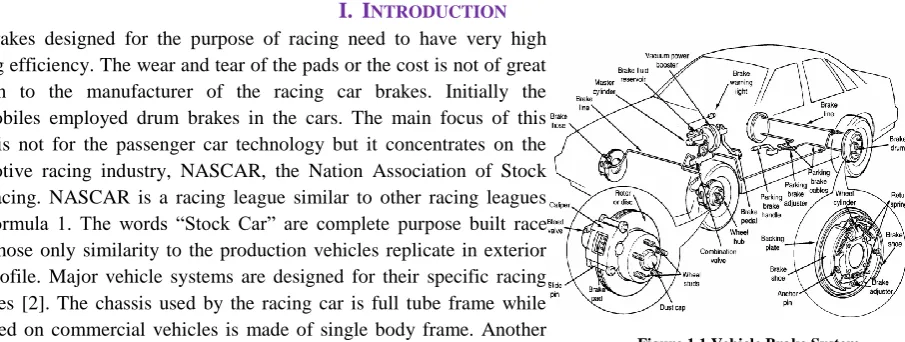
The brakes designed for the purpose of racing need to have very high braking efficiency. The wear and tear of the pads or the cost is not of great concern to the manufacturer of the racing car brakes. Initially the automobiles employed drum brakes in the cars. The main focus of this thesis is not for the passenger car technology but it concentrates on the automotive racing industry, NASCAR, the Nation Association of Stock Car Racing. NASCAR is a racing league similar to other racing leagues like Formula 1. The words “Stock Car” are complete purpose built race cars whose only similarity to the production vehicles replicate in exterior side profile. Major vehicle systems are designed for their specific racing purposes [2]. The chassis used by the racing car is full tube frame while that used on commercial vehicles is made of single body frame. Anotherhttp: // www.ijrtsm.com© International Journal of Recent Technology Science & Management 14
ISSN : 2455-9679
[Gangadhar et al. , 3(7), July 2018] Impact Factor : 2.865
difference is the drive train; race versions have eight cylinder engines with rear wheel drive whereas commercialvehicles are four or six cylinder engines with front wheel drive
1.1 How do disk brakes work?
Disk brakes convert kinetic energy from the car into thermal energy by friction
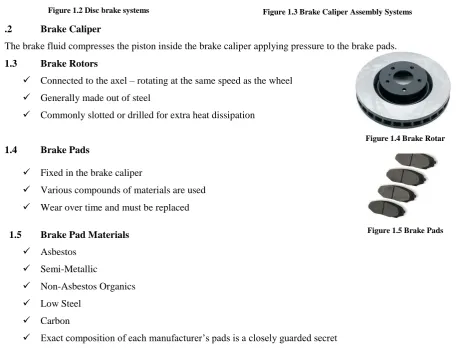
.2 Brake Caliper
The brake fluid compresses the piston inside the brake caliper applying pressure to the brake pads.
1.3 Brake Rotors
Connected to the axel – rotating at the same speed as the wheel Generally made out of steel
Commonly slotted or drilled for extra heat dissipation
1.4 Brake Pads
Fixed in the brake caliper
Various compounds of materials are used Wear over time and must be replaced
1.5 Brake Pad Materials
Asbestos Semi-Metallic
Non-Asbestos Organics Low Steel
Carbon
Exact composition of each manufacturer’s pads is a closely guarded secret
II. PROBLEM IN BRAKE CALIPERS
On studying the background of brakes the main purpose of conducting this research work was finalized. The main
objective was to propose a conceptual design for a disc brake caliper using exiting material Aluminium Alloy, Titanium,
Steel Alloy and New materials Carbon fiber, called a modular brake caliper. The efficient working of brake system
depends on how the brake behaves at high temperatures. Thus the aim of the research work will be to reduce the thermal
deformation in the modular brake caliper. Since Structural Steel is hard to machine, modular caliper will be developed
as an assembly instead of single block design.
Figure 1.2 Disc brake systems Figure 1.3 Brake Caliper Assembly Systems
Figure 1.4 Brake Rotar
http: // www.ijrtsm.com© International Journal of Recent Technology Science & Management 15
ISSN : 2455-9679
[Gangadhar et al. , 3(7), July 2018] Impact Factor : 2.865
III
.
OBJECTIVESDisc brake noise and vibration generation during braking has been one of the most important issues and definitely
worrying problem to automotive manufacturers. Despite brake noise is not a safety issue and has little impact on
braking performance, it gives customers the impression of underlying quality problems of the vehicle. In addition,
the customers view that the noise emitted from the brake system is indicator of malfunctioning condition and
consequently lose confidence on the quality of the vehicles.
IV
.
MATERIALS4.1 Material Selection
Material selection plays a very important role in machine design. Three metals are considered for the analysis of scissor lift is epoxy e glass fiber structural steel and stainless steel.
Material Field Variable Value Units
Density 7850 Kg/m³
Young’s modulus 2E+05 Mpa
Poisson Ratio 0.30
Shear modulus 76923 Mpa
Bulk Modulus 1.6667E+05 Mpa
Tensile Yield Strength 250 Mpa Compressive Yield
Strength
250 Mpa
Tensile Ultimate Strength 460 Mpa Compressive Ultimate
Strength
0 Mpa
Material Field Variable Value Units
Density 7750 Kg/m³
Young’s modulus 1.93E+05 Mpa
Poisson Ratio 0.31
Shear modulus 76664 Mpa
Bulk Modulus 1.6937E+05 Mpa
Tensile Yield Strength 207 Mpa Compressive Yield
Strength
207 Mpa
Tensile Ultimate Strength 310 Mpa Compressive Ultimate
Strength
0 Mpa
Material Field Variable Value Units
Density 1950 Kg/m³
Young’s Modulus 300000 MPa
Poisson Ratio 0.30
Tensile Strength 5090 MPa
Compressive strength 1793 MPa
Material Field Variable Value Units
Density 4620 Kg/m3
Young’s modulus 9.6E+10 Pa
Poisson Ratio 0.36
Shear modulus 3.528E+11 Pa
Bulk Modulus 1.1429E+11 Pa
Tensile Yield Strength 930 Mpa
Compressive Yield Strength 930 Mpa
Tensile Ultimate Strength 310 Mpa
Compressive Ultimate Strength 1070 Mpa Table- 1 Structure Steel Mechanical properties Table- 2 Aluminium Alloy Materials Mechanical properties
http: // www.ijrtsm.com© International Journal of Recent Technology Science & Management 16
ISSN : 2455-9679
[Gangadhar et al. , 3(7), July 2018] Impact Factor : 2.865
V. MODELING & SIMULATION
Figure 5.1 CAD Model generate in CATIA Figure 5.2 CAD Model import in ANSYS and generate meshing
Figure 5.3 Applied boundary conditions
Figure 5.4 Temperature Variations in Aluminium Alloy
Brake caliper
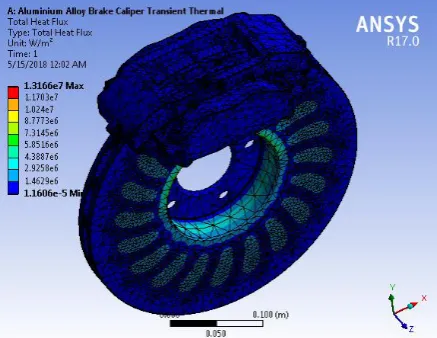
Figure 5.5 Total Heat Flux variations in Aluminium
Alloy Brake caliper
http: // www.ijrtsm.com© International Journal of Recent Technology Science & Management 17
ISSN : 2455-9679
[Gangadhar et al. , 3(7), July 2018] Impact Factor : 2.865
VI. ANALYTICAL CALCULATION
Toyota Car
Car Kerb Weight = 1250 kg and Velocity v = 80 km/hr = 22.2 m/sec K.E. =1/2 mv2 = 1/2 x 1250 (22.2)2 = 3.08 x10⁵ Joules
Braking Force (FB) = Work/ Displacement = W/s = 3.08 x10 5
/55.2 = 5580 N Now we take 60% and 40% ratio
So 60% ( 3348 N On front Two wheels) , 40% (2232 N on Rear Two wheels)
Our Calculation is based on Front Wheels For Single wheel (Front) Force = 3348/2 = 1674 N Pressure by one piston = 1674/4 = 418 N
Figure 5.7 Total Heat flux variations Titanium Brake caliper
Figure 5.8 Temperature variations in Structural Steel Alloy Brake caliper
http: // www.ijrtsm.com© International Journal of Recent Technology Science & Management 18
ISSN : 2455-9679
[Gangadhar et al. , 3(7), July 2018] Impact Factor : 2.865
VII. RESULT & DISCUSSION
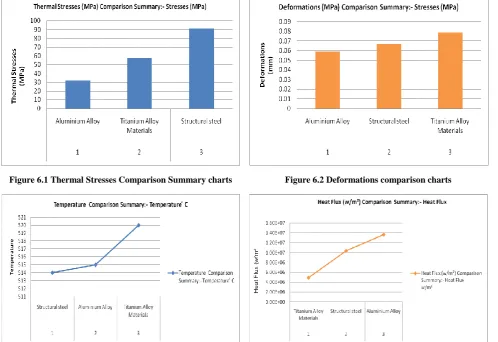
Its cleared that we take different three materials and seen that the maximum thermal von misses stress value for All
material like Structure Steel , Titanium Alloy, Aluminium and respectively are 91.5 MPa, 57.86MPa, 31.87 MPa.
Here we can cleared observed that Aluminium materials has less value of thermal stresses compare to other materials.
We get maximum deformation value for all material like Structure Steel , Titanium Alloy, Aluminium respectively are
0.067mm, 0.079mm, 0.059mm . Here we can cleared observed that Structural Steel alloy materials has lower value of
deformation compare to other materials and But it is desirable under the limit. So it is safe for future design.
So we can suggest Aluminium Alloy materials for brake caliper in future. Because it is light weight and durable
materials.
VIII. CONCLUSION
Determination of the braking force is the most crucial aspect to be considered while designing any braking system.
The generated braking force should always be greater than the required braking force.
The calculation of required clamping force helps us to decide the diameter and the number of pistons to be used.
Space and assembly constraints are also an important factor while designing the caliper body.
Figure 6.1 Thermal Stresses Comparison Summary charts Figure 6.2 Deformations comparison charts
http: // www.ijrtsm.com© International Journal of Recent Technology Science & Management 19
ISSN : 2455-9679
[Gangadhar et al. , 3(7), July 2018] Impact Factor : 2.865
The seal groove geometry is pivotal to the operation of the caliper as it allows the piston to retract after the requiredclamping force has been applied.
IX. FUTURE SCOPE
In future this work can be extended by using different composite materials and we can do thermal CFD analysis and
Vibration analysis in dick brake calliper with different boundary condition like fluid pressure temperature etc.
REFERENCES
1. Ting-Long Ho., “Effect of frictional heating on brake materials”, Wear, 30(1974) 73-91
2. Masahiro Kubota. “Development of lightweight brake disc rotor: A design approach for achieving an optimum
thermal, vibration and weight balance.” JASE review 21 (2000) 349-355.
3. JIANG Lan, , “Thermal analysis for brake disk of Sci/6061 Al. Alloy co-continuous composite for CRH3 during
emergency braking considering air flow cooling” ,Trans. Nonferrous Met. Soc. China 22(2012) 2783-2791.
4. PiotrGrzes and Adam Adamowicz,“Analysis of disc brake temperature distribution during single braking under
non-axisymmetric load”, Apllied thermal engineering 31(2011) 1003-1012.
5. Zhang Jian, “Research of the transient temperature field and friction properties on disc brakes”, Preceeding of the
2012 2nd International conference on computer and information application (ICCIA 2012).
6. K. Sowjanya,“Structural analysis of disk brake rotor”, International Journal of computer trends and technology (
IJCTT)- volume 4 , Issue 7- July 2013
7. K. M. Muniswamy, “Heat transfer enhancement on ventilated brake disk with blade inclination angle variation”,
international journal of automotive technology, vol. 14, No. 4, PP.569-575, 2013
8. Yugesh Anil Kharche and Prof. DheerajVerma” Design And Fem Based Analysis Of Disc Brake For Four
Wheeler” International Journal of Mechanical Engineering Research & Technology, vol.1 July 2015
9. Pravin Mohan and Patel Sudheendra S ,” Design and Analysis of Titanium Caliper Disc Brake” International
Journal of Engineering Development and Research, Volume 5, Issue 1 | ISSN: 2321-9939, PP 144 – 158, 2017
10. S.ArvinRao,MuhamadAnuwarJusoh, Abd Rahim Abu Bakar* 2017,”REDUCTION OF DISC BRAKE SQUEAL