_____________________________________________________________________________________________________
The Dynamics of Solids Removal in Waste
Stabilization Ponds
I. H. Nwankwo
1*, N. E. Nwaiwu
1and J. T. Nwabanne
21
Department of Civil Engineering, Nnamdi Azikwe University, Awka, Anambra State,Nigeria.
2Department of Chemical Engineering, Nnamdi Azikwe University, Awka, Anambra State,Nigeria.
Authors’ contributions
This work was carried out in collaboration among all authors. All authors read and approved the final manuscript.
Article Information
DOI: 10.9734/JERR/2019/v7i416976 Editor(s): (1) Dr. Pijush Samui, Associate Professor, Department of Civil Engineering, NIT Patna, India and Adjunct Professor, Ton Duc Thang University, Ho Chi Minh City, Vietnam. Reviewers: (1) Stig Morling, Sweden. (2)Nicholas Kuan Hoo Tien, Universiti Malaysia, Malaysia. (3)Tingting Zhang, Dalian University of Technology, China. Complete Peer review History:http://www.sdiarticle4.com/review-history/51063
Received 01 August 2019 Accepted 05 October 2019 Published 22 October 2019
ABSTRACT
Waste generation at Nigerian slaughterhouses poses a serious threat to the environment because of poor handling practices which results into adverse impact on land, air and water. The aim of this research is studying the dynamics of solid removal in waste stabilization pond at different hydraulics retention times (HRT). The characteristics of wastewater in Kwata slaughterhouse were 991 mg/l, 3427 mg/l and 4419 mg/l. For total suspended solids (TSS), total dissolved solids (TDS) and total solids (TS) respectively. The slaughterhouse wastewater was treated using waste stabilization pond which comprises one anaerobic pond, one facultative pond and one maturation pond. The physio-chemical analysis conducted at the end of the treatment, shows that the total suspended solids (TSS), total dissolved solids (TDS) and total solids (TS) in an effluent leaving the maturation achieved 97%, 92% and 93% removal efficiencies. The physio-chemical analysis results were also subjected to statistical analysis using one-way analysis of variance and two-way analysis of variance without replication. The results show the statistically significant difference exists in the quality of raw wastewater, effluent from anaerobic, facultative and maturation pond.
Keywords: Slaughterhouse wastewater; environmental pollution; waste stabilization pond.
1. INTRODUCTION
Pollution of environment by wastewater from slaughterhouse has exacerbated by accelerated human activities such as urbanization, industrialization and population needs for also proteins such as meats (because of high demand for food) and as such poses a serious environmental threat to sustainable development leading to potential environmental pollution [1]. Rapid growth of slaughterhouses has not only enhanced the productivity but also resulted in the production and release of toxic substances in the environment, creating health hazards. These wastewaters generated from slaughterhouse are potential pollutants that produces harmful effect if discharge untreated. The discharge of untreated wastewater into surface water bodies such as streams, rivers, lakes and oceans results in the pollution of such water environments [2,3]. In a typical Nigerian slaughterhouse, the surrounding land is often marshy due to improper channeling of wastewater arising from the dressing of the slaughtered animals and washings at the lairage. Land pollution also occurs when solid wastes such as bones, pieces of flesh and dung are left unattended in open spaces. When precipitation takes place, these wastes leave the land in a polluted state while part of it get washed into nearby streams. Most Nigerian slaughterhouses are situated close to surface water bodies in order to have access to water supply needed for slaughtered animal processing and to provide a sink for the run-off from meat processing activities [4]. Within a series of processes, slaughterhouses produce large amounts of different wastes and wastewaters. Human activities which lead to pollution of the environment and a disruption of ecosystem functionality contribute impurities in the form of industrial, domestic, agricultural, and chemical waste to the environment [5]. The term wastewater (WW) is defined as the spent or used water of a community or industry which contains dissolved and suspended matter and about 99% of which is liquid while the remaining 1% is solid waste. The composition of wastewater depends on the source of generation [6]. Slaughterhouses produce substantial amounts of wastewater containing high amounts of biodegradable organic matter, suspended and colloidal matter such as fats, proteins and cellulose [7]. Treatment of wastewater by means of biological processes has been widely implemented from urban to industrial wastewater (Seswoya et al.
variable (or any given combination of these) environmental parameters is usually unique to a given location [11]. Waste stabilization ponds rely on lengthy detention times and environmental factors (wind, solar, radiation) for treatment efficiency. Waste stabilization ponds (WSPs) are usually the most appropriate method of domestic and municipal wastewater treatment in developing countries, where the climate is most favourable for their operation. WSPs are low-cost (usually least-cost), low-maintenance, highly efficient, entirely natural and highly sustainable. Edris et al. [12] used poly-aluminium chloride (PACL) in coagulating small particles of slaughterhouse wastewater into larger flocs that can be efficiently removed through subsequent separation process of either sedimentation or filtration he achieved 64% removal efficiencies for total suspended solids. Giri et al. [13] used Anaerobic fixed film fixed bed reactor packed with special media to treat slaughterhouse wastewater and at 0.8 OLR, 1 day HRT was able to reduce total suspended solids from 1484 mg/l to 120 mg/l. Tansengco et al. [14] treated slaughterhouse wastewater using ASBR and Activated Carbon as Post treatment and recorded a reduction of 53 mg/l in total suspended solids. Hadi et al. [15] achieved 78% removal efficiency in treatment of TSS in urban wastewater using waste stabilization pond. Abdel-rahman et al. [16] treated municipal wastewater using WSP and recorded percentage removal efficiency of 70% and 26% for TSS and TDS respectively. This research work is aimed at studying the dynamics of solid removal in waste stabilization pond at different hydraulic retention times.
2. MATERIALS AND METHODS
2.1 Description of Study Area
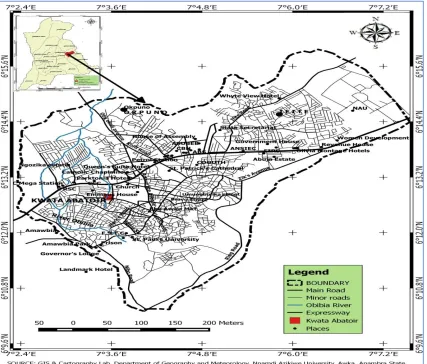
The sample was collected from Kwata slaughter site located at Awka. Awka is the capital of Anambra State, Nigeria and shares shares the latitude of 6.07°N and 6.17°N and longitude of 7.00°E and 7.10°E. Awka is in the tropical rainforest zone of Nigeria and experiences two distinct seasons brought about by the two predominant winds that rule the area: the southwestern monsoon winds from the Atlantic Ocean and the northeastern dry winds from across the Sahara Desert. Awka temperature is generally 27℃ - 30℃ between June and December but rises to 32℃ - 34℃ between January and April, with the last few months of the dry season marked by intense heat (Nigeria Meteorology Agency, 2014).
2.2 Laboratory Setup and Wastewater Generation
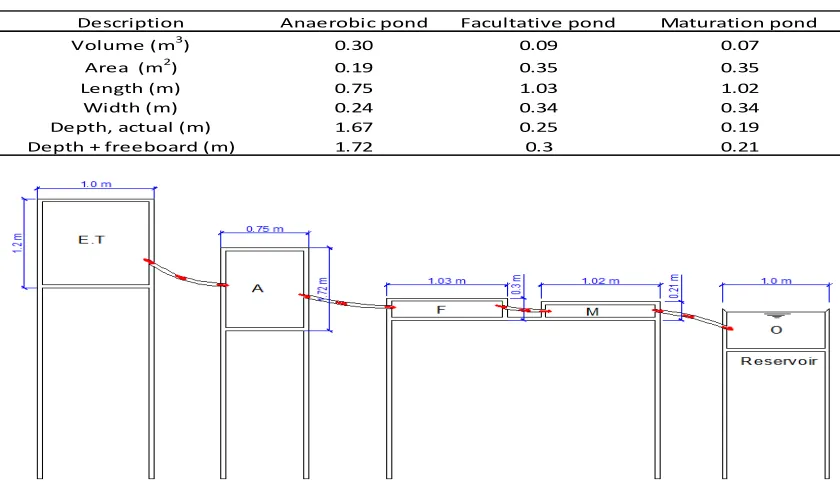
A field scale prototype pond which comprises of anaerobic, facultative and maturation pond were designed and reduced to a laboratory-scale model using dimensional analysis. The laboratory-scale model was constructed and arranged serially in the Nnamdi Azikwe university civil engineering workshop, the anaerobic pond was positioned on a steel stand of 1.2 m high which was done to allow a free flow of slaughterhouse wastewater by gravity to facultative pond while the two ponds, facultative and maturation pond were positioned on a laboratory work bench. Samples of wastewater were collected from Kwata slaughterhouse on a daily basis and were sent to equalization tank before it passes through the model ponds at different hydraulic retention times. The physio- chemical experiments such as total suspended solids, total dissolved solids and total solids were performed at Civil Engineering Department Laboratory.
2.2.1 Total suspended solids
The Total suspended solid was obtained by subtracting the value obtained for total dissolved solids from that obtained for total solid and result expressed as milligram/litre (mg/l) for both controls and treated effluent samples. Equation (1) shows the calculation of total suspended solids.
= − (1)
TSS is total suspended Solids mg/l TS is total Solids mg/l
TDS is total dissolved Solids mg/l
2.2.2 Totals solids
Total solids include total suspended solids and total dissolved solids, 50 ml of wastewater sample was measured into a pre-weighed dish and evaporated to dryness at 103°C on a steam bath. The evaporated wastewater sample was dried, cooled in a desiccator and recorded for constant weight. Total solids are calculated using Equation (2)
=( − ) 1000
( ) / (2)
Where
2.2.3 Total dissolved solids
50 ml of sample was filtered through a whatman filter paper (Whatman GF/F 0.45 µm). Filtrate was allowed to evaporate to dryness, stored in desiccators to cool. Total dissolved solid was calculated using Equation (3).
=( − ) 1000
( ) / (3)
Where
A is weight of filter + dried residue mg and B is weight of filter mg.
3. RESULTS AND DISCUSSION
The percentage removal efficiencies of total suspended solids, total dissolved solids and total
solids were presented from Figs. 1 to 3 and Tables 1 to 3.
3.1 Total Suspended Solids
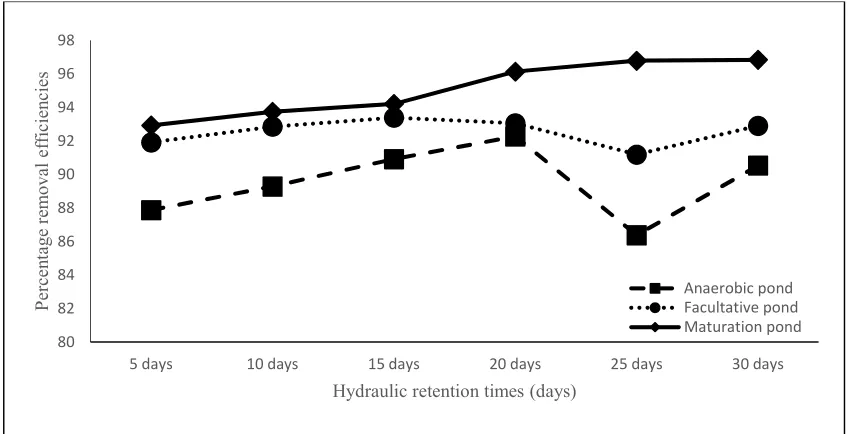
These occurs naturally in surface water as a result of erosion, transport of material from the bottom of the river and tributory inflows, they are also added by industrial effluent example slaughterhouse wastewater discharged directly to the surface water without treatment. TSS are solids in water that can be trapped by a filter, the discharge of effluents with high TSS concentrations can cause sludge depositions and anaerobic conditions in the receiving water body [17]. The percentage removal efficiency of total suspended solids in waste stabilization pond at different hydraulic retention times are shown in Fig. 3 and Table 1.
Table 1. Dimensions of laboratory scale models of waste stabilization pond
Fig. 2. Waste stabilization pond showing Equalization tank, Anaerobic pond and Facultative pond
Table 2. % removal efficiencies of total suspended solids in waste stabilization pond
The average value of the total suspended solids for slaughterhouse wastewater entering the anaerobic pond were 991 mg/l, 1121 mg/l, 1212 mg/l, 1297 mg/l, 1248 mg/l and 1269 mg/l for 5 days, 10 days, 15 days, 20 days, 25 days and 30 days hydraulic retention times which are in agreement with [18-22]; [8] Dipti et al. [23] but parallel with [24,25] the values of total suspended solids are much higher than the 50 mg/l set limit recommended by WHO for discharge, the high total suspended solids can be attributed to algal bloom that produces oxygen and appears as total suspended solids in wastewater effluent. At the end of the wastewater treatment, the percentage efficiencies of solids leaving the maturation for 5-30 days HRT were 99%, 97%, 98% 99%,99% and 99% respectively. These values are comparable with the study conducted by Hadi et al. [15] and Orumieh and Mazaheri, [26] which recorded an average removal efficiency of 78% and 87%. The sharp decline of Total suspended solids in wastewater
effluent can be attributed to the high level of contamination of the wastewater, hence causing the quick sedimentation of heavier particles due to gravitational forces and further reduction of total suspended solids can also be attributed to the agglomeration of the finer suspended particles into larger and hence heavier particles which were also pulled to the base as a sludge, this agglomeration effect are probably as a result of flocculation effects of bacterial discharge in the waste stabilization pond, the activities of algae in facultative and maturation pond, bacteria in the decomposition of suspended organic matter and the effect of time on settling of fine suspended particles by gravity. Towards the end of slaughterhouse wastewater treatment, the Total suspended solids became steady throughout the remaining treatment time without any further reduction, this implies that the remaining suspended particles are very fine and will require coagulation process for further reduction.
Description Anaerobic pond Facultative pond Maturation pond
Volume (m3) 0.30 0.09 0.07
Area (m2) 0.19 0.35 0.35
Length (m) 0.75 1.03 1.02
Width (m) 0.24 0.34 0.34
Depth, actual (m) 1.67 0.25 0.19
Depth + freeboard (m) 1.72 0.3 0.21
Pond 5 days 10 days 15 days 20 days 25 days 30 days
Anaerobic pond (%) 88 89 91 92 86 91
Facultative pond (%) 92 93 93 93 91 93
3.2 Total Dissolved Solids
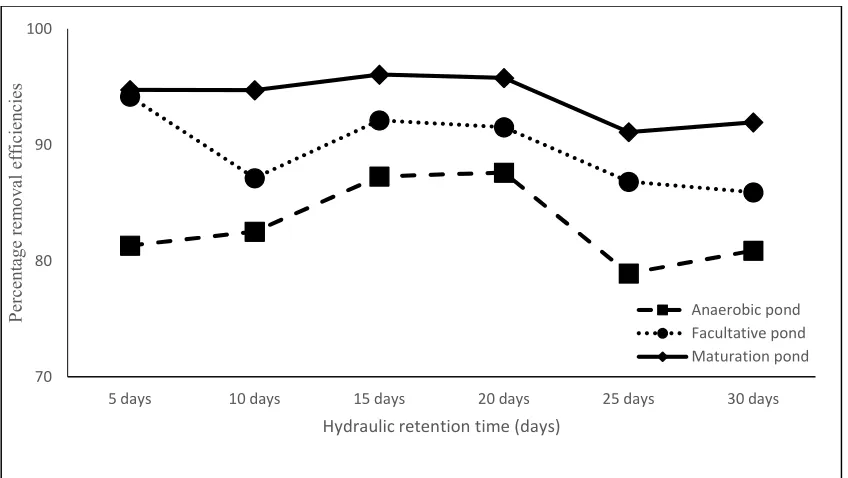
These are referred to any minerals, salts, metals, cations or anions dissolved in water, they comprise inorganic salts and some small amounts of organic matter that are dissolved in wastewater. The total dissolved solids (TDS) concentration is an important parameter of the water quality in agriculture since the productivity and the quality of plants depends on the soil salinity levels, which may be determined by irrigation. A high concentration of dissolved solids increases the density of dissolving water and reduces the solubility of oxygen gas, creating danger for aquatic life. TDS directly relates to the electrical conductivity that measures the ionizable constitutes in wastewater. The percentage removal efficiency of TDS in waste stabilization pond at different hydraulic retention times are presented in Fig. 4 and Table 2.
The average value of total dissolved solids in slaughterhouse wastewater entering the anaerobic pond were 3427 mg/l, 3033 mg/l, 3301 mg/l 3070 mg/l, 3038 mg/l and 2983 mg/l for 5 days, 10 days, 15 days, 20 days, 25 days and 30
days hydraulic retention times, these values are comparable with the study conducted by Ameen and Ahmed, [27] and are above the World Health Organization standard for discharge and as such necessitate treatment before they are discharged to the environment. At the end of the wastewater treatment the concentration of TDS in wastewater effluent leaving the maturation pond were 180 mg/l, 160 mg/l, 130 mg/l, 130 mg/l, 270 mg/l and 240 mg/l representing 95%, 95%, 96%, 96%, 91% and 91% removal efficiencies for 5 days, 10 days, 15 days, 20 days, 25 days and 30 days HRT. These values are within the 500 mg/l WHO standard for effluent discharge.
3.3 Total Solids
The average values of Total solids in slaughterhouse wastewater entering anaerobic pond were 4419 mg/l, 4154 mg/l, 4513 mg/l, 4366 mg/l, 4286 mg/l and 4252 mg/l, these values are lower than values recorded by Sunder and Satyanarayan, [22] and Dipti et al. (2015) but are higher than the study conducted by Ameen and Ahmed, [27] and above the 1000 mg/l World Health Organization standard for effluent discharge, as such wastewater treatment is
Fig. 3. Percentage removal of TSS in WSP at different HRT
Table 3. % removal efficiencies of total dissolved solids in waste stabilization pond
80 82 84 86 88 90 92 94 96 98
5 days 10 days 15 days 20 days 25 days 30 days
P
er
ce
n
ta
g
e
re
m
o
v
al
e
ff
ic
ie
n
ci
es
Hydraulic retention times (days)
Anaerobic pond Facultative pond Maturation pond
Pond 5 days 10 days 15 days 20 days 25 days 30 days
Anaerobic pond (%) 81 83 87 88 79 81
Facultative pond (%) 94 87 92 92 87 86
required before it can be safely discharged to the environment. Table 3 and Fig. 5 shows the percentage removal efficiencies of total solids in waste stabilization pond, after the wastewater treatment using waste stabilization pond, the value of total solids in an effluent exiting the maturation pond were reduced to 250 mg/l. 230 mg/l, 200 mg/l, 180 mg/l, 310 mg/l and 280 mg/l representing 94%, 94%, 96%, 96%, 93% and 93% removal efficiencies at 5 days, 10 days, 15 days, 20 days, 25 days and 30 days HRT. The total solids value in effluent leaving maturation pond after the treatment are generally below 1000 mg/l set by World Health Organization above which becomes significantly and increasingly unpalatable.
3.4 Statistical Analysis of Slaughterhouse Wastewater Parameters
Statistically significant difference between the raw wastewater, anaerobic, facultative and maturation pond results obtained (p<0.05) was observed using one-way analysis of variance and two-way analysis of variance without replication.
3.4.1 One-way analysis of variance (ANOVA)
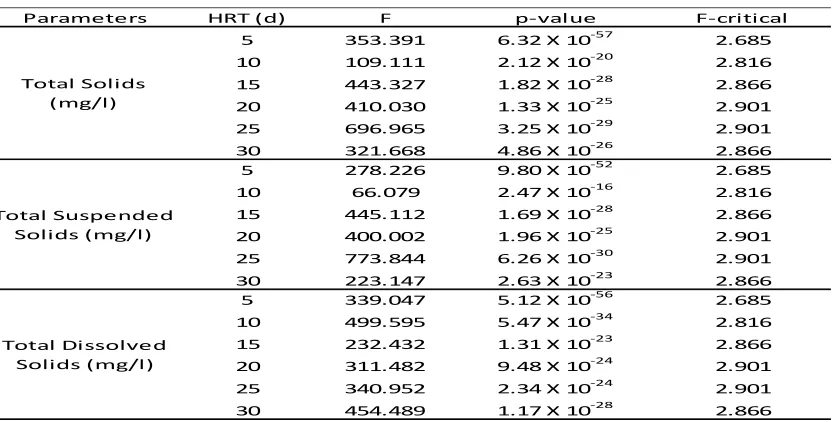
One-way analysis of variance (ANOVA) conducted for Total solids, Total suspended solids and Total dissolved solids (Table 1),
shows that statistically significant difference exists in the quality of raw wastewater, wastewater from anaerobic, facultative and maturation pond results obtained (p<0.05). The differences were much and agrees with the results of the percentage removal efficiency.
3.4.2 Two-way analysis of variance without replication (ANOVA)
Two-way analysis of variance without replication was conducted to examine the relationship of solids removal between the raw wastewater, anaerobic pond, facultative pond, maturation pond and their individual hydraulic retention times as shown in (Table 2).
The analysis of variance for two way without replication for total suspended solids in slaughterhouse wastewater conducted, shows a strong relationship between slaughterhouse raw wastewater, effluent from anaerobic pond, facultative pond and maturation pond, as the p- value obtained (p = 0.0000000000000226) shows that the total suspended solids in slaughterhouse wastewater depletes between pond this can be attributed to as agglomeration effect which are probably as a result of flocculation effects of bacterial discharge in the waste stabilization pond, the activities of algae in facultative and maturation pond, bacteria in the decomposition of suspended organic matter and
Fig. 4. Percentage removal efficiency of TDS in WSP at different HRT
70 80 90 100
5 days 10 days 15 days 20 days 25 days 30 days
P
er
ce
n
ta
g
e
re
m
o
v
al
e
ff
ic
ie
n
ci
es
Hydraulic retention time (days)
Table 4. Percentage removal efficiencies of total solids in waste stabilization pond
Fig. 5. Percentage removal efficiencies of TS in WSP at different HRT
Table 5. ANOVA results (One way) for 5 days to 30 days retention times for total solids, total suspended solids, total dissolved solids
the effect of time on settling of fine suspended particles by gravity. It also that shows an appreciable treatment in waste stabilization pond and the results obtained between the hydraulic retention times (p = 0.81) failed significance test as the p-value obtained was > 0.05. Total
dissolved solids were significantly removed in the ponds, this can be confirmed by (p = 0.0374). The total solids removal was not significant (p = 0.160) but significant differences exist between the hydraulic retention times this can be confirmed by (p = 3.39 x 10).
Pond 5 days 10 days 15 days 20 days 25 days 30 days
Anaerobic pond (%) 83 84 88 89 81 84
Facultative pond (%) 94 89 92 92 88 88
Maturation pond (%) 94 94 96 96 93 93
70 75 80 85 90 95 100
5 days 10 days 15 days 20 days 25 days 30 days
P
er
ce
n
ta
ge
r
em
o
va
l e
ff
ic
en
ci
es
Hydraulic retention times (days)
Anaerobic pond Facultative pond Maturation pond
Parameters HRT (d) F p-value F-critical
5 353.391 6.32 X 10-57 2.685
10 109.111 2.12 X 10⁻²⁰ 2.816
15 443.327 1.82 X 10⁻²⁸ 2.866
20 410.030 1.33 X 10⁻²⁵ 2.901
25 696.965 3.25 X 10⁻²⁹ 2.901
30 321.668 4.86 X 10⁻²⁶ 2.866
5 278.226 9.80 X 10-52 2.685
10 66.079 2.47 X 10⁻¹⁶ 2.816
15 445.112 1.69 X 10⁻²⁸ 2.866
20 400.002 1.96 X 10⁻²⁵ 2.901
25 773.844 6.26 X 10⁻³⁰ 2.901
30 223.147 2.63 X 10⁻²³ 2.866
5 339.047 5.12 X 10-56 2.685
10 499.595 5.47 X 10⁻³⁴ 2.816
15 232.432 1.31 X 10⁻²³ 2.866
20 311.482 9.48 X 10⁻²⁴ 2.901
25 340.952 2.34 X 10⁻²⁴ 2.901
30 454.489 1.17 X 10⁻²⁸ 2.866
Total Solids (mg/l)
Total Suspended Solids (mg/l)
Table 6. ANOVA results (Two way without replication) for 5 to 30 days retention times for total suspended solids, total dissolved solids and total solids
4. CONCLUSION
The discharge of untreated wastewater into surface water bodies such as the case of Kwata slaughterhouse in Awka, Anambra state results in the pollution of such water environments. The high level of solids in slaughterhouse wastewater from kwata slaughterhouse as obtained in this study revealed a very high contaminant, capable of endangering the environment and hazardous to human and animal health. Treatment of slaughterhouse waste using waste stabilization pond was able to achieve 99.05%, 97.57%, 98.66%, 98.88%, 99.19% and 99.23% removal efficiencies for total suspended solids, 94.75%, 94.72%, 96.06%, 95.77%, 91.11% and 91.95% removal efficiencies for total dissolved solids and 94.34%, 94.46%, 95.57%, 95.88%, 92.77% and 93.41% removal efficiencies for total solids at 5 days, 10 days, 15 days, 20 days, 25 days and 30 days hydraulic retention times respectively. One-way analysis of variance and two-One-way analysis of variance without replication shows that significant difference exits between the raw wastewater, anaerobic, facultative and maturation pond results except on total solids. The performance of the waste stabilization pond was found to be satisfactory in slaughterhouse wastewater solids removal.
COMPETING INTERESTS
Authors have declared that no competing interests exist.
REFERENCES
1. Ladu JLC, Lu X, Loboka MK. Experimental assessment on the effects of OLR and HRT on the efficiency of anaerobic filter treating abattoir wastewater. International Journal of Emerging Technology and Advanced Engineering. 2012;2(11):415-420.
2. Bello YO, Oyedemi DTA. Impact of abattoir activities and management in residential neighborhood. A case of Ogbomoso Nigeria. Journal of Social Science. 2009;19(2):121-127.
3. Kwadzah TK, Iorhemen OT. Assessment of the impact of abattoir effluent on the water quality of river Kaduna, Nigeria.
World Journal of Environmental
Engineering. 2015;3(3):87-94.
4. Omole DO, Ogbiye AS. An evaluation of slaughterhouse waste in southwest of
Nigeria. American Journal of
Environmental Pollution. 2013;2(3):85-89. 5. Weobong CA, Adinyira EY. Operation
impacts of the Tamale abattoir on the environment. Journal of Public Health and Epidemiology. 2011;3(9):386-393.
6. Yahaya M, Nurudeen S. Treatment
efficiency and economic benefit of Zartech poultry slaughterhouse wastewater treatment plant. Scientific Research and Easy. 2008;3(6):219-223.
7. Caixeta CET, Cammarota MC, Xavier
AMF. Slaughterhouse wastewater
treatment evaluation of new three-phase separation system in a UNSB reactor. Bioresource Technology. 2002;81(1):61-69.
8. Bustillo-Lecompte CF, Mehrvar M. Journal of Environmental Management. 2015;161: 287-302.
9. Irshad A, Talukder S, Selvakumar K. Current practices and emerging trends in abattoir effluent treatment in India: A review. International Journal of Livestock Research. 2015;5(2):13-31.
10. Mkude IT, Saria J. Assessment of waste stabilization ponds (WSP) efficiency on wastewater treatment for agriculture reuse and other activities. A case of Dodoma municipality Tanzania. Ethiopian Journal of Environmental Studies and Management. 2014;7(3):298-304.
Parameters Variation source F p-value F-critical
Columns (ponds) 0.44 2.26 x 10⁻¹⁴ 2.901
Rows (HRT) 380.56 8.10 x 10-01 3.287
Columns (ponds) 3.18 3.74 x 10-02 2.901
Rows (HRT) 681.51 3.00 x 10⁻¹⁶ 3.287
Columns (ponds) 1.86 1.60 x 10-01 2.901
Rows (HRT) 1242.81 3.39 x 10⁻¹⁸ 3.287
Total suspended solids
Total dissolved solids
11. Mohammed AI, Hayder TH. Stabilization pond for wastewater treatment. European Scientific Journal. 2013;9(14):278-294. 12. Edris B, Ferdos KM, Mehdi F, Kamal AO,
Amir HM. Slaughterhouse wastewater
treatment by combined chemical
coagulation and electrocoagulation process. PLos ONE. 2012;7(6):1-8. 13. Giri D, Armal P, Satyanarayan S.
Slaughterhouse wastewater treatment by anaerobic fixed film fixed bed reactor packed with special media. International
Journal of Plant, Animal and
Environmental Sciences. 2015;5(3):151-156.
14. Tansengco M, Herrera D, Tejano J, Yao M, Beraye JR, Esquerra R. Biological treatment of meat processing wastewater using anaerobic sequencing batch reactor. International Research Journal of Biological Science. 2015;4(3):66-75. 15. Hadi R, Elham RS, Mohammed RA,
Hossein A, Roya P. Wastewater treatment efficiency in stabilization ponds Olang treatment plant. Iranian Journal of Health Safety Environment. 2014;2(1):217-223. 16. Abd EL-Rahman AM, Abd EL-Rahman A,
Gad AAM, Hashem M. Assessment of waste stabilization ponds for. Journal of Engineering. 2015;5(1):10-18.
17. Suglo RS, Bansah KJ. Sewage treatment by waste stabilization pond systems. Journal of Environment Management. Research Article. 2016;3(1):7-14.
18. Masse D, Masse L. Treatment of slaughterhouse wastewater in anaerobic sequencing batch reactors. Canadian Agricultural Engineering. 2000;42(3):11-138.
19. Kobya M, Senturk E, Bayramoghi M. Treatment of poultry slaughterhouse wastewaters by electrocoagulation. Journal of Hazardous Materials. 2006;133(1):172-176.
20. Budiyono WIN, Johari SS. Study on slaughterhouse waste potency and
characteristics for biogas production. International Journal of Water Resource. 2011;1(2):4-7.
21. Sindhu R, Meera V. Treatment of slaughterhouse effluent using upflow
anaerobic packed bed reactor.
International Congress on Information Environment, Energy and Applications. 2012;38:1-7.
22. Sunder GC, Satyanarayan S. Efficient treatment of slaughterhouse wastewater by anaerobic hybrid reactor packed with special floating media. International Journal of Chemical and Physical Sciences. 2013;2:73-81.
23. Farzadkia M, Vanani AF, Golbaz S, Sajadi HS, Bazrafshan E. Characteristics and evaluation of treatability of wastewater generated in Khuzestan livestock slaughterhouse and assessing of their wastewater treatment systems. Global Nest Journal. 2016;18(10):1-10.
24. Kundu P, Debsarkar A, Mukherjee S. Treatment of slaughterhouse wastewater
in a sequencing batch reactor:
Performance evaluation and
bio-degradation kinetics. Biomed Research International. Article I.D 134872. 2013;1-11.
25. Abrha M, Tenalem A. Characterization of abattoir wastewater and evaluation of the effectiveness of the wastewater treatment systems in Luna and Kera abattoirs in Central Ethiopia. International Journal of Scientific and Engineering Research. 2015;6(4):1026-1039.
26. Orumiehl HR, Mazaheri R. Efficiency of stabilization ponds under different climate conditions in Iran. Indian Journal of Fundamental and Applied Sciences. 2015;5(6):794-805.
27. Ameen S, Ahmed J. Characterization and assessment of treatability of wastewater generated in Amman slaughterhouse. Diraset Engineering Sciences. 2008;35(2): 71-83.
© 2019 Nwankwo et al.; This is an Open Access article distributed under the terms of the Creative Commons Attribution License (http://creativecommons.org/licenses/by/4.0), which permits unrestricted use, distribution, and reproduction in any medium, provided the original work is properly cited.
Peer-review history: