Scope of Restructuring the Industrial Policy of Hill State with
Respect to Food Processing Industry
Dr. Kamal Kant Vashisth*, Snigdha Parihar**
*Faculty of Management Sciences & Liberal Arts, Shoolini University, Solan (H.P.) Email: [email protected]
** Faculty of Management Sciences & Liberal Arts, Shoolini University, Solan (H.P.) Email: [email protected]
---
************************
---Abstract:
This is a comprehensive study of the existing Industrial Policy of Himachal Pradesh. It involved in-depth study of the document so that the gap that exists could be established and suitable suggestions given. The study picks up one focus industry, “Food Processing” and builds around that for data collection, analysis of government incentives and the growth, and gives proposition for the improvement of the same. The main aim of the study has been to find drawbacks in the existing policy and suggest restructuring measures for more contribution from Food Processing industry in Himachal Pradesh. It envisages speeding industrial growth, generation of employment opportunities and to envision equitable and sustainable development of the state through the implementation of the restructured policy and recognizes the efforts of the government for creation of appropriate ecosystem, modernization infrastructure, setting up of food parks and providing necessary financial support for growth of food processing sector. This industry has become increasingly important to meet the challenge of feeding nutritionally enriched food to the growing young population of India and the state in particular.
The objective has been to study the already existing policy of the government and analyze the dataset that such reports provide so as to recognize the drawbacks in the formulated policy. After recognition of such shortcomings, certain recommendations have been provided with the aim of maximizing output of food processing industry in the state and enhancing its contribution to the state gross domestic product. Another focus of this study is to increase the employment opportunities for the locals as well as to improve procurement of local raw materials. The state industrial policy does talk about this objective, but fails to state the measure to do so. Therefore, the study has tried to address this concern.
Keywords —State Industrial Policy, Food Processing, Himachal Pradesh, Food Park.
---
************************
---I. INTRODUCTION
The study on restructuring the Industrial Policy of Himachal Pradesh was picked to identify gaps in the said policy which may lead to possible enhancement in the State Gross Domestic Product. The study attempts to address the problem of the ineffective policy formulation and implementation.
However, it has not completely negated the policy that exists. Restructuring of some of the policies so as to enhance the low levels of production, particularly in the food processing industry was the main aim to solve the problem of lesser contribution from the industry towards the State Gross Domestic Product.
1.1PURPOSE OF STUDY:
The purpose of the study involved analysing the shortcomings of the Industrial Policy so as to achieve a state of optimal production and contribution for the food processing industry in the Hill Sate. Another purpose was to be able to recognise the scope of improvement and restructure the policy to meet the resource availability in the state and reach levels of sustainability in the same aspect.
1.2OBJECTIVES OF STUDY:
• To study the Industrial policy of Himachal
Pradesh and find the gaps that exist in the industrial policy of the hill state
• To restructure the industrial policy so as to provide corrective suggestions with an aim to contribute more towards State Gross Domestic Product and enhancing the employment opportunities with an overall goal to improve the socio economic conditions in the hill state.
• To encourage eco-friendly and sustainable
industrial growth through adoption of cleaner technologies and therefore, tweak the existing policies so that it is greener and cleaner in its approach
1.3SCOPE OF STUDY:
The study area was limited to the hill state of Himachal Pradesh. The topic assigned was “Restructuring the Industrial Policy of Himachal Pradesh”. This had a wide scope and studying it would have no provided conclusive suggestions for restricting, given the limitation of time. Therefore, the scope was narrowed down to restructuring the Industrial policy only pertaining to the Food Processing Industry of the state.
II. LITERATUREREVIEW
2.1. Industrial Policy of Himachal Pradesh, 2013
This document formulated by the State Government talks about the mission, vision and strategies that will help to spur growth in the industrial sector. It begins with the current scenario of the production levels that exist in the state. The document aims to address the issues so as to boost the confidence of the investors and help in expansion of industries. The plan to develop infrastructure and related facilities and facilitation of ease of business has been put forth in this document. The State government also writes about the incentives, concession and reward to provide a conducive environment for industrial development.
2.2. Industries Annual Report, 2016-17
This report published by SOER, State Council for
Science, Technology & Environment, H.P.
provides insights as to how the industry in the state has been growing ever since industrialization entered the environs. Right from the time of industries to the 70’s, 80’s and the 2000 onward scenario has been described. It briefly talks about the Industrial policy of 2004 and its role in
accelerating the industrial development,
employment generation and creating an
environment to encourage additional investment in
the state. We come to know that the State has now
been categorized into three categories depending upon the extent of industrial development in these areas. Prior to this, the Govt. of India, Ministry of Commerce and Industry, Department of Industrial Policy and Promotion had notified the Special Package of Incentives for industrial units located in Himachal Pradesh on 7th January, 2003.
2.3 Industrial Development Scheme for Himachal Pradesh (HP) & Uttarakhand, 2017
Policy & Promotion) announces the Industrial Development Scheme for the States of Himachal Pradesh & Uttarakhand to boost industrialization. The scheme began from 1.04.2017 and will remain in force up to 31.03.2022. All the new industrial units and existing industrial units undertaking substantial expansion in manufacturing sector and services sector including Bio-technology and Hydel Power Generation Units up to 10 MW located in the states of H.P. & Uttarakhand will be eligible for incentives under the scheme. It clearly states the incentives that will be provided to eligible industrial units on reimbursement basis such as Central
Comprehensive Insurance Incentive, Central
Capital Investment Incentive for access to credit.
2.4. Investment Environment and Opportunities in Food Processing (2017)
This report by MOFPI is a comprehensive
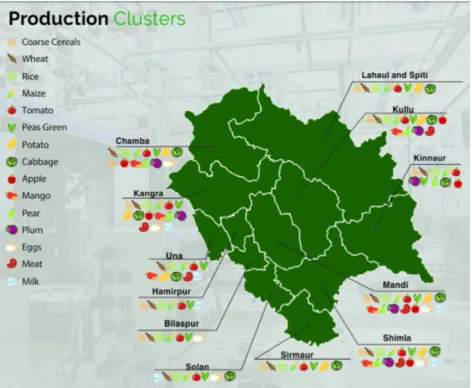
document that details the status of key physical and agricultural infrastructure in Himachal Pradesh. It also chats out the production clusters and the associated fruits and vegetable production. A number of reforms that the government has to offer an enabling and investor friendly business climate for investors keen on setting up business in the State have been discussed in detail. It also talks about the number of policies that the government plans to give impetus to the food processing sector. An indicative list of potential projects for investment is also presented in this report which helps to picture the future scenario.
III. RESEARCHMETHODOLOGY
3.1 RESEARCH DESIGN:
This study is an exploratory research studying the existing structure of the industrial policy of
Himachal Pradesh, which brought forth data and insights that gave way to understanding as to what the policy lacks. It explores the research topic with varying levels of depth so as to develop many options to the existing problems that the industrial policy of Himachal Pradesh has. It studies the data results in a range of causes and alternative options for correcting the drawbacks that exist in the policy document.
3.2. TYPE OF DATA:
The data is of secondary nature and is collected from various government sources including the official release of Department of Industries, H.P., MOSPI, research papers like “Analysis of Responses of Food Processing Industries in
Himachal Pradesh”. The project involved
collecting, analysing, and interpreting the data in the existing government reports. A systematic approach with procedural and evaluative steps was taken so as to arrive at solutions for the problems that were identified by studying the already existing dataset.
3.3. DATA PREPARATION AND ANALYSIS:
IV. DATAANALYSIS
Image 4.1: Key Features of Himachal Pradesh
4.1 THE ENVIRONMENT FOR THE INDUSTRY:
• Four favourable agro-climatic zones– One
of the largest producers of off-season
vegetables (Capsicum, Tomato, Peas,
Cabbage, Cucumber) and exotic fruits (Persimmon, Kiwi), Rank 2 in production of Apples and Almonds in the country.
• Enabling infrastructure with uninterrupted water supply, lowest power tariff in the country and strong hydropower base - availability of a rich labour pool with 82.8% literacy rate and no labour unrest.
• Availability of food processing
infrastructure- 1 dedicated mega Food Park, 12 cold chain projects, testing laboratory, land bank for industry.
• Presence of leading food processors
including Minchy’s, Britannia, TATA,
Cremica, ITC, PepsiCo, IFB Agro,
Keventer, Bisk Farm, Nestle
4.2. KEY PRODUCTION HIGHLIGHTS (2015-16) OF THE STATE INCLUDE:
• Production of 1715.16 thousand tonnes of vegetables– Rank 1 in the production of Capsicum with 57.41 thousand tonnes, largest production of off-season vegetables
• 2nd largest producer of Apples
• Ranks 2 in the production of Almonds, total
production of 0.94 thousand tonnes and 3 in the production of Walnut with total production of 2.25 thousand tonnes
• Total production of 928.83 thousand tonnes
of fruits- Rank 2 in the production of Apples with production of 777.13 thousand tonnes. Rank 5 in the production of Kiwi with total production of 0.34 thousand tonnes and pear with 32.04 thousand tonnes production. Rank 3 in the production of Peach with production of 8.05 thousand tonnes
• Total production of 1,537 thousand tonnes of food grains- Amongst top 10 in the production of Barley with total production of 31 thousand tonnes
4.3 AGRICULTURE MARKETING:
The State has 12 cold chain units under MoFPI of which 8 are completed. Apart from these, there are 12 clusters and markets in nearby areas, 19 registered mandis and about 7 agri-marketing yards.
Processing clusters: Some of the indicative processing clusters for Himachal Pradesh are Shimla, Mandi, Bilaspur, Kullu, Kangra, Solan, Hamirpur, Una & Sirmaur.
Produce Area
Cereal and cereal
products
Cereal and cereal
products:
Spices Mandi, Bilaspur, Shimla
Ready to eat Hamirpur, Solan, Kangra
Prepared Food Kangra, Mandi,
Hamirpur
Pickle, Jam Squash
Solan, Kangra, Una
Table 4.1: Processing Clusters
4.4 INFRASTRUCTURE
The status of key physical and agricultural infrastructure in Himachal Pradesh is as follows:
Inland Container Depots
Existing Industrial
Areas/ SEZs
1 agri-export zone 1 mega food park 12 industrial areas
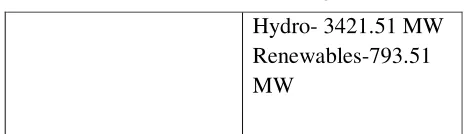
Installed power Thermal- 213.90 MW
Hydro- 3421.51 MW Renewables-793.51 MW
Table 4.2: Inland Container Depots
A number of industrial areas and food parks are available for investors keen on setting up food processing units in the state. The key food park in Himachal Pradesh includes Cremica Food Park spread over 50 acres at Una district. In addition to the above, land is also available at various industrial estates and industrial areas across the state.
The State has 12 cold chain units set up with assistance from MoFPI
Cold Chain Project Location
Adani Agri Fresh Ltd Shimla
Aromatrix Flora Pvt Ltd Solan
Canvas Integrated Cold Chain Una
Dev Bhumi Cold Chain Ltd Shimla
Fresh Produce Impex Shimla
Hillcrest Foods Solan
Himalaya Cotton Yarn Ltd Solan
Him Fresh Produce Co Shimla
Paonta Sahib Food Corporation Solan
Pulkit Fresh & Healthy Solan
Deluxe Integrated Cold Chain Pvt. Ltd
Kullu
Paras Spices Una
V.FINDINGS
5.1. POLICY INCENTIVES BY THE STATE GOVERNMENT:
• Interest subvention of 7 percent P.A. for 7 years ( maximum of INR 25 lacs)
• Electricity Duty : 33.33% - 75% grant in aid under various schemes of mission
• Interest subsidy of 5 percent P.A. on term loan ( up to INR 2 lacs)
• Priority to 100 percent export oriented units ( EOUs) for sanction of power connection
• Remittance of 50 per cent stamp duty on instruments of conveyance deed and lease deed in favour of new industrial enterprises to be set up in the State
• Incentives to support innovation projects, incubators, new industries/start-ups
• Special Category Entrepreneurs such as
entrepreneurs belonging to the Scheduled Castes, Schedule Tribes, Women,
Ex-servicemen, Physically Handicapped
persons, BPL family category are entitled to additional concessions/ facilities in the form of investment subsidy and subsidy on rate of interest
• Industrial enterprises are eligible for an incentive of INR 500 per bonafide Himachali candidate hired on regular basis
• Industrial enterprises will be reimbursed 50% of the actual cost of training or INR 5,000 per trainee to workers belonging to Below Poverty Line /SC /ST , up to a maximum amount of INR 25,000
• Reimbursement of cost incurred for
shipment of export samples with a ceiling of INR 15000 per consignment , subject to a maximum INR 50,000 per enterprise during its period of operation
• Special Category Entrepreneurs such as
entrepreneurs belonging to the Scheduled Castes, Schedule Tribes, Women,
Ex-servicemen, Physically Handicapped
persons, BPL family category are entitled to additional concessions/ facilities in the form of investment subsidy and subsidy on rate of interest.
• New Thrust Industrial Enterprises based on
Horticulture/Vegetable/Maize/ Herbal
Produce enterprises and located in ‘B’ and ‘C’ category areas shall be entitled for the following additional incentives:
• a) Total exemption from the payment of Electricity Duty for a period of 10 years from the date of commencement of production.
• b) Interest subsidy @5% p.a. on term loan, with a ceiling of INR 2 Lakhs p.a. for a period of 3 years.
5.2. POTENTIAL FOOD PROCESSING INDUSTRIES OBSERVED:
Himachal Pradesh offers tremendous opportunities for investment across the entire value chain in the food processing sector. An indicative list of potential projects for investment is presented in the table below:
Project name Processed Products
Value Proposition
Meat Processing Canned meat
and meat based sauces,
sausages, hotdogs, salami, chicken nuggets
Global processed meat market
to reach
USD 1,567
India had the 2nd fastest growing processed meat market, CAGR 22% between 2011-15 Individually
Quick Frozen
(IQF) Peas
Production
IQF Peas Over 25
thousand
tonnes of
IQF vegetables to be consumed globally during 2016-26
The size of Indian frozen
market is
9,219.60
tonnes and
frozen peas amounts to
75%, i.e.,
6915 tonnes Tomato
Processing
Tomato puree, sauce, prepared products (whole or in pieces), paste,
tomato juice,
mixtures of
vegetable
juice, tomato
ketchup
Global tomato processing
market to
reach 42
Million
tonnes by
2022. India ranks 2nd in the area as
well as
production
of tomato.
India's production
level of
processed
tomato has
risen by 50 percent
There has
been a surge in demand of processed Tomato due to rise in employment
with an
increase in
more of
adult working
ratio and
spending lesser time
in the
kitchen, changing lifestyles, rising income
levels and
lifestyles Mushroom Processing Fresh mushrooms, frozen mushrooms, dehydrated mushrooms, brine mushrooms, canned white/button mushrooms, canned oyster mushrooms, mushroom pickles, mushroom powder Globally, the mushroom market would reach USD 59.48
Billion by 2021
India is
home to
more than
300 varieties of
mushroom found in the
wild. The
market has
shown a
significant
growth in
recent years
making it
more
attractive for Indian exports
Cattle and
Poultry Feed
Processing
Cattle and
Poultry Feed
Animal feeds play a leading role in the global food
industry
India’s feed industry is growing at a
CAGR of
8% and is expected to touch USD 30 Billion by 2020.
India has
emerged as one of the largest and fastest growing compound feed markets in the world Wine
Manufacturing
Fruit Wine While the
global wine production
has grown
by a mere 2.2%, Indian wine
industry has
grown steadily at the rate of 25-30% p.a.
Local rules
allow for
easy licensing,
and any
retailer can
sell the
locally-produced wines
Exotic Fruit
Processing
Aseptic
products ,
frozen and
canned products including pulp, puree,
concentrates, juice and seeds
Sea Buckthorn Oil and other products
The global
market for
exotic fruit
segment is
expected to expand at a
CAGR of
3.8% in
terms of
volume over
the years
2016-26 and
the global
fruit puree
market is
expected to
grow at
CAGR of
4.8%
The exotic
fruit market has a USD 468 Million size
Sea buckthorn
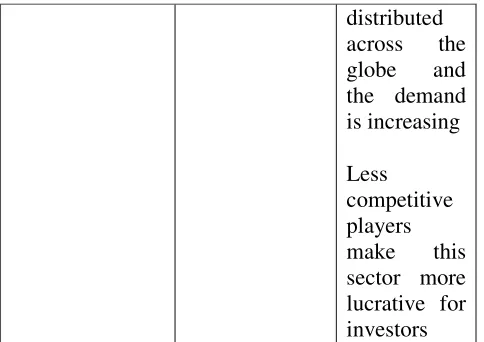
distributed
across the
globe and
the demand is increasing
Less competitive players
make this
sector more lucrative for investors
Table 5.1: Potential Food processing Units
5.3. DRAWBACKS OBSERVED:
• Direct entity oriented fiscal incentives have invariably led to the creation of inefficient and uncompetitive industry, which has become unsustainable in the long run.
• Introduction of GST, expiry of Central
package prompts for a fresh perspective to all incentives to the industry in the state.
• Although India is second largest producer of
vegetables and fruits, only 2.2% of this is processed which is very less as compared to countries like USA (65%), China (23%), and Philippines (78%).
• The industrial establishments with imported
machines faced maintenance and repair problem.
• Challenges observed in scaling up
production through automation.
• Absence of large scale procurement of raw material as well as good quality raw material as limited choices for procurement.
• Deterioration of raw material during
transportation.
• Only physical quality checks like size,
colour, and texture available. Analytical or scientific checking measures were absent.
• Absence of professional food technologists.
• No tie ups with R&D organizations except few like CFTRI (Central Food Technology
Research Institute), NEERI (National
Environmental Engineering Institute) and
HIMCU (Himachal Pradesh Food
Processing Unit).
• No product diversification.
• No value addition to waste generated and its
reuse.
• No knowledge about IPR, patent filing
methodology or the cost incurred.
VI. RECOMMENDATIONS
• To offset geographical and location
disadvantages: The major problem that the food processing industry faces in H.P. is
unfavourable terrain. Therefore,
transportation and storage is one of the main concerning factors. A possible solution to this could be strengthening the roads, transportation and storage facilities in rural and remote locations.
• Performance based incentives in addition
to subsidies: Until now, subsidies have been given to farmers to support them in establishing units or upgrading machines.
But this strategy fails to motivate
performance, but the state and the society also benefit from this.
• Strengthen the quality of infrastructure: According to the research paper “Analyses of Responses of Food Processing Industries in Himachal Pradesh” which studied the industries’ data using a pre tested structured questionnaire which developed information on infrastructure, accreditation, range of products and other constraints, it was observed that majority of the industries have indigenous machinery. Even those with imported machinery expressed that cost of imports, maintenance, repairs are high. The policy fails to distinguish between such industries and therefore, increase in quality production does not happen despite funds available. The problem identification is a major task along with provision of supporting services for mechanization or upgrading of services. The policy should have focus on improving the quality and facilitating easy procurement of machines, upgrading of units and tie ups with research institutes for training of technicians.
• To quantify local employment, local raw
materials, and industry based on local skills: Although the focus of the policies in the past have been to encourage local employment, procurement of local raw materials but no set measure or incentives if the practise is adopted have been stated. The need of the hour is to identify local talent
and provide them with skills.
Apprenticeship as well as internships opportunities which prepare the youth for future avenues could be added to the
measures that the food processing industry needs to adopt. It talks about creating 3 Lakh jobs for the youth of the state by 2022, but the policy is clueless as to how this will be achieved. The local youth understand the produce from the hill state, its climate, and its terrain better than anyone else. Thus, using the local knowledge and adding the necessary skill would not only benefit the industrialists to increase their performance but also aid in creating a sustainable progressive culture in society.
• To attract both domestic and
international industry:
The current policy does not differentiate for incentives for domestic or international investment nor does it strategize as to how it will attract such investments. A much needed plan that shows the state potential to investors should be thought by the
government. Seminars, exhibitions,
participation in international and national conferences should be facilitated. This will not only help in attracting the investors but will also bring the much needed exposure to the food processing industry of the state.
• Focus on ancillary industries and reuse of
waste:
an avenue for women from the hill state who could use local knowledge of reusing by-products to build mats, baskets, eco-friendly plates etc. We can set-up post management harvest infrastructure and to create value addition as near to the source as possible will also create another opportunity to gain as much from the process of food processing as is possible. For example, using fruit by-product that is left after juicing to add to marmalades or turn it into candied fruit, etc.
• Improving automation in the food
processing industry:
Post management harvest facility like cold stores need to be upgraded technically so as to enhance storage capacity and create cold chain facilities to cut post-harvest losses and ensure a better return to farmers. Not just increasing cold stores capacity but to set up the entire cold chain facilities, including pack-houses, transport facilities, frozen food plants, refrigerated vans and all other components. In addition to this mechanised packing and grading stores, setting up of ropeways for transportation of locally available produce, setting up of service centre to render farm related management services and services such as maintenance of farm equipment and machineries should be adopted. The aim is to get the maximum produce with minimum costs.
• Pollution control measures enabled by
digital and social media platforms:
Rather than depending on the industry to file reports or the inspecting officials, a web based platform or reporting app or some
social media linkage that enables all the people to report on any industry flouting waste disposal norms should be adopted. The idea is to empower and involve all the stakeholders into the betterment of the environment and using this to check on polluting industries.
VII. CONCLUSIONS
The industrial policy of Himachal Pradesh in addition to progressive growth also focuses on making it socially sustainable and environmentally friendly. The main focus is to give the policy an edge to compete with industries from various regions of the country as well as outside. The target is to achieve highest level of quality so as to not lag behind the international industries.
The project through its analysis of existing reports, articles and the dataset that has been built by
various forums has tried to suggest
recommendations to tweak the industrial policy in a way that it better suits the state and its people. Ensuring effective, efficient and optimal use of resources has been the guiding principal of all the recommendations.
The efforts of the state government to improve the status of the food processing industry have not been negated in the project, rather strengthening and complimentary measure suggested so as boosting the performance of the food processing industry.
in the industrial policy so that continued sustainable industrial development keeps on taking place in the state. This is separate from restructuring the industrial policy and lies more in the range of continuous up gradation of fiscal and monetary measures churned out by the government.
To conclude the topic and put forth the last recommendation, I would like to urge the government of the state to recognize the potential and build policies not mimicking the national policy for industries. Rather the aim should be to complement the larger policy by making a better suited, more sustainable and socially conscious state industrial policy that best knows its people and resources.
REFERENCES
[I]. http://www.mospi.gov.in/statistical-year-book-india/2017/171 2. [II]. http://www.mospi.gov.in/statistical-year-book-india/2017/171 3. [III].
http://www.mospi.gov.in/publication/state-domestic-product-state-series-2004-05# 4.
[IV]. https://www.rbi.org.in/scripts/referenceratearchive.aspx 5. [V]. http://pib.nic.in/newsite/PrintRelease.aspx?relid=123563 6. [VI]. http://dipp.nic.in/sites/default/files/india_FDI_July2013_0.pdf [VII]. http://dipp.nic.in/sites/default/files/india_FDI_May201
4_0.pdf
[VIII]. http://dipp.nic.in/sites/default/files/FDI_FactSheet_Jan uary_March2017.pdf 7.
[IX]. http://www.mospi.gov.in/statistical-year-book-india/2017/190 8. [X]. http://www.airportsindia.org.in/public_notices/aaisite_test/main_n
ew.jsp 9.
[XI].http://mospi.nic.in/sites/default/files/statistical_year_book_india_2 015/Table-8.3%20.xlsx
[XII]. http://agricoop.nic.in/sites/default/files/2015-16%20%28Final%20Est.%29_0.xlsx
[XIII]. http://eands.dacnet.nic.in/PDF/Glance-2016.pdf 10. http://mofpi.nic.in/sites/default/files/ministrys_notification.pdf [XIV]. http://sezindia.gov.in/writereaddata/pdf/Listofoperation
alSEZs.pdf
[XV]. http://apeda.gov.in/apedawebsite/trade_promotion/Agri _Export_Zone.htm
[XVI]. http://www.mospi.gov.in/sites/default/files/statistical_y ear_book_india_2015/Table-8.1_0.xlsx 11.
[XVII]. http://geo-sampada.nic.in/ 12.
[XVIII]. https://data.gov.in/catalog/district-wise-season-wise-crop-production-statistics 13.
[XIX]. http://pib.nic.in/newsite/PrintRelease.aspx?relid=16899 0 14.
[XX]. http://www.mofpi.nic.in/sites/default/files/website_cold _chain_status_18.08.2017.pdf
[XXI]. http://www.msmetfc.in/cluster-activity
http://www.mofpi.nic.in/sites/default/files/asi_state_wise_2014-15.pdf 15.
[XXII]. http://commerce.nic.in/trade/ICD_list.pdf 16. http://mofpi.nic.in/sites/default/files/ministrys_notification.pdf 17. [XXIII]. http://www.cea.nic.in/reports/monthly/installedcapacity
/2017/installed_capacity-01.pdf 18.
[XXIV]. http://www.cea.nic.in/reports/monthly/installedcapacity /2016/installed_capacity-03.pdf 19.
[XXV]. http://admis.hp.nic.in/himachal/economics/pdfs/Econo micSurveyEng2016_17_A1b.pdf Investment environment & opportunities in food processing
[XXVI]. https://www.thehindubusinessline.com/economy/agri-