Regularization-Free Principal Curve Estimation
Samuel Gerber [email protected]
Mathematics Department Duke University
Durham, NC 27708
Ross Whitaker [email protected]
Scientific Computing and Imaging Institute University of Utah
Salt Lake City, UT 84112
Editor:Sridhar Mahadevan
Abstract
Principal curves and manifolds provide a framework to formulate manifold learning within a sta-tistical context. Principal curves define the notion of a curve passing through the middle of a distri-bution. While the intuition is clear, the formal definition leads to some technical and practical dif-ficulties. In particular, principal curves are saddle points of the mean-squared projection distance, which poses severe challenges for estimation and model selection. This paper demonstrates that the difficulties in model selection associated with the saddle point property of principal curves are intrinsically tied to the minimization of the mean-squared projection distance. We introduce a new objective function, facilitated through a modification of the principal curve estimation approach, for which all critical points are principal curves and minima. Thus, the new formulation removes the fundamental issue for model selection in principal curve estimation. A gradient-descent-based estimator demonstrates the effectiveness of the new formulation for controlling model complexity on numerical experiments with synthetic and real data.
Keywords: principal curve, manifold estimation, unsupervised learning, model complexity, model selection
1. Introduction
Manifold learning is emerging as an important tool in many data analysis applications. In mani-fold learning, the assumption is that a given sample is drawn from a low-dimensional manimani-fold embedded in a higher dimensional space, possibly corrupted by noise. However, the manifold is typically unknown and only observations from the ambient high-dimensional space are available. Manifold learning refers to the task of uncovering the low-dimensional manifold given the high-dimensional observations. Recent work in the machine learning community, such as Laplacian eigenmaps (Belkin and Niyogi, 2003), isomap (Tenenbaum et al., 2000), and locally linear embed-ding (Roweis and Saul, 2000) build directly on the manifold assumption and typically formulate the manifold estimation in terms of a graph embedding problem. The focus of these methods is to recover a low-dimensional description without modeling the manifold.
ap-proaches that fit a manifold model, such as autoencoder neural networks (Hinton and Salakhutdi-nov, 2006), self-organizing maps (Kohonen, 1988) and unsupervised kernel regression (Meinicke et al., 2005), can be implicitly or explicitly related to the principal curve formulation. The principal curve approach to manifold learning can be advantageous over alternatives that exclusively estimate descriptive parameters. For instance, the expected distance of the data to the manifold provides a quantitative measure of the geometric fit to the data. Additionally, the formulation provides a con-sistent approach to project and reconstruct unseen data points which can be important in practical applications.
While several methods have been proposed to estimate principal curves, a systematic approach to model selection remains an open question. To facilitate the discussion, recall the formal definition of principal curves. LetY be a random variable with a smooth density p such that the support Ω={y:p(y)>0}is a compact, connected region with a smooth boundary.
Definition 1 (Principal Curve, Hastie and Stuetzle, 1989) Let g:Λ→Rn,Λ⊂Randλg:Ω→Λ withprojection indexλg(y) =maxs{s:ky−g(s)k=infs˜ky−g(s˜)k}. The principal curves of Y are the set
G
of smooth functions g that fulfill the self consistency property E[Y|λg(Y) =s] =g(s).Hastie and Stuetzle (1989) showed that principal curves are critical points of the expected projection distanced(g,Y)2=E[kg(λ
g(Y))−Yk2], that is, forg a principal curve the (Fr´echet) derivative of d(g,Y)2 with respect to g is zero. Estimators for principal curves typically minimizes d(g,Y)2
directly over a suitable representation of g (e.g., kernel smoother, piece-wise linear). However, Duchamp and Stuetzle (1996) showed, for principal curves in the plane, that all critical points are saddles. Thus, there are always adjacent (nonprincipal) curves with lower projection distance.
In fact, without additional regularization, principal curve estimation results in space-filling curves, which have both lower training and test projection distance than curves that provide a more
meaningfulsummary of the distribution. Thus, all estimation approaches impose, implicit or ex-plicit, regularity constraints on the curves (Tibshirani, 1992; K´egl et al., 2000; Chang and Ghosh, 2001; Smola et al., 2001; Meinicke et al., 2005) which, due to the saddle point property, will lead to estimates that lie on the constraint boundary and typically do not satisfy the conditions for prin-cipal curves. Using only the data, there is no well-defined,correct amount of regularization, and a regularization strategy would necessarily depend on extraneous considerations (e.g., the particular properties of the application). Thus, Duchamp and Stuetzle (1996) noted: “To our knowledge, no-body has yet suggested a reasonably motivated, automatic method for choice of model complexity in the context of manifold estimation or nonparametric orthogonal distance regression. This remains an important open problem”. In this paper we propose a solution to address the model complexity challenge in principal curve estimation.
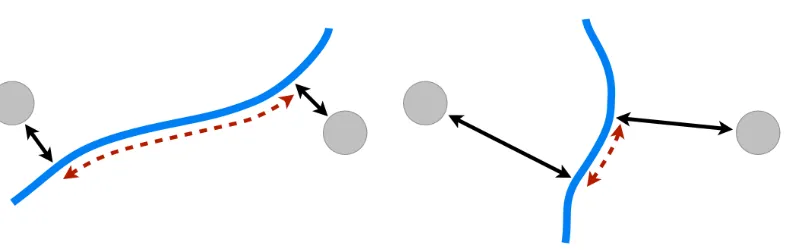
This paper contends that the model selection problem is intrinsically tied to the mean-squared-error objective function of the principal curve formulation. In the supervised setting, for example, for regression, the mean squared error provides an adequate measure for model selection (H¨ardle and Marron, 1985). In the unsupervised setting, for manifold estimation, the missing information on variable relationships renders distance measures inadequate. To be more precise, in regression for two observations with the same predictor measurements, the differences in predicted value is necessarily due to noise. Manifold estimation faces an inherent ambiguity in whether differences between observations should be treated as variationorthogonalto the manifold or as variationalong
Figure 1: Two curves (solid lines) with a different trade off between variation along (dashed arrows) and orthogonal to (solid arrows) the curve for two data points in identical positions. A direct minimization of mean squared projection distanced(g,Y)2=E[kg(λ(Y))−Yk2]
will always favor curves passing close to the data points and not necessarily move towards a principal curve.
Informally, this indicates why principal curves are not minima of the distance function; trad-ing off variation orthogonal to the manifold with variation along the curve leads to curves with smaller projection distances. This becomes evident in cross-validation, where a test example has no fixed assigned manifold coordinate (as compared to the fixed predictor variables in regression) but has manifold coordinates assigned based on the current fit. This leaves the flexibility to adapt the manifold coordinates of the test data to minimize projection distance, and leads, almost always, to simultaneous decreases in train and test error. This would not pose a significant problem if the principal curves would be minima of the mean squared projection distance—one would rely on the local minimum provided by the optimization. However, due to the saddle point property, the opti-mization moves towards a curve that passes through all the training data and cross-validation does not provide any reliable indication for early stopping. Thus, principal curve estimation based on minimizing the projection distance is not a viable path for automatic model selection.
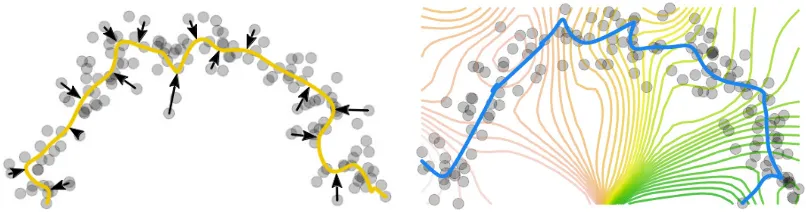
Figure 2: Illustration of the traditional approach compared to the proposed method for estimating principal curves. (left) The traditional approach specifies a curveg(yellow) and defines λgas the coordinate corresponding to the closest point on the curve. (right) The proposed
formulation specifies and arbitrary λ—here a few level sets of λ are shown—which in turn defines the curveg=E[Y|λ(Y)](blue). In the traditional approachgis optimized to find a principal curve. In the new formulation the optimization is overλ.
principal curves emerge naturally as minima, alleviates the need for regularization or changes of the original principal curve definition.
The proposed formulation rests on the observation that minimizing d(g,Y)2 allows principal
curves gto move away from saddle points and improve their fit by violating the self consistency property. This leads to the idea of turning the optimization problem around. Instead of having the projection indexλgcontrolled by the curveg, we fixg≡E[Y|λ(Y)]to the conditional expectation
given λ and let λ be an arbitrary function λ:Ω7→R (with mild conditions, to be specified in Section 2). To distinguish from Hastie and Stuetzle (1989), withλg fixed giveng, we call λthe coordinate mappingandE[Y|λ(Y)]theconditional expectation curveofλ. The difference between the two formulations is illustrated in Figure 2. Now, the strategy is to optimize over the coordinate mapping λ rather than g. Minimizing d(λ,Y) =E
h
kg(λ(Y))−Yk2i with respect to λ leads to critical points that are, indeed, principal curves, but unfortunately they are still saddle points. In this case, escaping from saddle points is possible by violating the orthogonal projection condition. This inspires the design of an objective function, facilitated through this level-set based formulation, that penalizes nonorthogonality of the coordinate mappingλ
q(λ,Y)2=E
*
(g(λ(Y))−Y), d dsg(s)
s=λ(Y)
+2
.
Here,gis by definition self-consistent and the orthogonal projection ofλis enforced by the objective function. In this formulation, all critical points λ∗ are minima with q(λ∗,Y)2 =0. Hence, the
conditional expectation curve at a minima g≡E[Y|λ∗(Y)] corresponds to a principal curve (see Section 2).
2. Conditional Expectation Curves
LetY be a random variable with a smooth density pwith support ˜Ω={y:p(y)>0} ⊂Rn such
that the closureΩ=cl(Ω˜)is a compact, connected region with smooth boundary. This includes densities pthat smoothly go to 0 at the boundary with an open support as well as densities with a compact support. Letλ:Ω→Λbe Lipschitz withΛa connected closed subset ofR. To shorten notation, letµbe the measure such thatpis the Radon-Nikodym derivative ofµwith respect to the Lebesgue measure and writedµ=dµ(y) =µ(dy) =p(y)dy.
As for principal curve setting, the conditional expectation E[Y|λ(Y)] is defined over a set of measure zero and is not a priori well defined. To formally define the conditional expectation let
gσ(s) = R
ΩKσ(s−λ(y))ydµ R
ΩKσ(s−λ(y))dµ
withKσ(s)a mollifier. Now we define the conditional expectation as the limit
E[Y|λ(Y) =s] =lim
σ→0gσ(s) = R
Ωδ(λ(y)−s)ydµ R
Ωδ(λ(y)−s)dµ
=
R
λ−1(s)yp(y)Jλ(y)−1d
H
n−1(y) Rλ−1(s)p(y)Jλ(y)−1d
H
n−1(y). (1)
withJλ(y)the 1-dimensional Jacobian ofλand
H
n−1dimensional Hausdorff measure. The secondequality follows from the uniform convergence of the mollifier to the Dirac delta distribution. The last equality invokes the coarea formula (Federer, 1969) by changing to integration over the level sets ofλ. This definition is, forλan orthogonal projection, equivalent to the conditional expectation as understood in Hastie and Stuetzle (1989) and Duchamp and Stuetzle (1996). This formulation also directly extends to define conditional expectation manifolds withΛ⊂Rm.
Depending onλandΩthe conditional expectation (1) can be discontinuous, for example, forλ with constant regions or forλandΩthat result inabrupttopological or geometrical changes in the level sets. However, additional conditions onλandΩ, ensure thatgis a differentiable.
Lemma 2 Forλ∈C2(Ω), g is differentiableΛ-almost everywhere. Proof The derivative ofgis
d dsg(s) =
d dsm(s)
n(s) −g(s) d dsn(s)
n(s) .
with
m(s) =
Z
λ−1(s)yp(y)Jλ(y)
−1d
H
n−1(y), n(s) =Z
λ−1(s)p(y)Jλ(y)
−1d
H
n−1(y).the Hausdorff measure is equivalent to integration over the manifoldλ−1(s),Λ-almost everywhere.
Then, by the general Leibniz rule (Flanders, 1973), the derivatives dsdm(s)anddsdn(s)are
d ds
Z
λ−1(s)ω=
Z
λ−1(s)i(v,dyω) +
Z
∂λ−1(s)i(v,ω) +
Z
λ−1(s) d
dsω (2)
with i(·,·) the interior product, dy the exterior derivative with respect to y andω the differential (n−1)-formyp(y)Jλ(y)−1dλ−1(s)fordsdm(s)andp(y)Jλ(y)−1dλ−1(s)for
d
dsn(s), respectively. The
vector fieldvis the change of the manifoldλ−1(s)with respect tos. ForΩwith smooth boundary
∂Ω, the restrictionλ|∂Ωis also inC2(∂Ω). Thus, by the implicit function theorem,vexistΛ-almost everywhere for bothλandλ|∂Ωand it follows that dsdg(s)existsΛ-almost everywhere.
Corollary 3 Ifλ∈C2(Ω), Jλ(y)>0Ω-almost everywhere and Jλ|∂Ω(y)>0,∂Ω-almost everywhere then g is differentiable everywhere.
The conditions in Corollary 3 ensure that the integrals in Equation (2) are well defined for alls∈Λ and hence, the derivative ofgis defined everywhere as well. As for the conditional expectation (1), Lemma 2 and Corollary 3 do not rest on a scalarλand directly extends to conditional expectation manifolds.
With the definition ofg≡E[Y|λ(Y)], the conditional expectation given a coordinate mapping λ, one is tempted to minimize the distance function
d(λ,Y)2=Ehkg(λ(Y))−Yk2i
with respect toλ. This formulation does, indeed, lead to conditional expectations at critical points that are principal curves and the self consistency cannot be violated by definition. Unfortunately, critical points are still saddles. In this case, λ can move towards conditional expectation curves with lower objective by violating the orthogonal projection requirement (rather than violating the self consistency requirement, as happens in the original formulation). However, the switch from optimization of curvesgto optimization of coordinate mappingsλpermits an alternative objective function that penalizes nonorthogonalλ:
q(λ,Y)2=E
*
g(λ(Y))−Y, d dsg(s)
s=λ(Y)
+2
. (3)
Forq(λ,Y)to be well defined dsdg(s)has to existΩ-almost everywhere and thus, requires the con-ditions of Corollary 3.
The next Section shows that all critical points of (3) are minima and that the corresponding conditional expectation curves are principal curves in the sense of Hastie and Stuetzle (1989).
2.1 Properties of Critical Points
Definition 4 (Weak Principal Curves) Let g:Λ→Rnandλ:Ω→Λ. The weak principal curves of Y are the set
G
wof functions g that fulfill the self consistency property E[Y|λ(Y) =s] =g(s)withλsatisfying D
y−g(λ(y)),dsdg(s) s=λ(y)
E
=0∀y∈Ω.
Weak principal curves do include all principal curves but can potentially also include additional curves forλgwith discontinuities, that is, curves with ambiguity points. However, under restriction
to continuousλ, which excludes principal curves with ambiguity points, the set of principal curves and weak principal curves are identical under this restriction. Furthermore, in practical applications principal curves with ambiguity points are typically not of interest.
Theorem 5 The conditional expectation curves of critical points of q(λ,Y)2 are weak principal curves.
Proof The self-consistency property follows immediately from the definition of gas conditional expectation givenλ. Thus, to show that critical points of q(λ,Y)2 are principal curves, requires
d
dsg(s)to be orthogonal tog(s)−yalmost everywhere foryin the level setλ
−1(s).
Letτbe an admissible variation ofλ, that is,τ∈C3and satisfies the conditions of Corollary (3). Taking the Gˆateaux derivative ofq(λ,Y)2with respect toτyields
d
dεq(λ+ετ,Y)
2
ε=0 =
Z
Ω *
(g(λ(y))−y), d dsg(s)
s=λ(y)
+
d dε
*
(g(λ(y) +ετ(y))−y), d dsg(s)
s=λ(y+ετ(y))
+
ε=0 dµ.
It immediately followsλis critical if it is orthogonal to its conditional expectation curveΩ-almost everywhere.
To exclude other possible critical points requires that there is noλfor which
* d
dεg(λ(y) +ετ(y))
ε=0 , d
dsg(s)
s=λ(y)
+ +
*
(g(λ(y))−y), d dε
d dsg(s)
s=λ(y+ετ(y))
ε=0 +
=0
for all admissibleτ.
For the variation ofg(λ(y))take the Gˆateaux derivative of the mollified expectation
d
dεgσ(λ(y) +ετ(y))
ε=0 =
R
ΩKσ′(λ(y)−λ(y˜))(τ(y)−τ(y˜)) y˜−gσ(λ(y))
dµ(y˜)
R
ΩKσ(λ(y)−λ(y˜))dµ(y˜)
withKσ′(s−λ(y˜)) = dsdKσ(s−λ(y˜)). Separating the terms intoτ(y)andτ(y˜)yields
d
dεgσ(λ(y) +ετ(y))
ε=0
=τ(λ(y)) d dsg(s)
s=λ(y)
+ασ(λ(y),τ)
with
ασ(s,τ) = R
ΩKσ′(s−λ(y˜))τ(y˜) (y˜−gσ(s))dµ R
The same procedure for dsdg(s)yields
d dε
dgσ(s) ds
s=λ(y)+ετ(y)
ε=0 =
R
ΩKσ′′(λ(y)−λ(y˜))(τ(y)−τ(y˜)) (y−gσ(λ(y)))dµ(y˜) R
ΩKσ(λ(y)−λ(y˜))dµ(y˜)
− R
ΩKσ′R(λ(y)−λ(y˜))(τ(y)−τ(y˜))dµ
ΩKσ(λ(y)−λ(y˜))dµ(y˜)
d dsgσ(s)
s=λ(y)
− d dsgσ(s)
s=λ(y)
d
dεg(λ(y) +ετ(y))
ε=0
and by separating the terms
d dε
dgσ(s) ds
s=λ(y)+ετ(y)
ε=0
=τ(y) d 2 ds2gσ(s)
s=λ(y)
+βσ(λ(y),τ)
with
βσ(s,τ) =− R
ΩKσ′′(s−λ(y˜))τ(y˜) (y−gσ(s))dµ R
ΩKσ(s−λ(y˜))dµ
+
R
ΩRKσ′(s−λ(y˜))τ(y˜)dµ
ΩKσ(s−λ(y˜))dµ d
dsgσ(s)− d
dsgσ(s)ασ(s,τ).
Terms of the form RΩKσ′(s−λ(y˜)f(y˜)dy˜ converge uniformly to RΩδ′(s−λ(y˜)f(y˜)dy˜ =
d ds
R
λ−1(s)f(y˜)dy˜ which under the conditions of Lemma (2) exist. Thus, dsdgσ(s) converges
uni-formly and with the uniform convergence ofgσ→gyields the limit limσ→0dsdgσ(s) =dsdg(s). With
α(s,τ) =limσ→0ασ(s,τ)andβ(s,τ) =limσ→0βσ(s,τ)and taking the limit asσ→0 yields d
dε
*
(g(λ(y) +ετ(y))−y), d dsg(s)
s=λ(y+ετ(y))
+
ε=0 =τ(y)
d dsg(s)
s=λ(y)
2 + * d dsg(s)
s=λ(y)
,α(λ(y),τ) +
+ *
g(λ(y))−y, τ(y) d 2 ds2g(s)
s=λ(y)
+β(λ(y),τ) !+
.
Note that Z
λ−1(s)(g(s)−y)dµ=g(s)
Z
λ−1(s)dµ−
Z
λ−1(s)ydµ=0,
and thus the termDα(λ(y),τ),dsdg(s)
s=λ(y)
E
with constant value along the level sets ofλdoes not contribute to the variation. Therefore, a critical point for which
*
g(λ(y))−y, d dsg(s)
s=λ(y)
+
6
=0
Ω-almost everywhere, there must be aλfor which
d dsg(s)
s=λ(y)
2 + *
g(λ(y))−y, d 2 ds2g(s)
s=λ(y)
+β(λ(y),τ) +
Ω-almost everywhere. Sinceβ(λ(y),τ), dsdg(s)
s=λ(y)and
d2 ds2g(s)
s=λ(y)are constant along the level set ofλrequires that
d dsg(s)
s=λ(y)
2
=0 and eitherg(λ(y))−y=0 or
*
g(λ(y))−y, d 2 ds2g(s)
s=λ(y)
+β(λ(y),τ) +
=0,
Ω-almost everywhere. It follows that for all critical points
*
g(λ(y))−y, d dsg(s)
s
=λ(y)
+ =0.
Corollary 6 All critical points of q(λ,Y)2are minima.
Proof By definitionq(λ,Y)2≥0 and by Theorem 5q(λ,Y)2=0 for all critical points.
Corollary 7 The coordinate mappingλis a minima of q(λ,Y)if and only if E[Y|λ(Y)]is a weak principal curve.
Proof If λ is minimal it follows from Theorem 5 that E[Y|λ(Y)] is a weak principal curve. If
E[Y|λ(Y)]is a principal curveλhas to be an orthogonal projection and thusq(λ,Y)2=0 is
mini-mal.
2.2 Remarks
The minima include pathologicalconditional expectation sets such as single points, curves with discontinuities and space-filling curves. However, ifΩand padmit a minimalλ that satisfies the condition in Lemma 2, the conditional expectation is a well behaved curveΛ-almost everywhere.
In principle, q(λ,Y)2 can be minimized by shrinking the tangent d
dsg(s), that is, through a
re-parametrization ofg. Ifλ is constrained so that the resulting conditional expectation has a fixed-length tangent, for example, a unit parametrization, or if the objective function is changed to
qn(λ,Y)2=E
D
g(λ(Y))−Y,dsdg(s)
s=λ(Y)
E2
d dsg(s)
s=λ(Y)
2 ,
then shortening the tangent does not change the objective. However, in practice, using the approach described in Section 3, this problem did not arise and the empirical differences between minimizing
qnandqwere negligible.
Λ7→Rdifferentiable and monotonic results in a re-parametrization of the conditional expectation curve, thus, the minimal sets consist of an infinite number of curves. Only for a re-parametrization η(s) =c, that is, a constantλ, is the geometry of the curve changed to a single point. Thus, the set of local minima of this objective form a single connected set, with many re-parametrizations and different curves connected at the solutionλ=c. In terms of the objective functionq(λ,Y), these are all equally good solutions. Similar to principal components, choosing among the possible principal curves an alternate criterion, possibly application dependent, is required. An obvious choice is the mean squared projection distance and exclude the trivial space filling solution with zero mean squared projection distance.
3. An Algorithm for Data Sets
Gerber et al. (2009) proposed an algorithm to minimized(λ,Y)2 using a radial basis function
ex-pansion forλand a kernel regression for the conditional expectationg. For a data setY={yi}n 1, the
radial basis function expansion is
λ(y) = ∑ n
j=1K(y−yj)zj
∑nj=1K(y−yj)
withKa Gaussian kernel with bandwidthσλandZ={zi}n
1∈Ra set of parameters. The parameters Zare a set of locations inΛ, the range of the coordinate mappingλ. Each point inΩis thus mapped to a weighted average of the parameters Z. The expected squared projection distance d(λ,Y)2
is estimated with the sample mean-squared projection distance ˆd(λ,Y)2=1 n∑
n
i=1kg(λ(yi))−yik2.
Gerber et al. (2009) employ a gradient descent onZto minimize ˆd(λ,Y)2. Here, the same approach
is used for minimizing
ˆ
q(λ,Y) =1 n
n
∑
i=1 *
g(λ(yi))−yi, d dsg(s)
s=λ(yi)
+2
(4)
but instead of a Nadaraya-Watson kernel regression (Nadaraya, 1964; Watson, 1964) forgwe use a locally linear regression (Cleveland, 1979), for better behavior for data near the boundaries ofΛ. The algorithm is implemented in R in the packagecems(Gerber, 2011).
The gradient of (4) is
d
dzkqˆ(λ,Y) 2=
∑
ni=1 *
(g(λ(yi))−yi), d dsg(s)
s=λ(yi)
+
"* d
dzkg(λ(yi)), d dsg(s)
s=λ(yi)
+
+ *
(g(λ(yi))−yi), d dzk
d dsg(s)
s=λ(yi)
+#
. (5)
This has a similar form as the first variation ofq(λ,Y)2and forλorthogonal togqˆ(λ,Y)is also
Because this is a local optimization, one must consider the initialization. The parameters Z
can be initialized by principal components, a spectral manifold learning method (Tenenbaum et al., 2000; Roweis and Saul, 2000; Belkin and Niyogi, 2003), or by some heuristic that is particular to the application. The algorithm generalizes in a straightforward manner tom-dimensional manifolds by initializing Z to points in Rm and replacing dot products with the appropriate matrix-vector multiplications.
3.1 Model Complexity through Automatic Bandwidth Selection
Gerber et al. (2009) reported good results with cross-validation for minimizing the mean-squared projection distance ˆd(λ,Y)2 starting from aλ that results in a smooth estimate g. However, the
optimization was based on fixed bandwidths for the kernel regression and radial basis function expansion and thus imposed implicitly a regularization on the estimate.
In the proposed computational scheme, there are two bandwidth selection problemsσλforλand σg forgthat control model complexity. The bandwidth for λdetermines a degree of smoothness
in the coordinate mapping and thereby provides a form of regularization. For sufficiently small λ, the regularization effect is negligible but can negatively affect generalization performance. The bandwidth ofgdetermines the smoothness of the conditional expectation estimate. By shrinkingσg
towards zero the estimate will be forced to pass through the training data.
For automatically deducing model complexity the bandwidth selection is incorporated into the optimization. The optimization alternates between gradient descent steps of the spatial locationsZ
(5) of the radial basis function expansionλand gradient descent steps of the bandwidths
d
dσqˆ(λ,Y)
2=
∂ ∂σg
ˆ
q(λ,Y)2, ∂
∂σλqˆ(λ,Y)
2
with stopping based on held out data.
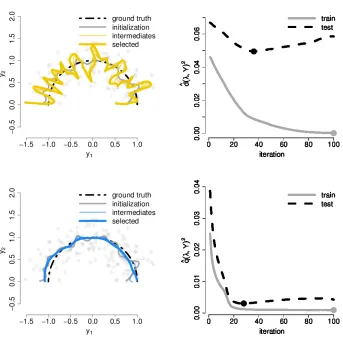
The empirical results bear out the theoretical arguments in Section 2: cross-validation for band-width selection forgandλis not feasible when minimizing projection distance. The minimization of ˆd(λ,Y)2with bandwidth selection tends towards curves with increased curvature, possibly
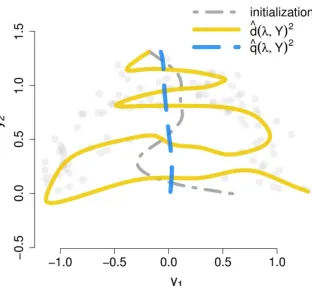
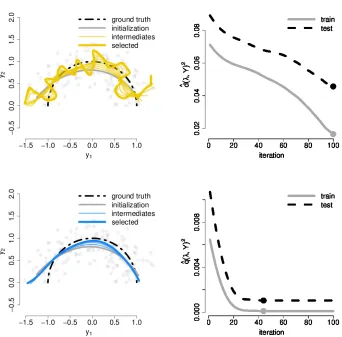
mov-ing away from a close by principal curve that is smoother than the initial curve (see Figures 3 and 5). Even starting from smooth curves cross-validation is not a reliable indicator for estimating a good, approximating principal curve (see Figure 4). This, empirically, demonstrates the saddle point nature of the critical points. Minimizing ˆq(λ,Y)mitigates these issues and shows a desirable objective-function landscape (see Figures 3, 4 and 5).
For minimizing ˆq(λ,Y)2stopping based on cross-validation data was unnecessary in all
numer-ical experiments—the test error follows closely in step with the training error. This nice property is not unexpected and hinges directly on the theoretical results of the new formulation to principal curves. Over-fitting in the case of minimizing ˆq(λ,Y)2requires aλwhich is close to orthogonal for
training data but not on the test data. However, the objective function ˆq(λ,Y)2 indicates no
pref-erence towards such a particular orthogonalλon the training data and does not express a desire to increase the length/complexity of the curve in order to achieve a minima. Furthermore, a minima ofq(λ,Y)2given the complete densitypis also a minima for the empirical objective ˆq(λ,Y)2on a
sample ofY. This is not true for the objective functiond(λ,Y)2or even for least squares regression
property of the proposed estimation scheme that a regularization-free minimum on the training data is typically a desirable principal curve.
3.2 Computational Considerations
The observation on the properties of the regularization suggest the optimization strategy of Z,σλ
andσgin Algorithm 1, which proves to be effective in practice (see Section 4). Data:Y
Result: Conditional expectation curve
InitializeZfromY ( isomap, PCA, LLE,. . .) ;
Initializeσλto averagek-nearest neighbor distance ofY; Initializeσgto averagek-nearest neighbor distance ofλ(Y); while qˆ(λ,Y)is improvingdo
while qˆ(λ,Y)is improvingdo
Gradient descent step inσλ; end
Gradient descent step inσg;
Gradient descent step inZ;
end
Algorithm 1:Conditional expectation curve optimization strategy
Various alternatives and extensions for the algorithm proposed here are possible, such as the choice of the conditional expectation estimator and the modeling ofλ. A naive implementation of the algorithm has a complexity ofO(n3md)per gradient descent step withnthe number of points,m
the intrinsic dimensionality of the manifold andd the ambient dimensionality. This can be reduced toO(nc2md)by taking advantage of local nature of the kernel based formulation for bothg anλ. For anyyiandzi only approximatelycdata points, withcdepending on the bandwidth parameter, are effectively contributing to the mapping. A detailed analysis of these run time complexity results is in Gerber et al. (2009). For further speed up one can consider reducing the number of parameters
Zin the mappingλ. The mapping complexity ofλonly depends on the complexity of the principal curve and can be independent of the number of data points. Since the complexity can conceiv-ably vary spatially, one should consider an adaptive algorithm that introduces more or lesscontrol points Zinλas required and varies the bandwidth spatially as well. While the spatial varying band-width is essentially included in the optimization through spreading the parametersZ differently, an implementation incorporating variable bandwidths is potentially more effective in practice.
4. Numerical Experiments
The numerical experiments illustrate the theoretical results on the critical point properties ofq(λ,Y)2
and d(λ,Y)2 using the estimation strategy proposed in Section 3. Gerber et al. (2009) report
extensive results on the optimization of ˆd(λ,Y)2 with equal or improved performance compared
to several principal curve algorithms in various settings. Thus, the comparison is representative to a typical principal curve estimation scheme based on minimizing the squared projection distance. The results demonstrate that automatic bandwidth selection leads to good results for ˆq(λ,Y)2, while
minimizing ˆd(λ,Y)2 shows the expected behavior of tending towards curves with high curvature
4.1 Conditional Expectation Curves in the Plane
Here we demonstrate the observations on optimization and bandwidth selection on a 2D data set generated bya(φ) = (sin(φ),cos(φ))t(1+ε). A 180 degree arc of radius one andε≈
N
(0,η2)nor-mal distributed noise added orthogonal to the arc. To generatendata pointsφis sampled uniformly on[0,π].
Figure 3 shows optimization results for n=150 andη=0.15 but with Z=sin(φ) initialized close to a principal component. Starting from bandwidthsσg=0.2 andσλ=0.1, the minimization
of ˆd(λ,Y) moves away from the principal component while ˆq(λ,Y) approximately recovers the principal component. These observations also hold for other bandwidth initializations.
Figure 3: Minimization of ˆd(λ,Y)2 and ˆq(λ,Y)2 starting from a curve close to a principal
compo-nent with bandwidths initialized toσg=0.2 andσλ=0.1.
Figures 4 and 5 show optimization results for n=150, η=0.25 and Z=φinitialized to the ground truth starting from different bandwidth initialization. Once again, minimizing ˆd(λ,Y)2
fa-vors curves with high curvature. The minimization of ˆq(λ,Y)2 moves towards the ground truth,
even for a small initial bandwidth.
The theoretical results give no guarantee/bounds on the radius of convergence around solutions. However,in all numerical experiments the optimization moved towards the anticipated solution.
4.2 Conditional Expectation Surfaces in 3D
The numerical results on algorithm behavior generalize to conditional expectation surfaces. This section replicates the results from Section 4.1 on the synthetic Swissroll data, a 2D-manifold in 3D-space (illustrated in Figures 6 and 7), commonly used to validate manifold learning techniques. The Swissroll is a parametric surfaces(h,φ) = (cos(φ)φ,h,sin(φ)φ). The data for the experiments are generated by drawing observations(hi,φi)∈H×Φ, withH= [0,4]andΦ= [π,3π]and adding
normal
N
(0,12)distributed noise orthogonal tos(hi,φi). Note, this induces a nonuniform sample ofthe Swissroll, where the density in the ambient space decreases with increasing radius.
Figure 6 shows results for minimizing ˆd(λ,Y)2and ˆq(λ,Y)2on a training sample withn=1000
Figure 4: Minimization of (top) ˆd(λ,Y)2and (bottom) ˆq(λ,Y)2with automatic bandwidth selection
starting fromσg=1 andσλ=0.1. (left) Fitted curve with optimization path and (right)
train and test error with points indicating minimal train and test error, respectively.
1D case in Section 4.1 holds. To qualitatively inspect the optimization, test data is created using points from a regular grid on H×Φ, again with normal
N
(0,12) noise orthogonal to the surfaceadded at each grid location.
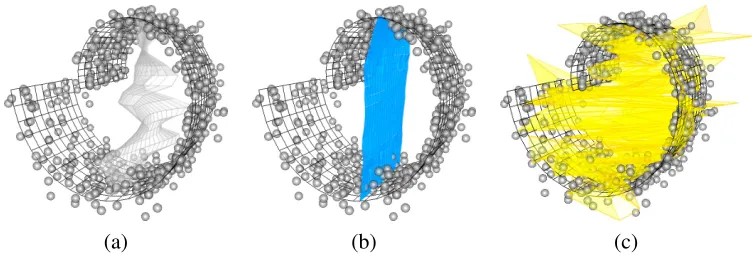
Figure 7 shows optimization results starting from a surface close to a principal plane. Band-widths are initialized by the average 75-nearest neighbor distance ofλ(Y) forσg and the average
25-nearest neighbor distance ofY forσλ. As in the 1D case ˆq(λ,Y)2 moves towards the principal
plane, while ˆd(λ,Y)2results in a highly curved fit that begins to fill the space. 4.3 Conditional Expectation Manifolds in Higher Dimensions
The final experiment reports results of fitting a 3D manifold on an image data set. The data set con-sists of 1965 images of a face with different facial expression with varying orientation. The images are 20×28 pixels with intensities in[0,255]and treated as points in a 560-dimensional Euclidean
Figure 5: Minimization of (top) ˆd(λ,Y)2and (bottom) ˆq(λ,Y)2with automatic bandwidth selection
starting fromσg=0.1 andσλ=0.1. (left) Fitted curve with optimization path and (right)
train and test error with points indicating minimal train and test error, respectively.
ˆ
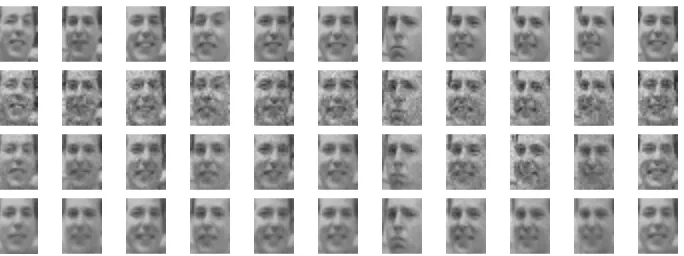
q2(λ,Y) and ˆd2(λ,Y) is optimized on the training data withZ initialized to a 3D isomap embed-ding. The optimization is stopped based on the objective function value of the test data. Figure 8 shows the original and noisy images and the projection on the conditional expectation manifold for each optimization. While the mean squared projection distance is similar for both solutions, the optimization ˆq2(λ,Y) leads to qualitatively much better results. This underscores the observa-tions in the introduction: mean squared error in itself is not a good indicator of model quality for nonparametric manifold estimation.
5. Conclusion
(a) (b) (c)
Figure 6: Optimization results on the Swissroll (wire frame). Projection g(λ(y))of (a) test data after minimization (on a separate training sample shown in Figure 7) of (b) ˆq(λ,Y)2and
(c) ˆd(λ,Y)2. A good estimate projects the noisy test data points, located orthogonal to the
wire frame, close to the intersections.
(a) (b) (c)
Figure 7: Minimization of (b) ˆq(λ,Y)2and (c) ˆd(λ,Y)2starting from an (a) initial surface close to
a principal plane.
problem of principal curve estimation into a well-posed, or at least stable, problem. A formal inves-tigation of the stability as defined in the framework of Mukherjee et al. (2006) could provide insight towards possible adaptations to other ill-posed problems.
Several important questions regarding the interplay between noise, curvature and sample size remain open. Of particular interest are the convergence rates of ˆq(λ,Y)toq(λ,Y)or error bounds on the corresponding conditional expectation curves. An analysis of the requirements imposed by projection distance, curvature and sample size onσλand implications on alternative formulations for modellingλis an interesting direction for future research.
Acknowledgments
Figure 8: Optimization results on (1st row) face data set. Test data (2nd row) with
N
(0,20)noise added, projected onto the conditional expectation manifold after minimization of (3rd row) ˆd(λ,Y)2and (4th row) ˆq(λ,Y)2on training data also withN
(0,20)noise added. ReferencesM. Belkin and P. Niyogi. Laplacian eigenmaps for dimensionality reduction and data representation.
Neural Computation, 15(6):1373–1396, 2003.
G. Biau and A. Fischer. Parameter selection for principal curves.IEEE Transactions On Information Theory, 58(3):1924 –1939, 2012.
K-Y. Chang and J. Ghosh. A unified model for probabilistic principal surfaces. IEEE Transaction On Pattern Analysis And Machine Intelligence, 23(1):22–41, 2001.
W. S. Cleveland. Robust locally weighted regression and smoothing scatterplots. Journal of the American Statistical Association, 74(368):829–836, 1979.
T. Duchamp and W. Stuetzle. Extremal properties of principal curves in the plane. The Annals of Statistics, 24(4):1511–1520, 1996.
H. Federer. Geometric Measure Theory. Springer, NY, 1969.
H. Flanders. Differentiation under the integral sign. The American Mathematical Monthly, 80(6): 615–627, 1973.
S. Gerber. Cems: Conditional Expectation Manifolds, 2011. URL
http://CRAN.R-project.org/package=cems. R package version 0.1.
S. Gerber, T. Tasdizen, and R. Whitaker. Dimensionality reduction and principal surfaces via kernel map manifolds. In IEEE 12th International Conference on Computer Vision, pages 529–536, 2009.
W. H¨ardle and J. S. Marron. Optimal bandwidth selection in nonparametric regression function estimation. Annals of Statistics, 13(4), 1985.
G. E. Hinton and R. R. Salakhutdinov. Reducing the dimensionality of data with neural networks.
Science, 313(5786):504 – 507, 2006.
B. K´egl, A. Krzyzak, T. Linder, and K. Zeger. Learning and design of principal curves. IEEE Transaction On Pattern Analysis Machine Intelligence, 22(3):281–297, 2000.
T. Kohonen. Self-organized Formation of Topologically Correct Feature Maps, pages 509–521. MIT Press, Cambridge, MA, USA, 1988.
P. Meinicke, S. Klanke, R. Memisevic, and H. Ritter. Principal surfaces from unsupervised kernel regression. IEEE Transactions on Pattern Analysis And Machine Intelligence, 27(9):1379–1391, 2005. ISSN 0162-8828.
S. Mukherjee, P. Niyogi, T. Poggio, and R. Rifkin. Learning theory: stability is sufficient for gener-alization and necessary and sufficient for consistency of empirical risk minimization. Advances in Computational Mathematics, 25:161–193, 2006.
E. A. Nadaraya. On estimating regression. Theory of Probability and its Applications, 9(1):141– 142, 1964.
S. Roweis and L. Saul. Nonlinear dimensionality reduction by locally linear embedding. Science, 290(550), 2000.
A. J. Smola, S. Mika, B. Sch¨olkopf, and R. C. Williamson. Regularized principal manifolds.Journal Of Machine Learning Research, 1:179–209, 2001.
J. B. Tenenbaum, V. de Silva, and J. C. Langford. A global geometric framework for nonlinear dimensionality reduction. Science, 290(550):2319–2323, 2000.
R. Tibshirani. Principal curves revisited.Statistics and Computing, 2:183–190, 1992.
H. Wang and T. C. M. Lee. Automatic parameter selection for a k-segments algorithm for computing principal curves. Pattern Recognition Letteerss, 27(10):1142–1150, 2006.