ISSN:2278 7496
FORMULATION DEVELOPMENT AND EVALUATION OF FAST DISSOLVING ORAL FILM OF A LIPID-LOWERING DRUG
Mohd. Adil Khan*1, Girijesh Kumar Pandey1, Amit Joshi1, B.K. Dubey2, Amit Kumar Jain1, Prabhat Jain3
1Technocrats Institute of Technology-Pharmacy Education and Research, Bhopal (M.P.)
2Technocrats institute of technology- pharmacy, Bhopal (M.P.)
3 Scan Research laboratories Bhopal (M.P.)
*Corresponding Author’s E mail: [email protected]
Received 22 Nov. 2018; Revised 28 Nov. 2018; Accepted 22 Dec. 2018, Available online 15 Jan. 2019. ABSTRACT
Recently, fast dissolving films are gaining interest as an alternative of fast dissolving tablets. The films are designed to dissolve upon contact with a wet surface, such as the tongue, within a few seconds meaning the consumer can take the product without need for additional liquid. This convenience provides both a marketing advantage and increased patient compliance. As the drug is directly absorbed into systemic circulation, degradation in gastrointestinal tract and first pass effect can be avoided. These points make this formulation most popular and acceptable among pediatric and geriatric patients and patients with fear of choking. Thus the objective of the present study was to formulate and evaluate fast dissolving oral films (FDOFs) of simvastatin to overcome the limitation of bioavailability and increase patient’s compliance. Simvastatin is an anti-hyperlipidemic drug, inhibits HMG CoA reductase enzyme and short half life (t1/2) and usually oral dose regimen (5 to 40 mg) taken to 4 times a day. In the present study oral films were prepared by solvent casting method using HPMC K15 as a film formers and PEG 400, glycerine as plasticizers and evaluated for mechanical properties, disintegration and in vitro dissolution. All formulations showed good mechanical properties and in vitro drug release. The optimized (F5) Formulation (HPMC K15, CCS and PEG 400) exhibited drug release of 98.78 % in 15 minutes which was significantly high when compared to other formulation. Fast dissolving films of Simvastatin can be considered suitable for clinical use to lower cholesterol and triglycerides level, where a quicker onset of action for a dosage form is desirable along with the convenience of administration.
Keywords: Simvastatin, Fast dissolving oral film, Bioavailability, Mechanical properties.
INTRODUCTION:
It is estimated that 26–50% of the patient population find difficulty in swallowing tablets and hard gelatin capsules 1. These patients mainly include the elderly who have difficulty taking conventional oral dosage forms because of hand tremors and dysphagia and pediatric patients who are often fearful of taking solid oral dosage forms owing to their underdeveloped muscular and nervous systems 2. In addition, patients who are mentally ill, developmentally disabled, uncooperative, on reduced liquid-intake plans or nauseated and travelers who may not have access to clean water also are candidates for FDOFs 3,4. The traditional alternative to swallowing difficulties is formulating a drug substance in liquid dosage form.
However, liquid dosage forms have several limitations, such as the need for measuring, bulkiness, physical, chemical and microbial stability issues, spoilage, inaccurate dosing and organoleptic properties of drug and drug formulations5. Conventional solid oral formulations contributed significantly to minimizing the shortcomings of liquid dosage forms. The crushing of tablets or opening of capsules is a straightforward way for patients or caregivers to lessen the swallowing difficulties. However, serious consequences may be associated with modified release, enteric-coated and cytotoxic or hormonal medicines, as these formulations are designed for special cases 6. Moreover, European Medical Agency does not recommend the splitting or crushing of tablets because the active pharmaceutical ingredient (API) is not evenly distributed in the tablet 7,8. Thus, it is very convenient to develop a formulation that disintegrates in the oral cavity and eases the swallowing process. In recent years, fast dissolving oral formulations established their importance in patient population suffering from dysphagia, stroke, thyroid disorder, Parkinson’s disease, multiple sclerosis and cerebral palsy9. Commercially available
The inhibition of the HMG-CoA causes a decrease in LDL, low-density lipoprotein (20-40%), triglycerides (10–20 %), while it increases HDL, high-density lipoprotein (5-15%) and LDL receptor expression. Due to this fact these compounds are the most commonly prescribed drugs for the prevention of atherosclerosis and heart disease, both as a prodrug or non-modified form. The fact that they can be used after heart attack and in co-existence of diabetes as well as in kidney dysfunction gives statins the status of a first choice drug. However, overdose of statins causes an increase of amino transferases concentration which can lead to myopathy. Simvastatin is a powerful lipid-lowering drug that can decrease low density lipoprotein (LDL) levels by up to 50%. It is used in doses of 5 mg up to 80 mg. Higher doses (160 mg) have been found to be too toxic, while giving only minimal benefit in terms of lipid lowering. Its act by inhibiting 3-hydroxy-3- methylglutaryl coenzyme A HMG-CoA reductase, the rate limiting enzyme of the HMG-CoA reductase pathway, the metabolic pathway responsible for the endogenous production of cholesterol. Statins are more effective than other lipidregulating drugs at lowering LDL-cholesterol concentration but they are less effective than the fibrates in reducing triglyceride concentration 16-19. Initial investigations were focused on the development of placebo fast dissolving films with good peel ability, appearance and a quick disintegration time. After choosing the components for the placebo film, simvastatin loaded films were formulated. Although, fast dissolving film is an attractive dosage form for the delivery of simvastatin. Finally fast dissolving films using HPMC and CCS were formulated and evaluated.
MATERIALS AND METHODS
Materials
Simvastatin were obtained as pure sample from Aristo Pharmaceuticals Limited, Mandideep, Bhopal (MP), India as gift samples along with their analytical reports. HPMC K15M, PEG-400, SSG, CCS was obtained from Mapromax, Life sciences Pvt. Ltd. Dehradun. Aspartame, citric acid was obtained from Loba Chemical Pvt Ltd (Mumbai, India). Hydrochloric acid was obtained from S. D. Fine Chem. Ltd., Mumbai. All other chemical were purchased from Hi Media, Mumbai. Double distilled water was prepared freshly and used whenever required. All other chemicals used in this study including those stated were of analytical reagent (A.R.) grade.
Drug-excipient compatibility study
spectra of all the samples were recorded over a spectral region from 4700 to 400 cm-1 using 20 scans with 4 cm-1 resolution.
Preparation of oral films
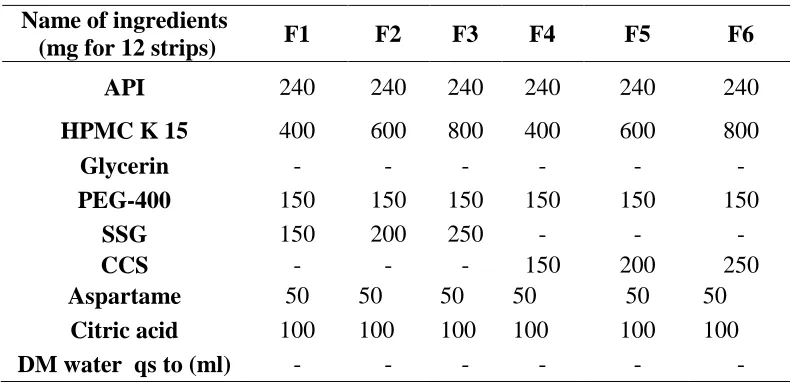
Drug (Simvastatin) containing fast dissolving films were fabricated by the solvent casting method. The optimized amount of HPMC was dissolved in 5ml of water and stirrer continuously for 1 hour, optimized amount of plasticizer and drug were dissolved in 95 % ethanol and then added to the polymeric solution, polymeric solution was stirred for 30 min using magnetic stirrer and was kept in undisturbed condition till the entrapped air bubbles were removed. The aqueous solution was casted in a glass moulds having 2.5 x 2.5 cm, 10 films area and was dried at controlled room temperature (25-30°C, 45 % RH) as well as at increased temperature (microwave oven). The film took approximately 48 hr to dry at controlled room temperature. The dried film was carefully removed from the glass plates and was cut into size required for testing. The films were stored in air tight plastic bags till further use. Formulations were prepared using HPMC K15, PEG-400, SSG and CCS at different drug: polymer ratios. The compositions of the formulations were shown in table 1.
Table 1 Formulation of simvastatin oral fast dissolving films
Name of ingredients
(mg for 12 strips) F1 F2 F3 F4 F5 F6
API 240 240 240 240 240 240
HPMC K 15 400 600 800 400 600 800
Glycerin - - - -
PEG-400 150 150 150 150 150 150
SSG 150 200 250 - - -
CCS - - - 150 200 250
Aspartame 50 50 50 50 50 50
Citric acid 100 100 100 100 100 100
DM water qs to (ml) - - - -
Evaluation
The formulations were evaluated by the following tests.
Thickness
Weight variation
For each formulation, three randomly selected patches were used. For weight variation test, 10 films from each batch were weighed individually by digital electronic balance and the average weight was calculated.
Drug content analysis
The patches (n = 3) of specified area were taken into a 10 ml volumetric flask and dissolved in methanol and volume was made up with 10 ml methanol. Subsequent dilutions were made and analyzed by UV spectrophotometer at 225nm.
Folding endurance
This was determined by repeatedly folding one film at the same place until it broke. The number of times the film could be folded at the same place without breaking cracking gave the value of folding endurance.
Percentage of moisture content
The films were weighed individually and kept in desiccators containing activated silica at room temperature for 24 hrs. Individual films were weighed repeatedly until they showed a constant weight. The percentage of moisture content was calculated as the difference between initial and final weight.
In vitro dissolution study
The in vitro dissolution test was performed using the USPXXX dissolution apparatus II (Paddle with sinker). The dissolution studies were carried out at 37±0.5°C; with stirring speed of 50 rpm in 900 ml phosphate buffer (pH 6.8). Film size required for dose delivery (2.5×2.5 cm2) was used. Five ml aliquot of dissolution media was collected at time intervals of 1, 2, 5, 10 and 15 minutes and replaced with equal volumes of phosphate buffer (pH 6.8). The collected samples were filtered through 0.45 μm membrane filter and the concentration of the dissolved simvastatin was determined using UV-Visible spectrophotometer at 225nm. The results were presented as an average of three such concentrations.
Stability studies
Stability studies were carried out with optimized formulation which was stored for a period of one, two and three months at 40±2oC temperature and 75±5% relative humidity for a period 3 months. The % Assay of formulation was determined by U.V. spectrophotometer using calibration curve method. The % assay of film was found to slightly decrease at higher temperature.
Physical appearance and texture analysis of the films
These parameters were checked simply with visual infection of films and by feel or touch.
In vitro disintegration
Measurement of mechanical properties
Microprocessor based advanced force gauge tensiometer (DS 2 series) equipped with a 50 kg load cell was used to determine the mechanical properties of OFDFs. Film of 60x10 mm2 was fixed between two clamps separated by a distance of 3 cm 20. The lower clamp was held stationary and the strips were pulled apart by the upper clamp moving at a rate of 2 mm/sec until the strip broke. The force and elongation of the film at the point when the strip broke was recorded. The tensile strength and percent elongation values were calculated using the following formula.
Tensile strength = load at breakage/film thickness × film width
% Elongation = increase in length ×100/original length
RESULTS AND DISCUSSION
Fig. 1 FT-IR Spectrum of pure drug
Fig. 2 FT-IR Spectrum of drug and excipients
Table 2 Result of general appearance, thickness, weight variation and % Assay
Table 3 Result of folding endurance, disintegrating time, tensile strength &% of moisture content
F. Code
Folding endurance
(Times)
Disintegrating time (Sec.)
Tensile strength
kg/cm2
%o Moisture
Content
F1 104.33 ± 9.87 120±10 0.985±0.065 0.521±0.45
F2 106.25 ± 4.56 145±11 0.965±0.045 0.458±0.32
F3 100.33 ± 7.67 113±15 0.978±0.078 0.325±0.36
F4 112.02 ± 8.55 115±13 0.985±0.045 0.748±0.41
F5 120.35 ± 6.45 105±14 1.012±0.063 0.658±0.25
F6 118.66 ± 5.29 135±15 1.054±0.078 0.741±0.74
F. Code
General Appearance
Thickness in µm
Weight(mg) Mean ± S.D
% Assay
F1 Translucent 92±4 92±4 96.45±2.12
F2 Translucent 95±6 98±3 97.89±1.45
F3 Translucent 96±5 95±4 96.45±1.21
F4 Translucent 98±8 92±5 97.25±1.78
F5 Translucent 96±7 96±4 98.65±1.32
Fig. 3 Graph of In vitro drug release study of optimized formulation F5
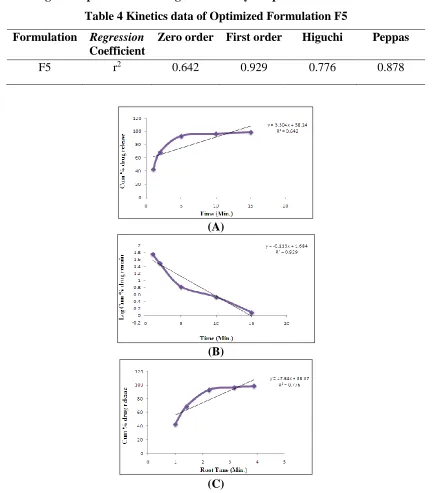
Table 4 Kinetics data of Optimized Formulation F5
Formulation Regression
Coefficient
Zero order First order Higuchi Peppas
F5 r2 0.642 0.929 0.776 0.878
(A)
(B)
(D)
Fig.4 (A) Zero order (B) First order (C) Higuchi release (D) Korsmeyer-Peppas release kinetics of
optimized formulation F5
CONCLUSION
From present study it can be concluded that oral fast dissolving films are superior in drug release. The films prepared by HPMC and PEG 400 had shown good mechanical strength, drug release, disintegration time and stability. F5 formulation is considered as the best according to the obtained results with less disintegrating time and complete drug release in 15 min. Percent drug release and disintegration time was taken as responses for study which were found within the accepted ranges. As the concentration of CCS was increased, both the disintegration and the drug release rates increased. The disintegration and release rates were found to be faster for films prepared with lowest concentration of HPMC along with maximum concentration of superdisintegrants. Simvastatin administered in the form of fast dissolving films will be potential novel drug dosage form for pediatric, geriatric and also for general population by providing faster release and better patient compliance.
REFERENCES
1. Andersen O, Zweidorff OK, Hjelde T and Rodland EA. Problems when swallowing tablets. A questionnaire study from general practice, Tidsskrift for den Norske laegeforening: tidsskrift for praktisk medicin, ny raekke. 1995; 115: 947–949.
2. Slowson M and Slowson S. What to do when patients cannot swallow their medications, Pharma Times. 51: 90–96.
3. Chang RK, Xiaodi G, Burnside BA and Couch RA. Fast-dissolving tablets, Pharmaceut. Technol. 2000; 24:52–58.
4. Lindgreen S and Janzon L. Dysphagia: Prevalence of swallowing complaints and clinical findings, Med. Clin. North. Am. 1993; 77: 3–5.
5. Shahiwala A. Formulation approaches in enhancement of patient compliance to oral drug therapy. Expert. Opinion Drug Deliv. 2011; 8:1521–1529.
7. Shah RB, Collier JS, Sayeed VA, Bryant A, Habib MJ and Khan MA. Tablet splitting of a narrow therapeutic index drug: a case with levothyroxine sodium, Aaps Pharmscitech. 2010; 11: 1359–1367. 8. Zhao N, Zidan A, Tawakkul M, Sayeed VA and Khan M. Tablet splitting: product quality assessment
of metoprolol succinate extended release tablets. Int. J. Pharmaceut. 2010; 401:25–31.
9. Badgujar BP and Mundada AS, The technologies used for developing orally disintegrating tablets: a review, Acta Pharmaceut. 2011; 61:117–139.
10.Pimparade MB, Morott JT, Park JB, Kulkarni VI, Majumdar S, Murthy S, Lian Z, Pinto E, Bi V and Durig T. Development of taste masked caffeine citrate formulations utilizing hot melt extrusion technology and in vitro–in vivo evaluations. Int. J. Pharmaceut. 2015; 487:167–176.
11.Slavkova M and Breitkreutz J. Orodispersible drug formulations for children and elderly, Eur. J. Pharm. Sci. 2015;75:2–9.
12.Dahiya M, Saha S and Shahiwala AF. A review on mouth dissolving films, Curr. Drug Deliv. 2009; 6:469–476.
13.Reiner V, Giarratana N, Monti NC, Breitenbach A and Klaffenbach P. Rapidfilm: an innovative pharmaceutical form designed to improve patient compliance. Int. J. Pharm. 2010; 393: 55–60. 14.Dixit RP and Puthli SP. Oral strip technology: overview and future potential. J. Controll. Release:
official journal of the Controlled Release Society. 2009; 139: 94–107.
15.Low AQ, Parmentier J, Khong YM, Chai CC, Tun TY, Berania JE, Liu X, Gokhale R and Chan SY. Effect of type and ratio of solubilising polymer on characteristics of hot-melt extruded orodispersible films. Int. J. Pharm. 2013; 455: 138–147.
16.Naga KR, Sudheer B, Jyothi R and Prathyusha S. Spectrophotometric Methods For Estimation Of Simvastatin In Bulk Drug And Its Dosage Form. International Journal of Pharmaceutical, Chemical and Biological Sciences. 2012; 2(1): 124-129.
17.Guzik L, Mrozik W and Kamysz W. Determination of Simvastatin in Pharmaceutical Dosage Forms by Optimized and Validated Method Using HPLC/UV. Croatica Chemica Acta, 2010; 83(4): 371– 377.
18.Jang SB, Lee YJ, Lim LA, Park KM, Kwon JB, Woo JS, Kim YI, Park MS, Kim KH and Park K. Pharmacokinetic Comparison of Controlled-Release and Immediate-Release Oral Formulations of Simvastatin in Healthy Korean Subjects: A Randomized, Open-Label, Parallel-Group, Single- and Multiple-Dose Study. Clinical Therapeutics. 2010; 32(1): 206- 216.