Available Online at www.ijpret.com 48
INTERNATIONAL JOURNAL OF PURE AND
APPLIED RESEARCH IN ENGINEERING AND
TECHNOLOGY
A PATH FOR HORIZING YOUR INNOVATIVE WORKAN EVALUATION OF TRANSITION TEMPERATURE T
CAND EVALUATION OF
PRESSURE AND VOLUME DEPENDENT
(
𝒅𝑻𝒄𝒅𝒑
) , (
𝒅𝑻𝒄𝒅𝒗
)
, ISOTOPE COEFFICIENT (α)
AND ENERGY GAP PARAMETER (Δ) FOR ALKALI METAL DOPED FULLERIDE K
3C
60 ASHOK KUMAR PATHAK1, SHYAMJEE MISHRA2, L. K. MISHRA31. s/o Shree V. N. Pathak, S.S.+2 High School, Kasmar, Bokaro-829115(Jharkhand) 2. Department of Physics, M.V. College, Buxar (Bihar)
3. Department of Physics, Magadh University, Bodh-Gaya-824234 (Bihar)
Accepted Date: 30/08/2016; Published Date: 01/09/2016
\
Abstract: - Using theoretical formalism of Kresin(1987& 1991) which is based on the contribution of intermolecular and interamolecular phonon interaction, we have evaluated transition temperature of alkali doped fluoride K3C60 .Our theoretical results matches with the experimental data and with other theoretical
workers. We also observed that coulomb repulsive parameter µ*plays an important role in the evaluation if
transition temperature TC alkali doped fluoride. We have also evaluated pressure and volume dependent
transition temperature, isotope coefficient and energy gap parameter for alkali doped fullerides. Our theoretical results indicate that variation of TC with pressure depends upon the variation of density of state at
the Fermi level, the Coulomb potential and the characteristic phonon frequency. On the other hand for the volume dependent TC , our theoretical results indicate that it depends upon the three factors (a) screening
parameter µ* (b) intermolecular vibration mode (c) intramolecular phonon coupling strength ra.
Keywords: Intermolecular and interamolecular phonons, alkali doped fluorides, transition temperature, TC
renormalized repulsive parameter µ*, isotope coefficient α, Isotopic mass dependent transition temperature,
Soft optical intermolecular phonon, Thermal compressibility, Logarithmic volume derivative.
Corresponding Author: MR. ASHOK KUMAR PATHAK Access Online On:
www.ijpret.com
How to Cite This Article:
Ashok Kumar Pathak., IJPRET, 2016; Volume 5 (1): 48-62
Available Online at www.ijpret.com 49
INTRODUCTION
Buckminster fullerenes are known to make compounds with alkali metals intensively studied
mainly due to superconductivity and the variation of compounds.1-3 Neutron inelastic scattering
measurement probes that the vibrational spectrum may be conveniently divided into two
regions. One of them belongs to the rotation of C60 molecule and the intermolecular vibrations
(~2.5- 2.5meV) and the others are the interamolecular mode. The wide frequency range of phonon spectrum however raises an important issue to clarify which of these molecular phonon modes induce the superconductivity in doped fluoride. The dispersion relation for the interamolecular phonon modes originate due to displacement of C60 molecule or K+ ions in
doped fluorides. It is evident from the eigen frequencies that these corresponds to the
interamolecular acoustic and alkali C60 optical modes in the long wavelength (q → 0), the mass
of three alkali metals (K) is used as 0.17 amu. The interamolecular alkali (C60) optic mode of ωer
is 7.84 meV at q → 0. The electron density η (= 4 3/a3) is estimated4 as 4.12×1021 cm-3 from
𝑡ℎ𝑒 lattice parameters a=14.28 A°. The band structure value of mass =0.3me is used5. Electon
parameters as Fermi velocity 𝜈F (= 1.91 107 cms-1) Fermi wave vector (qp =0.496 A-1) and plasma
frequency (=1.37eV)6. The electron phonon coupling strength (λ
er) is obtained as 1.2. The
dimensionless electron-phonon coupling strength as estimated by Gunnarson7 is about 0.5-1.0.
Earlier calculations by Zhang etal8 indicates that the alkali phonons could contributes an
attractive interactions of the order of 0.9 eV, which corresponds to λ≅ 2.0 i.e. strong coupling limit.
The energy scale of the various phonon modes that mediate the electron- phonon Coupling is different because of the isotopic mass dependent transition temperature. The
carbon isotopic effect demonstrate 4 α
c=0.30 ± 0.05, which 100% substitution of 6c13 for 6c
12.This naturally favours the phonon mediated pairing and ruled out electronic in origin.
Further investigation shows that it is an alkali metal isotope effect not the carbon isotope effect. This has identified that it is an inter or intera molecular phonon mode that induce the superconductivity in fullerides9.
In this paper taking the theoretical formalism of Kresin10, we have theoretically
evaluated the transition temperature of alkali doped fulleride particularly K3C60. Our
theoretically evaluated results are in good agreement with the experimental data as well as
with the other theoretical workers.11-13 . We have also evaluated pressure and volume
dependent transition temperature isotope coefficient and energy gap parameter for alkali doped fullerides. Our theoretical result indicates that variation of Tc with pressure depends
Available Online at www.ijpret.com 50
characteristic phonon frequency. On the other hand for the volume dependent Tc, our
theoretical results indicates that it depends upon the three factors (a) screening parameter μ*
(b) intermolecular vibration mode (c) intramolecular phonon coupling strength λra. .
Our theoretical results for isotope coefficient α indicates that it decreases with screening
parameter μ*, energy gap parameter β depends upon the Fermi velocity 𝜈F and a coherence
length ξ0, alkali metal doped fulleride, the coherence length ξ0 is small but larger than inverse
Fermi momentum.
1.0 MATERIALS AND METHODS
We have taken renormalized coulomb repulsive parameter µ*, which signifies the role of the
intermolecular alkali C60optical phonon frequency. Here the coupling strength (λ>1) and µ*=0.9,
which gives the characteristic phonon frequency (ωer=7.84)
One takes the theoretical formalism developed by Kresin10,11 where transition temperature is
written as
Tcer = 0.25ωer[exp(2/λeff)- 1]-1/2 (I)
λeff = ( λer-µ* ) [1+2µ*+ λerµ* t( λer) ]-1 (2)
t (λer) = 1.5exp (- 0.28λer) (3)
The effective coupling constant, λeff, deduced as 0.62 for the numerical t (λer) value 1.07 with
λer= 1.2 and Tcer is estimated as ≅ 5 K which is much lower than reported experimental data of
about 18 K. The low value of Tc is due to the fact that the vibrations developed due to lattice deformations, i,e the soft optical intermolecular phonons are considered. The above approach
with intermolecular phonons does not explain a medium Tc in K3 C 60. It is essential to seek the
role of the high energy phonons to assess the reported value.
An analytic result for Tc is employed by incorporating the simultaneous presence of both
inter and intra molecular fluorides. Now the above formula given in equation (I) is modified by the simultaneous use of both inter and intramolecular phonon
Tc=Tcer [ωra/ Tcer]χ (4)
with χ = λra[λra+λer]-1
Available Online at www.ijpret.com 51
λ
ra= ℏ 2K
βTτ
⁄ (5)
τ = 1.2 × 10⁻⁴
λ ra=0.4
To analyze the pressure dependence of Tc in K3C60
systems, one begin with TC expression (Kresin)10,11
Now
𝑑𝑙𝑛𝑇𝑑𝑝𝑐= [1 − 𝜆𝑟𝑎 𝜆𝑟𝑎 +𝜆𝑒𝑟]
𝑑𝑙𝑛𝑇𝑐𝑒𝑟
𝑑𝑝 +
[ln𝜔𝑟𝑎− 𝑙𝑛𝑇𝑐𝑒𝑟] d
dp[ 𝜆𝑟𝑎 𝜆𝑟𝑎 +𝜆𝑒𝑟] + [
𝜆𝑟𝑎 𝜆𝑟𝑎 +𝜆𝑒𝑟]
d l n𝜔𝑟𝑎
𝑑𝑃 (6)
keeping in mind that C60 molecules are extremely rigid and hence neglecting the pressure
induced effect of intramolecular phonons,
d l n𝜔𝑟𝑎
𝑑𝑃 =
d 𝜔𝑟𝑎
𝑑𝑃 = 0 (7)
Then equation (6) assumes the form
𝑑𝑙𝑛𝑇𝑐
𝑑𝑝 = [1 −
𝜆𝑟𝑎 𝜆𝑟𝑎 +𝜆𝑒𝑟]
𝑑𝑙𝑛𝑇𝑐𝑒𝑟
𝑑𝑝 +
1 (𝜆𝑟𝑎 +𝜆𝑒𝑟)2
[ln (𝜔𝑟𝑎
𝑇𝑐𝑒𝑟)] [𝜆𝑒𝑟 𝜆𝑟𝑎
dP − 𝜆𝑒𝑟+
𝑑𝜆𝑒𝑟
𝑑𝑃 ] (8)
Furthermore, 𝑑𝑙𝑛𝑇𝑐 𝑑𝑝 = 𝜕𝑙𝑛𝑇𝑐𝑒𝑟 𝜕𝜆𝑒𝑟 𝜕𝜆𝑒𝑟 𝑑𝑃 + 𝜕𝑙𝑛𝑇𝑐𝑒𝑟 𝜕𝜔𝑒𝑟 𝜕𝜔𝑒𝑟 𝑑𝑃 + 𝜕𝑙𝑛𝑇𝑐𝑒𝑟 𝜕𝜇∗ 𝜕𝜇∗
𝑑𝑃 (9)
Now one uses Kresin Tc expression10,11
𝑇𝑐 = 0.25𝜔𝑒𝑟[exp (2 𝜋⁄ 𝑒𝑓𝑓) − 1]
−1 2 ⁄
(10)
where
𝜆𝑒𝑓𝑓 = (𝜆𝑒𝑓𝑓−𝜇∗) [1 + 2𝜇∗+ 𝜆𝑒𝑟𝜇∗𝑡(𝜆𝑒𝑟)]−1 (11)
Available Online at www.ijpret.com 52
𝑡(𝜆𝑒𝑟) = 1.5 exp. (−0.28𝜆𝑒𝑟) (12)
𝜆𝑒𝑓𝑓 =0.62
𝜆𝑒𝑟 = 1.2
we get the following results
Now
𝑑𝑙𝑛𝑇𝑑𝜆𝑐𝑒𝑟
𝑒𝑟 𝜕𝜆𝑒𝑟
𝑑𝑃 = 𝐷11
𝑑 𝑙𝑛𝜆𝑒𝑟
𝑑𝑃 (13)
where
𝐷11 =𝜆𝑒𝑟(1+2𝜇∗+1.07𝜇∗2)
(𝜆𝑒𝑟−𝜇∗)2 [
1 + {exp (2+4𝜇∗+2.14𝜆𝑒𝑟𝜇∗
𝜆𝑒𝑟−𝜇∗ )}
−1
+ {exp (2+4𝜇∗+2.14𝜆𝑒𝑟𝜇∗
𝜆𝑒𝑟−𝜇∗ )}
−2] (14)
Now ones the following
𝑑𝑙𝑛𝑇𝑐𝑒𝑟 𝜕𝜔𝑒𝑟
𝜕𝜔𝑒𝑟
𝑑𝑃 =
𝑑 𝑙𝑛 𝜔𝑒𝑟
𝑑𝑃 (15)
and
𝑑𝑙𝑛𝑇𝑐𝑒𝑟
𝜕𝜇∗
𝜕𝜇∗
𝑑𝑃 = 𝐷12
𝑑𝜇∗
𝑑𝑃 (16)
where
𝐷12 =
𝜆𝑒𝑟(1+2𝜇∗+1.07𝜇∗2) (𝜆𝑒𝑟−𝜇∗)2 [
1 + {exp (2+4𝜇∗+2.14𝜆𝑒𝑟𝜇∗
𝜆𝑒𝑟−𝜇∗ )}
−1
+ {exp (2+4𝜇∗+2.14𝜆𝑒𝑟𝜇∗
𝜆𝑒𝑟−𝜇∗ )}
−2] (17)
Combining these, one writes
𝑑𝑙𝑛𝑇𝑐
𝑑𝑝 = 𝐷11
𝑑 𝑙𝑛𝜆𝑒𝑟
𝑑𝑃 +
𝑑 𝑙𝑛𝜔𝑒𝑟
𝑑𝑃 + 𝐷12 𝑑 𝑙𝑛𝜇∗
𝑑𝑃 (18)
The first and the third terms are dependent on the variation on the with Ν(𝜀𝐹) pressure.
One proceeds for further calculations by using the reported value13 of B, 13.18
Available Online at www.ijpret.com 53
𝑘T (~𝐵 𝑎−1) is a thermal compressibility. Deduced value of dln(Ν(𝜀𝐹)/dp is about 5.058 %
(GPA)–1 . Kerkoud and coworkers14 reported a rate of about ~ − 10 % (GPA)–1 from NMR
technique although of limited accuracy.
Now we have electron- phonon coupling strength 𝜆𝑒𝑟 as
𝜆𝑒𝑟 =
Ν(𝜀𝐹)〈𝐼2〉
Mred〈ωer2 〉 (19)
where 〈𝐼2〉 is a mean square electron ion matrix elementM
red is the reduced molecular mass
and 〈ωer2 〉 is an averaged square molecular vibration frequency .
One has
〈𝐼2〉 = ∫2𝑘𝐹𝑞3
0 𝑑𝑞
|𝑉(𝑞)|
∫2𝑘𝐹𝑞𝑑𝑞
0
⁄ (20)
V(q) is the screened coulomb potential
From (19) and (20) one has
𝑑 𝑙𝑛𝜇∗
𝑑𝑃 =
𝑑𝑙𝑛Ν(𝜀𝐹)
𝑑𝑃 (
𝜇∗ 𝜇) − 𝜇
∗ [2𝑑𝑙𝑛𝜔𝑝
𝑑𝑃 −
𝑑𝑙𝑛𝑁(𝜀𝐹)
𝑑𝑃 −
𝑑𝑙𝑛𝜔𝑒𝑟
𝑑𝑃 ] (21)
𝑑 𝑙𝑛𝜆𝑒𝑟
𝑑𝑃 =
𝑑𝑙𝑛𝑁(𝜀𝐹)
𝑑𝑃 −
𝑑𝑙𝑛⟨𝜔𝑒𝑟2 ⟩
𝑑𝑃 (22)
Herein the pressure dependence of the quantity 〈𝐼2〉 has been neglected as the
mean-square electron-ion matrix element is independent of phonon frequencies. Assuming that delta functions entering the integrals do not vary much under pressure, one neglects the pressur dependence of the quantity 〈𝐼2〉 .
Using (21) and (22) into (20), one obtains
𝑑𝑙𝑛Tcer
𝑑𝑃 = [𝐷11+ 𝐷12 s ( 𝜇∗
𝜇) + 𝐷12𝜇
∗]𝑑𝑙𝑛𝑁(𝜀𝐹) 𝑑𝑃
+[1 + 𝐷12𝜇∗− 2𝐷11]𝑑𝑙𝑛〈𝜔𝑒𝑟〉
𝑑𝑃 − 𝐷12𝜔 ∗ 𝑑𝑙𝑛𝜔𝑝
𝑑𝑃 (23)
In order to make progress one assumes d ln λer / dP ≈ d ln N(εF ) / dP, d ln (ωer)2/ dP ≈2d ln
(ωer) / dP and d ln (ωer)/ dP ≈ d ln (ωer) / dP. The free electron estimate for d ln ωp / dP =1/2
yields a value of about 3.79 % (GPA)-1. One follows 𝛄
G = +2 as reported earlier15. The
Available Online at www.ijpret.com 54
value of λ=1.2, 𝝁=0.75 and μ*=0.19. Using (6) to (23) one finds the value of (𝑑 𝑙𝑛)𝜇 ∗/𝑑𝑃 =
−0.78 % (GPA)-1, dln λ
er/ dP = −35.39 (GPA)-1, d ln λer /dp = −5.05 % (GPA)-1, dln Tcer/dP is –
45.64 % (GPA)-1, dln T
c/ dP = - 39.60 (GPA)-1, and slope d tc/ dP = - 8 .7 K/ GPa which is
consistent with the earlier reported value16,17 of -7.8 K/ GPa.
Volume Dependent Transition Temperature
One now explore one’s efforts in studying the volume derivative of Tc or dTc /dV. One notes
that due to extreme rigidity of C60 the compression contracts the weak intermolecular bonds
and high- energy intramolecular bonds are unaffected.
Now one uses equations for Tc given in equation (1) and (2) and obtained 𝑑𝑇𝑑𝑉 𝑐 as
𝑑𝑇 𝑐 𝑑𝑉 = 𝑇𝑐 𝑒𝑟 𝑑 𝑑𝑉 [ 𝜔𝑟𝑎 𝑇𝑐𝑒𝑟] 𝜒 + [𝜔𝑟𝑎 𝑇𝑐𝑒𝑟] 𝜒 𝑑𝑇𝑐𝑒𝑟
𝑑𝑉 (24)
One further writes
𝑑𝑇𝑐
𝑑𝑉 = (1 − 𝜒) [ 𝜔𝑟𝑎 𝑇𝑐𝑒𝑟]
χ 𝑇
𝑐𝑒𝑟 (25)
Herein, it is assumed that intramolecular phonons are independent in any change of the volume
𝑑𝑙𝑛𝜔𝑟𝑎
𝑑𝑉 =
𝑑𝜔𝑟𝑎
𝑑𝑉 = 0 (26)
Following eq.(8) ones write
𝑑𝑇𝑐𝑒𝑟
𝑑𝑉 =
o.25
[𝑒𝑥𝑝(2 𝜆⁄ 𝑒𝑓𝑓)−1] 1
2 ⁄ ×
𝑑𝜔𝑟𝑎
𝑑𝑉 +
exp(2 𝜆⁄ 𝑒𝑓𝑓)
[𝑒𝑥𝑝(2 𝜆⁄ 𝑒𝑓𝑓)−1] 3 2 ⁄ × ( 0.25𝑑𝜔𝑒𝑟 𝜆2 𝑒𝑓𝑓 ) 𝜆𝑒𝑓𝑓
dv (27)
where
𝜆dv𝑒𝑓𝑓 = (1 + 2μ∗ + μ∗2 t(𝜆 𝑒𝑟))
𝜆𝑒𝑟
dv +
(μ∗ 𝜆
𝑒𝑟− μ∗ 𝜆2𝑒𝑟) dt(𝜆𝑒𝑟)
dV −
(1 + 2𝜆𝑒𝑟+ 2𝜆𝑒𝑟2t(𝜆𝑒𝑟))dμ∗
Available Online at www.ijpret.com 55
Using (27) and (28), one writes
𝑑𝑇𝑐
𝑑𝑉 = 𝐷21
𝑑𝜔𝑒𝑟
𝑑𝑉 + 𝐷22
𝑑𝜆𝑒𝑟
𝑑𝑉 + 𝐷23
𝑑𝑡(𝜆𝑒𝑟)
𝑑𝑉 − 𝐷24
𝑑𝜇∗
𝑑𝑉 (29)
Here one defines,
𝐷21 =𝑉00{
o.25
[𝑒𝑥𝑝(2 𝜆⁄ 𝑒𝑓𝑓)−1] 1
2
⁄ } (30)
𝐷22 = 𝑉00 { exp(2 𝜆⁄ 𝑒𝑓𝑓)
[𝑒𝑥𝑝(2 𝜆⁄ 𝑒𝑓𝑓)−1] 3
2
⁄ ×
0.25𝑑𝜔𝑒𝑟
𝜆2
𝑒𝑓𝑓 } (31)
(1 + 2μ∗ + μ∗2 t(𝜆𝑒𝑟))
𝐷23= 𝑉00 { exp(2 𝜆⁄ 𝑒𝑓𝑓)
[𝑒𝑥𝑝(2 𝜆⁄ 𝑒𝑓𝑓)−1] 3
2 ⁄ ×
0.25𝑑𝜔𝑒𝑟
𝜆2
𝑒𝑓𝑓 } (32)
(μ∗ 𝜆
𝑒𝑟− μ∗ 𝜆2𝑒𝑟)
𝐷24 = 𝑉00 { exp(2 𝜆⁄ 𝑒𝑓𝑓)
[𝑒𝑥𝑝(2 𝜆⁄ 𝑒𝑓𝑓)−1] 3
2 ⁄ ×
0.25𝑑𝜔𝑒𝑟
𝜆2
𝑒𝑓𝑓 } (33)
(1 + 2𝜆𝑒𝑟+ 2𝜆2𝑒𝑟t(𝜆𝑒𝑟))
where
𝑉00 = (𝜔𝑟𝑎⁄𝑇𝑐𝑒𝑟) 𝜆𝑟𝑎
𝜆𝑒𝑟 +𝜆𝑟𝑎 (1 − 𝜆𝑟𝑎
𝜆𝑒𝑟 +𝜆𝑟𝑎) (34)
Furthermore the logarithmic volume derivative of the coupling constant
parameter 𝜆𝑒𝑟 follows
Φ = 𝑑𝑙𝑛𝜆𝑒𝑟
𝑑𝑙𝑛𝑉 = 𝐵
𝑑𝑙𝑛(𝜀𝐹)
𝑑𝑃 + 2𝛾𝐺
With the value of B,dln N(εF)/dP, dln〈𝜔〉/dP discussed earlier, one finds Φ=3.3 for K3C60. To
ascertain the physical significance of the volume derivative of TC one estimates the parameter
as D21= 0.16, D22= 70.6, D23= - 2.7 and D24= - 323 from the earlier mentioned values of various
coupling strengths. Looking to (27), dTC/dV is being influenced by (a) volume dependence of
Available Online at www.ijpret.com 56
volume derivative of molecular phonon frequency, one is only able to provide some suggestive formal argument below.
Usually, the compression increases the bandwidth and hence εF resulted in the reduction
of renormalized screening parameter. One notes that the Coulomb repulsion suppresses TC.
Henceforth, the condition dTC/dV proportional to dμ*/dV is negative. The logarithmic
dependence of μ*of εF points to the fact that volume derivative of is μ* small in magnitude. A
natural argument follows that the volume derivative of t(λer) and of μ* is small in comparison to
dλer /dV, henceforth, one neglects these two terms in (29)
we have
𝑑𝑙𝑛𝑇𝑐
𝑑𝑙𝑛𝑉 = - 𝑑𝑙𝑛𝑇𝑐
𝑑𝑙𝑛𝑃 B (35)
As dTC/dP is negative, one finds the volume derivative of TC is positive
and large in fullerides.
Isotope effect coefficient
Isotope effect coefficient is defined as
𝛼 = (0.5)(𝑑𝑙𝑛 𝑇𝑐⁄𝑑𝑙𝑛 𝑀𝑟𝑒𝑑) (36)
The Mred dependence of Tc is introuduced in terms of μ*, leading to the following result
𝜶 = {𝟏 − 𝝁∗𝟐(𝟏 + 𝟐𝝀
𝒆𝒓+ 𝝀𝟐𝒆𝒓) ⁄ 𝝀𝒆𝒇𝒇 (𝝀𝒆𝒓− 𝝁∗) [𝟏 + (𝟒𝑻𝒄⁄ )𝝎 𝟐]} 𝟐⁄
with ω as the average phonon frequency. (37)
Equation (37) yields 𝛼 ≅ 0.24 which is slightly lower than the reported value18
of 𝛼 =0.30 ± 0.06 with 100% substitution of 6C
13 for 6C12 and consistent with results of Fuhrer
et.al19. It is noticed that the BCS one half value is recovered for μ*=0.0. With the increase in μ*
values the isotope effect exponent decreases for λer = 1.2 and λra = 0.4.
Energy gap parameter
The energy gap parameter is
Available Online at www.ijpret.com 57
where ∆(0) is the energy gap at zero temperature. The gap parameter when intramolecular phonons are alone considered in the pairing mechanism is estimated as 3.54 which is close to the BCS limit where the values, ωra =1012-1 cm and TC =22K, are used. This
implies that, the intramolecular phonons require moderate interaction with the conduction
electrons and is consistent with infrared spectroscopy20, muon spin relaxation measurements21
and nuclear spin relaxation measurements22, which strongly favour the participation of
intramolecular phonons in the pairing mechanism. Furthermore, the absolute reflectivity
measurements23, on K
3C60 reports β=3.6 4.0, which is similar to BCS weak coupling limit and the
electron-phonon coupling strength cannot be as large as 2.
The Fermi velocity 𝜈F, along with a Tc of 22 K leads to a BCS coherence length
of 12.9 nm using the precise definition
𝝃0 ≅ ℏ𝜈F /1.76 𝛑 kBTC (39)
which is consistent with the value24 of 12.0, 13.0 ±0.15 and 15.0 nm for K
3C60 fullerenes25.
In the case of alkali metal doped fullerides the coherence length is small but larger than the inverse Fermi momentum. One further estimates the zero temperature mean free path 𝓁= 𝜈Fτ = 3.4nm. The small value of 𝓁 is mainly attributed to the disorder which is
present in the doped fulleride samples of single crystals. The effective coherence length following 𝝃00=𝝃10+ 𝓁-1 leads to a value of about 2.7 nm consistent with the earlier
estimates of
2.6- 4.5 nm 26. It shows that the alkali metal doped fullerides are dirty superconductor doped by
𝓁≤ 𝝃0< 𝝃00.
The magnetic penetration depth at T =0 K as λ10=[m*c2/4πne2]1/2 is estimated
as 143.6 nm which is slightly smaller than the values27 of 156 nm in K
3C60. The consistency is
attributed to the proper choice of transport parameters as effective mass and carrier density.
The effective penetration depth λ1.00 =λ1.0 {1+ 𝝃00𝓁-1} is about 192 nm consistent from the
earlier estimate of 240 nm, 600nm and 800 nm . Given the numbers that emerge from the analysis it seems fair to conclude that fuller ides belong to conventional s-wave superconductor28,29.
RESULTS AND DISCUSSION:
In this paper, using the theoretical formalism of Kresin10,11, we have evaluated the
Available Online at www.ijpret.com 58
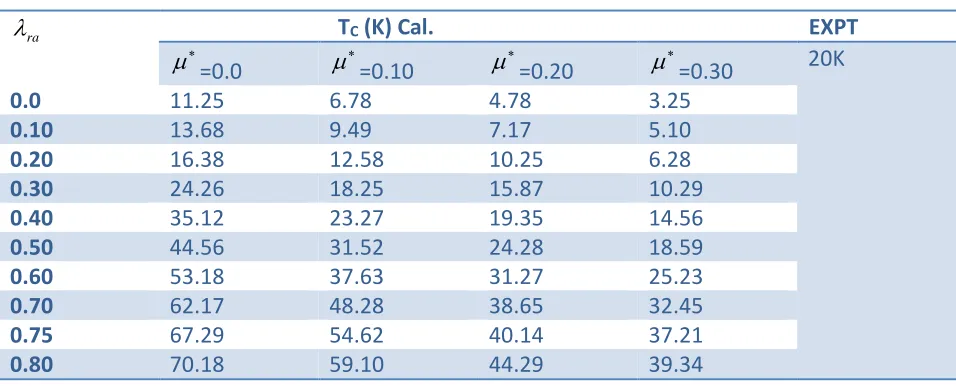
constant (λra) for fixed value of coulomb repulsion parameter μ*. The results are shown in table
T2. We have compared our theoretical results with experimental data of K3C60. Our evaluated
results shows that for set of values (λra = 0.25 & μ*= 0), (λra = 0.35 & μ*= 0.1), (λra = 0.40 & μ*=
0.2) and (λra= 0.50 & μ*= 0.3) the theoretical result matches with experimental data 20K for
K3C60 fluoride. It indicates that coulomb repulsive parameter μ* is a very important parameter
along with λra. In table T1, we have shown the transition temperature Tc of various alkali metal
doped compounds which varies from 20K to 45K. Some recent observations shown
superconductivity above 30K in alkali doped hydrocarbon and hole doped C60.
Superconductivity30 at 33K is obtained in K-doped dibenzopentacium (C
30H18) and
superconductivity31 at 52K is observed in hole-doped C
60. We have also evaluated the pressure
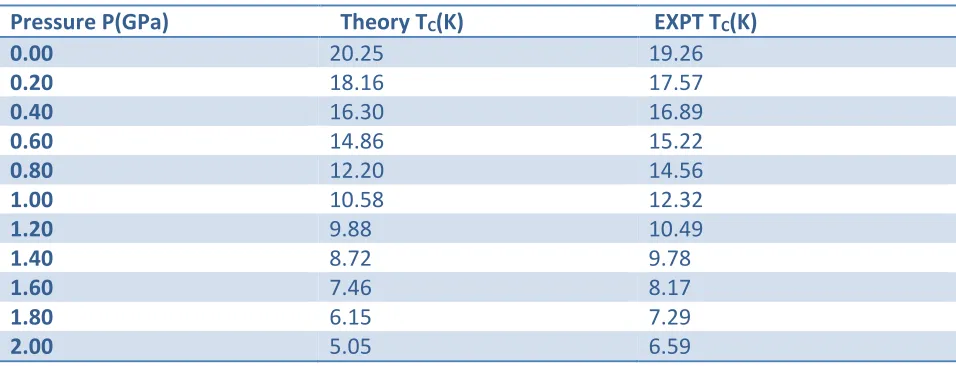
dependent and volume dependent transition temperature isotope effect exponent and energy gap parameter for alkali metal doped fullerides (K3C60). For pressure dependent transiition
temperature we have used equation (16) in which the first and third terms depends upon the
variation of density of state N(EF) with pressure. The result is showing in table T3 along with
experimental data. We have used empirical relation
TC(P)= TC(0) exp[0.3ϒG.P] (40)
Hence the value of the ϒG has been taken +2, from the paper15 and for the evaluation of 𝑑𝑇𝑑𝑃𝑐
and 𝑑𝑇𝑐
𝑑𝑉, we have taken the value of the parameter D21 = 0.16, D22 = 17.6, D23 = - 2.7, D24 = - 323
,using various coupling strength 32. For the evaluation of isotope coefficient α, we have used the
equation (36) and (37). Here ω is the average phonon frequency we get the value of α=0.24,
which is slightly lower than the reported values18,19 of = 0.30 ± 0.06. In this evaluation we have
taken the value of λer =1.2, λra = 0.4 and the result is shown in table T4 . From our evaluated
results it appears that isotope exponent α decreases with increasing µ*. This result is consistent
with BCS results and also with other theoretical workers33,34. There is some recent
calculations35-42 which also reveals the similar behaviour.
CONCLUSION:
From the above investigations and theoretical analysis, we have come across the following conclusions:
(i)The theoretical formalism of Kresin which includes both intermolecular and intramolecular
Available Online at www.ijpret.com 59
(ii)Our theoretical results indicate that variation of TC with pressure depends upon the variation
of density of state at the Fermi level, Coulomb Potential and characteristic phonon frequency
(iii) Our theoretical results for volume dependence TC depends on three factors (a)
screening parameter µ* (b) intermolecular Vibration mode (c) intramolecular coupling
strength
(iv) Our theoretical results for isotopic coefficient α decreases with screening parameter µ*.
Table T1: Transition temperature TC of some alkali doped C60 full rides.
Compounds Transition temperature TC (K)
K3C60 20
K2RbC60 22
Rb2KC60 25
Rb3C60 29
Rb2CsC60 31
Cs2RbC60 33
Cs3C60 47
Rb2.7Tl2.2C60 45
Table T2: An evaluated results of superconducting transition temperature TC as a function of
ra
(intramolecular coupling constant) for different values of Coulomb repulsive parameter
. The results were compared with doped alkali metal K3C60.
ra
TC (K) Cal. EXPT
=0.0 =0.10 =0.20 =0.30 20K
0.0 11.25 6.78 4.78 3.25
0.10 13.68 9.49 7.17 5.10
0.20 16.38 12.58 10.25 6.28
0.30 24.26 18.25 15.87 10.29
0.40 35.12 23.27 19.35 14.56
0.50 44.56 31.52 24.28 18.59
0.60 53.18 37.63 31.27 25.23
0.70 62.17 48.28 38.65 32.45
0.75 67.29 54.62 40.14 37.21
Available Online at www.ijpret.com 60
Table T3: An evaluated result of pressure dependent transition temperature T,C, The results
were compared with K3C60 fluoride.
Pressure P(GPa) Theory TC(K) EXPT TC(K)
0.00 20.25 19.26
0.20 18.16 17.57
0.40 16.30 16.89
0.60 14.86 15.22
0.80 12.20 14.56
1.00 10.58 12.32
1.20 9.88 10.49
1.40 8.72 9.78
1.60 7.46 8.17
1.80 6.15 7.29
2.00 5.05 6.59
Table T4: An evaluated result of isotope effect exponent as a function of pseudo potential
parameter for K3C60 fluoride taking er=1.2 and ra =0.4.
Isotope exponent
0.00 0.525
0.025 0.517
0.050 0.502
0.075 0.476
0.100 0.457
0.120 0.405
0.140 0.386
0.150 0.325
0.180 0.269
0.200 0.248
0.220 0.207
0.240 0.196
0.250 0.108
REFRENCES:
1. H. W. Kroto,J. A. Heath, S. C. O. Brien and R. E. Smalley, Nature 318, 162 (1985)
Available Online at www.ijpret.com 61
3. M. G. Mitch and J. S. Lannien, Phys. Rev B48, 16192 (1993)
4. A. F. Hebard, R. C. Hadden, D. W. Murphy, A. P. Ramiriz and A. R. Kortan, Nature 350, 600
(1991)
5. D. L. Novikov, V. A. Gubanov and A. J. Freeman, Physica C191, 399 (1992)
6. S. C. Erwin and W. E. Pickett, Phys. Rev. B46, 14257 (1992)
7. O. Gunnarson, Rev. Mod. Phys. 69, 575 (1997)
8. Z. Zhang, C. C. Chen and C. M. Lieber, Science 254, 1619 (1991)
9. E. Cappelluti, C. Gvimalidui, L. Piefrnero and S. Stassler, Phys. Rev. Lett. (PRL) 85, 4771 (2000)
10. V. Z. Kresin, Phys. Lett. A122, 434 (1987)
11. V. Z. Kresin, Phys. Rev. B46, 14833 (1991)
12. X. D. Xiang, J. G. Hou, V. H. Crepsi and M. L. Cohen, Nature 361, 54 (1993)
13. D. R. Hoffman, Physics Today, 44, 22 (1991)
14. Kerkoud, R. P. Auben-Senzier, D. Jerome and P. Bernier, Europhys. Lett. 25, 379 (1994)
15. J. Diederich, A. K. Gangopadhaya and J. S. Schilling, Phys. Rev. B54, R9662 (1996)
16. G. Span, J. D. Thompson, R. L. Whitten and K. Holczer, Science 252, 1829 (1991)
17. G. Span, J. D. Thompson, R. L. Whitten and K. Holczer, Phys. Rev. Lett. (PRL) 68, 1228 (1992)
18. C. C. Chen and C. M. Lieber, Science 259, 655 (1993)
19. S. Fuhrer, K. Cherrey, A. Zettl and M. L. Cohen, Phys. Rev. Lett.(PRL) 83, 404 (1999)
20. L. DeGiorgi, E. J. Nicol, O. Klein, G. Gruner and R. B. Kaner, Phys. Rev. B49, 7012 (1994)
21. R. F. Kiefl etal., Phys. Rev. Lett.(PRL) 70, 3987 (1993)
22. R Tycko, G. Dabbagh, M. J. Rosseinsky and R. M. Fleming, Phys. Rev. Lett. (PRL) 68, 1912 (1992)
23. L. Degiorgi, P. Wachter, G. Gruner, S. M. Huang and R. B. Kaner, Phys. Rev. Lett. (PRL) 69,
Available Online at www.ijpret.com 62
24. J. G. Hou, V. H. Crepsi, X. D. Xiang A. Zettl and M. L. Cohen, Solid. State commun. 86, 643
(1993)
25. T. T. M. Palstra, R. C. Hadden, A. F. Heabard and J. Zaaren, Phys. Rev. Lett. (PRL) 64, 1054
(1992)
26. G. Span, J. D. Thompson, R. L. Whetten and K. Holczer, Phys. Rev. Lett. (PRL) 68, 1228 (1992)
27. J. G. Hou, Lu Li, V. H. Crepsi, X. D. Xiang ,A. Zettl and M. L. Cohen, Solid. State commun. 93,
973 (1995)
28. K. Tanigaki etal. Nature 352, 222 (1991)
29. L. Ferro and L. Mihaly, Rep. Prog. Phys. 64, 649 (2001)
30. E. A. Ekimov etal. Nature 428, 542 (2004)
31. E. Bustarent atal. Nature 444, 465 (2006)
32. V. H. Crepsi, Nat. Meter. 2, 650 (2003)
33. T. Minami, Semicond. Sci. Technol. 20, 553 (2005)
34. U. Ozgur etal. J. Appl. Phys. 98, 041301 (2005)
35. T. Herrmannsdorfer etal. Phys. Rev. Lett. (PRL) 102, 217003 (2009)
36. M. A. Zwijnenburg etal. Phys. Rev. Lett. (PRL) 104, 175503 (2010)
37. J. A. Flores-Livas etal. Phys. Rev. Lett. (PRL) 106, 087002 (2011)
38. D. Hapiuk etal. Phys. Rev. Lett. (PRL) 108, 115903 (2012)
39. Z. Liu, X. Wang, G. Liu, P. Zhou and Z. Hou, J. Phys. Chem. C117, 17633 (2013)
40. J. Heinzelmann etal. J. Phys. Chem. Lett. 5, 2642 (2014)
41. C. Freysoldt etal. Rev. Mod. Phys. 86, 253 (2014)