Available Online at www.ijpret.com 118
INTERNATIONAL JOURNAL OF PURE AND
APPLIED RESEARCH IN ENGINEERING AND
TECHNOLOGY
A PATH FOR HORIZING YOUR INNOVATIVE WORKCOMPARISON AND ANALYSIS OF BENCHMARK FUNCTIONS USING
ARTIFICIAL BEE COLONY (ABC) ALGORITHM
BIRENBHAI V PATEL1, PROF. MOHAMMED G VAYADA2
1.P.G. Student, Department of Electronics & Communication Engineering, Silver Oak College of Engineering & Technology, Ahmedabad, Gujarat, India.
2.Assistant Professor, Department of Electronics & Communication Engineering, Silver Oak College of Engineering & Technology, Ahmedabad, Gujarat, India.
Accepted Date: 22/05/2015; Published Date: 01/06/2015
\
Abstract:This Paper shows the details of ABC algorithm, which was proposed by Dervish Karaboga based on Foraging behavior of honey bees. This type of based on stochastic search method that mimics the natural evolution and social behavior of spices. These types of algorithms were developed to arrive at near optimum solution of multimodal optimization problems. This paper also describes implementation of ABC algorithm on Complex benchmark functions like Sphere and Griewank function.
Keywords:ABC algorithm, Optimization algorithm, Benchmark functions
Corresponding Author: MR. BIRENBHAI V PATEL
Access Online On:
www.ijpret.com
How to Cite This Article:
Available Online at www.ijpret.com 119
INTRODUCTION
The ABC algorithm is swarm algorithm based on the foraging behavior of honey bee colonies. The bee colony contains three members: Scouts, onlooker and employed bees. The bee doing out random search is known as scout. The bee going to the food source which is visited by it previously is employed bee. The onlooker bee with scout is known as unemployed bee.[4]
The employed and unemployed bees search for the rich food sources around the beehive. The employed bees store the food source information and share the information with onlooker bees. The total food sources is equal to the number of employed bees and also equal to the number of onlooker bees. An employed bee whose solutions cannot be improved through a predetermined number of trials becomes scout and their solutions are abandoned [1, 3].
II. Fundamental of ABC [2]
Two Basic concepts, self-organization and division of labor, are necessary and sufficient properties to obtain swarm intelligent behavior such as distributed problem solving systems that self-organize and adapt to the given environment.
Self-organization can be defined as a set of dynamical mechanisms, which result instructors at the global level of a system by means of interactions with its components. These mechanisms organize basic rules for the interactions between the components of the system. The rules assure that the interactions are executed on the basis of purely local information without any relation to the global pattern. There are four basic properties on which self-organization relies: Positive response, Negative response, fluctuations and multiple interactions.
i)Positive Response is a simple behavioral “rules of thumb” that promotes the creation of favourable structures. Recruitment and reinforcement such as trail laying and following in some ant species or dances in bees can be shown as the examples of positive response.
ii)Negative response counterbalances positive response and helps to stabilize the collective pattern. In order to stop the saturation which might occur in terms of availability of foragers, food source exhaustion, crowding or competition at the food sources, a negative feedback mechanism is required.
Available Online at www.ijpret.com 120 iv)In Common, self-organization requires a minimal density of mutually tolerant individuals, enabling them to make use of the results from their own activities as well as others.
1. 3.3 Behaviour of honey bee swarm [6]
The minimum model of forage selection that leads to the emergence of collective intelligence of bee swarms contains three essential components: food sources, employed foragers and unemployed foragers and the model define two leading modes of the behavior: the recruitment to a nectar source and the abandonment of a source.
Food Sources: The food source depends on many criteria such as its closeness, its richness, and the ease of extracting this energy. For the sake of simplicity, the “profitability” of a food source can be represented witha single quantity.
Employed foragers: They are connected with a particular food source which they are recently exploiting or are “employed” at. They carry with them details about this particular source, distance and direction from the origin, the profitability of the source and share this information with a certain probability.
Available Online at www.ijpret.com 121
Figure 1 Waggle dance of bees
2. III. Pseudo code of ABC algorithm [2]
1. To initialize the population of solutions
2. To evaluate the population
3. To Produce new solutions for the employed bees
4. To apply the greedy selection process
5. To calculate the probability values
6. To produce the new solutions for the onlookers
7. Apply the greedy selection process between them
8. To determine the abandoned solution & Change it with new random solution
Available Online at www.ijpret.com 122 YES
NO
NO
Figure 2 ABC working principle
IV Procedure of ABC [4]
The ABC consists of four main phases
1)
Initialization Phase: The food sources whose population size is SN, are randomly generated by scout bees. Each food source represented by 𝑥𝑚 is an input vector to the optimizationproblem, 𝑥𝑚 has D variables and D is the dimension of searching space of the objective to be optimized. The initial food sources are randomly produced.
𝑥𝑚 = 𝑙𝑖+ 𝑟𝑎𝑛𝑑 0,1 ∗ 𝑢𝑖− 𝑙𝑖 (1)
Initialization of Parameters
Criteria
Satisfied
Update Employed bees
Update Onlooker bees
Update Scout bees
Memorize best food sources Best Solution
Available Online at www.ijpret.com 123
2)
Employed bee Phase :Employed bee flies to a food source and finds a new food source with in the neighbourhood of the food source.The higher Quantily food source is memorized by the employed bees.The food source information stored by employed bee will be shared with onlooker bees. A neighbour food source is determined by following equation.
𝑣𝑚𝑖 = 𝑥𝑚𝑖 + ∅𝑚𝑖 𝑥𝑚𝑖 − 𝑥𝑘𝑖 (2)
The Fitness is calculated by following formula
𝑓𝑖𝑡𝑚 𝑥𝑚 =
1
1+𝑓𝑚(𝑥𝑚), 𝑓𝑚(𝑥𝑚) > 0
1 + 𝑓𝑚 𝑥𝑚 , 𝑓𝑚(𝑥𝑚) < 0
(3)
3)
Onlooker bee Phase :Onlooker bees calculates the probability of food sources by observing the wagle dance in the dance area and then select a higher food source randomly.After that onlooker bees carry out randomly search in the neighborhood of food source. The quantity of a food source is evaluated by its profitability of all food sources
𝑝𝑚 = 𝑓𝑖𝑡𝑚 𝑥𝑚
𝑓𝑖𝑡𝑚 𝑥𝑚 𝑆𝑁
𝑚 =1 (4)
Onlooker bees search the neighborhood of food source according to below equation
𝑣𝑚𝑖 = 𝑥𝑚𝑖 + ∅𝑚𝑖 𝑥𝑚𝑖 − 𝑥𝑘𝑖 (5)
4)
Scout Phase :If the profitability of food source cannot be improved and the times of unchanged greater than the predetermined number of trials,which called “limit”, the solutions will be abandoned by scout bees.Then the new solutions are randomly searched by scouts bees.The new solution will be discovered by following equation.
Available Online at www.ijpret.com 124
V SIMULATION AND RESULTS
Here I have used two benchmark functions namely sphere and Griewank[2]
1) Sphere function:
𝑓1 𝑥 = 𝑥𝑖2
𝐷
𝑖=1
𝑥 ∈ −100, 100
2) Griewank function:
𝑓2 𝑥 = 1
4000( 𝑥𝑖
2 𝐷
𝑖=1 )-( cos(
𝑥𝑖
𝑖)) + 1 𝐷
𝑖=1
𝑥 ∈ −600, 600
The parameter used in this algorithm is population size, Limit, Maximum cycle[5] .Here it is taken 100 population size, no of cycle is 1000.
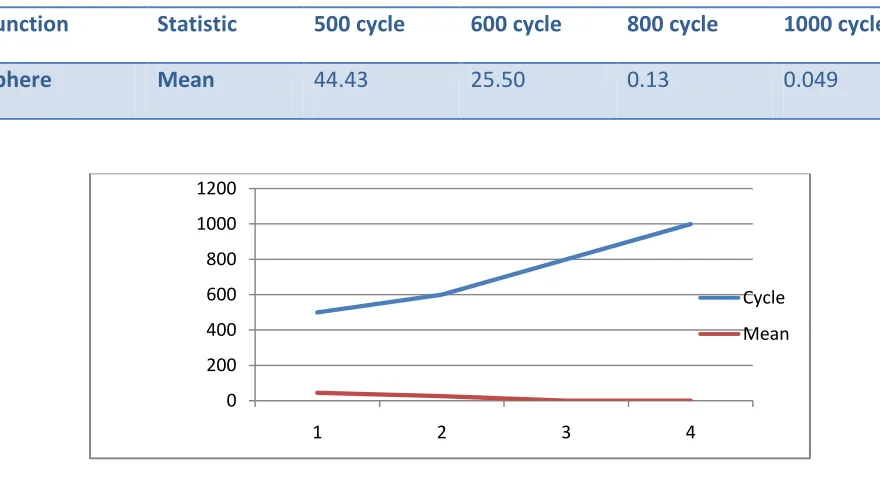
Table 1 Sphere Function Mean value
Function Statistic 500 cycle 600 cycle 800 cycle 1000 cycle
Sphere Mean 44.43 25.50 0.13 0.049
Figure 3 Sphere function
0 200 400 600 800 1000 1200
1 2 3 4
Cycle
Available Online at www.ijpret.com 125
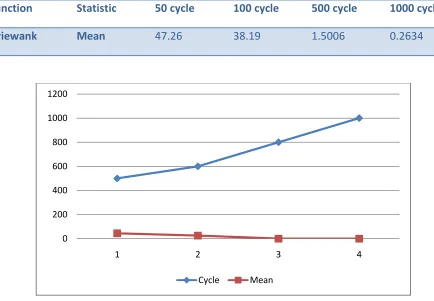
Table 2 Griewank function Mean value
Function Statistic 50 cycle 100 cycle 500 cycle 1000 cycle
Griewank Mean 47.26 38.19 1.5006 0.2634
Figure 4 Griewank function
VI CONCLUSION AND FUTURE WORK
In this Paper we tested algorithm on two benchmark function and we get optimum value with increasing the no of cycle. In future we will tested on other benchmark function. This algorithm can further be used for the dynamic deploy ment of wireless sensor network.
VII REFERENCES
1. Balwant Kumar, Dharmendra Kumar “A Review on Artificial Bee Colony algorithm” IJET 2013
2. Karaboga D, Basturk B “A powerful and efficient algorithm for numeric function optimization ABC Algorithm” Springer Science, April 2007
3. Balwant Kumar, Dharmendra Kumar “ Optimization of Benchmark functions using ABC algorithm” IOSR Journal of engineering Issue 10, October 2013
0 200 400 600 800 1000 1200
1 2 3 4
Available Online at www.ijpret.com 126 4. D Karaboga and B.akay “ A comparative study of Artificial bee colony algorithm ,Applied mathematics and computation,214(1),108-132,2009
5. Primpikapansuwan “ Identifying optimum artificial bee colony algorithm ‘s parameter for scheduling the manufacture and assembly of complex products ” IEEE 2010