Available Online at www.ijpret.com 1597
INTERNATIONAL JOURNAL OF PURE AND
APPLIED RESEARCH IN ENGINEERING AND
TECHNOLOGY
A PATH FOR HORIZING YOUR INNOVATIVE WORKFINGERPRINT RECOGNITION USING MINUTIAE EXTRACTOR
SHEETAL S. DHOLE1, PROF. V. K. LIKHITKAR2, DR. H. R. DESHMUKH3
Department of Computer Science & Engg., Dr. R. G. I. T. & R., Amravati.
Accepted Date: 15/03/2016; Published Date: 01/05/2016
\
0
Abstract: Fingerprint Recognition or fingerprint authentication refers to the automated methods of verifying a match between two human fingerprints. Fingerprints are the oldest and most widely used form of biometric identification. Biometric Recognition is the recognition of an individual by using biometric features. The biometric recognition is done by many different features like iris, face, palm, fingerprint, voice, etc. Each biometric has its strengths and weakness and the choice of biometric feature depends on the requirement of the system. In this paper, fingerprint feature is used and its various steps so here we projected Fingerprint Recognition using Minutia Score matching method for recognizing any individual.
Keywords: Minutiae, fingerprint, fingerprint recognition, identification, verification, biometric
authentication.
Corresponding Author: MS. SHEETAL S. DHOLE Access Online On:
www.ijpret.com
How to Cite This Article:
Sheetal S. Dhole, IJPRET, 2016; Volume 4(9): 1597-1609
Available Online at www.ijpret.com 1598 INTRODUCTION
Fingerprint has been scientifically studied for a number of years in our society.
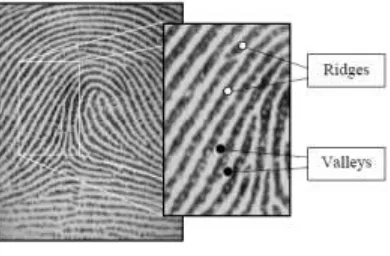
Previously, the identification of person was done by using smart cards, user id and password, punch cards etc. The cards can be stolen or misused, and user ids and passwords can also be forget or cracked. For security purposes, the biometric recognition is used. The biometric recognition is the recognition of an individual can be done by anatomical characteristics like face, iris, fingerprint etc and behavioral characteristics like speech etc. In this paper, the fingerprint is used for authentication and verification of an individual. Fingerprint is the impression of tip of the fingers. The sample of fingerprint image is shown in Fig. 1. Fingerprints are the patterns formed on the
Epidermis of the fingertip [1]. The most evident structural characteristic of a fingerprint is a pattern of interleaved ridges and valleys [2]. The ridges are dark area of the fingerprint image and the valleys are white area between two alternating ridges of the fingerprint image.
Fig. 1. Fingerprint Image
Fingerprint recognition is defined as the recognition (identification and verification) of individual using fingerprints.
Fingerprint Recognition can be done by two methods which are defined as:
1) Fingerprint verification: It verifies an individual and known as one-to-one (1:1) relationship.
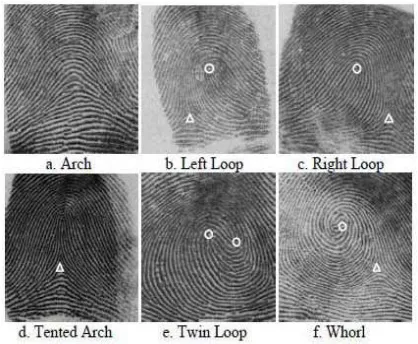
Available Online at www.ijpret.com 1599 The verification is much easier and faster because we have the two fingerprints and we just need to compare them [3]. On the other hand, the identification implies more time for extracting the fingerprint because there are needed much more details [3]. Each individual has unique and different fingerprints. Fingerprint classification involving 6 classes with critical points in a fingerprint called core and delta marked as
circles and triangles in a Fig. 2 [4].
Fig. 2. Fingerprint Classification
Fingerprint recognition is done in different approaches: Texture-based, Image based approach, Minutiae based approach. But in this paper, fingerprint recognition is done by minutiae based approach. In fingerprint terms, minutiae are termed as the points of interest in a fingerprint. The most commonly used minutiae in current fingerprint recognition technologies are ridge endings and bifurcations, because they can be easily detected by only looking at points that surround them (Bifurcation is the location where a ridge divides into two separate ridges)[4].
I. RELATED WORK
From the rigorous review of related work and published literature, it is observed that many researchers have studied different fingerprint matching Techniques and steps /Stages of Fingerprint recognition as below.
1. Correlation-based matching.
Available Online at www.ijpret.com 1600 3. Pattern-based /image-based matching.
Here in this paper we are implemented fingerprint recognition using minutiae extractor. So, for that some related work is given as:
Steps of fingerprint recognition using minutiae
The stages/steps of the fingerprint recognition are as follows:
A. Acquisition
In fingerprint recognition, the fingerprint images are acquired by two ways:
1) Online Fingerprint Images (Live Scan): For online fingerprint image acquisition, capacitance or optical fingerprint scanners such as URU 4000, etc [5]. Live scan scanners offer much greater image quality, usually a resolution of 512 dpi, which results in superior reliability during matching in comparison to inked fingerprints [5].
2) Offline Fingerprint Images (Inked): In the inked method an imprint of an inked finger is first obtained on a paper, which is then scanned [5]. This method usually produces images of very poor quality because of the non-uniform spread of ink and is therefore not exercised in online [5].
B. Pre-processing
Fingerprint pre-processing states that some operations are to be performed before extraction of the minutiae.
Available Online at www.ijpret.com 1601 processing stage [5]. Sangram Banal et al. [8], Manvjeet Kaur et al. [9], and Avinash Pokhriyal et al. [10] proposed different methods for this stage: histogram equalization and fast Fourier transformation methods for enhancement, region of interest is estimated by ridge flow estimation and morphological operation is performed for segmentation, locally adaptive binarization implemented for binarization. Ruturaj M. Dekhane describes techniques for this stage are: histogram equalization, Gabor filter and fast Fourier transform are used for enhancement, binarization is done by threshold, and thinning are implemented at this stage [11]. Raju RajKumar et al. performed methods are: normalization, primary enhancement is done with the help of Gabor filter, short term Fourier transform, fast Fourier transform and secondary filter includes Gaussian filter [12]. In this, there are various methods are used for binarization like back propagation algorithm, local adaptive binarization method, binarization using convex threshold and double threshold binarization method etc. but local adaptive binarization method is used in this paper for binarization. Segmentation is done through ridge direction stage and region of interest for segmentation and thinning are also used for pre-processing in this paper. Khalid Saeed et al. proposed a new thinning algorithm in terms of processing quality and algorithm clarity enriches with examples [13]. Tatsat Naik et al. implement this stage with various operations which are: histogram equalisation, enhancement using FFT, binarization, ridge direction [14]. Lin Hong developed fingerprint enhancement algorithm which can adaptively improve the clarity of ridge and valley structures based on the local ridge orientation and ridge frequency estimated from the fingerprint image [15]. Hui Xu implemented the hardware algorithm for fingerprint thinning which increases thinning operation efficiency with a highly-paralleled architecture built on Xilinx Virtex II Pro [16].
C. Minutiae Extraction
Available Online at www.ijpret.com 1602 D. Post Processing
Fingerprint post-processing is the process which is performed after extraction of minutiae or feature from the fingerprint image. Manal Abdullah et al. [4], Zain S. Barham [6], F.A. Afsar et al. [5], and Raju RajKumar et al. [12] are illustrated distance method for t minutiae and unify terminations and bifurcations operations are performed at this stage [14].
E. Matching
Fingerprint matching is the process which describes matching percentage/score between two fingerprint images. Manal Abdullah et al. [4], Zain S. Barham [6] proposed an alignment based match algorithm for the matching of the fingerprints. F.A. Afsar et al. describe the derivative of Hough transform is done with the help of spatial and oriental-based distance computation for registration of minutiae sets [5]. Sangram Banal described three matching techniques are correlation based matching, minutiae based matching, pattern based matching but in this paper, minutiae based matching is used [8]. Ruturaj M. Dekhane performed the various matching techniques and algorithms are used [11]. They are Cross Correlation Technique, Hungarian Matching algorithm, edit distance and neighbour vector. Tatsat Naik et al. perform operation at this stage: save template, and align and match template [14]. Neeta Murmu et al. proposed alignment based elastic matching algorithm is capable of finding the correspondences between minutiae without resorting to exhaustive research [18]. Shahram Mohammadi et al. describe a new approach for fingerprint matching which is more robust to shift and rotation of the fingerprints because of its high accuracy [19]. The reference point and reference orientation are determined and the features are converted into polar co-ordinates [19]. Due to high speed and accuracy of this approach, it appropriate for the real time applications.
II. MATERIALS & METHOD
After studying the various papers, the proposed method for fingerprint is described here. There are 5 stages/ steps with their operations or methods which are as follows:
1) Fingerprint Acquisition: The offline fingerprint images are taken for the implementation of finger print images.
2) Fingerprint Pre-processing: The operations are
• Fingerprint Enhancement: Histogram equalization, Fourier Transform is mostly used.
Available Online at www.ijpret.com 1603 • Segmentation: Region of interest method is used for segmentation.
• Thinning
3) Minutiae Extraction: The Crossing Number (CN) method is used for extraction of minutiae in mostly papers.
4) Fingerprint Post processing: The distance method for removal of false minutiae.
5) Fingerprint Matching: Alignment based matching algorithm (Minutiae based) is used.
The flow chart is shown in Fig. 3.
Fig. 3. Flow Chart
III. EXPECTED RESULT & DISCUSSION
The implementation of fingerprint recognition shows the results:
There are lot of fingerprint images available on the internet which is saved on the computer. Firstly, fingerprint acquisition stage is performed. In this, any fingerprint image is taken from the
Fingerprint Acquisition
Fingerprint Pre-processing
Minutiae Extraction
Fingerprint Post- processing
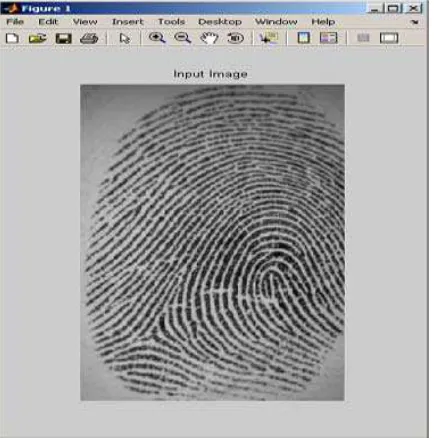
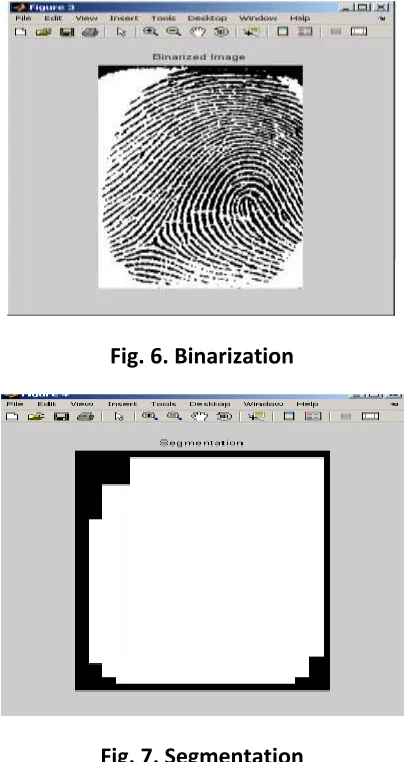
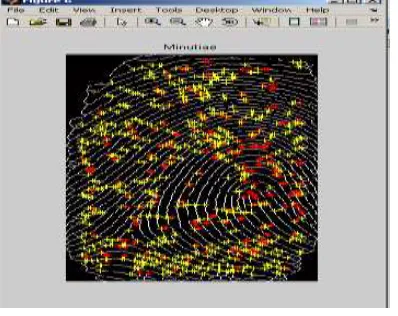
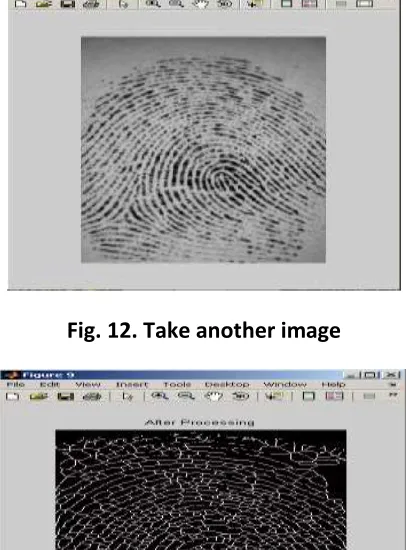
Available Online at www.ijpret.com 1604 disk Fig. 4. Pre-processing stage is implemented includes fingerprint enhancement in Fig. 5, binarization in Fig. 6, segmentation in Fig. 7, thinning in Fig. 8. Minutiae are extracted from thinned fingerprint image show in Fig. 9. The orange star represents ridge termination and the yellow star represents ridge bifurcation in fingerprint thinned image. Post-processing stage is performed in which removes the false minutiae in Fig. 10. Last stage, fingerprint matching is implemented for this, another fingerprint image is taken from the disk is shown in Fig. 11. After taking fingerprint image, some operations are on the fingerprint image. The resulted fingerprint image is shown in Fig. 12.
Fig. 4. Input Image
Available Online at www.ijpret.com 1605 Fig. 6. Binarization
Fig. 7. Segmentation
Available Online at www.ijpret.com 1606 Fig. 9. Minutiae Extraction
Fig. 10.Minutiae Matching
Available Online at www.ijpret.com 1607 Fig. 12. Take another image
Fig. 12. After processing on image
If another fingerprint image taken for fingerprint matching, the matching percentage is less than 90%. If the same fingerprint image is taken for fingerprint matching, the matching percentage is 90-100%.
V. CONCLUSION & FUTURE WORK
Available Online at www.ijpret.com 1608 REFERENCES
1. Krishna Kumar, Basant Kumar, Dharmendra Kumar and Rachna Shah, Fingerprint Recognition
using Minutiae Extraction, International Conference on ICT-Initiatives, Policies & Governance, Dehradun, India, 28-29 Nov 2011.
2. Davide Maltoni, Dario Maio, Anil K. Jain, Salil Prabhakar, Handbook of Fingerprint Recognition, 2nd Edition, Springer Press.
3. I. Iancu, N. Constantinescu, M. Colhon, Fingerprints Identification using a Fuzzy Logic System, Int. J. of Computers, Communications & Control, ISSN 1841-9836, E-ISSN 1841-9844, Vol. V (2010), No. 4, pp. 525-531.
4. Manal Abdullah, Mona Alkhozae and Mashaiel Alsowaiel, “Fingerprint Matching Approach
Based on Bifurcation Minutiae”, Journal of Information and Communication Technologies, Volume 2, Issue 5, May 2012.
5. F. A. Afsar, M. Arif and M. Hussain, Fingerprint Identification and Verification System using Minutiae Matching, National Conference on Emerging Technologies 2004.
6. Zain S. Barham, Fingerprint Recognition Using MATLAB, Graduation Project.
7. Sozan Abdullah Mahmood, Fingerprint identification Based on Skeleton Minutiae extraction, ICGST AIML-11 Conference, Dubai, UAE, 12-14 April 2011.
8. Sangram Bana1 and Dr. Davinder Kaur2, Fingerprint Recognition using Image Segmentation,
International Journal of Advanced Engineering Sciences and Technologies Vol No. 5, Issue No. 1, 012 – 023.
9. Manvjeet Kaur, Mukhwinder Singh, Akshay Girdhar, and Parvinder S. Sandhu, Fingerprint Verification System using Minutiae Extraction Technique, World Academy of Science, Engineering and Technology 22 2008.
10. Avinash Pokhriyal, Sushma Lehri, MERIT: Minutiae Extraction using Rotation Invariant Thinning, International Journal of Engineering Science and Technology Vol. 2(7), 2010, 3225-3235.
11. Ruturaj M. Dekhane, Fingerprint Matching and Template Security Using Fuzzy Vault.
12. Raju Rajkumar , K Hemachandran, A Secondary Fingerprint Enhancement and Minutiae Extraction, Signal & Image Processing : An International Journal (SIPIJ) Vol.3, No.2, April 2012. 13. Khalid Saeed, Marek Tabe˛Dzki, Mariusz Rybnik, Macin Adamski, K3M: A Universal Algorithm for Image Skeltonization and Review of Thinning Technique, Int. J. Appl. Math. Computer. Sci., 2010, Vol. 20, No. 2, 317–335.
Available Online at www.ijpret.com 1609 15. Lin Hong, Student Member, IEEE, Yifei Wan, and Anil Jain, Fellow, IEEE, Fingerprint Image Enhancement: Algorithm and Performance Evaluation, IEEE Transactions on Pattern Analysis and Machine Intelligence, VOL. 20, NO. 8, AUGUST 1998.
16. Hui Xu, Yifan Qu, Yan Zhang, Feng Zhao, FPGA Based Parallel Thinning for Binary Fingerprint Image, IEEE, 2009.
17. Graig T. Diefenderfer, Fingerprint Recognition, M. Sc. Thesis, Ensign, United States Navy, B.S., United States Naval Academy, 2005.
18. Neeta Murmu, Abha Otti, Fingerprint Recognition, National Institute of Technology, Rourkela.