ROLE OF PUBLIC DISTRIBUTION SYSTEM AMONG SOCIAL
GROUPS : A CASE STUDY OF TUMAKURU DISTRIC, OF
KARNATAKA STATE, INDIA.
1 Shilpashree T., 2 Pallavi S. Kusugal. 1 Research Scholar, 2 Research Guide.
Department of Studies and Research in Economics Tumkur University, Tumakuru, Karnataka state, India.
Email - [email protected]
1. INTRODUCTION:
The public distribution system (PDS) is a largest distribution system in the world, agriculturecontinues to be the main occupation of the people but agriculture sector yield low production, so it don’t supply food to overall country because it create the problem of lack of food facility due to lack of food facility food prices are increases it mainly
negative effect on the poor people so they don’t consume proper nutrient food so they suffer from some type of illness According to above problem PDS play a very meaningful role to decrease such type of problems through providing basic needs, nutrient food at the lower price to poor people.
The public distribution started at 1960’s government takes some actions to improve the performance of PDS.
Government takes so many schemes that are TPDS, Revamping of PDS and recently introduced token system in distributing grains through PDS.
Tumkuru is one of the largest district in the state of Karnataka it have 10 taluks according to 2011 censes totally Tumkuru have 640081 families, 49510 AAY card holders 495090 BPL card holders 100322 APL card holders this also have 1096 of fair shops
Therefore social group PDS beneficiaries have become a necessary and interesting field for research.
2. REVIEW OF LITERATURE:
Review of Literature is a basement of our study it identified the gap of the research and gives us the knowledge about our study area. Some important review of literature are as follows,
Amarasinghe, Upali A.; Shah, Tushaar; Anand, BK (2008)-they examine the India s water supply and demand from 2025-2050: business-as-usual scenario and issues. In Amarasinghe, Upali A.; Sharma, Bharat R. (Eds.) Strategic Analyses of the National River Linking Project (NRLP) of India
A Tanksale, JK Jha (NASA 2015) Explain a unique step taken by Indian Government to fight against hunger and protect the right of the people.
G Surya Narayan ( 1985 Public Distribution in India ) It tells the structure, organization, working scope importance limitations of Indian Public Distribution System and critically analysis of the PDS working in India.
S. Nakkiran (A study on the effective Public Distribution System In Rural Tamil Naidu. 2004)
PDS is conceder as principal instrument in the hands of State Governments for providing safety net to the poor against the spiraling rice in prices of essential commodities. In this regard Tamil Nadu sets a model in implementing the PDS as universal system. Here the involvement of the cooperative societies is noteworthy, since they cover more than 93% of the FPS in Tamil Nadu. Further the involvement of women SHGs in the distribution work ensure
Abstract: The public distribution system (PDS) distribute commodities on the basis of Poverty hasn’t considered caste. Public distribution system acts as a break to rising prices, the main objective of public distribution system is to control inflation and increasing the welfare of the poor people. PDS operated under the joint responsibility of the central and the state governments. Public distribution system made available to poor people, this PDS main aim is reduce inequality of Income across the Country. An attempt it made on this paper to study Role of Public Distribution System among social group in Tumakuru district.
Hence here this paper focus on social group people benefit through PDS, PDS influence among social groups with special reference to Tumakuru district and this paper based on primary data.
safety, transparency and accessibility and above all reduced the truncation cost. Hence this channel distribution can be promoted.
Sakshi Balini, “Functioning of the Public Distribution System” (Dec 2013) – He tells During September 2013, parliament passed the National Food Security Act (NFSA) 2013 the NFSA seek to make the right to food a legal entitlement by providing subsidised food grains to nearly 2/3rd of the population the act relies on the existing
Targeting Public Distribution System (TPDS) mechanism to deliver these entitlement. This article describe the functioning of the existing TPDS mechanism and the role played by the center and state. It also explores challenges in the effective implementation of TPDS and alternatives to reform the existing machinery.
V. Gopichandran, P.Claudius, L.S.Baby, A. Felinda, V.R. Mohan.(Household food security in Tamil Nadu: A survey in Vellore. 2010)
Food security has been a matter of concern in recent years due to the global food crisis and rising food prices. We aimed to study the level of food security in a densely populated urban area in southern India.
3. STATEMENT OF THE PROBLEM:
Nutrient food is very important to people to live healthy and happy life but in India more percentage of the
people don’t take proper nutrient food so they suffering from so kind of illness. So government of India starts PDS to solve such type of problems.
PDS starts 1960’s before on words the problems and situations of resent days are different from 1960’s so PDS want to modify so government takes several programmers to modify PDS
The Tumakuru district of Karnataka is one of the main district now we discuss the Role of PDS among social groups, and what is the reaction of the Tumakuru district social group people into PDS.
4. SCOPE OF THE STUDY:
The present study covers only role of PDS among social group, it don’t study private sector this present study mainly focus on social group people and how they beneficence through PDS.
5. OBJECTIVES OF THE STUDY:
The following are the specific objectives of the present study 1. To study the role of PDS system among social group. 2. To examine the PDS system in Tumakuru district 3. Suggest for improving the PDS functions
6. METHOD:
Collection of the data
This article based on Primary data and Secondary data collected from various Journals, Books, and Government publications, visit Food office of Tumakuru, Ministry of Agriculture, Economic Survey.
Name of the taluk;
For the field survey Tumkuru district selected. In tumkuru district three taluks are selected on the basis of the number of fair price shops, Number of the BPL Ration card holders, That taluks are Tumakuru, Madhugiri, and Turuvekere.in each taluks 80 Beneficiries (80+80+80= 240) selected. This discuss with a below Table.
Table-1,Name of the Taluks,
Source; Field Survey . . . Above table explain that totally 240 sample size concidered for the study In three taluks. 20 Beneficiries selected
from social group that are SC(20), ST(20), OBC(20), OTH (20) in each taluks of the study area.
Basic knowledge about Public Distribution System;
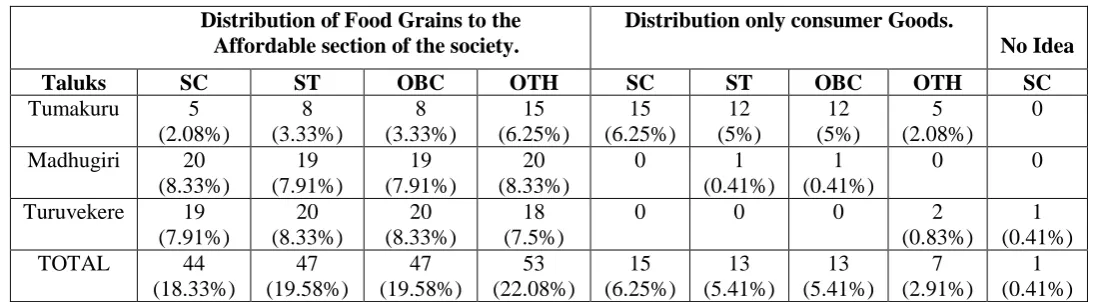
This shows the works and functions of PDS, that is what is PDS? PDS distribute only consumer goods? or PDS distribute all type of goods which necessary to beneficiaries?, In my field survey beneficiaries have minimum knowledge
Taluks No of the Beneficiaries in social Groups
SC ST OBC OTH
about Public Distribution System that is meaning of Public Distribution system in the 240 beneficiaries 191 beneficiaries response that PDS is distribute food grains to the affordable section of a society, 48 beneficiaries response that PDS distribute only consumer goods, one beneficiary haven’t idea about PDS.
This are discuss with a help of a below table.
Table-2, Basic knowledge about Public Distribution System;
Source; Field Survey.
This above Table explain that selected beneficiaries’ opinion more than 75% of the selected beneficiaries tells that
Distribution of Food Grains to the Affordable section of the society. But more than 20 % of the beneficiaries believe in PDS distribute only consumer goods. This shows the beneficiaries are lake of awareness about PDS.
Eradicating Malnutrition Problem.
Malnutrition problem is a very dangers problem to every country. This kills the mental ability of the people. And also damage physically, this made the people physically and mentally week. It effects more on the children.
This type of the problem creates in backward areas, and weaker section of the society. They are economically
poor people they don’t able to purchase and consume nutrition food so they are suffering from Malnutrition problem.
In this way PDS play a very important role this PDS supply nutrition food to needed people of the society at a lower level of the price.
This are discuss with a help of a below table.
Table no-3, Eradicating Malnutrition Problem.
Eradicate Malnutrition Problem
YES NO No Idea
Talukas SC ST OBC OTH SC ST OBC OTH SC OBC
Tumakuru 18(7.5%) 19(7.91%) 18(7.5%) 19(7.91%) 2(0.83%) 1(0.41%) 2(0.83%) 1(0.41%)
Madhugiri 20(8.33%) 19(7.91%) 19(7.91%) 20(8.33%) 0 1(0.41%) 1(0.41%) 0
Turuvekere 19(7.91%) 20(8.33%) 20(8.33%) 19(7.91%) 1(0.41%) 1(0.41%)
TOTAL 57(23.75%) 58(24.16%) 57(23.16) 58(23.16%) 2(0.83%) 2(0.83%) 3(1.25%) 1(0.41%) 1(0.41%) 1(0.41%)
Source; Field Survey
This above table explain that more than 96% of the beneficiaries reply that PDS eradicate the malnutrition problem by providing nutrition food like Dhal, salt with Iodine, wheat etc… but here also some linkages it effect on functions of PDS. This is a necessary to remove the linkages to PDS made more effective.
Quantities and commodities allocated to the family.
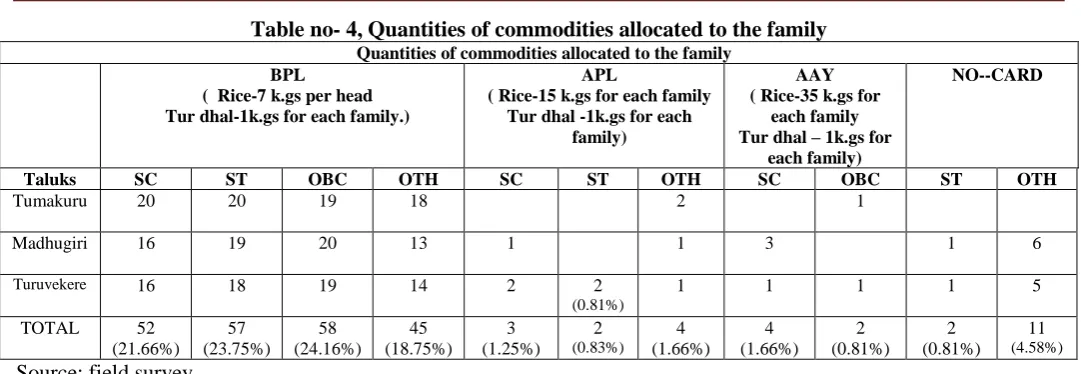
Quantity of Commodities is also important concept because PDS have a relation with beneficiaries through PDS shops. These shops distribute the food grains to beneficiaries. Allocated of food grains is different to different cord holders.
To BPL card holders; PDS distribute 7 k.gs of rice per head at free of cost, and also1k.gs of Tur Dhal at the rate lower price.
To BPL card holders; PDS distribute 15 k.gs of rice for each family at a free of cost, and 1 k.gs of Tur Dhal at a lower price.
To AAY card holders; PDS distribute 35 k.gs of rice for each family at a free of cost and 1 k.gs Tur Dhal at a lower price.
These are discuss with a help of a below Table,
Distribution of Food Grains to the Affordable section of the society.
Distribution only consumer Goods.
No Idea
Taluks SC ST OBC OTH SC ST OBC OTH SC
Tumakuru 5 (2.08%) 8 (3.33%) 8 (3.33%) 15 (6.25%) 15 (6.25%) 12 (5%) 12 (5%) 5 (2.08%) 0
Madhugiri 20 (8.33%) 19 (7.91%) 19 (7.91%) 20 (8.33%)
0 1 (0.41%)
1 (0.41%)
0 0
Turuvekere 19 (7.91%) 20 (8.33%) 20 (8.33%) 18 (7.5%)
0 0 0 2 (0.83%)
1 (0.41%) TOTAL 44
Table no- 4, Quantities of commodities allocated to the family
Quantities of commodities allocated to the family BPL
( Rice-7 k.gs per head Tur dhal-1k.gs for each family.)
APL
( Rice-15 k.gs for each family Tur dhal -1k.gs for each
family)
AAY ( Rice-35 k.gs for
each family Tur dhal – 1k.gs for
each family)
NO--CARD
Taluks SC ST OBC OTH SC ST OTH SC OBC ST OTH
Tumakuru 20 20 19 18 2 1
Madhugiri 16 19 20 13 1 1 3 1 6
Turuvekere 16 18 19 14 2 2
(0.81%)
1 1 1 1 5
TOTAL 52
(21.66%) 57 (23.75%)
58 (24.16%)
45 (18.75%)
3 (1.25%)
2
(0.83%)
4 (1.66%)
4 (1.66%)
2 (0.81%)
2 (0.81%)
11
(4.58%)
Source; field survey.
This table explains that more than 85% of the selected beneficiaries are BPL card holders, and few selected beneficiaries belong to APL and AAY card holders. Government provide Tur Dhal, Rice to different quantity to different types of ration cards of the social group through Public Distribution System shops. To decrease the income inequality and to achieve well fair of the poor people.
7. SUGGESTIONS:
The Public Distribution System (PDS) is one of the most valuable feature of state intervention in the market for basic wage goods like cereals in India. Its main objective is to control inflation and soften the impact f endemic inflation on vulnerable groups of the economy.
To improve the current system of PDS the following are some suggestions that are 1) PDS should open more fair shops in slam area of Tumakuru district.
2) The fair shops distribute more quantity and commodities to poorest people because present distribution commodities
aren’t fulfill the needs of beneficiaries.
3) Measurement of chosen BPL, AAY card holders it should straightly followed by related department for control corruption.
4) Government conducts survey every year and also discuss with the poor people related to distribution commodities. Government more focus on vulnerable groups of the society to reduce their poverty made them physically, economically strong and it contribute nation development also.
So Government more priority to poorest poor people, vulnerable Groups through PDS progrmmes like TPDS, Revamping PDS, Bio-metric system this type progrmmes comes as broadly it made equal development between the poor and rich people.
8. CONCLUSION:
PDS main aim is increase the standard of living of poor people and venerable groups, when this people’s
standard of living increases they think and work on development of the country. The main aim of this study is to help the government to take up policy decisions and formulate suitable schemes and programmers to decreasing corruption in PDS distributing and also increase the socio-economic conditions of poor people especially SC-ST poor people and venerable groups, the policy implications suggested if properly implemented may result in increased welfare of the poor people of the nation.
REFERENCES:
1. Conducted field survey.
2. Food Office Records - Tumakuru. 3. Prathiyogitha Darpana.
4. Kurukshetra –A journal of Rural Development.
5. Shkshi Balani “Functioning of public distribution system” –Dec 2013. 6. Tumakuru District at a Glance 2014-15.
7. Karnataka state at a glance 2014-15
10. Mohapatra BP and Mahalik DK (2015) reducing public distribution system leakages and its strategy journal of business and management.
11. Rahman A. (2014) Revival of Rural PDS; Expansion and outreach working paper. Indira Gandhi institute of Development Research .Mumbai.
12. Ram A(2015) Public distribution system in Haryana. International Journal of Research in engineering, IT and Social seiences.
13. Sakshi Balini.(2013) “Functioning of the public distribution System.” An Analytical Report.
14. Sckaran VC (2014) Corruption in public distribution system – A Micro analysis Global Journal for Research analysis.